Individuals form populations
Definition
Individual
An individual is one living organism.
Definition
Population
A population is all the organisms of one species living in a defined area at the same time.
- One oak tree, one fox or one bacterial cell can each be described as an individual organism.
- A population includes all the individuals of one species within a stated area at the same time.
- For example, all the common frogs in one pond form a population, whereas one frog is an individual.
- A population must refer to a particular species, so all the animals in the pond do not form a single population.
- The area and time must be clear because the same species can occur in several places and its numbers can change.
- Population size is the number of individuals in that population, rather than the number of species present.
Common Mistake
A large group is not automatically a population: its organisms must belong to the same species and occur in the same defined area at the same time.
Populations form a community
Definition
Community
A community is all the populations of different species living and interacting in the same area.
- A pond can contain separate populations of common frogs, great pond snails, duckweed and many other species.
- These populations together make up its community.
- A community includes plants, animals, fungi and microorganisms, including organisms that are too small to see without a microscope.
- The word community refers to the living organisms, so the pond water, rocks and light are not themselves members of the community.
- A species represented by only one individual in the area still contributes to the community.
- When naming a community, use the different populations together, rather than listing only the most visible animals.
Example
- One common frog in a pond represents the individual level.
- All the common frogs in that pond represent one population.
- The frogs, snails, duckweed, algae, bacteria and all other populations together represent the pond community.
- Adding the pond’s water, light, temperature, dissolved gases and other non-living surroundings, together with their interactions with organisms, describes the ecosystem.
An ecosystem includes the environment
Definition
Ecosystem
An ecosystem is a community of organisms interacting with one another and with the non-living components of their environment.
- An ecosystem contains a community and the non-living environment with which that community interacts.
- The living organisms are its biotic components, while water, air, soil and physical conditions are its abiotic components.
- Including interactions matters because an ecosystem is more than a list of organisms and objects in the same place.
- For example, pond plants take in dissolved substances from the water, and their activity changes the substances present in that water.
- The levels of organisation progress from individual to population to community to ecosystem.
- An ecosystem can be relatively small, such as a rock pool, or much larger, such as a woodland.
- Its defining feature is the living community interacting with its surroundings, rather than a fixed size.
Exam technique
- To distinguish a population from a community, state whether one species or all the different species are included.
- To distinguish a community from an ecosystem, add the abiotic environment and the interactions with it.
Habitats are places within ecosystems
Definition
Habitat
A habitat is the place in which an organism lives.
Definition
Niche
A niche is the role of an organism in its ecosystem, including its use of resources and its interactions with other organisms.
- A woodland contains several habitats, including leaf litter, tree bark and the canopy, even though they belong to the same wider ecosystem.
- Different organisms can share a habitat, so a habitat does not correspond to only one population.
- A microhabitat is a small, localised part of a habitat, such as the damp space beneath a log.
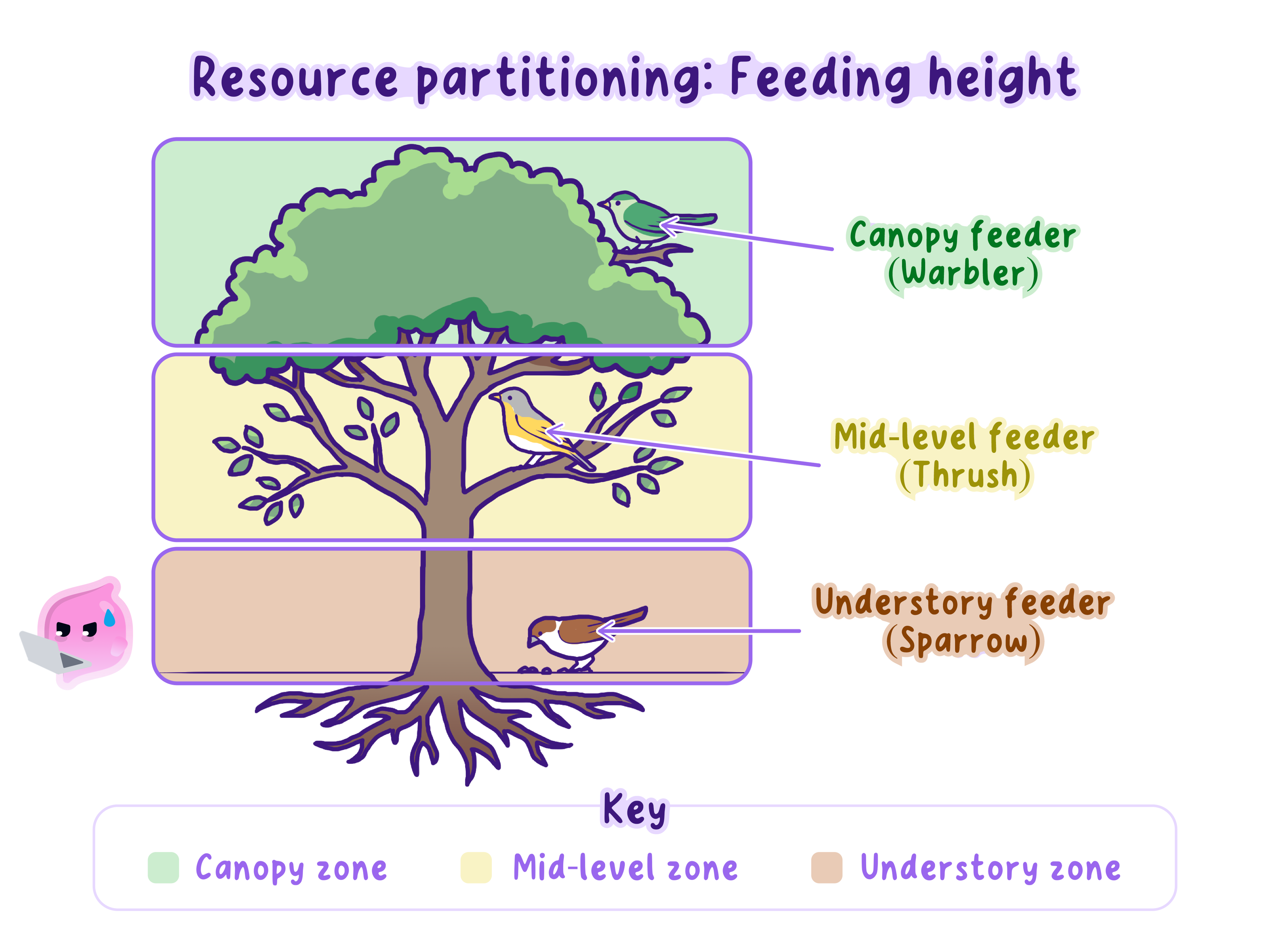
- The same tree can provide living space for several bird species, as shown in the retained illustration.
- The birds occupy different parts of the tree and use its resources differently, illustrating that a habitat describes a place while a niche describes an organism’s role there.
- When identifying organisational levels, keep where an organism lives separate from whether the description concerns an individual, population, community or ecosystem.
Self review
- What makes a group of organisms a population?
- Which organisms are included in a community?
- What must be added to a community to describe an ecosystem?
- What is the order of the four levels of organisation?
- How does a habitat differ from a niche?
