FSH and the start of the cycle
Definition
FSH (follicle stimulating hormone)
A hormone secreted by the pituitary gland that makes an egg mature inside a follicle in the ovary and stimulates the ovaries to secrete oestrogen.
Definition
LH (luteinising hormone)
A hormone secreted by the pituitary gland that triggers ovulation, the release of a mature egg from the ovary.
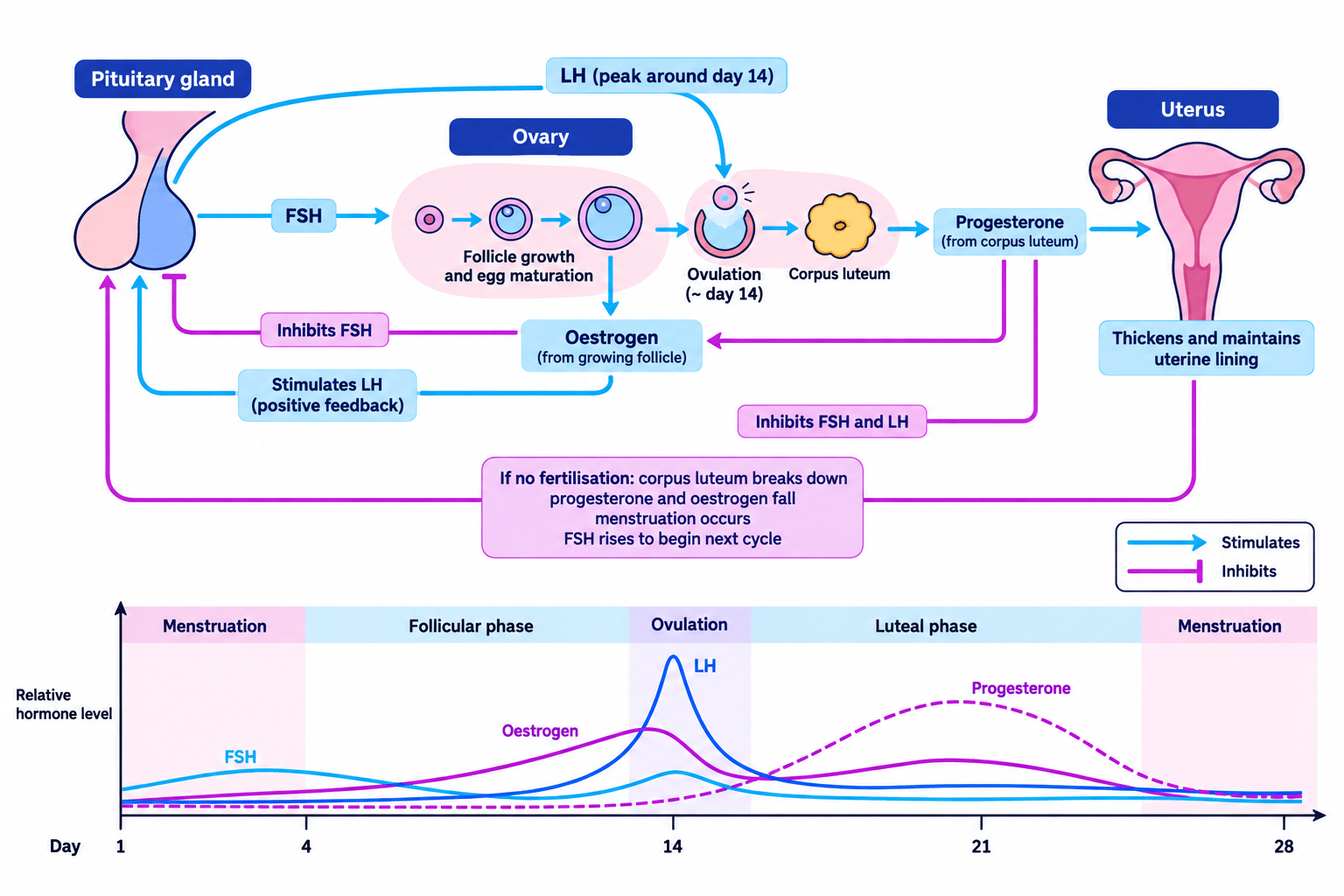
- At the end of a cycle the concentrations of oestrogen and progesterone in the blood are low.
- With little inhibition acting on it, the pituitary gland secretes FSH into the blood.
- FSH is carried in the blood to the ovaries, which are its target organs.
- In an ovary, FSH makes a follicle containing an immature egg grow and the egg inside it mature.
- FSH also stimulates the ovary to secrete oestrogen, so the oestrogen concentration starts to rise from about day 444.
- The rise in oestrogen is therefore a direct consequence of the FSH released at the start of the cycle.
Oestrogen inhibits FSH
Definition
Oestrogen
The main female reproductive hormone, secreted by the ovaries, which causes the uterus lining to thicken and brings about the changes of puberty.
- Oestrogen from the ovary travels in the blood to the uterus, where it makes the lining grow thick and rich in blood vessels.
- Oestrogen also travels to the pituitary gland, where it inhibits the release of FSH.
- Less FSH means no further follicles are stimulated, so usually only one egg completes its development.
- At the same time oestrogen stimulates the pituitary to secrete LH.
- Because a rise in oestrogen causes a further rise in LH, this part of the cycle is an example of positive feedback.
- The LH concentration therefore climbs steeply and reaches a sharp peak at about day 141414.
LH triggers ovulation
- The sharp peak in LH acts on the mature follicle in the ovary.
- The follicle bursts and releases the egg into the oviduct, which is ovulation, at about day 141414.
- The empty follicle stays behind in the ovary and develops into a yellow structure of dividing cells.
- That structure secretes progesterone, so the progesterone concentration rises from day 141414 onwards.
- Oestrogen output drops slightly just after ovulation, then rises again as the empty follicle develops.
Progesterone maintains the lining
Definition
Progesterone
A hormone secreted by the ovaries after ovulation that maintains the thickened lining of the uterus.
- Progesterone acts on the uterus and maintains the thick lining, keeping it ready to receive a fertilised egg.
- Progesterone also acts on the pituitary gland, where it inhibits the release of both FSH and LH.
- With FSH inhibited, no new follicle matures, so a second ovulation cannot happen in the same cycle.
- If the egg is fertilised and implants in the lining, progesterone stays high and the lining is kept in place.
- If the egg is not fertilised, the structure in the ovary breaks down and progesterone and oestrogen concentrations fall.
- Once progesterone is low, the lining is no longer maintained and it breaks down as menstruation.
- Low progesterone and oestrogen also stop inhibiting the pituitary, so FSH rises again and the next cycle begins.
Example
Reading the hormone graphs
- A graph of a 282828 day cycle shows LH rising to a sharp peak on day 141414.
- That peak marks ovulation, because LH triggers the release of the egg.
- Progesterone rises from day 141414 and reaches its highest value at about day 212121.
- Progesterone then falls between day 212121 and day 282828, so the uterus lining is no longer maintained.
- Menstruation therefore begins once progesterone has fallen to its lowest value, on day 111 of the next cycle.
Exam technique
Explaining the interactions
- State which hormone acts on which gland, and say whether it stimulates or inhibits that gland.
- Follow one hormone at a time through the cycle rather than describing all four at once.
- Read a sharp peak in LH on a graph as the moment of ovulation.
- Give the fall in progesterone as the cause of menstruation, because that link is where the mark sits.
Common Mistake
- Do not write that oestrogen inhibits LH, because oestrogen inhibits FSH and stimulates LH.
- Do not write that FSH causes ovulation, because FSH matures the egg and LH releases it.
- Do not write that progesterone thickens the uterus lining, because oestrogen builds it and progesterone only maintains it.
Self review
- Which hormone stimulates the ovaries to secrete oestrogen?
- Explain how a rise in oestrogen changes the release of FSH and of LH.
- What does the sharp rise in LH cause at about day 141414?
- Which hormone maintains the uterus lining, and which organ secretes it?
- Explain why a fall in progesterone leads to menstruation.