How humans interact with ecosystems
Ecosystem
An ecosystem is a community of organisms interacting with one another and with the non-living components of their environment.
Biodiversity
Biodiversity is the variety of living organisms, including variation within species and the range of species and ecosystems.
- Every human activity that takes something from an ecosystem, or puts something into it, changes the conditions the organisms living there depend on.
- Negative interactions reduce biodiversity, and the three main groups are destroying habitats through land use, removing organisms by hunting and fishing, and releasing pollutants.
- Positive interactions protect or raise biodiversity, and they include conserving individual species, protecting whole habitats and cutting the amount of waste released.
- The size of the human population and the resources each person uses set the scale of the pressure, because more food, land, energy and materials are needed each year.
- Biodiversity falls when species are lost from an area, and the loss is measured as a drop in the number of different species rather than a drop in the total number of organisms.
- A change that removes one species rarely stops there, because the species in a community are linked by feeding, shelter and pollination.
An area planted with millions of identical conifers holds a huge number of organisms but a very low biodiversity, because almost all of them belong to the same few species.
Land use destroys habitats
Habitat destruction
Habitat destruction is the loss or damage of the place where a species lives, so that the species can no longer survive there.
Deforestation
Deforestation is the permanent removal of trees from a large area of land.
Monoculture
A monoculture is a large area of land planted with a single crop species.
- Land is cleared for housing, roads, shops, factories, quarries, landfill sites and farmland, and each of these replaces a living habitat with a surface that supports almost nothing.
- Deforestation removes the trees that provide food, nesting sites and shade, so the species that depend on them have nowhere to feed or breed.
- Tree roots hold the soil together, so once the trees are gone the topsoil is washed away by rain, which is called soil erosion.
- Cutting and burning forest also releases the carbon locked in the wood as carbon dioxide, and removes the trees that were absorbing carbon dioxide for photosynthesis.
- Draining a peat bog for fuel or compost destroys a habitat that only specialised plants such as sphagnum moss and sundew can live in, and those species cannot simply move elsewhere.
- Drained peat also begins to decompose, and the decomposers respire, releasing stored carbon as carbon dioxide.
- Modern farming replaces mixed vegetation with a monoculture, so a field that once held dozens of plant species and the insects feeding on them now holds one.
- Removing hedgerows to make larger fields destroys a habitat used for nesting and shelter, and also removes the corridor that allowed animals to travel safely between woods.
- Clearing land in patches leaves fragmented habitats, and a small isolated patch supports fewer species and cuts populations off from one another.
- Isolated populations cannot interbreed, so each one ends up with fewer alleles and less chance of adapting if conditions change.
- Herbicides and insecticides used on farmland remove the wild plants and insects that other species feed on, even when those organisms were not the target.
Hedgerow loss on British farmland
- Hedgerows were pulled out across British farmland during the twentieth century so that larger machinery could work bigger fields.
- A hedgerow is a habitat in its own right, holding hawthorn, bramble and wild flowers, along with the insects that feed on them.
- Nesting birds such as the yellowhammer lost their nest sites, and their numbers on farmland fell as a result.
- Hedgehogs and dormice lost the sheltered routes they used to cross open ground, so their populations became isolated in separate patches.
- Replanting hedges and leaving uncut margins around fields restores both the habitat and the corridor between habitats.
Hunting and overfishing remove species
Endangered species
An endangered species is a species whose population has fallen so low that it is at risk of extinction.
Extinction
Extinction is the permanent loss of every living member of a species.
- Animals are hunted for meat, for skins and fur, for ivory and horn, for traditional medicines and for sport.
- Hunting only reduces a population permanently when individuals are killed faster than the species can replace them by breeding.
- Species that breed slowly, have few young and mature late are the most vulnerable, which is why rhinoceroses and whales were driven to low numbers far faster than rabbits ever could be.
- A species whose numbers fall this far becomes endangered, and if the last individuals die the species becomes extinct and its alleles are lost for good.
- Overfishing takes fish from the sea faster than the stock can breed, so the number of adults left to spawn each year keeps falling.
- Fine-meshed nets make this worse by catching young fish before they have bred at all.
- Nets also catch species that were never the target, such as dolphins, turtles and seabirds, and this unwanted catch is called bycatch.
- Trawling a net along the sea floor drags up the seabed itself, destroying the habitat that shellfish and corals were living in.
Hunting and fishing are only sustainable while the number removed each year is no greater than the number the population produces in that year.
Pollution of land, water and air
Pollution
Pollution is the release of a harmful substance into the air, water or land.
Eutrophication
Eutrophication is the process in which nutrients entering a body of water cause rapid algal growth that leads to a fall in the dissolved oxygen concentration.
Acid rain
Acid rain is rain with a pH lower than normal, formed when sulfur dioxide and nitrogen oxides dissolve in water in the atmosphere.
- Land is polluted by household waste sent to landfill, by toxic waste from industry, and by pesticides and herbicides sprayed onto crops.
- Plastics are non-biodegradable, meaning decomposers have no enzymes that break them down, so they stay in the environment for hundreds of years.
- Animals become entangled in discarded netting and packaging, and others swallow plastic that blocks the gut so that the animal starves with a full stomach.
- Plastic breaks into fragments called microplastics, which are small enough to be eaten by plankton and so pass into the food chain.
- Water is polluted by untreated sewage, by fertiliser washed off fields, by oil spills and by toxic chemicals discharged from factories.
- Fertiliser causes eutrophication, and the sequence runs through six clear steps.
- Rain washes nitrates and phosphates from the fertilised field into a river or lake, which is called leaching.
- The extra nitrate removes the shortage that was limiting algal growth, so algae reproduce rapidly and form an algal bloom across the surface.
- The bloom blocks the light, so the plants rooted below can no longer photosynthesise.
- Those plants die, and the algae at the surface die soon afterwards once the nitrate runs out.
- Decomposing bacteria feed on the dead material and multiply rapidly.
- The bacteria respire aerobically and use up the dissolved oxygen, so fish and aerobic invertebrates suffocate and die.
- Untreated sewage has the same effect twice over, because it adds nutrients and it also feeds the decomposers directly with organic matter.
- Air is polluted by smoke, soot and gases released when fossil fuels are burned in power stations, factories and vehicles.
- Fossil fuels contain sulfur, so burning them releases sulfur dioxide, and the high temperatures inside an engine also produce nitrogen oxides.
- These gases dissolve in water droplets in the clouds and fall as acid rain, often hundreds of kilometres from where they were released.
- Acid rain lowers the pH of lakes so that fish eggs fail to hatch, damages the waxy cuticle on tree leaves, and washes aluminium ions out of the soil into rivers where they damage fish gills.
- Do not write that algae use up the oxygen in eutrophication.
- The oxygen is used by the decomposing bacteria respiring aerobically on the dead plants and algae.
- Name the bacteria and name aerobic respiration, because both are needed for the final marks.
Indicator species reveal pollution
Indicator species
An indicator species is a species whose presence or absence in a habitat shows the level of pollution in that habitat.
- Species differ in how much pollution they can tolerate, so which species are present at a site is itself a measurement of how polluted that site is.
- An indicator species may work in either direction: a sensitive species indicates clean conditions by being present, and a tolerant species indicates pollution by being present in large numbers.
- Lichens indicate air quality, because they absorb water and dissolved gases straight across their surface and so take in sulfur dioxide with no barrier.
- Bushy and leafy lichens have a large surface area exposed to the air and grow only where it is clean, while flat crusty lichens tolerate moderate pollution and bare bark or algae alone indicates heavily polluted air.
- Freshwater invertebrates indicate water quality, because the sensitive species need a high concentration of dissolved oxygen.
- Stonefly nymphs and mayfly nymphs are found only in clean, well oxygenated water, and freshwater shrimps need reasonably clean water.
- Bloodworms and sludgeworms survive where oxygen is very low because they contain haemoglobin that binds oxygen strongly, and a rat-tailed maggot breathes air through a tube at the surface, so it does not depend on dissolved oxygen at all.
- Living indicators are cheap, need no equipment and show the conditions over weeks rather than at one instant.
- Living indicators are also only qualitative, they cannot say which pollutant is present, and a species may be absent for a reason that has nothing to do with pollution.
- Non-living indicators give a number instead, using a dissolved oxygen meter, a nitrate test kit, a pH probe or an electronic sulfur dioxide monitor, so the result is quantitative and can be compared between sites.
- The two approaches are used together, because the meter says how polluted the water is now and the invertebrates say what the water has been like for some time.
Using freshwater invertebrates to compare water quality at two sites
- Aim: to compare the invertebrate indicator species in a stream upstream and downstream of a farm outflow, and to check the result against a dissolved oxygen reading.
- Apparatus: a pond net, two white sampling trays, a plastic pipette, a hand lens, a freshwater invertebrate identification key, a dissolved oxygen meter, a thermometer, a stopwatch, a tally chart, waterproof boots and gloves.
- Method, sampling the upstream site:
- Half fill a white tray with stream water and set it on the bank ready for the catch.
- Stand downstream of the net and disturb the gravel with your boot for exactly 303030 seconds, so the animals living among the stones are swept into the net by the current.
- Empty the net into the tray straight away, because small invertebrates die quickly once out of the water.
- Use the pipette to move each animal into a separate corner of the tray, identify it with the key and the hand lens, and record it on the tally chart.
- Lower the oxygen meter probe to mid depth, wait for the reading to settle and record the dissolved oxygen concentration and the water temperature.
- Method, sampling the downstream site:
- Repeat every step at a point below the outflow, using the same net, the same 303030 second disturbance and the same depth of water, so that only the site differs.
- Take three samples at each site and work out a mean count for each species, since one net sweep can miss animals entirely.
- Return every animal to the water it came from as soon as it has been counted.
- Results: tabulate the mean number of each species against site, and expect stonefly and mayfly nymphs upstream with bloodworms and sludgeworms dominating downstream.
- Maths: count the number of different species at each site to compare biodiversity, and calculate the percentage fall in dissolved oxygen with upstream−downstreamupstream×100\dfrac{\text{upstream}-\text{downstream}}{\text{upstream}}\times100upstreamupstream−downstream×100.
- Watch out: a different depth, flow rate or stream bed at the two sites changes the catch for reasons unconnected with pollution, and disturbing the gravel for longer at one site inflates that count.
- Safety: work in pairs on a firm bank well away from deep or fast water, cover any cut with a waterproof plaster, wear gloves and wash hands thoroughly afterwards because stream water can carry pathogens.
Toxins build up along food chains
Bioaccumulation
Bioaccumulation is the build-up of a substance in the body of an organism because it is taken in faster than it is broken down or excreted.
Biomagnification
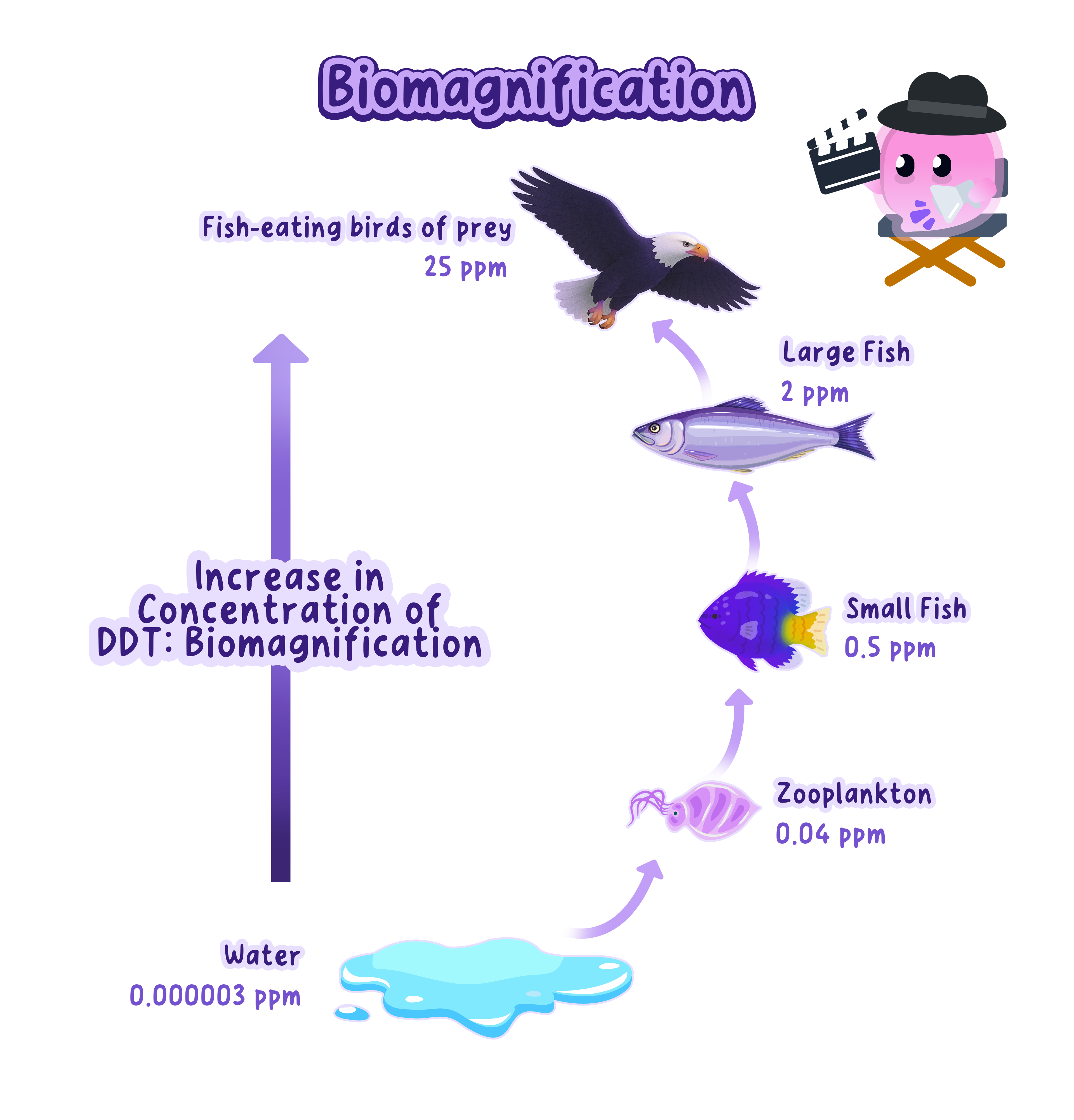
Biomagnification is the increase in the concentration of a substance in the bodies of organisms at each successive trophic level of a food chain.
- Some pollutants, such as the pesticide DDT and the heavy metal mercury, are absorbed by producers and small organisms at very low concentrations.
- These substances are not broken down by enzymes and are not excreted, so they are stored in the body, usually in fatty tissue.
- The amount inside one organism therefore rises steadily throughout its life, which is bioaccumulation.
- A consumer has to eat many prey organisms to survive, and it takes in the stored toxin from every one of them.
- The concentration in its body therefore ends up higher than the concentration in any single prey animal, and the same happens again at the next level up, which is biomagnification.
- The top predator carries the highest concentration of all, which is why birds of prey and large fish are harmed first even though the water around them appears almost clean.
- DDT reached concentrations in birds of prey that thinned their eggshells, so the eggs broke under the weight of the incubating parent and few chicks hatched.
- Populations of peregrine falcons and sparrowhawks fell sharply as a result, and recovered after DDT was banned in Britain.
- Concentrations of this kind are quoted in parts per million, written ppm\text{ppm}ppm, where 1 ppm1\ \text{ppm}1 ppm is one gram of the substance in one million grams of tissue.
Working out how far a pollutant is magnified
- In a lake, DDT is measured at 0.000003 ppm0.000003\ \text{ppm}0.000003 ppm in the water and at 25 ppm25\ \text{ppm}25 ppm in fish-eating birds.
- The number of times the concentration has been magnified is 250.000003\dfrac{25}{0.000003}0.00000325.
- This works out as roughly 8 300 0008\,300\,0008300000 times, written in standard form as 8.3×1068.3\times10^{6}8.3×10⁶.
- A concentration that is harmless in the water is therefore lethal by the time it reaches the top of the chain.
Effects spread through the food web
Food web
A food web is a set of interconnected food chains showing all the feeding relationships in a community.
Interdependence
Interdependence is the reliance of organisms on other organisms in their community for resources or processes needed for survival and reproduction.
- Because the species in a community are interdependent, damage done to one species passes outwards through the food web to species that were never touched directly.
- When a species is removed, its predators lose a food source, so their numbers fall unless they can switch to alternative prey.
- At the same time the organisms it used to eat are no longer being eaten, so their numbers rise.
- Those organisms then eat more of their own food source, and the disturbance carries on down the web in this alternating pattern.
- A species with many links in the web has the widest effect, so removing a plant eaten by twenty insect species matters more than removing one with a single specialist feeder.
- Losing a pollinating insect also removes the plants that depended on it for reproduction, so the damage crosses from animals to plants.
Overfishing one species of fish leaves its predators short of food while the plankton it grazed on increases, so a single fishing decision changes numbers at three levels of the web.
Conserving species and habitats
Conservation
Conservation is the protection and management of species and habitats so that biodiversity is maintained.
Seed bank
A seed bank is a collection of stored seeds kept viable to conserve plant species and their genetic diversity.
- Conservation works at two scales: protecting one species that is close to extinction, and protecting a whole habitat so that every species in it survives together.
- A breeding programme keeps an endangered species in a zoo or wildlife park and breeds it in captivity, away from the predators, poachers and habitat loss that reduced it in the wild.
- Records of how every individual is related, kept in a studbook shared between zoos, are used to choose which animals are paired, and individuals are moved between zoos so that close relatives never breed together.
- Artificial insemination places sperm collected from a male directly into a female, so two animals in different countries can breed without either being moved.
- In vitro fertilisation joins an egg and a sperm outside the body and the embryo is then implanted into a female, which produces more offspring from a rare pair than natural mating would.
- Animals bred in captivity are released back into protected habitat once numbers are high enough, which is called reintroduction.
- Reintroduction only succeeds if the habitat still exists and the released animals can find food and avoid predators, so captive-bred animals are often trained to hunt before release.
- Plants are conserved in the same way by seed banks, which store dried seeds at low temperature so they stay alive for decades and can be grown again if the wild plants are lost.
- Botanic gardens grow rare species directly and hold living collections alongside the stored seed.
- Whole habitats are protected as nature reserves, national parks and marine protected areas, where building, ploughing and hunting are restricted by law.
- Damaged habitats are rebuilt by replanting native trees, replanting hedgerows, restoring drained peat bogs and leaving wide uncut margins around arable fields.
- Legal controls limit the damage directly, through bans on hunting protected species, fishing quotas that cap the mass landed each year, and rules setting a minimum net mesh size so young fish escape.
- Reducing what is released matters just as much, through recycling, treating sewage before it is discharged, removing sulfur from fuels and fitting catalytic converters to vehicles.
Answering questions on human impact
- Finish the chain of reasoning rather than stopping at the activity, so write that deforestation removes nest sites and food, which reduces the number of species living there.
- Name a real organism wherever one is available, such as a stonefly nymph or a bushy lichen, because a named indicator scores where the word insect does not.
- When a question asks for both positive and negative interactions, give both, since half the marks sit on the side most answers leave out.
- Read biomagnification data from the top of the chain down, and quote the two concentrations with their units when describing the trend.
- Give three ways that human land use reduces the biodiversity of an area.
- Describe the six steps of eutrophication, from fertiliser on a field to dead fish in a lake.
- Explain why lichens are used as indicators of air quality.
- State one advantage and one disadvantage of using a living indicator species rather than a meter.
- Explain why the concentration of a pesticide is highest in a top predator.
- Describe two ways a breeding programme keeps genetic variation high in a captive population.
