6.2.1 Biological factors affecting food security
What food security means
Food security
Food security is reliable access at all times to enough safe, nutritious and affordable food for a whole population.
- Food security is reliable access at all times to enough safe, nutritious and affordable food for a whole population.
- Four conditions have to be met together: the food must be available, people must be able to access it, they must be able to afford it, and the supply must be stable from one year to the next.
- Food insecurity is the state in which one or more of those conditions fails, so people cannot rely on getting the food they need.
- A country does not have to grow all of its own food to be food secure, because food can be imported, but it does need a supply it can depend on.
- The United Kingdom produces a little over half of the food it eats and imports the rest, so a disruption to trade affects its food security as much as a poor harvest at home does.
- Food security is judged at several scales, from a single household, to a country, to the whole world, and a country with a good average supply can still contain households that are food insecure.
Food security depends on the food supply and on people being able to reach and afford that supply, so both production and distribution matter.
- Do not treat food insecurity as only a shortage of food.
- A country can produce a surplus and still be food insecure if prices are too high, if transport fails, or if the supply collapses in some years.
A growing human population
- The human population is rising, so the total mass of food that has to be produced each year rises with it.
- The rise comes mainly from a falling death rate, as medicine, clean water and sanitation improve, while the birth rate stays high in many countries.
- The area of land suitable for farming is not rising at the same rate, so the amount of food produced per hectare, the yield, has to rise instead.
- Clearing more land to farm is possible but removes habitats, so it trades food production against the wildlife and soil that farming itself depends on.
- More people also need more fresh water, and irrigation competes with drinking water and with water for industry.
Working out a change in yield
- A wheat field yields 8.4 tonnes per hectare8.4\ \text{tonnes per hectare}8.4 tonnes per hectare, and after an outbreak of a fungal disease the same field yields 6.3 tonnes per hectare6.3\ \text{tonnes per hectare}6.3 tonnes per hectare.
- The change in yield is 8.4−6.3=2.1 tonnes per hectare8.4-6.3=2.1\ \text{tonnes per hectare}8.4−6.3=2.1 tonnes per hectare.
- Percentage change is found from percentage change=changeoriginal value×100\text{percentage change}=\dfrac{\text{change}}{\text{original value}}\times100percentage change=original valuechange×100.
- Substituting gives 2.18.4×100=25%\dfrac{2.1}{8.4}\times100=25\%8.42.1×100=25%.
- The yield has fallen by 25%25\%25%, and the same method run in reverse gives the percentage rise when a new variety or a new input raises the yield.
Changing diets in wealthier populations
- As average incomes rise, people eat less cereal and more meat, fish and dairy produce.
- Producing food from animals is far less efficient than producing it from plants, because only a small fraction of the energy in the feed a farm animal eats ends up in the meat or milk that people eat.
- The rest of that energy is lost in respiration, in movement, as heat, and in material that is not eaten, so several kilograms of plant material are needed for every kilogram of meat produced.
- Land used to grow animal feed is therefore land that is not growing food for people directly, and a shift towards meat raises the total area of farmland a population needs.
- Livestock also need large volumes of water, both to drink and to grow their feed, which adds to the demand on water supplies.
- Wealthier populations expect foods out of season as well, so crops are flown or shipped in from other climates, which raises the fuel cost of the food supply.
The demand for food is not simply the number of people, because what those people choose to eat changes how much land, water and energy each person needs.
New pests and pathogens
Pest
A pest is an organism that feeds on or damages a crop or a farm animal and so lowers the amount of food produced.
- A pest is an organism that feeds on or damages a crop or a farm animal, and a pathogen is a microorganism that causes disease in one.
- Both lower yield, because a damaged or diseased plant photosynthesises less and puts less of its biomass into the parts that are harvested.
- International trade and travel move pests and pathogens between continents, so a species arrives in a region where local varieties have no resistance to it and no natural predator controls it.
- Fields planted with a single variety are especially vulnerable, because every plant in the field carries the same alleles and so has the same susceptibility.
- Insect pests cause damage twice over, by eating the crop and by carrying plant viruses from one plant to the next as they feed.
- Disease in livestock can force whole herds or flocks to be culled, which removes that food supply for several years while numbers are rebuilt.
- Warmer winters allow insect pests to survive from one season to the next, so their populations start each spring from a larger number.
How a pest and a pathogen combine
- Aphids feed by pushing a needle-like mouthpart into the phloem of a cereal plant and drawing off sugars, which slows the plant's growth.
- As the aphid moves to the next plant it carries a virus on its mouthparts and injects it into the phloem.
- The infected plant becomes stunted and yellow and produces far fewer grains, so a light aphid infestation can still cause a heavy loss of yield.
Environmental change
- Rising average temperatures shift the regions in which a crop grows well, so land that reliably produced a crop may stop doing so while land further north becomes usable.
- Drought lowers the water available to a crop, the stomata close to conserve water, carbon dioxide can no longer diffuse into the leaf, and the rate of photosynthesis falls.
- Flooding fills the air spaces in soil with water, so root cells cannot obtain enough oxygen for aerobic respiration and the roots die.
- Extreme weather at the wrong point in the growing season is particularly damaging, because a storm at flowering or at harvest can destroy a crop that was growing well.
- Salt water flooding coastal farmland lowers the water potential of the soil solution, so roots cannot take up water by osmosis and the land becomes unusable.
- Environmental change also moves pests and pathogens into new areas, which is why its effects on food security are larger than the direct effect on plant growth alone.
Environmental change lowers food security by making the supply less reliable from year to year, not only by lowering the average amount produced.
Cost and sustainability of farming inputs
Yield
Yield is the amount of useful product harvested from a given area of crop or from a given number of farm animals.
Sustainability
Sustainability is meeting the needs of people today without preventing future generations from meeting their own needs.
- Yield is the amount of useful product harvested from a given area of crop or from a given number of animals, and raising it is how farmers meet rising demand from a fixed area of land.
- Raising yield depends on inputs, which include fertilisers, pesticides, fuel, irrigation water, animal feed, seed and machinery.
- Manufacturing nitrogen fertiliser uses a large amount of energy, so its price rises and falls with the price of fuel, and fuel is also needed for every tractor, pump and lorry on the farm.
- When input costs rise faster than the price a farmer is paid, the farmer applies less fertiliser or plants a smaller area, and the amount of food produced falls.
- Sustainability means meeting the needs of people today without preventing future generations from meeting their own needs.
- Irrigating from underground water taken out faster than rainfall replaces it is not sustainable, because the supply eventually fails.
- Ploughing bare soil and growing the same crop repeatedly without returning organic matter causes soil erosion and a loss of soil fertility, so yields fall in later years.
- A method that raises yield this season while destroying the soil, water or pollinating insects that next season depends on lowers food security in the long term.
Answering questions on food security
- Name the factor and then say what it does to the food supply, because a mark is given for the link rather than for the factor alone.
- Write the chain out in full, so a factor such as drought becomes less water, closed stomata, less photosynthesis, lower yield.
- Watch for the difference between a factor that raises demand, such as a growing population, and one that lowers supply, such as a new pathogen.
- When data is supplied, quote a figure from it and give the unit, since answers that describe a trend without using the numbers usually drop a mark.
- State what is meant by food security.
- Explain why a country that grows a surplus of food can still have food insecure households.
- Explain why a shift towards eating more meat increases the area of farmland a population needs.
- Describe two ways in which a new insect pest can lower the yield of a cereal crop.
- A field yields 6.0 tonnes per hectare6.0\ \text{tonnes per hectare}6.0 tonnes per hectare and a new variety raises this to 7.2 tonnes per hectare7.2\ \text{tonnes per hectare}7.2 tonnes per hectare, so calculate the percentage increase.
- Explain why taking irrigation water from underground faster than rainfall replaces it is not sustainable.
6.2.2 Agricultural solutions to growing demand
Raising yield from a fixed area of land
Yield
Yield is the amount of useful product harvested from a given area of crop or from a given number of farm animals.
- Yield is the amount of useful product harvested from a given area of crop or from a given number of animals.
- The area of land that can be farmed is limited, and clearing more wild land destroys habitats, so the food supply is raised mainly by getting more from each hectare already in use.
- Anything that is holding growth back acts as a limiting factor, so raising yield means finding what is in short supply and supplying it.
- For a crop the usual limits are light, carbon dioxide, temperature, water, mineral ions, and losses to pests, disease and weeds.
- Agricultural solutions attack those limits directly, by controlling conditions, replacing mineral ions, removing pests and weeds, and reducing disease.
- Selective breeding and gene technology raise yield by a different route, changing the plants and animals themselves rather than the conditions they grow in, and each is set out in its own article.
Every agricultural solution works by removing something that was limiting growth, and every one of them has a cost in money, energy or damage to the environment.
Fertilisers replace lost mineral ions
Fertiliser
A fertiliser is a substance added to soil or to a nutrient solution to supply the mineral ions that plants need in order to grow.
- A fertiliser is a substance added to soil or to a nutrient solution to supply the mineral ions that plants need in order to grow.
- In a natural ecosystem, dead material is decomposed and the mineral ions it contains return to the soil, but on a farm the crop is harvested and carried away, so those ions leave the field for good.
- Without replacement the soil is gradually stripped of the ions the crop needs most, and each year's yield is lower than the last.
- Nitrate ions are supplied because a plant uses nitrogen to make amino acids, and therefore to make the proteins needed for new cells and growth.
- Phosphate and potassium ions are supplied alongside nitrate, and a fertiliser sold as NPK contains all three.
- Magnesium ions are needed as well, because magnesium is part of the chlorophyll molecule and a shortage of it lowers the rate of photosynthesis.
- Fertiliser can be applied as manure and compost, which release ions slowly as decomposers break them down, or as manufactured granules, which dissolve quickly and act fast.
- Applying more fertiliser than the crop can take up wastes money, and rain washes the surplus into rivers and lakes where it causes the water to become choked with algae.
Do not write that fertiliser is food for a plant, because a plant makes its own food by photosynthesis and uses mineral ions only as raw materials for other molecules.
Pesticides kill the organisms that damage crops
Pesticide
A pesticide is a chemical applied to a crop to kill the organisms that feed on it or damage it.
- A pesticide is a chemical applied to a crop to kill the organisms that feed on it or damage it.
- Insecticides kill insect pests, fungicides kill fungi that cause plant disease, and herbicides kill weeds that compete with the crop for light, water and mineral ions.
- Killing the pest means more of the crop survives to be harvested and more of its biomass goes into the parts people eat, so yield rises.
- Pesticides are quick to apply over a large area and act within days, which is why they are still the most widely used method of crop protection.
- A pesticide rarely kills only the target species, so pollinating insects and the natural predators of the pest are killed alongside it.
- A pesticide that does not break down easily is eaten with the tissue of the organisms it is in, and its concentration builds up along a food chain, so top predators receive the largest dose.
- Pests also vary, and any individual with an allele giving resistance survives the spray and passes that allele on, so repeated use selects for a resistant population and the pesticide stops working.
- Pesticide applied close to harvest can leave residues on food, so there are legal limits on which chemicals may be used and how long before harvest they may be applied.
Biological control uses a natural enemy
Biological control
Biological control is lowering the number of a pest by introducing a natural predator, parasite or pathogen of that pest.
- Biological control is lowering the number of a pest by introducing a natural predator, parasite or pathogen of that pest.
- The control organism eats or infects the pest, the pest population falls, and less of the crop is damaged.
- Ladybirds and their larvae are released to feed on aphids, and the parasitic wasp Encarsia formosa is released in glasshouses, where it lays its eggs inside whitefly larvae and its own larvae kill them from within.
- Because the control organism reproduces, one release can keep working for a whole growing season without further cost.
- No chemical is sprayed, so there are no residues on the food, no damage to the wider community of insects, and no selection for chemical resistance.
- Biological control is slower than spraying, and it never removes the pest completely, because the control organism needs some pest left to feed on.
- The pest and its enemy settle into a cycle in which each population rises and falls after the other, and the grower accepts a low level of damage rather than none.
- Introducing a species also carries a risk, because a control organism with no natural enemy of its own may attack harmless native species or become a pest itself.
- Biological control and chemical pesticides are often combined in one system, with a pesticide used only when monitoring shows the pest has passed a set level.
- This lowers the total amount of chemical used while still protecting the crop when the natural enemy cannot keep up.
Hydroponics grows plants without soil
Hydroponics
Hydroponics is growing plants with their roots in a nutrient solution instead of in soil.
- Hydroponics is growing plants with their roots in a nutrient solution instead of in soil.
- The roots sit in a shallow flowing film of solution, or in an inert material such as rockwool that the solution is pumped through, and the plants are held upright by a support.
- The concentration of every mineral ion is measured and adjusted, so the plant is never short of nitrate, phosphate, potassium or magnesium, and none is wasted.
- There are no weeds, so nothing competes with the crop for light, water or mineral ions, and no herbicide is needed.
- Soil-borne pests and diseases are absent because there is no soil, which cuts the need for pesticides.
- The solution is collected and recirculated, so hydroponics uses far less water than irrigating a field, where most of the water drains away or evaporates.
- Crops can be grown on land with poor or contaminated soil, and can be stacked in layers indoors, so a large growing area fits into a small footprint.
- Hydroponics is usually combined with a glasshouse or polytunnel, where the temperature is kept near the optimum for the enzymes controlling photosynthesis, artificial lighting extends the day, and the carbon dioxide concentration is raised above its level in the air.
- The costs are high, because pumps, lamps, heaters and monitoring equipment all use energy and the equipment is expensive to install.
- Disease is also a serious risk, because every plant shares one body of solution, so a pathogen that reaches the tank is carried to every root in the system.
Comparing plant growth in a nutrient solution and in water
- Aim: to find out whether seedlings grown hydroponically in a full nutrient solution grow more than seedlings whose roots sit in distilled water.
- Apparatus: twenty wheat or barley seedlings of similar height, ten boiling tubes, aluminium foil, cotton wool, full nutrient solution, distilled water, a 10 cm310\ \text{cm}^310 cm3 syringe, a ruler marked in millimetres, a balance reading to 0.01 g0.01\ \text{g}0.01 g, a lamp, labels and eye protection.
- Method, setting up:
- Measure the height of each seedling from the base of the stem to the tip of the longest leaf, and keep only seedlings within a few millimetres of one another so the starting point is fair.
- Fill five tubes with 20 cm320\ \text{cm}^320 cm3 of full nutrient solution and five tubes with 20 cm320\ \text{cm}^320 cm3 of distilled water, measured with the syringe.
- Wrap each tube in aluminium foil, which keeps light off the roots and stops algae growing in the solution and using up the mineral ions.
- Push a seedling through a plug of cotton wool in the neck of each tube so that only the roots are in the liquid and the stem is held in the air.
- Label the tubes, place them the same distance from the lamp, and leave them at room temperature.
- Method, taking readings:
- Top the tubes back up to 20 cm320\ \text{cm}^320 cm3 with the correct liquid every two days, so the concentration of ions does not drift as water is lost.
- Measure the height of every seedling with the ruler on the same day each week, for four weeks.
- At the end, cut each plant at the base, blot it dry, and find its mass on the balance.
- Handling the results: calculate the mean height and the mean mass for each group, and plot mean height against time with the two groups on the same axes.
- Expected outcome: the seedlings in the nutrient solution grow taller and end with a greater mass, because they can make amino acids and chlorophyll while the seedlings in distilled water cannot.
- Control variables: light intensity, temperature, volume of liquid, species and starting height of the seedling.
- Improving the result: use at least five plants per group and work with means, since seedlings vary and a single plant may be unusual.
Working out how much fertiliser a field needs
- A grower applies nitrogen fertiliser at a rate of 180 kg per hectare180\ \text{kg per hectare}180 kg per hectare to a field of area 12.5 hectares12.5\ \text{hectares}12.5 hectares.
- The total mass needed is 180×12.5=2250 kg180\times12.5=2250\ \text{kg}180×12.5=2250 kg.
- The fertiliser is sold in 25 kg25\ \text{kg}25 kg bags, so the number of bags is 225025=90\dfrac{2250}{25}=90252250=90.
- Applying the fertiliser raises the yield from 7.5 tonnes per hectare7.5\ \text{tonnes per hectare}7.5 tonnes per hectare to 9.0 tonnes per hectare9.0\ \text{tonnes per hectare}9.0 tonnes per hectare.
- The percentage increase in yield is 9.0−7.57.5×100=20%\dfrac{9.0-7.5}{7.5}\times100=20\%7.59.0−7.5×100=20%.
Answering questions on agricultural solutions
- Give the biology, not the outcome, so write that a pesticide kills the insects eating the leaves, which leaves more leaf area for photosynthesis, rather than only writing that yield goes up.
- When a question asks for an advantage of biological control, compare it with spraying, because the mark is usually for the comparison such as no residue on the crop or no resistance developing.
- For hydroponics, name the variable being controlled, since answers that say conditions are ideal without naming the mineral ions or the temperature rarely score.
- In questions that give a cost as well as a yield, use both numbers, because the answer expected is whether the extra yield is worth the extra input.
- Explain why mineral ions have to be added to farmland but not to a natural woodland.
- Name the mineral ion a plant uses to make proteins and the one it uses to make chlorophyll.
- Explain how repeated use of the same insecticide can lead to a pest population that the insecticide no longer kills.
- Give two advantages and one disadvantage of biological control compared with spraying a pesticide.
- Explain two reasons why hydroponics can give a higher yield than growing the same crop in soil.
- A field of area 8.0 hectares8.0\ \text{hectares}8.0 hectares is treated at 150 kg per hectare150\ \text{kg per hectare}150 kg per hectare, so calculate the total mass of fertiliser required.
6.2.3 Selective breeding
How selective breeding works
Selective breeding
Selective breeding is choosing the organisms that show a desired characteristic and breeding them together over many generations so that the characteristic becomes more common in the population.
- Selective breeding is choosing the organisms that show a desired characteristic and breeding them together over many generations so that the characteristic becomes more common in the population.
- It is also called artificial selection, because the choice of which individuals reproduce is made by people rather than by the environment.
- The characteristic must already be present as variation within the population, since breeding can only work with alleles that some individuals already carry.
- The first step is to choose, from a varied population, the individuals that show the desired characteristic most strongly.
- The second step is to breed those chosen individuals together, so that their alleles are brought together in the offspring.
- The third step is to examine the offspring, keep only those that show the characteristic most strongly, and breed from those.
- Those steps are repeated over many generations, and each round raises the proportion of individuals carrying the alleles for the characteristic.
- The frequency of the useful alleles in the population therefore rises while the frequency of the alternative alleles falls, which is why the whole population changes and not just a few individuals.
- Selective breeding is slow, because one round takes a full generation, and it cannot bring in an allele that no member of the species carries.
In natural selection the environment decides which individuals survive to breed, while in selective breeding a farmer or breeder makes that decision, and the mechanism of inheritance is the same in both.
- Do not write that selective breeding creates a new characteristic.
- It increases how common an existing characteristic is, by choosing which parents pass their alleles on.
Selective breeding of crop plants
- Growers select the plants with the best version of a characteristic and sow the seed from those plants to raise the next generation.
- Higher yield is the characteristic selected most often, so cereals have been bred to produce more grains per ear and more ears per plant.
- Disease resistance is selected by growing a crop where a disease is present and breeding only from the plants that stay healthy.
- Drought and salt tolerance are selected so that a crop can be grown where water is scarce or where soil contains salt.
- Larger or sweeter fruit and a longer shelf life are selected in fruit and vegetable crops so that more of the harvest reaches the shop in good condition.
- Shorter, stiffer stems are selected in wheat so that the plant puts less of its biomass into the stalk and is less likely to be flattened by wind and rain.
- Plants are convenient to breed selectively because one plant produces very many seeds, generations are short, and many varieties can be grown side by side and compared in one season.
One wild plant, many vegetables
- Wild brassica is a coastal plant with small leaves, a thin stem and a loose head of flowers.
- Growers who repeatedly chose and re-sowed the plants with the tightest leaf buds produced the cabbage, while those who chose the largest side buds produced Brussels sprouts.
- Choosing the plants with the largest flower heads produced broccoli and cauliflower, choosing the largest leaves produced kale, and choosing the thickest stems produced kohlrabi.
- Every one of those vegetables belongs to the same species, which shows how far a population can be changed by repeatedly selecting different parts of the same plant.
Selective breeding of farm animals
- Farmers choose the animals with the best version of a characteristic, mate them together, and then breed from the best of their offspring.
- Milk yield is selected in dairy cattle, so modern dairy cows produce several times as much milk each year as the cattle they were bred from.
- Meat production is selected in beef cattle, sheep and pigs, choosing animals that grow quickly and lay down more muscle for each kilogram of feed eaten.
- Egg number is selected in hens, and wool quality in sheep, by keeping the birds and sheep that produce most and breeding from them.
- Disease resistance and a calm temperament are selected as well, because healthy animals that are easy to handle are cheaper and safer to keep.
- A characteristic that appears in only one sex can still be selected, and a bull is judged by the milk yields of his daughters rather than by anything that can be measured in the bull himself.
- Animal breeding is much slower than plant breeding, because a cow produces roughly one calf a year and takes about two years to reach breeding age, so a noticeable change takes decades.
Raising the milk yield of a dairy herd
- A herd has a mean milk yield of 5200 litres5200\ \text{litres}5200 litres per cow per year, and the farmer breeds only from the cows above that mean.
- After several generations of this selection the mean yield of the herd is 7800 litres7800\ \text{litres}7800 litres per cow per year.
- The increase is 7800−5200=2600 litres7800-5200=2600\ \text{litres}7800−5200=2600 litres per cow per year.
- The percentage increase is 26005200×100=50%\dfrac{2600}{5200}\times100=50\%52002600×100=50%.
Impacts of selective breeding
Gene pool
A gene pool is all of the alleles present in all of the individuals of a population.
Inbreeding
Inbreeding is breeding between closely related individuals, which raises the chance that offspring inherit two copies of the same harmful recessive allele.
- The benefit is more food from the same land and the same number of animals, which lowers the cost of food and supports the food supply of a growing population.
- A selectively bred crop is also uniform, so it ripens together and can be harvested by machine in one pass.
- The cost is a loss of variation, because each generation only a few individuals are allowed to breed and the alleles carried by the rest are lost from the population.
- The gene pool, which is all the alleles present in the population, therefore becomes smaller with every generation of selection.
- Breeding from close relatives is called inbreeding, and it raises the chance that an offspring inherits two copies of the same harmful recessive allele, so the disorder that allele causes appears.
- A population with little variation is also vulnerable as a whole, because if a new pathogen or a change in conditions harms one individual it is likely to harm every individual in the same way.
- There may be no allele left anywhere in the population to breed a resistant variety from, so the breeder has to look for one in a wild relative or in a stored collection of older varieties.
- Selecting hard for one characteristic can also harm the animal, and cattle bred for very high milk yields are more prone to lameness and udder infection, while dogs bred for a flattened face have difficulty breathing.
- Breeders reduce these problems by keeping records of relatedness, by crossing in unrelated individuals from time to time, and by maintaining rare breeds and older varieties as a store of alleles.
Answering questions on selective breeding
- Describe the process as a repeated cycle, and say that the selection and breeding are repeated over many generations, since the word generations is usually needed for the mark.
- Use the word allele when explaining the loss of variation, because answers written only in terms of characteristics rarely gain the explanation mark.
- When the question says explain the impact, give a benefit and a problem, as questions on this point almost always expect both sides.
- Name the characteristic being selected rather than writing that the animal is better, so write higher milk yield or resistance to a named disease.
- Describe the repeating steps of selective breeding.
- Explain why a characteristic must already exist in a population before it can be selected for.
- Name three characteristics that are selected for in crop plants and three that are selected for in farm animals.
- Explain why selective breeding of cattle takes far longer than selective breeding of wheat.
- Explain, using the word allele, why selective breeding reduces variation in a population.
- Give two problems that can follow from the reduced variation caused by selective breeding.
6.2.4 Genetic engineering
What genetic engineering is
Genetic engineering
Genetic engineering is changing the genome of an organism by inserting a gene taken from a different organism so that the organism shows a desired characteristic.
Genetically modified organism
A genetically modified organism is an organism whose genome has had a gene from another organism inserted into it by genetic engineering.
- Genetic engineering is changing the genome of an organism by inserting a gene taken from a different organism so that the organism shows a desired characteristic.
- The genome is the entire genetic material of an organism, so adding a gene to it is a permanent change that is copied every time the cell divides.
- An organism that has been changed in this way is a genetically modified organism, usually shortened to GM.
- Only the gene for the wanted characteristic is moved, so the rest of the organism's genome is unchanged.
- The gene can be taken from a completely different kingdom, so a gene from a bacterium can be placed in a plant, which no amount of breeding could achieve.
Genetic engineering moves one known gene between organisms, so the characteristic that gene controls appears in an organism that could never have inherited it.
Why the transferred gene works
- A gene is a length of DNA that codes for a particular protein, and the order of bases in the gene sets the order of amino acids in that protein.
- The genetic code is universal, which means that the same triplet of bases codes for the same amino acid in every living organism.
- Because of that, the cells of the organism receiving the gene read it in exactly the same way as the cells it came from, and build exactly the same protein.
- The new protein then gives the organism the characteristic, since proteins act as enzymes, as structures and as chemicals that affect other organisms.
- The full chain is therefore gene, then protein, then characteristic, and a question asking why a GM plant is resistant to an insect is asking for that chain.
- The gene must be inserted into cells at an early stage of development, so that as the organism grows every one of its cells carries a copy and the whole organism shows the characteristic.
A bacterial gene that protects a maize plant
- The soil bacterium Bacillus thuringiensis carries a gene that codes for a protein poisonous to caterpillars.
- That gene is inserted into the genome of a maize plant, which then makes the protein in its own leaves and stem.
- A caterpillar that eats the leaf takes in the protein, which damages the lining of its gut, so it stops feeding and dies.
- The maize is unharmed, because the protein only becomes active in the alkaline conditions of an insect gut.
- The plant therefore protects itself, and no insecticide has to be sprayed onto the field.
What genetic engineering is used for
- Insect resistance is added to crops so that the plant makes its own protection and less pesticide is needed.
- Herbicide tolerance is added so that a field can be sprayed to kill the weeds without harming the crop.
- Improved nutrition is added by inserting genes that let a crop make a substance it normally cannot, such as the orange pigment that the human body converts into vitamin A.
- Drought and salt tolerance are added so that crops can be grown on land that is currently too dry or too salty to farm.
- Longer shelf life is added by changing the genes that control ripening, so less of the harvest is lost between the field and the shop.
- Microorganisms are given genes so that they make a human or animal protein, and bacteria carrying the human gene for insulin are the best known example.
- Farm animals have been engineered to produce a useful protein in their milk, from which it can be collected and purified.
Genetic engineering is also used to treat and diagnose human disease, and that use is set out separately in the articles on gene technology in medicine.
How genetic engineering differs from selective breeding
- Selective breeding works only with the alleles a species already has, while genetic engineering can bring in a gene from any organism on Earth.
- Selective breeding takes many generations, while genetic engineering produces the change in a single generation.
- Selective breeding mixes thousands of genes at once, so unwanted characteristics come along with the wanted one, while genetic engineering transfers one identified gene.
- Selective breeding needs no specialist equipment, while genetic engineering needs laboratory facilities, trained staff and approval from a regulator.
- Do not write that genetic engineering adds a chemical or a hormone to an organism, because what is added is a gene made of DNA.
- Do not say the whole genome is replaced, since only one gene is inserted and the rest of the genome stays as it was.
- Do not use genetic engineering and selective breeding as though they mean the same thing, as one moves a gene directly and the other chooses which parents mate.
Answering questions on genetic engineering
- Define it using the word gene and the word genome, since a definition that only says the organism is changed does not score.
- Explain a characteristic through the protein, so write that the gene codes for a protein and the protein gives the characteristic.
- If a question asks why a gene from a bacterium works inside a plant, the answer wanted is that the genetic code is universal.
- Name the organism the gene came from and the organism it went into, because questions often award a mark for identifying both.
- Define genetic engineering.
- Explain why a gene taken from a bacterium still produces the same protein when it is placed in a plant cell.
- Describe the chain that links a transferred gene to the characteristic that appears in the modified organism.
- Give three characteristics that have been added to crop plants by genetic engineering.
- Explain why the gene has to be inserted at an early stage of the organism's development.
- Give two differences between genetic engineering and selective breeding.
6.2.5 Steps in genetic engineering
Cutting the gene out of the DNA
Restriction enzyme
A restriction enzyme is an enzyme that cuts DNA at one specific sequence of bases.
Sticky end
A sticky end is the short length of unpaired bases left at the edge of a piece of DNA that has been cut by a restriction enzyme.
- The first step is to find which chromosome carries the required gene and where along that chromosome it lies, so that the correct length of DNA is taken.
- A restriction enzyme is then used to cut the DNA, and each restriction enzyme cuts only where it finds one specific sequence of bases called its recognition site.
- Because the enzyme cuts at a fixed sequence, the same gene is cut out in the same place every time, which is what makes the process repeatable.
- The cut is staggered, so the two strands of the double helix are cut a few bases apart rather than straight across.
- That leaves a short length of unpaired bases on each end of the cut piece, and these are the sticky ends.
- Sticky ends matter because unpaired bases can form hydrogen bonds with a complementary set of unpaired bases, so the gene can later be fitted into another piece of DNA.
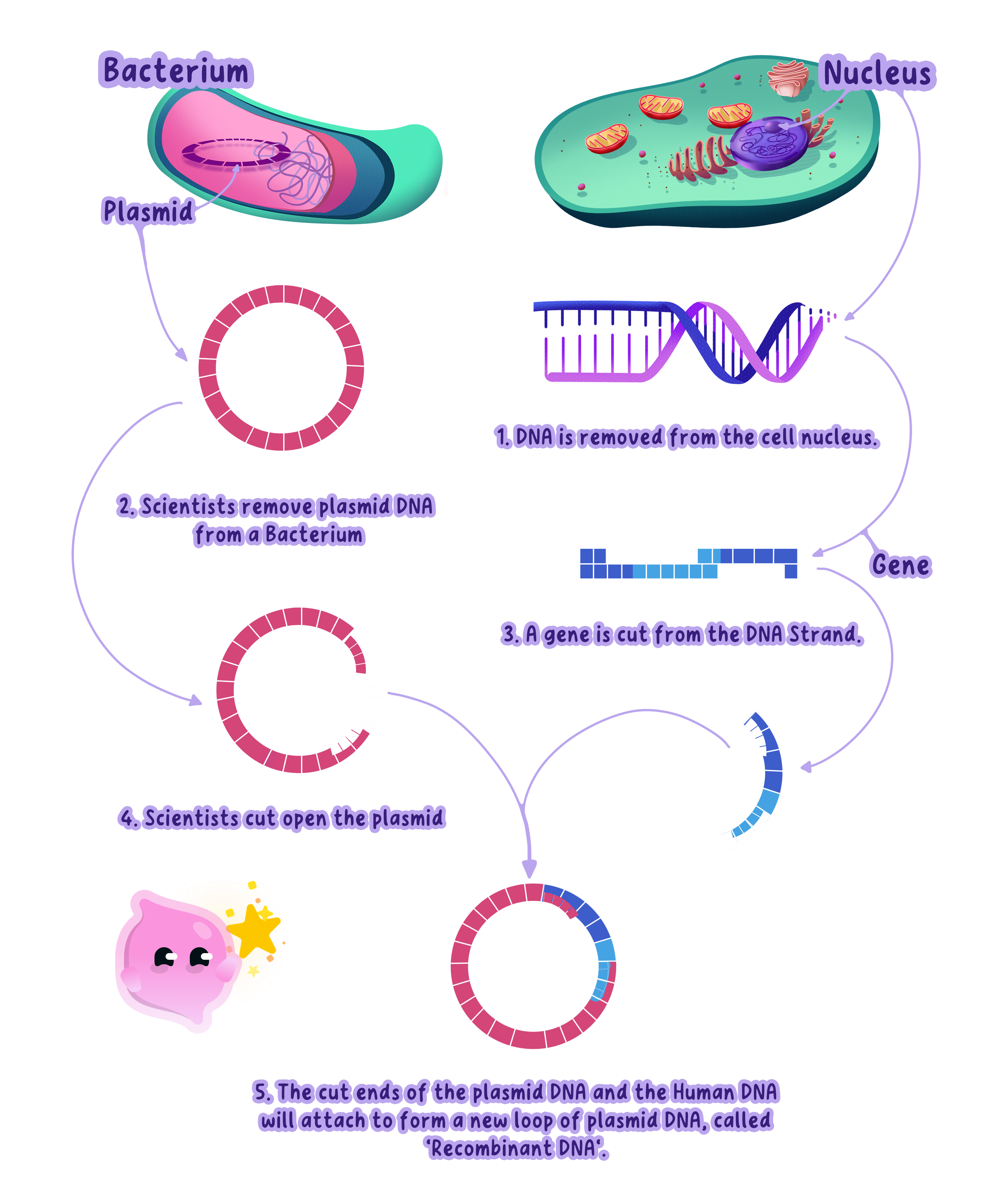
Cutting open the vector
Vector
A vector is a piece of DNA, usually a plasmid or a virus, that is used to carry a gene into a host cell.
Plasmid
A plasmid is a small circular loop of DNA in a bacterial cell that is separate from the main bacterial chromosome.
- A vector is a piece of DNA used to carry a gene into a host cell, and the two vectors used are plasmids and viruses.
- A plasmid is a small circular loop of DNA found in a bacterial cell, separate from the single large bacterial chromosome.
- Plasmids are convenient vectors because they are small, they are easy to take out of and put back into bacteria, and they are copied by the bacterium along with its own DNA.
- A virus can be used instead, because a virus naturally injects its own genetic material into a host cell, and the required gene is carried in with it.
- The plasmid is cut open using the same restriction enzyme that was used to cut out the gene.
- Using the same enzyme is essential, because it leaves sticky ends on the plasmid whose unpaired bases are complementary to those on the gene, so the two fit together and no other fragment does.
Joining the gene into the vector
DNA ligase
DNA ligase is an enzyme that joins two pieces of DNA together by sealing the gaps in their sugar-phosphate backbones.
Recombinant DNA
Recombinant DNA is a single DNA molecule made by joining together DNA from two different organisms.
- The cut gene and the cut plasmid are mixed, and the sticky ends pair up by complementary base pairing, with adenine pairing to thymine and cytosine pairing to guanine.
- Base pairing alone holds the pieces together only weakly, because the sugar-phosphate backbone of each strand is still broken.
- DNA ligase is added, and this enzyme seals those breaks so the gene becomes a permanent part of the circular plasmid.
- The result is recombinant DNA, a single molecule made from the DNA of two different organisms.
- Do not swap the two enzymes, because a restriction enzyme cuts DNA and DNA ligase joins it.
- Do not write that a different restriction enzyme is used on the plasmid, since the sticky ends would not be complementary and the gene would not fit.
Transferring the plasmid into host bacteria
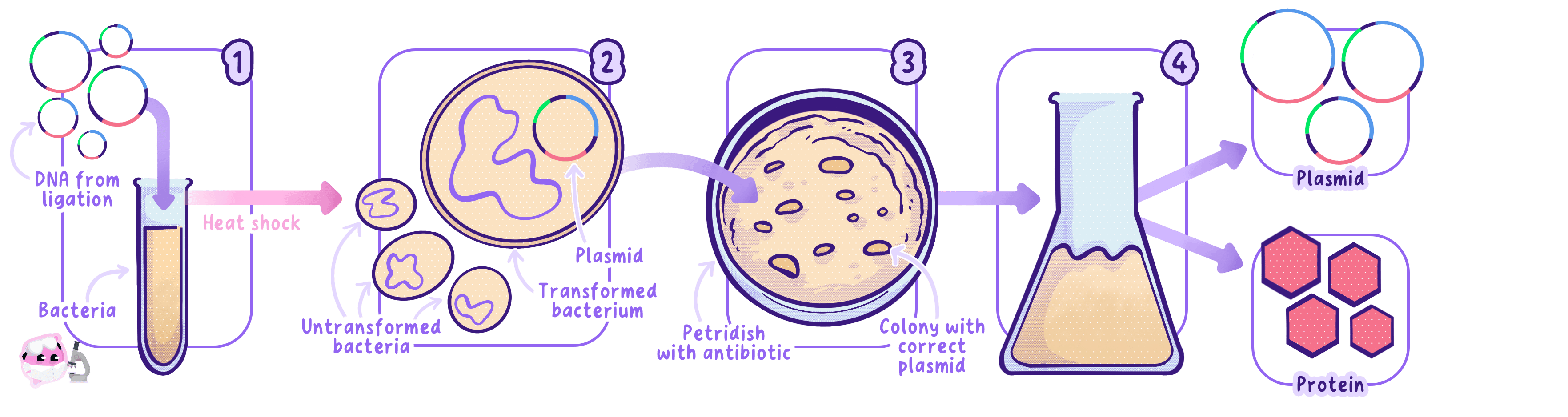
- The recombinant plasmids are mixed with host bacteria in a solution containing calcium ions, which makes the bacterial cell membrane more permeable.
- The mixture is given a brief heat shock, and some of the bacteria take a plasmid in through the membrane, which is called transformation.
- Only a small proportion of the bacteria take up a plasmid, so the mixture contains transformed and untransformed cells together.
- Bacteria are used as hosts because they reproduce roughly every twenty minutes, so a few transformed cells become millions within a day, each carrying a copy of the gene.
Selecting the bacteria that took up the gene
Marker gene
A marker gene is a gene added to a vector, such as one for antibiotic resistance, that allows the host cells which have taken up the vector to be identified.
- A marker gene is added to the plasmid alongside the required gene before the transfer, and the marker used is usually a gene for resistance to a named antibiotic.
- Every bacterium that takes up the plasmid therefore takes up the resistance gene as well, so it can survive that antibiotic while untransformed bacteria cannot.
- All of the bacteria are spread over agar that contains the antibiotic, and the plates are left in a warm incubator.
- Untransformed bacteria are killed by the antibiotic, while transformed bacteria divide repeatedly and each one grows into a visible colony.
- Every colony that appears is therefore a clone of cells carrying the required gene, and those colonies are the ones taken forward.
- The selected bacteria are then grown in large numbers and the protein they make is collected and purified.
Finding the proportion of transformed bacteria
- A technician spreads 400040004000 bacterial cells onto agar containing the antibiotic and incubates the plate.
- After incubation, 525252 colonies have grown, and each colony grew from one transformed cell.
- The proportion transformed is 524000\dfrac{52}{4000}400052.
- As a percentage this is 524000×100=1.3%\dfrac{52}{4000}\times100=1.3\%400052×100=1.3%.
- The low percentage is why the selection step is needed, since the great majority of the cells did not take up a plasmid.
Transferring genes into plants and animals
- For a plant, the gene is usually carried in by a bacterium that naturally inserts part of its plasmid into plant cells, or it is fired into the cells on tiny metal particles.
- A single transformed plant cell is then grown in a nutrient medium into a whole plant, and every cell of that plant carries the gene.
- For an animal, the gene is inserted into a fertilised egg cell at a very early stage, before the cells have begun to specialise.
- Because the modified cell divides by mitosis to form the whole organism, every cell receives a copy of the gene and the characteristic appears throughout the body.
- A gene inserted into an adult organism would only be present in the cells that received it, so the whole organism would not show the characteristic.
Answering questions on the steps of genetic engineering
- Give the steps in order, since the mark scheme for a describe question usually requires cut, insert, transfer, select and grow in that sequence.
- Name the enzymes rather than describing them, so write restriction enzyme and DNA ligase in full.
- Say that the same restriction enzyme is used on the gene and on the plasmid, because that word alone often carries a mark.
- When explaining the antibiotic resistance marker, say what happens to both groups of bacteria, since the mark is for the untransformed cells dying as well as the transformed ones surviving.
- Name the enzyme that cuts out the required gene and state what it recognises.
- Explain what sticky ends are and why they are useful.
- Explain why the same restriction enzyme must be used to cut the gene and to cut the plasmid.
- Name the enzyme that joins the gene into the vector and state what it does to the DNA.
- Describe how bacteria that have taken up the plasmid are identified using a marker gene.
- Explain why a gene must be inserted into a fertilised egg cell rather than into an adult animal.
6.2.6 Benefits and risks of gene technology in agriculture
Gene technology already used on farms
Transgenic organism
A transgenic organism is an organism that contains a gene transferred into it from a different species.
Herbicide
A herbicide is a chemical applied to land to kill the weeds that compete with a crop.
- A transgenic organism is an organism that contains a gene transferred into it from a different species, and every GM crop grown commercially is one.
- Insect-resistant crops carry a bacterial gene that makes the plant produce a protein poisonous to the caterpillars that eat it.
- Herbicide-tolerant crops carry a gene that lets the plant survive a herbicide, so a whole field can be sprayed and only the weeds are killed.
- Nutrient-enriched crops carry genes that let them make a substance they normally cannot, and the best known is a rice modified to make beta-carotene, which the human body converts into vitamin A.
- Slow-ripening crops carry a changed version of a ripening gene, so the fruit stays firm for longer after it is picked.
- Transgenic farm animals have been produced as well, for example to grow faster or to secrete a useful protein into their milk.
Rice modified to carry vitamin A
- Vitamin A deficiency is common where rice is the main food, because rice grain contains almost none of it, and the deficiency causes blindness.
- Genes taken from a daffodil and from a soil bacterium were inserted into rice so that the grain makes beta-carotene, the orange pigment found in carrots.
- A person who eats the rice converts the beta-carotene into vitamin A, so an ordinary meal supplies a vitamin the diet had been missing.
- The crop was developed to be grown by farmers who keep their own seed rather than buying it, which was intended to make it affordable.
Practical benefits of gene technology in agriculture
- Yield rises, because less of the crop is lost to insect pests and to competition from weeds, so more food is produced from the same area of land.
- Less pesticide is sprayed on an insect-resistant crop, which lowers the cost to the farmer, reduces the fuel burned by the sprayer, and spares the insects that were not the target.
- Weed control becomes simpler with a herbicide-tolerant crop, since one spray removes the weeds that were competing for light, water and mineral ions.
- Nutrition improves where a crop is modified to supply a vitamin or mineral that the local diet lacks, so deficiency diseases become less common.
- Land that cannot currently be farmed can be used, because crops modified to tolerate drought or salty soil will grow where ordinary varieties die.
- Less food is wasted, because slow-ripening varieties survive transport and storage, which matters most where refrigeration is limited.
- Every one of these benefits raises food security, by increasing the amount of food available and by making the supply less likely to fail.
Practical risks of gene technology in agriculture
Biodiversity
Biodiversity is the variety of different species living in a habitat or ecosystem.
Monoculture
A monoculture is a large area of land planted with a single variety of one crop.
- Genes can escape into wild populations, because pollen from a GM crop is carried by wind and insects to related wild plants growing nearby.
- If a herbicide-tolerance gene reaches a wild relative, a weed that the herbicide no longer kills is created, which makes the problem worse than before.
- Insects that were not the target can be harmed, since any insect eating the leaves of an insect-resistant crop takes in the same protein, and birds that fed on those insects lose part of their food supply.
- Pests evolve resistance, because a few caterpillars carry an allele that lets them survive the protein, they breed, and within a few generations the protection stops working.
- Biodiversity can fall, because GM crops are usually grown as a monoculture, so a wide area contains one variety, few weeds and therefore few of the insects, birds and mammals that depended on them.
- Long-term effects on human health are not fully known, since a protein that is new to the food supply could act as an allergen, so GM foods are tested and monitored before approval.
- Antibiotic resistance marker genes used when the crop was made raise the concern that the resistance could pass to bacteria, which is why newer methods avoid those markers.
Do not describe a risk as something that has definitely happened, since the exact wording expected is that a gene could spread or that an effect is not yet fully known.
Ethical and economic concerns
- Some people object in principle to moving genes between species, on religious grounds or because they regard it as interfering with nature.
- Seed for GM varieties is developed and sold by a small number of companies, so farmers may have to buy new seed each year rather than saving their own.
- That cost falls hardest on farmers in poorer countries, who are often the ones whose food security most needs improving.
- Consumers argue that they should be able to choose, which is why GM ingredients must be shown on food labels in the United Kingdom.
- Animal welfare is questioned where livestock are modified to grow faster or produce more, because the animal's body has to support a change it did not evolve to cope with.
- Because of these concerns, GM crops are tested in contained trials and must be approved by a government regulator before they can be grown or sold.
Comparing the yield of a GM and a non-GM variety
- A trial grows a non-GM maize variety and an insect-resistant GM variety on the same farm in the same season.
- The non-GM variety yields 9.2 tonnes per hectare9.2\ \text{tonnes per hectare}9.2 tonnes per hectare and the GM variety yields 10.8 tonnes per hectare10.8\ \text{tonnes per hectare}10.8 tonnes per hectare.
- The difference is 10.8−9.2=1.6 tonnes per hectare10.8-9.2=1.6\ \text{tonnes per hectare}10.8−9.2=1.6 tonnes per hectare.
- The percentage increase is 1.69.2×100=17.4%\dfrac{1.6}{9.2}\times100=17.4\%9.21.6×100=17.4% to one decimal place.
- One season on one farm is not enough to judge the variety, because weather and pest numbers vary, so the trial has to be repeated over several years and several sites.
Answering evaluate questions on gene technology
- Give benefits and risks in roughly equal measure, because a one-sided answer is capped however good the points are.
- Finish with a judgement that follows from what you wrote, such as saying the benefit outweighs the risk where the crop is grown well away from wild relatives.
- Separate a practical point, such as a gene spreading to a weed, from an ethical point, such as an objection to crossing species, since questions often ask for one of each.
- Use any data in the question, quoting the figures and their units, rather than answering only from memory.
- Define a transgenic organism.
- Explain how an insect-resistant GM crop lowers the amount of pesticide a farmer has to spray.
- Describe how a herbicide-tolerance gene could reach a wild plant and why that matters.
- Give two reasons why growing a GM crop over a wide area can reduce biodiversity.
- Give one ethical and one economic concern about GM crops.
- A non-GM crop yields 4.0 tonnes per hectare4.0\ \text{tonnes per hectare}4.0 tonnes per hectare and a GM crop yields 5.2 tonnes per hectare5.2\ \text{tonnes per hectare}5.2 tonnes per hectare, so calculate the percentage increase.
6.2.7 Biotechnological solutions to growing demand
Why microorganisms are used to make food
Biotechnology
Biotechnology is the use of living organisms, or of processes carried out by them, to make useful products on a large scale.
- Biotechnology is the use of living organisms, or of processes carried out by them, to make useful products on a large scale.
- Microorganisms are the organisms used, because a bacterium or a yeast cell can divide every twenty minutes or so, which means a culture doubles many times in a single day.
- They feed on cheap and simple nutrients, including sugars and waste materials left over from other food industries, so the raw materials cost little.
- They are grown indoors in tanks, so production does not depend on the weather, the season, the soil or the number of hours of daylight.
- A tank occupies a very small area compared with the farmland needed to produce the same mass of protein, so the land freed up can be used for other crops or left as habitat.
- Microorganisms are also the easiest organisms to modify genetically, because a bacterium has a single circular chromosome and plasmids that are simple to work with.
- The product is either the cells themselves, which are harvested as food, or a substance the cells release into the liquid around them, which is separated out and purified.
Microorganisms turn cheap nutrients into protein and other useful products far faster than any crop or farm animal, which is why biotechnology adds to the food supply without needing more farmland.
Growing microorganisms in a fermenter
Fermenter
A fermenter is a large sterile vessel in which microorganisms are grown in controlled conditions so that they make a useful product.
- A fermenter is a large sterile vessel in which microorganisms are grown in controlled conditions so that they make a useful product.
- Industrial fermenters are made of stainless steel, which does not react with the culture and can be cleaned and sterilised with steam between batches.
- Everything entering the fermenter is sterilised first, because any other microorganism that got in would compete for the nutrients and could spoil or contaminate the product.
- Nutrients are added as a controlled supply of a carbohydrate for respiration, a source of nitrogen for making amino acids, and the mineral ions the cells need.
- A water-cooled jacket surrounds the vessel, because respiration releases heat and without cooling the temperature would rise until the enzymes in the cells denatured.
- Keeping the temperature at the optimum for those enzymes keeps the rate of respiration and of product formation as high as possible.
- A motorised stirrer with paddles keeps the cells suspended in the liquid rather than settling, and spreads nutrients, oxygen and heat evenly through the vessel.
- Sterile air is bubbled in when the organism respires aerobically, so that oxygen never becomes the factor limiting growth.
- Probes monitor temperature and pH continuously, and small volumes of acid or alkali are added automatically to hold the pH at its optimum.
- When the batch is finished the culture is drained off, the cells or the product are separated from the liquid, and the vessel is cleaned and sterilised for the next batch.
Investigating how temperature affects the rate of fermentation by yeast
- Aim: to find the temperature at which yeast produces carbon dioxide fastest, which models the way an industrial fermenter is held at an optimum temperature.
- Apparatus: dried yeast, glucose solution of concentration 5 g per 100 cm35\ \text{g per }100\ \text{cm}^35 g per 100 cm3, five boiling tubes with delivery tubes and bungs, five water baths set to different temperatures, a thermometer, a measuring cylinder, a trough of water, a stopclock and eye protection.
- Method, preparing the yeast:
- Stir 2 g2\ \text{g}2 g of dried yeast into 100 cm3100\ \text{cm}^3100 cm3 of warm glucose solution and leave it for ten minutes so the cells rehydrate and begin respiring.
- Measure 20 cm320\ \text{cm}^320 cm3 of the yeast suspension into each boiling tube, so every tube starts with the same number of cells and the same mass of glucose.
- Method, running the investigation:
- Set the water baths to 20∘C20^\circ\text{C}20∘C, 30∘C30^\circ\text{C}30∘C, 40∘C40^\circ\text{C}40∘C, 50∘C50^\circ\text{C}50∘C and 60∘C60^\circ\text{C}60∘C, and check each with a thermometer rather than trusting the dial.
- Stand one tube in each bath for five minutes before starting, so the suspension reaches the temperature of the bath.
- Fit the bung and delivery tube, and lead the delivery tube under an upturned measuring cylinder filled with water in the trough.
- Start the stopclock and count the volume of gas that collects in the measuring cylinder over five minutes.
- Repeat each temperature three times and calculate a mean volume.
- Handling the results: find the rate using rate=volume of gastime\text{rate}=\dfrac{\text{volume of gas}}{\text{time}}rate=timevolume of gas, then plot rate against temperature.
- Expected outcome: the rate rises as temperature rises to roughly 40∘C40^\circ\text{C}40∘C because the molecules collide more often, then falls sharply as the enzymes in the yeast denature.
- Control variables: volume and concentration of glucose solution, mass of yeast, volume of suspension and the time over which gas is collected.
- Safety: wear eye protection, and do not seal the tube without the delivery tube open, since pressure would build up inside.
How quickly a culture grows
- A fermenter is inoculated with 500500500 bacterial cells, and the population doubles every 202020 minutes.
- In 444 hours there are 24020=12\dfrac{240}{20}=1220240=12 divisions.
- The number of cells is found from N=N0×2nN=N_0\times2^nN=N0×2n, where N0N_0N0 is the starting number and nnn is the number of divisions.
- Substituting gives N=500×212=500×4096N=500\times2^{12}=500\times4096N=500×212=500×4096.
- The population is therefore 204800020480002048000 cells, which in standard form is 2.048×1062.048\times10^{6}2.048×10⁶.
Mycoprotein as a source of food
Mycoprotein
Mycoprotein is a protein-rich food made from the fungus Fusarium venenatum grown in a fermenter.
- Mycoprotein is a protein-rich food made from the fungus Fusarium venenatum grown in a fermenter.
- The fungus is supplied with glucose syrup as its carbohydrate source and ammonia as its source of nitrogen for making amino acids.
- Oxygen is bubbled through the vessel because the fungus respires aerobically, and this releases the energy it needs to grow.
- The fungus grows as fine threads, and it is these threads that give the harvested product a fibrous texture similar to meat.
- The harvested biomass is heat-treated to lower the amount of RNA it contains, then dried and pressed into blocks.
- Mycoprotein is high in protein and in fibre and low in saturated fat, and it contains no animal material, so it suits a vegetarian diet.
- Producing a kilogram of mycoprotein uses far less land and water than producing a kilogram of beef protein, and it can be produced at the same rate all year round.
Growing protein in a fermenter still uses energy for heating, cooling, stirring and sterilising, so the saving on land is traded against the electricity the process consumes.
Genetically modified microorganisms in food production
- Because a microorganism can be given a gene from another species, it can be made to produce a protein it would never normally make.
- The modified cells are then grown in a fermenter in exactly the conditions described above, so the protein is produced continuously and in large amounts.
- Chymosin is the clearest example, since the enzyme that clots milk in cheese making used to be taken from the stomach lining of calves.
- The gene for chymosin was inserted into yeast and bacteria, which now make the enzyme in fermenters, so cheese can be made without slaughtering calves and is suitable for vegetarians.
- The enzyme produced this way is also pure and identical from batch to batch, which makes the cheese more consistent than it was when the supply depended on animals.
- Other modified microorganisms produce enzymes used to break down starch into sugar syrups, vitamins added to foods, and flavourings and colourings.
- The same technology in the same vessels produces medicines such as human insulin, and those medical uses are covered separately.
- The concerns raised are the same as for any genetically modified organism, which is why the products are tested and regulated before they reach the food supply.
Answering questions on fermenters and biotechnology
- Link every feature of a fermenter to a reason, so write that the stirrer keeps the cells suspended and spreads the nutrients evenly, rather than just naming it.
- Use the word optimum for temperature and pH, and say that above the optimum the enzymes denature.
- When asked why microorganisms are used, give a property and its consequence, such as a short reproduction time meaning a large mass of product in a few days.
- In questions comparing mycoprotein with meat, name the resource being compared, such as land area or water, since a general claim that it is better scores nothing.
- Give three properties of microorganisms that make them suitable for producing food on a large scale.
- Explain why a fermenter needs a water-cooled jacket and what would happen without one.
- Explain why the contents of a fermenter are kept sterile.
- Name the fungus used to make mycoprotein and state the nitrogen source it is supplied with.
- Explain why chymosin made by genetically modified yeast allows cheese to be suitable for vegetarians.
- A culture starts with 200200200 cells and divides 888 times, so use N=N0×2nN=N_0\times2^nN=N0×2n to calculate the final number of cells.
