Discovering new medicines
Drug
A chemical substance that changes the way the body works.
- A drug changes the way the body works, and a medicine is a drug that is used to prevent or treat disease or to relieve its symptoms.
- Many of the first medicines were found in plants, which make chemicals to defend themselves against pathogens and animals.
- Digitalis, which slows and strengthens the heartbeat in people with heart failure, comes from foxgloves.
- Aspirin, a painkiller, was developed from a chemical found in the bark of willow trees.
- Other medicines have been found in microorganisms.
- In 192819281928 Alexander Fleming noticed that a mould called Penicillium had killed the bacteria growing around it on a Petri dish.
- The substance released by the mould was the antibiotic penicillin.
- Penicillin was not produced in large amounts until the early 1940s, when Howard Florey and Ernst Chain found a way to purify it and test it on patients.
- Most new medicines are now made, or synthesised, by chemists in the laboratory.
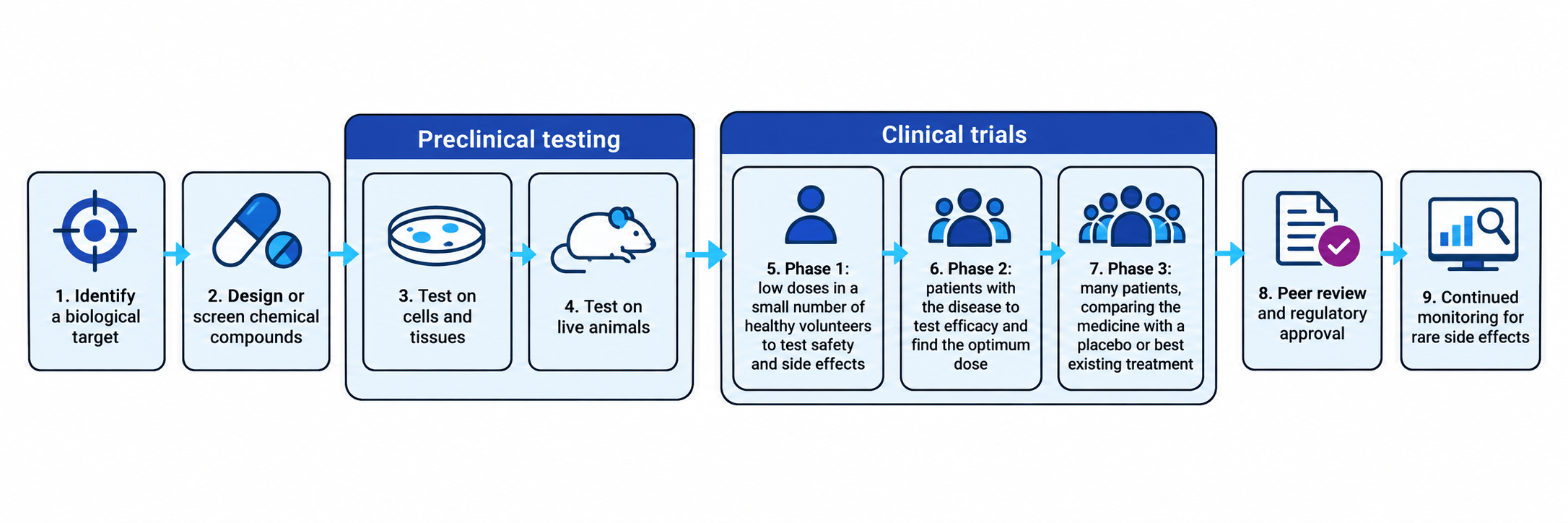
- Scientists first identify a target, such as a protein that a pathogen needs or a protein that is not working properly in a disease.
- Computers are used to model the shape of the target and design molecules that might bind to it.
- Huge libraries of chemicals, containing hundreds of thousands of compounds, are also tested automatically against the target to find any that have the right effect.
- A compound that looks promising is called a potential new medicine, and it must now be tested thoroughly before it can be given to patients.
- Most potential medicines fail during testing, and only a very small proportion of the compounds first identified ever reach patients.
Preclinical testing
Preclinical testing
The testing of a potential new medicine on cells, tissues and animals before it is given to any human.
Efficacy
How well a medicine produces the effect it is intended to have.
Toxicity
How harmful a substance is to the body.
- Preclinical testing is carried out in the laboratory before a potential medicine is given to any human.
- It checks three things about the medicine.
- Its toxicity, which is whether it is harmful to cells and to the body.
- Its efficacy, which is whether it has the effect it is meant to have.
- The dose that is likely to be effective without being harmful.
- The medicine is first tested on cells and tissues grown in the laboratory.
- These tests are quick and cheap, and they show whether the medicine damages living cells.
- They cannot show how the medicine affects a whole body, with its many organs working together.
- It is then tested on live animals, usually mice or rats, and in the UK a second species of animal is normally used as well.
- Animal tests show how the medicine is absorbed, carried around the body, broken down and removed.
- They show whether it harms any organ, such as the liver or kidneys.
- Animal testing has limitations and raises ethical questions.
- The bodies of animals differ from human bodies, so a medicine that is safe in mice may still harm humans.
- Some people believe it is wrong to cause animals harm or suffering to test medicines.
- UK law requires animal tests to use as few animals as possible and to reduce any suffering.
- Only medicines that pass preclinical testing are allowed to move on to testing in humans.
Clinical trials
Clinical trial
The testing of a potential new medicine on human volunteers to find out whether it is safe, whether it works and which dose to use.
Dose
The amount of a medicine that is given and how often it is given.
Side effect
An unwanted effect of a medicine on the body.
- Clinical trials test the potential medicine on human volunteers, and they are carried out in phases, each involving more people.
- In the first phase the medicine is given to a small number of healthy volunteers, often between 202020 and 100100100 people.
- It starts at a very low dose, which is then increased slowly.
- The aim is to check that the medicine is safe in humans and to find any side effects.
- Healthy volunteers are used because the aim is only to test safety, and a person who is already ill might react badly to an untested drug.
- In the second phase the medicine is given to a small number of patients who have the disease.
- This tests whether the medicine works in people with the illness.
- Different doses are compared to find the optimum dose, which is the dose that works best with the fewest side effects.
- In the third phase the medicine is given to a large number of patients, often several thousand, in many different hospitals.
- The medicine is compared with a placebo or with the best existing treatment.
- The large number of patients means that rare side effects are more likely to be found and that the results are more reliable.
- A clinical trial can be stopped at any point if the medicine causes serious side effects or clearly does not work.
- The whole process from discovery to a medicine being available often takes more than ten years and costs a very large amount of money.
- Do not write that healthy volunteers are used to test whether the medicine works, because they do not have the disease, so they are used to test its safety.
- Do not mix up the order, because preclinical testing on cells, tissues and animals always comes before any clinical trial in humans.
Placebos and blind trials
Placebo
A substance that looks like the medicine being tested but contains no active drug.
Blind trial
A clinical trial in which the volunteers do not know whether they are receiving the medicine or a placebo.
Double-blind trial
A clinical trial in which neither the volunteers nor the doctors know who is receiving the medicine and who is receiving a placebo.
- People often feel better after taking any treatment simply because they expect it to help, and this is called the placebo effect.
- To show that a medicine really works, the patients are split at random into two groups.
- One group receives the medicine being tested.
- The other group, called the control group, receives a placebo, a dummy tablet or injection that looks the same but contains no active drug.
- If the group taking the medicine improves more than the placebo group, the difference must be caused by the medicine itself.
- Patients are placed in the groups at random, so each group has a similar mix of ages, sexes and severity of illness.
- In a blind trial, the patients do not know which group they are in, so their expectations cannot affect the results.
- In a double-blind trial, neither the patients nor the doctors know who is receiving the medicine and who is receiving the placebo.
- This removes bias from the doctors as well, because a doctor who knows which patient has the medicine might treat them differently or judge their improvement more favourably.
- The information about who received what is held by a third party and revealed only when the trial ends.
- It can be unethical to give a placebo to a patient with a serious illness, because it means withholding a treatment that could help them.
- In these cases the new medicine is compared with the best existing treatment instead of a placebo.
Analysing the results of a trial
- A trial of a new medicine for migraine uses 400400400 patients split at random into two groups of 200200200.
- In the group given the medicine, 124124124 patients report fewer migraines, so the percentage who improved is 124200×100=62%\dfrac{124}{200}\times100=62\%200124×100=62%.
- In the group given the placebo, 464646 patients report fewer migraines, so the percentage who improved is 46200×100=23%\dfrac{46}{200}\times100=23\%20046×100=23%.
- Some patients improved on the placebo, which shows the placebo effect is present.
- The medicine group improved by 62−23=3962-23=3962−23=39 percentage points more than the placebo group, so the medicine has a real effect beyond the placebo effect.
Approval and publication
Peer review
The checking of a scientist's methods, results and conclusions by other experts in the same field before the work is published.
- When a trial is finished, the scientists write up their methods and results and send them to a scientific journal.
- Before it is published, the work goes through peer review, in which other scientists who are experts in the same field check it.
- Peer review checks that the methods were suitable, that the results support the conclusions, and that no mistakes or false claims have been made.
- Publishing the results allows other scientists to repeat the work and check that they get the same results.
- In the UK a medicine can only be sold once the Medicines and Healthcare products Regulatory Agency, the MHRA, has examined all the trial data and granted a licence.
- Doctors continue to report side effects after the medicine is licensed, because very rare side effects may only appear once millions of people have taken it.
Describing drug development
- Write the stages in the correct order, which are discovery, preclinical testing on cells and tissues, preclinical testing on animals, then clinical trials on healthy volunteers and then on patients.
- Give the purpose of each stage, such as "healthy volunteers are given low doses to test for safety and side effects".
- When explaining a double-blind trial, say that neither the patient nor the doctor knows who has the placebo, and give the reason, which is to remove bias.
- When analysing trial data, compare percentages rather than raw numbers if the groups are different sizes.
- Name one medicine that was first found in a plant and one that was first found in a microorganism.
- State the two stages of preclinical testing and give one limitation of each.
- Explain why the first clinical trials use low doses given to healthy volunteers.
- Describe the difference between a blind trial and a double-blind trial.
- Explain why the results of a drug trial are peer reviewed before they are published.