3.2.1 Principles of hormonal coordination and control
The endocrine system
Endocrine system
The system of glands that coordinates and controls body processes by secreting hormones into the blood.
Endocrine gland
A gland that secretes hormones directly into the blood rather than releasing them through a duct.
- The endocrine system is the set of glands that controls body processes by releasing chemicals into the bloodstream.
- An endocrine gland has no duct, so the chemical it makes passes straight out of the gland cells into the capillaries running through the gland.
- That is what separates an endocrine gland from an exocrine gland such as a salivary gland, which releases its product down a tube.
- The chemicals released by endocrine glands are hormones, and the blood then distributes them around the whole body.
- Because the blood reaches every organ, a single gland can control organs that lie a long way from it.
- Endocrine control suits processes that must be held steady or changed gradually, such as growth, development, and the concentration of substances dissolved in the blood.
How hormones reach their target
Hormone
A chemical messenger secreted by an endocrine gland into the blood and carried to a target organ, where it causes an effect.
Target organ
The organ that a particular hormone acts on, because its cells carry receptors with a shape complementary to that hormone.
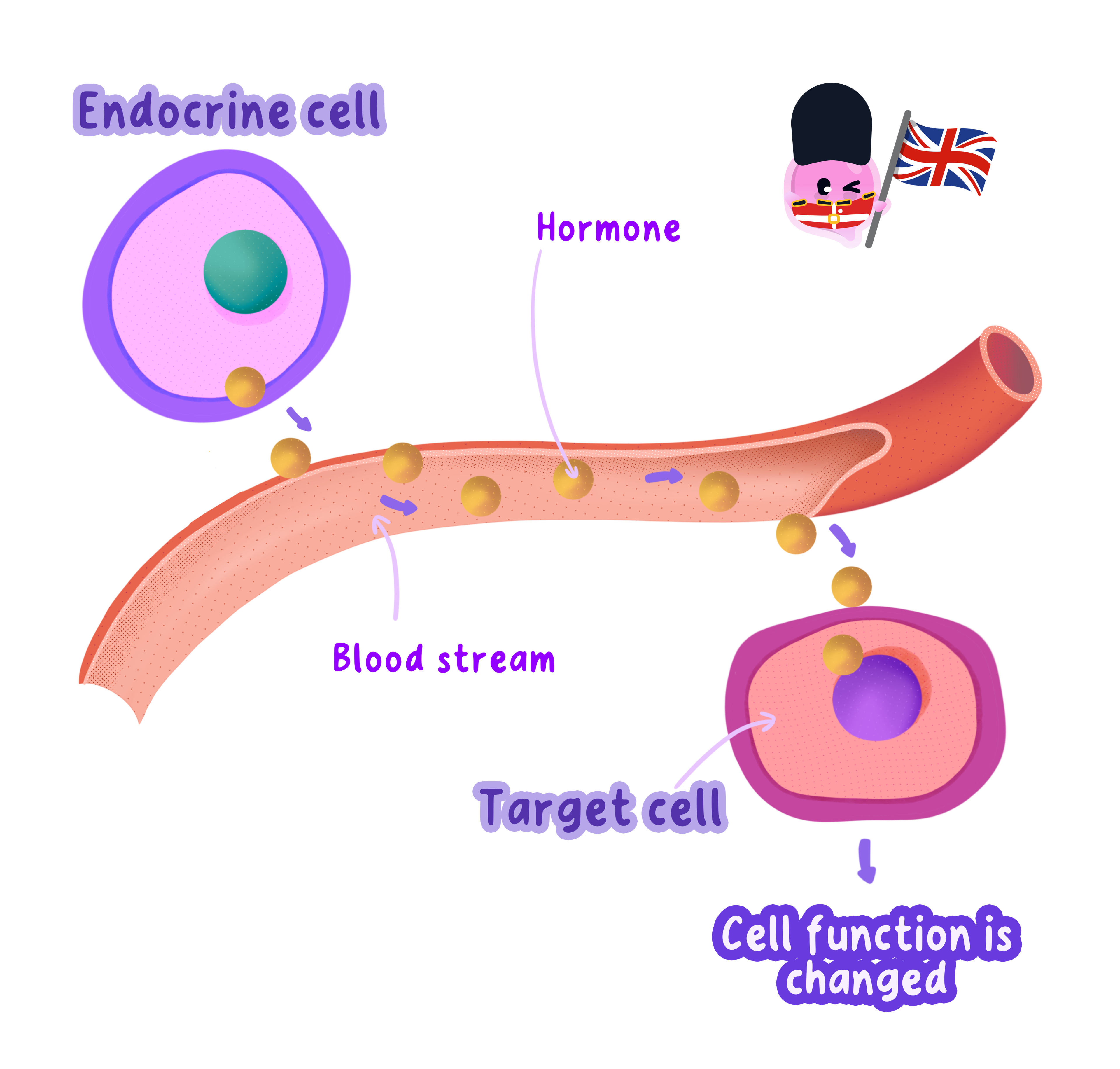
- A hormone is made inside an endocrine gland and passes into the blood plasma.
- The heart pumps that plasma through every organ, so the hormone is carried past cells throughout the body.
- Only cells carrying a receptor with a shape complementary to the hormone are able to bind it.
- Cells without the matching receptor are unaffected even though the hormone reaches them in the blood.
- The organ whose cells carry the matching receptors is the target organ for that hormone.
- Binding of the hormone to its receptor changes what the target cell does, for example by switching a chemical reaction on or off.
- Hormones are broken down slowly, mostly in the liver, so the response continues for a while after the gland stops secreting.
Which organs respond
- A gland secretes a hormone, and the plasma carries it past the liver, the muscles, the brain and the skin.
- Only the liver cells and the muscle cells carry receptors with a shape complementary to that hormone.
- The brain cells and skin cells cannot bind the hormone, so nothing changes inside them.
- The liver and the muscles are therefore the target organs, even though every organ received the hormone.
Nervous and hormonal control
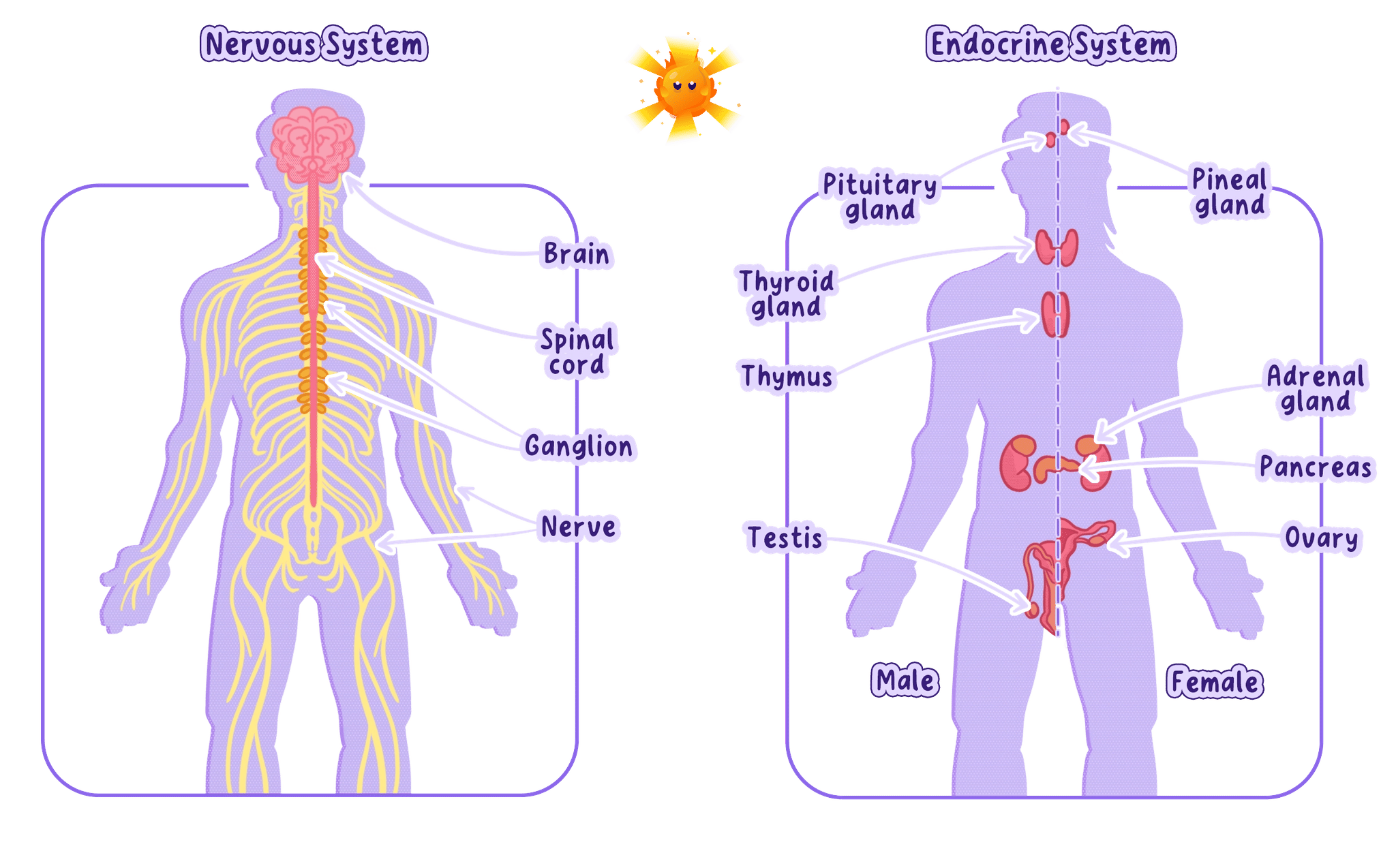
- Nervous coordination uses electrical impulses carried along neurones, while hormonal coordination uses chemicals carried in the blood.
- An impulse travels along a neurone far faster than blood carries a hormone, so nervous responses happen in a fraction of a second.
- A hormonal response takes seconds, hours or even years, because the hormone must first be secreted and then circulated.
- A neurone ends at one precise place, so a nervous response acts on a single muscle or gland.
- A hormone reaches every organ, so its effect can be spread across several organs at once.
- A nervous response stops quickly once the impulses stop, because the transmitter substance at the synapse is broken down.
- A hormonal response lasts longer because the hormone remains in the blood until it is broken down.
- Speed makes the nervous system suited to danger and reflexes, while duration makes the endocrine system suited to growth, development and pregnancy.
Comparing response times
- A reflex withdrawal from a hot object takes roughly 0.02 s0.02\ \text{s}0.02 s from stimulus to muscle contraction.
- A hormonal response to the same stress takes roughly 20 s20\ \text{s}20 s to reach its full effect.
- The hormonal response is therefore 200.02=1000\dfrac{20}{0.02}=10000.0220=1000 times slower.
- The extra time is spent secreting the hormone and circulating it in the blood.
- Do not write that hormones travel along nerves, because they are carried dissolved in the blood plasma.
- Do not write that a hormone only reaches its target organ, because it reaches every organ and only the target organ has the receptors.
- Do not describe the endocrine system as fast, because a response measured in seconds is slow next to a nervous response.
The main endocrine glands
- The pituitary gland lies at the base of the brain and is known as the master gland.
- The thyroid gland in the neck secretes thyroxine, which sets the rate of the chemical reactions taking place in the body.
- The adrenal glands sit on top of the kidneys and secrete adrenaline when you are frightened or under stress.
- The pancreas secretes insulin and glucagon, which together control the concentration of glucose in the blood.
- The ovaries secrete oestrogen and progesterone, which control the changes of puberty and the menstrual cycle.
- The testes secrete testosterone, which controls sperm production and the changes of puberty.
- Every one of these glands works the same way, secreting its hormone into the blood rather than down a duct.
The pituitary as master gland
- The pituitary gland receives signals from the brain about conditions inside the body.
- It responds by secreting hormones of its own into the blood.
- Several of those hormones act on other endocrine glands rather than on ordinary body tissue.
- Pituitary hormones act on the thyroid gland, on the adrenal glands and on the ovaries or testes.
- Each of those glands then secretes its own hormone, so control passes along a chain of two glands.
- Because the first step in so many chains happens in the pituitary, it sets the output of much of the endocrine system.
Naming glands and hormones
- Name the gland and its hormone as two separate things, because the adrenal gland secretes adrenaline and there is no gland called adrenaline.
- Write that a gland secretes a hormone into the blood, since marks are given for naming the transport route.
- Answer a comparison question with both halves of every point, such as nervous responses being fast whereas hormonal responses are slow.
- Name the target organ as well as the hormone whenever a question asks what a hormone does.
- What is the difference between an endocrine gland and an exocrine gland?
- Explain why a hormone reaches every organ but changes only some of them.
- Give two ways in which a hormonal response differs from a nervous response.
- Name the gland that secretes thyroxine and the gland that secretes adrenaline.
- Why is the pituitary gland described as the master gland?
3.2.2 Roles of thyroxine and adrenaline
Thyroxine and metabolic rate
Thyroxine
A hormone secreted by the thyroid gland that controls the basal metabolic rate and is needed for normal growth and development.
Metabolic rate
The rate at which the chemical reactions of the body take place in its cells.
- The thyroid gland lies in the neck, just below the voice box, and secretes thyroxine into the blood.
- Thyroxine molecules contain iodine, which the body can only obtain from the diet.
- Thyroxine sets the basal metabolic rate, which is the rate at which the body's chemical reactions run while at rest.
- It raises the rate of aerobic respiration in cells, so more energy is transferred from glucose every second.
- A high concentration of thyroxine speeds up these reactions, raising the heart rate, increasing body heat and causing weight loss.
- A low concentration slows the reactions, causing tiredness, weight gain and a feeling of being cold.
- Thyroxine is also needed for normal growth and for the development of the brain during childhood.
Negative feedback control
Negative feedback
A control mechanism in which a change in a condition triggers a response that returns the condition towards its normal level.
- The concentration of thyroxine in the blood is held close to a set point by negative feedback.
- The pituitary gland secretes thyroid stimulating hormone, known as TSH, into the blood.
- TSH travels to the thyroid gland and stimulates it to secrete thyroxine.
- When the thyroxine concentration rises above the set point, thyroxine acts on the pituitary and inhibits the release of TSH.
- Less TSH reaches the thyroid, so the thyroid secretes less thyroxine and the concentration falls back towards the set point.
- When the thyroxine concentration drops below the set point, that inhibition is lifted and the pituitary secretes more TSH.
- More TSH stimulates the thyroid, so thyroxine output rises and the concentration climbs back towards the set point.
- The result is a concentration that fluctuates slightly around the set point rather than drifting away from it.
A shortage of iodine
- A diet contains too little iodine, so the thyroid gland cannot make enough thyroxine.
- The thyroxine concentration in the blood falls below the set point.
- Less thyroxine reaches the pituitary, so the inhibition of TSH release is reduced.
- The pituitary secretes more TSH, which stimulates the thyroid gland harder.
- The thyroid still lacks iodine, so thyroxine output stays low while TSH stays high and the gland swells.
Adrenaline and fight or flight
Adrenaline
A hormone secreted by the adrenal glands in response to fear or stress that prepares the body for fight or flight.
Fight or flight response
The set of body changes brought about by adrenaline that prepares the body to face danger or to run from it.
- The adrenal glands sit one on top of each kidney and secrete adrenaline into the blood.
- Release is triggered by nervous impulses sent from the brain when it detects fear, danger or stress.
- Adrenaline increases the heart rate and the force of each beat, so blood is pumped around the body faster.
- It increases the breathing rate and the depth of each breath, so more oxygen enters the blood.
- Together these changes deliver oxygen and glucose to the muscles and the brain more quickly.
- Adrenaline makes the liver break down stored glycogen into glucose, raising the blood glucose concentration.
- Blood vessels supplying the muscles widen while those supplying the gut narrow, diverting blood to where it is needed.
- The pupils widen, letting more light into the eye so that vision improves.
- All of these changes together prepare the body either to fight the danger or to run from it.
- Adrenaline is not controlled by negative feedback, because it is released as a response to a stimulus and stops once the danger has passed.
Change in heart rate
- A resting heart rate is 707070 beats per minute before a sudden fright.
- Adrenaline is secreted and the heart rate rises to 130130130 beats per minute.
- The increase is 130−70=60130-70=60130−70=60 beats per minute.
- As a percentage of the resting rate this is 6070×100=86%\dfrac{60}{70}\times100=86\%7060×100=86% to two significant figures.
- The faster rate delivers glucose and oxygen to the leg muscles for respiration.
Comparing the two hormones
- Thyroxine is secreted continuously and its concentration is held steady, while adrenaline is secreted in short bursts.
- Thyroxine release is controlled by negative feedback from the pituitary, while adrenaline release is triggered by nervous impulses from the brain.
- Thyroxine controls a long-term process, the overall rate of the body's reactions, over months and years.
- Adrenaline controls a short-term response that lasts minutes, preparing the body for immediate action.
- Both hormones are secreted into the blood and both raise the rate at which energy is transferred, so the difference lies in the timing and the trigger.
Explaining a feedback loop
- Write the loop as a chain of steps, naming the gland, the hormone and the direction of change at each step.
- Always state whether the concentration rises or falls, because a mark is given for the direction as well as for the hormone.
- Use the word inhibits when thyroxine acts back on the pituitary, rather than saying it stops it.
- Link each change adrenaline causes to its purpose, such as a faster heart rate delivering more glucose to the muscles.
- Do not write that adrenaline is controlled by negative feedback, because its release depends on a stimulus rather than on a set point.
- Do not write that adrenaline gives the muscles energy, because energy is transferred by respiration and adrenaline only speeds up the delivery of glucose and oxygen.
- Do not confuse TSH from the pituitary with thyroxine from the thyroid, because they travel in opposite directions along the loop.
- Which gland secretes thyroxine, and which element must be in the diet for it to be made?
- Describe what happens to TSH release when the thyroxine concentration rises above the set point.
- Explain how negative feedback returns a low thyroxine concentration to normal.
- Give three changes adrenaline causes in the body and state the purpose of each.
- Why is adrenaline release not an example of negative feedback?
3.2.3 Hormones in human reproduction
Sex hormones at puberty
Puberty
The stage of development at which the reproductive organs become active and secondary sexual characteristics develop under the control of sex hormones.
Secondary sexual characteristics
The physical features other than the reproductive organs themselves that develop at puberty under the control of sex hormones.
- Puberty begins when the pituitary gland starts to secrete more of the hormones that act on the ovaries and testes.
- Those hormones make the ovaries or testes become active and secrete sex hormones of their own.
- The sex hormones circulate in the blood and act on tissues throughout the body.
- They bring about secondary sexual characteristics, which are the physical changes other than the reproductive organs themselves.
- In males these include a deeper voice, facial and body hair, broader shoulders and more muscle.
- In females these include breast development, wider hips and the start of the menstrual cycle.
- The reproductive organs also mature, so sperm production begins in males and eggs begin to be released in females.
- Because the hormones stay in the blood for years, these changes happen gradually and are permanent.
Testosterone and oestrogen
Testosterone
The main male reproductive hormone, secreted by the testes, which stimulates sperm production and brings about the changes of puberty.
Oestrogen
The main female reproductive hormone, secreted by the ovaries, which causes the uterus lining to thicken and brings about the changes of puberty.
- Testosterone is secreted by the testes and is the main male reproductive hormone.
- It stimulates the testes to produce sperm from puberty onwards.
- It also brings about the male secondary sexual characteristics.
- Oestrogen is secreted by the ovaries and is the main female reproductive hormone.
- It brings about the female secondary sexual characteristics at puberty.
- During each cycle it makes the lining of the uterus grow thicker and richer in blood vessels.
- A thick lining is needed so a fertilised egg can implant and be supplied with food and oxygen.
- Both hormones are secreted from puberty onwards, but oestrogen output rises and falls within each cycle.
Stages of the menstrual cycle
Menstrual cycle
The approximately 28 day cycle in which the lining of the uterus is built up and broken down and an egg is released from an ovary.
Ovulation
The release of a mature egg from an ovary, which happens around day 14 of the menstrual cycle.
- The menstrual cycle lasts about 282828 days, though the length varies from person to person.
- Day 111 is the first day of menstruation, when the uterus lining breaks down and passes out through the vagina.
- Menstruation usually lasts about 444 days.
- From roughly day 444 to day 141414 the lining of the uterus is rebuilt until it is thick and well supplied with blood.
- Over the same period an egg matures inside a follicle in one of the ovaries.
- Ovulation happens at about day 141414, when the mature egg is released from the ovary into the oviduct.
- From day 141414 to day 282828 the thick lining is maintained so it is ready to receive a fertilised egg.
- If the egg is not fertilised the lining breaks down again, and the next cycle starts at day 111.
Timing within a cycle
- A person has a regular cycle of 282828 days and menstruation begins on day 111.
- The uterus lining is rebuilt over roughly the next 101010 days.
- Ovulation is expected around day 141414, which is 282\dfrac{28}{2}228.
- An egg survives about 242424 hours after release, so fertilisation is possible on days 141414 and 151515.
- With no fertilisation the lining breaks down about 141414 days later, at day 282828.
The four hormones of the cycle
FSH (follicle stimulating hormone)
A hormone secreted by the pituitary gland that makes an egg mature inside a follicle in the ovary and stimulates the ovaries to secrete oestrogen.
LH (luteinising hormone)
A hormone secreted by the pituitary gland that triggers ovulation, the release of a mature egg from the ovary.
Progesterone
A hormone secreted by the ovaries after ovulation that maintains the thickened lining of the uterus.
- Four hormones control the cycle, two secreted by the pituitary gland and two by the ovaries.
- FSH is secreted by the pituitary and makes an egg mature inside a follicle in the ovary.
- FSH also stimulates the ovaries to secrete oestrogen.
- LH is secreted by the pituitary and triggers ovulation at about day 141414.
- Oestrogen is secreted by the ovaries and thickens the uterus lining in the days before ovulation.
- Progesterone is secreted by the ovaries after ovulation and maintains the thickened lining.
- When progesterone output falls, the lining can no longer be maintained and menstruation begins.
Describing the cycle
- Give a day number with every stage you describe, because questions almost always supply a 282828 day cycle.
- Name the ovaries as the source of oestrogen and progesterone, and the pituitary gland as the source of FSH and LH.
- Write that the lining is maintained after ovulation rather than that it carries on growing.
- Describe ovulation as the release of an egg from the ovary, not as the egg leaving the body.
- Do not write that menstruation is the release of the egg, because it is the loss of the uterus lining.
- Do not write that FSH releases the egg, because FSH matures the egg and LH triggers its release.
- Do not treat every cycle as exactly 282828 days, because the length varies and the day of ovulation moves with it.
- Name the gland that secretes FSH and the organ that secretes oestrogen.
- What are secondary sexual characteristics, and which hormone brings them about in males?
- What happens to the uterus lining between day 444 and day 141414?
- On roughly which day of a 282828 day cycle does ovulation take place?
- Which hormone maintains the uterus lining after ovulation?
3.2.4 Interactions of reproductive hormones
FSH and the start of the cycle
FSH (follicle stimulating hormone)
A hormone secreted by the pituitary gland that makes an egg mature inside a follicle in the ovary and stimulates the ovaries to secrete oestrogen.
LH (luteinising hormone)
A hormone secreted by the pituitary gland that triggers ovulation, the release of a mature egg from the ovary.
- At the end of a cycle the concentrations of oestrogen and progesterone in the blood are low.
- With little inhibition acting on it, the pituitary gland secretes FSH into the blood.
- FSH is carried in the blood to the ovaries, which are its target organs.
- In an ovary, FSH makes a follicle containing an immature egg grow and the egg inside it mature.
- FSH also stimulates the ovary to secrete oestrogen, so the oestrogen concentration starts to rise from about day 444.
- The rise in oestrogen is therefore a direct consequence of the FSH released at the start of the cycle.
Oestrogen inhibits FSH
Oestrogen
The main female reproductive hormone, secreted by the ovaries, which causes the uterus lining to thicken and brings about the changes of puberty.
- Oestrogen from the ovary travels in the blood to the uterus, where it makes the lining grow thick and rich in blood vessels.
- Oestrogen also travels to the pituitary gland, where it inhibits the release of FSH.
- Less FSH means no further follicles are stimulated, so usually only one egg completes its development.
- At the same time oestrogen stimulates the pituitary to secrete LH.
- Because a rise in oestrogen causes a further rise in LH, this part of the cycle is an example of positive feedback.
- The LH concentration therefore climbs steeply and reaches a sharp peak at about day 141414.
LH triggers ovulation
- The sharp peak in LH acts on the mature follicle in the ovary.
- The follicle bursts and releases the egg into the oviduct, which is ovulation, at about day 141414.
- The empty follicle stays behind in the ovary and develops into a yellow structure of dividing cells.
- That structure secretes progesterone, so the progesterone concentration rises from day 141414 onwards.
- Oestrogen output drops slightly just after ovulation, then rises again as the empty follicle develops.
Progesterone maintains the lining
Progesterone
A hormone secreted by the ovaries after ovulation that maintains the thickened lining of the uterus.
- Progesterone acts on the uterus and maintains the thick lining, keeping it ready to receive a fertilised egg.
- Progesterone also acts on the pituitary gland, where it inhibits the release of both FSH and LH.
- With FSH inhibited, no new follicle matures, so a second ovulation cannot happen in the same cycle.
- If the egg is fertilised and implants in the lining, progesterone stays high and the lining is kept in place.
- If the egg is not fertilised, the structure in the ovary breaks down and progesterone and oestrogen concentrations fall.
- Once progesterone is low, the lining is no longer maintained and it breaks down as menstruation.
- Low progesterone and oestrogen also stop inhibiting the pituitary, so FSH rises again and the next cycle begins.
Reading the hormone graphs
- A graph of a 282828 day cycle shows LH rising to a sharp peak on day 141414.
- That peak marks ovulation, because LH triggers the release of the egg.
- Progesterone rises from day 141414 and reaches its highest value at about day 212121.
- Progesterone then falls between day 212121 and day 282828, so the uterus lining is no longer maintained.
- Menstruation therefore begins once progesterone has fallen to its lowest value, on day 111 of the next cycle.
Explaining the interactions
- State which hormone acts on which gland, and say whether it stimulates or inhibits that gland.
- Follow one hormone at a time through the cycle rather than describing all four at once.
- Read a sharp peak in LH on a graph as the moment of ovulation.
- Give the fall in progesterone as the cause of menstruation, because that link is where the mark sits.
- Do not write that oestrogen inhibits LH, because oestrogen inhibits FSH and stimulates LH.
- Do not write that FSH causes ovulation, because FSH matures the egg and LH releases it.
- Do not write that progesterone thickens the uterus lining, because oestrogen builds it and progesterone only maintains it.
- Which hormone stimulates the ovaries to secrete oestrogen?
- Explain how a rise in oestrogen changes the release of FSH and of LH.
- What does the sharp rise in LH cause at about day 141414?
- Which hormone maintains the uterus lining, and which organ secretes it?
- Explain why a fall in progesterone leads to menstruation.
3.2.5 Hormones in contraception
How hormonal contraception works
Contraception
A method used to prevent pregnancy, either by using hormones or by preventing sperm from reaching an egg.
- Hormonal contraception uses oestrogen, progesterone or both to interrupt the menstrual cycle.
- Oestrogen taken continuously keeps its concentration in the blood permanently high.
- A permanently high oestrogen concentration inhibits the release of FSH from the pituitary gland.
- Without FSH no follicle is stimulated, so no egg matures and ovulation cannot happen.
- Progesterone thickens the mucus produced at the cervix, forming a plug that sperm cannot swim through.
- Progesterone also inhibits the release of FSH and LH, which is a second route to preventing ovulation.
- Some methods also make the uterus lining too thin for a fertilised egg to implant.
Hormonal methods available
- The combined pill contains oestrogen and progesterone and is taken daily.
- Used exactly as directed it is over 99%99\%99% effective, but with typical use effectiveness falls to about 91%91\%91%.
- The progesterone only pill avoids oestrogen and so suits people at risk of blood clots, but it must be taken at the same time each day.
- A skin patch releases oestrogen and progesterone through the skin and is replaced once a week.
- An implant placed under the skin of the upper arm releases progesterone slowly for up to 333 years.
- An injection of progesterone lasts about 333 months before it must be repeated.
- An intrauterine system placed inside the uterus releases progesterone and lasts between 333 and 555 years.
- Side effects can include headaches, changes in mood and a small rise in the risk of blood clots.
- No hormonal method gives any protection against sexually transmitted infections.
Non-hormonal methods
Barrier method
A method of contraception that works by physically preventing sperm from reaching an egg.
- A condom is a barrier method worn over the penis that traps sperm so they never enter the vagina.
- Condoms are about 98%98\%98% effective when used correctly, though typical use gives closer to 82%82\%82%.
- A condom is the only common method that also reduces the spread of sexually transmitted infections.
- A diaphragm is a barrier fitted over the cervix and used with spermicide, giving roughly 92%92\%92% effectiveness.
- Spermicide is a chemical that kills or immobilises sperm, and used on its own it is only about 71%71\%71% to 82%82\%82% effective.
- A copper intrauterine device releases copper ions that are toxic to sperm and also prevent implantation, giving over 99%99\%99% effectiveness for up to 101010 years.
- Sterilisation means cutting or tying the oviducts in females or the sperm ducts in males, and it is over 99%99\%99% effective.
- Sterilisation must be treated as permanent, because reversing the operation is difficult and often fails.
- Natural methods avoid intercourse in the days around ovulation, which needs careful record keeping and gives between 76%76\%76% and 99%99\%99% effectiveness.
- Abstinence from intercourse is the only method that prevents pregnancy completely.
Comparing the methods
- Judge a method on its effectiveness, whether it is reversible, whether it protects against infection, its side effects, its cost and how easy it is to use.
- The implant, injection, intrauterine device and intrauterine system are the most effective in practice, because they do not depend on the user remembering anything.
- Pills are highly effective in theory but less so in practice, since a single missed pill can allow a follicle to mature.
- Only condoms reduce the transmission of sexually transmitted infections, so they are often used alongside a hormonal method.
- Barrier methods have no hormonal side effects, which suits people who cannot take oestrogen.
- Sterilisation is the most permanent option and is unsuitable for anyone who may want children later.
- Some people avoid hormonal and surgical methods for religious or ethical reasons and choose natural methods instead.
- Cost differs too, since condoms are bought repeatedly while an implant is fitted once and lasts for years.
Comparing failure rates
- Out of 100100100 people using the combined pill exactly as directed for a year, fewer than 111 becomes pregnant.
- With typical use about 999 out of every 100100100 become pregnant in the same year.
- The difference is 9−1=89-1=89−1=8 pregnancies per 100100100 people per year.
- Those extra pregnancies come from missed pills rather than from the hormones failing to work.
- An implant releases progesterone continuously, so its typical use figure stays below 111 in 100100100.
Evaluating contraception
- Give a mechanism rather than a label, such as oestrogen inhibiting FSH so no egg matures.
- Answer an evaluation question with points on both sides and then a judgement that follows from them.
- Quote effectiveness figures with the units of comparison, such as 91%91\%91% with typical use against over 99%99\%99% with perfect use.
- Name protection against infection as a separate advantage from preventing pregnancy.
- Do not write that the pill kills sperm, because it works by stopping an egg maturing and by thickening cervical mucus.
- Do not claim any hormonal method protects against sexually transmitted infections, because only barrier methods do.
- Do not treat the perfect use figure as the real one, because typical use figures are lower for every method that has to be remembered.
- Explain how a high oestrogen concentration prevents an egg from maturing.
- Give two effects of progesterone that make it useful in contraception.
- Name two methods that are over 99%99\%99% effective and do not depend on the user remembering.
- Which method reduces the spread of sexually transmitted infections, and why?
- Give one advantage and one disadvantage of sterilisation.
3.2.6 Hormones in reproductive technologies
Causes of infertility
Infertility
The inability of a couple to conceive a child naturally after a long period of trying.
- Infertility has several causes, and only some of them can be treated with hormones.
- If the pituitary gland secretes too little FSH, no follicle is stimulated and no egg matures.
- If it secretes too little LH, an egg may mature but ovulation never happens.
- Both of these causes are hormonal, so giving the missing hormone can restore the cycle.
- Blocked oviducts stop sperm reaching the egg, and hormones cannot clear the blockage.
- A low sperm count or poorly swimming sperm also prevent fertilisation, and again hormones do not help.
- Treatment is chosen to match the cause, so the first step is always to find out which part of the process is failing.
Fertility drugs
- A fertility drug contains FSH and LH, the same hormones the pituitary gland normally secretes.
- The drug is given by injection over the first part of the cycle.
- FSH stimulates follicles in the ovaries so that eggs mature.
- LH is then given to trigger ovulation, releasing the mature eggs into the oviducts.
- The natural cycle is restored, so the couple can conceive through intercourse in the usual way.
- Because the dose stimulates more than one follicle, several eggs can be released at once.
- That raises the chance of twins or triplets, which carries greater risk for the mother and the babies.
Steps in IVF
IVF (in vitro fertilisation)
A fertility treatment in which eggs collected from the ovaries are fertilised by sperm in a laboratory and one or more of the resulting embryos are transferred into the uterus.
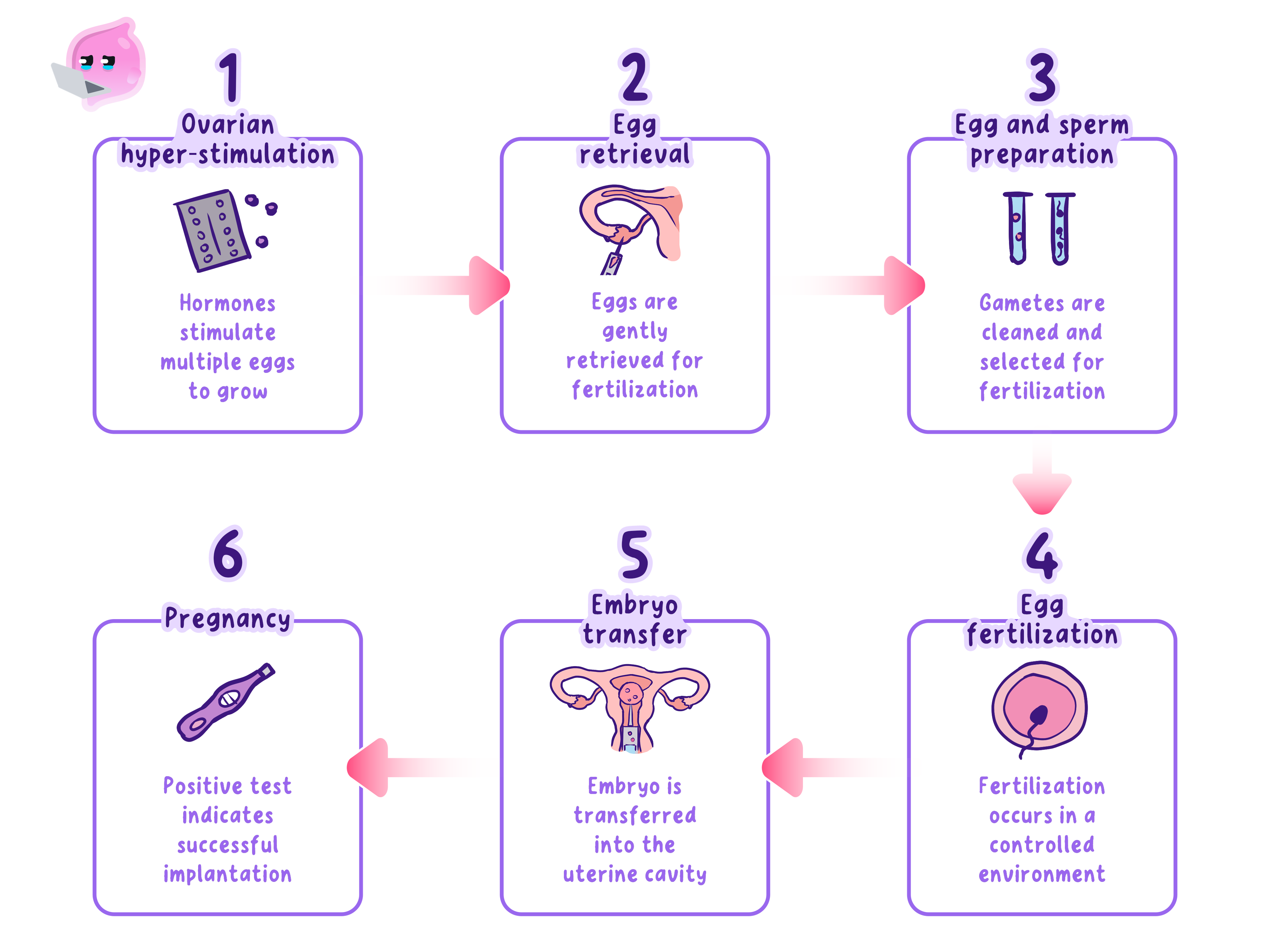
- FSH and LH are given first, so several eggs mature in the ovaries at the same time.
- The mature eggs are collected from the ovaries through a fine needle.
- Each egg is mixed with the father's sperm in a dish in the laboratory, where fertilisation takes place.
- The fertilised eggs are kept in an incubator and allowed to divide into embryos.
- When each embryo is a small ball of cells, one or two are inserted into the uterus through the cervix.
- Progesterone is often given so the uterus lining is maintained and the embryo can implant.
- A pregnancy test taken about two weeks later shows whether implantation was successful.
- Any remaining embryos can be frozen and stored for a later attempt.
Evaluating IVF
- IVF allows couples who could not conceive naturally to have a child of their own, which is its main benefit.
- Success rates are low, at roughly 32%32\%32% of cycles for patients under 353535 and falling below 5%5\%5% above the age of 434343.
- Several attempts are often needed, so the emotional strain of repeated failure is considerable.
- The hormone injections have physical side effects including abdominal pain, vomiting and, rarely, a dangerous over-response of the ovaries.
- Transferring more than one embryo raises the chance of multiple births, which brings a higher risk of premature birth and low birth mass.
- Each cycle is expensive, often over £5000\pounds5000£5000 privately, and funding on the NHS varies between areas.
- Spare embryos are frozen or destroyed, and some people object to this because they regard an embryo as a potential life.
- A judgement therefore weighs the chance of a much wanted child against the cost, the risks and the ethical objections.
Working out a success rate
- A clinic begins 250250250 IVF cycles in one year for patients under 353535.
- Of those cycles, 808080 end in a live birth.
- The success rate is 80250×100=32%\dfrac{80}{250}\times100=32\%25080×100=32%.
- The same clinic records 121212 live births from 300300300 cycles for patients over 434343, which is 12300×100=4%\dfrac{12}{300}\times100=4\%30012×100=4%.
- Success falls with age because fewer eggs of good quality can be collected.
Describing IVF clearly
- Put the stages in order and name the hormone used at each one, since marks follow the sequence.
- Say that fertilisation happens outside the body in a laboratory, because that is what separates IVF from a fertility drug.
- Balance an evaluation with the benefit as well as the risks, then finish with a judgement.
- Quote a success rate as a percentage of cycles started, not as a percentage of embryos transferred.
- Do not write that IVF guarantees a pregnancy, because most cycles do not result in a live birth.
- Do not confuse a fertility drug with IVF, because a fertility drug leaves fertilisation to happen inside the body.
- Do not write that the embryo is placed in the ovary, because it is transferred into the uterus.
- Name two causes of infertility that hormones can treat and one that they cannot.
- Which two hormones are given as a fertility drug, and what does each one do?
- List the stages of IVF in order from hormone treatment to the pregnancy test.
- Why is transferring two embryos rather than one a risk?
- Give one ethical objection people raise against IVF.
3.2.7 Plant hormones in growth and coordination
Tropisms in plants
Tropism
A growth response of a plant in which the direction of growth is determined by the direction of a stimulus.
Phototropism
A growth response of a plant in which the direction of growth is determined by the direction of light.
Gravitropism
A growth response of a plant in which the direction of growth is determined by the direction of gravity.
- A plant cannot move, so it responds to a stimulus by changing the direction in which it grows.
- A tropism is a growth response in which the direction of growth is set by the direction of the stimulus.
- A response towards the stimulus is positive, and a response away from the stimulus is negative.
- Phototropism is a growth response to light, and shoots show positive phototropism while roots show negative phototropism.
- Gravitropism is a growth response to gravity, and roots show positive gravitropism while shoots show negative gravitropism.
- Growing shoots towards light raises the light the leaves receive, so the rate of photosynthesis increases.
- Growing roots downwards takes them into the soil, where they absorb water and mineral ions and anchor the plant.
Auxin and cell elongation
Auxin
A plant hormone made in the tips of shoots and roots that controls growth by changing the rate at which cells elongate.
- Auxin is a plant hormone made in the tip of a growing shoot or root.
- It then moves back from the tip into the region of cells just behind it.
- In a shoot, auxin makes the cell walls looser so the cells take in more water and elongate faster.
- Faster elongation on one side of a shoot makes that side longer, which bends the shoot the other way.
- In a root, a high auxin concentration has the opposite effect and inhibits cell elongation.
- Because auxin is made in the tip, cutting the tip off removes the source and the growth response stops.
- Auxin is only redistributed after it has been made, so the size of the response depends on how much reaches each side.
Phototropism in shoots
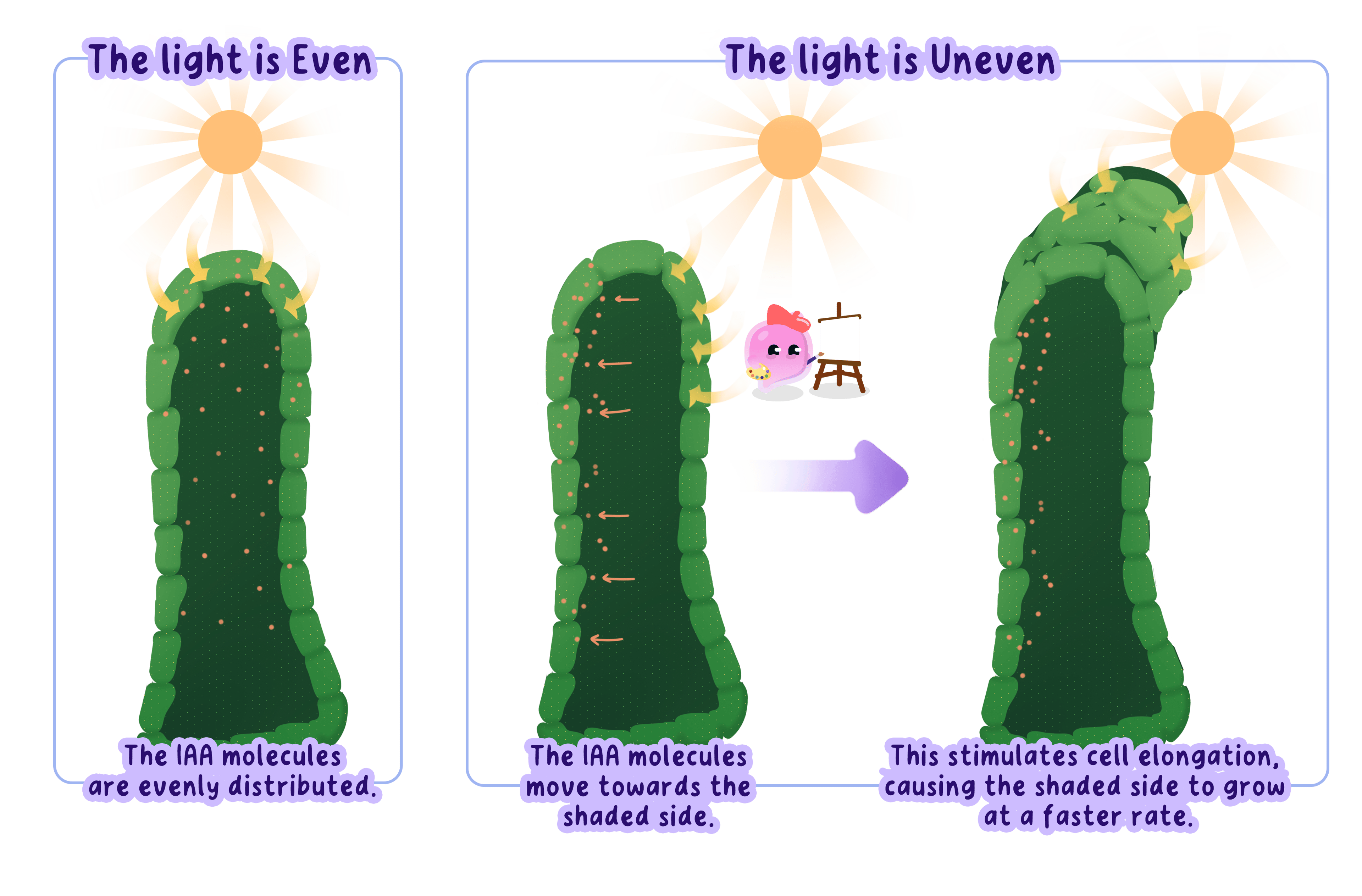
- A shoot lit from one side receives more light on one side than the other.
- Auxin made in the tip moves across towards the shaded side, giving an unequal distribution of auxin.
- The shaded side therefore has a higher auxin concentration than the lit side.
- Cells on the shaded side elongate more than the cells on the lit side.
- The shaded side grows longer, so the shoot bends towards the light.
- Once the shoot faces the light, auxin is shared evenly again and the shoot grows straight.
Removing the shoot tip
- Three identical seedlings are lit from the left and their tips are treated differently.
- Seedling A keeps its tip, so auxin collects on the shaded right side and the shoot bends left towards the light.
- Seedling B has its tip cut off, so no auxin is made and the shoot grows straight upwards.
- Seedling C has an opaque cap over the tip, so the tip cannot detect the direction of the light and the shoot grows straight.
- Comparing the three shows that the tip both detects the light and makes the auxin.
Gravitropism in roots and shoots
- A germinating seed is buried in soil, so it has no light to respond to and uses gravity instead.
- When a root or a shoot lies horizontally, gravity makes auxin collect on its lower side.
- In a shoot, the extra auxin on the lower side makes those cells elongate faster.
- The lower side of the shoot grows longer, so the shoot curves upwards, away from gravity.
- In a root, the extra auxin on the lower side inhibits elongation instead.
- The upper side of the root therefore elongates faster, so the root curves downwards, towards gravity.
- The same unequal distribution produces opposite results because auxin promotes elongation in shoots and inhibits it in roots.
- The outcome is a shoot that reaches the light and a root that reaches water, whichever way up the seed happens to land.
Investigating phototropism
- Aim: to find out how the direction of light affects the direction in which cress seedlings grow.
- Apparatus: four Petri dishes, cotton wool, cress seeds, a measuring cylinder, distilled water, four cardboard boxes, scissors, a lamp, a ruler, a protractor and a klinostat.
- Variables: the direction of the light is the independent variable and the angle of the shoots from the vertical is the dependent variable.
- Controlled variables: the number of seeds, the volume of water, the temperature, the light intensity, the distance from the lamp and the growing time are all kept the same.
- Method, setting up:
- Line each Petri dish with cotton wool of the same thickness.
- Add 10 cm310\ \text{cm}^{3}10 cm3 of distilled water to each dish using a measuring cylinder.
- Sprinkle 202020 cress seeds evenly across the cotton wool in each dish.
- Leave all four dishes in the dark at room temperature for two days so the seeds germinate.
- Method, applying the light:
- Cut a narrow vertical slit in one side of three of the cardboard boxes.
- Place one dish in a box with the slit on the left, one in a box with the slit on the right, and one in a box with the slit at the top.
- Place the fourth dish on a slowly turning klinostat in the open, so every side receives the same light and it acts as the control.
- Set the lamp the same distance from every box and switch it on for the same number of hours each day.
- Add the same volume of water to every dish each day so the cotton wool never dries out.
- Method, measuring:
- After five days, open each box and hold a protractor against the side of the dish.
- Measure the angle between each shoot and the vertical, reading to the nearest degree.
- Repeat for at least ten seedlings in each dish, choosing them at random rather than picking the most bent ones.
- Results: the shoots in each closed box bend towards the slit, while the shoots on the klinostat stay vertical.
- Maths: calculate the mean angle for each dish using xˉ=∑xn\bar{x}=\dfrac{\sum x}{n}xˉ=n∑x and plot the means as a bar chart against the direction of the light.
- Watch out: keep the volume of water identical in every dish, otherwise differences in growth could be caused by water rather than by light.
- Watch out: close the boxes fully apart from the slit, since stray light from the room weakens the difference between the dishes.
- Watch out: use seedlings of the same age, because older shoots have already bent further than younger ones.
- Safety: wash your hands after handling seeds and damp cotton wool, and do not eat the seedlings.
Explaining a bending shoot
- Write the chain in order: the tip makes auxin, auxin moves to the shaded side, those cells elongate more, and the shoot bends.
- Use unequal distribution of auxin rather than saying the auxin moves away from the light.
- Say elongate rather than divide, because auxin changes cell length rather than the rate of cell division.
- State the direction of the bend at the end, since a mark is usually reserved for it.
- Do not write that auxin makes cells divide faster, because it makes them take in water and elongate.
- Do not write that auxin is destroyed by light, because the explanation required is that auxin moves to the shaded side.
- Do not give a root the same response as a shoot, because auxin inhibits elongation in roots and promotes it in shoots.
- Do not describe a plant as moving towards the light, because it grows towards it.
- Define a tropism and give one example in a shoot and one in a root.
- Where in a plant is auxin made, and where does it act?
- Explain why a shoot lit from one side bends towards the light.
- Explain why a horizontal root curves downwards while a horizontal shoot curves upwards.
- Why is a klinostat used as the control in the phototropism investigation?
3.2.8 Effects of plant hormones
Auxins and plant growth
Auxin
A plant hormone made in the tips of shoots and roots that controls growth by changing the rate at which cells elongate.
Apical dominance
The suppression of growth in the side buds of a plant by auxin made in the shoot tip, so the main shoot grows fastest.
- Auxin controls growth by changing how much the cells behind a shoot or root tip elongate.
- Auxin made in the shoot tip travels down the stem and reaches the side buds lower down.
- At the concentration that reaches them, auxin inhibits those side buds from growing, which is apical dominance.
- The main shoot therefore grows tallest and reaches the light before its neighbours shade it out.
- If the shoot tip is removed, auxin no longer reaches the side buds and they start to grow.
- The plant then produces many side shoots and becomes short and bushy rather than tall.
- Auxin also stimulates the growth of new roots from the cut end of a stem.
- The effect depends on concentration, because a low auxin concentration promotes root growth while a high one inhibits it.
Gibberellins
Gibberellin
A plant hormone that ends seed dormancy and starts germination, and that also promotes stem elongation and flowering.
Dormancy
A resting state in which a living seed does not germinate until the right conditions are met.
- Gibberellins are plant hormones made in seeds, young leaves and roots.
- They end seed dormancy, which is the resting state that stops a living seed germinating.
- Gibberellin makes the seed produce enzymes such as amylase inside the seed.
- Amylase breaks the stored starch down into sugars such as maltose and glucose.
- Those sugars are used in respiration to release the energy the embryo needs to grow, so germination begins.
- Gibberellins also promote stem elongation, so treated plants grow taller than untreated ones.
- They promote flowering, and can make a plant flower without the day length it would normally need.
- They also increase the size of fruit, because larger cells make a larger fruit.
Effect on stem height
- Ten pea plants are sprayed with gibberellin solution and ten identical plants are sprayed with water.
- After 141414 days the treated plants have a mean height of 32 cm32\ \text{cm}32 cm and the untreated plants 20 cm20\ \text{cm}20 cm.
- The increase is 32−20=12 cm32-20=12\ \text{cm}32−20=12 cm.
- As a percentage of the untreated height this is 1220×100=60%\dfrac{12}{20}\times100=60\%2012×100=60%.
- The extra height comes from gibberellin promoting elongation of the cells in the stem.
Ethene and fruit ripening
Ethene
A gaseous plant hormone that controls cell division and causes fruit to ripen.
- Ethene is unusual among plant hormones because it is a gas.
- It is released by ripening fruit and by ageing plant tissue.
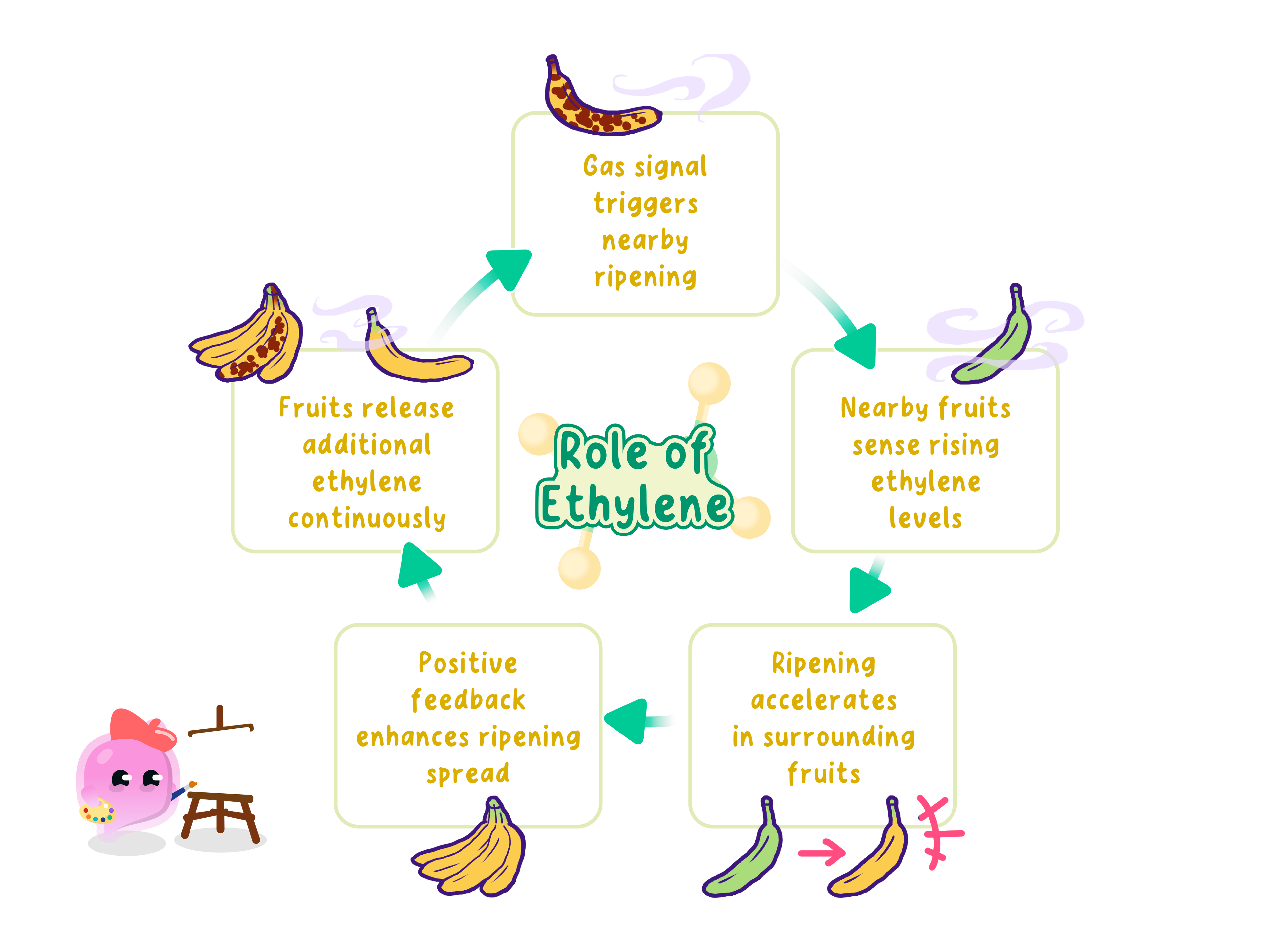
- Being a gas, ethene spreads through the air and reaches fruit that is not touching the source.
- Ethene switches on enzymes that convert stored starch into sugars, making the fruit taste sweeter.
- Other enzymes break down the cell walls, which is what makes a ripe fruit soft.
- Further enzymes break down green chlorophyll and reveal or make other pigments, so the fruit changes colour.
- Ripening fruit releases still more ethene, so ripening spreads from one fruit to the whole crate.
- Ethene also controls cell division in growing parts of the plant.
Flowering and leaf fall
- Gibberellins promote flower opening, so treated plants flower earlier or at an unusual time of year.
- Ethene speeds up the ageing of an open flower, so the petals wilt and are shed sooner.
- Leaf fall, called abscission, is controlled by the balance between auxin and ethene.
- A healthy leaf makes auxin, and that auxin keeps the leaf attached to the stem.
- As autumn approaches the leaf makes less auxin, so the balance shifts towards ethene.
- Ethene makes a weak abscission layer of cells form across the base of the leaf stalk.
- The layer breaks and the leaf falls, sealing the scar so water is not lost from it.
- Shedding leaves cuts water loss in winter, when frozen soil makes it hard for the roots to replace that water.
Investigating fruit ripening
- Aim: to find out how ethene released by a ripe banana affects the ripening of unripe pears.
- Apparatus: nine unripe pears, one ripe banana, three sealable transparent bags, a balance, a printed colour chart, a knife, a white tile, iodine solution, a dropping pipette and eye protection.
- Variables: the presence of ethene is the independent variable and the ripeness of the pears is the dependent variable.
- Controlled variables: the mass and starting colour of the pears, the temperature, the light and the number of days are all kept the same.
- Method, setting up:
- Weigh nine unripe pears and choose ones of similar mass and colour so they start at the same stage.
- Divide them into three groups of three and record the starting colour of each pear against the colour chart.
- Seal group A in a bag with the ripe banana, which is the source of ethene.
- Seal group B in a bag on its own, so it has no extra ethene but the same still air.
- Leave group C in the open air as a second control.
- Method, taking readings:
- Keep all three groups in the same dark cupboard at the same temperature.
- Each day for six days, score the colour of every pear against the colour chart without opening the bags for longer than needed.
- Record every score in a results table with the day number.
- Method, testing for starch:
- On day six, cut a thin slice from one pear in each group and place it on a white tile.
- Add three drops of iodine solution to each slice with a pipette.
- Record whether the slice turns blue-black, which shows starch, or stays orange-brown, which shows the starch has been converted.
- Results: the pears kept with the banana ripen fastest and give the least blue-black colour with iodine.
- Maths: calculate the mean colour score for each group each day using xˉ=∑xn\bar{x}=\dfrac{\sum x}{n}xˉ=n∑x and plot the three means against day on one set of axes.
- Watch out: match the pears for mass and starting colour, because fruit that is already riper will finish first whatever the ethene does.
- Watch out: seal the bags properly, since ethene that escapes reduces the difference between group A and group B.
- Watch out: use a printed colour chart rather than judging by eye, because that makes the readings far less subjective.
- Safety: wear eye protection when using iodine solution, cut away from your fingers, and do not eat any fruit used in the laboratory.
Describing hormone effects
- Match each effect to the right hormone, since auxins, gibberellins and ethene are often mixed up in answers.
- Explain ripening through the enzymes ethene switches on rather than saying the fruit simply goes soft.
- Describe apical dominance as auxin inhibiting the side buds, not as auxin making the main shoot grow.
- Give the reason as well as the effect, such as leaf fall reducing water loss in winter.
- Do not write that ethene is a liquid sprayed onto fruit, because it is a gas that spreads through the air.
- Do not write that gibberellin feeds the seed, because it makes the seed produce the enzymes that release sugars from its own store.
- Do not write that removing the shoot tip stops the plant growing, because it makes the side buds grow and the plant becomes bushy.
- Explain how auxin from the shoot tip keeps a plant growing tall rather than bushy.
- Describe the steps by which gibberellin starts germination in a dormant seed.
- Name three changes ethene causes in a ripening fruit.
- Explain how the balance of auxin and ethene causes a leaf to fall in autumn.
- Why does the fruit ripening investigation need a bag with no banana in it?
3.2.9 Uses of plant hormones
Selective weedkillers
Selective herbicide
A weedkiller containing synthetic auxins that kills broad leaved weeds while leaving narrow leaved crops such as cereals unharmed.
Auxin
A plant hormone made in the tips of shoots and roots that controls growth by changing the rate at which cells elongate.
- A selective herbicide contains a synthetic auxin, a chemical that behaves like the plant's own auxin.
- The herbicide is sprayed across a whole field, so it lands on the crop and the weeds together.
- Broad leaved weeds such as dandelions and thistles have a large leaf surface area, so they absorb far more of the spray.
- The high auxin concentration inside them makes them grow uncontrollably fast.
- Growing that fast uses up their stored food faster than photosynthesis can replace it, so the weeds die.
- Narrow leaved crops such as wheat, barley and grass catch far less spray on their upright leaves and survive.
- Removing the weeds reduces competition for light, water, mineral ions and space, so the crop yield rises.
- Repeated use can select for resistant weeds, and spray drifting onto hedgerows reduces the biodiversity around the field.
Rooting powder for cuttings
- A cutting is a short length of stem cut from a parent plant.
- The cut end is dipped in rooting powder, which contains auxins at the concentration that promotes root growth.
- The auxin stimulates the cells at the cut end to develop into new roots.
- Once rooted, the cutting can absorb water and mineral ions and grow into a complete plant.
- Every plant produced this way is a clone of the parent, so a desirable variety is reproduced exactly.
- The method is faster and more reliable than growing from seed, and it works on species that root poorly on their own.
- Because the plants are genetically identical, a whole crop of them can be wiped out by the same disease.
Success rate of cuttings
- Forty cuttings are dipped in rooting powder and forty identical cuttings are left untreated.
- After three weeks 343434 of the treated cuttings have roots and 121212 of the untreated ones do.
- The treated success rate is 3440×100=85%\dfrac{34}{40}\times100=85\%4034×100=85%.
- The untreated success rate is 1240×100=30%\dfrac{12}{40}\times100=30\%4012×100=30%.
- The gap of 85−30=5585-30=5585−30=55 percentage points is caused by the auxin in the powder.
Investigating rooting powder
- Aim: to find out how rooting powder affects the number of roots that grow from stem cuttings.
- Apparatus: one healthy parent geranium, a scalpel, a cutting board, rooting powder, twenty small pots, compost, labels, a measuring cylinder, water and a ruler.
- Variables: the presence of rooting powder is the independent variable and the number of roots after three weeks is the dependent variable.
- Controlled variables: the length of each cutting, the number of leaves, the parent plant, the compost, the pot size, the volume of water, the temperature and the light are all kept the same.
- Method, taking the cuttings:
- Cut twenty stems of the same length, about 10 cm10\ \text{cm}10 cm, from the same parent plant.
- Make each cut just below a leaf joint, because that is where new roots form most readily.
- Strip the lower leaves from every cutting so that each one keeps the same number of leaves.
- Method, treating and planting:
- Dip the cut end of ten cuttings in water, then in rooting powder, and tap off the excess.
- Leave the other ten cuttings untreated so they act as the control.
- Push each cutting to the same depth into an identical pot of the same compost.
- Label every pot so the treated and untreated cuttings cannot be confused.
- Give each pot the same volume of water on the same days and keep them together on one bench.
- Method, measuring:
- After three weeks, wash the compost gently from the base of each cutting under a slow tap.
- Count the number of roots on every cutting.
- Measure the length of the longest root on each cutting with a ruler, to the nearest millimetre.
- Results: the cuttings treated with rooting powder produce more roots, and longer roots, than the untreated ones.
- Maths: calculate the mean number of roots for each group using xˉ=∑xn\bar{x}=\dfrac{\sum x}{n}xˉ=n∑x and compare the two means on a bar chart.
- Watch out: take every cutting from the same parent plant, so genetic differences cannot explain the results.
- Watch out: keep the length and the number of leaves the same, because a larger cutting carries more stored food.
- Watch out: wash the compost off gently, since roots snap easily and any that break off lower the count.
- Safety: cut away from your fingers with the scalpel, avoid breathing in the powder, and wash your hands after handling compost.
Producing seedless fruit
Parthenocarpy
The development of a fruit without fertilisation, so the fruit produced contains no seeds.
- A flower normally has to be pollinated and fertilised before its ovary develops into a fruit.
- The developing seeds release hormones, and those hormones make the ovary wall grow into the fruit.
- Spraying auxins or gibberellins onto unpollinated flowers supplies those hormones from outside.
- The ovary develops into a fruit even though no fertilisation has happened, which is parthenocarpy.
- Because there was no fertilisation, the fruit contains no seeds.
- Seedless grapes, and some tomatoes and cucumbers, are produced this way.
- Customers will pay more for fruit without seeds, so the grower earns a higher price for the same crop.
- No seeds also means no way of growing the next generation from them, so growers must buy new stock or take cuttings.
Altering seed dormancy
Dormancy
A resting state in which a living seed does not germinate until the right conditions are met.
Gibberellin
A plant hormone that ends seed dormancy and starts germination, and that also promotes stem elongation and flowering.
- Many seeds stay in dormancy until they have had a period of cold or several months in storage.
- Dormancy protects a wild seed from germinating in autumn, when the seedling would be killed by winter.
- For a grower, dormancy is a nuisance, because a sown batch germinates over several weeks rather than all at once.
- Treating the seeds with gibberellin ends dormancy, so they germinate straight away.
- The whole batch then germinates at the same time, giving an even crop that can be harvested on one date.
- Gibberellin is used the same way on barley grains in malting for the brewing industry.
- It makes every grain produce amylase together, and that amylase converts the stored starch into sugars.
- The sugars are then fermented by yeast, so treating the grain shortens the whole process.
Controlling fruit ripening
Ethene
A gaseous plant hormone that controls cell division and causes fruit to ripen.
- Fruit is picked while it is still unripe and hard, because ripe fruit bruises easily in transit.
- It is then stored in cool air that is low in oxygen and from which ethene has been removed.
- Those conditions slow respiration and stop the ripening reactions, so the fruit stays unripe for weeks.
- Ethene gas is released into the store a few days before the fruit is needed.
- The ethene switches on the ripening enzymes, so the fruit softens, sweetens and changes colour together.
- Timing the ripening this way means fruit reaches the shelves ready to eat rather than already spoiled.
- It also lets fruit be shipped long distances, so supermarkets can sell it all year round.
- The stores need refrigeration and gas control, so the method costs energy and money.
Answering on hormone uses
- Name the hormone and then the effect it produces, because both are usually needed for the marks.
- Explain a selective herbicide through leaf surface area, since that is why the weed absorbs more than the crop.
- Give a benefit and a drawback whenever a question asks you to evaluate a use.
- Link a use back to yield or profit, such as uniform germination allowing a single harvest.
- Do not write that a selective herbicide poisons weeds, because it kills them by making them grow too fast.
- Do not write that rooting powder feeds the cutting, because it supplies auxin that makes roots develop.
- Do not write that seedless fruit is made by removing the seeds, because the fruit develops without fertilisation.
- Do not write that ethene is used to keep fruit fresh, because it is removed during storage and added only to start ripening.
- Explain why a selective herbicide kills a dandelion but not a wheat plant.
- What does rooting powder contain, and what does it make the cutting do?
- Explain how spraying a flower with auxin produces a fruit with no seeds.
- Why does a grower treat a batch of seeds with gibberellin before sowing them?
- Describe how ethene is used to control when transported fruit ripens.
