3.4.1 Causes of variation
Variation comes from genes and environment
Variation
Differences in the characteristics of individuals belonging to the same species.
- Genetic variation is caused by differences in the alleles inherited by individuals of the same species.
- Environmental variation is caused by conditions experienced during life, such as diet, light availability or injury.
- Many phenotypes, including height and body mass, result from an interaction between genes and the environment.
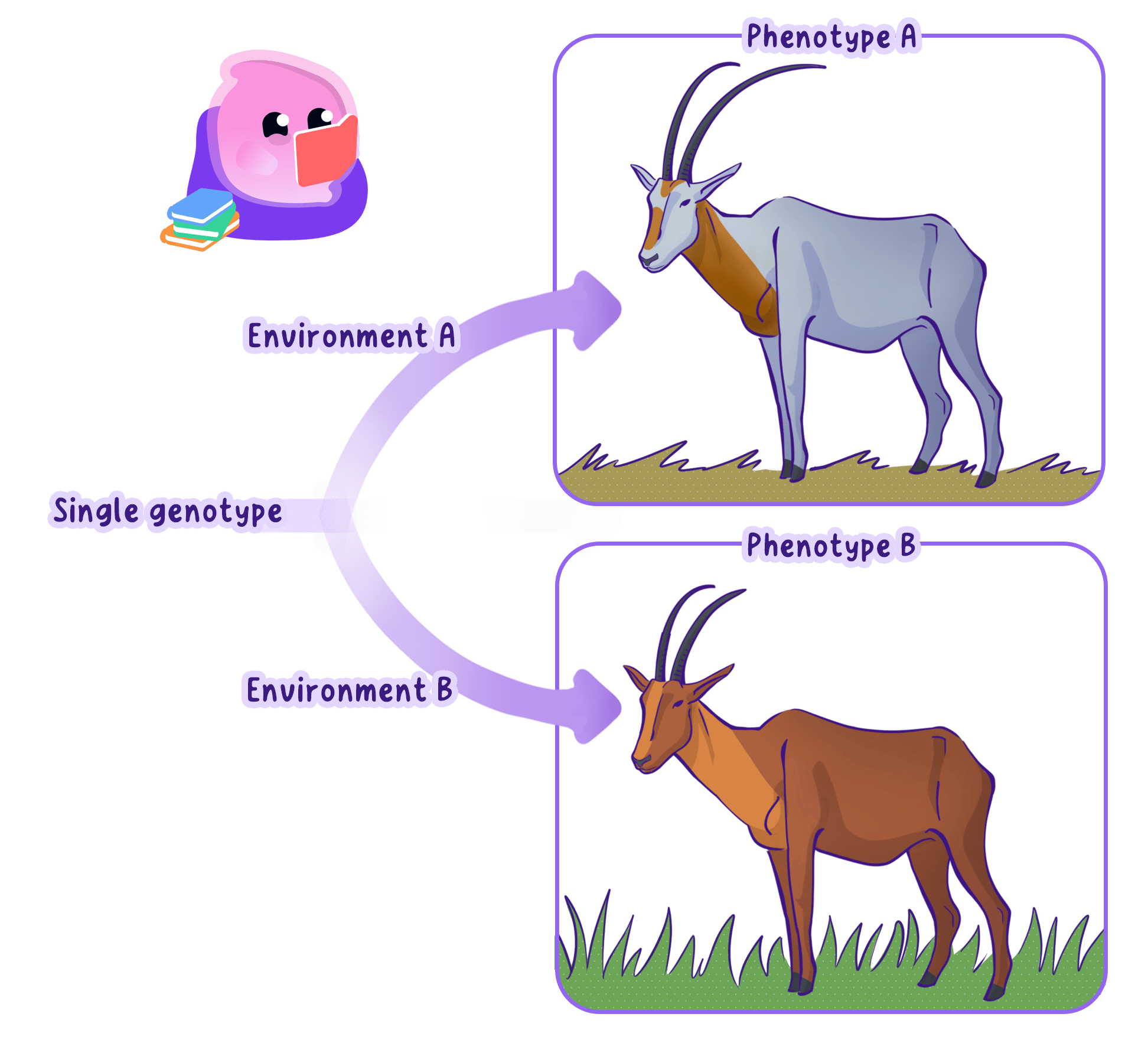
In an explanation, identify the genetic factor and the environmental factor, then connect both to the phenotype.
Continuous variation forms a measurable range
Continuous variation
Variation that produces a continuous range of phenotypes between two extremes, with no distinct categories.
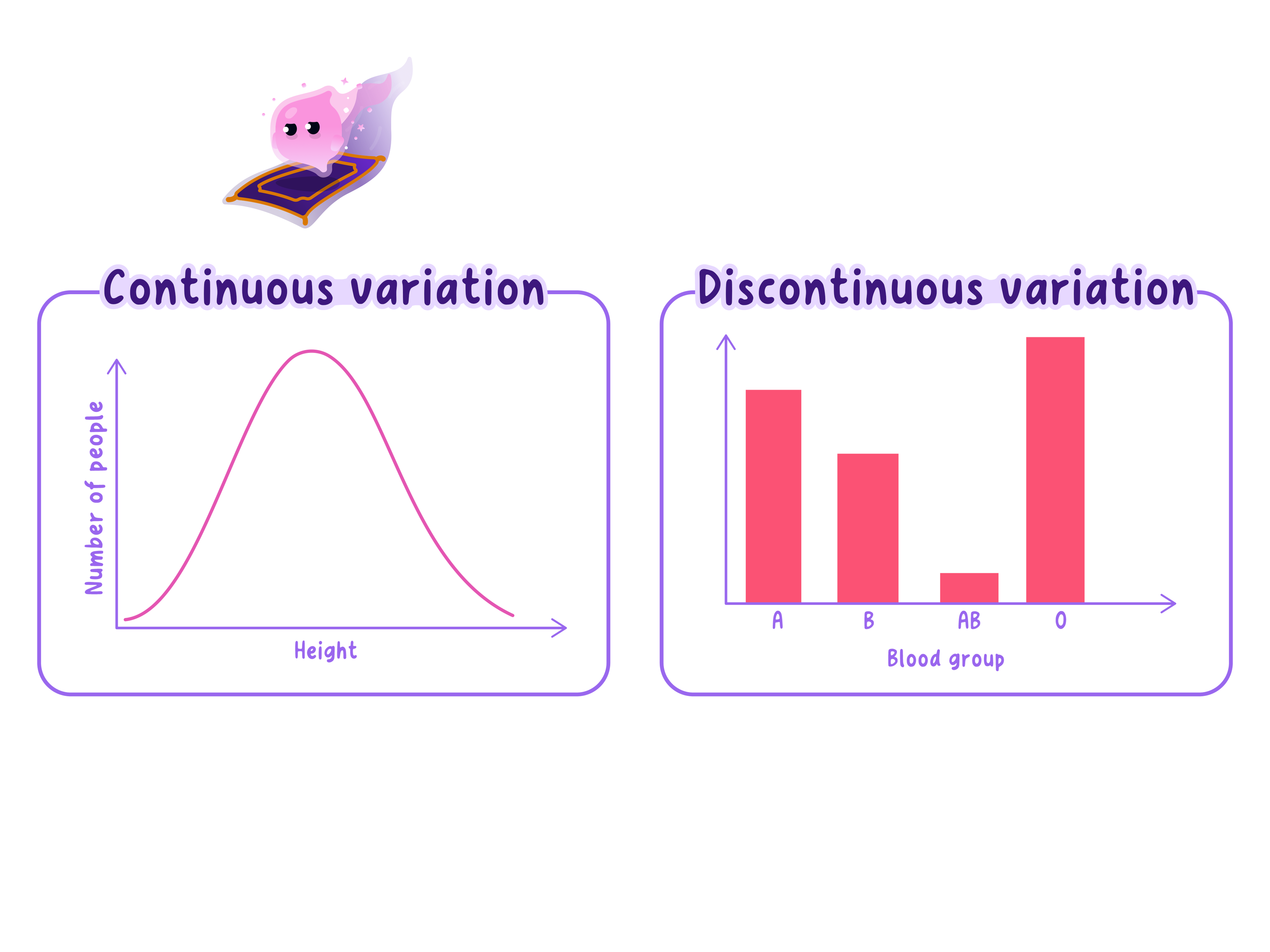
- Continuous variation produces many intermediate values between two extremes, with no distinct categories.
- Examples include height, mass, hand span and leaf length.
- Continuous characteristics are usually affected by many genes and the environment.
- A large sample may form a normal distribution, with most values near the mean and fewer values at either extreme.
- Display continuous data in a histogram with touching bars because the measurement scale has no gaps.
Discontinuous variation forms categories
Discontinuous variation
Variation in which individuals fall into distinct categories with no intermediate values.
- Discontinuous variation places each individual into one of a limited number of distinct categories.
- Examples include ABO blood group and the ability or inability to roll the tongue.
- Discontinuous characteristics are usually controlled by one gene or a small number of genes, with little environmental influence.
- Display discontinuous data in a bar chart with gaps because the categories are separate.
- Worked example: five seedlings have heights of 8.28.28.2, 9.19.19.1, 9.79.79.7, 10.410.410.4 and 11.6 cm11.6\,\text{cm}11.6cm.
- Calculation: xˉ=8.2+9.1+9.7+10.4+11.65=9.8 cm\bar{x}=\dfrac{8.2+9.1+9.7+10.4+11.6}{5}=9.8\,\text{cm}xˉ=58.2+9.1+9.7+10.4+11.6=9.8cm.
- Interpretation: height is continuous because it can take any value within a range.
Investigating variation
- Aim: compare continuous and discontinuous variation in a human population.
- Apparatus: use a metre ruler fixed vertically to a wall, a set square, a tape measure, a results table and graphing equipment.
- Method:
- Sampling: select at least 303030 people at random to reduce sampling bias.
- Method 1: ask each person to remove their shoes and stand upright with their heels against the wall.
- Method 2: place the set square horizontally on the head and read height to the nearest 0.1 cm0.1\,\text{cm}0.1cm at eye level.
- Method 3: record one discontinuous characteristic for the same people using clearly defined categories.
- Variables: if two populations are compared, population is the independent variable and the measured characteristic is the dependent variable.
- Controls: keep the measuring instrument, technique, units, observer, sample size and age range the same.
- Processing: group heights into equal intervals and plot a histogram with touching bars.
- Processing: count each discontinuous category and plot a bar chart with separated bars.
- Mean: calculate mean height using xˉ=∑xn\bar{x}=\dfrac{\sum x}{n}xˉ=n∑x.
- Reliability: repeat doubtful measurements and repeat the investigation with another large random sample.
- Safety and ethics: keep the floor clear, obtain consent, record results anonymously and avoid sensitive characteristics.
Results reveal the pattern of variation
- Height should produce many intermediate values and may approximate a normal distribution.
- The discontinuous characteristic should produce separate categories with no intermediate values.
- A larger random sample reduces the influence of unusual individuals and makes the distribution more representative.
- What is variation?
- How does continuous variation differ from discontinuous variation?
- Which graph should you use for each type of variation?
- Why should a sample be large and randomly selected?
3.4.2 Outcomes of the Human Genome Project
Genome sequencing produced a human reference
Human Genome Project
An international research project that determined the base sequence of the human genome and identified its genes.
Genome
The complete genetic material of an organism.
- The Human Genome Project was an international programme that determined the order of bases across the human genome.
- The project also identified the positions of genes within the sequence.
- A human genome contains about 3×1093\times10^93×109 base pairs and approximately 20,00020{,}00020,000 protein-coding genes.
- The completed sequence provides a reference genome against which individual genomes can be compared.
The project read and mapped human DNA; it did not change anyone's genes.
Genome data supports medicine
- Comparing DNA sequences can identify alleles associated with inherited disorders.
- This information can support diagnosis, carrier testing and estimates of disease risk.
- Knowledge of a gene and its protein can guide the development of treatments.
- Personalised medicine uses genomic information to help select a medicine or dose for an individual.
- A risk allele does not guarantee disease because many conditions are affected by several genes and environmental factors.
For an outcome question, connect the information found to a specific use, such as identifying a risk allele so that earlier monitoring can be offered.
Sequence comparisons reveal ancestry
- More similar DNA sequences suggest that two individuals or populations share a more recent common ancestor.
- Patterns of sequence similarity can therefore be used to investigate ancestry and past human migration.
Genomic information raises ethical issues
- A statistical association between an allele and a disease does not always prove that the allele causes the disease.
- Predictions may be uncertain and can cause anxiety for the person tested.
- Genomic records require informed consent and secure storage because employers or insurers could misuse the information.
- What did the Human Genome Project determine?
- What is a genome?
- How can genome data support medical care?
- How can DNA sequences be used to investigate ancestry?
- Name one ethical concern about genomic data.
3.4.3 Genetic variation within a population
Mutations create new alleles
Mutation
A random change in the base sequence of DNA that can produce a new allele.
Allele
A different version of a gene.
- A mutation is the source of a new allele because it changes the base sequence of DNA.
- Mutations occur randomly and continuously, rather than appearing because an organism needs a particular phenotype.
- A population contains different alleles, so its members can have different genotypes and phenotypes.
Sexual reproduction reshuffles alleles
- During meiosis, homologous chromosomes separate independently and genetic material is reshuffled into genetically different gametes.
- Random fertilisation combines one gamete from each parent to produce new allele combinations.
- Sexual reproduction increases variation by rearranging existing alleles, but it does not create new alleles.
Do not write that organisms mutate because they need to adapt; mutations occur before a selection pressure favours or removes their effects.
Selection changes allele frequencies
- Most mutations have no observable effect, while a few change the phenotype.
- An allele that improves survival or reproductive success in a particular environment may be described as advantageous.
- Individuals with the advantageous allele are more likely to reproduce and pass the allele to offspring.
- The frequency of the allele can therefore increase over many generations through natural selection.
- Initial variation: a random mutation gives one bacterium an allele for antibiotic resistance.
- Selection: an antibiotic kills susceptible bacteria while the resistant bacterium survives.
- Inheritance: the surviving bacterium reproduces and passes the resistance allele to its descendants.
- Outcome: the resistance allele becomes more frequent in the population.
The environment determines advantage
- An allele is advantageous only when it improves reproductive success under the current environmental conditions.
- A change in the environment can alter which phenotypes are favoured.
- The antibiotic selects resistant bacteria; it does not produce the resistance mutation.
- What process creates new alleles?
- How does sexual reproduction increase genetic variation?
- Why are mutations described as random?
- How can an advantageous allele become more common?
3.4.4 Effects of genetic mutations on phenotype
A base change can alter a protein
Mutation
A random change in the base sequence of DNA that can produce a new allele.
- A mutation changes the base sequence of DNA.
- A mutation in a coding region may change a codon and therefore alter the amino acid sequence of a protein.
- A changed amino acid sequence may alter how the polypeptide folds.
- Different folding can change the protein's three-dimensional shape and its function.
- If an enzyme's active site changes shape, fewer substrates bind and the reaction rate may decrease.
Trace the full causal chain in an explanation: base sequence →\rightarrow→ codon →\rightarrow→ amino acid sequence →\rightarrow→ protein shape →\rightarrow→ protein function →\rightarrow→ phenotype.
Non-coding mutations can change gene expression
- A mutation in non-coding DNA can change whether a gene is switched on or off.
- It can also change how much protein the cell produces.
- A change in the amount of protein can alter the phenotype even when the protein's amino acid sequence is unchanged.
Mutations have different effects
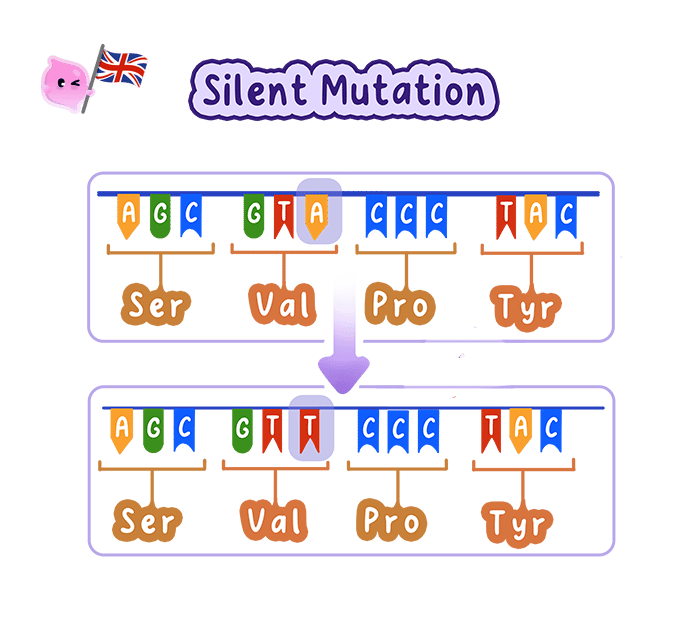
- Most mutations have no effect on phenotype.
- A coding mutation may have no effect because the altered codon specifies the same amino acid.
- Some mutations have a small effect, while a rare mutation may have a large harmful or beneficial effect.
- Whether a mutation is advantageous depends on the environment.
A mutation can produce a new allele
Allele
A different version of a gene.
- A mutation within a gene creates a new allele of that gene.
- DNA replication copies the allele so that it passes to daughter cells.
- A mutation in a body cell is not normally inherited by offspring.
- A mutation in a cell that forms a gamete can be inherited.
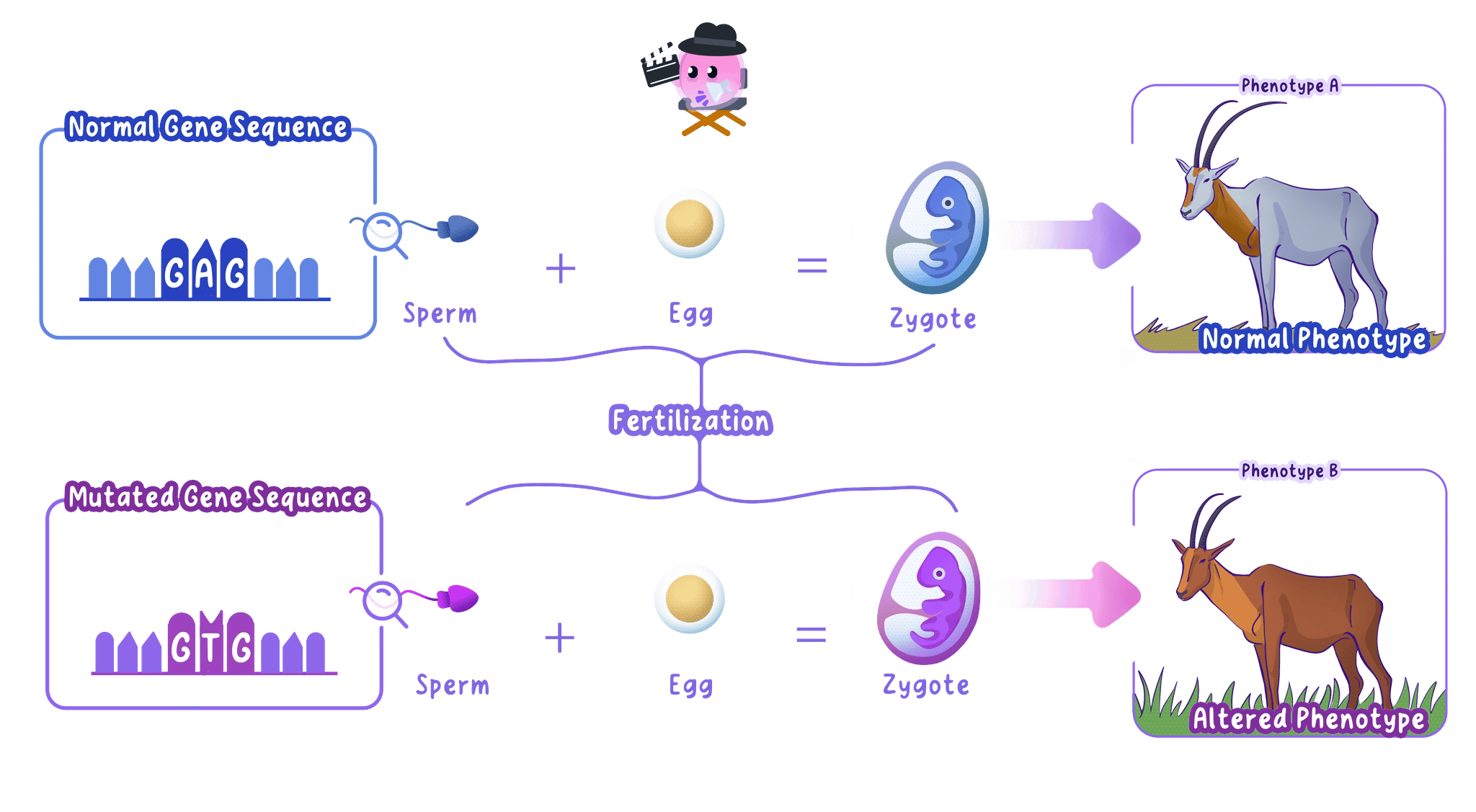
- DNA change: a substitution changes one codon in a gene coding for an enzyme.
- Protein change: the new codon places a different amino acid in the polypeptide.
- Shape change: the polypeptide folds differently and changes the active site.
- Phenotype change: fewer enzyme-substrate complexes form and the reaction rate decreases.
Gene and allele must not be confused
- A gene is a section of DNA that codes for a protein or functional RNA.
- An allele is a different version of the same gene.
- A mutation normally creates a new allele rather than a completely new gene.
- What is a mutation?
- How can a coding mutation alter phenotype?
- How can a non-coding mutation alter phenotype?
- When can a mutation be inherited?
- How does an allele differ from a gene?
