Why cells move substances
Concentration gradient
The difference in the concentration of a substance between two regions.
- A cell has to take in oxygen, glucose, water and mineral ions, and get rid of carbon dioxide, urea and excess water.
- Everything crosses the cell membrane, which is partially permeable and lets some substances through while blocking others.
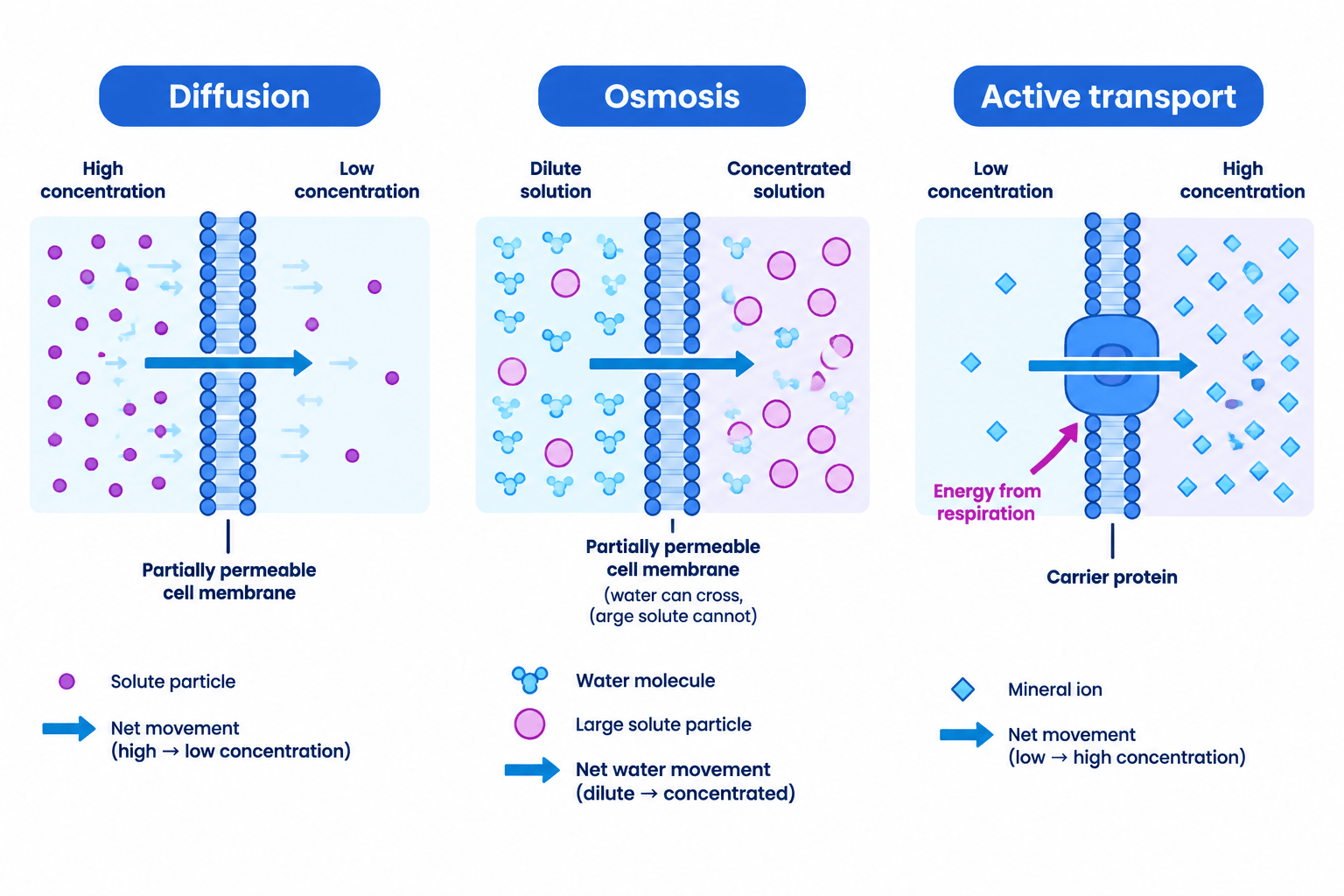
- Edexcel names three ways this happens: diffusion, osmosis and active transport.
- Two questions separate them: which way the substance moves relative to the concentration gradient, and whether energy from respiration is needed.
Diffusion and osmosis run down the concentration gradient and need no energy from respiration, while active transport runs up the gradient and does.
Diffusion
Diffusion
The net movement of particles from a region of higher concentration to a region of lower concentration, down a concentration gradient.
- Particles in a liquid or a gas are constantly moving in random directions.
- Where there are more particles, more of them happen to move away, so the net movement is from the crowded region to the emptier one.
- No energy from respiration is needed, because the random movement of the particles is doing the work.
- Diffusion continues until the particles are evenly spread, although a living cell keeps a gradient going by using up whatever arrives.
- Oxygen diffuses from the air in the alveoli into the blood, and carbon dioxide diffuses the other way, because respiring cells keep both gradients steep.
- Diffusion speeds up when the gradient is steeper, the surface area is larger, the distance to cross is shorter, or the temperature is higher.
Particles keep crossing in both directions even at equilibrium, which is why the word net matters in the definition.
Osmosis
Osmosis
The net movement of water molecules from a dilute solution to a concentrated solution through a partially permeable membrane.
- Osmosis is diffusion applied to one substance only, and that substance is water.
- A partially permeable membrane has pores small enough to let water molecules through but too small for larger solute molecules such as sucrose.
- Only the water can move, so it is the water that redistributes itself.
- A dilute solution has a high concentration of water molecules, and a concentrated solution has a low one.
- The net movement of water is therefore from the dilute solution into the concentrated solution, which is still movement down a gradient.
- Osmosis is passive, so it needs no energy from respiration.
- Root hair cells absorb water from the soil by osmosis, because the soil water is more dilute than the cell contents.
- A red blood cell placed in pure water takes in so much water that it bursts, while a plant cell in the same water is held in shape by its cell wall and becomes firm instead.
Osmosis moves water and nothing else, so an answer describing sugar or salt moving by osmosis is wrong however well the rest of it reads.
Active transport
Active transport
The movement of a substance across a cell membrane against its concentration gradient, using energy released by respiration.
- Sometimes a cell needs a substance that is already more concentrated inside it than outside.
- Moving it in means going against the concentration gradient, which random movement will never do on its own.
- A carrier protein in the membrane binds the molecule on one side, changes shape, and releases it on the other side.
- That change of shape is powered by energy released in respiration, which is the feature that separates active transport from the other two processes.
- Root hair cells take up mineral ions this way, because soil water is very dilute and the ions are already more concentrated inside the cell.
- The small intestine absorbs the last of the glucose from digested food by active transport, once the concentration in the gut has dropped below that in the blood.
- Cells that carry out a lot of active transport contain many mitochondria, and a shortage of oxygen slows the process down.
A poison that stops respiration halts active transport almost immediately but leaves diffusion and osmosis running, and experiments of that kind are how the difference was first shown.
Comparing the three processes
- Diffusion moves any small dissolved substance or gas, down the gradient, with no energy from respiration.
- Osmosis moves water only, down the water gradient, through a partially permeable membrane, with no energy from respiration.
- Active transport moves dissolved substances against the gradient using energy from respiration and carrier proteins.
- All three depend on the membrane, and all three are faster when the surface area is larger.
- Decide the process by comparing the two concentrations given in the question, since a move from low to high can only be active transport.
- The mark most often dropped is the direction, so write from a higher to a lower concentration rather than just saying the substance moves across.
- Name respiration as the source of the energy for active transport, because energy on its own is not enough for the mark.
- Diffusion and osmosis are passive, so describing either as using energy from respiration is wrong.
- A dilute solution is one with a high concentration of water, which is the point most often muddled when comparing two solutions.
- Particles do not know where to go, so describe net movement rather than substances wanting to reach a balance.
- Use the word net in your definitions, because movement happens in both directions and only the overall direction is being described.
- Define diffusion, osmosis and active transport, one sentence each.
- Which of the three needs energy from respiration, and why?
- Explain how a root hair cell takes in water and how it takes in mineral ions.
- What does partially permeable mean?
- Give two factors that increase the rate of diffusion.