1.4.1 Transport into and out of cells
Why cells move substances
Concentration gradient
The difference in the concentration of a substance between two regions.
- A cell has to take in oxygen, glucose, water and mineral ions, and get rid of carbon dioxide, urea and excess water.
- Everything crosses the cell membrane, which is partially permeable and lets some substances through while blocking others.
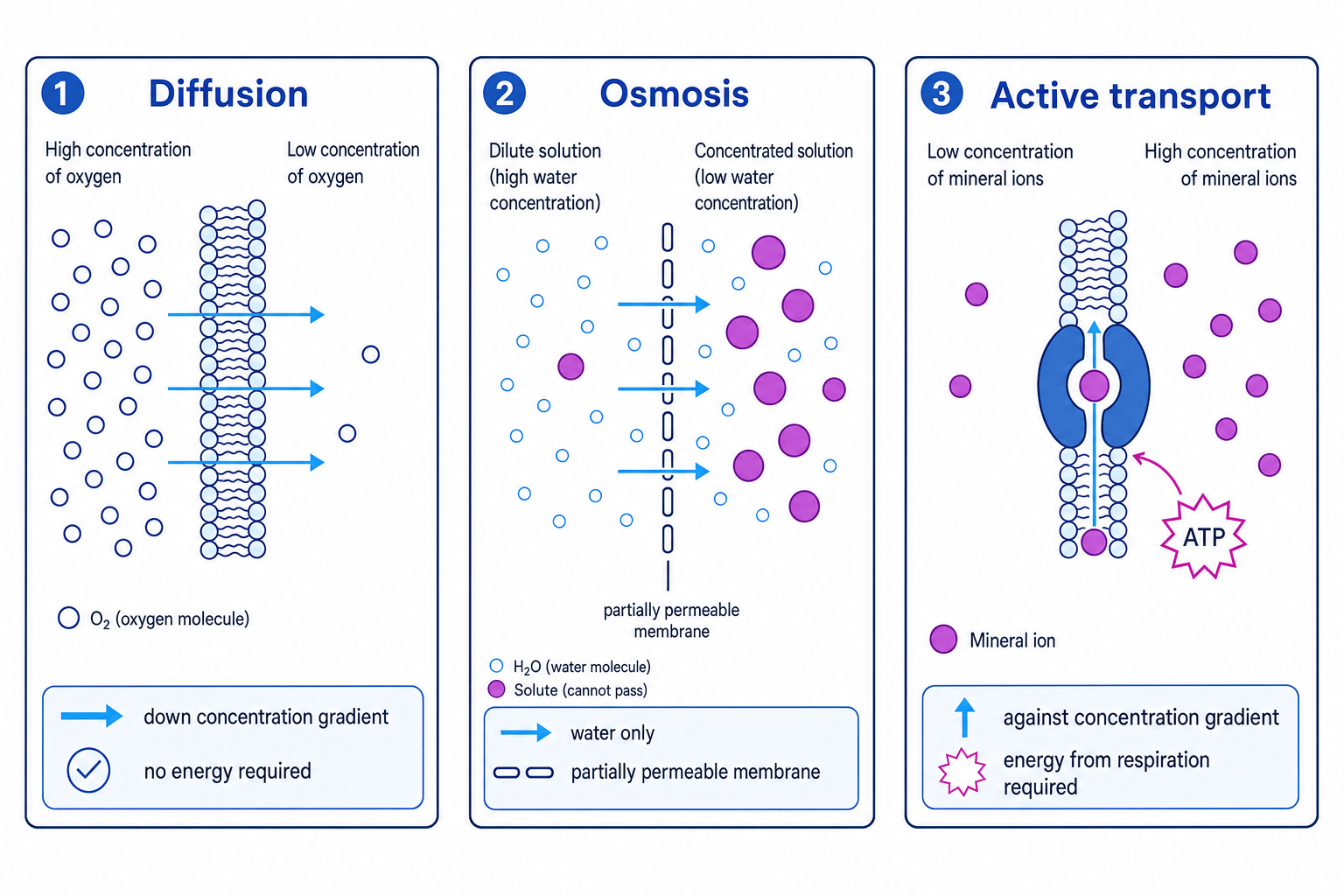
- Edexcel names three ways this happens: diffusion, osmosis and active transport.
- Two questions separate them: which way the substance moves relative to the concentration gradient, and whether energy from respiration is needed.
Diffusion and osmosis run down the concentration gradient and need no energy from respiration, while active transport runs up the gradient and does.
Diffusion
Diffusion
The net movement of particles from a region of higher concentration to a region of lower concentration, down a concentration gradient.
- Particles in a liquid or a gas are constantly moving in random directions.
- Where there are more particles, more of them happen to move away, so the net movement is from the crowded region to the emptier one.
- No energy from respiration is needed, because the random movement of the particles is doing the work.
- Diffusion continues until the particles are evenly spread, although a living cell keeps a gradient going by using up whatever arrives.
- Oxygen diffuses from the air in the alveoli into the blood, and carbon dioxide diffuses the other way, because respiring cells keep both gradients steep.
- Diffusion speeds up when the gradient is steeper, the surface area is larger, the distance to cross is shorter, or the temperature is higher.
Particles keep crossing in both directions even at equilibrium, which is why the word net matters in the definition.
Osmosis
Osmosis
The net movement of water molecules from a dilute solution to a concentrated solution through a partially permeable membrane.
- Osmosis is diffusion applied to one substance only, and that substance is water.
- A partially permeable membrane has pores small enough to let water molecules through but too small for larger solute molecules such as sucrose.
- Only the water can move, so it is the water that redistributes itself.
- A dilute solution has a high concentration of water molecules, and a concentrated solution has a low one.
- The net movement of water is therefore from the dilute solution into the concentrated solution, which is still movement down a gradient.
- Osmosis is passive, so it needs no energy from respiration.
- Root hair cells absorb water from the soil by osmosis, because the soil water is more dilute than the cell contents.
- A red blood cell placed in pure water takes in so much water that it bursts, while a plant cell in the same water is held in shape by its cell wall and becomes firm instead.
Osmosis moves water and nothing else, so an answer describing sugar or salt moving by osmosis is wrong however well the rest of it reads.
Active transport
Active transport
The movement of a substance across a cell membrane against its concentration gradient, using energy released by respiration.
- Sometimes a cell needs a substance that is already more concentrated inside it than outside.
- Moving it in means going against the concentration gradient, which random movement will never do on its own.
- A carrier protein in the membrane binds the molecule on one side, changes shape, and releases it on the other side.
- That change of shape is powered by energy released in respiration, which is the feature that separates active transport from the other two processes.
- Root hair cells take up mineral ions this way, because soil water is very dilute and the ions are already more concentrated inside the cell.
- The small intestine absorbs the last of the glucose from digested food by active transport, once the concentration in the gut has dropped below that in the blood.
- Cells that carry out a lot of active transport contain many mitochondria, and a shortage of oxygen slows the process down.
A poison that stops respiration halts active transport almost immediately but leaves diffusion and osmosis running, and experiments of that kind are how the difference was first shown.
Comparing the three processes
- Diffusion moves any small dissolved substance or gas, down the gradient, with no energy from respiration.
- Osmosis moves water only, down the water gradient, through a partially permeable membrane, with no energy from respiration.
- Active transport moves dissolved substances against the gradient using energy from respiration and carrier proteins.
- All three depend on the membrane, and all three are faster when the surface area is larger.
- Decide the process by comparing the two concentrations given in the question, since a move from low to high can only be active transport.
- The mark most often dropped is the direction, so write from a higher to a lower concentration rather than just saying the substance moves across.
- Name respiration as the source of the energy for active transport, because energy on its own is not enough for the mark.
- Diffusion and osmosis are passive, so describing either as using energy from respiration is wrong.
- A dilute solution is one with a high concentration of water, which is the point most often muddled when comparing two solutions.
- Particles do not know where to go, so describe net movement rather than substances wanting to reach a balance.
- Use the word net in your definitions, because movement happens in both directions and only the overall direction is being described.
- Define diffusion, osmosis and active transport, one sentence each.
- Which of the three needs energy from respiration, and why?
- Explain how a root hair cell takes in water and how it takes in mineral ions.
- What does partially permeable mean?
- Give two factors that increase the rate of diffusion.
1.4.2 Percentage gain and loss in osmosis
Osmosis in plant tissue
Osmosis
The net movement of water molecules from a dilute solution to a concentrated solution through a partially permeable membrane.
- The cells inside a potato hold a solution of sugars and salts, and that solution has its own concentration.
- Put potato tissue in a solution more dilute than its cells and water moves in by osmosis, so the tissue gains mass and feels firm.
- Put it in a solution more concentrated than its cells and water moves out, so the tissue loses mass and goes floppy.
- If the outside solution matches the concentration inside the cells, water still crosses the membrane but there is no net movement, so the mass does not change.
- That no-change point is what the core practical is designed to find, because it reveals the concentration inside the potato cells.
A change in mass is the visible evidence of water moving by osmosis, which is why mass is the quantity you measure.
Turgid and flaccid cells
Turgid
Describes a plant cell that has gained water by osmosis until its contents press firmly against the cell wall.
- As water enters a plant cell the vacuole swells and pushes the cytoplasm and membrane out against the cell wall.
- The rigid cell wall resists that push, so the cell becomes firm rather than bursting, and the pressure helps hold a stem or leaf up.
- As water leaves, the vacuole shrinks and the contents stop pressing on the wall, so the cell becomes soft and the plant wilts.
- If a great deal of water is lost, the membrane pulls away from the wall altogether, which is called plasmolysis.
Flaccid
Describes a plant cell that has lost water by osmosis so its contents no longer press against the cell wall and the cell becomes soft.
An animal cell has no wall, so in a dilute solution it swells until it bursts and in a concentrated one it shrivels, which is why the words turgid and flaccid are used for plant cells only.
Osmosis in potatoes
- Aim: to find how the concentration of a sucrose solution affects the mass of potato tissue, and from that work out the concentration inside the potato cells.
- Apparatus: one potato, cork borer and knife, white tile, ruler, a balance reading to 2 decimal places, paper towels, boiling tubes and rack, waterproof marker, sucrose solutions from 000 up to about 550 g/dm3550\,\text{g/dm}^3550g/dm3, forceps, stop clock and eye protection.
- Method:
- Cut cylinders from a single potato with a cork borer, then trim them all to the same length on a white tile, typically 3 cm3\,\text{cm}3cm.
- Blot each one gently with a paper towel to remove the surface liquid.
- Weigh each cylinder and record its initial mass to 2 decimal places.
- Label one boiling tube per concentration and put 20 cm320\,\text{cm}^320cm3 of the right solution in each.
- Drop one cylinder into each tube, start the clock and leave them for at least 30 minutes so the water movement reaches equilibrium.
- Lift each cylinder out with forceps, blot it in exactly the same way as before, and reweigh it.
- Variables: you change the sucrose concentration and you measure the percentage change in mass, while keeping the length and diameter of the cylinders, the volume of solution, the temperature, the time and the blotting the same.
- Results: in dilute solutions the cylinder gains mass and feels firm because water has moved in and the cells are turgid, and in concentrated solutions it loses mass and bends easily because water has moved out and the cells are flaccid.
- Maths: work out the percentage change in mass for each tube, plot it against concentration, draw a line of best fit, and read off the concentration where the line crosses zero, because there the solution matches the inside of the cells.
- Watch out: blot every cylinder the same number of times because leftover surface water is the biggest single error here, use one potato throughout since two potatoes can differ in internal concentration, and leave the tubes long enough for the movement to finish.
- Safety: cut on a tile with the blade moving away from your fingers because a cork borer slips easily, and wear eye protection.
Calculating percentage change in mass
- Subtract the initial mass from the final mass, divide by the initial mass, then multiply by 100100100.
- percentage change in mass=final mass−initial massinitial mass×100\text{percentage change in mass} = \dfrac{\text{final mass} - \text{initial mass}}{\text{initial mass}} \times 100percentage change in mass=initial massfinal mass−initial mass×100
- A positive answer means the tissue gained water, and a negative answer means it lost water.
- Percentage change is used rather than raw change in mass because the cylinders never start at exactly the same mass.
- A gain of 0.4 g0.4\,\text{g}0.4g means far more to a small cylinder than to a large one, so percentages make the results comparable and allow class data to be pooled.
Divide by the initial mass rather than the final mass, and keep the minus sign on a loss, because a lost negative sign turns a decrease into an increase.
- A cylinder in distilled water starts at 4.20 g4.20\,\text{g}4.20g and ends at 4.62 g4.62\,\text{g}4.62g.
- 4.62−4.204.20×100=0.424.20×100=+10%\dfrac{4.62 - 4.20}{4.20} \times 100 = \dfrac{0.42}{4.20} \times 100 = +10\%4.204.62−4.20×100=4.200.42×100=+10%
- The gain shows water moved into the cells, so the distilled water was more dilute than the cell contents.
- A cylinder in concentrated sucrose starts at 4.50 g4.50\,\text{g}4.50g and ends at 4.05 g4.05\,\text{g}4.05g.
- 4.05−4.504.50×100=−0.454.50×100=−10%\dfrac{4.05 - 4.50}{4.50} \times 100 = \dfrac{-0.45}{4.50} \times 100 = -10\%4.504.05−4.50×100=4.50−0.45×100=−10%
- The loss shows water moved out, so that solution was more concentrated than the cell contents.
Give percentage change to the same number of decimal places as the data allows, usually one, and always include the sign.
Reading the graph
- Put concentration on the horizontal axis and percentage change in mass on the vertical axis.
- The vertical axis needs values above and below zero, because the results include gains and losses.
- Draw a line of best fit through the points rather than joining them dot to dot.
- Where the line crosses the horizontal axis the percentage change is zero, so there is no net movement of water.
- That concentration equals the concentration of the solution inside the potato cells, which is the conclusion the practical is built around.
- To pin the crossing point down more precisely, use more concentrations clustered near it and repeat each one.
- Draw the read-off lines on the graph in pencil when you find the crossing point, because examiners credit the working as well as the value.
- The mark most often dropped is the conclusion, so state that at that concentration the solution and the cell contents are equal.
- Circle an anomalous point and leave it out of the line of best fit rather than forcing the line through it.
- The potato gains mass because water enters, not because sucrose enters, since sucrose cannot cross the membrane.
- Zero percentage change means no net movement rather than no movement at all.
- Blotting is a controlled variable and not a source of the change, so blot identically rather than skipping it.
- Osmosis is passive, so a potato does not use energy to take water in.
- Write the equation for percentage change in mass.
- A cylinder goes from 3.00 g3.00\,\text{g}3.00g to 2.70 g2.70\,\text{g}2.70g, so what is the percentage change?
- Why is percentage change used instead of change in mass?
- What does the point where the line of best fit crosses the x-axis tell you?
- Explain why all the cylinders should be cut from the same potato.