6.2.1 Root hair cell adaptations
Root hair cells: efficient uptake from soil
Root hair cell
A root surface cell with a long, thin extension that gives a large surface area for absorbing water and mineral ions from the soil.
- Root hair cell means a specialised epidermal cell with a long projection that absorbs water and mineral ions from the soil.
- The long projection gives a very large surface area in contact with the thin film of water around soil particles.
- A thin cell wall and membrane give a short pathway into the cell, which increases the rate of uptake.
- Many mitochondria release energy by aerobic respiration for active transport of mineral ions.
Adaptation answers must link a feature to its effect: long extension, larger surface area, faster uptake.
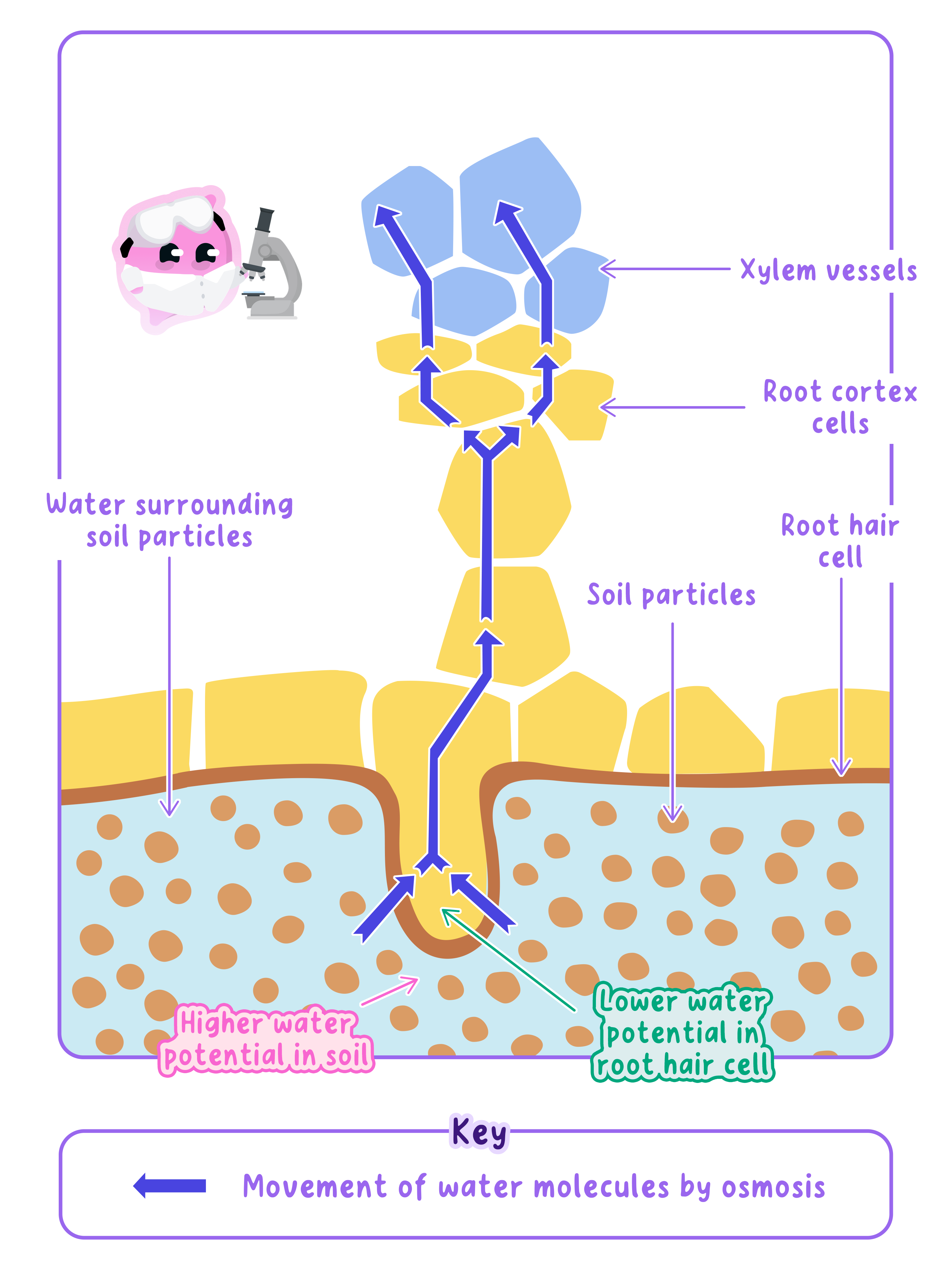
Water enters by osmosis
Osmosis
The net movement of water molecules from a more dilute solution to a more concentrated solution through a partially permeable membrane.
- Osmosis is the net movement of water molecules from a dilute solution to a more concentrated solution through a partially permeable membrane.
- Soil water is usually more dilute than the cell sap, so water moves into the root hair cell across its cell membrane.
- This movement is passive and does not require energy from respiration.
Do not write that roots suck up water or that mineral ions enter by osmosis.
Mineral ions enter by active transport
Active transport
The movement of a substance against its concentration gradient, from a lower to a higher concentration, using energy released by respiration.
- Active transport is the movement of particles from a lower concentration to a higher concentration using energy released by respiration.
- Mineral ions can be less concentrated in the soil than inside the root hair cell, so diffusion cannot move them into the cell.
- Carrier proteins in the cell membrane move ions such as nitrate and magnesium ions against their concentration gradient.
- Nitrate ions are needed to make amino acids and proteins, while magnesium ions are needed to make chlorophyll.
Example: if the nitrate ion concentration is lower in the soil than in the root hair cell, the ions still enter because active transport uses energy.
- Full-credit wording: the root hair extension increases surface area, so more water and mineral ions can be absorbed at the same time.
- Common lost mark: naming many mitochondria without linking them to respiration and active transport.
- Connect each structure to its function and each transport process to its direction, material and energy requirement.
- What is a root hair cell?
- Why does its long extension increase uptake?
- How does water enter a root hair cell?
- Why is energy needed to absorb some mineral ions?
6.2.2 Structure of xylem and phloem
Transport tissues: xylem and phloem
Xylem
A plant tissue made of dead, hollow, lignified tubes that carries water and dissolved mineral ions upwards from the roots and helps support the plant.
- Xylem is a tissue of dead, hollow, lignified vessels that carries water and dissolved mineral ions from roots to stems and leaves.
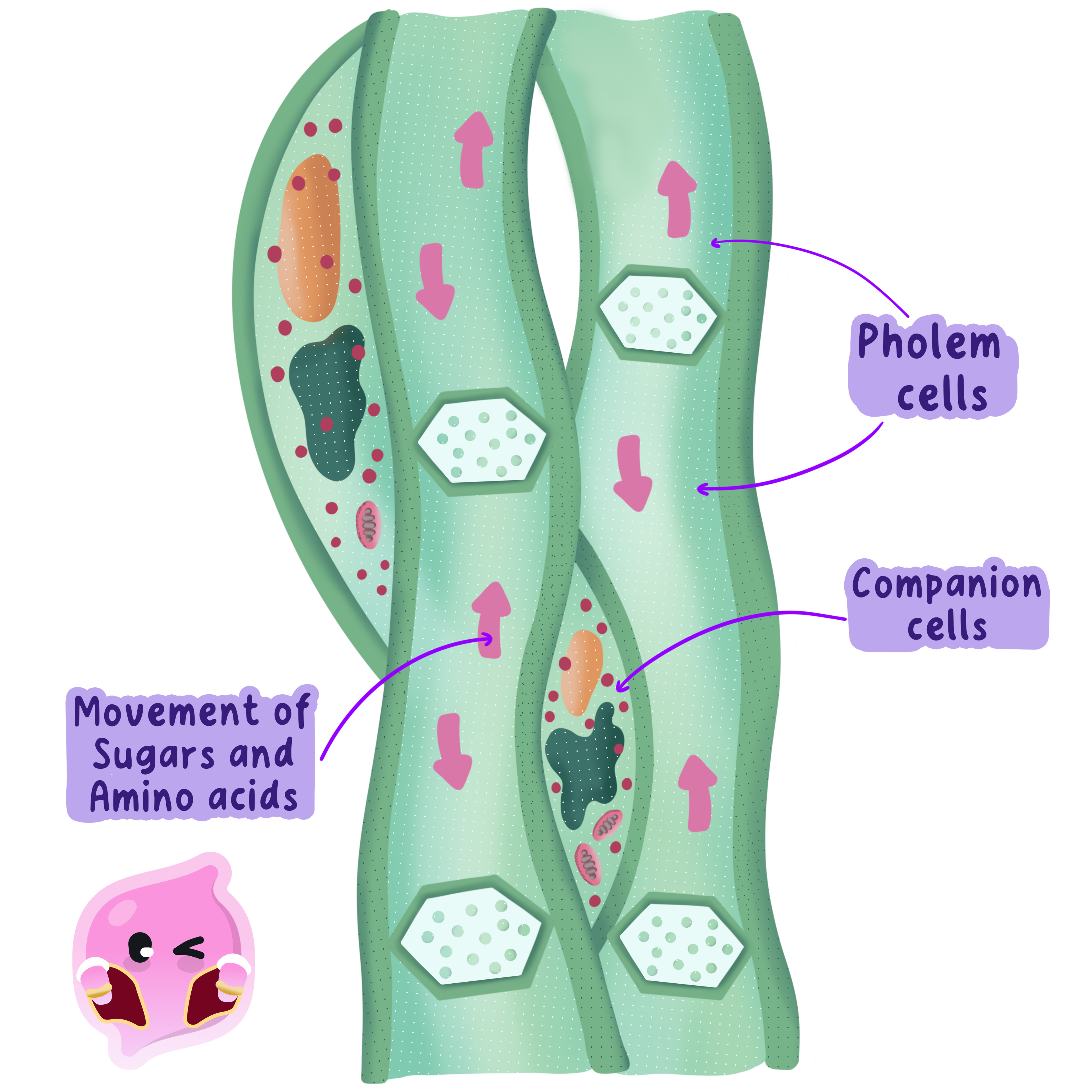
- Phloem is living tissue made of sieve tubes and companion cells that transports dissolved sucrose and amino acids between sources and sinks.
- The tissues occur together in vascular bundles that run through roots, stems and leaf veins.
Xylem is built for one-way water flow
- Mature xylem vessel cells are dead and joined end to end, with their end walls lost to form a continuous hollow tube.
- The vessels contain no cytoplasm, so water meets little resistance as it moves upwards.
- Lignin is deposited in the walls to make them strong and waterproof, preventing collapse when water is pulled upwards. The deposition of the lignin causes the cells to die.
- Pits in the walls allow water to move sideways between vessels and into neighbouring tissues.
Direction: xylem carries water and mineral ions mainly upwards from the roots, not dissolved sugars.
Phloem is living transport tissue
Phloem
A living plant tissue made of sieve tubes and companion cells that carries dissolved food such as sucrose and amino acids around the plant.
- Sieve tube elements are living cells arranged end to end, and their perforated end walls form sieve plates.
- Sieve tube elements have very little cytoplasm and no nucleus, leaving space for phloem sap to flow.
- Companion cells contain a nucleus and many mitochondria, providing the energy needed to load and unload sucrose.
- Phloem can transport substances upwards or downwards because different sources and sinks occur in different parts of the plant.
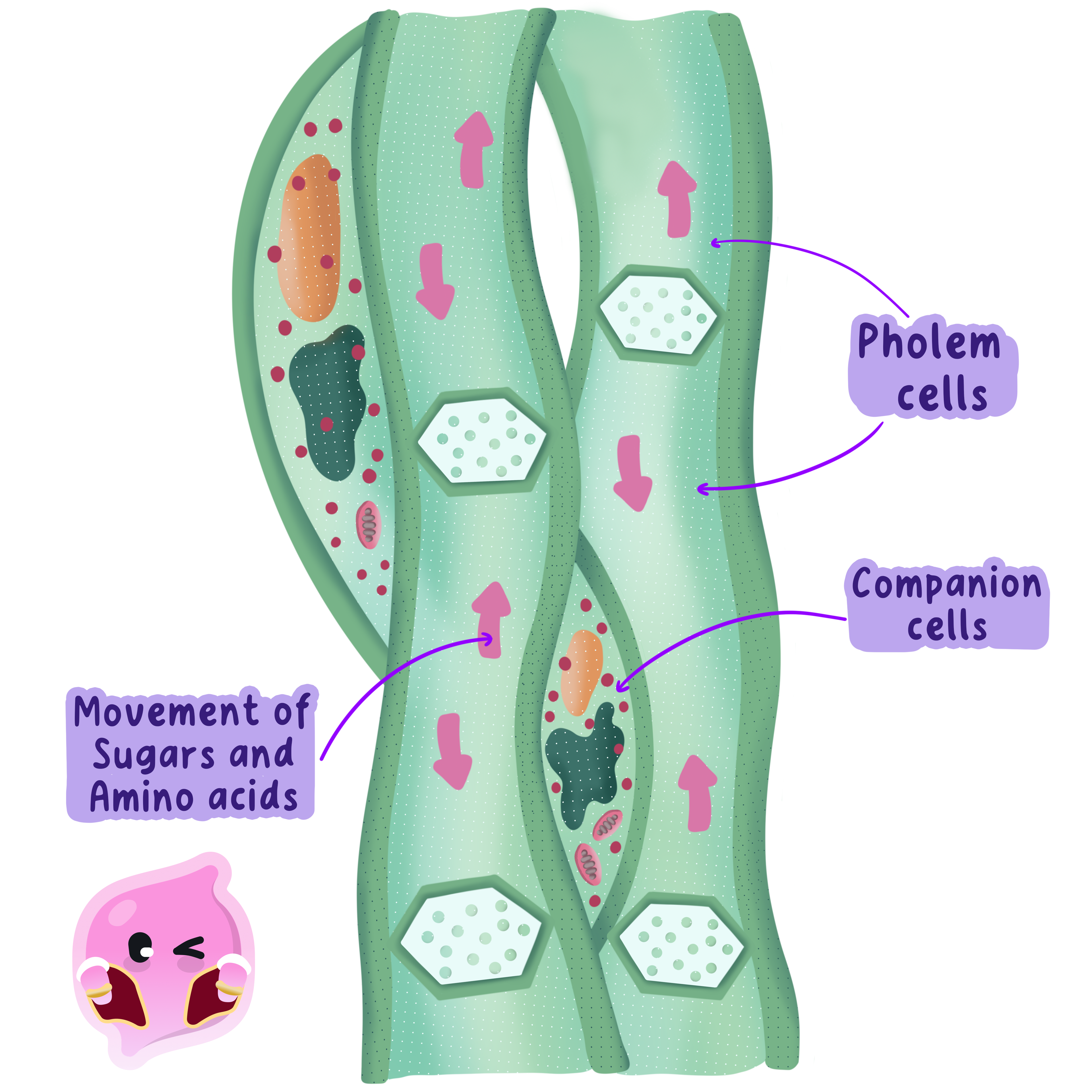
Example: in summer, sucrose may move from photosynthesising leaves to growing roots, while in spring stored carbohydrate can move from roots to developing shoots.
Comparing the tissues
- Xylem is dead, hollow, lignified and carries water and mineral ions mainly upwards.
- Phloem is living, has sieve plates and companion cells, and carries dissolved food in either direction.
- Comparison questions: use paired statements about the same feature, such as dead xylem versus living phloem.
- Structure-to-function marks: explain how the missing end walls form a continuous tube and how lignin prevents collapse.
- What does xylem transport?
- How does lignin adapt a xylem vessel?
- What are sieve plates?
- Why do companion cells contain many mitochondria?
- How do the directions of transport differ?
6.2.3 Transpiration and stomata
Transpiration: water loss pulls water upwards
Transpiration
The loss of water vapour from the surfaces of a plant, mainly through the stomata of the leaves.
Transpiration stream
The continuous flow of water drawn up the xylem from the roots to the leaves that replaces the water lost by transpiration.
- Transpiration is the loss of water vapour from the aerial parts of a plant, mainly through the stomata in leaves.
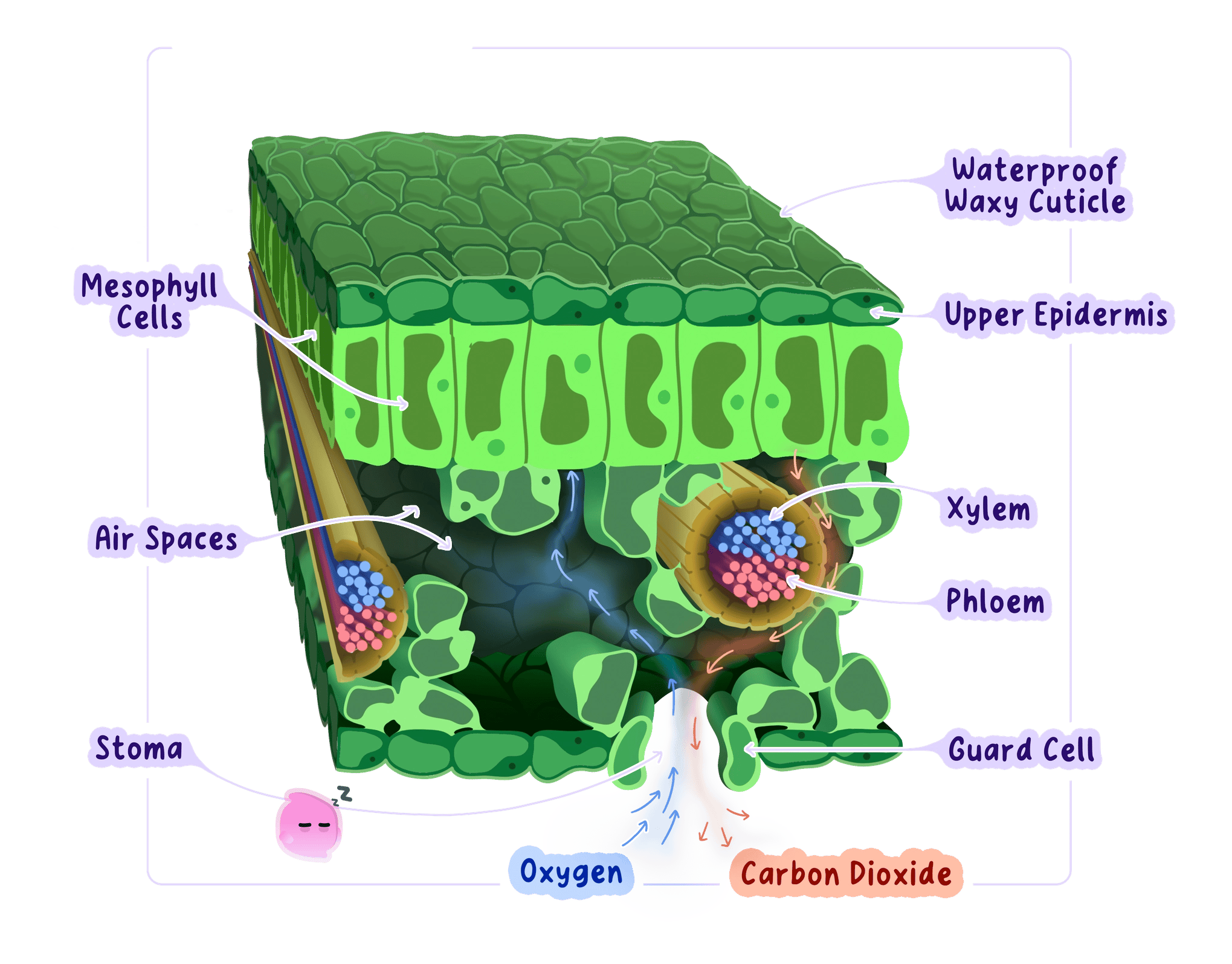
- Water evaporates from the moist cell walls of mesophyll cells into the leaf air spaces.
- Water vapour then diffuses out through open stomata because its concentration is higher inside the leaf than outside.
- Water lost from mesophyll cells is replaced by water from the xylem, maintaining a continuous transpiration stream.
- Cohesion between water molecules helps keep an unbroken column of water in the xylem as it is pulled upwards.
Causal chain: evaporation from mesophyll, diffusion through stomata, water drawn from xylem, water pulled up from roots.
Stomata control gas exchange and water loss
Stomata
The small pores in the surface of a leaf, each called a stoma, through which gases are exchanged and water vapour is lost.
- Stomata are pores in the leaf epidermis through which carbon dioxide, oxygen and water vapour diffuse.
- Each stoma is surrounded by two guard cells that change shape to open or close the pore.
- In light and when water is available, guard cells become turgid and curve apart, opening the stoma for carbon dioxide uptake.
- When water is scarce, guard cells lose turgor and the stoma closes, reducing water loss but also limiting photosynthesis.
Do not confuse evaporation from mesophyll surfaces with diffusion of water vapour out through stomata.
Investigating water uptake with a potometer
- Aim: to compare the rate of water uptake by a leafy shoot under different environmental conditions.
- Apparatus: bubble potometer, freshly cut leafy shoot, water, beaker, sharp blade, petroleum jelly, ruler, stop clock, lamp, fan and eye protection.
- Method:
- Fill the apparatus completely with water.
- Cut the shoot under water at an angle and fit it into the tubing without allowing air into the xylem.
- Seal every joint with petroleum jelly.
- Introduce one air bubble into the capillary tube and mark its starting position.
- Measure the distance moved in a fixed time.
- Reset the bubble and repeat at least three times.
- Change one factor, such as lamp distance or air movement, and allow the shoot to settle before repeating.
- Variables: change one environmental factor and measure bubble distance per unit time; keep leaf area, shoot species, time, temperature and the rest of the apparatus constant.
- Results: faster bubble movement shows faster water uptake, which estimates transpiration rate but is not a direct measurement of water loss.
- Maths: calculate rate=distance movedtime\text{rate}=\frac{\text{distance moved}}{\text{time}}rate=timedistance moved, or volume=πr2l\text{volume}=\pi r^{2}lvolume=πr2l and then rate=volumetime\text{rate}=\frac{\text{volume}}{\text{time}}rate=timevolume.
- Watch out: an air leak or extra bubble breaks the water column; seal joints and cut the shoot under water.
- Safety: cut the shoot on a tile with the blade moving away from your fingers, keep water away from electrical equipment and wear eye protection.
- Question: a bubble moves 48 mm48\,\text{mm}48mm in 6 min6\,\text{min}6min.
- Calculation: rate=486=8 mm min−1\text{rate}=\frac{48}{6}=8\,\text{mm min}^{-1}rate=648=8mm min−1.
Writing transpiration explanations
- Explain questions: give the full sequence from evaporation to diffusion and replacement from the xylem.
- Practical questions: identify the independent, dependent and controlled variables, then explain how a named error changes the result.
- What is transpiration?
- Where does water evaporate inside a leaf?
- How do guard cells reduce water loss?
- Why is a potometer an indirect measure of transpiration?
- How is bubble movement converted into a rate?
6.2.4 Translocation of sucrose
Translocation: moving dissolved food
Translocation
The movement of dissolved food, mainly sucrose and amino acids, through the phloem from sources to sinks.
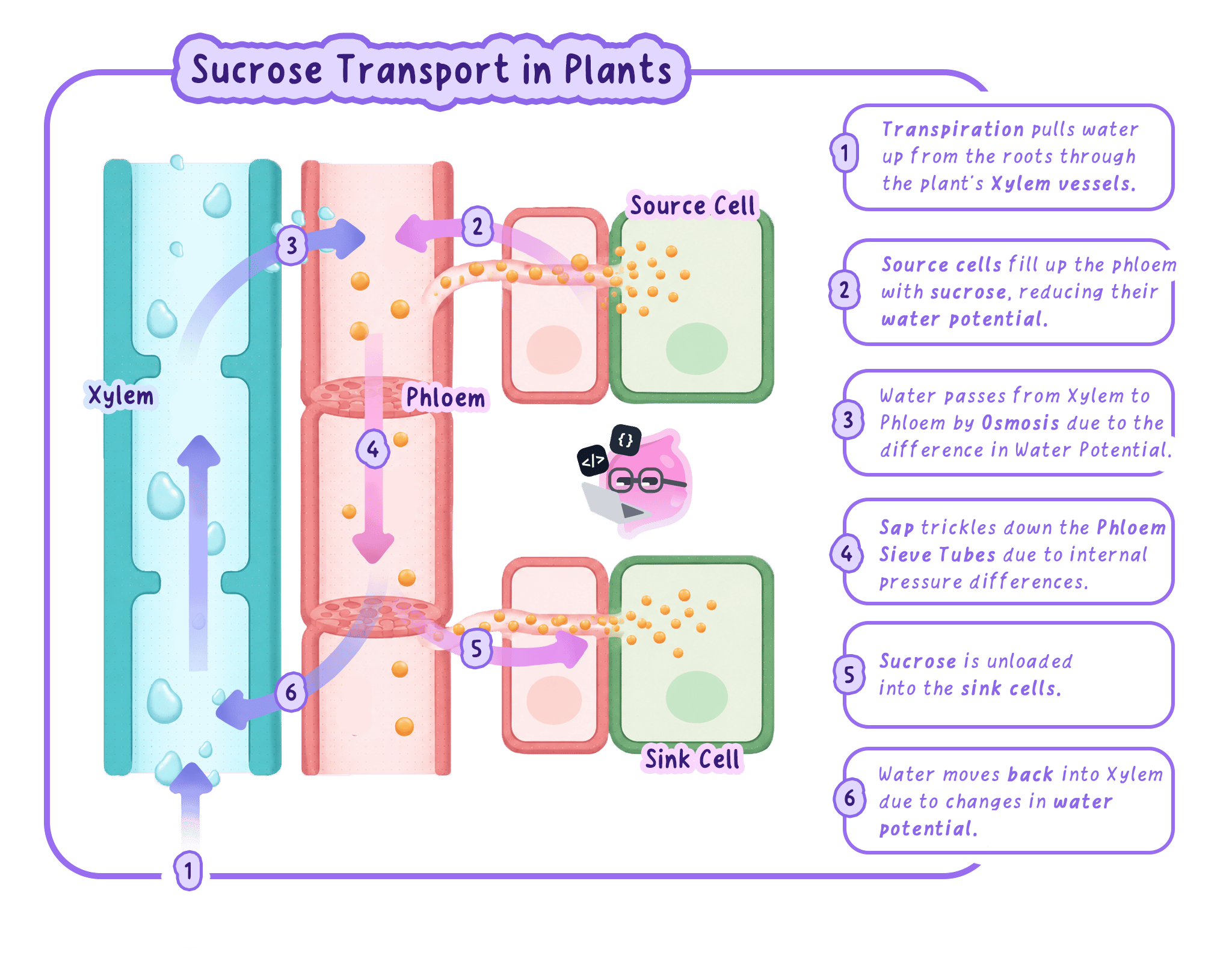
- Translocation is the movement of dissolved food, mainly sucrose and amino acids, through phloem from sources to sinks.
- Glucose made by photosynthesis is often converted to sucrose because sucrose is soluble and suitable for transport.
- Translocation requires energy for loading and unloading substances, supplied by respiration in companion cells.
- It is separate from the transpiration stream, which moves water and mineral ions through xylem.
Sources load food into phloem
Source (translocation)
A part of a plant that loads dissolved food into the phloem, such as a photosynthesising leaf or a storage organ releasing its store.
- Source means a plant region that releases or produces more sucrose than it uses, so sucrose enters the phloem.
- A mature photosynthesising leaf is usually a source because it makes sugars faster than it uses them.
- A storage organ can become a source when stored carbohydrate is converted into soluble sugar and exported.
Sinks remove food from phloem
Sink (translocation)
A part of a plant that removes dissolved food from the phloem to use or store it, such as a growing root or developing fruit.
- Sink means a plant region that removes sucrose from phloem for respiration, growth or storage.
- Growing roots, shoot tips, flowers, fruits and seeds are common sinks because their cells need energy and new biological molecules.
- A sink can later become a source, so phloem transport can occur upwards or downwards according to the plant's needs.
Example: during summer a leaf is a source and a developing fruit is a sink; during spring a storage root can become a source for a growing shoot.
Phloem structure supports transport
Phloem
A living plant tissue made of sieve tubes and companion cells that carries dissolved food such as sucrose and amino acids around the plant.
- Sieve tube elements join end to end, and pores in their sieve plates allow phloem sap to pass between cells.
- Companion cells have many mitochondria, so they can release energy for active loading and unloading of sucrose.
- Different sieve tubes can carry sap in different directions at the same time, but movement within one tube is from its source towards its sink.
Do not write that phloem carries glucose only downwards or that translocation happens in xylem.
Answering source-and-sink questions
- Use the context: decide which organ is producing or releasing sucrose and which is using or storing it.
- Explain the direction: name the source, name the sink and state that sucrose moves through phloem between them.
- What is translocation?
- What makes a leaf a source?
- What makes a growing root a sink?
- Why can phloem transport occur in either direction?
- How do companion cells support translocation?
6.2.5 Leaf structure for photosynthesis
Leaf structure: maximising photosynthesis
Photosynthesis
The process in which plants and algae use light energy, absorbed by chlorophyll in the chloroplasts, to make glucose from carbon dioxide and water, releasing oxygen as a by-product.
- Photosynthesis is the process in which light energy absorbed by chlorophyll is used to make glucose from carbon dioxide and water, releasing oxygen.
- The word equation is carbon dioxide+water→glucose+oxygen\text{carbon dioxide}+\text{water}\rightarrow\text{glucose}+\text{oxygen}carbon dioxide+water→glucose+oxygen.
- The balanced symbol equation is 6CO2+6H2O→C6H12O6+6O26\mathrm{CO_2}+6\mathrm{H_2O}\rightarrow\mathrm{C_6H_{12}O_6}+6\mathrm{O_2}6CO2+6H2O→C6H12O6+6O2.
- A broad leaf provides a large surface area for light absorption, while a thin leaf gives carbon dioxide a short diffusion distance.
Upper layers let light reach chloroplasts
Palisade mesophyll
The layer of tall cells near the top of a leaf, packed with chloroplasts to absorb the most light for photosynthesis.
- The waxy cuticle is transparent so light passes through, and waterproof so it reduces evaporation from the surface.
- The upper epidermis is thin and transparent, allowing light to reach the palisade mesophyll.
- Palisade mesophyll is a layer of tall, closely packed cells near the upper leaf surface containing many chloroplasts.
- Its position and chloroplast density allow it to absorb a high proportion of the incoming light.
Do not state that epidermal cells contain many chloroplasts; guard cells are the main epidermal exception.
Spongy mesophyll speeds gas exchange
Spongy mesophyll
A layer of loosely packed leaf cells with large air spaces that give a big surface area for water to evaporate and gases to move.
- Spongy mesophyll is a loosely packed layer with many interconnecting air spaces and moist cell surfaces.
- The air spaces provide a large internal surface area and let carbon dioxide diffuse rapidly from stomata to photosynthesising cells.
- Oxygen made in photosynthesis diffuses through the same spaces and out of the leaf.
- The lower epidermis contains many stomata, which allow gas exchange while reducing exposure to direct sunlight and air movement.
Veins supply and remove materials
- Xylem in each vascular bundle supplies water and mineral ions to leaf cells.
- Phloem carries sucrose and amino acids away from photosynthesising cells to sources and sinks elsewhere in the plant.
- A network of veins keeps cells close to transport tissue and also helps support the leaf blade.
Example: palisade cells contain many chloroplasts, so they absorb more light and can photosynthesise at a higher rate.
Explaining adaptations in exams
- Required link: state the feature and then explain how it increases light absorption, gas diffusion, water supply or sugar removal.
- Diagram labels: use waxy cuticle, upper epidermis, palisade mesophyll, spongy mesophyll, air space, lower epidermis, guard cells, stoma, xylem and phloem.
- Why is a leaf broad and thin?
- How is palisade mesophyll adapted for photosynthesis?
- How do spongy mesophyll air spaces aid gas exchange?
- What do xylem and phloem do in a leaf vein?
- Why is the upper epidermis transparent?
6.2.6 Environmental factors on water uptake
Environmental factors change water uptake
Transpiration
The loss of water vapour from the surfaces of a plant, mainly through the stomata of the leaves.
- Transpiration is the loss of water vapour from the aerial parts of a plant, mainly through leaf stomata.
- As transpiration removes water from leaves, water is pulled through the xylem and replaced by water absorbed from the soil.
- A factor that increases transpiration therefore usually increases the rate of water uptake by the roots.
Cause and effect: environmental factor, change to stomata or diffusion, change in transpiration, change in water uptake.
Light intensity opens stomata
- Increasing light intensity usually increases water uptake because stomata open to admit carbon dioxide for photosynthesis.
- Wider stomatal pores allow more water vapour to diffuse out of the leaf.
- This increases transpiration and pulls water through the xylem more quickly.
- In darkness, most stomata close, reducing both water loss and water uptake.
Air movement maintains a steep gradient
- Moving air removes the moist layer of air beside the leaf surface.
- The water vapour concentration outside the stomata falls, making the concentration gradient from the leaf to the air steeper.
- Water vapour diffuses out faster, so transpiration and water uptake increase.
- In still air, moist air remains near the leaf and the smaller gradient reduces diffusion.
Temperature increases particle movement
- At a higher temperature, water molecules have more kinetic energy.
- Water evaporates more rapidly from mesophyll cell surfaces and water vapour diffuses through stomata more quickly.
- Transpiration and water uptake therefore increase, provided the plant has enough water and the stomata remain open.
Do not stop at stating that heat increases transpiration; explain the increase in kinetic energy, evaporation and diffusion.
Measuring the effect of an environmental factor
- Aim: to determine how light intensity, air movement or temperature affects the rate of water uptake by a leafy shoot.
- Apparatus: bubble potometer, freshly cut leafy shoot, beaker of water, sharp blade, petroleum jelly, ruler, stop clock, lamp, fan or controlled-temperature surroundings, and eye protection.
- Method:
- Fill the apparatus completely with water.
- Cut the shoot under water at an angle and fit it without letting air enter the xylem.
- Seal every joint with petroleum jelly.
- Introduce one air bubble into the capillary tube and record its starting position.
- Apply one chosen condition and allow the shoot to adjust.
- Measure the distance moved by the bubble in a fixed time.
- Reset the bubble and repeat at least three times.
- Change only the selected factor and repeat across a suitable range.
- Variables: change one environmental factor and measure bubble movement per unit time; control the shoot species, leaf area, measurement time and all other environmental factors.
- Results: brighter light, greater air movement or higher temperature usually makes the bubble move faster because water uptake increases.
- Maths: calculate rate=distance movedtime\text{rate}=\frac{\text{distance moved}}{\text{time}}rate=timedistance moved, then compare the mean rates for the different conditions.
- Watch out: air leaks make the bubble move without water entering the shoot, while a different leaf area changes the surface available for transpiration.
- Safety: cut the shoot on a tile away from your fingers, wear eye protection and keep water away from electrical lamps and fans.
Explaining experimental results
- Use repeat readings to identify anomalies and calculate a mean, which makes the comparison more reliable.
- Describe the pattern in the data before explaining it with stomatal opening, kinetic energy or the water vapour gradient.
- Explanation chain: increased air movement removes moist air, steepens the water vapour gradient, increases diffusion and raises water uptake.
- Fair-test mark: name a specific controlled variable and explain why changing it would affect transpiration.
- How does increased light intensity affect water uptake?
- Why does moving air increase transpiration?
- How does temperature affect evaporation and diffusion?
- Why must leaf area be controlled in a potometer investigation?
6.2.7 Rate calculations for transpiration
Transpiration rates: distance divided by time
Potometer
A piece of apparatus that estimates the rate of transpiration by measuring the water a leafy shoot takes up.
- Potometer means apparatus that estimates transpiration rate by measuring water uptake by a leafy shoot.
- The air bubble moves as the shoot takes up water, so its distance travelled can be measured against time.
- A potometer does not measure transpiration directly because some absorbed water is used in photosynthesis, growth and maintaining cell turgor.
State precisely: the apparatus measures water uptake and uses it to estimate transpiration.
Calculate distance per unit time
- Use rate=distance moved by bubbletime taken\text{rate}=\frac{\text{distance moved by bubble}}{\text{time taken}}rate=time takendistance moved by bubble.
- If distance is measured in millimetres and time in minutes, the unit is mm min−1\mathrm{mm\,min^{-1}}mmmin−1.
- Convert quantities before calculating when the question gives different time or distance units.
- Question: a bubble moves 54 mm54\,\mathrm{mm}54mm in 9 min9\,\mathrm{min}9min.
- Calculation: rate=549=6.0 mm min−1\text{rate}=\frac{54}{9}=6.0\,\mathrm{mm\,min^{-1}}rate=954=6.0mmmin−1.
Calculate water volume per unit time
- For a cylindrical capillary tube, its cross-sectional area is A=πr2A=\pi r^{2}A=πr2.
- The volume of water taken up is V=Al=πr2lV=Al=\pi r^{2}lV=Al=πr2l, where lll is the bubble distance.
- The volume uptake rate is rate=πr2lt\text{rate}=\frac{\pi r^{2}l}{t}rate=tπr2l.
- Use matching length units throughout so the volume unit is correct, such as mm3\mathrm{mm^{3}}mm3.
- Question: a tube has radius 0.50 mm0.50\,\mathrm{mm}0.50mm, and the bubble moves 40 mm40\,\mathrm{mm}40mm in 5.0 min5.0\,\mathrm{min}5.0min.
- Cross-sectional area: A=π(0.50)2=0.785 mm2A=\pi(0.50)^{2}=0.785\,\mathrm{mm^{2}}A=π(0.50)2=0.785mm2.
- Volume: V=0.785×40=31.4 mm3V=0.785\times40=31.4\,\mathrm{mm^{3}}V=0.785×40=31.4mm3.
- Rate: rate=31.45.0=6.28 mm3 min−1\text{rate}=\frac{31.4}{5.0}=6.28\,\mathrm{mm^{3}\,min^{-1}}rate=5.031.4=6.28mm3min−1.
Calculate means and percentage change
- For repeats, calculate mean=sum of valid readingsnumber of valid readings\text{mean}=\frac{\text{sum of valid readings}}{\text{number of valid readings}}mean=number of valid readingssum of valid readings.
- Exclude an anomalous reading only when there is evidence that it does not fit the repeat pattern.
- Calculate percentage change using percentage change=new rate−original rateoriginal rate×100\text{percentage change}=\frac{\text{new rate}-\text{original rate}}{\text{original rate}}\times100percentage change=original ratenew rate−original rate×100.
- Question: water uptake rises from 4.0 mm min−14.0\,\mathrm{mm\,min^{-1}}4.0mmmin−1 to 5.6 mm min−15.6\,\mathrm{mm\,min^{-1}}5.6mmmin−1.
- Calculation: percentage increase=5.6−4.04.0×100=40%\text{percentage increase}=\frac{5.6-4.0}{4.0}\times100=40\%percentage increase=4.05.6−4.0×100=40%.
Use graphs and tables correctly
- Put the independent variable on the horizontal axis and transpiration or water-uptake rate on the vertical axis.
- Include units in each axis label and use a suitable linear scale that fills most of the graph.
- A straight or smooth line of best fit should represent the overall pattern rather than joining every point automatically.
- Method mark: write the substituted equation before calculating so your process is clear.
- Unit mark: attach the correct compound unit, such as mm min−1\mathrm{mm\,min^{-1}}mmmin−1 or mm3 min−1\mathrm{mm^{3}\,min^{-1}}mm3min−1.
- Calculator display: keep extra digits during working and round only the final answer to a sensible precision.
- Confirm that the unit matches the quantity calculated and that a faster bubble movement gives a larger positive rate.
- What does a potometer measure directly?
- How do you calculate bubble distance per unit time?
- How is water volume calculated from tube radius and bubble distance?
- How do you calculate percentage change in rate?
- Which variables belong on each graph axis?
6.2.8 Plant adaptations to extreme environments
Dry-environment plants reduce water loss
Xerophyte
A plant adapted to live where water is scarce, with features that reduce the rate of transpiration.
- Xerophyte means a plant adapted to live where water is scarce, with features that reduce transpiration.
- Water loss threatens cell turgor, transport and photosynthesis, so xerophyte leaves reduce evaporation or trap moist air near stomata.
- Each useful adaptation changes leaf size or shape, the cuticle, or the number and position of stomata.
Examples: cacti reduce their leaves to spines, while marram grass rolls its leaves and has stomata inside the roll.
Smaller leaves reduce surface area
- Small leaves or spines provide less surface area from which water can evaporate.
- A low surface-area-to-volume ratio reduces the exposed surface compared with the amount of tissue containing stored water.
- Some plants shed their leaves during dry periods, removing a major surface for transpiration.
Link the feature to reduced water loss; writing only that a plant has spines or small leaves does not explain the adaptation.
Leaf shape traps humid air
- Rolled leaves enclose stomata inside a sheltered space where water vapour accumulates.
- Leaf hairs trap still, moist air and reduce the movement of air across stomata.
- The smaller water vapour concentration gradient between the leaf and the trapped air slows diffusion out of the leaf.
- Marram grass combines rolled leaves, hairs and stomata on the inner surface, so all three features act on the same gradient.
Mechanism: trapped moist air, smaller concentration gradient, slower diffusion of water vapour, lower transpiration.
A thick cuticle reduces evaporation
- A thick, waxy cuticle forms a waterproof barrier over the epidermis.
- This reduces evaporation through the leaf surface and limits water loss when stomata are closed.
- The cuticle remains transparent, allowing light to reach photosynthesising tissues.
Stomata limit vapour loss
- Having fewer stomata reduces the total pore area through which water vapour can diffuse.
- Sunken stomata sit in pits that shelter them from air movement and trap humid air.
- Closing stomata during the hottest or driest conditions conserves water, although it also reduces carbon dioxide uptake and photosynthesis.
Cactus: spines reduce leaf surface area, a thick cuticle limits evaporation, and water-storing stem tissue helps the plant survive long dry periods.
Explaining an unfamiliar adaptation
- Identify how the feature changes exposed surface area, evaporation, air movement, stomatal opening or the water vapour gradient.
- Then link that change to slower diffusion of water vapour and a lower rate of transpiration.
- Two-mark explanation: a sunken stoma traps moist air, which reduces the water vapour concentration gradient and slows diffusion out of the leaf.
- Comparison questions: compare the same feature in both plants, such as leaf area or stomatal position, before explaining the consequence.
- What is a xerophyte?
- How do small leaves or spines reduce water loss?
- Why do rolled leaves and hairs reduce transpiration?
- How does a thick waxy cuticle conserve water?
- Why do sunken stomata reduce the diffusion of water vapour?
