4.3.1 Selective breeding and its impact
Selective breeding concentrates chosen alleles
Selective breeding
Choosing organisms with a desired characteristic and breeding them together over many generations so the characteristic becomes stronger in the offspring. Also called artificial selection.
- Selective breeding is the repeated breeding of organisms chosen for an inherited characteristic so that alleles for that characteristic become more common.
- Choose parents that show the desired phenotype, such as high milk yield, disease resistance or large fruit.
- Breed the selected parents and assess the offspring under the same conditions.
- Select offspring that show the characteristic most strongly and breed them together.
- Repeat the process over many generations until the characteristic is common and stable in the population.
- Selective breeding uses existing variation and sexual reproduction, so it is slower and less precise than transferring a known gene.
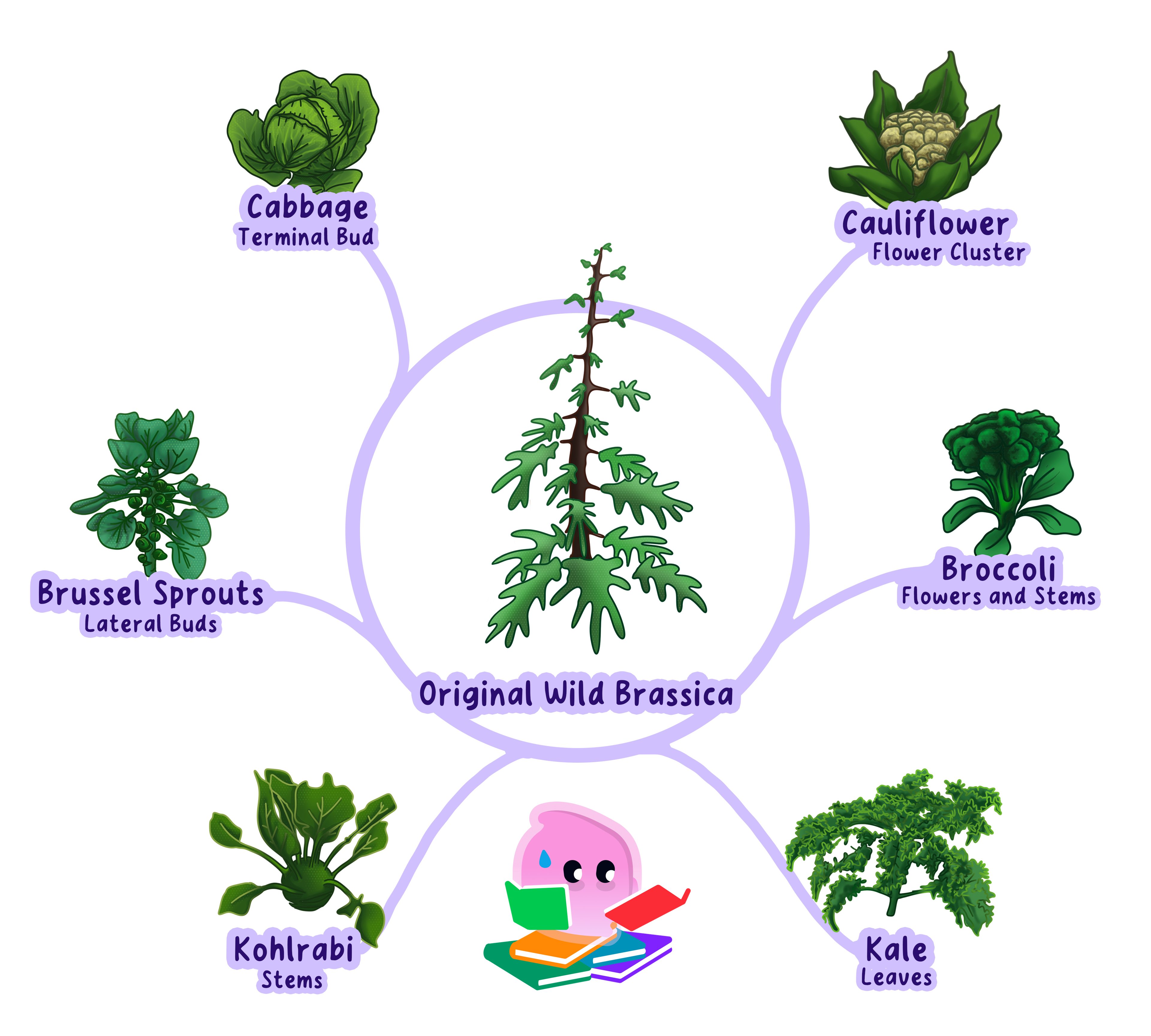
A full process answer must include choosing parents, breeding them, selecting the best offspring and repeating over many generations.
Benefits can reduce genetic diversity
- Food plants can be bred for higher yield, improved nutritional value, resistance to disease, uniform ripening or tolerance of drought.
- Domesticated animals can be bred for greater meat, milk or egg production, a calm temperament or resistance to disease.
- Repeatedly using closely related individuals narrows the gene pool and increases inbreeding.
- A smaller gene pool raises the chance that harmful recessive alleles meet in offspring and reduces the population's ability to respond to a new disease or environmental change.
Do not describe selective breeding as genetic engineering; selective breeding chooses whole organisms, while genetic engineering directly changes DNA.
- What is selective breeding?
- What four stages are repeated?
- Give one useful plant characteristic and one useful animal characteristic.
- Why can selective breeding increase inherited disorders?
4.3.2 Tissue culture
Tissue culture makes genetically identical cells
Tissue culture
Growing many identical new plants (or cells) from a small sample of tissue on a nutrient medium.
- Tissue culture is the growth of cells or small pieces of tissue on a sterile nutrient medium so that many genetically identical cells or organisms are produced.
- For plants, remove a small piece of tissue called an explant from a parent with the desired characteristics.
- Sterilise the explant and equipment to prevent bacteria or fungi from outcompeting the plant cells.
- Place the explant on sterile agar containing minerals, sugar and plant growth regulators.
- Keep the culture under controlled light and temperature until cells divide by mitosis and form a mass of cells.
- Transfer small groups of cells to media with suitable hormone balances so shoots and roots develop, then move plantlets to compost and acclimatise them gradually.
Contamination can destroy a culture, so aseptic technique is part of the biological method rather than a minor laboratory detail.
Clones give consistency and rapid production
Clone
An organism that is genetically identical to another, produced without sexual reproduction.
- A clone is an organism or cell that is genetically identical to another because it was produced from one parent by mitosis.
- A small sample can produce many plants quickly, at any time of year and in little space.
- Rare plants can be conserved and crop varieties with high yield or disease resistance can be copied without losing their allele combination.
- Genetically identical cells allow medical researchers to test treatments while reducing genetic variation between samples.
- All clones may share the same susceptibility to a pathogen, and mutation or contamination can affect many cultures.
A disease-resistant banana plant can supply sterile explants that produce thousands of genetically identical plantlets.
- What is tissue culture?
- Why must the equipment and medium be sterile?
- How are shoots and roots produced from an explant?
- Give one benefit and one risk of cloning many plants.
4.3.3 Genetic engineering overview
Genetic engineering changes an organism's genome
Genetic engineering
Changing an organism's characteristics by transferring a gene from one organism into another, so the second organism produces a desired protein or feature.
- Genetic engineering is the deliberate modification of an organism's genome by inserting, removing or changing DNA to produce a desired inherited characteristic.
- A gene contains the base sequence for a protein, so transferring a gene can give the recipient cell instructions to make a new protein.
- The inserted gene becomes part of the recipient's genetic material and can be copied when the cell divides.
- An organism containing DNA introduced from another species is described as transgenic.
- Genetic engineering targets a known gene, while selective breeding mixes many alleles from two parents.
A human insulin gene can be placed in bacteria, which then make human insulin protein when the gene is expressed.
Desired features depend on gene expression
- The transferred gene must enter suitable cells and be switched on for its protein to be made.
- A regulatory DNA sequence may be needed so the host cell transcribes the inserted gene.
- Successfully modified cells must be identified and copied to produce enough cells or a complete organism.
- The new phenotype depends on the protein's action, such as producing an insecticidal protein or a medically useful hormone.
Do not write that a gene is an organism's characteristic; the gene codes for a product that helps produce the characteristic.
Link gene transfer to protein production, then link the protein to the desired phenotype.
- What is genetic engineering?
- How can an inserted gene change a phenotype?
- What does transgenic mean?
- How does genetic engineering differ from selective breeding?
4.3.4 Main stages of genetic engineering
Enzymes cut and join the required gene
Restriction enzyme
An enzyme that cuts DNA at a specific base sequence, used in genetic engineering to cut out a required gene and to open a vector.
- A restriction enzyme cuts DNA at a specific recognition sequence.
- Use a restriction enzyme to cut the required gene from donor DNA.
- Cut a plasmid with the same restriction enzyme so the gene and plasmid have complementary sticky ends.
- Sticky ends are short exposed single-stranded DNA sequences that pair by complementary base pairing.
- Mix the gene and opened plasmid so matching sticky ends join.
- DNA ligase seals the sugar-phosphate backbone, producing a recombinant plasmid.
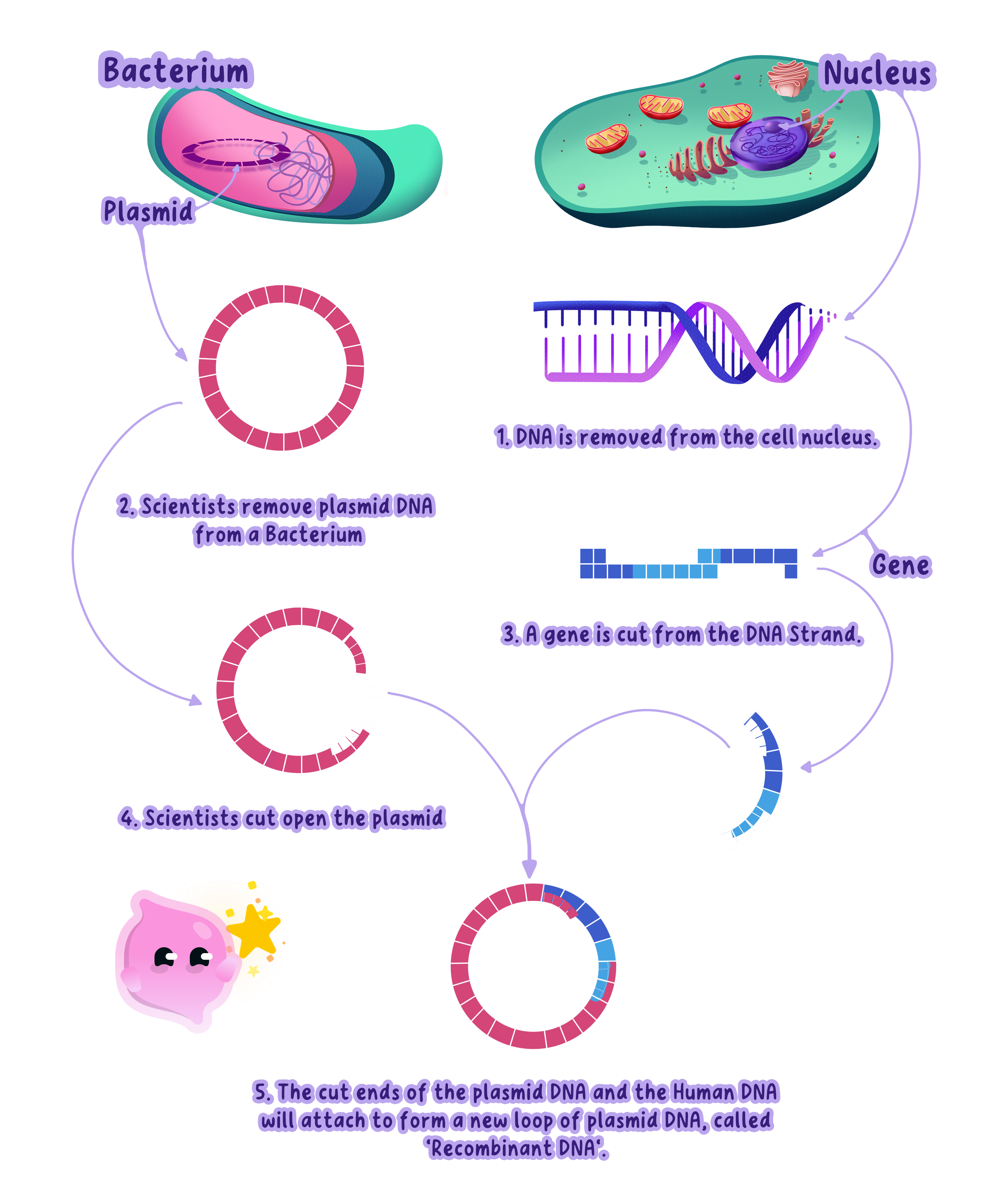
Restriction enzymes cut DNA, while DNA ligase joins the DNA backbone.
A vector carries the gene into cells
Vector
Something used to carry a gene into a cell during genetic engineering, usually a plasmid or a virus.
- A vector is a carrier used to transfer genetic material into a cell.
- Plasmids are small circular DNA molecules that can be removed from bacteria, modified and returned to bacterial cells.
- Viruses can also act as vectors because they naturally insert genetic material into cells.
- Introduce the recombinant vector into recipient cells, then use a marker to identify cells that received it.
- Grow the selected cells by mitosis so the inserted gene is copied and its protein can be produced on a large scale.
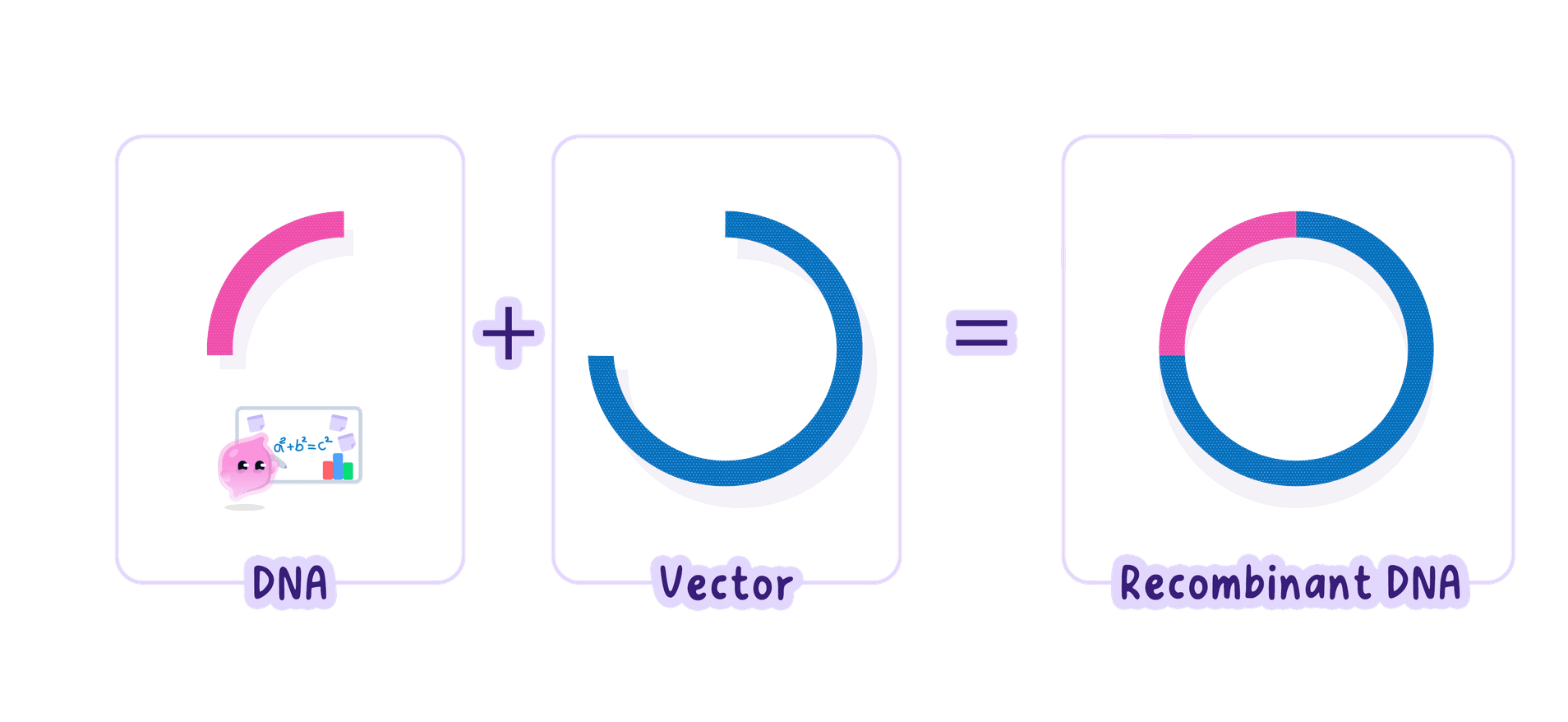
Keep the sequence precise: isolate the gene, cut donor DNA and vector with the same restriction enzyme, pair sticky ends, seal with ligase, transfer with a vector, then select and clone modified cells.
The whole process forms a causal chain
- The restriction site determines where DNA is cut and whether compatible sticky ends form.
- Complementary sticky ends hold the two DNA pieces together before ligase makes the join permanent.
- The vector protects and transports the gene, while the host cell supplies the machinery for gene expression.
- Selection separates successfully modified cells from cells that did not take up the vector.
Bacteria containing a recombinant plasmid can be cultured in fermenters to make a protein such as human insulin.
- What does a restriction enzyme do?
- How do sticky ends help join DNA?
- What does DNA ligase do?
- What is the role of a vector?
4.3.5 Advantages and disadvantages of GM organisms
GM crops can gain useful characteristics
Transgenic organism
An organism that contains genetic material transferred into it from a different species by genetic engineering.
- A transgenic organism contains genetic material introduced from another species by genetic engineering.
- A gene from the bacterium Bacillus thuringiensis can be inserted into a crop plant so its cells produce the Bt protein.
- The protein is toxic to particular insect pests that feed on the crop, so less crop tissue is damaged.
- Reduced pest damage can increase yield and reduce the amount of broad-spectrum insecticide sprayed.
- Other modifications can improve nutritional content, delay ripening, produce medicine or increase tolerance of drought, salt or disease.
Bt maize makes an insecticidal protein in its tissues, so susceptible larvae feeding on the plant are killed.
Benefits must be weighed against risks
Biodiversity
The number of different species that live in an area.
- Biodiversity is the variety of different species living in an area.
- Pollen can transfer an inserted allele to wild relatives, where the characteristic may spread beyond the crop field.
- Heavy use of one insecticidal trait creates selection pressure that can increase resistant pest populations.
- A toxin may affect non-target organisms, food webs or biodiversity, so effects must be monitored.
- Seeds may be expensive or controlled by a small number of companies, which can make farmers dependent on suppliers.
- Potential health effects are tested before approval, but uncertainty about long-term ecological effects remains part of an evaluation.
Do not claim that every GM crop has the same benefit or risk; evaluate the inserted gene, organism and environment in the question.
For an evaluation, develop both sides with consequences and finish with a judgement based on the evidence given.
- How is a Bt crop produced and protected?
- Give two benefits of GM crops.
- How could an inserted allele spread into wild plants?
- Why can resistant pests evolve?
4.3.6 Agricultural solutions for a growing population
Fertilisers raise yield but can pollute water
Fertiliser
A substance added to soil to supply the mineral ions, such as nitrate, phosphate and potassium, that plants need for healthy growth.
- Fertilisers supply mineral ions that may limit plant growth, including nitrate ions for amino acids and magnesium ions for chlorophyll.
- Correct application can increase growth and crop yield, helping more food to be produced from the same area of land.
- Excess soluble fertiliser can be washed from soil into rivers and lakes by rain.
- The extra nitrate stimulates rapid algal growth, forming an algal bloom that blocks light.
- Aquatic plants die, decomposers multiply and their respiration removes dissolved oxygen.
- Low oxygen can kill fish and other aerobic organisms, a process called eutrophication.
In a eutrophication explanation, link fertiliser run-off to algal growth, blocked light, plant death, decomposition, oxygen loss and death of aquatic organisms.
Biological control uses natural enemies
Biological control
The use of a natural predator, parasite or pathogen to reduce the population of a pest, instead of chemical pesticides.
- Biological control reduces a pest population by introducing or encouraging a predator, parasite or pathogen of that pest.
- It can reduce chemical pesticide use, leave fewer chemical residues and provide longer-term control if the control organism reproduces.
- The control organism may not remove the pest quickly enough and usually does not eradicate it.
- An introduced organism may attack non-target species, spread beyond the intended area or disrupt food webs.
- The control species should be host-specific, tested in containment and monitored after release.
Ladybirds can be used to reduce aphids because they feed on the pest, but the population and effects on other insects still need monitoring.
Agriculture needs a balanced judgement
- A growing population increases demand for reliable food production, but higher yield can create environmental costs.
- Fertilisers give rapid, predictable mineral supply, while biological control can reduce repeated pesticide use.
- The best method depends on crop, climate, pest, cost, speed, environmental risk and the evidence available.
- Integrated pest management combines monitoring, targeted chemicals, resistant varieties and biological controls to reduce harm while maintaining yield.
Compare methods using the same criteria, then make a conclusion that follows from the context rather than stating that one method is always best.
- How can nitrate fertiliser increase plant growth?
- Explain eutrophication as a sequence.
- What is biological control?
- Give one benefit and one risk of biological control.
4.3.7 Evaluating genetic engineering and breeding
The methods change populations in different ways
Genetic engineering
Changing an organism's characteristics by transferring a gene from one organism into another, so the second organism produces a desired protein or feature.
- Genetic engineering directly changes DNA by inserting, removing or altering a gene, so a chosen characteristic can be introduced in one generation.
- It can cross species boundaries and target a known protein, but the inserted gene may have unexpected effects or spread into other populations.
- The method requires specialist equipment, testing and regulation, which can make development expensive.
Selective breeding uses existing variation
Selective breeding
Choosing organisms with a desired characteristic and breeding them together over many generations so the characteristic becomes stronger in the offspring. Also called artificial selection.
- Selective breeding chooses parents with desirable inherited characteristics and repeats selection over many generations.
- It is widely used and does not require direct DNA manipulation, but it is slower and transfers many alleles together.
- Inbreeding can reduce genetic diversity and increase the frequency of harmful recessive disorders.
Producing disease-resistant cattle by selective breeding may also concentrate an unwanted recessive allele, while inserting a known resistance gene is more targeted but raises different technical and ethical questions.
Agricultural benefits have linked risks
- Higher yield, improved nutrition, disease resistance and drought tolerance can strengthen food security.
- Reduced pesticide use can lower costs and harm to non-target organisms.
- Gene flow, resistant pests, reduced biodiversity and dependence on patented seed can create environmental or economic costs.
- Animal breeding for extreme production may reduce welfare if rapid growth or body shape causes pain or disease.
Medical uses require ethical safeguards
- Genetically modified microorganisms can produce human proteins such as insulin in large, consistent quantities.
- Genetic technologies may help treat disease, but changes to body cells and inherited changes to embryos have different consequences.
- Ethical concerns include consent, fairness of access, animal welfare, ownership of genetic material and effects on future generations.
- Risk is reduced by testing, containment, monitoring, regulation and comparing the method with available alternatives.
Build an evaluation from specific benefits, specific risks, evidence from the context and a justified conclusion that states the conditions under which the benefit outweighs the risk.
Ethical concern alone is not a conclusion; explain who or what may be affected and how.
- How does genetic engineering differ from selective breeding?
- Give one benefit and one risk of each method.
- Why can selective breeding reduce genetic diversity?
- What makes an evaluation judgement justified?
