3.1.1 Advantages and disadvantages of reproduction
Asexual reproduction
Asexual reproduction
Reproduction involving only one parent and no fusion of gametes, producing offspring that are genetically identical to the parent.
- Asexual reproduction produces new individuals from a single parent.
- No sex cells are made and no two cells fuse together, so no genetic material arrives from a second organism.
- The new individuals are produced by mitosis, the cell division that copies every chromosome exactly before the cell divides.
- Each new cell therefore receives a complete copy of the parent's DNA.
- The offspring are genetically identical to the parent and to one another.
- Any differences between them come from the conditions they grow in rather than from their genes.
Clones and natural examples
Clone
An offspring that is genetically identical to its parent.
- Offspring that carry exactly the same genetic material as the parent that produced them are clones.
- Bacteria divide by binary fission, in which one cell copies its DNA and then splits into two identical daughter cells.
- A single bacterium can produce a colony of millions of clones within a day when food and warmth are available.
- A strawberry plant grows horizontal stems called runners, and a new plant with the same genes forms wherever a runner touches the soil.
- A potato plant swells the ends of underground stems into tubers, and each tuber can sprout into a new plant identical to the one that made it.
- A spider plant produces small plants on long arching stems, and each plantlet roots into a separate identical plant.
- Aphids reproduce asexually through the summer, so a single female can fill a plant with identical young without ever mating.
Every advantage and disadvantage of the two methods follows from one difference: asexual reproduction copies one set of genes unchanged, while sexual reproduction mixes two.
Asexual reproduction: advantages and disadvantages
- No mate is needed, so no time or energy is spent searching for one or competing for one.
- An organism that is isolated, or that lives in a population spread thinly over a large area, can still reproduce.
- The reproductive cycle is rapid, so numbers build up very quickly whenever conditions are favourable.
- Only one parent is needed, so a single organism arriving in a new habitat can populate that habitat on its own.
- A set of genes that already suits the habitat is passed on unchanged, so the offspring are as well suited to those conditions as the parent is.
- Less energy goes into making sex cells, into courtship displays and into caring for young, leaving more energy for growth.
- The central disadvantage is that there is no genetic variation in the population.
- Because every individual carries the same genes, a new disease affects every one of them in the same way, and the whole population can be wiped out.
- A change in conditions, such as a drop in temperature or the loss of one food source, affects every individual equally for the same reason.
- The population cannot adapt by natural selection, because there is no variation for selection to act on.
- Offspring grow close to the parent, so they compete with the parent and with each other for the same light, water, mineral ions or food.
- Questions commonly ask you to explain advantages and disadvantages, so each point needs a biological consequence rather than a label alone.
- The mark sits in the consequence, not in the label, so writing that asexual reproduction gives no variation and stopping there scores nothing.
- Adding what the lack of variation leads to, that one new disease could kill every individual because they all respond to it in the same way, is what earns the mark.
- Check each point you have written ends in a clause beginning so or because, and in a six mark answer group the advantages together and then the disadvantages, so both halves are easy to find.
Sexual reproduction
Sexual reproduction
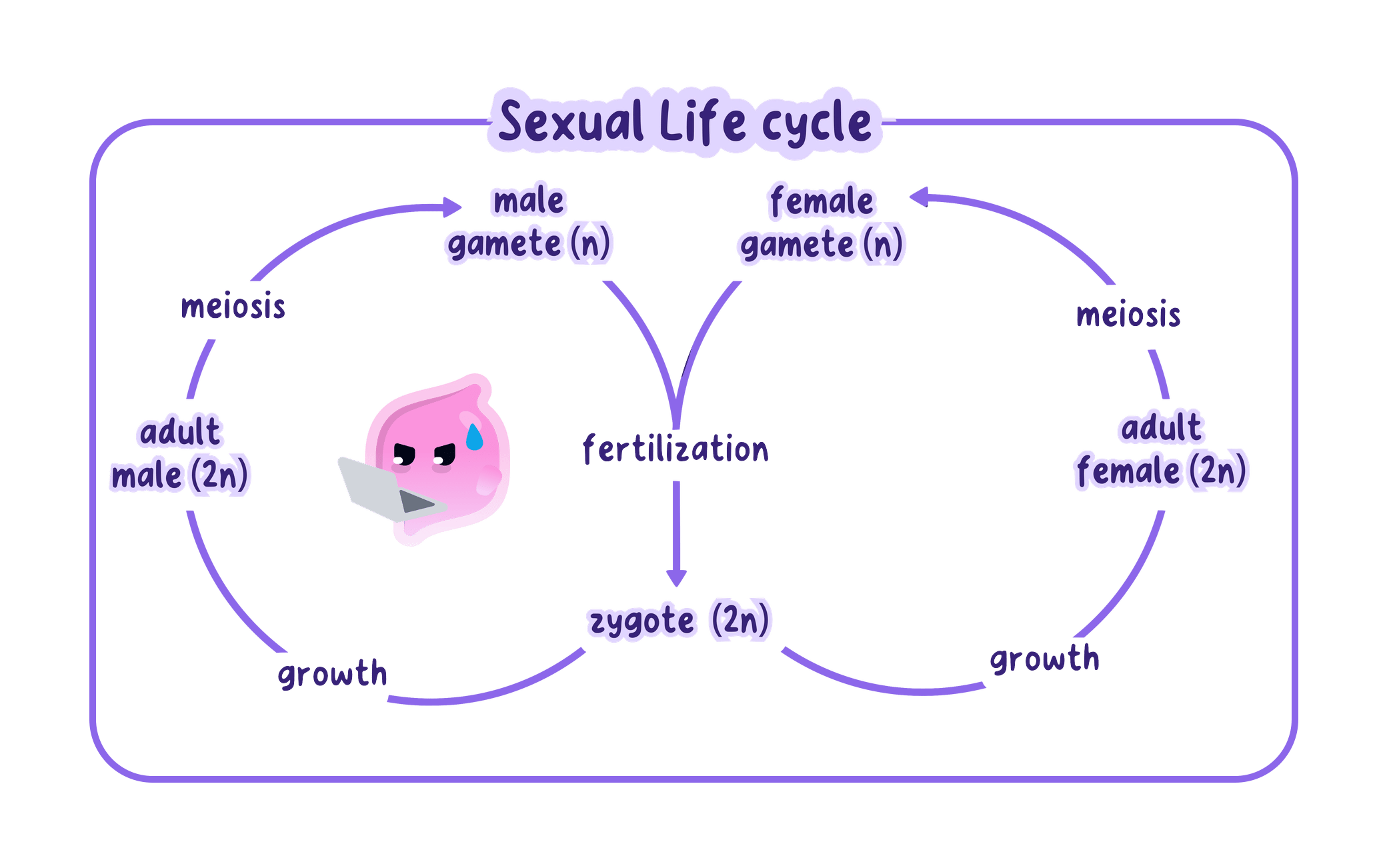
Reproduction involving the fusion of a male gamete and a female gamete at fertilisation, producing offspring that are genetically different from their parents.
- Sexual reproduction produces offspring from two parents rather than one.
- Each parent passes on half of the genetic material that the offspring will carry.
- The two parents carry different alleles, which are different versions of the same gene, so the offspring inherit a combination that neither parent had.
- The offspring are therefore genetically different from both parents and from each other.
- Brothers and sisters resemble their parents without matching them, and only identical twins share exactly the same genes.
- Do not write that sexual reproduction is simply better than asexual reproduction.
- Each method carries real costs, and which one is useful depends on the conditions the organism is living in, so an answer that ranks them loses the comparison mark.
- Do not describe asexually produced offspring as similar to the parent, because the mark is awarded for genetically identical.
Gametes and meiosis
Gamete
A sex cell that carries half the number of chromosomes of a body cell and fuses with another gamete at fertilisation.
- The sex cells that fuse in sexual reproduction are gametes.
- In animals the male gamete is the sperm cell and the female gamete is the egg cell.
- In flowering plants the male gamete is carried inside a pollen grain and the female gamete is the egg cell held in the ovule.
- Gametes are made by meiosis, the cell division that halves the chromosome number.
- A human body cell contains 2n=462n = 462n=46 chromosomes, while a human gamete contains n=23n = 23n=23.
- Every gamete a parent makes carries a different selection of that parent's alleles, which is the first source of the variation seen in the offspring.
- Meiosis is used only to make gametes; every other cell division in the body, including the growth of the offspring itself, is mitosis.
- How meiosis halves the chromosome number and produces four genetically different cells is set out in full in the next article.
Fertilisation and the zygote
Fertilisation
The fusion of the nucleus of a male gamete with the nucleus of a female gamete to form a zygote.
- Fertilisation is the fusion of the nucleus of a male gamete with the nucleus of a female gamete.
- The single cell formed by that fusion is a zygote.
- Each gamete supplied half a set of chromosomes, so the zygote carries the full number again, 2n=462n = 462n=46 in humans.
- The zygote then divides by mitosis to form an embryo, so every body cell of the new individual carries the same mixture of alleles.
- Half of those alleles came from one parent and half from the other, which is why the offspring resembles both parents without matching either of them.
Sexual reproduction: advantages and disadvantages
- Sexual reproduction produces genetic variation, because the offspring receive a mixture of alleles from two parents.
- When conditions change or a new disease appears, that variation makes it likely that some individuals already carry alleles allowing them to survive.
- Those survivors live long enough to reproduce and pass the helpful alleles on to their own offspring.
- The proportion of individuals carrying those alleles rises with each generation, so the species adapts by natural selection.
- The same variation is what makes selective breeding of crops and farm animals possible.
- The first cost is that a mate must be found, which takes time and energy and can expose an organism to predators while it searches or displays.
- An organism isolated from others of its species cannot reproduce at all.
- The reproductive cycle is slower, so fewer offspring are produced in the same length of time.
- Energy is spent building gametes, on courtship, and in many animals on feeding and protecting the young after birth.
- An aphid uses both methods within a single year, and the conditions decide which one pays.
- Through spring and summer the plant sap it feeds on is plentiful and the weather is mild, so a female produces daughters asexually.
- No male, no mate and no gametes are needed, and each daughter is a clone that can itself reproduce within days, so the colony exploits the food supply before the plant is exhausted.
- Uniformity costs the colony almost nothing while the conditions stay the same, because the parent's genes already suit them.
- In autumn the day length shortens and the plant dies back, so the conditions the clones are suited to disappear.
- Males are now produced, mating takes place and fertilised eggs are laid that survive the winter.
- Those eggs are genetically varied, so some are likely to carry alleles that let them tolerate the cold and hatch in spring.
Comparing sexual and asexual reproduction
- Asexual reproduction needs one parent, while sexual reproduction needs two.
- Asexual reproduction involves no gametes and no fertilisation, while sexual reproduction depends on both.
- Offspring produced asexually are made by mitosis and are genetically identical, while offspring produced sexually begin as a zygote and are genetically different.
- Asexual reproduction is faster and yields more offspring in a given time, while sexual reproduction is slower and yields fewer.
- Asexual reproduction gives no variation, so the population cannot adapt, while sexual reproduction gives variation, so natural selection has something to act on.
- Many organisms use both methods and switch between them as their conditions change.
- While conditions are favourable they reproduce asexually, so numbers rise quickly and the habitat is exploited.
- When conditions turn harsh they reproduce sexually, so the varied offspring include some that may survive the new conditions.
- The malarial parasite reproduces asexually inside the human host, where conditions are constant, and sexually inside the mosquito.
- A strawberry plant sends out runners through the summer and also produces flowers, whose fertilised ovules become genetically varied seeds.
- Aphids follow the same pattern, reproducing asexually in summer and sexually in autumn.
- Why are the offspring of asexual reproduction genetically identical to the parent?
- Give one advantage of asexual reproduction and state the consequence that makes it an advantage.
- Explain why a population of clones can be destroyed by a single new disease.
- How does the variation produced by sexual reproduction allow a species to adapt over generations?
- Why does an aphid switch from asexual to sexual reproduction in autumn?
3.1.2 Role of meiotic cell division
Chromosomes in body cells
Chromosome
A long molecule of coiled DNA found in the nucleus, carrying many genes in a fixed order.
- A chromosome is a long molecule of DNA in the nucleus that carries the genes controlling a cell's characteristics.
- The nucleus of a human body cell contains 464646 chromosomes.
- These chromosomes are arranged in 232323 pairs, and the two chromosomes of a pair carry the same genes in the same order.
- One chromosome of each pair was inherited from the mother in the egg cell, and the other was inherited from the father in the sperm cell.
- A cell that contains two copies of every chromosome is described as diploid.
- The diploid number of a human body cell is written 2n=462n = 462n=46, where nnn stands for one complete set of chromosomes.
- Every body cell is diploid, including skin cells, muscle cells and nerve cells.
Haploid gametes
Haploid
Describes a cell that contains one copy of each chromosome, which in humans is 23 chromosomes.
- Gametes are the sex cells that fuse together in sexual reproduction.
- In humans the gametes are the sperm cell and the egg cell.
- In flowering plants the gametes are the nucleus inside a pollen grain and the egg cell inside an ovule.
- A gamete contains one chromosome from each pair rather than both, so it carries a single set of chromosomes.
- A cell that carries a single set of chromosomes is described as haploid.
- A human gamete therefore contains 232323 chromosomes, one from each of the 232323 pairs, written n=23n = 23n=23.
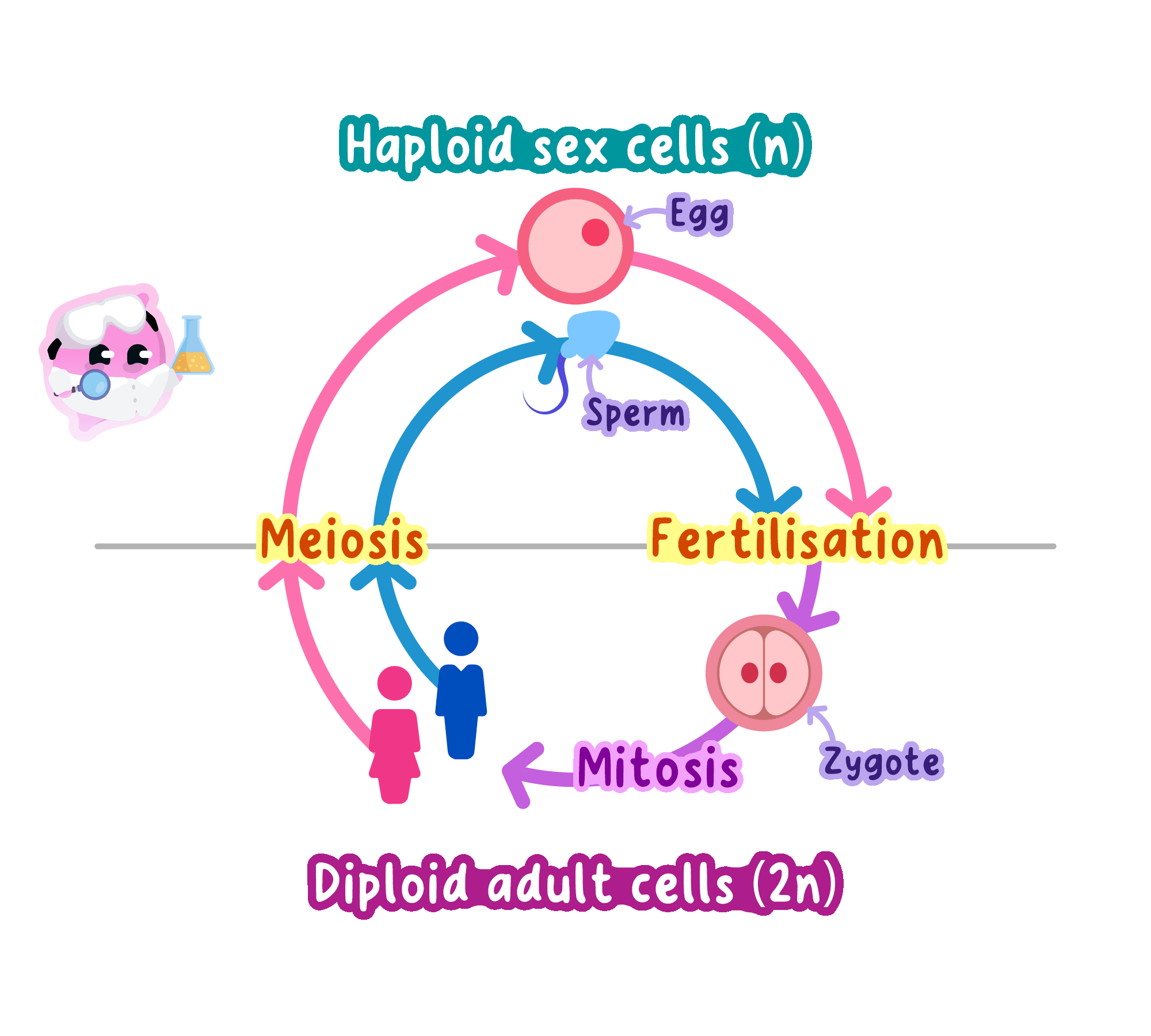
A body cell carries two copies of every chromosome, while a gamete carries only one chromosome from each pair.
How meiosis works
Meiosis
A type of cell division in which one diploid cell divides twice to produce four genetically different haploid daughter cells, which become the gametes.
- Meiosis is the type of cell division that produces gametes.
- In humans, meiosis takes place in the testes, where it makes sperm cells, and in the ovaries, where it makes egg cells.
- In flowering plants, meiosis takes place in the anthers, which make pollen, and in the ovules, which make egg cells.
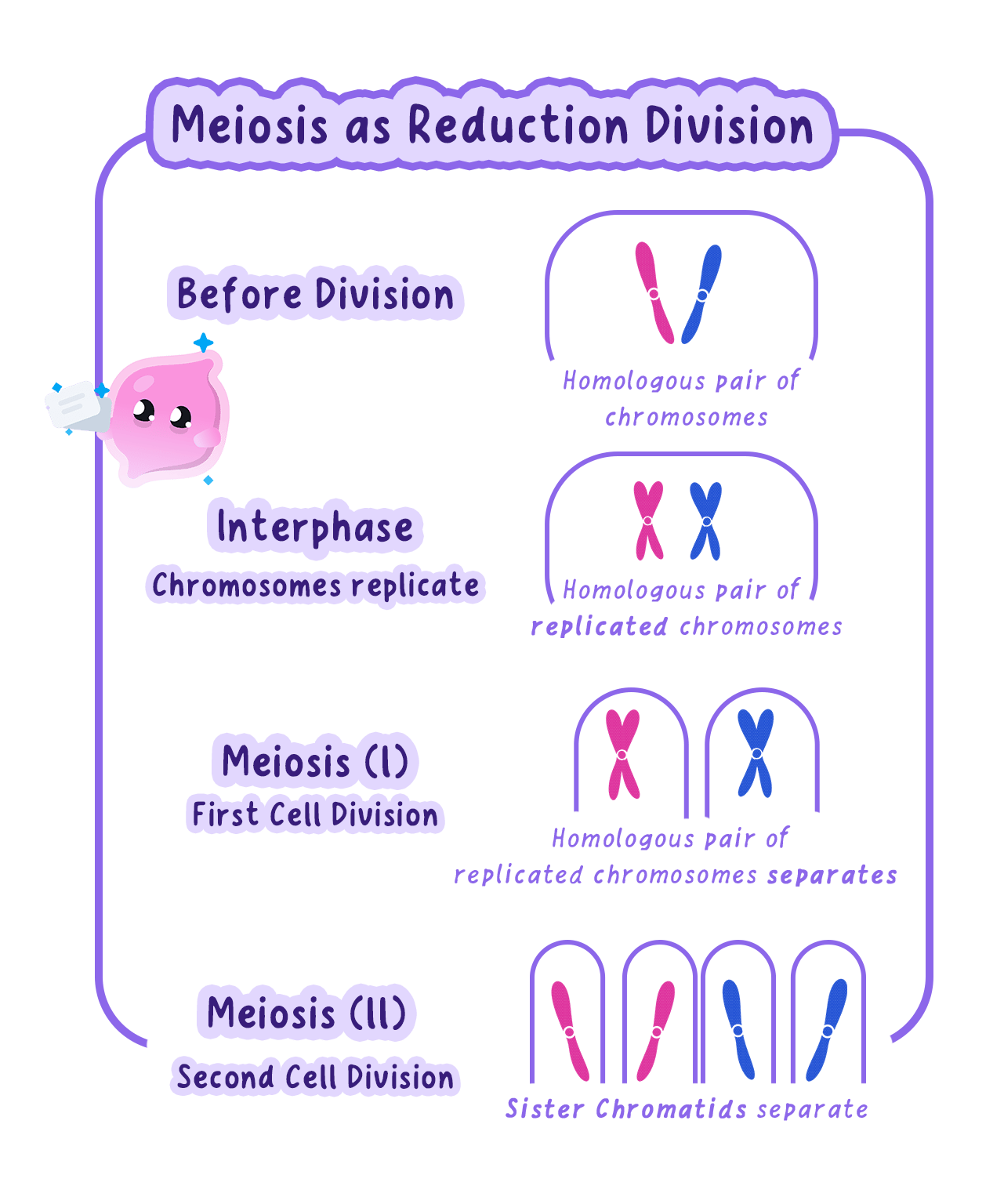
- Meiosis starts with a single diploid parent cell in which every chromosome has been copied.
- The cell then divides twice, so one parent cell gives rise to four daughter cells.
- Each daughter cell receives half the number of chromosomes of the parent cell, so each one is haploid.
- One human cell with 464646 chromosomes therefore produces four cells with 232323 chromosomes each.
- Each daughter cell is genetically different from the other three and from the parent cell it came from.
- The role of meiosis is therefore to produce genetically different haploid gametes from one diploid cell.
- Do not write that meiosis produces two genetically identical cells, because that describes mitosis instead.
- Do not describe gametes as identical, because the four cells made by one meiosis differ from one another.
- Read back the word you have written, because mitosis and meiosis are marked as different answers and describing the wrong division earns nothing.
Fertilisation restores chromosome number
Fertilisation
The fusion of the nucleus of a male gamete with the nucleus of a female gamete to form a zygote.
- Fertilisation is the fusion of the nucleus of a male gamete with the nucleus of a female gamete.
- Each gamete brings a single set of chromosomes, so the new cell receives 232323 chromosomes from the mother and 232323 from the father.
- The new cell therefore contains 23+23=4623 + 23 = 4623+23=46 chromosomes and is diploid, 2n=462n = 462n=46.
- The halving in meiosis and the doubling at fertilisation cancel each other out, so the chromosome number of the species stays the same from one generation to the next.
- If gametes were diploid instead, two gametes of 464646 chromosomes would fuse to give a cell with 929292 chromosomes.
- That generation would then make gametes of 929292 chromosomes and offspring of 184184184, so the number would double at every fertilisation.
- Halving the chromosome number in meiosis is what prevents this doubling and keeps the chromosome number of the species constant.
- When you are asked why gametes must be haploid, the mark sits on the consequence, so write that the chromosome number would double at every fertilisation if gametes were diploid.
- Answers saying only that the chromosome number would be wrong, or that the offspring would have too many chromosomes, describe the problem without explaining it and are not credited.
- The mark most often dropped is the second half of the chain: many answers stop at meiosis halving the chromosome number and never say that this keeps the number constant from generation to generation.
- If the question asks for a difference between mitosis and meiosis, give both halves of it, such as two daughter cells from mitosis against four from meiosis, since a statement about only one of the two divisions is not a difference.
Zygote growth by mitosis
Zygote
The single diploid cell produced when two gametes fuse at fertilisation.
- The diploid cell formed at fertilisation is called a zygote.
- The zygote divides repeatedly by mitosis to form a ball of cells that develops into an embryo.
- Every chromosome is copied before each of these divisions, so each new cell receives a full set of 464646 chromosomes.
- All of the body cells built in this way are diploid and genetically identical to the zygote they came from.
- The chromosome number of an organism can therefore be tracked through the whole cycle: diploid body cell, haploid gamete, diploid zygote, diploid body cell.
- A body cell of a fruit fly contains 2n=82n = 82n=8 chromosomes, so meiosis halves this and a fruit fly gamete contains n=82=4n = \dfrac{8}{2} = 4n=28=4 chromosomes.
- Two of those gametes fuse at fertilisation, so the zygote contains 4+4=84 + 4 = 84+4=8 chromosomes, back to 2n=82n = 82n=8.
- A horse body cell contains 2n=642n = 642n=64 chromosomes, so a horse gamete contains 642=32\dfrac{64}{2} = 32264=32 chromosomes.
- A donkey body cell contains 2n=622n = 622n=62 chromosomes, so a donkey gamete contains 622=31\dfrac{62}{2} = 31262=31 chromosomes.
- A horse gamete fusing with a donkey gamete gives a mule with 32+31=6332 + 31 = 6332+31=63 chromosomes, so a mule has a diploid number of 2n=632n = 632n=63.
- An odd number of chromosomes cannot be sorted into matching pairs, which is why a mule cannot make working gametes and is almost always sterile.
Comparing mitosis and meiosis
- Both divisions begin after the chromosomes have been copied, but they differ in the number of divisions, daughter cells, chromosome sets, genetic similarity and biological role.
- Number of divisions: mitosis divides the parent cell once, while meiosis divides it twice.
- Number of daughter cells: mitosis produces two daughter cells, while meiosis produces four.
- Chromosome number: the daughter cells of mitosis are diploid with 464646 chromosomes, while the daughter cells of meiosis are haploid with 232323.
- Genetic make-up: the daughter cells of mitosis are genetically identical to the parent cell and to each other, while the daughter cells of meiosis are genetically different.
- Use in the organism: mitosis is used for growth, for the repair of damaged tissue and for asexual reproduction.
- Meiosis is used only to make gametes for sexual reproduction, and it takes place only in the reproductive organs.
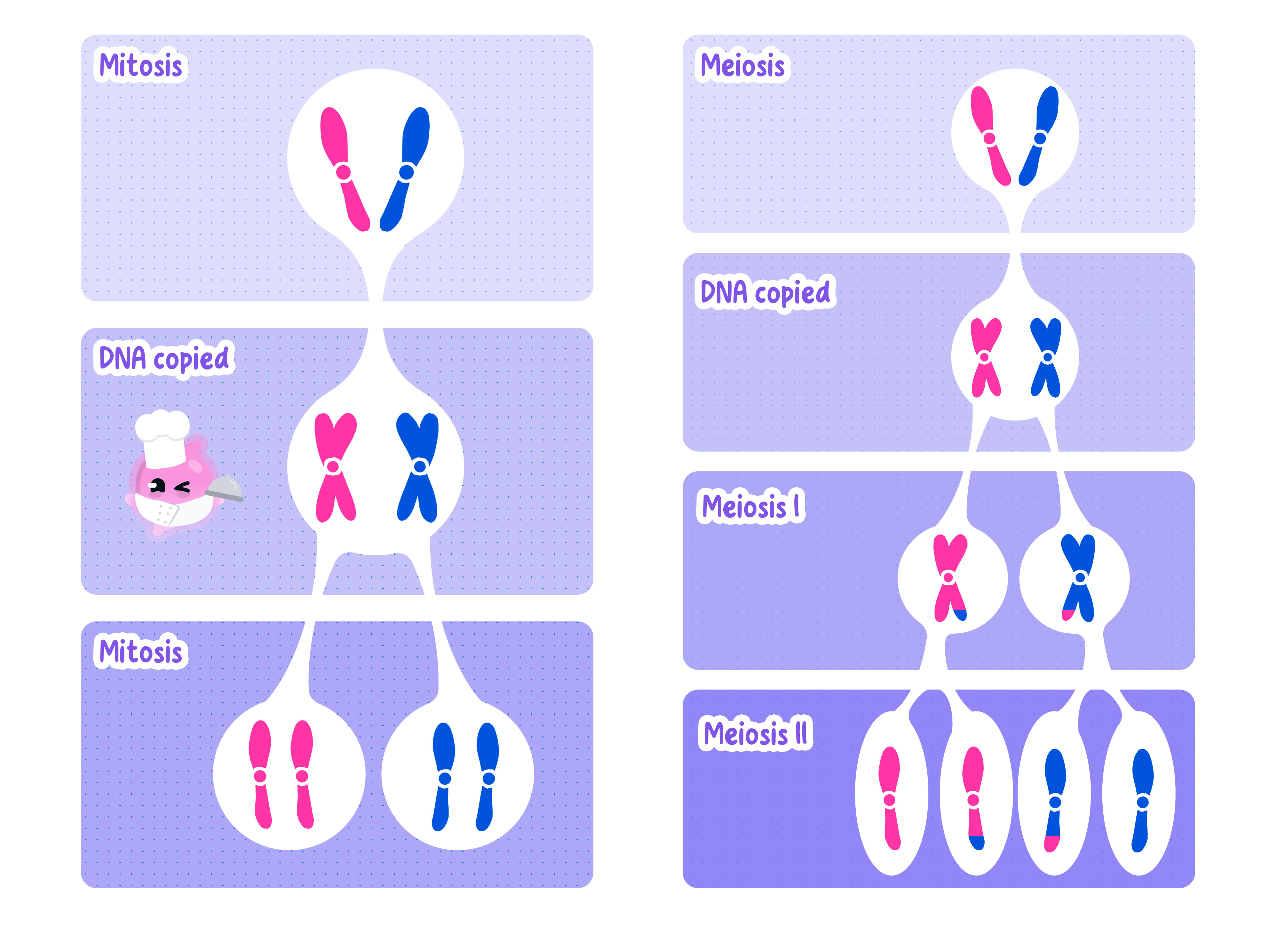
- Counting keeps the two apart: mitosis is one division and two identical cells, meiosis is two divisions and four different cells.
- The letters ei in meiosis can stand for eggs, and eggs are gametes, which only meiosis makes.
How meiosis creates variation
- The four gametes made by one meiosis are all genetically different from one another.
- Each gamete receives one chromosome from each pair, and which chromosome of a pair it receives varies from gamete to gamete.
- Every gamete therefore ends up with a different combination of the chromosomes the parent inherited from its own mother and father.
- Because a human cell has 232323 pairs to choose from, the number of different combinations a single person can produce is very large.
- Fertilisation is also random, because any sperm cell can fertilise any egg cell.
- Any one of a huge number of genetically different sperm cells can fuse with any one of a huge number of genetically different egg cells, so the number of possible zygotes is enormous.
- This is why offspring produced by sexual reproduction differ from each other and from both of their parents, while offspring produced by mitosis alone do not.
- How many chromosomes are there in a human body cell, and how many in a human gamete?
- How many daughter cells does one meiosis produce, and how do they compare genetically with the parent cell?
- Explain what would happen to the chromosome number of a species over several generations if its gametes were diploid.
- Give three differences between mitosis and meiosis.
- Why are the offspring of two parents genetically different from one another?
3.2.1 DNA structure as a polymer
Where DNA is found
DNA
The polymer that carries the genetic code, made of two nucleotide strands coiled into a double helix.
- DNA is the molecule that carries the genetic instructions an organism needs to build and run itself.
- In an animal or plant cell, DNA is found inside the nucleus.
- Within the nucleus the DNA is coiled up tightly and packaged into structures called chromosomes.
- Each chromosome contains one very long DNA molecule, and that coiling is what allows a molecule of such length to fit inside a nucleus.
- A DNA molecule is far too large to be a single simple unit, so its structure is best understood as one small unit repeated over and over.
DNA as a polymer
Nucleotide
The repeating unit of a DNA strand, made of a sugar and a phosphate group with one of four bases attached to the sugar.
- A polymer is a long molecule built from many small repeating units joined together in a chain.
- The repeating unit that DNA is built from is called a nucleotide, so DNA is a polymer of nucleotides.
- A single nucleotide is made of three parts joined together.
- One part is a sugar, which sits at the centre of the nucleotide.
- A phosphate group is joined to that sugar.
- A base is also attached to the same sugar.
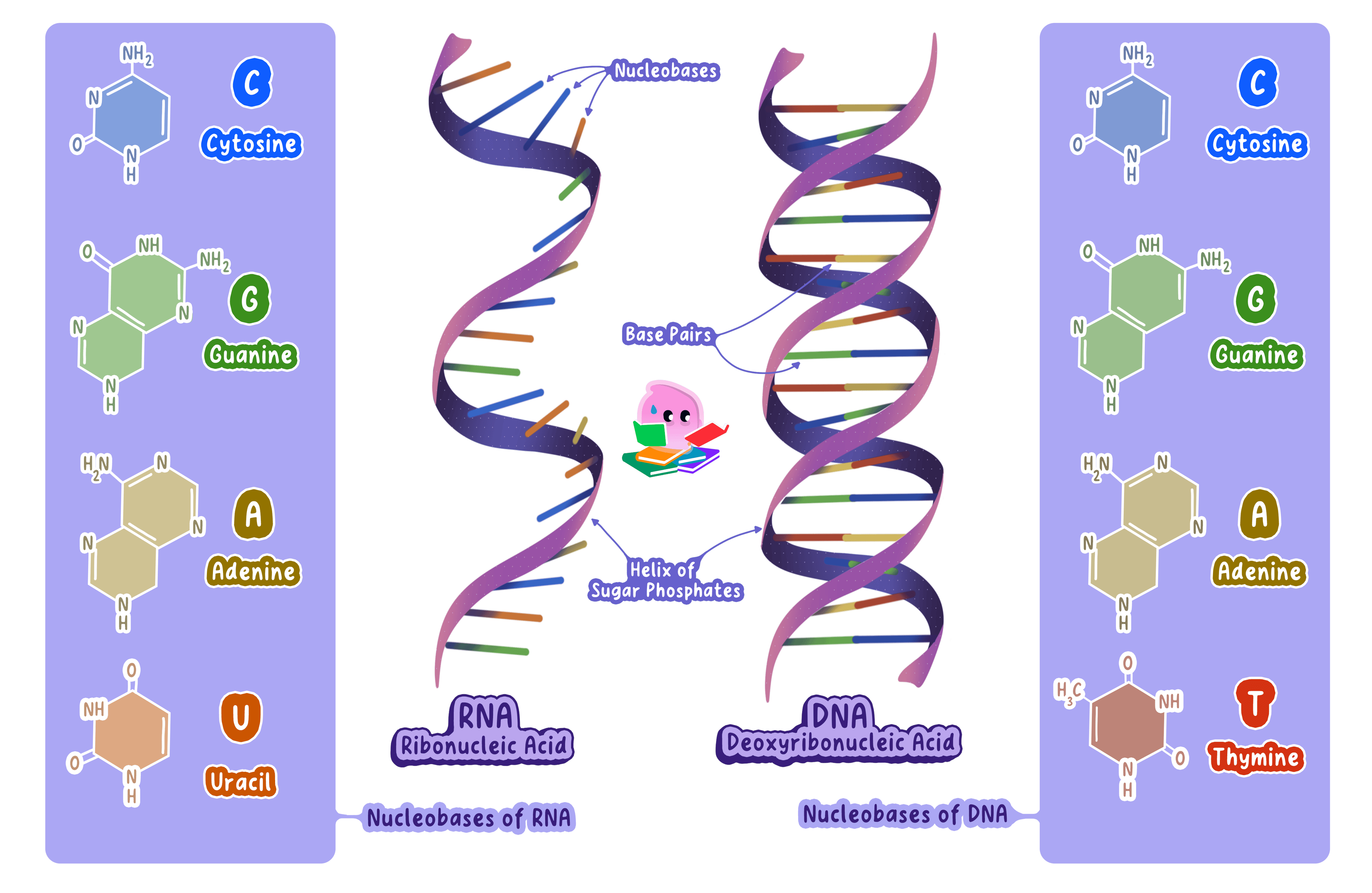
- There are four different bases in DNA: adenine (A\text{A}A), thymine (T\text{T}T), cytosine (C\text{C}C) and guanine (G\text{G}G).
- Every nucleotide in DNA contains the same sugar and the same phosphate group.
- The only difference between one nucleotide and another is therefore which of the four bases is attached to its sugar.
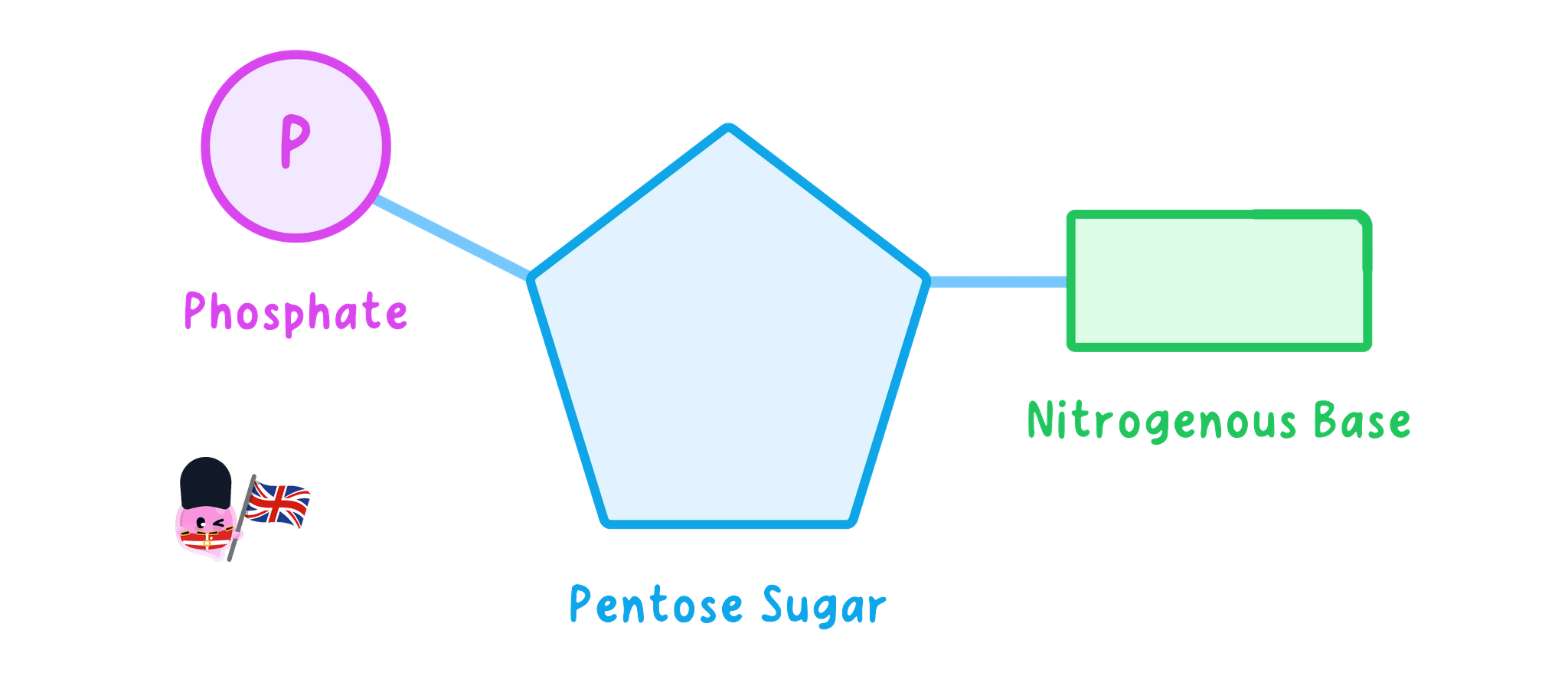
DNA is a polymer of nucleotides, and each nucleotide is a sugar joined to a phosphate group with one of four bases attached to that sugar.
The sugar-phosphate backbone
- Nucleotides join end to end to build a long strand of DNA.
- The phosphate group of one nucleotide joins to the sugar of the next nucleotide.
- Repeating that join thousands of times produces a chain in which sugars and phosphates alternate along the whole length of the strand.
- This alternating chain of sugars and phosphates is the sugar-phosphate backbone of the strand.
- The bases are not part of the backbone, because each base stays attached to its own sugar and points inwards, away from the backbone.
- A complete DNA molecule is made of two such strands lying alongside each other, with the bases of one strand facing the bases of the other.
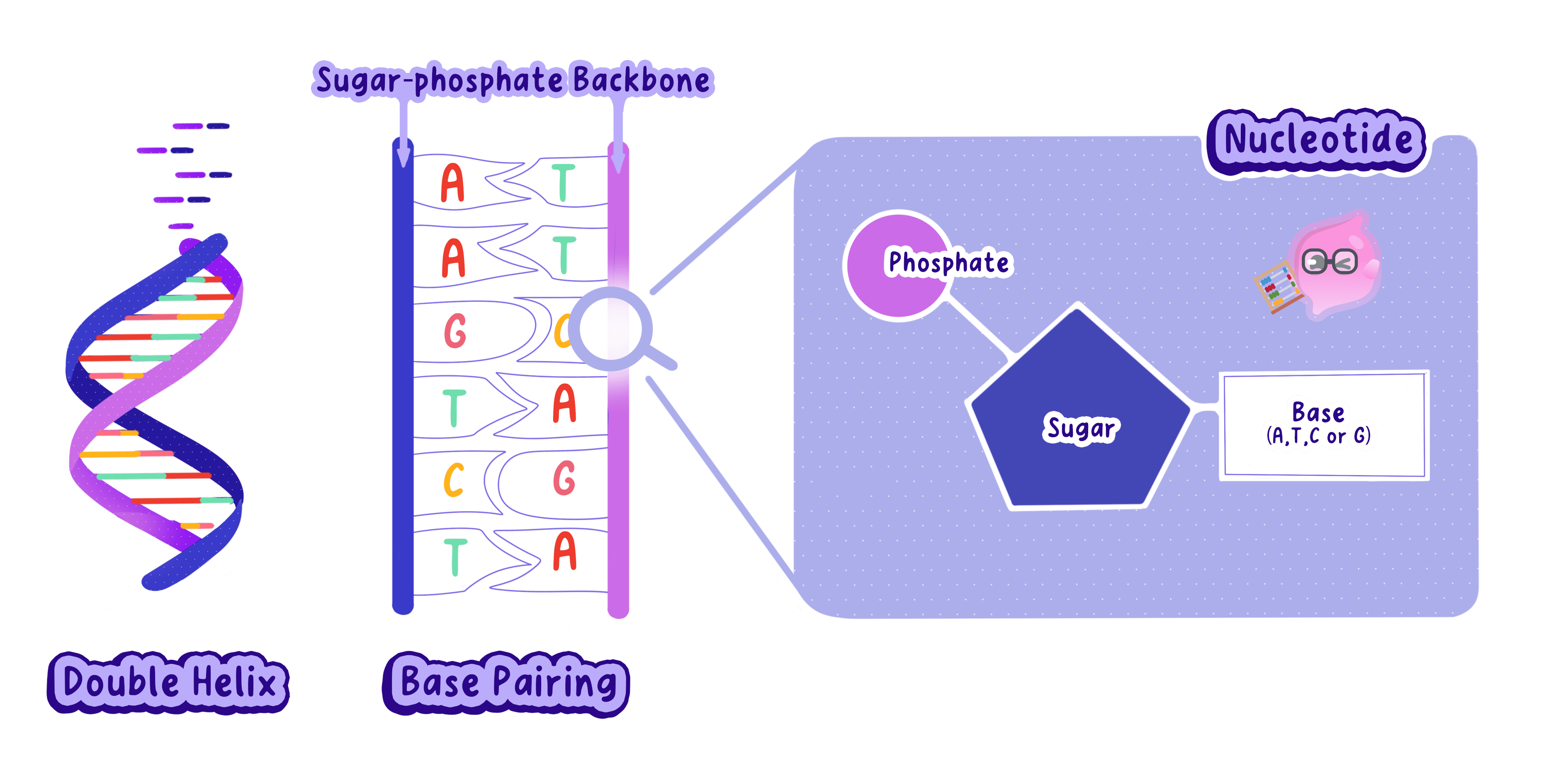
Complementary base pairing
Complementary base pairing
The rule that adenine always pairs with thymine and cytosine always pairs with guanine, the two bases being joined by weak hydrogen bonds.
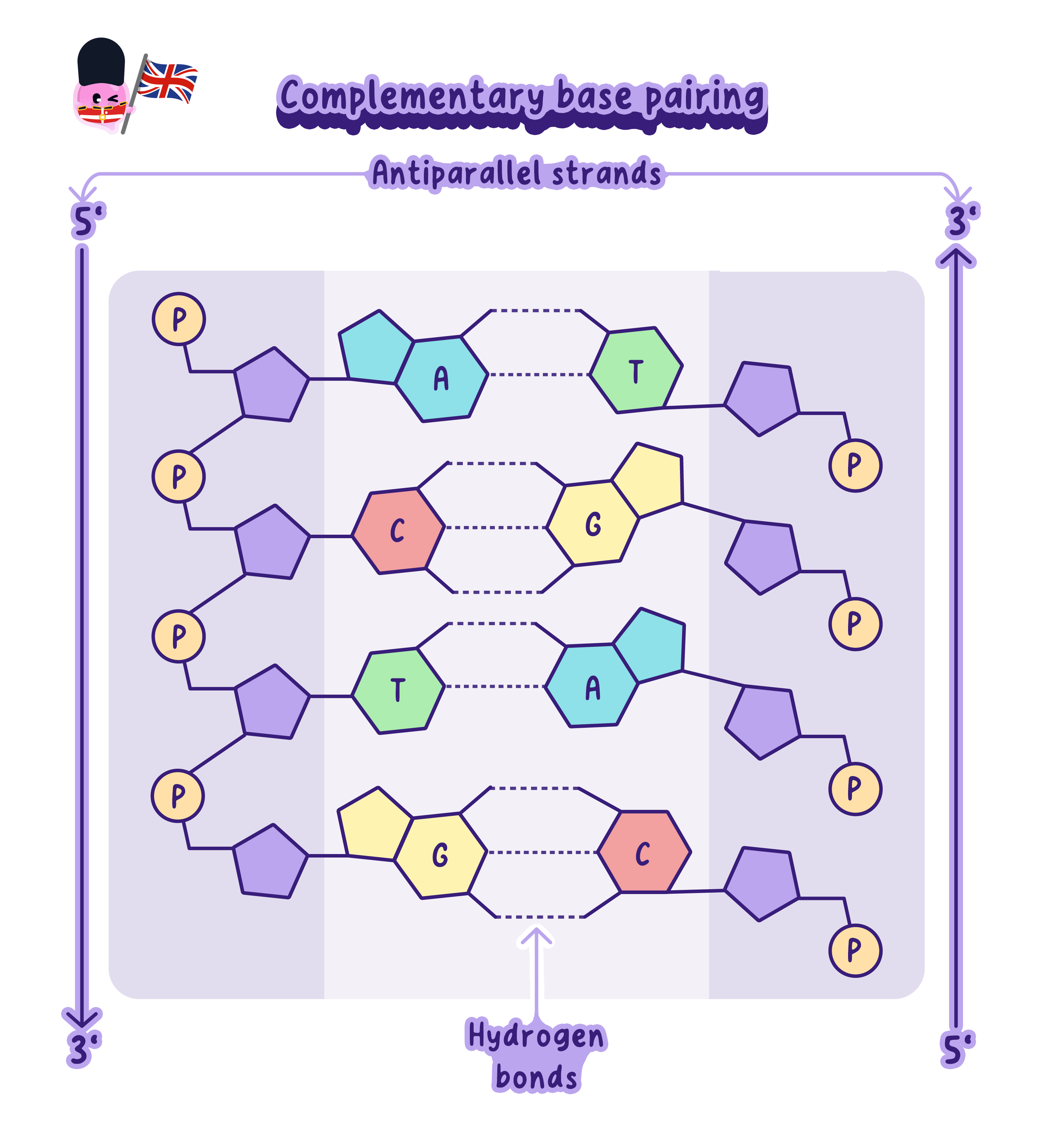
- The two strands of a DNA molecule are held together by their bases, which pair up across the middle of the molecule.
- The pairing is fixed rather than random, because A\text{A}A always pairs with T\text{T}T, and C\text{C}C always pairs with G\text{G}G.
- Each of these joined pairs is called a base pair.
- Because the base on one strand fixes which base must sit opposite it, the two strands are described as complementary.
- This means that the sequence of bases along one strand determines the sequence of bases along the other strand.
- It also means that a DNA molecule contains equal amounts of adenine and thymine, since every A\text{A}A is matched by a T\text{T}T opposite it.
- For the same reason, a DNA molecule contains equal amounts of cytosine and guanine.
- The four bases account for every base in the molecule, so their four percentages add up to 100%100\%100%.
- One strand of a DNA molecule has the base sequence A T G C C A G T\text{A}\,\text{T}\,\text{G}\,\text{C}\,\text{C}\,\text{A}\,\text{G}\,\text{T}ATGCCAGT, and the complementary strand is built one base at a time.
- A\text{A}A pairs with T\text{T}T, so the first base of the complementary strand is T\text{T}T.
- T\text{T}T pairs with A\text{A}A, so the second base is A\text{A}A.
- G\text{G}G pairs with C\text{C}C, so the third base is C\text{C}C.
- The two C\text{C}C bases that follow each pair with G\text{G}G, giving G G\text{G}\,\text{G}GG.
- The remaining A\text{A}A, G\text{G}G and T\text{T}T give T\text{T}T, C\text{C}C and A\text{A}A in turn.
- The complementary strand is therefore T A C G G T C A\text{T}\,\text{A}\,\text{C}\,\text{G}\,\text{G}\,\text{T}\,\text{C}\,\text{A}TACGGTCA.
- The same fixed pairing also fixes how much of each base is present, so a sample of DNA containing 20%20\%20% adenine can be worked through in the same way.
- Adenine pairs only with thymine, so thymine is present in the same amount: thymine=20%\text{thymine} = 20\%thymine=20%.
- Adenine and thymine together therefore account for 20%+20%=40%20\% + 20\% = 40\%20%+20%=40% of the bases.
- Every remaining base is either cytosine or guanine, so together those two make up 100%−40%=60%100\% - 40\% = 60\%100%−40%=60%.
- Cytosine and guanine are present in equal amounts, so each one is half of that total: 60%2=30%\dfrac{60\%}{2} = 30\%260%=30%.
- The sample therefore contains 20%20\%20% thymine, 30%30\%30% cytosine and 30%30\%30% guanine.
Hydrogen bonds between bases
- Each base pair is held together by weak hydrogen bonds between the two bases.
- A single hydrogen bond is easily broken, and that weakness is the useful part of the structure rather than a fault in it.
- When a cell copies its DNA or reads a section of it, the hydrogen bonds along that section are broken so that the two strands can be pulled apart and the bases exposed.
- Strong bonds would lock the strands together permanently, and the order of the bases could never be reached.
- A DNA molecule contains millions of base pairs, and every pair adds its own hydrogen bonds to the total.
- So many weak bonds acting together hold the two strands firmly, even though any single one of them gives way easily.
- Do not write that the base pairs are joined by strong bonds, because the credited answer is weak hydrogen bonds, and strong bonds would stop the strands ever separating.
- Do not pair A\text{A}A with C\text{C}C or G\text{G}G with T\text{T}T, as the only pairings that exist are A\text{A}A with T\text{T}T and C\text{C}C with G\text{G}G.
- Do not describe the bases as part of the sugar-phosphate backbone, since each base is attached to a sugar and points inwards towards the base opposite it.
The double helix
Double helix
The shape of a DNA molecule, in which two nucleotide strands are coiled around each other.
- The two strands of a DNA molecule do not lie flat alongside each other.
- They are twisted around each other along their whole length, so the molecule takes the shape of a spiral.
- Two strands coiled around each other in this way form a double helix, and that is the overall shape of a DNA molecule.
- The two sugar-phosphate backbones run along the outside of the helix, and the base pairs sit on the inside, joined by their hydrogen bonds.
- A request to describe the structure of DNA is worth two or three marks, and each mark is tied to a named component rather than to a general impression of the molecule.
- Write weak hydrogen bonds in full, because the word bonds on its own does not earn that mark.
- State which base pairs with which, giving A\text{A}A with T\text{T}T and C\text{C}C with G\text{G}G, as writing only that the bases pair up leaves the mark unearned.
- Name the two strands, the double helix and the nucleotide as the repeating unit, so that every component you are being marked on is on the page.
Base sequence
- The order of the bases along a strand is the information that a cell reads.
- A section of DNA that codes for one protein is a gene, and the complete set of DNA in an organism is its genome.
- A single DNA molecule carries many genes, one after another along its length.
- Name the three parts of a single nucleotide, and state which of the three differs between one nucleotide and the next.
- Which base pairs with cytosine, and what type of bond holds that pair together?
- Explain why weak bonds between the base pairs are useful to a cell rather than a problem.
- A DNA sample contains 30%30\%30% thymine. What percentage of its bases is guanine?
- What does the term double helix describe?
3.2.2 Genome and gene definitions
The genome
Genome
The entire DNA of an organism.
- The genome of an organism is the entire DNA that the organism contains.
- That total includes every chromosome, every gene carried on those chromosomes, and the DNA that lies between and around the genes.
- The human genome is about three billion base pairs long, which is written as 3×1093 \times 10^{9}3×10⁹ base pairs.
- Spread through that length are roughly 20 00020\,00020000 genes.
- A complete copy of the genome sits in the nucleus of almost every body cell, so a liver cell and a skin cell hold the same instructions as each other.
- A large part of the genome does not code for a protein at all, so the genome is far more than a list of genes.
- This non-coding DNA still has effects on how the genes are used, and a later article deals with what it does.
The genome is all of an organism's DNA taken together, not only the parts of it that make up genes.
Organising genetic material
Chromosome
A long molecule of coiled DNA found in the nucleus, carrying many genes in a fixed order.
- In a body cell the DNA is held inside the nucleus.
- Inside the nucleus the DNA is packaged into chromosomes, and a human body cell contains 464646 chromosomes arranged as 232323 pairs.
- Each chromosome is one very long DNA molecule, coiled up tightly so that its full length fits into the nucleus.
- A gene is one section of that molecule, picked out by where it begins and ends along the strand rather than by being a separate molecule of its own.
- Within that section the bases lie in a particular order, and this base sequence is what carries the coded instruction.
- The levels therefore run in this order: nucleus, then chromosome, then the DNA molecule the chromosome is made of, then a gene as one section of that molecule, then the sequence of bases inside the gene.
- One chromosome carries many genes, set out one after another along its length.
- Every gene sits at a fixed position on one particular chromosome.
- Because that position is fixed, the same gene is found in the same place on the same chromosome in every member of a species.
Picture the genome as a complete set of instruction manuals, each chromosome as one manual in that set, and each gene as a single instruction printed on one page of one manual.
Genes code for proteins
Gene
A section of a DNA molecule that codes for a specific protein.
- A gene is a section of a DNA molecule that codes for a specific protein.
- Proteins are built from amino acids, small molecules joined end to end into a long chain.
- The phrase codes for has an exact meaning here: the order of the bases along the gene determines the order of the amino acids in the protein made from it.
- The order in which the amino acids are joined decides how the finished chain folds, and therefore which protein it becomes.
- A different gene has a different base sequence, so it sets a different order of amino acids and produces a different protein.
- The protein itself is assembled outside the nucleus, and later articles set out the steps by which the coded instruction is read and used.
- In a cell of the salivary gland, the nucleus holds all 464646 chromosomes of that cell.
- One of those chromosomes is a single long DNA molecule, and one section of that molecule is the gene for amylase.
- Inside that section the bases sit in one particular order, and that order is the coded instruction for amylase and for no other protein.
- The cell joins amino acids together in the order that base sequence specifies, and the chain that results is amylase.
- Amylase is an enzyme, and its job is to break starch down into smaller sugar molecules.
- Read the same route in reverse and the levels run base sequence, gene, DNA molecule, chromosome, nucleus.
Functions of proteins
- Genes matter because proteins do the work of the body, and different genes code for different proteins.
- Amylase is an enzyme that digests starch, breaking it down into sugars small enough to be absorbed.
- Haemoglobin is the protein inside red blood cells that binds oxygen in the lungs and carries it to the tissues.
- Keratin is a structural protein that makes hair and nails tough and hard-wearing.
- Antibodies are proteins made by white blood cells, and they bind to pathogens as part of the immune response.
- Each of these four proteins is coded for by its own gene, with its own base sequence, in a fixed position on a chromosome.
- Because the genome carries the code for every protein an organism can make, it controls how that organism is built and how its body works.
- Do not write that a gene codes for a characteristic, because a gene codes for a protein and it is the protein that goes on to produce the characteristic.
- Do not write genome when you mean gene, since the genome is the whole of an organism's DNA while a gene is one section of it.
- Do not describe the genome as only the genes, because it also includes all the DNA lying between and around them.
- Both of these definitions turn up as one-mark questions, and the mark is awarded on the wording you choose.
- For the genome, the wording that earns the mark is the entire DNA of an organism.
- For a gene, the wording that earns the mark is a section of DNA that codes for a specific protein, so keep the word protein in your sentence.
- An answer such as a gene decides your eye colour drops the mark, because it names something the gene eventually affects instead of saying what the gene is.
Chromosomes, genes and genomes
DNA
The polymer that carries the genetic code, made of two nucleotide strands coiled into a double helix.
- A chromosome is a whole DNA molecule, coiled up, carrying many genes along its length.
- A gene is one section of that molecule, and it codes for one specific protein.
- The genome is all of an organism's DNA taken together, which means every chromosome and every gene along with the DNA between them.
- The three terms name three different scales of the same material rather than three different substances.
- Different versions of the same gene are called alleles, and they are covered in the inheritance articles.
- What is meant by the genome of an organism, and what does it include besides the genes?
- What does the order of bases along a gene determine?
- How many chromosomes does a human body cell contain, and how are they arranged?
- Name two proteins and state the job each one does in the body.
- Why does saying that a gene decides eye colour fail to define what a gene is?
3.2.3 Extracting DNA from fruit
Why fruit is used
DNA
The polymer that carries the genetic code, made of two nucleotide strands coiled into a double helix.
- DNA can be extracted from any tissue whose cells contain nuclei, and soft fruit is the usual starting material because it is easy to work with at the bench.
- Fruit tissue is soft, so it is broken up by mashing alone, without the grinding or heating that tougher tissue would need.
- The cells of the fruit are packed closely together and each one holds a nucleus, so even a few grams of tissue contains a very large number of nuclei and therefore a large amount of DNA.
- Strawberries and kiwi fruit work particularly well, because their cells contain several sets of chromosomes rather than the two sets found in a human body cell.
- Each extra set is a further copy of the same DNA, so a given mass of strawberry tissue yields more DNA than the same mass of most other tissue.
- Fruit is also cheap, safe to handle and needs no preservation, so the whole extraction can be done in a single lesson with everyday materials.
A strawberry cell carries several sets of chromosomes, so a few grams of mashed fruit holds enough DNA for the extracted threads to be seen with the naked eye.
Barriers around DNA
- In a fruit cell the DNA is held inside the nucleus, which is enclosed by its own membrane.
- The nucleus sits in the cytoplasm, and the cytoplasm is enclosed by the cell surface membrane.
- Outside the cell surface membrane there is a rigid cell wall made of cellulose, which gives the plant cell its strength.
- Four layers therefore lie between the DNA and the outside of the cell: the cell wall, the cell surface membrane, the cytoplasm and the membrane around the nucleus.
- Every step of the extraction method exists either to remove one of these layers or to separate the released DNA from everything else that comes out of the cell with it.
- The cell wall is broken by physical force, the two membranes are broken down chemically, and the DNA is then separated from the liquid it has dissolved in.
Extracting DNA from strawberries
- Aim: to extract DNA from strawberry tissue and see it as white threads, using detergent and salt to release the DNA and ice-cold ethanol to bring it out of solution.
- Apparatus: two or three ripe strawberries with the green tops pulled off, a self-seal plastic bag or a pestle and mortar, table salt, washing-up liquid, distilled water, a beaker and stirring rod for the extraction buffer, a measuring cylinder, a filter funnel with filter paper or a piece of muslin, a boiling tube and rack, ice-cold ethanol from a freezer, a glass rod, eye protection.
- Method:
- Make up the extraction buffer first: dissolve about 3 g3\,\text{g}3g of table salt in distilled water in a beaker, add 10 cm310\,\text{cm}^310cm3 of washing-up liquid, and make the volume up to 100 cm3100\,\text{cm}^3100cm3, stirring slowly so that no froth forms.
- Put about 10 g10\,\text{g}10g of strawberry into the plastic bag, seal it with air pushed out, and mash it with your fingers for 222 minutes until no lumps are left, because this physical mashing is what breaks the cellulose cell walls and releases the cell contents.
- Add about 10 cm310\,\text{cm}^310cm3 of the buffer to the bag, seal it again and squash gently for another minute, keeping the movement slow so the detergent does not froth up.
- Stand the bag or beaker still for 151515 minutes, which gives the detergent time to break down the cell surface membranes and the membranes around the nuclei so that the DNA is released into the mixture.
- Filter the pink mixture through filter paper in a funnel into a boiling tube, so that the insoluble cell walls and lumps of tissue are held back and only the liquid containing the dissolved DNA runs through; collect roughly a 2 cm2\,\text{cm}2cm depth of filtrate.
- Take the ethanol out of the freezer at the last moment, tilt the boiling tube to about 45∘45^\circ45∘, and pour about twice the volume of the filtrate slowly down the inside wall of the tube so that the ethanol settles as a separate clear layer on top of the pink extract instead of mixing with it.
- Stand the tube upright in the rack and leave it undisturbed for 111 to 222 minutes, watching the boundary between the two layers.
- Lift the white threads out on a glass rod by turning the rod slowly at the boundary, so the threads wind onto it.
- Variables: as written this is a preparation rather than an investigation, so nothing is deliberately changed and there is no independent variable. Run as an investigation, the independent variable is the type of fruit or the temperature of the ethanol, and the dependent variable is the amount of DNA obtained, judged from the length or bulk of the threads. Keep the mass of fruit, the volume of extraction buffer, the volume of ethanol and the mashing time the same each time.
- Results: within a minute or two, white stringy threads with tiny bubbles caught in them appear at the boundary where the clear ethanol layer meets the pink fruit extract, and they can be wound onto the glass rod. The extract below stays pink and cloudy. The threads are DNA that has come out of solution because DNA is insoluble in cold ethanol.
- Watch out: stir and squash gently throughout, because froth traps the DNA in the bubbles and hides the threads. Keep the ethanol ice-cold right up to the moment you pour it, since warm ethanol leaves much more of the DNA dissolved and you may see nothing. Pour it slowly down the side of a tilted tube, and do not shake or invert the tube afterwards, because once the two liquids mix there is no boundary for the threads to form at.
- Safety: ethanol is highly flammable and harmful, so keep it well away from any naked flame and wear eye protection. Do not eat any of the fruit used, and wash your hands at the end.
Releasing DNA from cells
Nucleotide
The repeating unit of a DNA strand, made of a sugar and a phosphate group with one of four bases attached to the sugar.
- Mashing or grinding the fruit breaks the cell walls by physical force, so the cell contents are released into the mixture.
- No reagent in the method breaks down cellulose, so the cell walls can only be broken mechanically and this step cannot be left out.
- Washing-up liquid is added because it is a detergent, and detergents break down lipids.
- The cell surface membrane and the membrane around the nucleus are both made largely of lipids, so the detergent breaks these membranes apart and the DNA passes out of the nucleus and out of the cell into the mixture.
- Salt is added because a DNA molecule carries a negative charge along its whole length, since every nucleotide in it contains a phosphate group.
- Two negatively charged DNA molecules repel each other, so on their own they stay spread out and dissolved in the liquid.
- The positively charged sodium ions from the salt are attracted to the negative charges on the DNA and screen them, so the DNA molecules stop repelling one another.
- The DNA molecules can then clump together, which makes them come out of solution far more readily once the ethanol is added.
- Questions often name one step or reagent and ask what it does, so learn the purpose of each stage. The mark is awarded for the function.
- The mark most often dropped is on the detergent: an answer saying it breaks open the cell is too vague to credit, so write that it dissolves the lipid membranes, both the cell surface membrane and the membrane around the nucleus, so that the DNA is released.
- Answer the salt in the same style, saying that it makes the DNA molecules clump together so they come out of solution, rather than simply saying that it helps.
- Where a question gives you a change to the method, such as ethanol left on the bench instead of in the freezer, explain the effect through the same reasoning: warmer ethanol keeps more DNA dissolved, so fewer threads form.
Separating the DNA
- After mashing, the mixture contains the released DNA together with broken cell walls, lumps of tissue that were not broken up and the rest of the cell contents.
- Filtering the mixture holds back the insoluble cell walls and lumps of tissue on the filter paper, so only a liquid containing the dissolved DNA passes through into the tube.
- Ice-cold ethanol is then layered on top of this filtrate.
- DNA is insoluble in cold ethanol, so as the DNA meets the ethanol it comes out of solution and appears as solid white threads.
- Ethanol is less dense than the fruit extract, so pouring it slowly down the side of a tilted tube keeps it as a separate layer, and the threads form at the boundary where the two liquids meet.
- The colder the ethanol, the less DNA stays dissolved, so more DNA comes out of solution and a larger, clearer mass of threads is seen.
- Do not stir or shake hard enough to make froth, because DNA is carried up into the bubbles and the threads are then hidden rather than absent.
- Do not pour ethanol that has been standing at room temperature, because much of the DNA stays in solution and you may see no threads at all.
- Do not tip the ethanol in quickly or invert the tube to mix it, because the two liquids then form one solution and there is no boundary for the threads to gather at.
- Do not skip the filtering step, since lumps of tissue in the tube look like solid material at the boundary and are easily mistaken for DNA.
Identifying the DNA
Genome
The entire DNA of an organism.
- The extracted DNA is seen as white stringy threads at the boundary between the ethanol layer and the fruit extract, often with small bubbles trapped in them.
- The threads are firm enough to be wound onto a glass rod and lifted out of the tube.
- A single DNA molecule is far too thin to be seen, and cannot be resolved even with a light microscope.
- What is visible is very many DNA molecules, released from the nuclei of thousands of cells and clumped together, so the threads are a mass of DNA rather than one molecule.
- The threads contain the whole genome of the fruit cells, because every chromosome is released and precipitated together.
- Nothing about the appearance of the threads reveals which genes the DNA carries, so the extraction shows only that DNA is present and can be handled.
- Why must the fruit be mashed before the detergent is added?
- What does the detergent do to the cell surface membrane and the membrane around the nucleus?
- Why does adding salt make the DNA come out of solution more readily?
- Why must the ethanol be ice-cold and poured slowly down a tilted tube?
- If one DNA molecule is too thin to see, what are the white threads made of?
3.2.4 Base order determines protein shape
Amino acid order and protein shape
Gene
A short section of DNA that codes for a particular protein and controls a characteristic.
- The order of bases in a gene sets the order of amino acids in the protein.
- The chain of amino acids folds up into a particular three-dimensional shape.
- This shape decides what the protein can do, so its shape determines its function.
- For example, an enzyme's active site has a shape that fits its substrate, and a structural protein such as collagen has a shape suited to its role.
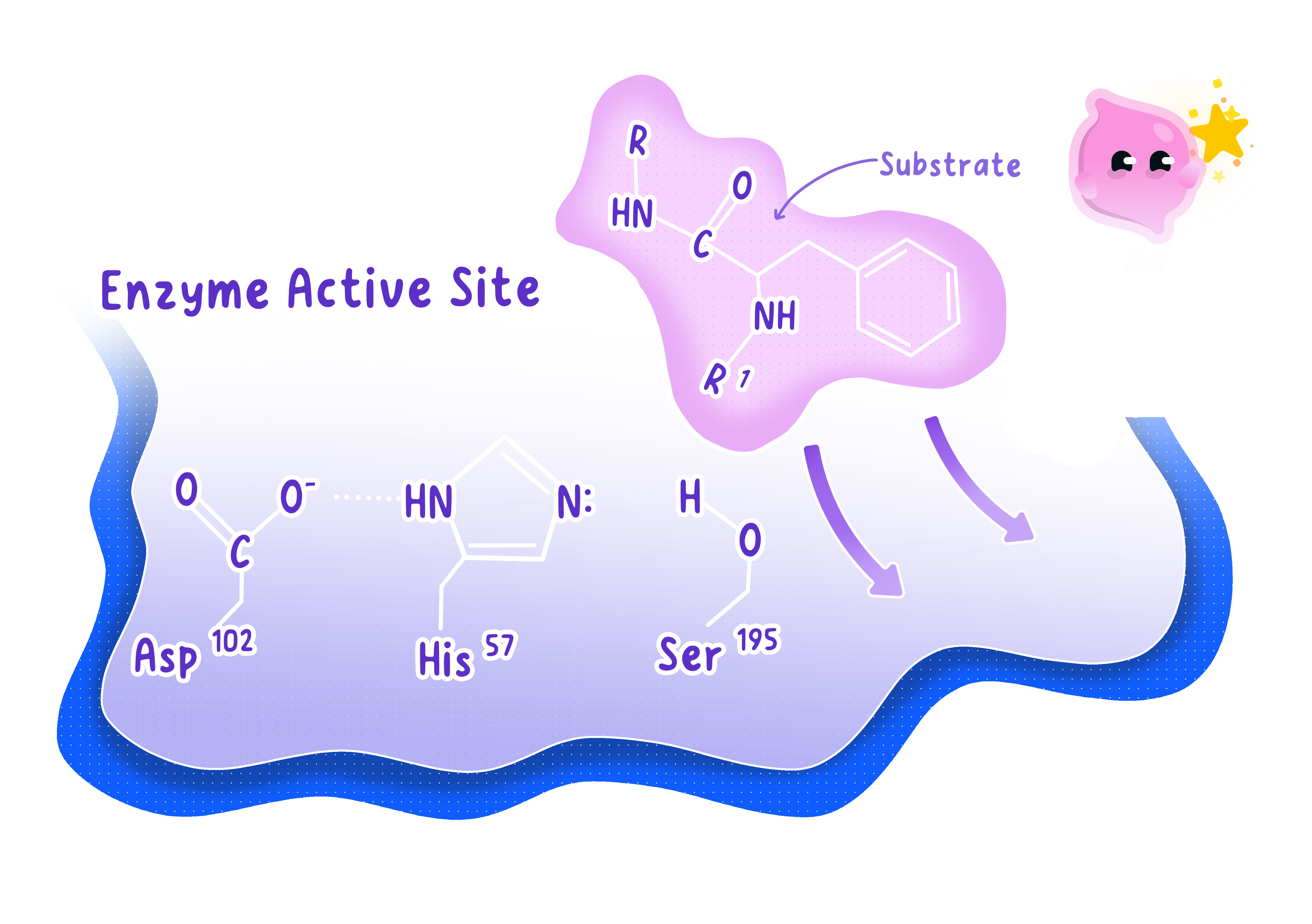
The active site of an enzyme has a shape that fits only its substrate, which is why the enzyme speeds up one particular reaction.
A protein only works if it folds into the right shape, and that shape comes straight from the order of amino acids.
How base changes affect proteins
- A change in the order of bases can change one or more amino acids in the protein.
- A different amino acid can make the protein fold into a different shape.
- A changed shape can weaken or stop the protein's function.
- For example, a change to an enzyme's active site can mean the substrate no longer fits.
- If the protein is changed, the characteristic it controls can also change.
Do not think every change to the bases changes the protein: many have little or no effect, and only some alter it enough to matter.
Bases set the amino acid order, the amino acids set the shape, and the shape sets the function, so a change in bases can run right through to the characteristic.
- What sets the order of amino acids in a protein?
- Why does a protein's shape matter for its function?
- Give an example of a protein whose shape is important for its job.
- How can a change in the base order lead to a change in a characteristic?
3.2.5 Stages of protein synthesis
Genes as protein codes
Codon
A sequence of three bases that codes for one amino acid.
- The order of bases in a gene is a coded instruction for making a protein.
- Each group of three bases, called a triplet or codon, codes for one amino acid.
- The order of the triplets sets the order in which amino acids are joined.
- This set of rules linking bases to amino acids is the genetic code.
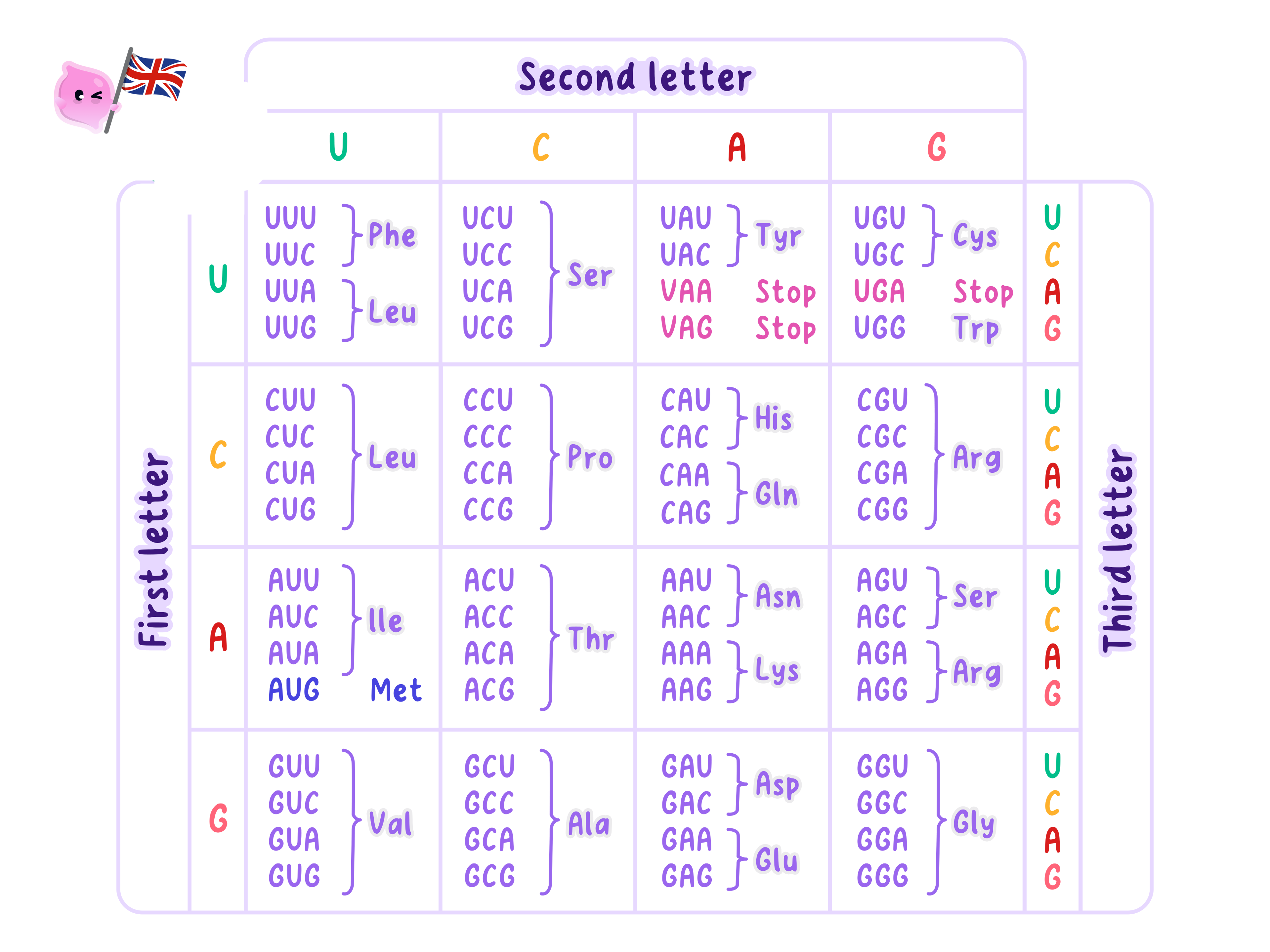
Because bases are read in threes, a gene of 303030 bases codes for a chain of 101010 amino acids.
Proteins are not made in the nucleus, so the coded message must be carried out to where proteins are built.
Transcription
Transcription
The stage of protein synthesis in which the base sequence of a gene is copied into a molecule of mRNA.
- Protein synthesis begins in the nucleus. RNA polymerase binds to a non-coding region immediately in front of the gene, positioning the enzyme at the correct starting point.
- The enzyme RNA polymerase separates the two DNA strands over the gene and builds a complementary copy.
- This copy is a molecule of mRNA (messenger RNA).
- The mRNA is a short, single strand that can leave the nucleus.
- It carries the coded instructions out into the cytoplasm.
Transcription means to copy: RNA polymerase copies the gene into mRNA.
Do not say the whole chromosome is copied: only the gene being used is transcribed.
Translation
Translation
The stage of protein synthesis in which the base sequence of mRNA is used at a ribosome to join amino acids in the correct order.
- In the cytoplasm the mRNA attaches to a ribosome.
- The ribosome reads the mRNA code three bases at a time.
- Transfer RNA (tRNA) molecules carry specific amino acids to the ribosome. Each tRNA matches a particular mRNA codon, placing the amino acids in the order set by the base sequence.
- The ribosome links the amino acids with peptide bonds to form a polypeptide, which then folds into a protein with a specific three-dimensional shape.
- Whether a protein is made, and how much, can also be affected by the non-coding DNA around a gene.
The order of bases decides the order of amino acids, so the code must be read accurately.
RNA polymerase transcribes the gene into mRNA; the ribosome then translates that mRNA to join amino acids into a protein.
How DNA controls cells
DNA
The molecule that carries the genetic code, made of two strands coiled into a double helix.
- Each gene in the DNA carries the code for one protein.
- Proteins do most of the work in a cell, including enzymes, structural proteins and hormones.
- By deciding which proteins are made, the DNA controls what the cell does.
- So a cell's activities are set by the genes that are used to make proteins.
Enzymes made from genes control the chemical reactions in a cell, such as those of respiration.
Genes act by coding for proteins, and it is the proteins that carry out the cell's functions.
- What does each triplet (codon) of bases code for?
- Which enzyme copies the gene into mRNA, and where does this happen?
- What is the job of mRNA?
- At the ribosome, what decides the order in which amino acids are joined?
3.2.6 Non-coding DNA variants affecting phenotype
Coding and non-coding DNA
Non-coding DNA
DNA that does not code for a protein, some of which switches genes on or off.
- Coding DNA is DNA that is used to make a protein.
- Non-coding DNA is DNA that does not code for a protein.
- Some non-coding DNA sits near genes and helps to control them.
- So a stretch of non-coding DNA can still be important, even though it is not made into a protein.
Non-coding does not mean useless: much of it has a controlling job.
A region of non-coding DNA in front of a gene can act like a switch that turns the gene on or off.
How non-coding variants affect genes
Gene expression
The process of using a gene to make its protein, which can be switched on or off.
- Gene expression means whether a gene is used and how much protein is made from it.
- Some non-coding DNA controls the expression of nearby genes.
- A variant in this non-coding DNA can turn a gene on or off, or change how much protein is made.
- This can change the phenotype, the organism's features.
- It does this without changing the amino acid sequence of the protein itself.
Do not assume the phenotype only changes when a protein changes: altering how much protein is made can change it too.
Non-coding variants change the phenotype by changing gene expression, not by changing the protein's own sequence.
- What is the difference between coding and non-coding DNA?
- What is meant by gene expression?
- How can a variant in non-coding DNA affect the phenotype?
- Does a non-coding variant change the protein's amino acid sequence?
3.2.7 Coding DNA variants affecting phenotype
Alleles and base sequences
Allele
A different version of a gene.
- A variant is a difference in the base sequence of a gene.
- Different alleles of a gene are simply different variants of that gene.
- Variants arise through mutations, which are changes to the DNA.
- This is a source of the genetic variation found within a species.
Every allele is a variant: a version of the gene with a slightly different base sequence.
The gene for a flower's colour may exist as several variants, giving alleles for different colours.
How coding variants affect phenotype
Phenotype
The observable characteristics of an organism, produced by its genotype and its environment.
- A variant in the coding DNA can change the protein made, and so change the characteristic.
- A variant in the non-coding DNA can change how much protein is made, and so change the characteristic.
- Most variants have no effect on the phenotype.
- Some variants have a small effect on the phenotype.
- Very few variants, on their own, determine the phenotype.
- Together, all these variants produce the range of phenotypes seen in a population.
To judge a variant, first ask whether it is in coding or non-coding DNA, then ask how big its likely effect is.
Alleles are variants, and it is the mix of many variants that gives a population its range of features.
- What is a variant?
- How are alleles related to variants?
- How can a variant in coding DNA affect the phenotype?
- Out of all variants, how many actually determine the phenotype?
