6.3.1 Plant hormones and tropisms
Plant hormones coordinate growth
Plant hormone
A chemical messenger made by a plant that changes the activity of target cells to coordinate growth, development or responses to stimuli.
- A plant hormone is a chemical messenger made by the plant that changes the activity of target cells.
- Plant hormones coordinate growth, development and responses to environmental stimuli.
- Unlike a nervous response, a plant response is usually slow because it often depends on cells growing at different rates.
Tropisms direct plant growth
Tropism
A growth response of a plant in which it grows towards or away from a stimulus.
- A tropism is a directional growth response in which a plant organ grows towards or away from a stimulus.
- A positive tropism is growth towards the stimulus, whereas a negative tropism is growth away from it.
- Phototropism is growth in response to light, while gravitropism is growth in response to gravity.
- Shoots are usually positively phototropic and negatively gravitropic, which places leaves where they can receive more light.
- Roots are usually positively gravitropic, which directs them into soil for anchorage and access to water and mineral ions.
Auxin creates unequal growth
Auxin
A plant hormone that controls growth by causing cells to elongate, bringing about tropisms in shoots and roots.
- Auxin is produced in the shoot tip and moves into the growing region immediately behind the tip.
- Auxin changes the rate of cell elongation, so it controls how much individual cells increase in length.
- When auxin is distributed evenly, cells on opposite sides elongate at the same rate and the organ grows straight.
- A directional stimulus such as light or gravity can produce an uneven auxin distribution across the organ.
- Cells on the two sides then elongate at different rates, making one side longer and causing the organ to curve.
- The effect depends on the organ: a higher auxin concentration promotes elongation in shoot cells but inhibits elongation in root cells.
Shoots bend towards light
Phototropism
The growth of a plant in response to light; shoots grow towards light (positive phototropism).
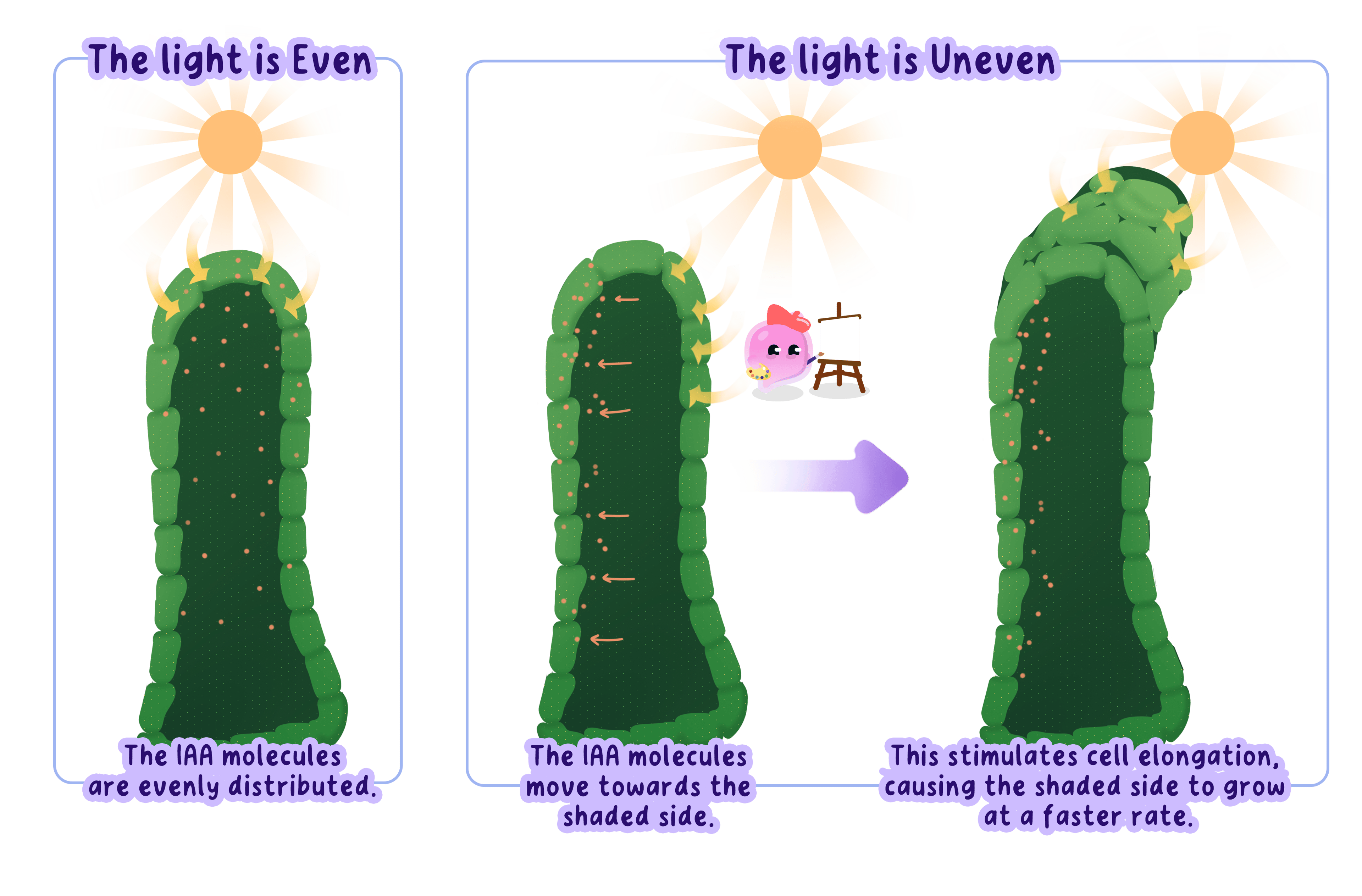
- When light reaches a shoot from one side, more auxin becomes distributed on the shaded side of the shoot.
- In shoots, the higher auxin concentration stimulates cell elongation on the shaded side.
- The shaded side therefore becomes longer than the illuminated side, so the shoot curves towards the light in positive phototropism.
Roots respond differently to auxin
Gravitropism
The growth of a plant in response to gravity; roots grow towards gravity and shoots grow away from it. Also called geotropism.
- When a root is placed horizontally, gravity causes more auxin to collect on its lower side.
- Root cells are more sensitive to auxin than shoot cells, so the higher auxin concentration inhibits cell elongation on the lower side.
- Cells on the upper side elongate faster, which makes the root curve downwards and produces positive gravitropism.
- In a horizontal shoot, auxin on the lower side stimulates elongation, so the lower side grows faster and the shoot curves upwards in negative gravitropism.
- The same hormone can therefore produce opposite growth patterns because roots and shoots respond differently to its concentration.
Investigating tropic responses
- Aim: to test how the direction of light or gravity affects the direction of seedling growth.
- Apparatus: germinating cress or oat seedlings of similar size, Petri dishes, damp cotton wool, two lightproof boxes, card, a lamp, a ruler, a protractor, labels and a camera.
- Method:
- Place equal numbers of similar seedlings on damp cotton wool in two labelled dishes
- put one dish in a box with a small opening facing the lamp so light arrives from one direction
- put the control dish in a box with light entering evenly from above
- keep both boxes beside each other for 48 hours
- photograph each dish from the same position and measure the angle between every shoot and the vertical with a protractor.
- Variables: change the direction of light and measure the angle of shoot growth, while keeping seed type, starting length, number of seedlings, lamp distance, temperature, water, growth time and box size constant.
- Results: shoots receiving one-sided light should curve towards the opening, while shoots receiving even light should remain approximately straight.
- Gravity test: place a second set of germinating seedlings horizontally in darkness so light cannot provide a directional cue, then record roots curving down and shoots curving up.
- Maths: calculate the mean curvature using mean angle=∑anglesnumber of seedlings\text{mean angle}=\frac{\sum \text{angles}}{\text{number of seedlings}}mean angle=number of seedlings∑angles, compare the two groups and plot mean angle against time if several readings are taken.
- Watch out: use several seedlings because natural variation is large, exclude damaged seedlings before starting and keep the cotton wool equally moist so water availability does not change growth.
- Safety: keep water away from the lamp and electrical leads, allow the lamp to cool before moving it and wash your hands after handling plant material.
Build the full causal explanation
- An exam explanation gains credit for a linked sequence: hormone distribution changes, cells on one side change their elongation rate, the two sides become unequal in length, and the organ bends in a stated direction.
- Write cells elongate rather than saying the entire stem elongates, because examiners distinguish the cellular mechanism from the visible movement of the shoot.
- Do not say that auxin always speeds growth, because a high auxin concentration promotes elongation in shoots but inhibits elongation in roots.
- Do not describe a tropism as movement of the whole plant, because it is a growth response produced by unequal growth on opposite sides of an organ.
- For a shoot response, link auxin on the shaded side to greater cell elongation and bending towards light.
- For a root response, link auxin on the lower side to inhibited cell elongation and bending towards gravity.
- Always finish with the direction of growth and name the response as positive or negative.
Compare shoots and roots
- In a shoot, more auxin means faster elongation, so the side with more auxin becomes longer.
- In a root, more auxin means slower elongation, so the opposite side becomes longer.
- In both organs, bending results from unequal cell elongation, not unequal cell division.
- What is a tropism?
- Why does a shoot bend towards one-sided light?
- How does auxin affect cell elongation in a root?
- What control would you use when investigating phototropism?
- Why can the same auxin distribution make a root and a shoot bend in different directions?
6.3.2 Commercial uses of plant hormones
Auxins support crop production
Auxin
A plant hormone that controls growth by causing cells to elongate, bringing about tropisms in shoots and roots.
- Synthetic auxins are used in selective weedkillers that affect broad-leaved weeds more than narrow-leaved grasses and cereal crops.
- The auxin disrupts normal growth and makes susceptible weeds grow uncontrollably, so they die while the crop remains.
- Killing weeds reduces competition with the crop for light, water, mineral ions and space, which can increase crop yield.
- Auxin in rooting powder stimulates root formation at the cut end of a stem cutting.
- Once roots form, the cutting can grow independently and produces a new plant genetically identical to the parent.
Gibberellins control development
Gibberellins
Plant hormones that promote seed germination, stem growth, flowering and fruit development.
- Gibberellins can end seed dormancy and start germination when growers want a crop to develop.
- During germination, gibberellins stimulate enzymes that break stored starch into sugars, which provide a substrate for respiration and growth.
- Growers can use gibberellins to stimulate flower formation and to promote fruit formation.
- Applying gibberellins before pollination can start fruit development without fertilisation, producing seedless fruit.
- Gibberellins can also increase fruit size, which is useful when producing larger seedless grapes.
Ethene controls fruit ripening
Ethene
A gaseous plant hormone that controls fruit ripening.
- Ethene is a gaseous plant hormone that triggers and coordinates changes during fruit ripening.
- Fruit can be harvested while it is unripe and firm, so it is less likely to be bruised during storage and transport.
- The fruit is exposed to ethene in a ripening room shortly before sale, which produces a more even and predictable stage of ripeness.
- Controlled ripening lets growers and retailers time supply, extend transport time and reduce losses from fruit becoming overripe too early.
Link each hormone to an outcome
Match the hormone to the use
- Auxins are used for selective weed control and root formation in cuttings.
- Gibberellins are used for germination, flowering, fruit development and seedless fruit.
- Ethene is used to control when harvested fruit ripens.
- Why can an auxin weedkiller kill broad-leaved weeds without killing a cereal crop?
- How does rooting powder help a stem cutting form a new plant?
- How do gibberellins support germination?
- How can gibberellins produce seedless fruit?
- Why is ethene applied after fruit has been transported?
