6.1.1 Photosynthetic organisms as producers
Photosynthesis Makes Food and Biomass
Producer
An organism that makes organic substances from inorganic raw materials and forms the first trophic level in a food chain.
- A producer is an organism that makes organic substances from inorganic raw materials.
- Plants and algae are the main producers because they make glucose by photosynthesis.
- Glucose supplies carbon and stored chemical energy for building other biological molecules.
- Biomass is the total mass of living material in an organism or group of organisms.
- When plants and algae grow, glucose is converted into new cell material, so photosynthesis increases biomass.
- Consumers obtain this food and biomass directly by eating producers or indirectly by eating other consumers.
Nearly every food chain begins with photosynthetic organisms transferring light energy into chemical energy stored in biomass.
Photosynthesis Stores Light Energy
Photosynthesis
The endothermic process in which plants and algae use light energy to make glucose from carbon dioxide and water, releasing oxygen.
- Photosynthesis is the endothermic process in which plants and algae use light energy to make glucose from carbon dioxide and water, releasing oxygen.
- Endothermic means that energy is transferred into the reaction from the surroundings.
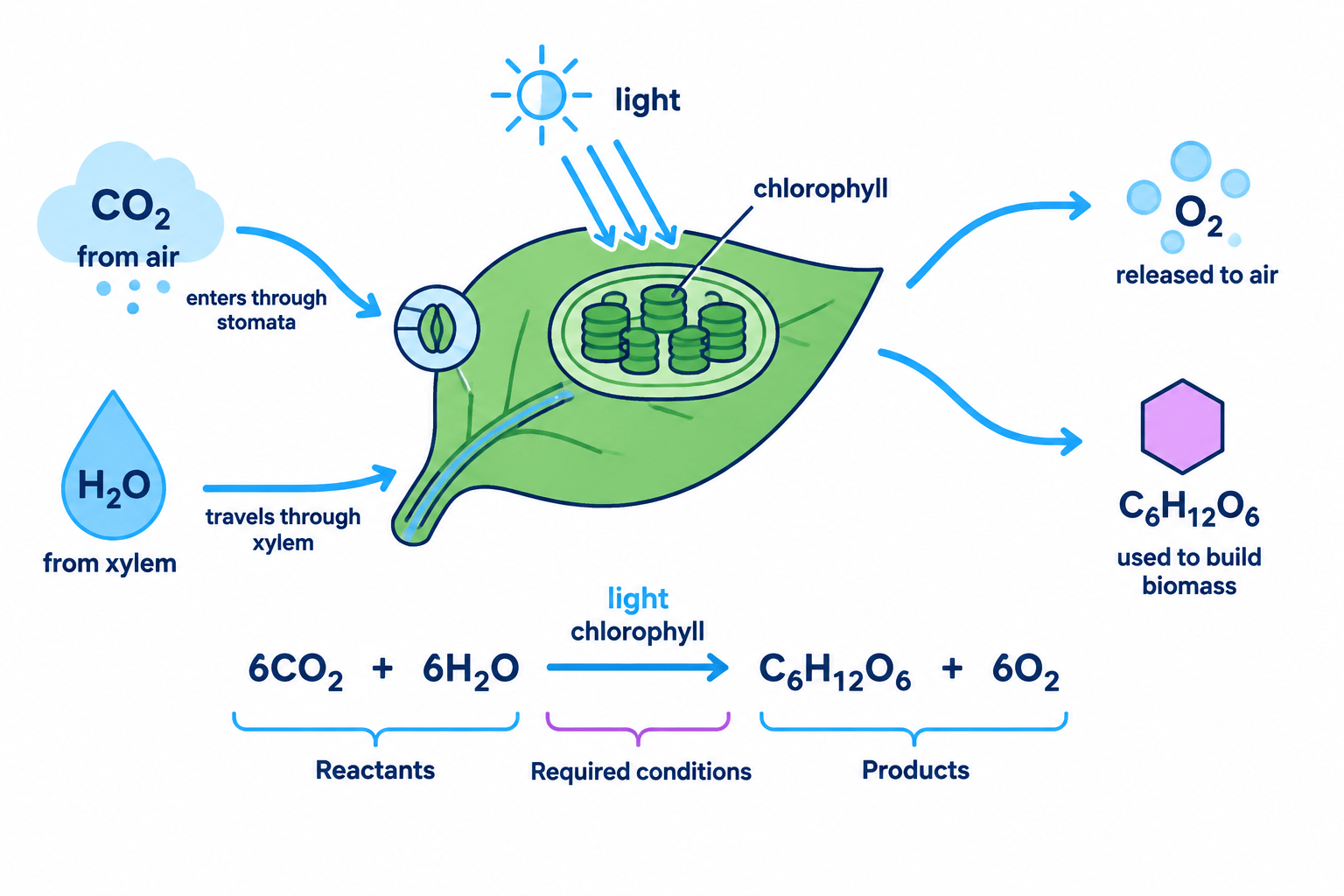
- Chlorophyll in chloroplasts absorbs light energy.
- The absorbed energy is transferred into chemical energy and stored in glucose.
- Carbon dioxide enters a leaf through the stomata, while water reaches the leaf through xylem vessels.
Do not describe photosynthesis as releasing energy, because energy is taken in and stored in glucose.
The Photosynthesis Equations
- The word equation is ** carbon dioxide+water→light and chlorophyllglucose+oxygen\text{carbon dioxide} + \text{water} \xrightarrow{\text{light and chlorophyll}} \text{glucose} + \text{oxygen}carbon dioxide+waterlight and chlorophyllglucose+oxygen **.
- The balanced symbol equation is ** 6CO2+6H2O→light and chlorophyllC6H12O6+6O26CO_2 + 6H_2O \xrightarrow{\text{light and chlorophyll}} C_6H_{12}O_6 + 6O_26CO2+6H2Olight and chlorophyllC6H12O6+6O2 **.
- Carbon dioxide and water are the reactants, while glucose and oxygen are the products.
- Light and chlorophyll are written over the arrow because they are required conditions rather than reactants that are used up.
- A leaf uses 666 molecules of CO2CO_2CO2 and 666 molecules of H2OH_2OH2O to form one molecule of C6H12O6C_6H_{12}O_6C6H12O6 and 666 molecules of O2O_2O2.
- The equation balances because both sides contain 666 carbon atoms, 121212 hydrogen atoms and 181818 oxygen atoms.
Check Your Understanding
Biomass
The total mass of living material in an organism or group of organisms.
- Photosynthetic organisms form biomass by converting glucose into substances used to make cells and tissues.
- This biomass passes through a food chain when one organism eats another.
- What is a producer?
- Why is photosynthesis an endothermic process?
- Write the balanced symbol equation for photosynthesis.
- How does photosynthesis provide biomass for consumers?
6.1.2a Limiting factors on the rate of photosynthesis
A Limiting Factor Sets the Rate
Limiting factor
A factor in shortest supply that restricts the rate of a process.
- The rate of photosynthesis is the amount of photosynthetic product formed, or reactant used, per unit time.
- A limiting factor is the factor in shortest supply that restricts the rate of a process.
- Increasing the limiting factor increases the rate until a different factor becomes limiting.
- The three factors assessed here are light intensity, carbon dioxide concentration and temperature.
A factor is limiting only when changing it changes the rate.
Light and Carbon Dioxide Reach Plateaus
- At low light intensity, light limits the rate because little energy is absorbed by chlorophyll.
- Increasing light intensity supplies more energy, so the rate rises.
- The curve eventually reaches a plateau, where light is no longer limiting and another factor restricts the rate.
- At low carbon dioxide concentration, carbon dioxide limits the rate because it is a reactant.
- Increasing carbon dioxide concentration increases the frequency with which the photosynthetic reactions can use this reactant, so the rate rises.
- The carbon dioxide curve also plateaus when light intensity or temperature becomes limiting.
- A plant produces 12 cm312\,\mathrm{cm^3}12cm3 of oxygen in 4 min4\,\mathrm{min}4min.
- Its mean rate is 12 cm34 min=3 cm3 min−1\dfrac{12\,\mathrm{cm^3}}{4\,\mathrm{min}} = 3\,\mathrm{cm^3\,min^{-1}}4min12cm3=3cm3min−1.
Temperature Has an Optimum
Denaturation
A permanent change in the shape of an enzyme's active site, caused by high temperature or extreme pH, so that the substrate no longer fits.
- At low temperature, molecules have less kinetic energy, so enzyme-controlled reactions proceed slowly.
- As temperature rises, particles move faster and successful collisions involving enzymes occur more often, so the rate increases.
- The rate reaches an optimum, which is the temperature at which it is highest.
- Above the optimum, bonds maintaining enzyme shape break and the active site changes shape.
- The substrate no longer fits the active site, so fewer enzyme-substrate complexes form and the rate falls rapidly.
High temperature denatures enzymes; it does not kill them.
Graphs Show What Is Limiting
- A rising line shows that the factor on the horizontal axis is limiting because increasing it increases the rate.
- A plateau shows that the factor on the horizontal axis is no longer limiting.
- A temperature graph rises to an optimum and then falls rather than forming a simple plateau.
- When comparing points, use values from the graph and describe both the change in the factor and the change in rate.
To explain a plateau, state that the named factor is no longer limiting and identify a plausible factor that now limits the rate.
Rate Calculations
- Rate is calculated using ** rate=quantity changedtime\text{rate} = \dfrac{\text{quantity changed}}{\text{time}}rate=timequantity changed **.
- Suitable measures include oxygen volume per minute, carbon dioxide uptake per minute or bubble count per minute.
- Oxygen volume is more reliable than bubble count because bubbles can have different volumes.
- A plant releases 18 cm318\,\mathrm{cm^3}18cm3 of oxygen in 6 min6\,\mathrm{min}6min.
- rate=186=3 cm3 min−1\text{rate} = \dfrac{18}{6} = 3\,\mathrm{cm^3\,min^{-1}}rate=618=3cm3min−1.
Recall the Relationships
- Light intensity and carbon dioxide concentration give rising curves that level off when another factor becomes limiting.
- Temperature gives a curve with an optimum because high temperatures denature enzymes.
- What is a limiting factor?
- Why does a light-intensity graph reach a plateau?
- Why does photosynthesis slow above the optimum temperature?
- How is a rate calculated?
6.1.2b Interactions of limiting factors on photosynthesis
Limiting Factors Change With Conditions
Limiting factor
A factor in shortest supply that restricts the rate of a process.
- Temperature, light intensity and carbon dioxide concentration interact because the factor in shortest supply sets the rate.
- If the limiting factor is increased, the rate rises until another factor becomes limiting.
- Increasing a factor that is not limiting produces little or no change in rate.
- Different combinations of conditions therefore produce different maximum rates.
The limiting factor can change as conditions change, so you must identify it from the evidence at the point being considered.
Compare Curves at the Same Point
- Graphs often show rate against light intensity using separate curves for different carbon dioxide concentrations or temperatures.
- Compare the curves at the same light intensity so only the second condition differs.
- If the higher-carbon-dioxide curve has a higher rate, carbon dioxide limited the lower curve at that light intensity.
- If two curves overlap at low light intensity, light is limiting both, so extra carbon dioxide has no effect.
- If a curve plateaus, increasing light no longer helps because carbon dioxide concentration or temperature now limits the rate.
- At 200200200 arbitrary light units, a plant photosynthesises at 888 units with 0.04%0.04\%0.04% carbon dioxide and 121212 units with 0.10%0.10\%0.10% carbon dioxide.
- The higher carbon dioxide concentration raises the rate by 12−8=412 - 8 = 412−8=4 units, so carbon dioxide was limiting at 0.04%0.04\%0.04%.
Control Conditions for Crop Yield
- Growers can add artificial light, enrich the air with carbon dioxide and control temperature to increase photosynthesis.
- Increasing photosynthesis can produce more glucose for growth, so crop biomass and yield may increase.
- Heating, lighting and carbon dioxide enrichment cost money.
- The most profitable conditions are those where the value of the extra yield exceeds the cost of controlling the environment.
Do not assume the fastest possible rate gives the greatest profit, because the extra crop may be worth less than the energy and equipment used.
Recall the Interactions
- At low light intensity, extra carbon dioxide or warmth may have no effect because light is limiting.
- At high light intensity, carbon dioxide concentration or temperature is more likely to become limiting.
- Why can the limiting factor change?
- Why might two curves overlap at low light intensity?
- How should two curves be compared fairly?
- Why do growers balance yield against cost?
6.1.3 Inverse square law and light intensity
Light Intensity Falls With Distance
Inverse square law
The relationship in which light intensity is inversely proportional to the square of the distance from the light source.
- Light from a lamp spreads over a larger area as distance increases, so the energy received per unit area decreases.
- The inverse square law states that light intensity is inversely proportional to the square of the distance from the source.
- The relationship is ** I∝1d2I \propto \dfrac{1}{d^2}I∝d21 **, where III is light intensity and ddd is distance.
- For relative light intensity, use ** I=1d2I = \dfrac{1}{d^2}I=d21 ** when no constant of proportionality is supplied.
Distance and light intensity are not directly proportional, so doubling distance does not halve intensity.
Distance Changes Intensity by a Square
- If distance is multiplied by a scale factor nnn, light intensity is divided by n2n^2n2.
- Doubling distance gives ** 122=14\dfrac{1}{2^2} = \dfrac{1}{4}221=41 ** of the original intensity.
- Tripling distance gives ** 132=19\dfrac{1}{3^2} = \dfrac{1}{9}321=91 ** of the original intensity.
- Halving distance gives ** 1(1/2)2=4\dfrac{1}{(1/2)^2} = 4(1/2)21=4 ** times the original intensity.
- A lamp is moved from 10 cm10\,\mathrm{cm}10cm to 30 cm30\,\mathrm{cm}30cm, so distance is multiplied by 333.
- The new relative intensity is 132=19\dfrac{1}{3^2} = \dfrac{1}{9}321=91 of the original intensity.
Calculate Relative Light Intensity
- Convert all distances to the same unit before squaring them.
- At d=0.20 md = 0.20\,\mathrm{m}d=0.20m, ** I=1(0.20)2=25 m−2I = \dfrac{1}{(0.20)^2} = 25\,\mathrm{m^{-2}}I=(0.20)21=25m−2 ** as a relative value.
- At d=0.40 md = 0.40\,\mathrm{m}d=0.40m, ** I=1(0.40)2=6.25 m−2I = \dfrac{1}{(0.40)^2} = 6.25\,\mathrm{m^{-2}}I=(0.40)21=6.25m−2 **.
- The second value is one quarter of the first because the distance doubled.
- A lamp is 25 cm25\,\mathrm{cm}25cm from a plant, so the relative intensity is I=1252=1625=0.0016 cm−2I = \dfrac{1}{25^2} = \dfrac{1}{625} = 0.0016\,\mathrm{cm^{-2}}I=2521=6251=0.0016cm−2.
- At 50 cm50\,\mathrm{cm}50cm, I=1502=0.0004 cm−2I = \dfrac{1}{50^2} = 0.0004\,\mathrm{cm^{-2}}I=5021=0.0004cm−2, which is one quarter as large.
Link Intensity to Photosynthesis
- When light is the limiting factor, the rate of photosynthesis is directly proportional to light intensity.
- Moving a lamp closer increases light intensity, so chlorophyll absorbs more energy and the rate increases.
- The rate does not keep increasing indefinitely because carbon dioxide concentration or temperature can become limiting.
- A graph of rate against 1/d21/d^21/d2 tests the relationship more directly than a graph of rate against ddd.
Show the substitution, square the distance before taking the reciprocal, and state the final relationship to the rate of photosynthesis.
Check the Calculation
- A larger distance must give a smaller relative intensity, so use this pattern to check your answer.
- Keep the same distance unit throughout a comparison because changing units changes the numerical relative intensity.
- State the inverse square relationship.
- What happens to intensity when distance is tripled?
- Calculate relative intensity at d=5 cmd = 5\,\mathrm{cm}d=5cm.
- Why can photosynthesis stop rising even when light intensity increases?