9.3.1 Cycling of materials through ecosystems
Materials cycle through ecosystems
Nutrient cycle
The repeated movement of a nutrient, such as carbon or nitrogen, between the living organisms and the non-living environment of an ecosystem.
- A biotic component is a living part of an ecosystem, including organisms and the dead material that came from them.
- An abiotic component is a non-living part of an ecosystem, such as the atmosphere, water or soil.
- Atoms of carbon, nitrogen, water and mineral ions move repeatedly between these components because matter is conserved.
- A carbon atom may enter a leaf as carbon dioxide during photosynthesis, pass to a caterpillar by feeding and return to the atmosphere during respiration.
- If the caterpillar dies first, decomposers feed on it and release carbon dioxide as they respire.
Materials enter living organisms
- Producers absorb carbon dioxide from the air and take up water and mineral ions from their surroundings.
- Plants use these materials to make biomass, including carbohydrates, lipids, proteins and nucleic acids.
- Feeding transfers the atoms in this biomass along food chains from producers to consumers.
- Animals obtain water and nitrogen-containing compounds by eating and drinking because they cannot make matter from energy.
Materials return to the environment
Decomposer
An organism that gets its energy from dead or waste organic material.
- Respiration returns carbon dioxide and water to the abiotic environment.
- Excretion returns water and nitrogen-containing waste to the surroundings.
- Death and the production of faeces create organic material that bacteria, fungi and detritivores can break down.
- Decomposition releases mineral ions into the soil, while decomposer respiration releases carbon dioxide into the atmosphere.
- When you describe a cycle, name the substance, the process and the two places between which it moves.
- Write linked steps such as carbon dioxide in the atmosphere to plant biomass by photosynthesis, rather than saying that carbon goes into plants.
Recycling keeps materials available
- The supply of each chemical element on Earth is finite, so ecosystems depend on atoms being reused.
- Without decomposition, atoms would remain locked in dead biomass and the supply available to producers would fall.
- Energy is not a material and is not recycled because energy transferred through food chains is eventually dissipated to the surroundings as heat.
- A continuous input of light from the Sun supports new photosynthesis while materials continue to cycle.
- What is the difference between a biotic component and an abiotic component?
- How does carbon move from the atmosphere into a consumer?
- Name three processes that return materials to the abiotic environment.
- Why would nutrient cycles slow if decomposers were absent?
9.3.2 The carbon cycle
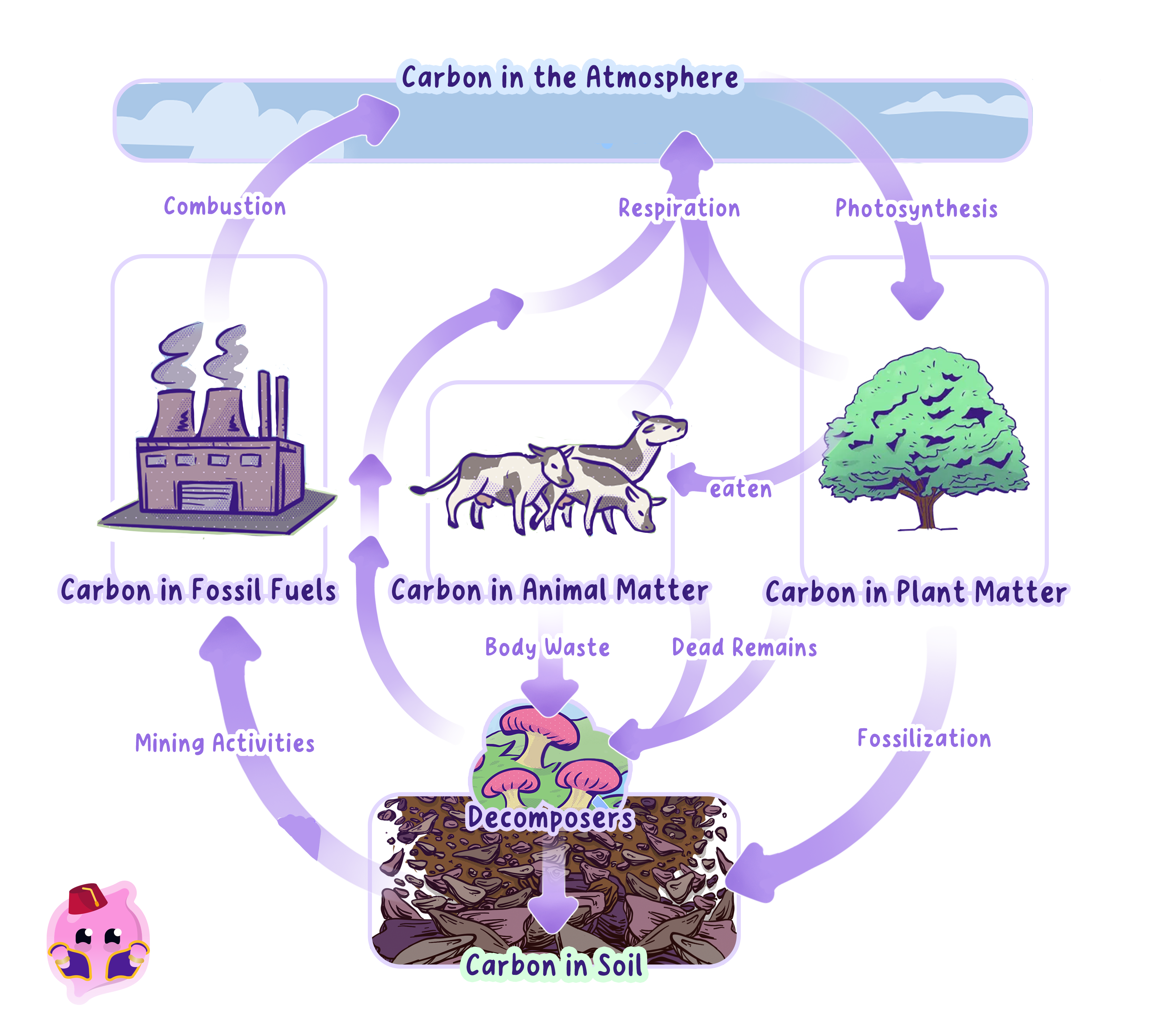
Carbon moves between major stores
Carbon cycle
The movement of carbon between the atmosphere, living organisms and the non-living environment through photosynthesis, feeding, respiration, decomposition and combustion.
- Carbon dioxide in the atmosphere and dissolved in water is an abiotic store of carbon.
- Living biomass, dead organic matter, soils, peat, oceans, carbonate rocks and fossil fuels also store carbon for different lengths of time.
- The cycle is important because living organisms need carbon to make carbohydrates, lipids, proteins and nucleic acids.
Photosynthesis starts the food-chain route
Biomass
The total mass of living material, usually measured as dry mass, present in an organism or at a trophic level.
- Producers take carbon dioxide from the air or water during photosynthesis and use its carbon atoms to make glucose.
- Plants convert glucose into other carbon compounds, so the carbon becomes part of their biomass.
- Feeding transfers carbon through a food chain when consumers eat producers or other consumers.
- The carbon remains in living tissue until it is respired, excreted, egested or the organism dies.
Respiration and decay return carbon dioxide
Decomposer
An organism that gets its energy from dead or waste organic material.
- Plants, animals and microorganisms carry out respiration, which releases carbon dioxide to the atmosphere or water.
- Bacteria and fungi secrete enzymes onto dead organisms and waste, absorb the soluble products and use them for growth and respiration.
- Microorganisms therefore return carbon dioxide while also releasing mineral ions that producers can absorb.
- A low rate of decomposition can leave carbon stored in peat or sediments, and some buried carbon eventually forms fossil fuels over geological time.
Combustion releases stored carbon
Combustion
The burning of fuels such as wood and fossil fuels, which releases carbon dioxide into the atmosphere.
- Combustion of wood and fossil fuels transfers stored carbon to the atmosphere as carbon dioxide.
- Burning fossil fuels returns carbon that had been outside the rapid biological cycle for millions of years.
- If carbon dioxide is added faster than photosynthesis and ocean uptake remove it, the atmospheric store increases.
- A complete explanation can begin with atmospheric carbon dioxide entering plants by photosynthesis and becoming plant biomass.
- It then links feeding to consumers, respiration by plants, animals and microorganisms, and decomposition of dead material and waste.
- It finishes by explaining that combustion returns carbon from wood and fossil fuels as carbon dioxide.
- For a six-mark response, cover carbon entering biomass, passing by feeding and returning through respiration, decomposition and combustion.
- Use directional language such as from the atmosphere into plant biomass so each transfer is unambiguous.
Carbon cycling supports continued growth
- Photosynthesis would slow if carbon dioxide were not returned, reducing the production of plant biomass and the food available to consumers.
- Decomposition prevents carbon and mineral nutrients remaining locked in dead organisms and waste.
- Carbon stores can change in size, but carbon atoms are transferred rather than created or destroyed.
- Which process transfers carbon dioxide into living biomass?
- How do microorganisms return carbon dioxide during decomposition?
- Name three abiotic stores of carbon.
- Which linked processes should appear in a full carbon-cycle explanation?
9.3.3 The water cycle
Solar energy drives the water cycle
Transpiration
The loss of water vapour from a plant, mainly by evaporation from leaf cells followed by diffusion through the stomata.
- Evaporation occurs when solar energy gives liquid water enough energy to become water vapour from oceans, lakes, rivers and soil.
- Transpiration adds water vapour when water absorbed by plant roots travels through the xylem and evaporates from leaf cells before diffusing through stomata.
- Water vapour rises, cools and condenses into tiny liquid droplets that form clouds.
- Precipitation occurs when droplets or ice crystals become large enough to fall as rain, snow, sleet or hail.
- Sea water can supply fresh rain because evaporation transfers water molecules into the air while dissolved salts remain in the sea.
- Cooling then condenses the water vapour before it falls as precipitation.
Water returns to organisms and the sea
- Surface runoff carries water downhill into streams and rivers that return it to lakes and oceans.
- Infiltration moves water into the soil, where it may be stored as groundwater or flow slowly towards rivers and the sea.
- Plants absorb soil water through their roots, and animals obtain water by drinking and feeding.
- Organisms need water as a solvent for metabolic reactions, as a transport medium and as a reactant in photosynthesis.
- Water returns through transpiration, respiration, sweating, excretion and evaporation from surfaces, so the cycle continues.
- Keep evaporation and condensation separate by naming the state change in each process.
- When a diagram asks for one arrow, draw only the requested transfer and label it with the process name.
Drought reduces available fresh water
- A drought is a prolonged period of unusually low rainfall, so reservoirs, rivers and groundwater stores are not replenished fast enough.
- Demand can then exceed the supply of fresh water available for homes, agriculture and ecosystems.
- Water conservation, storage, reuse and treatment reduce pressure on supplies but cannot create rainfall.
Desalination produces potable water
Potable water
Water that is safe to drink because it contains acceptably low levels of harmful microorganisms and dissolved substances.
- Desalination removes dissolved salts from sea water or brackish water when local fresh-water stores are insufficient.
- Distillation boils water and condenses the vapour, leaving most dissolved salts behind.
- Reverse osmosis forces water through a partially permeable membrane at high pressure while salts remain on the other side.
- Both methods require substantial energy, so they are expensive and can increase carbon dioxide emissions if fossil fuels supply the energy.
- The concentrated brine left behind must be managed because releasing it carelessly can damage aquatic ecosystems.
- A coastal town in drought has access to abundant sea water but little reservoir water.
- A desalination plant can provide a reliable supply of potable water, but the judgement must also consider energy cost, greenhouse-gas emissions and disposal of concentrated brine.
Water treatment makes supplies safe
- Water from fresh sources is screened and filtered to remove debris and suspended particles.
- Sterilisation destroys harmful microorganisms, while chemical tests check that dissolved substances remain at safe levels.
- Potable water is safe to drink but is not chemically pure because small amounts of dissolved substances remain.
- Which energy source drives evaporation in the water cycle?
- How do condensation and precipitation differ?
- Why can desalination help during drought?
- Give one advantage and two disadvantages of desalination.
9.3.4 The nitrogen cycle
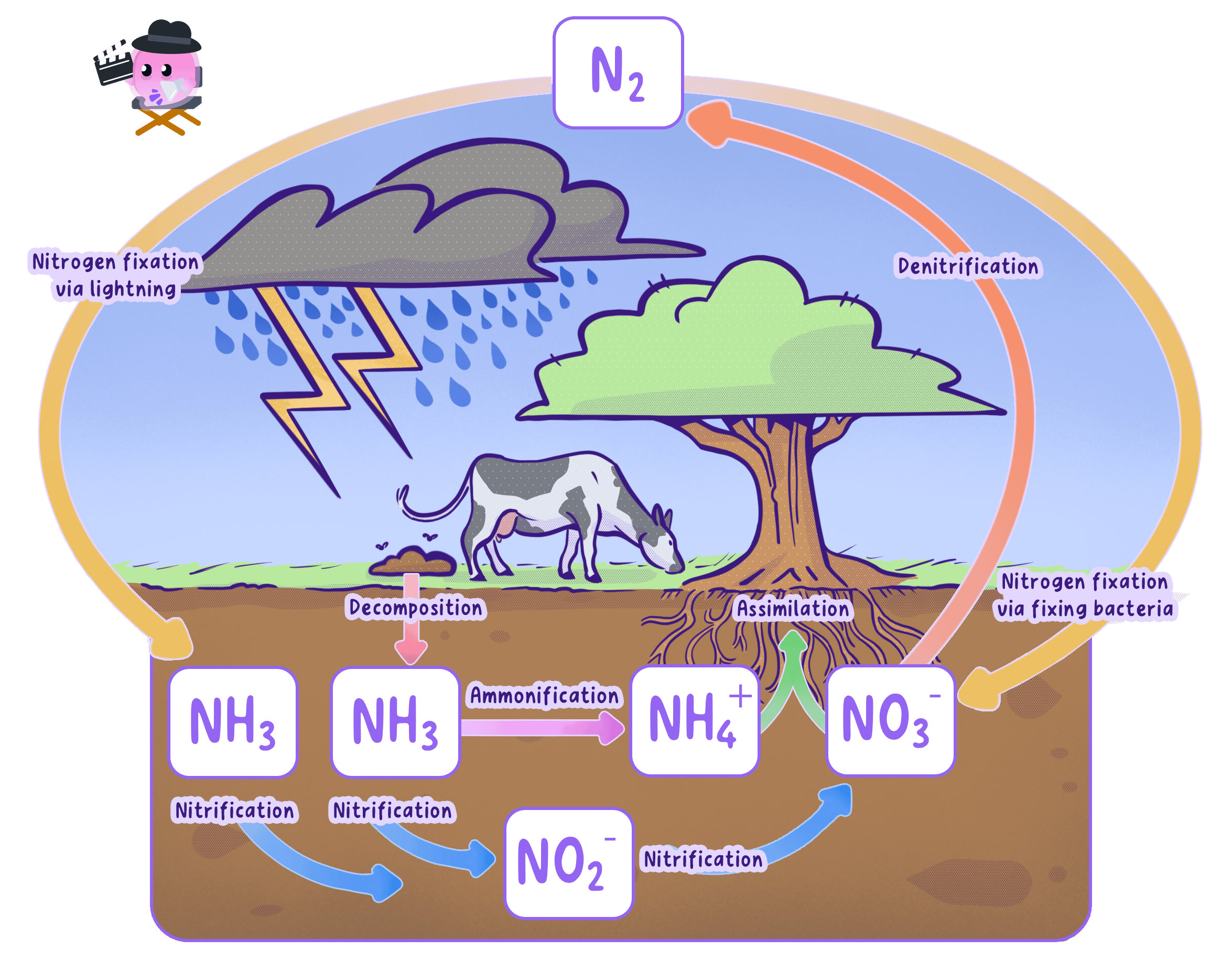
Nitrogen cycles through air, soil and organisms
Nitrogen cycle
The movement of nitrogen between the atmosphere, soil and living organisms through nitrogen fixation, feeding, decomposition, nitrification and denitrification.
- Living organisms need nitrogen to make amino acids, proteins and nucleic acids.
- Nitrogen gas makes up about 78%78\%78% of the atmosphere, but plants cannot absorb or use nitrogen gas directly.
- Plants absorb soluble nitrate ions through their roots and use the nitrogen to make amino acids.
- Feeding transfers nitrogen compounds from plants to animals and through food chains.
Bacteria make nitrogen available
Nitrogen fixation
The conversion of nitrogen gas from the air into nitrogen compounds that plants can use, carried out by nitrogen-fixing bacteria and by lightning.
- Nitrogen-fixing bacteria convert nitrogen gas into nitrogen-containing compounds that can enter the soil.
- Some nitrogen-fixing bacteria live freely in soil, while others live in root nodules of legumes such as peas, beans and clover.
- Decomposer bacteria and fungi break down proteins in dead organisms, urine and faeces, producing ammonium compounds.
- Nitrifying bacteria convert ammonium compounds into nitrites and then nitrates in oxygenated soil.
Nitrates are absorbed or returned to air
Nitrification
The conversion of ammonium compounds in the soil into nitrates by nitrifying bacteria.
- Plant roots absorb nitrates, so the nitrogen becomes part of new plant biomass.
- Denitrifying bacteria convert nitrates back into nitrogen gas when oxygen availability is low, especially in waterlogged soil.
- Denitrification lowers the nitrate content of soil and can reduce plant growth.
- Drainage and aeration reduce waterlogging, favour nitrifying bacteria and limit denitrification.
Fertilisers replace nitrate ions
Fertiliser
A substance added to soil to supply the mineral ions, such as nitrate, phosphate and potassium, that plants need for healthy growth.
- Nitrogen-containing fertilisers dissolve in soil water and provide nitrate ions that roots can absorb.
- A higher nitrate supply allows plants to make more amino acids and proteins, supporting growth and increasing crop yield when nitrate is the limiting factor.
- Applying more fertiliser than crops can absorb wastes resources and allows nitrate ions to leach from the soil.
Crop rotation raises soil nitrate levels
Crop rotation
The planned growth of different crops in sequence on the same field, including legumes that increase the nitrate content of the soil.
- A farmer grows a legume during one part of the rotation because nitrogen-fixing bacteria live in its root nodules.
- The bacteria convert atmospheric nitrogen into nitrogen compounds used by the legume.
- When roots and other plant material remain in the soil or are ploughed in, decomposers release ammonium compounds that nitrifying bacteria convert into nitrates.
- The following crop absorbs these nitrates, so crop rotation can reduce the amount of manufactured fertiliser needed.
Bacterial names must match their roles
Denitrification
The conversion of nitrates in the soil back into nitrogen gas by denitrifying bacteria, usually in waterlogged soil.
- Nitrogen-fixing bacteria move nitrogen from atmospheric gas into compounds, while nitrifying bacteria move nitrogen from ammonium compounds into nitrates.
- Denitrifying bacteria move nitrogen in the opposite direction by converting nitrates into nitrogen gas.
- Decomposers supply ammonium compounds from dead material and waste, so they connect organisms back to the soil.
- Name the bacterial group and its starting and final nitrogen compound because the word bacteria alone is too vague.
- For crop rotation, link root nodules to nitrogen fixation, soil nitrates, plant protein synthesis and increased growth.
The cycle prevents nitrogen becoming locked away
- Without decomposition, nitrogen would remain in dead biomass and waste rather than returning to the soil.
- Without nitrogen fixation and nitrate replacement, continued plant uptake would reduce the nitrate supply available for new growth.
- The balance between fixation, nitrification, uptake, decomposition and denitrification controls how much nitrate is available to plants.
- Why can plants not use atmospheric nitrogen gas directly?
- What do nitrogen-fixing, nitrifying and denitrifying bacteria each do?
- How does crop rotation with legumes increase nitrate availability?
- Why can waterlogged soil reduce plant growth?
9.3.5 Indicator species and pollution
Indicator species reveal pollution effects
Indicator species
A species whose presence or absence in a habitat shows how polluted the habitat is.
- An indicator species is useful because its presence, absence or abundance is associated with particular environmental conditions.
- A survey provides biological evidence of how conditions affect organisms over time rather than measuring one pollutant at one moment.
- Indicator evidence is indirect, so a conclusion should be supported by repeated sampling and physical or chemical measurements.
Water species reflect oxygen availability
- Bloodworms and sludgeworms can tolerate water with a low dissolved-oxygen concentration, so their presence can indicate polluted water.
- Freshwater shrimps and stonefly nymphs require cleaner, oxygen-rich water, so their presence can indicate low water pollution.
- Organic pollution can increase decomposition, and decomposer respiration then removes oxygen from the water.
- Bloodworms contain abundant haemoglobin, which helps them absorb enough oxygen when dissolved-oxygen concentration is low.
Air species respond to sulfur dioxide
- Different lichen species have different tolerances to air pollution, so the number and type of lichens can indicate air quality.
- Fewer sensitive lichen species usually occur where sulfur dioxide concentration is high.
- Blackspot fungus on rose leaves is associated with clean air because sulfur dioxide inhibits the fungus.
- The presence of blackspot supports a conclusion of low sulfur dioxide and good air quality, while its absence alone is weak evidence because other factors can prevent infection.
- Site A contains many stonefly nymphs and freshwater shrimps but no sludgeworms, so the biological evidence supports a conclusion that its water is relatively clean and oxygen-rich.
- Site B contains many sludgeworms and bloodworms but no stonefly nymphs, so it is likely to be more polluted and lower in dissolved oxygen.
- The conclusion becomes stronger if repeated samples show the same pattern and a dissolved-oxygen test agrees with the species data.
Evidence must be evaluated
- Indicator surveys are usually inexpensive, can cover many sites and show the combined biological effect of pollution over time.
- Species may be unevenly distributed, seasonal or difficult to identify, so one small sample may not represent the whole habitat.
- Temperature, pH, flow rate, shade, substrate and recent weather can affect species independently of pollution.
- Indicator species cannot identify the pollutant or give its exact concentration, so chemical measurements are needed for that information.
Investigating water indicator species
- Aim: to compare biological evidence of water pollution at several sites along the same stream.
- Apparatus: pond net, white sampling tray, forceps, identification key, timer, labelled sample containers, gloves, eye protection, thermometer, pH probe and dissolved-oxygen meter.
- Method:
- Choose sites upstream and downstream of a suspected pollution source.
- At each site, disturb the same measured area of stream bed for the same time while holding the net downstream.
- Empty the catch into a tray containing stream water.
- Use a key to identify and count bloodworms, sludgeworms, freshwater shrimps and stonefly nymphs.
- Return organisms carefully.
- Repeat at least three times at each site.
- Measure temperature, pH and dissolved oxygen at every site.
- Variables: change the sampling site and measure the abundance of each indicator species, while keeping sampling area, sampling time, net movement, time of day and identification method the same.
- Results: more stonefly nymphs and freshwater shrimps support cleaner, oxygen-rich water, while more bloodworms and sludgeworms support polluted, oxygen-poor water.
- Processing: calculate the mean count using mean count=total countnumber of samples\text{mean count}=\frac{\text{total count}}{\text{number of samples}}mean count=number of samplestotal count and compare the pattern with dissolved-oxygen readings.
- Watch out: avoid concluding from one organism because patchy distribution and identification errors can distort the result, so use repeated samples and an identification key.
- Safety: wear gloves, cover cuts, avoid deep or fast-flowing water, wash hands after sampling and do not touch unknown waste or sharp objects.
Reliable surveys use consistent sampling
- The same sampling effort at every site makes differences in counts more likely to reflect conditions rather than method.
- Repeats allow a mean to be calculated and reveal anomalous samples.
- Sampling several distances from a pollution source can reveal a trend, while an upstream control site provides a comparison.
- An evaluate question needs evidence for the conclusion, a limitation and a supported judgement.
- Use the named species and link each one to clean or polluted conditions rather than writing that some organisms like pollution.
Conclusions must match the evidence
- A correlation between an indicator species and pollution does not prove that the pollutant caused the distribution.
- A strong judgement combines the species pattern, repeated samples, appropriate controls and measurements such as dissolved oxygen or sulfur dioxide.
- If different types of evidence disagree, state the uncertainty and identify the additional measurement needed.
- Which two species indicate polluted water?
- Which two species indicate clean water?
- What do lichens and blackspot fungus indicate about air quality?
- Give two strengths and two limitations of indicator-species evidence.
9.3.6 Decomposition in preservation and composting
Decomposition depends on microbial activity
Decomposition
The breakdown of dead organisms and waste by microorganisms, which releases nutrients back into the environment.
- Bacteria and fungi secrete digestive enzymes onto biological material and absorb the soluble products.
- Temperature changes enzyme activity and the rates of microbial respiration, growth and reproduction.
- Water is needed for enzyme-controlled reactions and for soluble substances to move into microbial cells.
- Oxygen allows aerobic decomposers to respire and release enough energy for rapid growth and active transport.
Food preservation removes favourable conditions
- Refrigeration lowers temperature, reducing enzyme activity and slowing microbial growth without killing every microorganism.
- Freezing makes liquid water unavailable and lowers enzyme activity, so decay becomes very slow until the food thaws.
- Drying removes water, while high concentrations of salt or sugar draw water out of microbial cells by osmosis.
- Vacuum packaging and sealed containers reduce oxygen availability, slowing aerobic decomposers.
- Canning combines heating to kill microorganisms with sealing to prevent re-entry and restrict oxygen.
- Pasteurisation uses controlled heating to kill many microorganisms and is followed by cooling to slow survivors.
- Fresh fruit kept warm, moist and exposed to air provides favourable conditions for decomposers, so it decays rapidly.
- The same fruit lasts longer when chilled because lower temperature reduces enzyme activity and microbial reproduction.
- Drying or sealing it removes another requirement, so the explanation should name the factor and its effect on microorganisms.
Composting supplies favourable conditions
- A compost heap is kept moist so decomposers have water, but excess water fills air spaces and restricts oxygen.
- Turning the heap introduces oxygen for aerobic respiration and mixes undecomposed material with microorganisms.
- Microbial respiration releases heat, so a large, insulated heap can remain warm and support rapid enzyme activity.
- Very high temperature slows some decomposers because enzymes denature and microorganisms may die.
- Shredding material increases its surface area, giving decomposer enzymes more contact with the material.
- A mixture of soft green material and tougher dry material helps retain moisture without removing all the air spaces.
- For each factor, write a causal chain from the condition to microbial enzyme activity or respiration and then to the rate of decomposition.
- Avoid saying cold kills bacteria because refrigeration mainly slows their reactions and growth.
Preservation and composting use opposite aims
- Preservation keeps food cold, dry or low in oxygen to reduce the rate at which decomposers break it down.
- Composting keeps material warm, moist and aerated to increase decomposition and produce nutrient-rich compost.
- Compost returns mineral ions to soil, where plants can absorb them for new growth.
- Conditions must be balanced because a waterlogged heap has little oxygen, while a dry heap limits enzyme-controlled reactions.
- How does low temperature slow food decomposition?
- Why do drying, salt and sugar preserve food?
- Why does turning a compost heap increase decomposition?
- Why can both too little and too much water slow composting?
9.3.7 Rate changes in decay of biological material
Mean decay rate uses change per time
Rate of decay
The amount of biological material decomposed per unit time.
- The amount decomposed can be measured as a decrease in mass, volume or another stated quantity.
- For mass data, calculate Δm=minitial−mfinal\Delta m=m_{\text{initial}}-m_{\text{final}}Δm=minitial−mfinal before calculating the rate.
- The mean rate is mean rate of decay=amount decomposedtime taken\text{mean rate of decay}=\frac{\text{amount decomposed}}{\text{time taken}}mean rate of decay=time takenamount decomposed.
- For mass loss, mean rate=minitial−mfinalΔt\text{mean rate}=\frac{m_{\text{initial}}-m_{\text{final}}}{\Delta t}mean rate=Δtminitial−mfinal.
- A suitable unit is g d−1\mathrm{g\,d^{-1}}gd−1 when mass is measured in grams and time in days.
- A leaf sample decreases from 180 g180\,\mathrm{g}180g to 132 g132\,\mathrm{g}132g in 30 d30\,\mathrm{d}30d.
- The mass decomposed is 180−132=48 g180-132=48\,\mathrm{g}180−132=48g.
- The mean rate is 48 g30 d=1.6 g d−1\frac{48\,\mathrm{g}}{30\,\mathrm{d}}=1.6\,\mathrm{g\,d^{-1}}30d48g=1.6gd−1.
- A second sample decaying at 1.2 g d−11.2\,\mathrm{g\,d^{-1}}1.2gd−1 is slower by 0.4 g d−10.4\,\mathrm{g\,d^{-1}}0.4gd−1.
Use the elapsed time, not the reading count
- The time interval is Δt=tfinal−tinitial\Delta t=t_{\text{final}}-t_{\text{initial}}Δt=tfinal−tinitial, even when the table contains several intermediate readings.
- Intermediate values are not added when the question asks for the mean rate between two named times.
- Keep unrounded values during working and round only the final answer to a sensible number of significant figures.
- Include the unit because a numerical rate without amount per time is incomplete.
- Subtract the two endpoint quantities, then divide by the elapsed time, not by the number of rows in the table.
- Show the subtraction and division because each stage can earn credit even if the final number is wrong.
- Check whether the question asks for mass lost, mass remaining or percentage change before choosing the numerator.
Percentage changes compare samples fairly
- The percentage mass lost is percentage mass lost=minitial−mfinalminitial×100\text{percentage mass lost}=\frac{m_{\text{initial}}-m_{\text{final}}}{m_{\text{initial}}}\times100percentage mass lost=minitialminitial−mfinal×100.
- The percentage change in rate is percentage change=new rate−original rateoriginal rate×100\text{percentage change}=\frac{\text{new rate}-\text{original rate}}{\text{original rate}}\times100percentage change=original ratenew rate−original rate×100.
- A negative percentage change shows that the rate decreased, while a positive value shows that it increased.
- Percentages allow samples with different starting masses or original rates to be compared on the same scale.
Graphs show changes through time
- On a mass-remaining graph, a steeper downward section represents a faster rate of decomposition.
- The mean rate between two times is the magnitude of the gradient of the line joining those points.
- For a curve, a tangent at one time estimates the instantaneous rate using rate=∣ΔyΔx∣\text{rate}=\left|\frac{\Delta y}{\Delta x}\right|rate=ΔxΔy.
- Read both axes and their units before substituting values because time may be given in hours, days or weeks.
- If the mass falls by 24 g24\,\mathrm{g}24g over 12 d12\,\mathrm{d}12d, the gradient is −2412=−2 g d−1\frac{-24}{12}=-2\,\mathrm{g\,d^{-1}}12−24=−2gd−1.
- The negative gradient shows that mass remaining decreases, while the rate of decay is usually reported as the positive magnitude 2 g d−12\,\mathrm{g\,d^{-1}}2gd−1.
Rate comparisons need the same basis
- Compare rates only after converting them to the same units and checking that they describe the same measured quantity.
- A fair conclusion states which sample decayed faster and supports it with the calculated rates.
- Differences in temperature, water or oxygen can explain a difference in rate by changing decomposer activity.
- Write the equation for mean rate of decay.
- Why is the number of table readings not used as the time denominator?
- What does a steeper downward mass graph show?
- How do you calculate percentage mass lost?
