3.3.1 Gregor Mendel and the basis of genetics
Mendel's pea plant experiments
- Gregor Mendel was a monk who studied inheritance in pea plants in the 180018001800s.
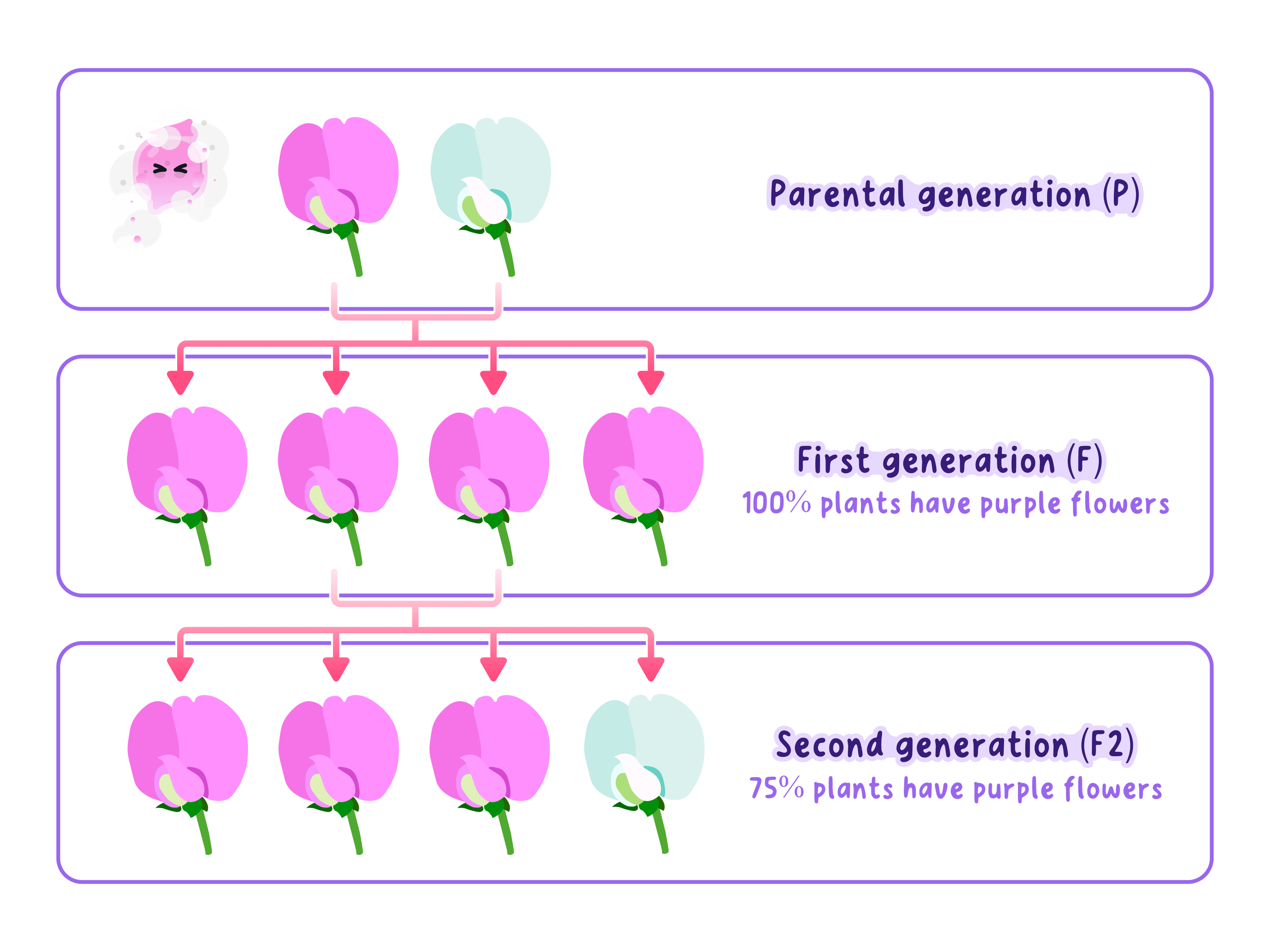
- He crossed pea plants with different features, such as tall and short, and counted the offspring.
- He found that features were passed on in fixed ratios, such as 3:13:13:1.
- From this he proposed that features are controlled by separate units of inheritance passed from parents to offspring.
Mendel worked before chromosomes, genes or DNA were known about.
Crossing tall and short peas, then breeding the offspring, gave a 3:13:13:1 ratio of tall to short.
From Mendel to modern genetics
Gene
A short section of DNA that codes for a particular protein and controls a characteristic.
- Mendel's work was not widely accepted during his lifetime.
- Later, chromosomes were seen moving during cell division.
- Then genes were identified on chromosomes, and DNA was found to be the genetic material.
- Mendel's units of inheritance were then understood to be genes.
Mendel described how features are inherited long before anyone knew that genes or DNA existed.
Remember the order: Mendel's units, then chromosomes, then genes and DNA.
- Who was Gregor Mendel and what did he study?
- What did Mendel call the things that carry features?
- Why were Mendel's ideas not accepted at first?
- What are Mendel's units of inheritance now known to be?
3.3.2 Alleles and inherited characteristics
Chromosomes and genes
Chromosome
A thread-like structure of tightly coiled DNA in the nucleus that carries many genes.
Gene
A short section of DNA that codes for a particular protein and controls a characteristic.
- The nucleus of a cell contains thread-like structures called chromosomes.
- Each chromosome is made from one very long molecule of DNA that is tightly coiled up.
- A gene is a small section of that DNA that carries the instructions for one feature.
- The genes sit along a chromosome in a fixed order, and the fixed position of a gene is called its locus.
- A single chromosome carries many hundreds or thousands of genes, one after another.
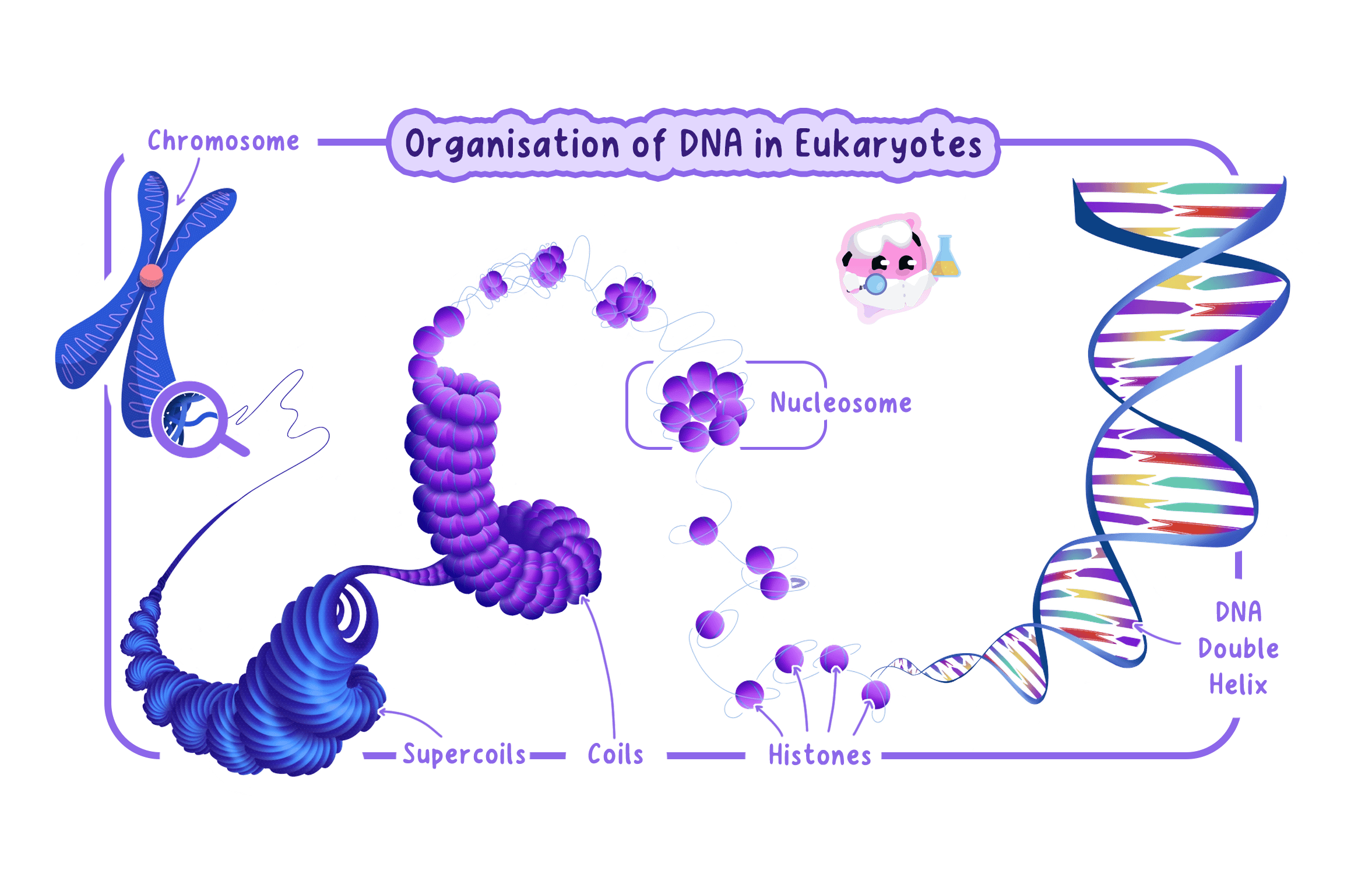
Picture a chromosome as a long shelf and the genes as books in a set order: the locus is the exact spot where one gene always sits.
Remember the nesting from large to small: nucleus holds chromosomes, a chromosome is one long DNA molecule, and a gene is a short section of that DNA.
Alleles
Allele
A different version of a gene.
- Body cells contain chromosomes in matching pairs, called homologous pairs.
- In humans there are 232323 pairs, giving 464646 chromosomes in each body cell.
- One chromosome of each pair comes from the mother and one from the father.
- The two chromosomes in a pair carry the same genes at the same loci.
- A gene can exist in different versions called alleles, and the two alleles at a locus may be the same or different.
The gene for eye colour sits at one locus: one allele may give brown eyes and a different allele blue eyes.
Do not mix up a gene and an allele: a gene is the section of DNA for a feature, while an allele is one particular version of that gene.
Dominant and recessive alleles
Dominant allele
An allele that is expressed in the phenotype even when only one copy is present.
Recessive allele
An allele that is only expressed in the phenotype when two copies are present.
- A dominant allele shows its effect even if only one copy is present.
- A recessive allele shows its effect only when two copies are present.
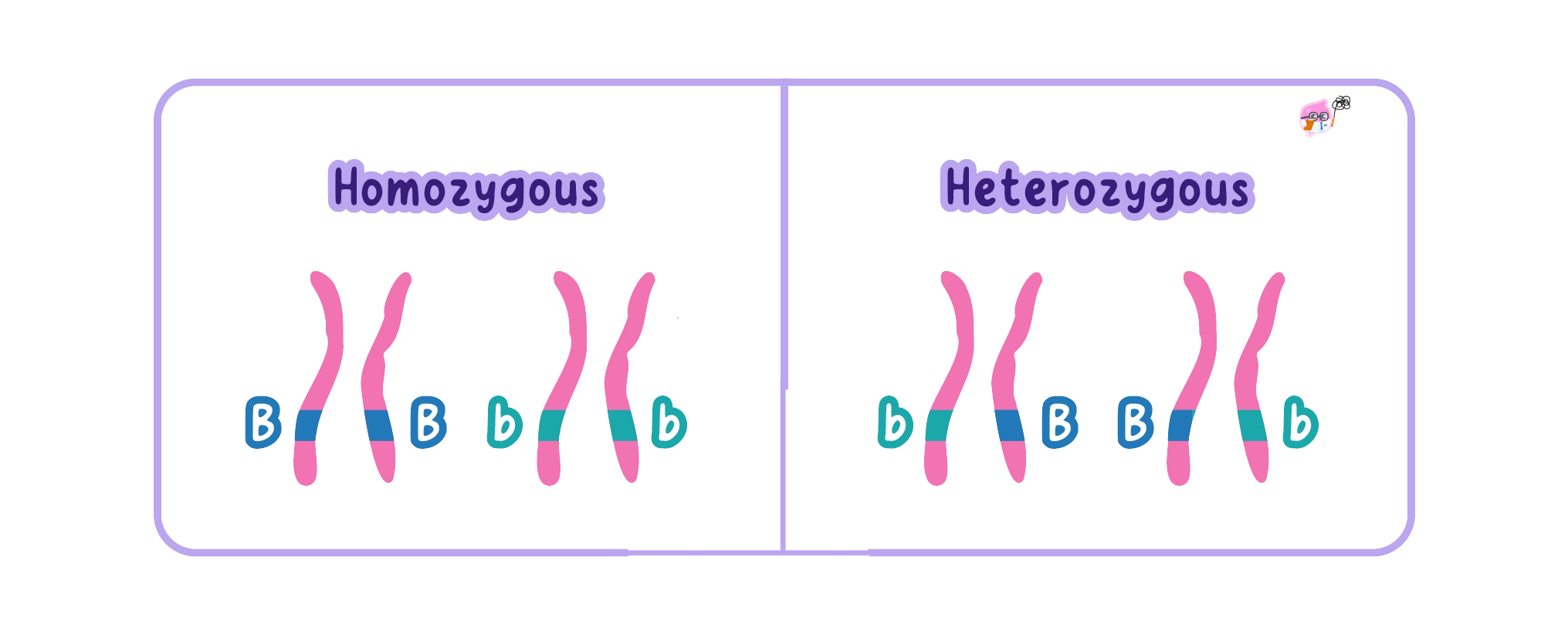
A dominant allele is usually written as a capital letter and its recessive partner as the same letter in lower case, such as BBB and bbb.
A dominant allele needs just one copy to show; a recessive allele needs two.
Homozygous and heterozygous
Homozygous
Having two identical alleles of a gene.
Heterozygous
Having two different alleles of a gene.
- Homozygous means the two alleles for a gene are the same, such as BBBBBB or bbbbbb.
- Heterozygous means the two alleles are different, such as BbBbBb.
- A homozygous organism is pure-breeding for that gene because every gamete receives the same allele.
Genotype and phenotype
Genotype
The combination of alleles an organism has for a characteristic.
Phenotype
The observable characteristics of an organism, produced by its genotype and its environment.
- The genotype is the alleles an organism has for a gene.
- The phenotype is the observable feature that results.
- The phenotype is set by the genotype together with the environment.
An organism with genotype BbBbBb is heterozygous, and if BBB is dominant its phenotype is the dominant feature.
Do not confuse genotype with phenotype: the genotype is the alleles, the phenotype is the feature you can observe.
Gametes and zygotes
Gamete
A sex cell that carries half the number of chromosomes of a body cell and fuses with another gamete at fertilisation.
Zygote
The single diploid cell produced when two gametes fuse at fertilisation.
- A gamete contains one allele for each gene because it is haploid and carries one chromosome from each homologous pair.
- At fertilisation, a male gamete and a female gamete fuse. The resulting zygote is diploid, so it contains two alleles for each gene, one inherited from each parent.
- Different combinations of parental alleles give offspring different genotypes, which can produce different inherited phenotypes.
- Define chromosome, gene and allele.
- Explain the difference between dominant and recessive alleles.
- Distinguish homozygous from heterozygous genotypes.
- Explain the difference between genotype and phenotype.
- What allele does each gamete carry for one gene?
- How does a zygote obtain two alleles for each gene?
3.3.3 Monohybrid inheritance
Monohybrid inheritance
Monohybrid cross
A genetic cross that follows the inheritance of a single gene.
- A monohybrid cross follows the inheritance of a single gene.
- A genetic diagram sets out the parents' genotypes, the alleles in their gametes, and the possible offspring.
- Each parent passes just one allele of the gene into each gamete.
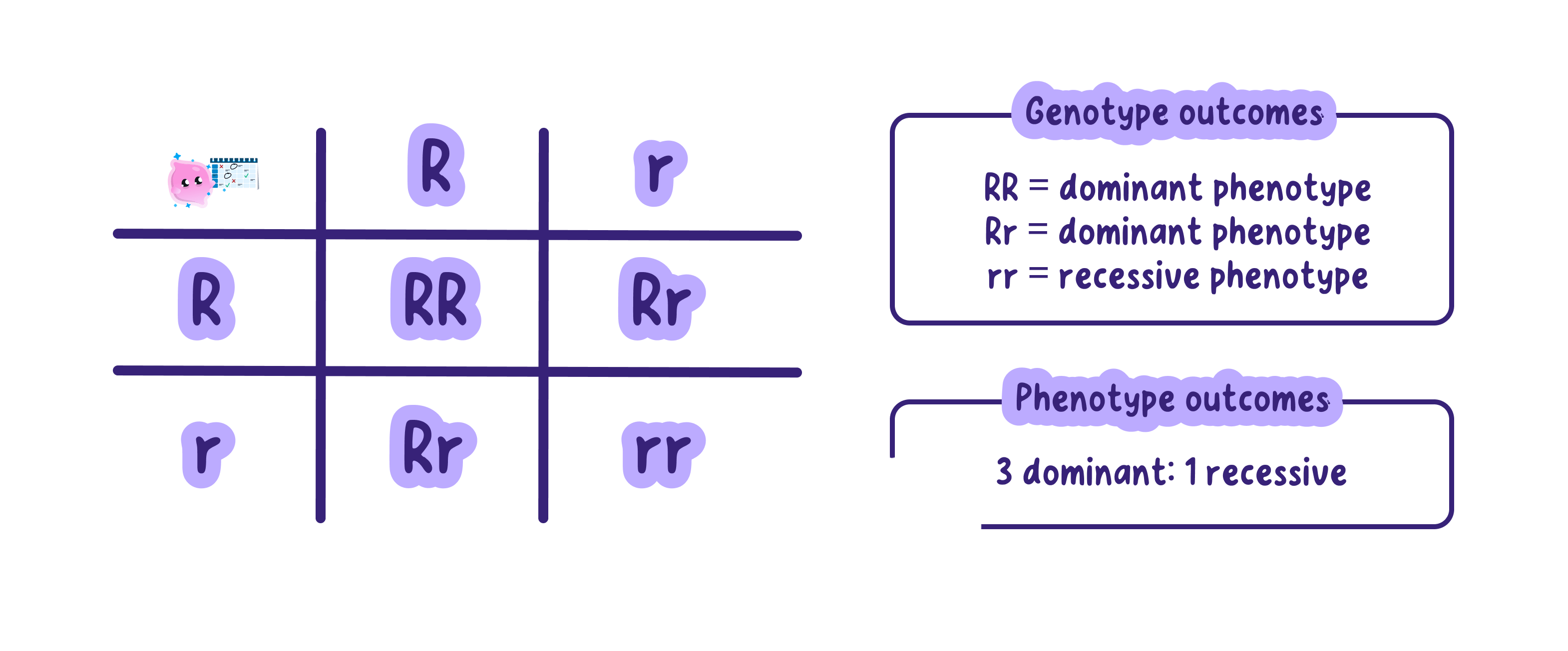
- A Punnett square is a grid used to combine the parents' gametes and find the offspring genotypes.
Each gamete carries only one allele of each gene, because meiosis halves the number.
Work in order: write the parents' genotypes, then their gametes, then combine them.
Genotype and phenotype ratios
Phenotype
The observable characteristics of an organism, produced by its genotype and its environment.
- Combining the gametes gives the possible offspring genotypes.
- From a cross of two heterozygotes (Bb×BbBb \times BbBb×Bb), the offspring are BBBBBB, BbBbBb, BbBbBb and bbbbbb.
- This is a genotype ratio of 1:2:11:2:11:2:1 and a phenotype ratio of 3:13:13:1, dominant to recessive.
- A cross of a heterozygote with a homozygous recessive (Bb×bbBb \times bbBb×bb) gives a 1:11:11:1 phenotype ratio.
Do not confuse the genotype ratio (1:2:11:2:11:2:1) with the phenotype ratio (3:13:13:1).
Worked cross: two heterozygous pea plants
- Parental genotypes: Tt×TtTt \times TtTt×Tt. The allele TTT is dominant for tall plants and ttt is recessive for short plants.
- Gametes: each parent produces gametes carrying either TTT or ttt.
- Punnett outcomes: TTTTTT, TtTtTt, TtTtTt and tttttt.
- Genotype ratio: 1 TT:2 Tt:1 tt1\,TT : 2\,Tt : 1\,tt1TT:2Tt:1tt.
- Phenotype ratio: 333 tall : 111 short because both TTTTTT and TtTtTt show the dominant phenotype.
- Probability: each offspring has a 34\dfrac{3}{4}43 chance of being tall and a 14\dfrac{1}{4}41 chance of being short. These are probabilities for each fertilisation, not a guarantee that every four offspring will have exactly this pattern.
Using a Punnett square
Punnett square
A grid used to predict the possible genotypes and phenotypes of offspring from a genetic cross.
- A Punnett square is a grid for combining the parents' gametes.
- Write one parent's gametes along the top and the other's down the side.
- Fill each box by combining the allele from its row with the allele from its column.
- The filled boxes show all the possible offspring genotypes.
- For Bb×BbBb \times BbBb×Bb, the four boxes give BBBBBB, BbBbBb, BbBbBb and bbbbbb.
Put single alleles on the edges of the grid, not whole genotypes.
Do not put both of a parent's alleles into one gamete: each gamete gets only one.
- What is a monohybrid cross?
- What is a Punnett square used for?
- What phenotype ratio comes from crossing two heterozygotes?
- What is the difference between a genotype ratio and a phenotype ratio?
3.3.4 Determination of sex at fertilisation
Sex chromosomes
Sex chromosomes
The pair of chromosomes that determine biological sex: XX in females and XY in males.
- One of the 232323 pairs of chromosomes is the pair of sex chromosomes.
- Females have two X chromosomes (XXXXXX).
- Males have one X and one Y chromosome (XYXYXY).
- The other 222222 pairs are the same type in both sexes.
The Y chromosome carries the genes that lead to male development.
Females are XXXXXX and males are XYXYXY: the male has the Y.
How sex is determined
Punnett square
A grid used to predict the possible genotypes and phenotypes of offspring from a genetic cross.
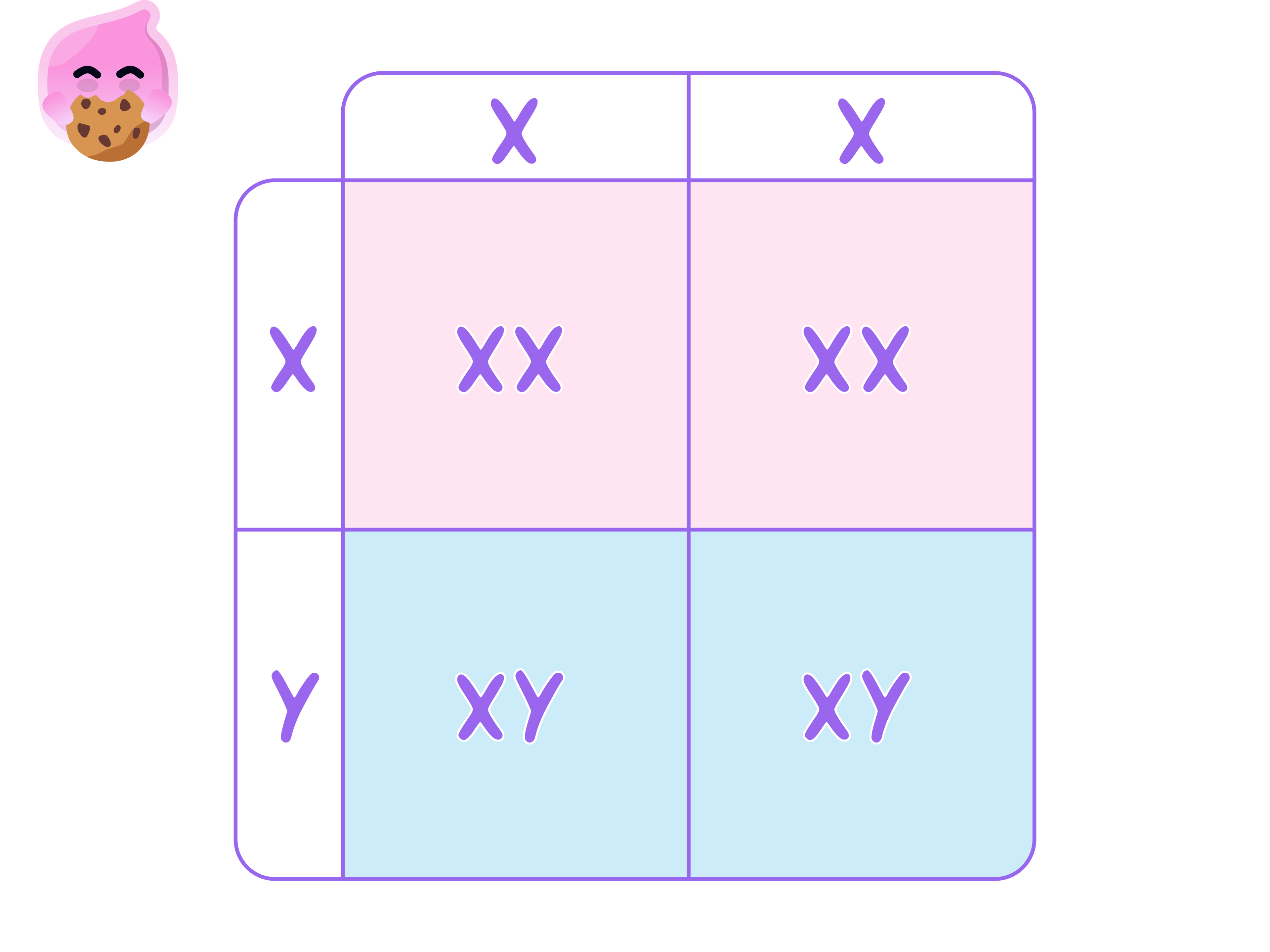
- All egg cells carry one X chromosome.
- Half the sperm carry an X and half carry a Y.
- If an X sperm fertilises the egg, the child is XXXXXX (female).
- If a Y sperm fertilises the egg, the child is XYXYXY (male).
- So there is a 1:11:11:1 ratio, giving about a 50%50\%50% chance of each sex.
Worked cross: determining sex
- Parental sex chromosomes: mother XXXXXX and father XYXYXY.
- Gametes: every egg carries XXX; half the sperm carry XXX and half carry YYY.
- Possible offspring: XXXXXX, XXXXXX, XYXYXY and XYXYXY.
- Outcome: 222 female : 222 male, which simplifies to a 1:11:11:1 ratio.
- Probability: each fertilisation has a 12\dfrac{1}{2}21 or 50%50\%50% chance of producing an XXXXXX offspring and the same chance of producing an XYXYXY offspring.
Do not say the mother decides the sex: the sperm carries the X or Y that decides it.
- Which sex chromosomes do females and males have?
- Which parent's gamete decides the sex of the child?
- What is the ratio of male to female offspring?
- What is the chance that a child is male?
3.3.5 Outcomes from monohybrid crosses
Reading a family pedigree
Family pedigree
A diagram that shows how one characteristic has been inherited through several generations of a single family.
- A pedigree is a family tree that shows how a feature is passed down the generations.
- Usually squares stand for males and circles for females, and shaded shapes show individuals with the feature.
- Lines link parents to their children, so you can follow the feature through the family.
- From the pattern you can work out whether the feature is dominant or recessive.
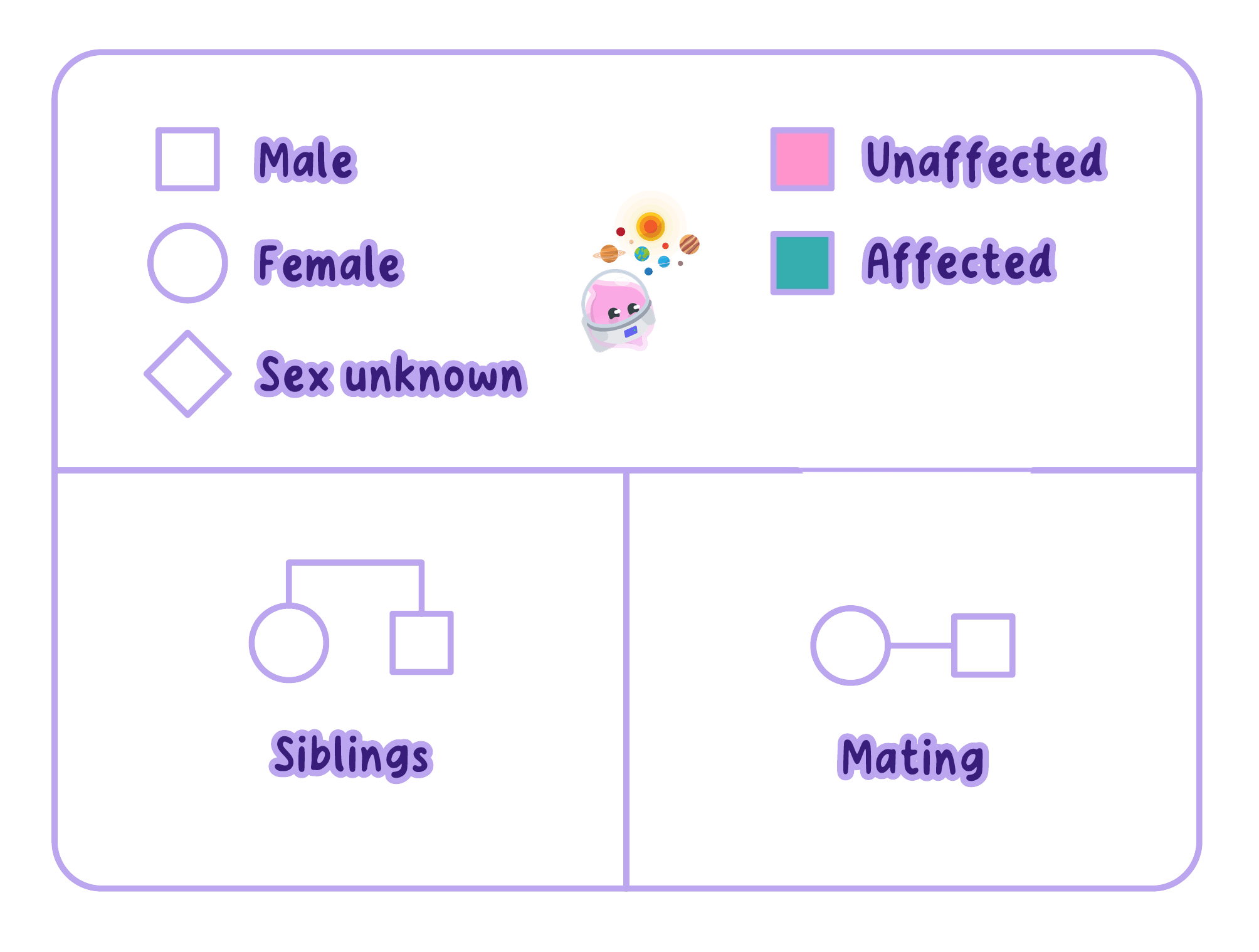
A shaded shape shows someone who has the feature; an unshaded one shows someone who does not.
Start by asking whether the feature can skip a generation, which points to it being recessive.
Genotypes and carriers
Carrier
A person who is heterozygous for a recessive disorder, so they do not have the disorder themselves but can pass the faulty allele to their children.
- If two unaffected parents have an affected child, the feature must be recessive, and both parents must be carriers.
- A carrier is heterozygous: they have the recessive allele but do not show the feature.
- If the feature appears in every generation and affected children always have an affected parent, it is likely dominant.
- Once you know the pattern, you can give genotypes and predict the chance of future children being affected.
Worked pedigree outcome
- Two unaffected parents have a child with a recessive disorder. Because the child is affected, the child's genotype must be ffffff.
- Each parent must have supplied an fff allele. Since both parents are unaffected, each must also carry the dominant normal allele, so both parents are FfFfFf.
- Cross: Ff×FfFf \times FfFf×Ff. The possible offspring are FFFFFF, FfFfFf, FfFfFf and ffffff.
- Genotype ratio: 1 FF:2 Ff:1 ff1\,FF : 2\,Ff : 1\,ff1FF:2Ff:1ff.
- The probability of an affected child is 14=25%\dfrac{1}{4}=25\%41=25%. The probability of an unaffected carrier is 24=12=50%\dfrac{2}{4}=\dfrac{1}{2}=50\%42=21=50%.
- Each pregnancy is an independent event, so a previous affected or unaffected child does not change the probability for the next child.
Do not assume an unaffected person has no recessive allele: they may be a carrier.
- What is a pedigree?
- How can you tell a feature is recessive from a pedigree?
- What is a carrier?
- If a feature appears in every generation, is it more likely dominant or recessive?
3.3.6 Inheritance of ABO blood groups
Codominance
Codominance
Where two different alleles of a gene are both fully expressed in the phenotype of a heterozygous organism.
- In codominance, neither allele is dominant over the other, so both show in the phenotype.
- A heterozygote then shows both features at once, not just one.
- Codominant alleles are written as capital letters with a raised label, rather than a capital and a lower-case.
Worked cross: group A and group B parents
- Parent genotypes: IAi×IBiI^A i \times I^B iIAi×IBi. The alleles IAI^AIA and IBI^BIB are codominant, while iii is recessive.
- Gametes: the group A parent produces IAI^AIA or iii gametes; the group B parent produces IBI^BIB or iii gametes.
- Offspring genotypes: IAIBI^A I^BIAIB, IAiI^A iIAi, IBiI^B iIBi and iiiiii.
- Phenotypes: group AB, group A, group B and group O.
- Each blood group has a probability of 14=25%\dfrac{1}{4}=25\%41=25% for each child.
Codominance is not a blend: both alleles are fully shown at the same time.
ABO alleles
Codominance
Where two different alleles of a gene are both fully expressed in the phenotype of a heterozygous organism.
- The ABO blood group is controlled by a gene with three alleles: IAI^AIA, IBI^BIB and iii.
- IAI^AIA and IBI^BIB are codominant, so both show if they are present together.
- Both IAI^AIA and IBI^BIB are dominant over iii.
- Each person carries only two of the three alleles.
Only IAI^AIA and IBI^BIB are codominant; iii is recessive to both.
ABO genotypes and phenotypes
Allele
A different version of a gene.
- Genotypes IAIAI^A I^AIAIA and IAiI^A iIAi give group A.
- Genotypes IBIBI^B I^BIBIB and IBiI^B iIBi give group B.
- Genotype IAIBI^A I^BIAIB gives group AB, because both alleles are shown.
- Genotype iiiiii gives group O.
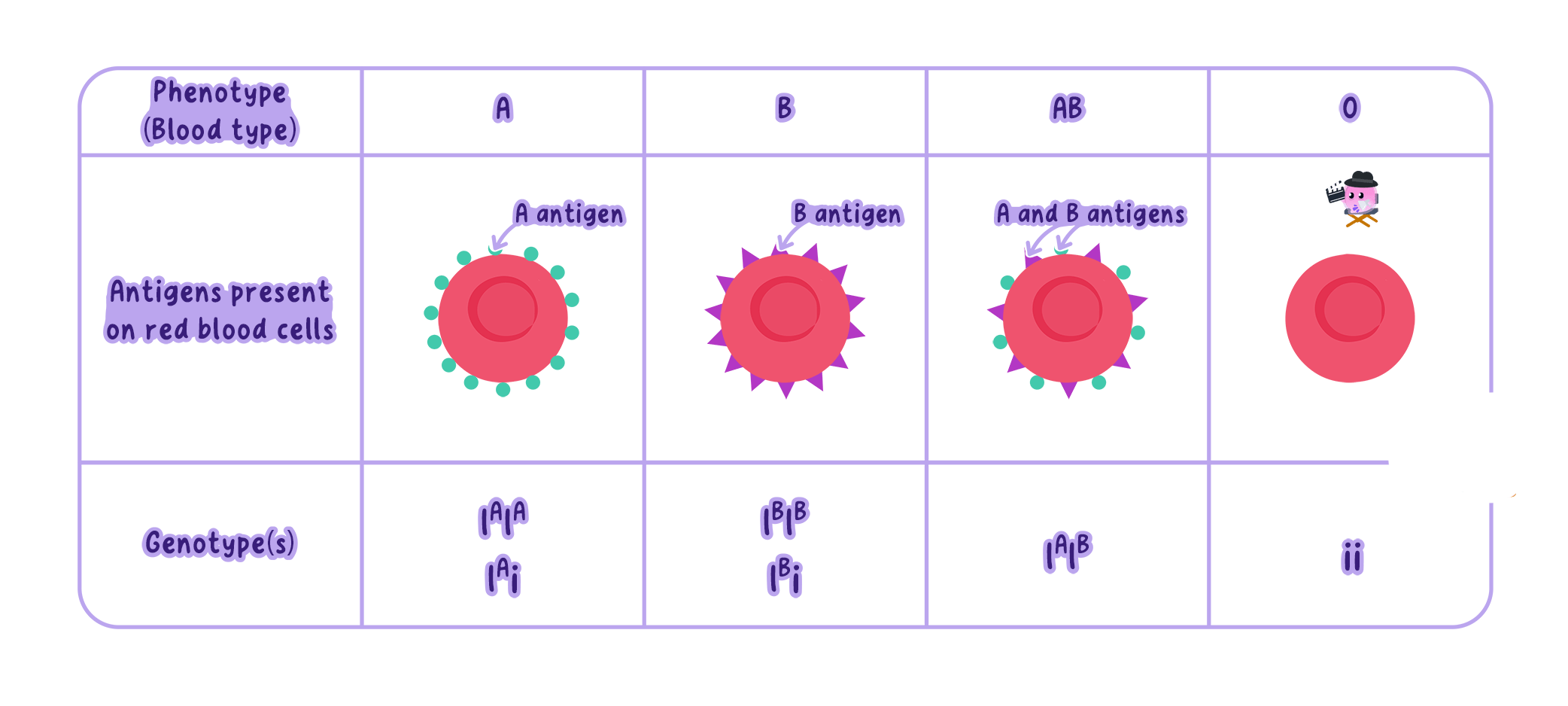
A group A parent (IAiI^A iIAi) and a group B parent (IBiI^B iIBi) can have a child of any of the four groups.
Do not forget that group O is the homozygous recessive genotype iiiiii.
- What are the three ABO alleles?
- Which two alleles are codominant?
- What genotype gives group O?
- What genotype gives group AB?
3.3.7 Inheritance of sex-linked disorders
Sex-linked genes
Sex-linked inheritance
The inheritance of a characteristic controlled by a gene on a sex chromosome, usually the X chromosome.
Sex chromosomes
The pair of chromosomes that determine the sex of an individual, XX in a human female and XY in a human male.
- A sex-linked gene is carried on a sex chromosome. At this level, sex-linked inheritance usually means a gene on the X chromosome.
- Human females have XXXXXX sex chromosomes, while human males have XYXYXY. The Y chromosome does not usually carry a matching allele for an X-linked gene.
- A male therefore has only one allele for most X-linked genes. If that allele is recessive and causes a disorder, it is expressed because there is no second allele on the Y chromosome to mask it.
- A female usually needs two copies of a recessive X-linked allele to have the disorder. A heterozygous female has one normal allele and one faulty allele, so she is usually an unaffected carrier.
Genotypes and inheritance
Carrier
A person who is heterozygous for a recessive disorder, so they do not have the disorder themselves but can pass the faulty allele to their children.
- Write X-linked alleles as superscripts on the X chromosome. For example, XNX^NXN can represent the normal allele and XnX^nXn the recessive disorder allele.
- A carrier female is XNXnX^N X^nXNXn, an affected female is XnXnX^n X^nXnXn, an unaffected male is XNYX^N YXNY and an affected male is XnYX^n YXnY.
- A father passes his X chromosome to every daughter and his Y chromosome to every son. He therefore cannot pass an X-linked allele directly to a son.
Keep each allele attached to its X chromosome. Writing bare NNN and nnn loses the information about both the allele and the sex of the offspring.
Worked cross: carrier mother and unaffected father
- Parents: XNXn×XNYX^N X^n \times X^N YXNXn×XNY.
- Gametes: the mother produces XNX^NXN or XnX^nXn eggs; the father produces XNX^NXN or YYY sperm.
- Possible daughters: XNXNX^N X^NXNXN unaffected and XNXnX^N X^nXNXn unaffected carrier.
- Possible sons: XNYX^N YXNY unaffected and XnYX^n YXnY affected.
- Across all children, the probability of an affected child is 14=25%\dfrac{1}{4}=25\%41=25%. Among sons only, the probability of being affected is 12=50%\dfrac{1}{2}=50\%21=50%.
- No daughter from this cross is affected because every daughter receives the father's normal XNX^NXN chromosome.
- Begin with the parents' full sex-linked genotypes, including the Y chromosome.
- List the gametes before filling the Punnett square, then identify daughters and sons separately.
- State clearly whether a probability refers to all children or only to sons or daughters.
- Why are recessive X-linked disorders more common in males?
- Write the genotype of a carrier female and an affected male.
- Why can a father not pass an X-linked allele to his son?
- For XNXn×XNYX^N X^n \times X^N YXNXn×XNY, what fraction of all children is expected to be affected?
3.3.8 Multiple genes and phenotypic features
Features controlled by several genes
Polygenic inheritance
The control of a single characteristic by several genes acting together.
- Polygenic inheritance is when a feature is controlled by several genes working together.
- Many everyday features, such as height, skin colour and eye colour, are polygenic.
- Each of the genes adds a small effect, and together they set the feature.
Human height is affected by many genes, so people range through every height rather than being simply tall or short.
Most features are polygenic; features controlled by a single gene are the exception.
Polygenic features and variation
Continuous variation
Variation that produces a continuous range of phenotypes between two extremes, with no distinct categories.
- Because many genes each add a little, polygenic features vary smoothly across a range.
- This smooth range is called continuous variation, with no distinct categories.
- A feature controlled by a single gene tends to fall into a few clear categories instead.
- The environment can also affect polygenic features, widening the range further.
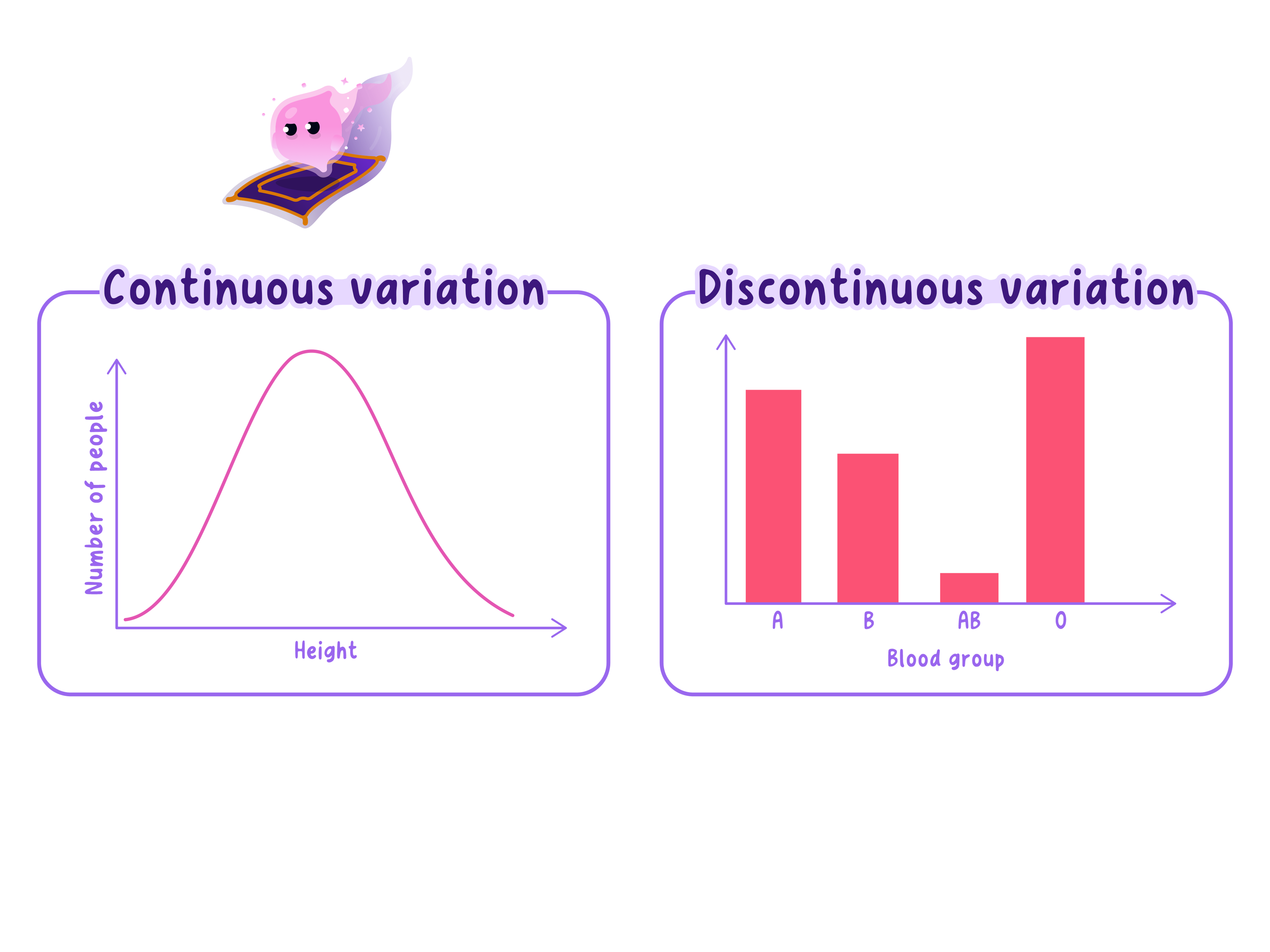
A smooth range points to many genes; a few distinct categories point to a single gene.
Do not treat a feature like height as controlled by one gene: it is polygenic.
- What is polygenic inheritance?
- Give two examples of polygenic features.
- What is continuous variation?
- How can you tell a polygenic feature from a single-gene feature?
