What Differentiation Is
Differentiation
The process by which an unspecialised cell switches on particular genes and develops the structures it needs to carry out one specific job.
- Every body cell in an organism is produced by mitosis and therefore carries the same genes.
- Differentiation is the process that turns one of these unspecialised cells into a cell with a particular job.
- It happens because the cell switches on only some of its genes and keeps the rest switched off.
- Once a cell has differentiated it usually keeps that identity for the rest of its life.
How a Cell Becomes Specialised
- The genes that are switched on are transcribed and translated, so the cell makes a particular set of proteins.
- Those proteins determine the cell's structure, because they build the sub-cellular structures it needs.
- A cell that switches on the genes for haemoglobin fills with that protein and loses its nucleus, becoming a red blood cell.
- A neighbouring cell with the identical genome switches on a different set and becomes something else entirely.
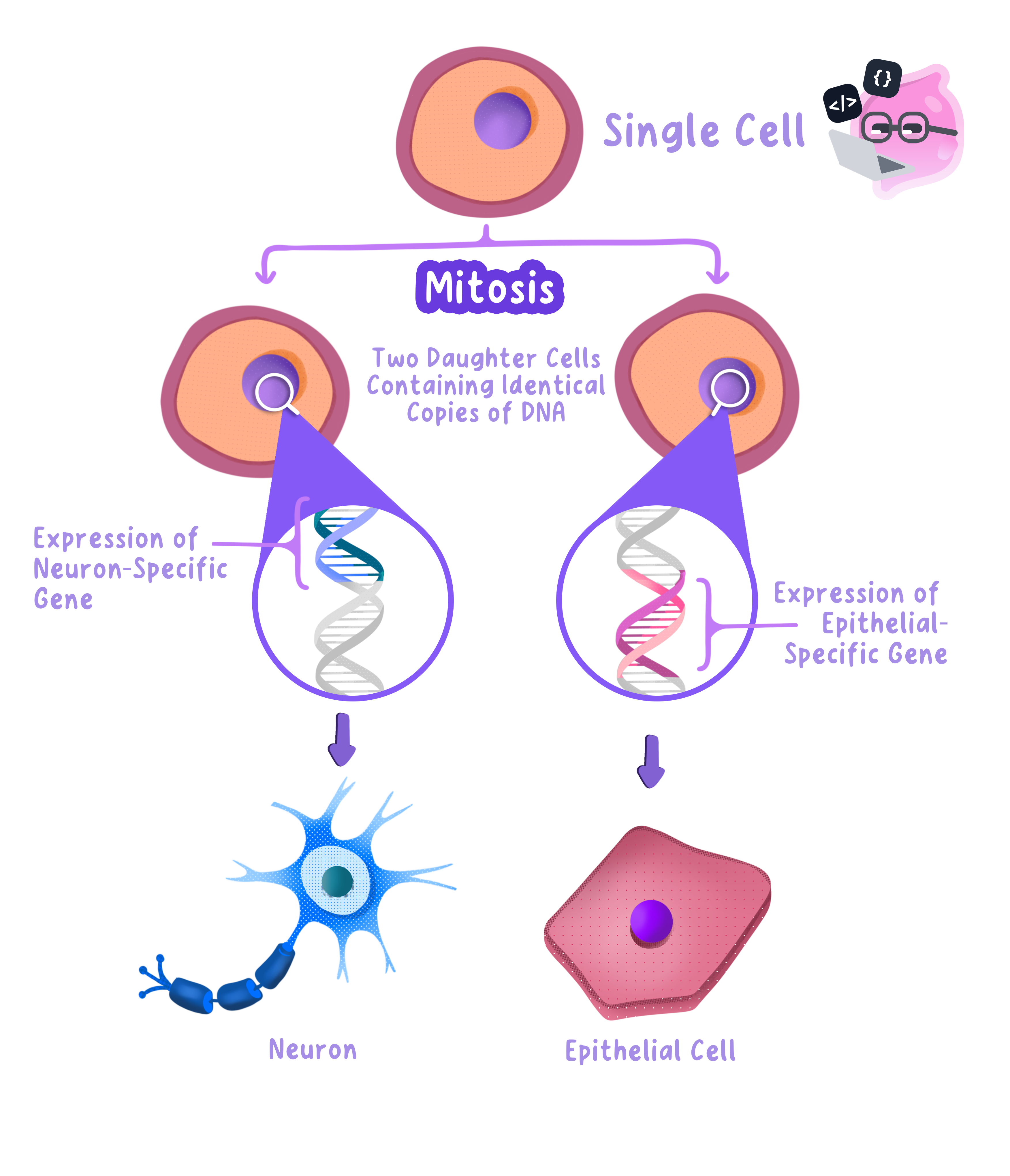
Differentiated cells do not have different genes. They have the same genes and use different ones, so an answer that says the cells lose the genes they do not need is wrong.
Why Specialisation Matters
Specialised cell
A cell whose structure is adapted so that it carries out one particular function.
- A specialised cell is far more efficient at one job than an unspecialised cell would be at everything.
- Specialisation allows a division of labour, so different cells take on different tasks and the whole organism works better.
- Specialised cells of the same type group together into a tissue, tissues form organs, and organs form organ systems.
- Without differentiation an organism could only ever be a shapeless ball of identical cells, so no tissues, organs or organ systems could exist.
- This is why differentiation is essential for the development of a fertilised egg into a complex multicellular organism.
Examples of Specialised Cells
- Sperm cell. A tail for swimming, many mitochondria to release the energy for movement, and an acrosome containing enzymes to digest through the egg membrane.
- Red blood cell. A biconcave shape for a large surface area, packed with haemoglobin, and no nucleus so there is more room for oxygen.
- Root hair cell. A long extension that increases the surface area for absorbing water and mineral ions from the soil.
- Neurone. A very long axon so an impulse can be carried a long way, and a myelin sheath that speeds transmission up.
- Palisade mesophyll cell. Tall, tightly packed and full of chloroplasts near the top of the leaf, where the light is strongest.
- Xylem vessel. Dead, hollow and open ended, with walls strengthened by lignin, forming a continuous tube for water.
For any specialised cell, the mark is for linking one named feature to the job it does, so pair each structure with its function rather than listing features on their own.
Differentiation in Animals and Plants
- In animals most differentiation happens in the embryo and in the young animal.
- Adult animals keep a small number of stem cells, in places such as bone marrow, and these are used mainly to replace worn out cells.
- In plants many cells keep the ability to differentiate throughout the plant's life.
- This is why a small cutting taken from a stem can grow roots and become a complete plant, while a piece of animal tissue cannot.
The cells that can still differentiate are stem cells in animals and meristem cells in plants. Both are covered in detail in the next section on stem cells and meristems.
When Differentiation Goes Wrong
- Cancer cells are often described as poorly differentiated, because they divide instead of taking on a specialised job.
- Under a microscope the cells of a malignant tumour look irregular and unlike the tissue they came from.
- Losing specialisation means the tissue can no longer do its job properly, which is one reason a tumour damages the organ it grows in.
- Explain the importance of differentiation is a why question, so build the chain: different genes are switched on, so different proteins are made, so the cell gains a structure suited to one job, so the organism works efficiently.
- If you are shown an unfamiliar specialised cell, describe a visible feature and suggest the function it serves, because these are application marks and there is no fact to recall.
- Do not stop at the cell. Finish the chain with tissues, organs and organ systems if the question is about the development of a whole organism.
- Define differentiation.
- Explain how two cells with identical genes can become different types of cell.
- Give two features of a sperm cell and state the function of each.
- State one difference between differentiation in animals and differentiation in plants.
- Why is differentiation essential for a multicellular organism?
