Biodiversity changes when populations change
Definition
Biodiversity
The number of different species that live in an area.
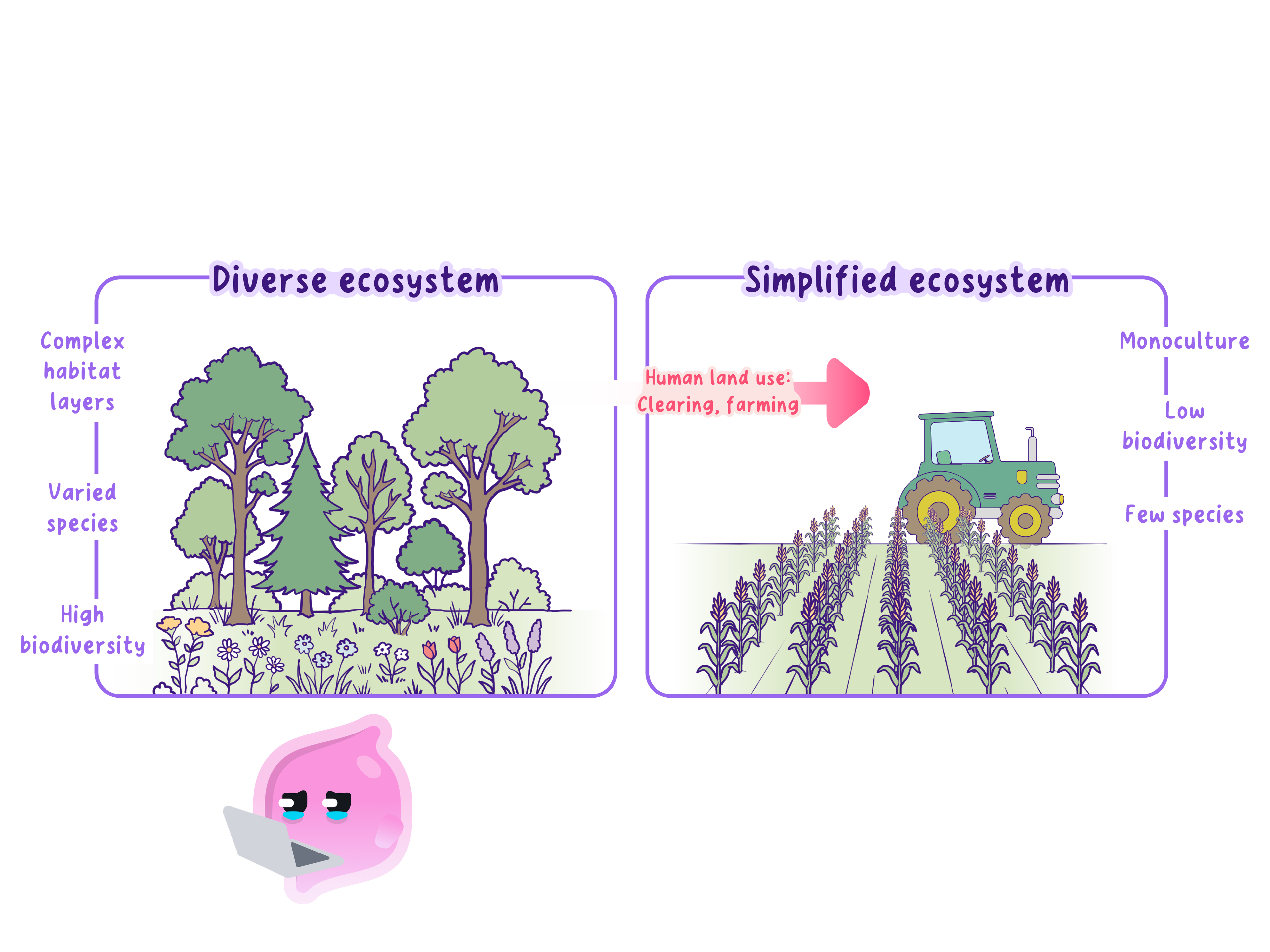
- Biodiversity is reduced when human activity causes native populations to fall, removes species or simplifies food webs.
- An interaction can have both benefits and costs, so its effect depends on how it changes habitats, competition, predation, disease and pollution.
- A strong biological explanation follows a chain from the human action to a changed condition, then to a population change and finally to biodiversity.
Exam technique
- Name the affected resource or condition instead of writing only that an organism is harmed.
- Finish the explanation by stating whether a named population and biodiversity increase or decrease.
Fish farming can help or harm
Definition
Fish farming
The rearing of fish in controlled enclosures for food.
- Fish farms can produce a predictable food supply and may reduce pressure on wild fish populations if fewer wild fish are caught for people to eat.
- Controlled feeding, protection from predators and selective breeding can increase survival and yield.
- High stocking density lets pathogens and parasites spread rapidly, and infections can pass to wild fish near open cages.
- Uneaten feed and faeces add organic matter and mineral ions to the water, which can reduce oxygen concentration and change the species able to survive.
- Medicines and chemicals used in farms can affect non-target organisms, while escaped farmed fish may compete or breed with wild populations.
- Some farmed fish are fed fishmeal made from wild-caught fish, so farming can still reduce wild populations lower in the food web.
Example
- A coastal cage farm increases the local food supply, but waste below the cages raises decomposer activity and lowers dissolved oxygen.
- If oxygen-sensitive species leave or die while tolerant species remain, local biodiversity falls even though fish production rises.
Introduced species alter competition
Definition
Non-indigenous species
A species living outside its natural geographical range because it has been introduced by humans, deliberately or accidentally.
- A non-indigenous species may be introduced deliberately for food, ornament or biological control, or arrive accidentally in cargo, ballast water or on equipment.
- An introduced species can add a useful food source or control a pest, but it may become invasive if it spreads rapidly and causes ecological harm.
- Without its usual predators or diseases, its population may grow quickly and compete with native species for food, light, space, oxygen or breeding sites.
- It may eat native organisms, carry new pathogens or alter habitats, causing native populations to decline and disrupting food webs.
- If native species disappear locally, species richness and biodiversity decrease.
Example
- Introduced signal crayfish compete with native crayfish for food and shelter.
- They can also carry a pathogen that causes disease in native crayfish.
- Competition and disease reduce the native population, so local biodiversity may fall.
Eutrophication removes oxygen
Definition
Eutrophication
The process in which excess nutrients in water cause rapid algal growth, leading to oxygen depletion and the death of aquatic organisms.
- Nitrate or phosphate ions from fertiliser runoff, animal waste or sewage enter a pond, lake or slow-moving river.
- The extra mineral ions remove a growth limitation, so algae reproduce rapidly and form an algal bloom near the surface.
- The dense algal growth blocks light, so submerged plants photosynthesise less and may die.
- Dead algae and plants are broken down by decomposer microorganisms.
- The decomposers respire aerobically and use dissolved oxygen faster than it is replaced.
- The oxygen concentration falls, so fish and other oxygen-dependent animals may suffocate, move away or die.
- The loss of sensitive species and dominance of a few tolerant species reduce biodiversity.
Exam technique
- Keep the sequence in order: mineral ions, algal bloom, less light, plant death, decomposition, respiration, oxygen loss and animal death.
- If the question asks about fish, complete the chain with the direct effect on fish rather than stopping at low oxygen.
- Use the terms algal bloom, decomposer, aerobic respiration and dissolved oxygen accurately.
Balance benefits against biodiversity costs
- A valid judgement identifies the benefit of the human activity and weighs it against the size, likelihood and reversibility of its ecological effects.
- Management can reduce damage through lower fish stocking densities, waste treatment, secure cages, quarantine and controls on releasing non-indigenous species.
- The conclusion should be based on the evidence in the question because the same interaction can have different effects in different ecosystems.
Self review
- How can fish farming reduce pressure on wild fish?
- How can a non-indigenous species reduce a native population?
- Why does an algal bloom cause dissolved oxygen to fall?
- Which final link must be stated when explaining an effect on biodiversity?
