7.3.1 Importance of a constant internal environment
A stable internal environment
Internal environment
The conditions inside the body that surround cells, especially the temperature and composition of the blood and tissue fluid.
- The internal environment is formed mainly by the blood and tissue fluid surrounding the body’s cells.
- Its conditions include temperature, water content, ion concentration, blood glucose concentration and pH.
- An external change, such as hot weather, cold weather or reduced water intake, can disturb these conditions.
- An internal change, such as exercise, eating a meal or increased respiration, can also disturb them.
- Control systems correct these disturbances before they move far enough to damage cells.
Stable conditions protect cells
- Enzyme activity depends on temperature and pH because each enzyme has an active site with a specific shape.
- A large temperature or pH change alters the rate of enzyme-controlled reactions, and extreme conditions can change the active site so the substrate no longer fits.
- Water and ion balance controls the net movement of water across cell membranes by osmosis.
- If too much water enters an animal cell, it swells and may burst because it has no cell wall.
- If too much water leaves an animal cell, it shrinks and its chemical reactions and membrane processes are disrupted.
- Blood glucose concentration must stay high enough to supply cells with glucose for respiration without rising to a level that damages tissues.
- Do not write that internal conditions stay exactly unchanged.
- They fluctuate within narrow limits, and corrective responses bring them back towards the normal range.
Control responses reverse change
- Receptors detect a change in an internal condition or in the external environment.
- A coordination centre receives the information and organises a response.
- Effectors, such as muscles or glands, produce a response that opposes the original change.
- The response becomes smaller or stops as the condition returns towards its normal range.
- For an explain question, connect the disturbance to a cellular effect rather than naming a condition on its own.
- A complete chain is change in condition, effect on cells or enzymes, effect on body function, then the benefit of correction.
- Use linking words such as because, so and therefore to make each biological consequence explicit.
Changes come from inside and outside
- Hot surroundings and exercise both raise body temperature, but one begins outside the body and the other begins with increased muscle activity.
- Drinking water, sweating and urine production alter the amount of water in the body.
- Eating, fasting and respiration alter the supply and use of glucose.
- Maintaining the internal environment allows cells to keep functioning while the body faces all of these changes.
- What is the internal environment of the body?
- Give one internal change and one external change that can disturb it.
- Why can a large change in temperature disrupt metabolism?
- Why must the water content around animal cells be controlled?
7.3.2 Importance of homeostasis
Homeostasis keeps cells working
Homeostasis
The maintenance of a stable internal environment within narrow limits despite internal and external changes.
- Homeostasis holds internal conditions within narrow limits while the body and its surroundings change.
- The controlled value moves slightly above and below its normal range because detection and correction take time.
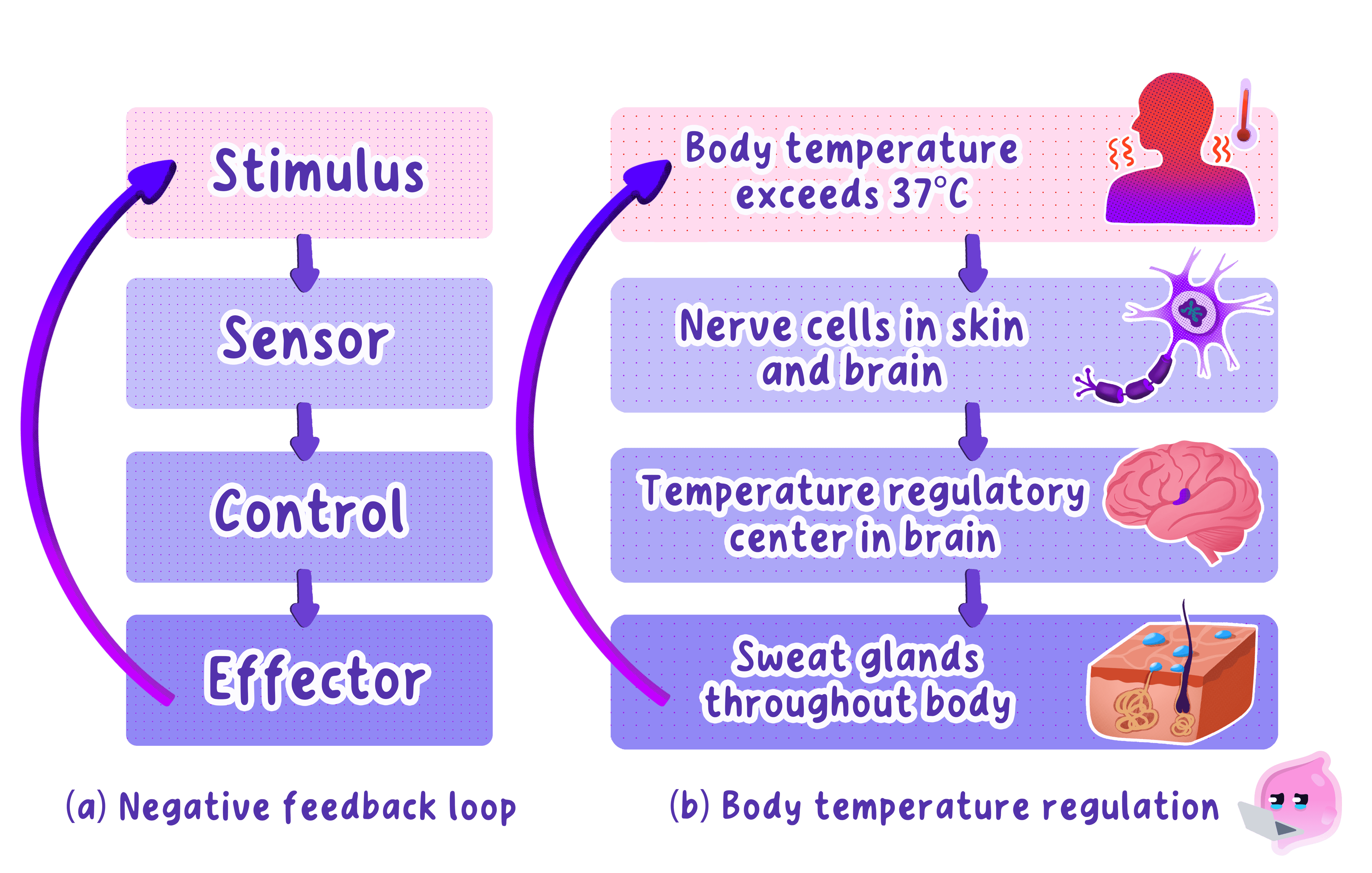
- A change is detected, effectors produce an opposing response, and the response reduces as the condition returns towards normal.
- This two-direction control prevents a small disturbance from becoming a damaging change.
Temperature affects enzyme activity
Thermoregulation
The control of core body temperature within narrow limits around approximately 37 ∘C37\,^\circ\mathrm{C}37∘C.
- Thermoregulation keeps core body temperature close to about 37 ∘C37\,^\circ\mathrm{C}37∘C, where many human enzymes work efficiently.
- Below an enzyme’s optimum temperature, particles have less kinetic energy and collide less often.
- Fewer successful collisions form enzyme-substrate complexes, so enzyme-controlled reactions proceed more slowly.
- Above the optimum, bonds maintaining the enzyme’s three-dimensional shape can be disrupted.
- The active site changes shape, the substrate is no longer complementary, and the reaction rate falls because fewer enzyme-substrate complexes form.
- If enough of the enzyme changes shape, the enzyme is denatured and can no longer catalyse its reaction.
- Thermoregulation limits both slow reactions in the cold and denaturation when body temperature becomes too high.
- Low temperature does not usually denature an enzyme because the active site keeps its shape.
- High temperature can denature an enzyme, so do not describe the effect as the enzyme being killed.
Water balance protects animal cells
Osmoregulation
The control of the water and ion content of the body within narrow limits.
- Osmoregulation controls the water and ion content of the body fluids surrounding cells.
- The cell membrane is partially permeable, so water can move across it by osmosis.
- Water moves from a more dilute solution to a more concentrated solution through the partially permeable membrane.
- If body fluids become too dilute, water enters animal cells by osmosis and the cells swell.
- An animal cell may burst if too much water enters because it has no rigid cell wall.
- If body fluids become too concentrated, water leaves animal cells by osmosis and the cells shrink.
- A swollen or shrunken cell cannot maintain normal concentrations of reactants, ions and enzymes, so its reactions and membrane processes are disrupted.
- Osmoregulation prevents excessive net movement of water and keeps animal cells at a suitable volume.
- When asked about osmoregulation, state the direction of water movement and name osmosis.
- Then link the movement to swelling or shrinking and explain why the lack of a cell wall makes animal cells vulnerable.
- For thermoregulation, connect temperature to collision frequency or active-site shape before stating the effect on reaction rate.
The two controls prevent damage
- Thermoregulation protects enzyme shape and keeps enzyme-controlled reactions close to suitable rates.
- Osmoregulation protects animal-cell volume and keeps the concentrations inside cells suitable for their reactions.
- Both controls keep the conditions around cells within limits that allow metabolism and membrane transport to continue.
- What is homeostasis?
- Why do enzyme-controlled reactions slow when body temperature is too low?
- How can a high temperature reduce enzyme activity?
- What happens to an animal cell in a solution that is too dilute?
- Why can an animal cell shrink when body fluids become too concentrated?
7.3.3a Thermoregulation via the skin and hypothalamus
Thermoregulation controls body temperature
Thermoregulation
The control of core body temperature within narrow limits around approximately 37 ∘C37\,^\circ\mathrm{C}37∘C.
- Thermoregulation keeps core body temperature within narrow limits around approximately 37 ∘C37\,^\circ\mathrm{C}37∘C.
- Respiration releases heat inside the body, while heat is transferred to and from the surroundings through the skin.
- A rise above the normal range activates responses that increase heat loss.
- A fall below the normal range activates responses that reduce heat loss or generate more heat.
- As temperature returns towards normal, the corrective response becomes smaller.
The epidermis forms the surface
Epidermis
The thin outer layer of the skin that forms a protective, waterproof barrier and contains no blood vessels.
- The epidermis is the thin outer layer of the skin and contains no blood vessels.
- It forms a protective, waterproof barrier that reduces uncontrolled water loss from the body.
- Sweat released by ducts reaches the epidermal surface and evaporates from it.
- Heat transferred from the dermis must pass through the epidermis before reaching the surroundings.
- Do not place sweat glands, blood vessels or most temperature receptors in the epidermis.
- These structures lie in the dermis, although sweat passes through ducts to the epidermal surface.
The dermis changes heat transfer
Dermis
The layer of skin beneath the epidermis that contains blood vessels, sweat glands, sensory receptors, hair follicles and hair erector muscles.
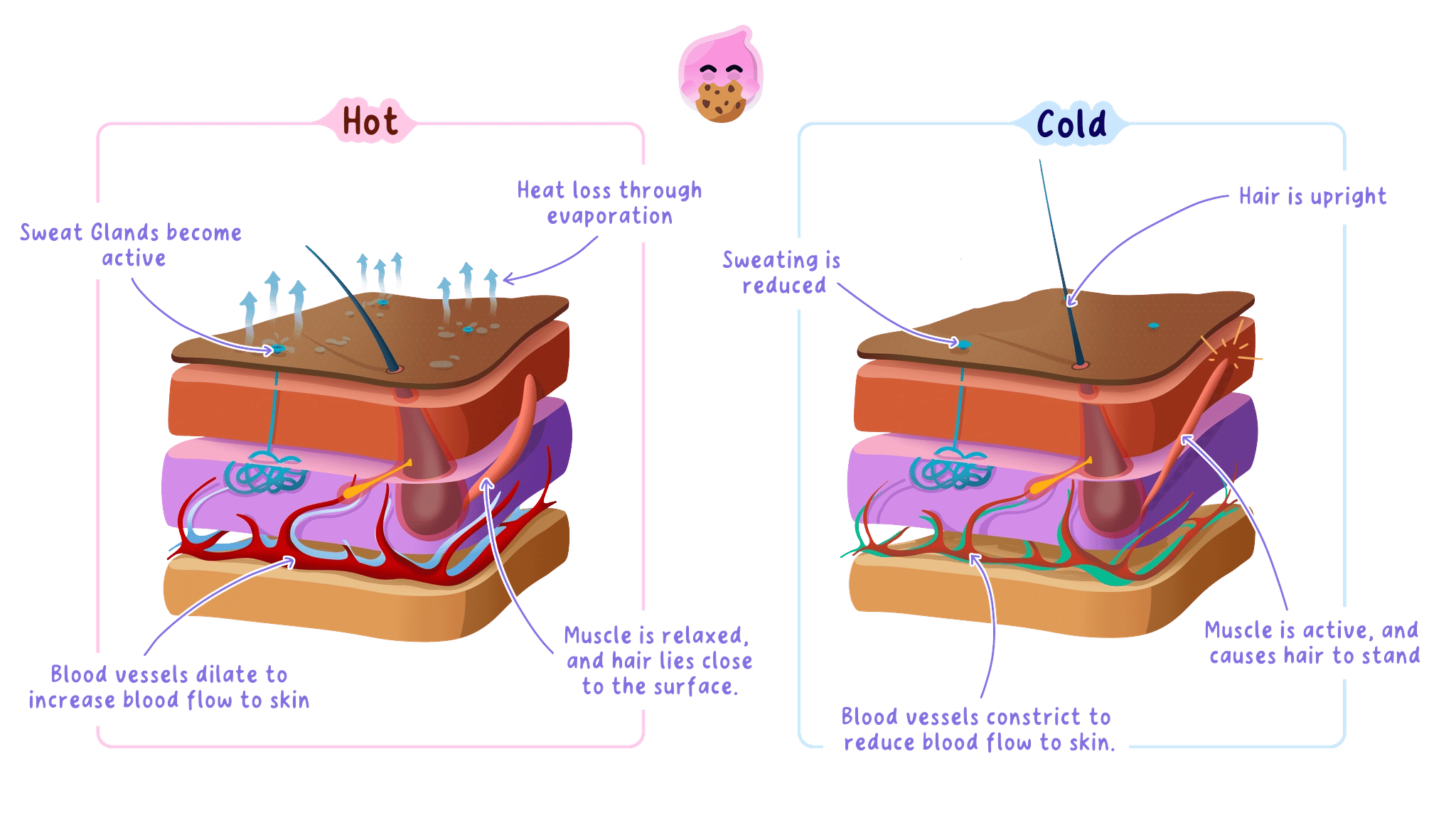
- The dermis contains the structures that detect temperature and alter heat loss through the skin.
- Sweat glands release more sweat when the body is too hot.
- Evaporation requires energy, so energy is transferred from the skin to the surroundings and the skin cools.
- Blood vessels supply capillary networks close to the surface, allowing the amount of warm blood near the surface to be adjusted.
- Temperature receptors detect changes in skin temperature and send electrical impulses towards the brain.
- Hair erector muscles contract in cold conditions and pull the hairs upright.
- Upright hairs trap a layer of still air, which reduces heat transfer by convection, although this response has a small effect in humans.
- Fatty tissue beneath the dermis insulates the body because fat conducts heat poorly.
The hypothalamus coordinates responses
Hypothalamus
A region of the brain that monitors internal conditions and controls the pituitary gland by releasing hormones such as TRH\mathrm{TRH}TRH.
- The hypothalamus contains the thermoregulatory centre in the brain.
- Temperature receptors in the hypothalamus detect the temperature of the blood flowing through it.
- Temperature receptors in the skin detect changes in the external environment and send electrical impulses to the hypothalamus.
- The hypothalamus processes both sources of information and compares body temperature with the normal range.
- It sends nerve impulses to effectors such as sweat glands, hair erector muscles and skeletal muscles.
- The effectors produce responses that oppose the temperature change, and the hypothalamus reduces the response as normal temperature is restored.
- In a skin question, name each labelled structure before explaining its response.
- For every structure, link structure to action, action to heat transfer, and heat transfer to the change in body temperature.
- A long list of structures without explaining how they cool or warm the body cannot reach the highest level in an extended response.
Shivering generates more heat
Shivering
Rapid, involuntary contractions of skeletal muscles that increase respiration and transfer energy as heat.
- When core body temperature falls, the hypothalamus sends impulses that trigger rapid, involuntary contractions of skeletal muscles.
- The contracting muscle cells need more energy, so their rate of respiration increases.
- Respiration transfers energy from glucose, and some of this energy is transferred as heat.
- The heat warms the blood and surrounding tissues, raising core body temperature towards normal.
- Shivering therefore increases heat production rather than reducing heat loss.
- What are the roles of the epidermis in thermoregulation?
- Which thermoregulatory structures are found in the dermis?
- What temperature information reaches the hypothalamus?
- How does sweat evaporation cool the skin?
- How does shivering raise core body temperature?
7.3.3b Vasoconstriction and vasodilation in thermoregulation
Vasodilation increases heat loss
Vasodilation
The widening of arterioles supplying the skin capillaries, which increases blood flow near the skin surface and increases heat loss.
- When body temperature rises above the normal range, the hypothalamus sends impulses to the blood vessels supplying skin capillaries.
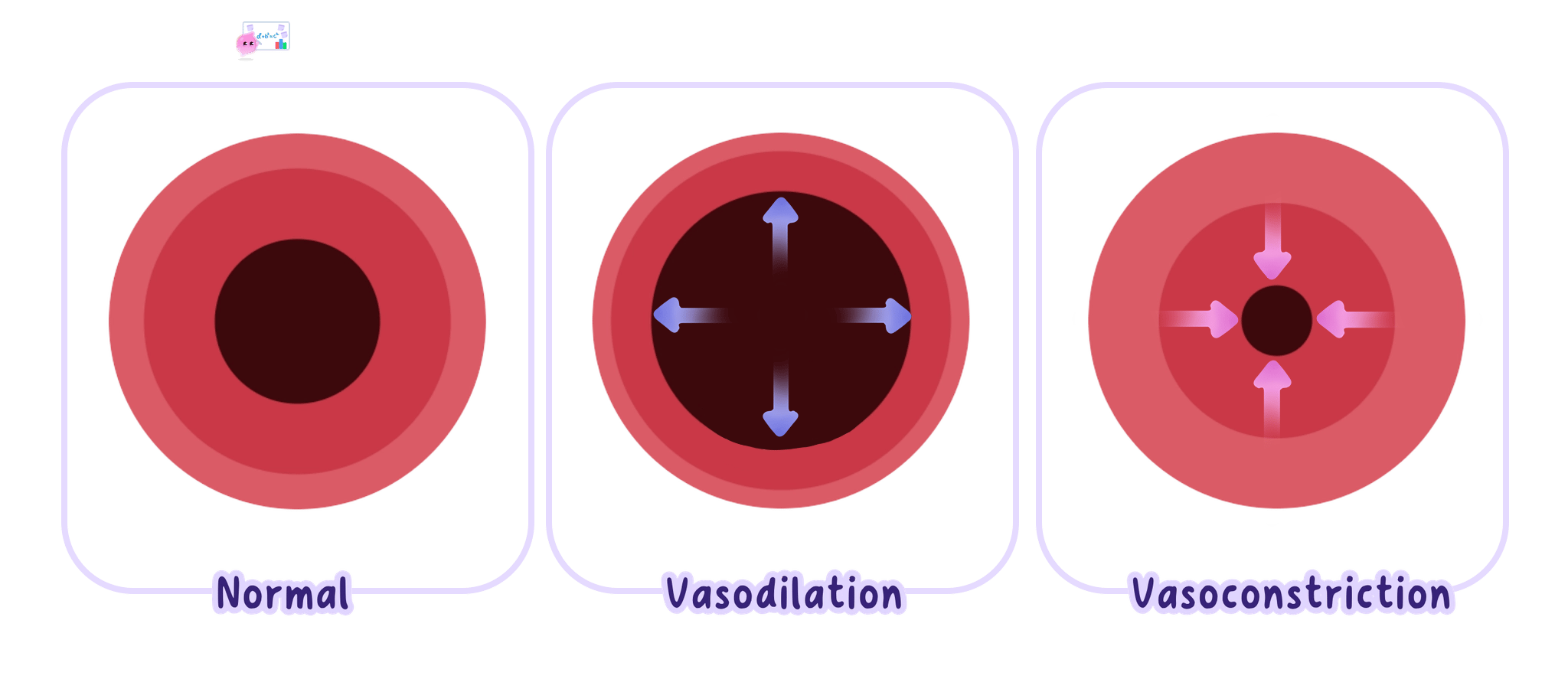
- Smooth muscle in the arteriole walls relaxes, so the arterioles widen by vasodilation.
- More blood flows through capillaries close to the skin surface.
- The warm blood raises the temperature of the skin and increases the temperature gradient between the skin and the surroundings.
- More energy is transferred from the skin by radiation and convection, so core body temperature falls towards normal.
- The skin may look redder because a larger volume of blood is flowing near the surface.
Vasoconstriction reduces heat loss
Vasoconstriction
The narrowing of arterioles supplying the skin capillaries, which reduces blood flow near the skin surface and reduces heat loss.
- When body temperature falls below the normal range, smooth muscle in the arteriole walls contracts.
- The arterioles supplying skin capillaries narrow by vasoconstriction.
- Less blood flows through capillaries near the skin surface, while more blood remains in deeper tissues.
- The skin surface becomes cooler and the temperature gradient between the skin and the surroundings becomes smaller.
- Less energy is transferred from the skin by radiation and convection, so heat is conserved and core body temperature rises towards normal.
- Vasoconstriction reduces surface blood flow but does not stop it completely because skin cells still need oxygen and glucose.
- Do not write that blood vessels move closer to or farther from the skin surface.
- The vessels stay in place and change diameter, which changes the volume of blood flowing through surface capillaries.
The responses work in opposite directions
- Vasodilation widens the arterioles, increases surface blood flow and increases heat loss when the body is too hot.
- Vasoconstriction narrows the arterioles, reduces surface blood flow and reduces heat loss when the body is too cold.
- Both responses change heat transfer through the skin without changing the position of the blood vessels.
- As core temperature returns towards normal, the hypothalamus reduces the corrective response.
- A complete explanation must continue beyond widen or narrow to surface blood flow, heat transfer and the resulting change in core temperature.
- Use the correct response name and write the direction of every change.
- For a comparison, describe both responses using matching stages so the contrast is explicit.
Heat transfer completes the explanation
- In hot conditions, more warm blood near the surface produces more heat transfer to cooler surroundings.
- In cold conditions, less warm blood near the surface produces less heat transfer to the surroundings.
- These causal links explain why changing blood flow helps restore body temperature.
- What happens to arterioles during vasodilation?
- Why does vasodilation increase heat loss?
- What happens to surface blood flow during vasoconstriction?
- Why does vasoconstriction conserve heat?
- Why is it incorrect to say that skin blood vessels move towards the surface?
