8.1.1 Introduction to exchange and transport
Substances move into and out of organisms
- Cells need a continuous supply of useful substances and must remove substances that would otherwise build up.
- Oxygen enters animals for aerobic respiration and leaves photosynthesising tissues when it is produced faster than it is used.
- Carbon dioxide leaves respiring cells as a waste product and enters photosynthesising cells as a raw material.
- Water is needed as a solvent, as a reactant and for transport, so it moves into, through and out of organisms.
- Dissolved food molecules, including glucose and amino acids, move from exchange surfaces to cells for respiration, growth and repair.
- Mineral ions enter plants through their roots and are transported to tissues where they are used to make essential substances.
- Urea is carried from the liver to the kidneys so that it can be removed from the blood and excreted.
Transport includes movement into and out of organisms, so name the substance, its direction and why it must move.
Size changes exchange needs
Surface area to volume ratio
The surface area to volume ratio is the total surface area of an organism or object divided by its volume.
- A small organism has a large surface area to volume ratio, so it has a large exchange surface compared with the amount of living tissue it must supply.
- Its cells are close to the outside, giving a short diffusion distance for oxygen, nutrients and waste products.
- As length increases, surface area rises with the square of length while volume rises with the cube of length.
- A large organism therefore has a smaller surface area to volume ratio and many cells that are far from the body surface.
- Diffusion across the outer surface cannot move enough material over these longer distances to meet the demands of all the cells.
Large active organisms need specialised exchange surfaces and transport systems because they have a small surface area to volume ratio, long diffusion distances and a high demand for materials.
Calculate surface area to volume ratio
- Calculate the ratio using surface area to volume ratio=surface areavolume\text{surface area to volume ratio}=\dfrac{\text{surface area}}{\text{volume}}surface area to volume ratio=volumesurface area.
- For a cube with side length lll, use surface area=6l2\text{surface area}=6l^2surface area=6l2 and volume=l3\text{volume}=l^3volume=l3.
- Write the result as surface area:volume\text{surface area}:\text{volume}surface area:volume and simplify both parts to the lowest convenient whole-number ratio when possible.
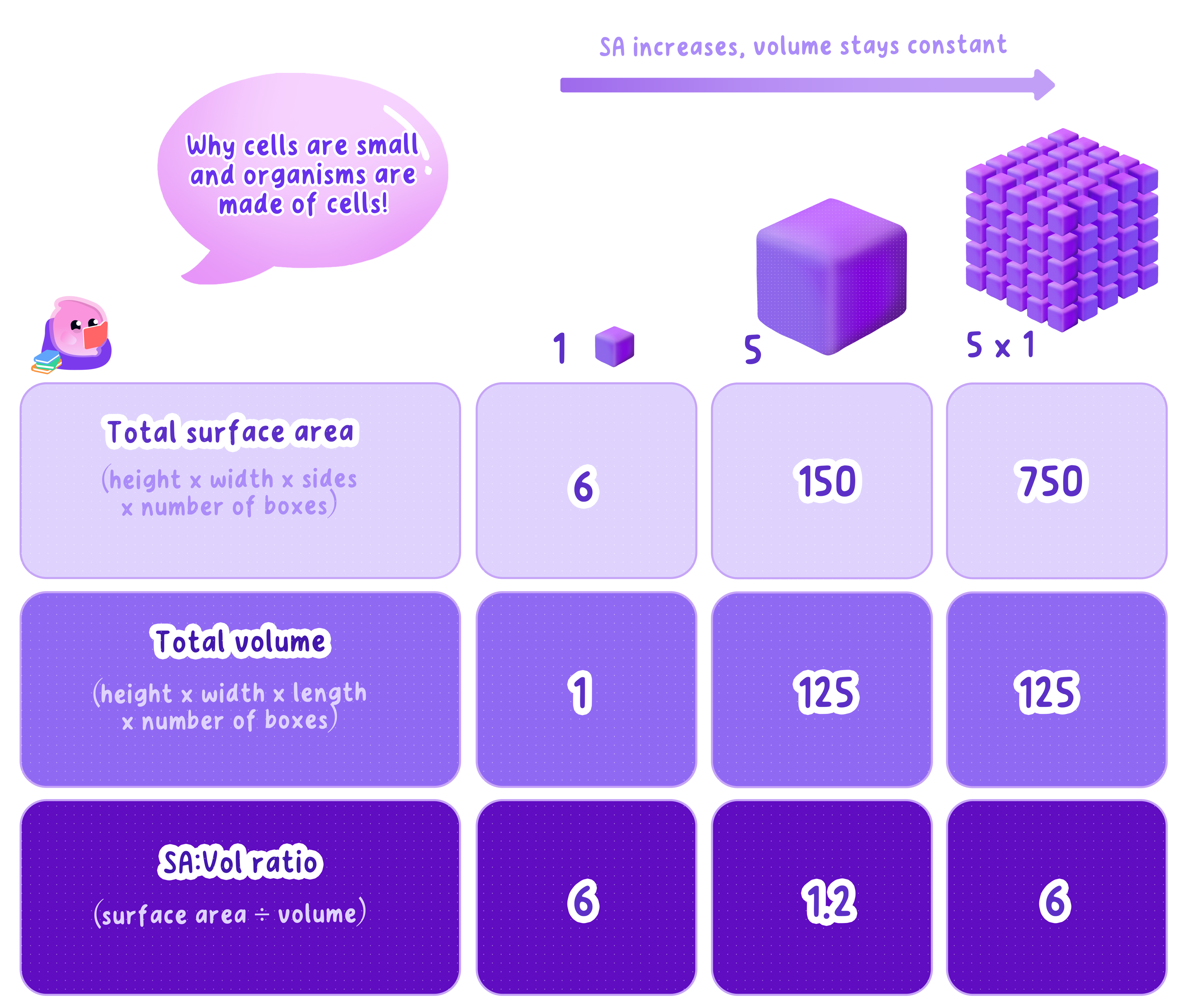
- A species has a surface area of 9000 μm29000\,\mu\mathrm{m}^29000μm2 and a volume of 6000 μm36000\,\mu\mathrm{m}^36000μm3.
- surface area:volume=9000:6000\text{surface area}:\text{volume}=9000:6000surface area:volume=9000:6000
- Dividing both values by 300030003000 gives 3:2\boxed{3:2}3:2, which can also be written as 1.5:11.5:11.5:1.
Exchange surfaces speed transfer
Exchange surface
An exchange surface is a boundary across which substances move between an organism and its environment.
- An exchange surface provides a specialised boundary where substances enter or leave an organism.
- A large surface area allows more particles to cross at the same time, while a thin barrier gives a short diffusion distance.
- A blood supply, water flow or air flow carries substances away and replaces them, which maintains a concentration gradient.
- Examples include alveoli in lungs, gills in fish, root hair cells in roots and the small intestine in mammals.
- For an explanation, link the feature to the process and then to the result.
- For example, a larger surface area means more oxygen molecules diffuse at the same time, so oxygen enters the organism faster.
Transport systems connect surfaces and cells
Transport system
A transport system is a network that carries substances between exchange surfaces and cells throughout a multicellular organism.
- A transport system moves substances rapidly between exchange surfaces and cells, reducing the distance over which diffusion must act.
- In mammals, the circulatory system carries oxygen and dissolved food molecules to cells and carries carbon dioxide and urea away.
- In plants, xylem carries water and mineral ions from roots, while phloem transports dissolved sugars and other organic substances.
- Transport maintains concentration gradients at exchange surfaces because arriving fluid supplies materials and departing fluid removes them.
- Why must oxygen, carbon dioxide and urea be transported?
- Why does surface area to volume ratio decrease as an organism gets larger?
- How do you calculate and simplify a surface area to volume ratio?
- Why can a large multicellular organism not rely on diffusion across its outer surface?
- How do an exchange surface and a transport system work together?
8.1.2 Alveoli adapted for gas exchange
Alveoli exchange two respiratory gases
Alveolus
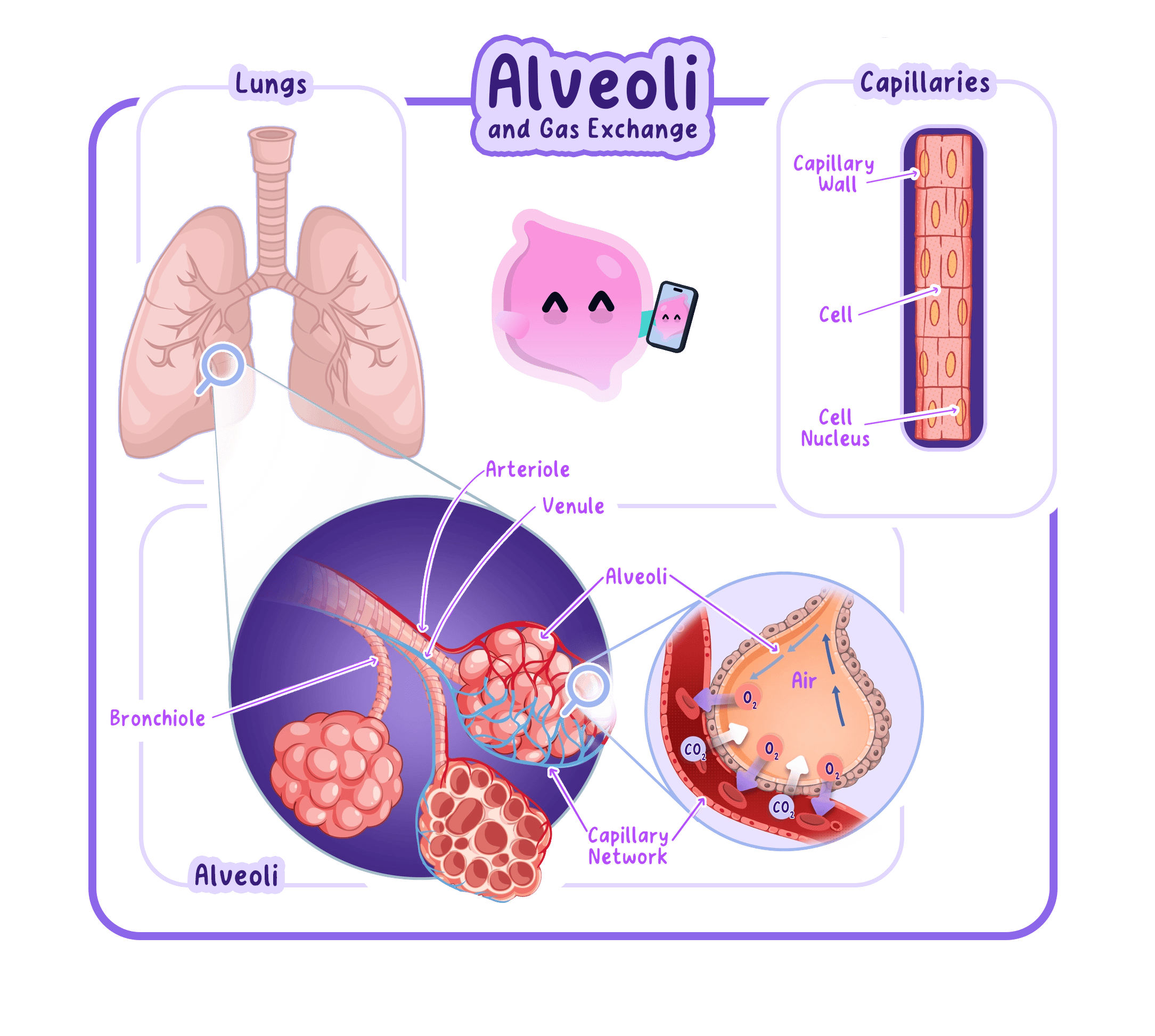
An alveolus is a microscopic air sac in the lungs where oxygen and carbon dioxide are exchanged by diffusion between air and the blood.
- Air reaching the alveoli contains a higher concentration of oxygen than the deoxygenated blood arriving in nearby capillaries.
- Oxygen dissolves in the moist lining and diffuses through the alveolar and capillary walls into the blood.
- The arriving blood contains a higher concentration of carbon dioxide than the air in the alveoli.
- Carbon dioxide diffuses from the blood into the alveoli and is removed from the lungs when you breathe out.
Large area increases gas exchange
Diffusion
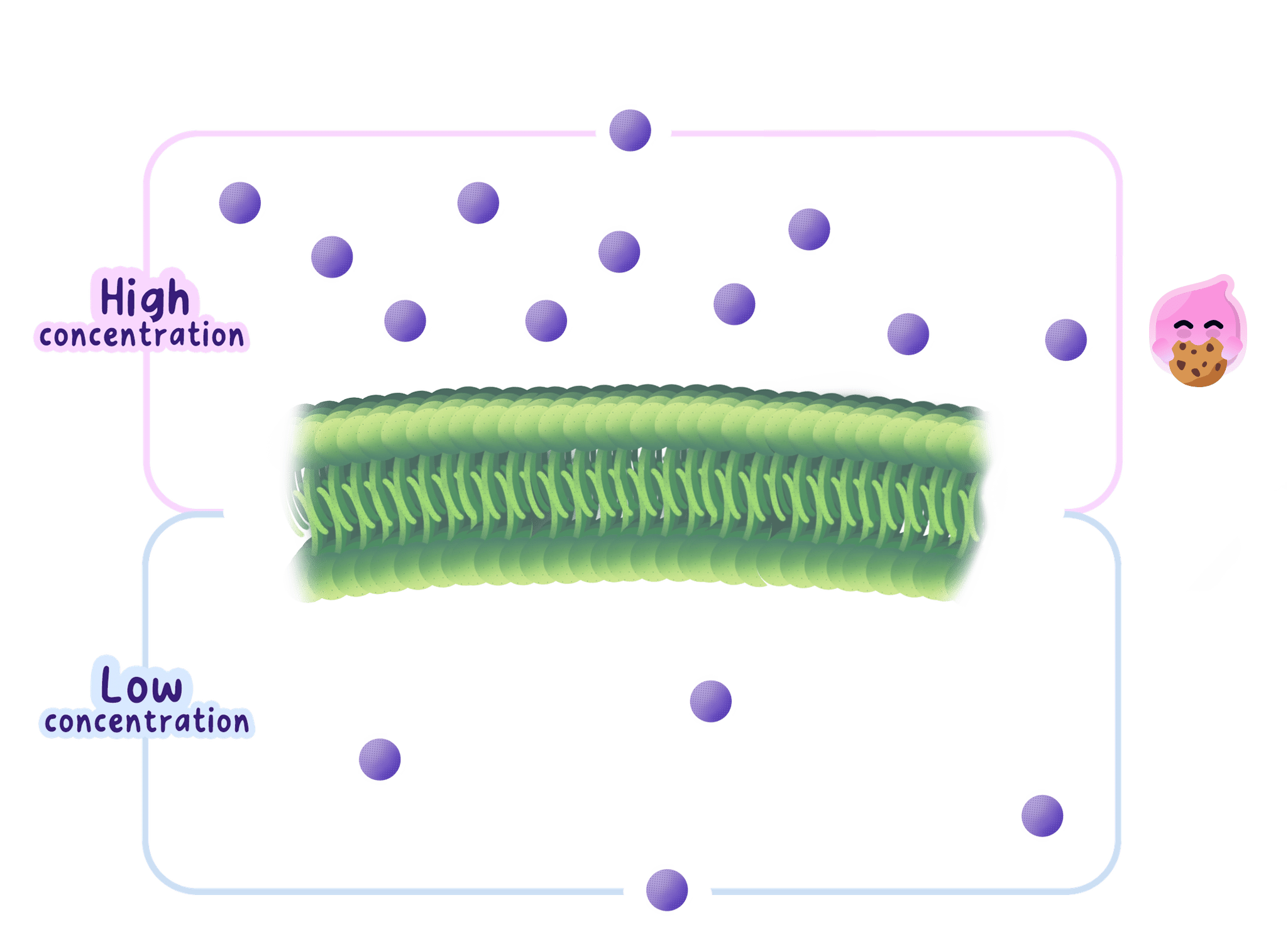
The net movement of particles from a region of higher concentration to a region of lower concentration, down a concentration gradient.
- Each lung contains millions of tiny alveoli, which together create a very large surface area.
- A larger area allows more oxygen and carbon dioxide molecules to cross the exchange surface at the same time.
- The result is a higher rate of diffusion than a single smooth lung surface could provide.
- Feature: millions of alveoli provide a large total surface area.
- Mechanism: more gas molecules can diffuse across the walls at the same time.
- Result: oxygen enters the blood and carbon dioxide leaves the blood faster.
Thin moist walls shorten the path
Diffusion distance
Diffusion distance is the distance that particles must travel between two regions during diffusion.
- The wall of each alveolus is one cell thick, and the wall of the neighbouring capillary is also one cell thick.
- These thin walls give oxygen and carbon dioxide a very short diffusion distance.
- The alveolar surface is moist so oxygen and carbon dioxide dissolve before crossing the cell membranes.
- The walls are permeable to the respiratory gases, so dissolved oxygen and carbon dioxide can pass through them.
- Do not stop after naming a feature such as thin walls.
- State that thin walls shorten the diffusion distance, so the respiratory gases diffuse faster.
- For a longer response, apply the same feature, mechanism and consequence chain to several adaptations and to both gases.
Airflow and blood flow maintain gradients
Concentration gradient
The difference in the concentration of a substance between two regions.
- Ventilation replaces alveolar air, keeping oxygen concentration high and carbon dioxide concentration low inside the alveoli.
- The capillary network brings deoxygenated blood with little oxygen and more carbon dioxide close to every alveolus.
- Blood flow carries absorbed oxygen away and continually brings more carbon dioxide to the lungs.
- Oxygen binding to haemoglobin helps keep the concentration of dissolved oxygen low in the blood beside the alveolus.
- Together, ventilation and blood flow maintain steep concentration gradients for oxygen into the blood and carbon dioxide into the alveoli.
- In which direction does oxygen diffuse at an alveolus?
- In which direction does carbon dioxide diffuse at an alveolus?
- How does a large alveolar surface area increase gas exchange?
- Why do thin and moist alveolar walls increase diffusion?
- How do ventilation and blood flow maintain concentration gradients?
8.1.3 Factors affecting rate of diffusion
Diffusion is net particle movement
Diffusion
The net movement of particles from a region of higher concentration to a region of lower concentration, down a concentration gradient.
- Particles move randomly in gases and liquids, crossing an exchange surface in both directions.
- If more particles cross from the more concentrated side to the less concentrated side, there is a net movement down the concentration gradient.
- Diffusion is passive, so it does not require energy released by respiration.
Four factors change diffusion rate
Rate of diffusion
The rate of diffusion is the amount of a substance that moves by diffusion across a surface in a given time.
- A steeper concentration gradient increases the net movement of particles because the difference between the two sides is greater.
- A higher temperature increases particle kinetic energy, so particles move faster and cross the surface more frequently.
- A larger surface area allows more particles to cross at the same time.
- A shorter diffusion distance reduces the distance particles must travel, so they cross the barrier sooner.
A gradient compares two regions
Concentration gradient
The difference in the concentration of a substance between two regions.
- A concentration gradient describes the difference in concentration between two places, not the concentration in one place alone.
- Increasing the difference makes the gradient steeper and increases the rate of diffusion.
- As diffusion continues in a closed system, the difference becomes smaller, so the net rate falls until there is no concentration gradient.
- Water surrounding an aquatic organism contains less carbon dioxide than the organism's cells.
- Carbon dioxide therefore diffuses from the cells into the water down a concentration gradient.
- Replacing the surrounding water keeps its carbon dioxide concentration low, maintains the gradient and keeps diffusion rapid.
Area and distance control the route
Diffusion distance
Diffusion distance is the distance that particles must travel between two regions during diffusion.
- Folding or dividing a surface increases its area without requiring the whole structure to become much larger.
- A thin membrane gives a short diffusion distance because particles cross less material.
- A thick membrane gives a longer diffusion distance and therefore a lower rate of diffusion when the other factors stay constant.
- Write concentration gradient, rather than concentration alone, when the question asks for a factor that affects diffusion.
- When you explain a change, name the factor, state whether it rises or falls and give the effect on diffusion rate.
Apply each factor to the context
- In lungs, gills and intestines, folded surfaces increase area, thin walls shorten the path and fluid flow maintains concentration gradients.
- When temperature rises, explain the faster rate through increased kinetic energy and faster particle movement.
- Use comparative words such as larger, steeper, shorter and faster so the direction of each change is unambiguous.
- What is diffusion?
- What is meant by the rate of diffusion?
- Which four factors can change the rate of diffusion?
- Why is concentration alone not the same as a concentration gradient?
- Why does a shorter diffusion distance increase the rate?
8.1.4 Rate of diffusion using Fick's law
Fick's law links three factors
Fick's law
Fick's law states that diffusion rate is proportional to surface area and concentration difference, and inversely proportional to membrane thickness.
- The relationship is rate of diffusion∝surface area×concentration differencemembrane thickness\displaystyle \text{rate of diffusion}\propto\frac{\text{surface area}\times\text{concentration difference}}{\text{membrane thickness}}rate of diffusion∝membrane thicknesssurface area×concentration difference.
- The symbol ∝\propto∝ means is proportional to, so the expression shows how the variables change together rather than giving a universal constant.
- The concentration difference is the size of the concentration gradient across the membrane.
- The membrane thickness represents the diffusion distance through the exchange surface.
- Use ∝\propto∝, not ===, when you write Fick's law as the stated proportional relationship.
- In an explanation, identify the changed factor and link it directly to an increase or decrease in the rate of diffusion.
Numerator factors increase the rate
- Surface area and concentration difference are in the numerator, so increasing either one increases the diffusion rate when the other variables stay constant.
- If surface area doubles, diffusion rate doubles, provided concentration difference and membrane thickness do not change.
- If concentration difference triples, diffusion rate triples, provided surface area and membrane thickness do not change.
- An exchange surface becomes three times larger while its concentration difference doubles and its thickness stays constant.
- The relative change is 3×2=63\times2=63×2=6.
- The diffusion rate becomes 6\boxed{6}6 times greater.
Thickness has an inverse effect
- Membrane thickness is in the denominator, so increasing thickness decreases diffusion rate when surface area and concentration difference stay constant.
- Halving membrane thickness halves the diffusion distance and doubles the diffusion rate.
- Multiplying thickness by four divides the diffusion rate by four.
- A membrane becomes thinner from 0.30 mm0.30\,\mathrm{mm}0.30mm to 0.10 mm0.10\,\mathrm{mm}0.10mm while the numerator stays constant.
- The thickness is divided by 333 because 0.30÷0.10=30.30\div0.10=30.30÷0.10=3.
- The diffusion rate therefore becomes 3\boxed{3}3 times greater.
Calculate a relative diffusion value
Rate of diffusion
The rate of diffusion is the amount of a substance that moves by diffusion across a surface in a given time.
- Substitute the values into surface area×concentration differencemembrane thickness\displaystyle \frac{\text{surface area}\times\text{concentration difference}}{\text{membrane thickness}}membrane thicknesssurface area×concentration difference.
- Calculate the numerator first, then divide by the thickness and keep the units supplied in the question.
- When comparing two exchange surfaces, calculate the expression for each one and divide one value by the other to find the fold change.
- An exchange surface has area 60 mm260\,\mathrm{mm}^260mm2, concentration difference 4.0 mmol dm−34.0\,\mathrm{mmol\,dm^{-3}}4.0mmoldm−3 and thickness 0.20 mm0.20\,\mathrm{mm}0.20mm.
- relative diffusion value=60×4.00.20\displaystyle \text{relative diffusion value}=\frac{60\times4.0}{0.20}relative diffusion value=0.2060×4.0
- relative diffusion value=1200\displaystyle \text{relative diffusion value}=\boxed{1200}relative diffusion value=1200
Apply the law to exchange surfaces
- Alveoli and villi have large surface areas, so more molecules can diffuse at the same time.
- Their thin walls reduce membrane thickness, which raises the rate because thickness is in the denominator.
- Ventilation, blood flow and the removal of absorbed substances maintain concentration differences across exchange surfaces.
- Write Fick's law using the proportionality symbol.
- What does the symbol ∝\propto∝ mean?
- How does doubling surface area affect diffusion rate if other factors stay constant?
- How does halving membrane thickness affect diffusion rate?
- Why do blood flow and ventilation increase diffusion rate?
