4.1.1 Work of Darwin and Wallace
Natural selection changes populations
Natural selection
The process by which organisms with alleles best suited to their environment are more likely to survive and reproduce, so those alleles become more common in the population over generations.
- Natural selection is the process in which individuals with inherited features that suit their environment survive and reproduce more successfully than other individuals.
- Individuals within a population show genetic variation because they carry different alleles, and new alleles can arise through random mutation.
- Organisms produce more offspring than the environment can support, so there is competition for food, space, shelter and mates.
- A selection pressure, such as predation, disease or a change in climate, makes some inherited features more useful than others.
- Individuals with advantageous alleles are more likely to survive, reproduce and pass those alleles to their offspring.
- Across many generations, advantageous alleles increase in frequency and the population becomes better adapted to its environment.
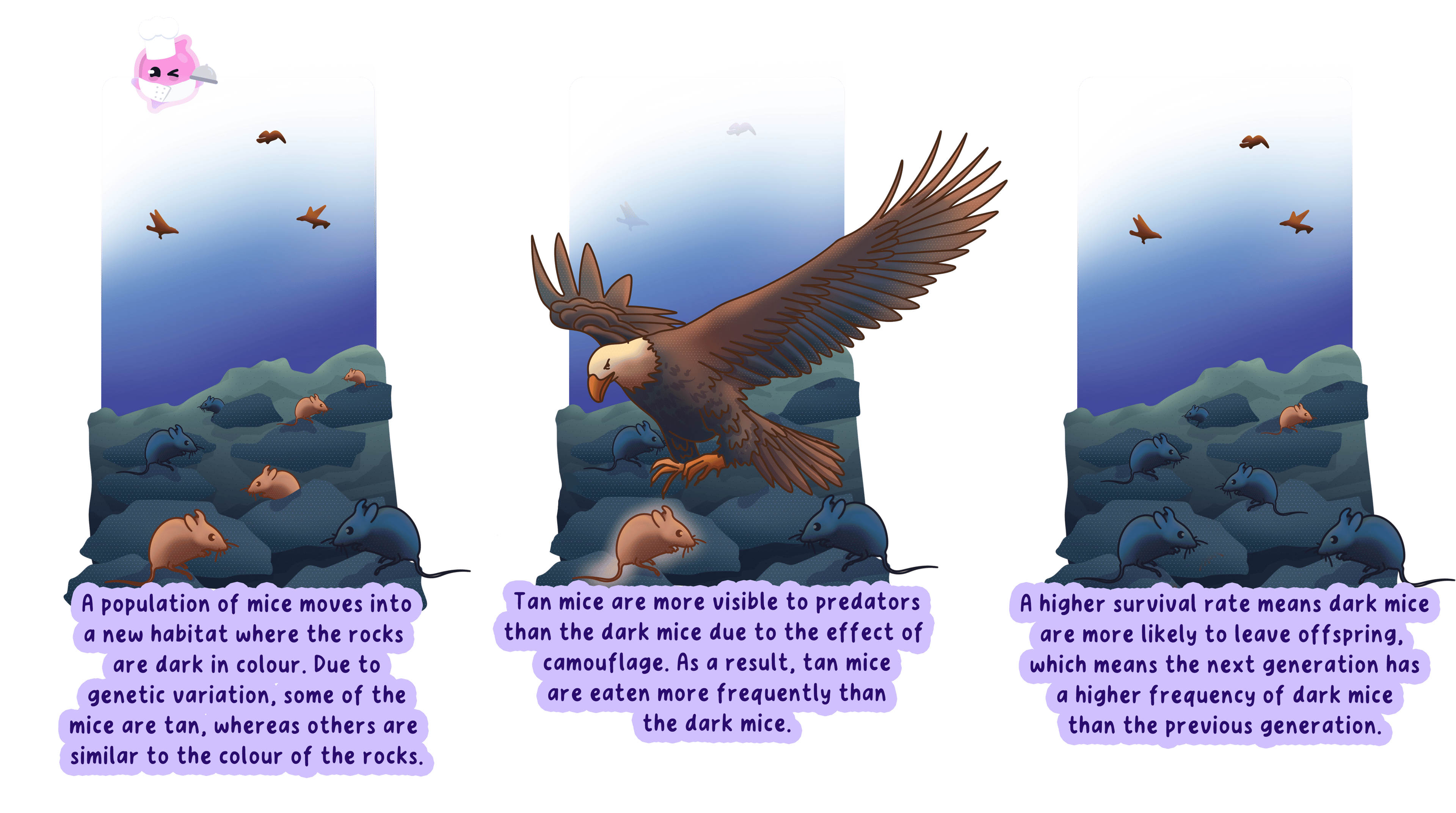
Do not write that an organism changes because it needs to; random inherited variation exists before the selection pressure acts.
For a natural-selection explanation, link variation, competition or selection pressure, survival and reproduction, inheritance, and the increase in allele frequency over generations.
Darwin and Wallace reached the same idea
Evolution
The gradual change in the inherited characteristics of a population over many generations, brought about by natural selection acting on variation.
- Evolution is the gradual change in the inherited characteristics of a population over many generations.
- Charles Darwin gathered evidence during his voyage on HMS Beagle and used observations of variation, fossils and geographical distribution to develop his explanation.
- Alfred Russel Wallace studied organisms in the Malay Archipelago and independently concluded that environmental pressures favour some inherited variations.
- Wallace sent his ideas to Darwin in 1858, and their accounts of natural selection were presented together before Darwin later published a detailed body of evidence.
- Their work provided a testable mechanism for evolution and helped biology explain adaptation, common ancestry and the formation of new species.
If darker mice are harder for predators to see on dark rock, more dark mice survive and reproduce, so alleles for dark fur become more common in later generations.
Evidence led to gradual acceptance
- Natural selection was not accepted immediately because it challenged widely held beliefs that species were fixed and had been created separately.
- Darwin and Wallace could not explain how inherited characteristics passed from parents to offspring because genes and DNA were not yet understood.
- The fossil record was incomplete, so many expected intermediate forms had not been discovered.
- Later discoveries in genetics, DNA, fossils and observed evolution supported the mechanism and strengthened scientific acceptance.
- Lamarck had proposed that features acquired during life could be inherited, but changes to body cells through use or disuse do not normally alter the alleles passed in gametes.
A giraffe stretching its neck does not create a longer-neck allele in its gametes, whereas a giraffe born with an inherited longer neck may leave more offspring if food is high in trees.
- What sequence of events causes natural selection?
- How did Wallace contribute to the theory?
- Why was natural selection accepted slowly?
- Why does a population evolve rather than an individual?
4.1.2 Resistant organisms and evolution
Resistance evolves through selection
Antibiotic resistance
The ability of a bacterium to survive an antibiotic that would normally kill it, caused by a chance mutation and spread through the population by natural selection.
- Antibiotic resistance is the inherited ability of a bacterium to survive exposure to an antibiotic that would normally kill it or stop it reproducing.
- A random mutation can give one bacterium an allele that provides resistance before the antibiotic is used.
- The antibiotic acts as a selection pressure by killing susceptible bacteria while resistant bacteria survive.
- The survivors reproduce rapidly by binary fission and pass copies of the resistance allele to their daughter cells.
- After repeated exposure, the proportion of resistant bacteria rises and a resistant strain can dominate the population.
- This observed change in an inherited characteristic across generations supports evolution by natural selection.
Do not say that bacteria become resistant because they try to adapt, or that the antibiotic causes the useful mutation.
In an MRSA population, bacteria with resistance survive treatment and reproduce, making the infection harder to control with the same antibiotics.
Antibiotic use changes selection pressure
- Using an antibiotic when it is not needed exposes bacteria to selection without giving a useful treatment benefit.
- Antibiotics cannot treat viral infections because viruses do not have the bacterial structures or processes that antibiotics target.
- Prescribing only when needed and using the correct dose reduce unnecessary selection for resistant bacteria.
- Good hygiene, isolation procedures and infection control reduce transmission of resistant strains between people.
- Reducing routine antibiotic use in livestock lowers selection pressure in agricultural bacterial populations.
- New antibiotics are difficult and expensive to develop, so resistance can spread faster than replacement treatments become available.
When asked how resistance develops, begin with a random mutation, then explain selection by the antibiotic, survival, reproduction, and the rising frequency of the resistance allele.
- How can antibiotic resistance first arise?
- Why does an antibiotic increase the proportion of resistant bacteria?
- How does resistance support natural selection?
- Give two ways to slow the spread of resistant strains.
4.2.1 Fossil evidence for human evolution
Fossils show a sequence of human change
Fossil
The preserved remains or traces of an organism from many thousands or millions of years ago, usually found in rock.
- A fossil is the preserved remains, impression or trace of an organism that lived in the past.
- Scientists date fossils and compare their age, skull shape, tooth structure, brain-case volume, pelvis and limb bones.
- A sequence from older to younger rocks reveals changes over time, while similarities show that extinct hominins and modern humans share ancestry.
- Ardi, about 4.4 million years old, had a small brain and features suited to climbing, but the pelvis and foot provide evidence relevant to upright movement.
- Lucy, about 3.2 million years old, had a small brain but a pelvis, knee and leg bones adapted for regular walking on two legs.
- Fossils discovered by Richard Leakey's team from about 1.6 million years ago had a larger brain case and a body shape closer to later humans.
The fossils do not form a straight ladder; they are evidence from branching groups of related hominins.
Evidence is strongest when features and dates agree
- The age of each fossil places it in time, and anatomical features show which traits appeared earlier or later.
- Older fossils with a mixture of ape-like and human-like features support gradual evolutionary change rather than a sudden appearance of modern humans.
- The fossil record is incomplete because fossilisation is rare, remains can be destroyed, and many fossils have not been found.
- A new discovery can change the proposed family tree, so scientific explanations are revised when better evidence appears.
Lucy provides stronger evidence for bipedal movement than a single tooth because several bones can be compared with the skeletons of apes and modern humans.
In an evidence question, name the fossil, state the dated feature, and explain what comparison that feature supports.
- What is a fossil?
- What does Ardi show?
- What does Lucy show?
- Why is the fossil record incomplete?
4.2.2 Stone tool evidence for human evolution
Stone tools record changing behaviour
Fossil
The preserved remains or traces of an organism from many thousands or millions of years ago, usually found in rock.
- Stone tools survive for long periods and provide evidence of the behaviour and manual skills of the humans who made them.
- The oldest tools are usually simple flakes or stones with a small number of cutting edges.
- Later hand axes are shaped on both sides and are more symmetrical, showing more planning and controlled manufacture.
- More recent tool sets include specialised blades, points, scrapers and small components made for different tasks.
- The long-term increase in complexity suggests changes in dexterity, learning, communication and the ability to plan.
A stone tool gives evidence about behaviour and technology, but it does not directly reveal the maker's genes or exact species.
The surroundings provide the date
- A tool can be given a relative date from its position in rock or sediment, because deeper undisturbed layers are usually older.
- Scientists can compare a tool with fossils or other artefacts found in the same layer.
- Layers of volcanic ash above or below the tool can be radiometrically dated, which brackets the tool's age.
- The method is reliable only if the layers have not been mixed by erosion, burrowing, earth movement or later human activity.
If a tool lies above ash dated to 1.8 million years and below ash dated to 1.5 million years, its age lies between those dates.
Separate the observation from the inference: describe the tool's shape first, then explain what its complexity suggests about its maker.
- How did stone tools change over time?
- What can tool complexity suggest?
- How can surrounding layers date a tool?
- Why can disturbed sediment make a date unreliable?
4.2.3 Pentadactyl limb as evidence
One bone pattern supports common ancestry
Pentadactyl limb
A vertebrate limb built from the same basic pattern of one upper bone, two lower bones, wrist or ankle bones and five digits.
- A pentadactyl limb has the same underlying plan of one upper bone, two lower bones, wrist or ankle bones, and five digits.
- Humans, bats, whales and many other vertebrates share this arrangement even though their limbs perform different functions.
- These are homologous structures, which means they have the same basic structural origin but may have different functions.
- The shared pattern is best explained by inheritance from a common ancestor.
- Natural selection then modified the ancestral limb for grasping, flying, swimming, walking or running in different environments.
Similar function alone is not evidence of homology; the underlying arrangement and evolutionary origin must also match.
Differences show divergent evolution
- The bones are not identical in size or shape because different selection pressures favoured different movements.
- In a bat, elongated digits support a wing membrane, while in a whale shortened and broadened bones form a flipper.
- The mixture of a shared plan and specialised proportions supports divergent evolution from a common ancestral structure.
- This anatomical evidence agrees with evidence from fossils and genetic comparisons.
A whale flipper and a human arm look different externally, but both contain a humerus, radius, ulna, wrist bones and digits in the same order.
A complete answer links the same bone pattern to common ancestry, then links different proportions to adaptation for different functions.
- What is a pentadactyl limb?
- What is a homologous structure?
- How does the limb plan support common ancestry?
- Why are the bones different in different animals?
4.2.4 Three domains classification
Genetic evidence reshaped classification
Classification
Sorting living organisms into groups based on their similarities and differences, from large groups such as kingdoms down to individual species.
- Classification is the organisation of living organisms into groups using shared features and evolutionary relationships.
- Older systems relied mainly on visible structures and cell features, which placed all prokaryotes together in one kingdom.
- Scientists can now compare DNA base sequences and the sequences of proteins made from genes.
- More similar sequences suggest a more recent common ancestor, while larger differences suggest an older split.
- Genetic analysis showed that two major prokaryote groups differ greatly from each other, despite both lacking a nucleus.
Classification changes when new evidence gives a better account of evolutionary relationships.
Three domains replace one prokaryote group
- The three-domain model groups organisms into Bacteria, Archaea and Eukaryota.
- Bacteria and Archaea are prokaryotic, but their genetic sequences and cell chemistry show separate evolutionary lineages.
- Eukaryota contains organisms whose cells have a nucleus, including animals, plants, fungi and protists.
- A phylogenetic tree shows hypotheses about common ancestry through branching lines rather than ranking living groups as more or less advanced.
- As more genomes are sequenced, branch positions can be tested and revised.
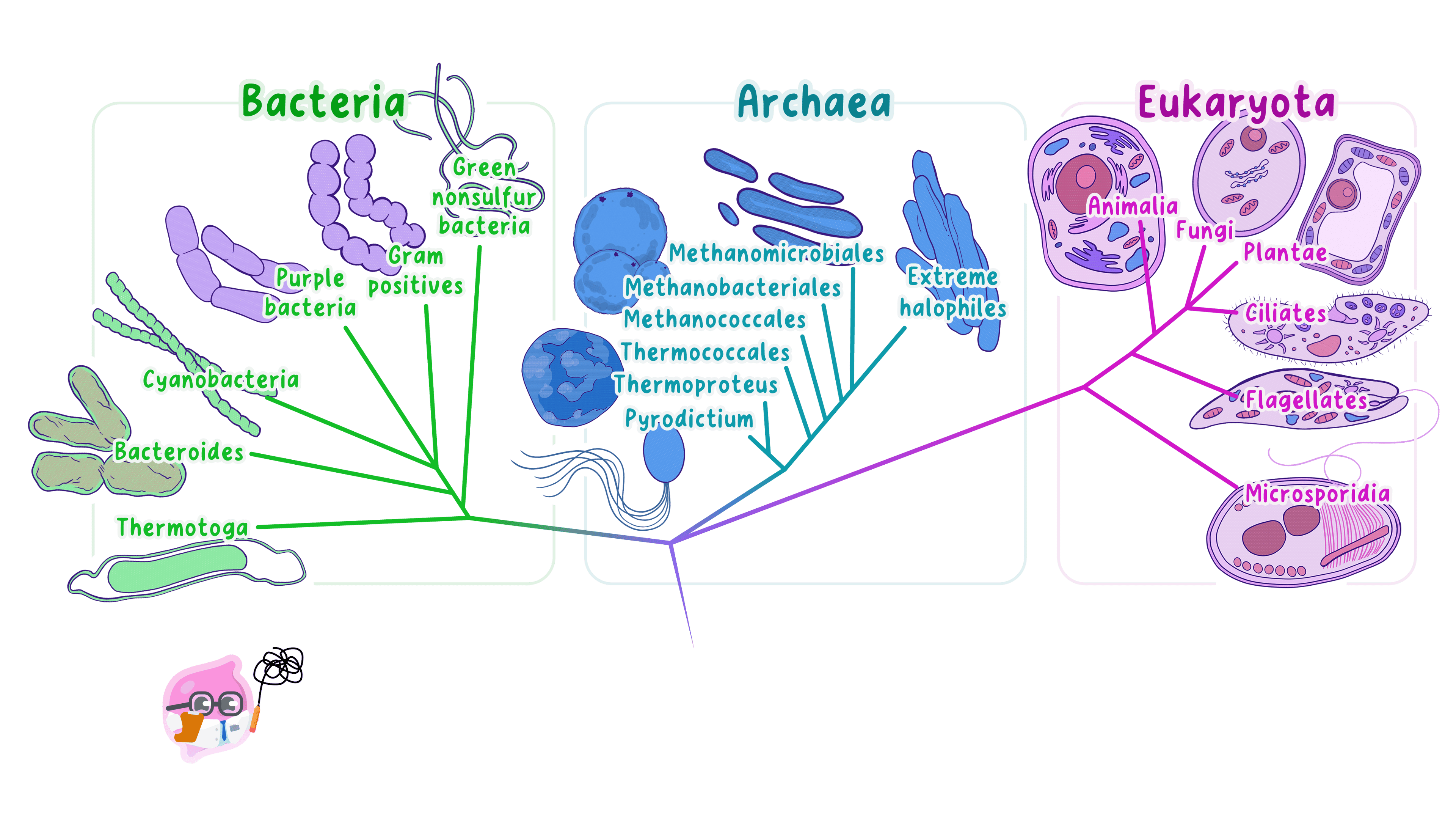
Explain the change by stating the new genetic evidence, the unexpected difference between prokaryote groups, and the resulting three-domain model.
Scientific names identify one species
Binomial name
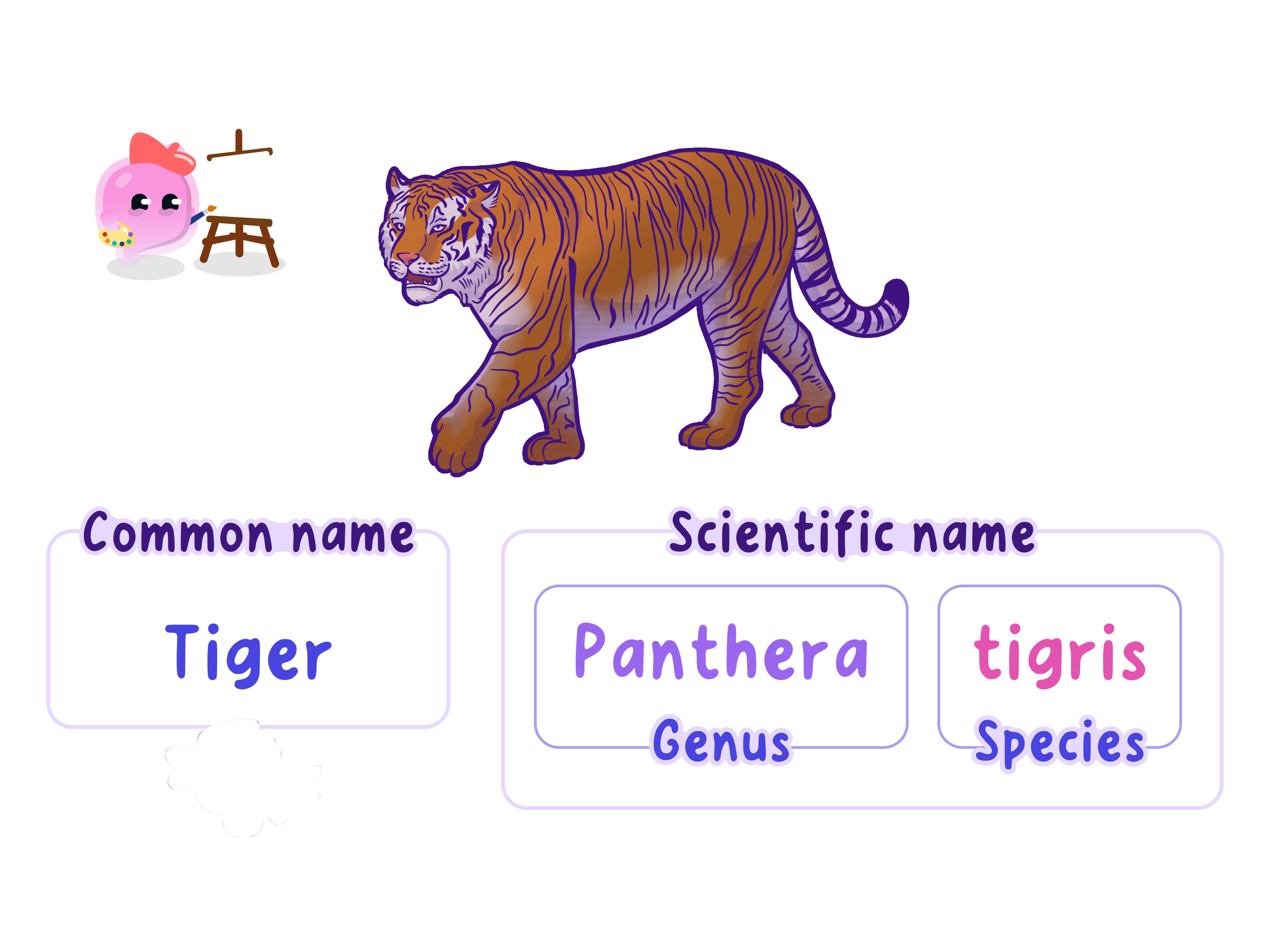
The two-part Latin name given to every species, made of its genus followed by its species name, for example Homo sapiens.
- A binomial name gives each species a two-part scientific name made from its genus and species.
- The genus begins with a capital letter, the species begins with a lower-case letter, and both words are written in italics.
- A universal name avoids confusion caused by different common names in different countries.
The binomial name for humans is Homo sapiens, with Homo as the genus and sapiens as the species.
- Why can DNA sequences improve classification?
- Name the three domains.
- How did genetic evidence split the old prokaryote group?
- How is a binomial name written?
