Energy is lost between trophic levels
Definition
Trophic level
The feeding position of an organism in a food chain, food web or ecological pyramid, numbered from level 1 at the producer.
- A trophic level is a feeding position in a food chain, with producers at trophic level 111.
- Only energy stored in an organism's new biomass can be transferred to the next trophic level when that biomass is eaten.
- Some organisms or body parts are not eaten, so the chemical energy in that material is not transferred to the consumer.
- Some eaten material cannot be digested and is egested in faeces, so its chemical energy is not absorbed into the consumer's body.
- Some absorbed substances are excreted, including nitrogen-containing waste in urine, so this material cannot become food for the next trophic level.
- Respiration transfers chemical energy from food for movement, active transport, growth, repair and temperature control, and much of this energy eventually spreads to the surroundings as heat.
Common Mistake
Do not write that energy disappears: energy is transferred to the surroundings or remains in material that does not pass to the next trophic level.
Less energy supports fewer organisms
- Each higher trophic level receives less usable chemical energy, so it can build less new biomass.
- Less biomass provides food for fewer individuals, which is why populations are usually smaller at higher trophic levels.
- Top predators need many prey organisms across a large feeding area because so little of the original energy reaches them.
- After several transfers, too little energy remains to support another stable consumer population, which limits most food chains to a small number of trophic levels.
Example
- A grassland can support many grass plants, fewer rabbits and still fewer foxes because energy is lost at both feeding transfers.
- The fox population cannot be larger than the rabbit population for long because each fox needs energy from many rabbits.
Biomass pyramids narrow upwards
Definition
Pyramid of biomass
A diagram in which the width of each bar shows the mass of living material at each trophic level in a food chain.
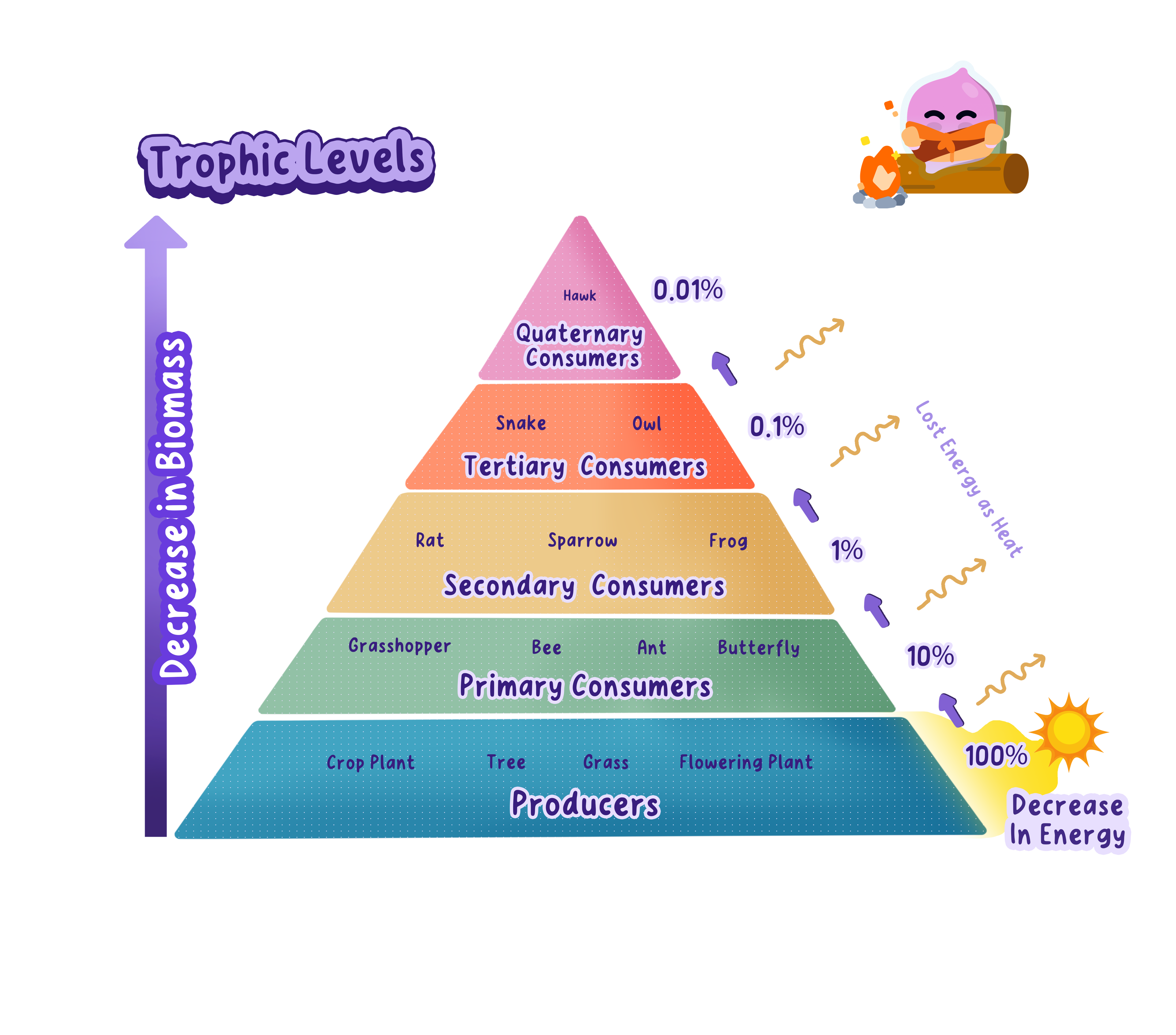
- A pyramid of biomass uses horizontal bars whose widths are proportional to the total dry mass of organisms at each trophic level.
- The producer bar is placed at the bottom, followed by primary, secondary and higher consumers in feeding order.
- Biomass normally decreases at each transfer because only part of the material at one level becomes new biomass at the next level.
- The bars therefore become narrower towards the top, showing why less living material and usually fewer organisms can be supported.
Example
- If producers contain 12 000 g12\,000\,\mathrm{g}12000g of biomass, primary consumers contain 1 800 g1\,800\,\mathrm{g}1800g and secondary consumers contain 180 g180\,\mathrm{g}180g, the three bars must be drawn in those proportions.
- The secondary-consumer bar is one tenth of the primary-consumer bar because 180÷1 800=0.10180 \div 1\,800 = 0.10180÷1800=0.10.
Pyramid diagrams must match the data
- Draw separate horizontal bars rather than a triangle, because each bar must show the biomass of one trophic level.
- Label the producer at the bottom and arrange every consumer above it in the order shown by the food chain.
- Use the numerical values to set the relative widths instead of drawing equally spaced steps.
Exam technique
- Marks are commonly awarded separately for the correct trophic order and for bar widths that match the biomass values.
- A correctly labelled triangle can gain a labelling mark but does not show the required biomass proportions.
Transfer rates are not fixed
- The often-used 10%10\%10% transfer figure is a rough model, not a rule that applies to every ecosystem or every trophic level.
- Transfer depends on factors such as how much of each organism is eaten, how much is digestible and how much energy the organisms use in respiration.
- Use values supplied in a question when explaining a particular food chain instead of assuming that every transfer is 10%10\%10%.
Self review
- What is a trophic level?
- Why is energy in faeces unavailable to the next trophic level?
- How does energy loss limit the length of a food chain?
- How should the bars in a pyramid of biomass be arranged?
