Cancer Is Uncontrolled Cell Division
Cancer
A disease in which changes to cells cause uncontrolled cell division, producing a tumour.
- In a healthy tissue the cell cycle is tightly controlled, and cells divide only when a new cell is needed.
- Cancer begins when changes inside a cell damage the genes that control this cycle.
- The cell then divides repeatedly and uncontrollably, ignoring the signals that would normally stop it.
- The damaged control is passed on to every daughter cell, so the population of faulty cells doubles again and again.
How a Tumour Forms
Tumour
A mass of cells produced by uncontrolled cell division.
- The dividing cells build up into a mass of cells called a tumour.
- Cells inside a growing tumour need a supply of oxygen and glucose, so a tumour triggers the growth of new blood vessels towards itself.
- A tumour can press on nearby organs, blood vessels or nerves, which is often what produces the first symptoms.
- Tumours are classified as benign or malignant, and only malignant tumours are described as cancerous.
Benign Tumours
Benign tumour
A tumour that stays in one place inside a membrane and does not invade other tissues.
- A benign tumour grows in one place and is usually contained within a membrane.
- Its cells do not invade surrounding tissue and do not spread to other parts of the body.
- Benign tumours are not classed as cancer and can often be removed by surgery.
- They can still be dangerous if they grow in a confined space, which is why a benign brain tumour can press on the brain and cause serious harm.
Malignant Tumours
Malignant tumour
A cancerous tumour whose cells invade neighbouring tissue and spread in the blood to form secondary tumours elsewhere in the body.
- A malignant tumour is cancerous, and its cells invade the healthy tissue around it.
- Cells break off and are carried in the blood or the lymph to other parts of the body.
- Where they settle they divide again and form secondary tumours, and this spread is called metastasis.
- Secondary tumours are what make malignant cancers difficult to treat, because removing the original tumour no longer removes the disease.
Do not treat tumour and cancer as the same word. Every cancer is a tumour, but a benign tumour is not a cancer, and the difference that earns the mark is whether the cells spread.
What Causes the Changes in the Cells
Mutation
A random change in the sequence of bases in DNA.
- The changes are mutations in the genes that control cell division.
- Mutations happen at random during DNA replication, and most are harmless or are repaired.
- A mutation that damages a control gene may allow the cell cycle to run without a brake.
- Cancer usually requires several mutations to build up in the same cell, which is why the risk rises with age.
Carcinogens and Risk Factors
Carcinogen
Any agent that increases the risk of cancer by causing mutations in DNA, such as the tar in tobacco smoke or ultraviolet light.
- A carcinogen is any agent that increases the rate of mutation and therefore the risk of cancer.
- Ionising radiation, including X-rays, gamma rays and the ultraviolet radiation in sunlight, damages DNA directly.
- Chemical carcinogens include the tar in tobacco smoke, asbestos fibres and some industrial solvents.
- Some viruses raise the risk, and human papillomavirus is linked to cervical cancer.
- Inherited alleles also matter, and a person who inherits a faulty BRCA1 allele has a higher risk of breast cancer.
- Lifestyle factors such as obesity and high alcohol intake raise the risk of several cancers.
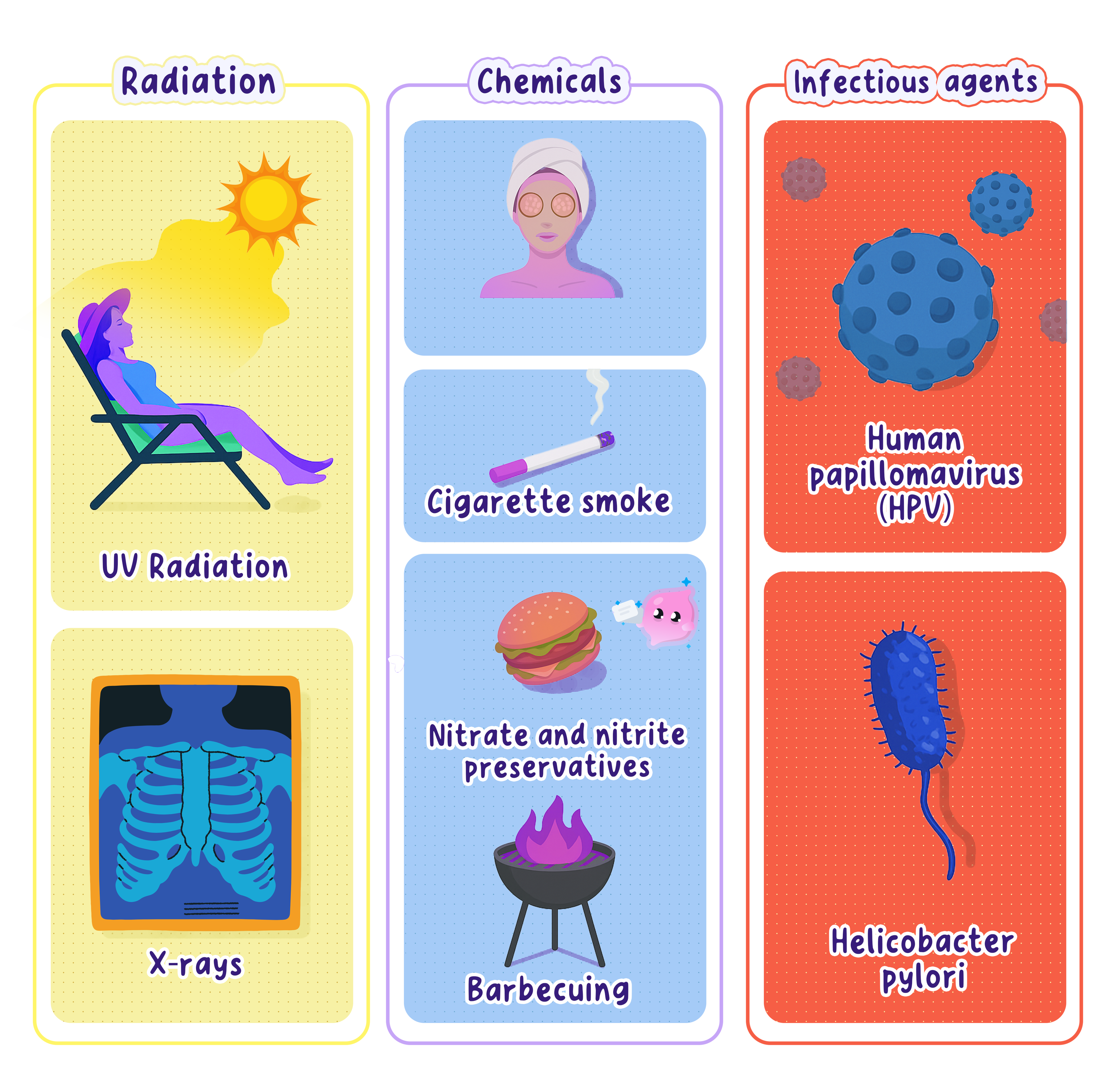
A risk factor is not a cause. Exposure to a carcinogen raises the probability of cancer, so an answer must say increases the risk of rather than causes.
Interpreting Cancer Data
- Exam data on cancer is usually given as an incidence rate, meaning new cases per 100 000 people per year, so populations of different sizes can be compared.
- A correlation between a factor and cancer incidence does not on its own prove that the factor causes the cancer.
- Stronger evidence comes from a dose response, where a larger exposure is matched by a larger increase in risk.
- Percentage change is a common calculation in these questions.
- percentage change=final value−initial valueinitial value×100\text{percentage change} = \frac{\text{final value} - \text{initial value}}{\text{initial value}} \times 100percentage change=initial valuefinal value−initial value×100
- Multiple choice items define cancer as uncontrolled cell division, and the distractors swap in controlled cell division or uncontrolled organ division, so read every option to the end.
- When asked to compare benign and malignant tumours, give a paired comparison: benign stays in one place while malignant invades and spreads to form secondary tumours.
- In a data question, quote figures from the graph or table with their units and state the trend before you interpret it.
- If asked to evaluate whether a factor causes cancer, say that the data shows a correlation and name one further piece of evidence that would be needed.
- Define cancer in one sentence.
- State two differences between a benign tumour and a malignant tumour.
- What is a carcinogen? Give two examples.
- What name is given to the spread of cancer cells to another part of the body?
- Why does the risk of developing cancer increase with age?
