Poverty is one of the most significant and debated topics in A-Level Sociology. It directly connects to core themes of power, social stratification, and the role of the state. While the UK is one of the wealthiest economies in the world, millions of citizens live in poverty. This section explores how we define this phenomenon, how we measure it, and why it persists despite decades of welfare policies.
What you'll learn
- How to distinguish between absolute, relative, and subjective definitions of poverty.
- How contemporary poverty is measured in the UK and the methodological challenges of doing so.
- The competing structural and individualistic theories that attempt to explain why poverty persists.
Defining the "Nature" of Poverty
Before we can investigate why poverty exists, we must define what "poverty" actually means. Sociologists generally categorise poverty into three main definitions: absolute, relative, and subjective.
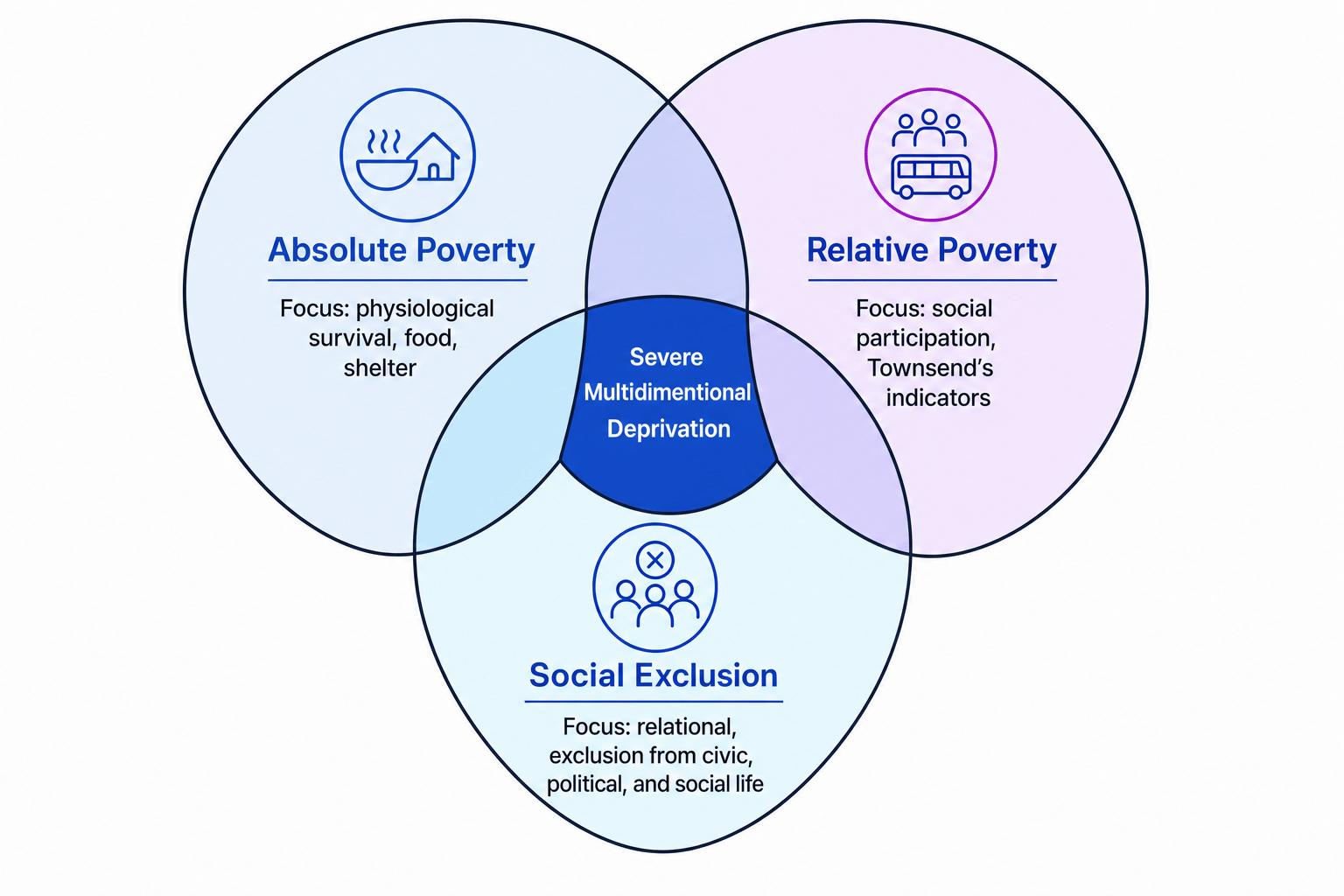
Absolute Poverty
This is the most traditional way of looking at poverty. It focuses on the bare physical necessities of life.
Absolute Poverty
A state in which a person lacks the resources necessary to sustain basic physical survival. This includes a lack of food, clean drinking water, basic sanitation, shelter, and clothing.
This concept was famously used by the social reformer Seebohm Rowntree in his pioneering 1899 study of poverty in York. Rowntree established a "poverty line" based on the minimum nutritional intake and basic physical necessities required to keep a human body functioning.
While absolute poverty is a vital concept for studying developing economies, many sociologists argue it is less useful for analyzing modern, high-income countries like the UK, where starvation is rare but deprivation remains widespread.
Relative Poverty
To address the limitations of the absolute definition, sociologists developed the concept of relative poverty. This approach links poverty directly to the standards of living of the wider society.
Relative Poverty
A state where an individual's resources are so far below those of the average citizen that they are effectively excluded from the normal lifestyle, customs, and activities of their society.
The pioneer of this approach was Peter Townsend (1979). Townsend argued that poverty is socially constructed. What we consider "necessities" changes over time as society becomes wealthier. For example, while a mobile phone or internet access was not a necessity in 1950, today it is virtually impossible to apply for jobs, access welfare benefits, or participate fully in society without them.
Townsend constructed a Deprivation Index of 12 items (such as having a holiday away from home once a year, or being able to afford a cooked meal containing meat or fish every other day). If people scored highly on this index, they were classified as living in relative poverty.
Social Exclusion
In recent decades, sociologists and policymakers have shifted toward using the broader concept of social exclusion. This moves beyond just income to look at the relational aspects of poverty—how people are cut off from key institutions.
Social Exclusion
The process of being shut out, fully or partially, from any of the social, economic, political, or cultural systems which determine the social integration of a person in society.
Confusing Absolute and Relative Poverty
Do not write that relative poverty is "less serious" or "not real poverty." Relative poverty is not just about "wanting a flat-screen TV." It means being unable to afford a warm home, fresh food, or school trips for your children—leading to severe stigma, social isolation, and poor physical and mental health.
Measuring Poverty in Contemporary Society
How do sociologists and the UK government operationalise poverty today? The standard measure used by the UK government's Department for Work and Pensions (DWP) is based on the Households Below Average Income (HBAI) dataset.
The 60% Median Income Rule
In the UK, a household is defined as living in relative poverty if its disposable income is less than 60% of the national median household income (adjusted for household size).
This measure is calculated in two ways:
- Before Housing Costs (BHC): This measures income before paying rent or mortgage.
- After Housing Costs (AHC): This is considered a more realistic measure of poverty, as housing costs are non-negotiable and vary wildly across different UK regions.
Determining relative poverty status using the median income method
Imagine we want to determine if "Household X" is living in relative poverty based on a simplified sample population of five households in a community. Follow these steps to calculate the threshold and determine status.
-
Order the equivalised disposable incomes of the sample households from lowest to highest to identify the median (middle) value:
- Household A: £12,000
- Household B: £18,000
- Household C: £24,000 (This is the median)
- Household D: £30,000
- Household E: £45,000
-
Calculate the relative poverty line by finding 60% of the median income identified in Step 1:
Poverty Line=Median Income×0.60 \text{Poverty Line} = \text{Median Income} \times 0.60 Poverty Line=Median Income×0.60 Poverty Line=£24,000×0.60=£14,400 \text{Poverty Line} = £24,000 \times 0.60 = £14,400 Poverty Line=£24,000×0.60=£14,400 -
Compare Household X's annual income (which is £13,500) to the calculated poverty line of £14,400.
-
Determine the poverty status: Since £13,500 is less than the poverty threshold of £14,400, Household X is classified as living in relative poverty.
Methodological Issues with Measuring Poverty
Measuring poverty is not a neutral, objective process. It involves several methodological challenges:
- The "Equivalisation" Problem: To make comparisons fair, incomes are "equivalised" (adjusted to account for the fact that a family of four needs more money than a single person to achieve the same standard of living). However, the formulas used may not accurately reflect the actual costs of raising children or living with a disability.
- The Intra-Household Distribution of Wealth: Standard surveys assume income is shared equally within a household. However, feminist sociologists (such as Jan Pahl) have shown that men often control household finances, meaning women and children can live in poverty even if the overall household income is above the poverty line.
- Fluctuating Incomes: Point-in-time surveys capture a snapshot. They can miss the difference between temporary poverty (e.g., being between jobs) and persistent poverty (years of deprivation).
The Existence and Persistence of Poverty
In contemporary Britain, poverty has not disappeared; it has evolved. Two key trends highlight its persistent nature:
- The Rise of Working Poverty: Historically, poverty was associated with unemployment. Today, the majority of people living in poverty in the UK belong to households where at least one adult is in work. This is driven by low wages, the rise of "zero-hours" contracts, and the gig economy.
- The "Feminisation" of Poverty: Women are statistically more likely to experience poverty than men. This is due to the gender pay gap, the high costs of childcare, and the fact that women are far more likely to head lone-parent households.
Theoretical Explanations: Why Does Poverty Persist?
Sociologists are deeply divided on why poverty persists in an otherwise wealthy society. We can categorise these explanations into two opposing camps: individualistic/cultural explanations and structural explanations.
1. Cultural/Individualistic Explanations (The Consensus & New Right View)
These theories argue that poverty persists because of the behavior, choices, and culture of the poor themselves.
The Culture of Poverty (Oscar Lewis)
Anthropologist Oscar Lewis (1966) argued that the poor develop a distinct "culture of poverty" as a psychological defense mechanism against their marginal position. This culture includes:
- Present-mindedness: Focusing on the present rather than planning for the future.
- Fatalism: A belief that nothing they do can change their circumstances.
- A lack of deferred gratification: Being unable to resist immediate rewards for long-term gains.
Lewis argued this culture is socialised into children, meaning poverty is passed down through generations, making it self-perpetuating even if economic opportunities improve.
The Underclass and Welfare Dependency (Charles Murray)
Writing from a New Right perspective, Charles Murray (1984) updated this idea. He argued that generous welfare benefits in western societies have created a welfare-dependent "underclass."
The Welfare Trap
Think of a safety net that is so comfortable and secure that people decide to lie down in it rather than use it to spring back onto their feet. Murray argues that when the state provides housing and income that rivals or exceeds what can be earned in low-paid work, it removes the incentive to work, creating a cycle of dependency.
According to Murray, this dependency has eroded traditional values of hard work and family responsibility, leading to rising rates of illegitimacy (lone parenthood) and a lack of positive male role models for young boys, which breeds further poverty and criminality.
2. Structural Explanations (The Conflict View)
Structural sociologists (Marxists, Social Democrats, and Feminists) completely reject individualistic explanations. They argue that poverty is built into the very structure of capitalist society and the labour market.
Marxist Explanations: Poverty as Functional for Capitalism
Marxists argue that poverty is an inevitable outcome of a capitalist system that prioritises profit over human need.
- The "Reserve Army of Labour": Marx argued that capitalism requires a pool of unemployed or underemployed workers. This "reserve army" can be brought into work during economic booms and discarded during recessions. Their existence keeps wages low because workers know they can easily be replaced if they demand higher pay or better conditions.
- Ideological Control: By blaming the poor for their own poverty (as the New Right does), the ruling class diverts attention away from the exploitative nature of capitalism. It prevents class consciousness and revolution.
Social Democratic Explanations: The Structure of the Welfare State
Social Democrats argue that poverty persists because of unequal life chances and the failure of the government to adequately redistribute wealth.
- The Dual Labour Market Theory: The modern economy is split into a primary labour market (secure, well-paid jobs with career progression) and a secondary labour market (insecure, low-paid, part-time work with no benefits). Working-class individuals, women, and ethnic minorities are disproportionately trapped in the secondary sector.
- Inadequate Welfare: Social Democrats argue that welfare benefits in the UK are set too low to prevent relative poverty, and the system is designed to punish rather than support.
<tip title="Use "The Precariat" in your essays">
Bring your essay up to date by referencing Guy Standing (2011). He argues that global capitalism has created a new social class: "the precariat." This group lacks any of the security of the traditional working class (such as stable contracts, pensions, or paid sick leave) and lives in a state of permanent economic insecurity.
Evaluating the Explanations (AO3)
When writing an essay on the persistence of poverty, you must weigh these perspectives against each other.
| Feature | Cultural / New Right Explanations | Structural Explanations |
|---|---|---|
| Root Cause | Individual choices, family breakdown, welfare dependency. | Capitalist exploitation, low wages, inadequate state support. |
| View of the Poor | Passive victims of their own culture or active exploiters of the welfare system. | Victims of unequal power structures and systemic barriers. |
| Solution | Cut welfare benefits, encourage marriage, enforce work requirements. | Redistribute wealth through taxation, raise the minimum wage, invest in public services. |
| Methodological Critique | Rely on subjective, moralistic judgments and selective case studies. | Can sometimes be overly deterministic, ignoring individual agency. |
Key Evaluation Points
- Blaming the Victim: Critics of Murray and Lewis (such as William Ryan) argue that cultural explanations are a form of "blaming the victim." They mistake the consequences of poverty for its causes. For example, fatalism is not a cultural choice; it is a realistic psychological reaction to having no power or resources.
- The Reality of Welfare: Empirical research consistently shows that the vast majority of people on benefits want to work. The "dependency culture" is largely a myth; most people cycle rapidly between low-paid, insecure work and short-term benefit claims.
- Power Dynamics: Structural explanations are far more successful at explaining who ends up in poverty. If poverty were purely down to individual choices, we would not see such consistent patterns of poverty based on class, gender, ethnicity, and geography.
In the exam
- Deconstruct the question: If the question asks you to "evaluate sociological explanations for the persistence of poverty," construct a clear debate between cultural/individualist models (Murray, Lewis) and structural models (Marxism, Social Democracy, Feminism).
- Use precise terminology: Don't just talk about "being poor." Use concepts like relative deprivation, equivalised income, social exclusion, and the reserve army of labour.
- Bring in research methods: If appropriate, evaluate the validity and reliability of how poverty is measured. Highlight how Townsend's index might be subjective, or how DWP statistics (HBAI) might obscure inequalities within households.
- Link to the core themes: Show how the persistence of poverty relates to the theme of power and stratification (who controls wealth and how the state uses welfare policy as a mechanism of control).
Check yourself
- Explain the key difference between absolute and relative poverty, referencing Rowntree and Townsend.
- Why do feminist sociologists argue that official household statistics might underestimate the true extent of poverty among women?
- Outline how Charles Murray's concept of the "underclass" explains the persistence of poverty, and provide one structural criticism of his view.
