What you'll learn
- How identity is shaped by work, class, consumption, media and global cultural flows.
- Why sociologists disagree about whether identity is mainly structured by inequality or chosen through lifestyle.
- How to apply theorists such as Marx, Weber, Bourdieu, Giddens, Bauman, Baudrillard, Hall and Ritzer.
- How to build AO1, AO2 and AO3 into essay-style answers on this topic.
Starting point: identity is social
Identity
Identity means how people see themselves and how others see them. It includes personal identity, such as your tastes and values, and social identity, such as class, gender, ethnicity, nationality, age, sexuality and religion.
Identity is not simply “inside your head”. It is developed through socialisation, meaning the process through which people learn norms, values and expected behaviour. Families, schools, peer groups, workplaces, media and religion all help shape who we think we are.
You also need to link identity to social differentiation, meaning the ways society divides people into social categories, and stratification, meaning unequal ranking by power, status and resources. Your identity is shaped partly by choice, but also by where you are placed in unequal social structures.
The big relationship
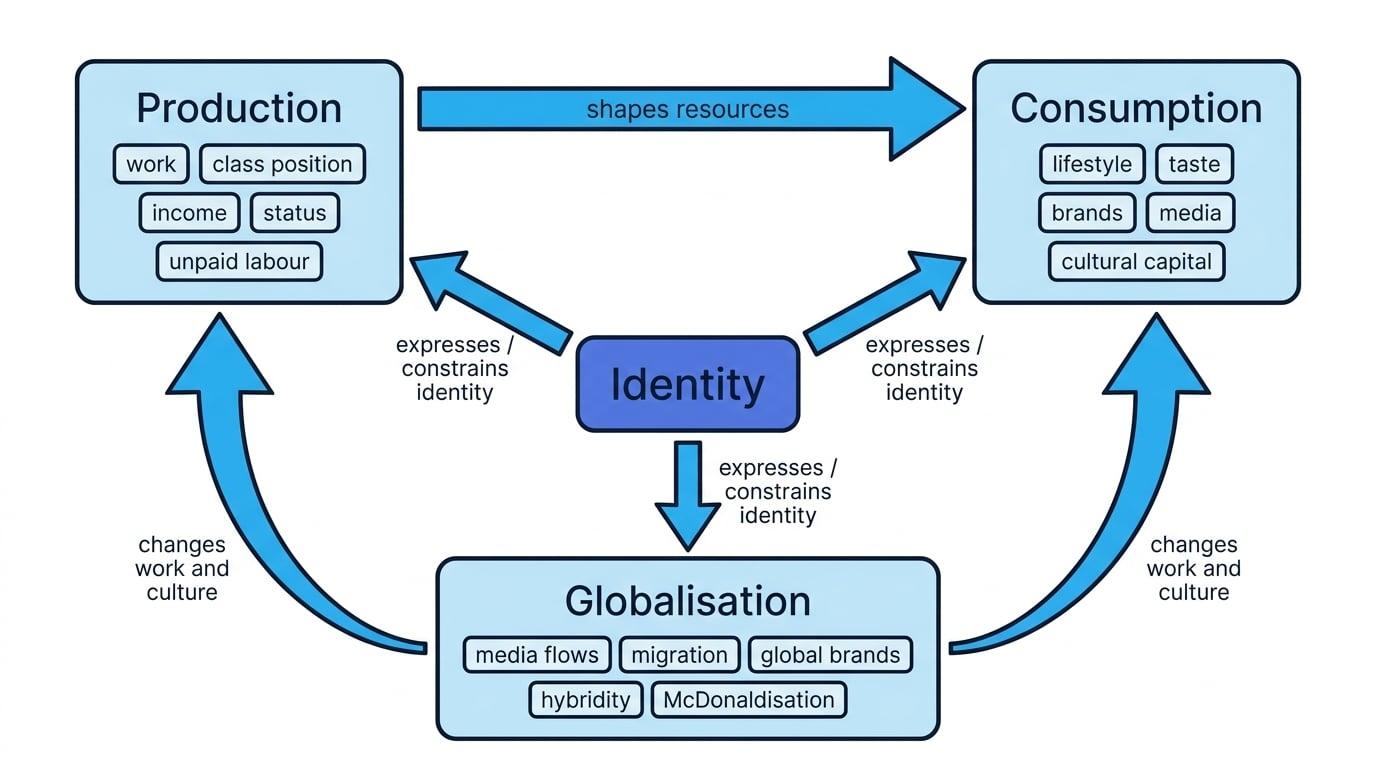
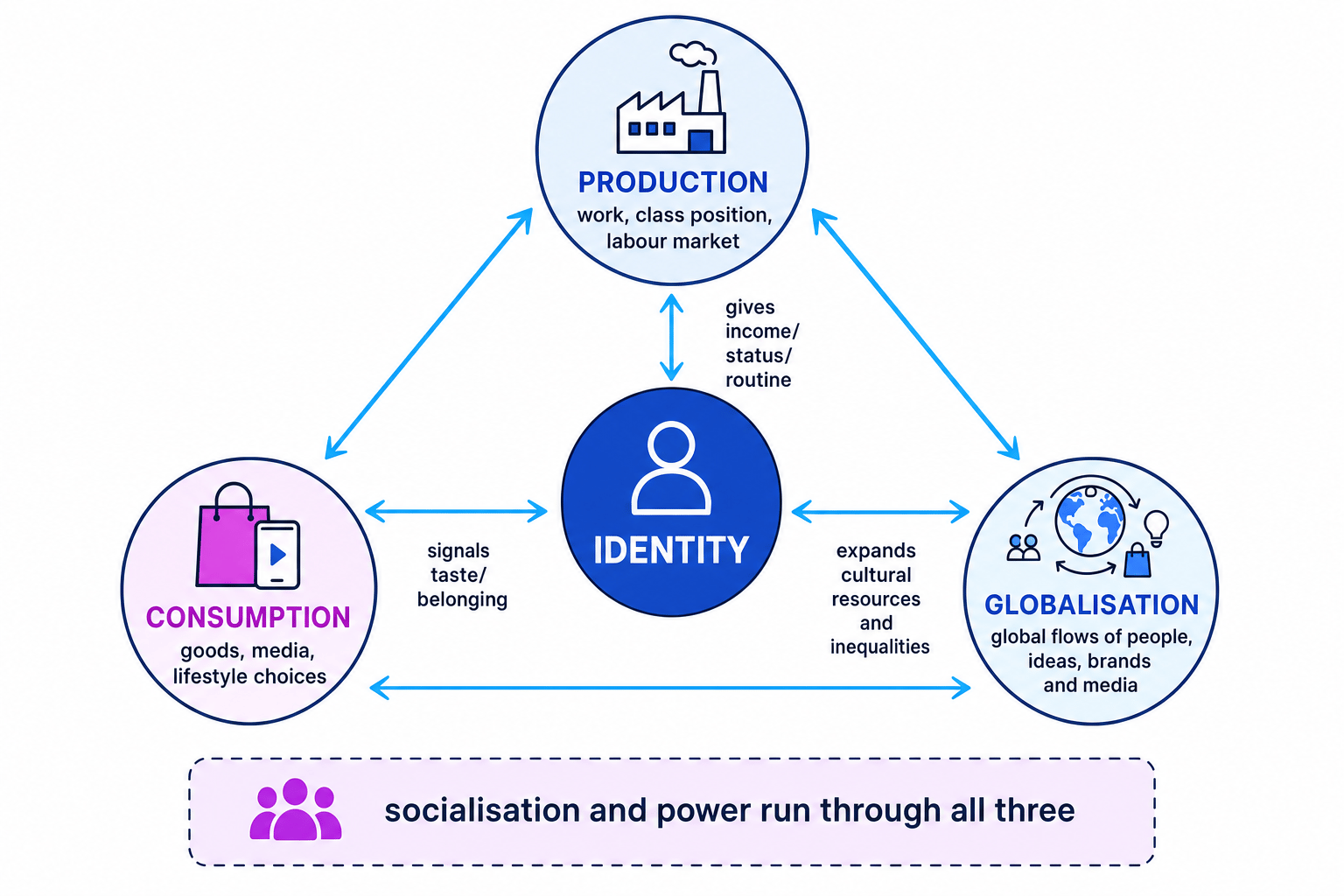
Production, consumption and globalisation are not separate. Work affects income and status; income affects consumption; globalisation changes both work and consumption; all three shape identity.
Production: identity through work and economic position
Production
Production means the creation of goods and services. In sociology, it usually refers to paid work, unpaid work, the labour market, class position and the organisation of economic life.
For many people, work gives identity because it provides income, routine, status, social networks and a sense of purpose. Someone may identify as a nurse, builder, student, carer, entrepreneur or unemployed person. These labels are not just job titles: they carry assumptions about skill, respectability, class and lifestyle.
Marxism: production shapes class identity
For Marx, the key issue is people’s relationship to the means of production, meaning the factories, land, offices, technologies and capital used to produce goods and services. The bourgeoisie own the means of production, while the proletariat sell their labour for wages.
Marxists argue that capitalism shapes identity by placing people into class positions. It may create class consciousness, where workers recognise shared exploitation, but it can also create false consciousness, where people accept capitalist ideas as natural.
AO2 example: in the UK, deindustrialisation in former mining, steel and manufacturing areas affected not only jobs, but also local working-class identities. The closure of workplaces can weaken community ties and pride, while insecure service work or gig work may make collective identity harder to build.
Weber: class, status and market position
Weber agreed that economic position matters, but argued that identity is also shaped by status, meaning social honour or prestige, and market situation, meaning the skills and qualifications people can sell in the labour market.
This helps explain why two people with similar incomes may have different identities. For example, a self-employed tradesperson, a teacher and a call-centre worker may all earn moderate incomes, but may experience different levels of autonomy, respect and status.
Feminism: production includes unpaid labour
Feminists point out that “production” should not only mean paid employment. Unpaid domestic labour, such as childcare, housework and emotional support, is essential to society but often undervalued because it is associated with women.
Walby argues that patriarchy operates across paid work, household labour, culture, sexuality, violence and the state. This means gender identity is shaped by both production and power. For example, women may be encouraged to see caring as “natural”, while men may be socialised into breadwinner identities.
Explaining a work-based identity
- A sociologist would first identify the person’s position in production: for example, a warehouse worker sells labour for wages, has limited control over the work process and may experience insecure hours.
- This can then be linked to identity: the worker may develop a class identity based on shared routines, low autonomy and common experiences with colleagues.
- Evaluation adds complexity: postmodernists would argue that this identity may be weakened if the worker expresses individuality more through music, fashion, social media or leisure than through class-based workplace solidarity.
Reducing production to occupation
Do not just say “work affects identity”. Explain how: income, status, autonomy, insecurity, gender roles, class culture and workplace socialisation are the mechanisms.
Consumption: identity through lifestyle and meaning
Consumption
Consumption means the use, purchase and display of goods, services, experiences and media. It includes shopping, fashion, food, music, holidays, technology and online content.
In contemporary society, people often express identity through what they consume. Clothing, phones, music taste, streaming platforms, gym membership, gaming, vegan food, tattoos or travel can all signal who someone is — or who they want to be seen as.
Bourdieu: taste is shaped by class
Bourdieu argues that taste is not purely individual. It is shaped by habitus, meaning deeply learned dispositions, and cultural capital, meaning knowledge, tastes, language and qualifications that carry social value.
For Bourdieu, consumption helps reproduce class inequality. Middle-class tastes may be treated as more “cultured” or legitimate, while working-class tastes may be looked down on. This means identity through consumption is linked to power.
AO2 example: knowing how to talk about theatre, university choices, wine, art galleries or “good” schools can act as cultural capital. These tastes may help some groups feel confident in middle-class spaces while excluding others.
Baudrillard and Bauman: consumer identity is fluid
Baudrillard argues that in consumer society, people consume signs, not just useful objects. A designer logo, a car brand or an Instagram aesthetic communicates meaning. The symbol can become more important than the object itself.
Bauman describes modern identity as more liquid and changeable. People are encouraged to constantly update themselves through consumption. However, this freedom is unequal: those with money can reinvent themselves more easily than those facing poverty or debt.
Consumption can be agency and control
Consumption can give people agency. Youth subcultures, LGBTQ+ fashion, religious dress, fan communities and music scenes can all allow people to create belonging and resistance.
But consumption is also shaped by advertising, algorithms, debt, fast fashion supply chains and corporate power. A teenager may feel they are freely choosing an identity on TikTok, while their choices are being shaped by platform design and influencer marketing.
Treating consumption as pure freedom
Consumption can express identity, but it is not equally available to everyone. Class, gender, ethnicity, disability, age and income affect what people can buy, access and safely display.
Analysing a consumer identity
- If a student buys second-hand clothes, eats vegan food and follows climate influencers, their consumption communicates an ethical and environmental identity.
- This can be linked to socialisation: peer groups, education and social media may encourage values such as sustainability and individual responsibility.
- AO3 evaluation would ask who can access this identity. Ethical products may cost more, and global supply chains mean “green” consumption can still depend on low-paid labour elsewhere.
Globalisation: identity across borders
Globalisation
Globalisation means the increasing interconnectedness of societies through flows of people, goods, money, media, technology, ideas and culture across national borders.
Globalisation changes identity because people are exposed to more cultural resources. Music, food, religion, fashion, political movements and media circulate globally. This can create more hybrid, flexible and diverse identities.
Giddens argues that globalisation stretches social relations across time and space. Events in one country can shape everyday life in another. For example, global conflicts, migration, climate change, online trends and international brands all affect identity in the UK.
McLuhan used the phrase global village to describe how media connect distant people and events. Today, platforms such as TikTok, YouTube and Instagram make global cultural trends part of everyday identity work.
Homogenisation, glocalisation and hybridity
Some sociologists argue globalisation creates cultural homogenisation, meaning cultures become more similar. Ritzer’s idea of McDonaldisation suggests that efficiency, predictability and standardisation spread across society, especially through global corporations.
However, Robertson argues that globalisation also produces glocalisation, meaning global products are adapted to local cultures. For example, fast-food chains may sell different menus in different countries, and global music styles may be blended with local languages and traditions.
Hall argues that globalisation can create hybrid identities, especially for diasporic communities. A person may identify as British, Pakistani, Muslim, Londoner, gamer and K-pop fan at the same time. These identities are not necessarily contradictory.
Globalisation is not just sameness
Globalisation can spread similar brands and media, but it can also create hybrid identities, revive local identities and produce conflict over belonging.
AO2 examples in the UK include Caribbean carnival culture, British Asian music scenes, halal food ranges in supermarkets, Korean pop fandoms, Polish shops, global football fandom and debates over Britishness after Brexit.
Power still matters in global culture
Globalisation is not neutral. Said’s concept of orientalism shows how Western representations can stereotype “Eastern” cultures as exotic, backward or dangerous. This affects ethnic and religious identities, especially when media representations shape public attitudes.
World-systems theorists such as Wallerstein argue that global capitalism is unequal. Core countries and corporations often profit from labour and resources in poorer regions. This links consumption identity in rich societies to production inequalities elsewhere.
Applying globalisation to a hybrid identity
- A British Pakistani teenager who listens to drill, attends mosque, watches Korean dramas and supports England football is drawing on local, national, religious and global cultural resources.
- This supports Hall’s idea that identity can be hybrid rather than fixed: belonging is built from several cultural positions at once.
- Evaluation should consider power: Islamophobia, racism or school policies may limit how freely this person can express parts of their identity.
Bringing the three together in essays
The strongest answers do not treat production, consumption and globalisation as three disconnected mini-topics. Show how they interact.
Production shapes consumption because people’s income, job security and class position affect what lifestyles they can afford. Consumption shapes production because demand for fast fashion, phones and delivery services creates global supply chains and gig work. Globalisation reshapes both by moving jobs, brands, media and people across borders.
Use a chain of explanation
A strong paragraph might move like this: globalisation changes production, which affects class and work identities, which then shapes consumption choices and lifestyle identities.
Comparing perspectives
| Perspective | Main claim | Useful evaluation |
|---|---|---|
| Marxism | Identity is strongly shaped by capitalist production and class inequality. | May underplay gender, ethnicity and consumer choice. |
| Feminism | Gender identities are shaped by paid work, unpaid labour, culture and patriarchy. | Different women experience class, ethnicity and sexuality differently. |
| Bourdieu | Consumption tastes reproduce class identity and inequality. | Some people use consumption creatively and do not simply copy class norms. |
| Postmodernism | Identity is fluid, chosen and expressed through consumption and media. | Can exaggerate freedom and ignore poverty, racism and patriarchy. |
| Late modernism | Identity is more reflexive, but still shaped by institutions and risk. | More balanced, but sometimes vague about who has real power. |
| Interactionism | Identity is negotiated through meanings in everyday interaction. | Strong on micro-level meaning, weaker on large-scale economic structures. |
Evidence and methods
Sociologists can study this topic using surveys, interviews, ethnography, media analysis and official statistics.
ONS data on occupation, income, ethnicity and migration can show broad patterns and is often reliable and representative. However, official categories may not capture the lived meaning of identity.
Interviews and ethnography can explore how people actually experience work, consumption and belonging. These methods are high in validity, but may involve smaller samples, access problems and ethical issues such as confidentiality when discussing workplace insecurity, debt, racism or migration status.
Digital research on influencers, algorithms and online communities is useful for studying consumption and globalisation, but raises consent and privacy issues because people may not expect their online behaviour to be used as research data.
In the exam
- Use AO1 precisely: define production, consumption and globalisation, then attach named theorists to each concept.
- Add AO2 with concrete UK examples, such as gig work, deindustrialisation, fast fashion, TikTok, supermarket food cultures, migration or debates over Britishness.
- Build AO3 into every paragraph: ask whether identity is really chosen, who has power, and whether class, gender, ethnicity or global inequality limit freedom.
Check yourself
- How would a Marxist explanation of identity differ from a postmodernist one?
- Why does Bourdieu argue that taste and lifestyle are linked to class power?
- Can globalisation create both cultural similarity and hybrid identities?