What you'll learn
- How to use issues and debates as AO3 evaluation for social psychology essays.
- Why ethics, culture, gender, reductionism and social control matter when studying obedience and prejudice.
- How classic and contemporary research, such as Sherif et al. (1954/1961) and Burger (2009), show psychology changing over time.
- How practical research issues, such as social desirability and validity, affect evidence in social psychology.
Why this topic matters
Issues and debates are the “big questions” behind psychology. In social psychology, you are not just learning what people do in groups: you are judging whether the evidence is ethical, valid, culturally limited, useful, or too simplistic.
Issues and debates
An issue or debate is a broad question about how psychological knowledge is produced, interpreted and used, such as whether research is ethical, scientific, reductionist, culturally biased, or useful in society.
In essays, these are mainly AO3 tools. You still need AO1 knowledge of theories and studies, and AO2 application to scenarios, but issues and debates help you explain why a theory or study is strong, weak, limited, or useful.
Turn issues into evaluation
A strong AO3 point usually follows this chain: name the issue, link it to a specific theory or study, then explain the consequence for validity, ethics, generalisability, or real-world usefulness.
The examples in the Edexcel specification, introduced by “e.g.”, are illustrative. You can use the examples below, but the key skill is applying the issue flexibly.
Ethics and socially sensitive research
Social psychology often investigates powerful real-life topics: obedience to authority, prejudice, racism, discrimination and conflict. This makes ethics especially important.
Ethics and socially sensitive research
Ethics means protecting participants and wider society during research. Socially sensitive research investigates topics that may have consequences for particular groups, such as research into racism, cultural differences, gender or obedience to authority.
The British Psychological Society Code of Ethics and Conduct (2009) highlights principles such as informed consent, avoiding unnecessary deception, the right to withdraw, protection from harm, confidentiality and debriefing.
In obedience research, Milgram (1963) raised serious ethical concerns. Participants were deceived into believing they were giving electric shocks, showed distress, and may not have felt fully free to withdraw. Burger (2009), a contemporary partial replication, improved ethics by stopping at 150 volts, screening participants, reminding them of their right to withdraw, and using a clinical psychologist.
In prejudice research, Sherif et al.’s Robbers Cave study (1954/1961) created competition and hostility between boys at a summer camp. This gave valuable evidence for realistic conflict theory, but the boys were children and did not fully know they were part of a study.
Evaluating ethics in Burger’s replication
- Compare the main ethical risk: Milgram exposed participants to intense stress because they believed they might be harming another person, while Burger stopped the procedure earlier at 150 volts.
- Judge the effect on protection from harm: Burger’s screening, right-to-withdraw reminders and immediate debrief reduced the chance of lasting distress.
- Balance ethics against validity: Burger’s study was more ethical, but because it did not continue to 450 volts, it gives less direct evidence about full destructive obedience.
Listing ethical guidelines
Do not just write “there was deception and no consent”. Explain why the ethical issue matters: for example, deception may reduce informed consent, but it can also reduce demand characteristics and improve internal validity.
Practical issues and psychology as a science
Social psychologists often use questionnaires, interviews, observations and experiments. Each method creates practical problems.
Social desirability bias
Social desirability bias occurs when participants give answers that make them look better or more socially acceptable, rather than answering honestly.
This is a major issue in prejudice research. A person may privately hold prejudiced attitudes but avoid expressing them in a questionnaire because racism and sexism are socially unacceptable. This lowers validity, meaning the research may not measure what it claims to measure.
Interviews can collect rich qualitative data, but participants may still manage their impression in front of the interviewer. Questionnaires can be made more scientific by using standardised instructions, anonymous responses, pilot testing, carefully worded items and clear operational definitions.
Psychology aims to be scientific because it uses empirical evidence, systematic methods and statistical testing. However, social behaviour is complex, so complete control is difficult. Social data may be affected by demand characteristics, social desirability and cultural norms.
For practical investigations in social psychology, you may summarise data using frequency tables, bar charts, histograms, measures of central tendency such as the mean, median and mode, and measures of dispersion such as the range and standard deviation. For qualitative interview data, you might use thematic analysis to identify repeated patterns or themes.
When testing data, the Edexcel named inferential tests are:
- Mann-Whitney U: difference between two independent groups.
- Wilcoxon signed-ranks: difference between repeated measures or matched pairs.
- Spearman’s rho: correlation between two variables.
- Chi-square: association between categories.
The usual significance level is p≤.05p \le .05p≤.05. A stricter level is p≤.01p \le .01p≤.01, which reduces the risk of a Type I error, while p≤.10p \le .10p≤.10 is more lenient and increases that risk. A Type I error is a false positive; a Type II error is a false negative. You also need to decide whether the hypothesis is one-tailed because it predicts a direction, or two-tailed because it predicts a difference or relationship without direction.
Choosing a test for social data
- A class measures prejudice scores before and after a cooperative contact programme, so the same participants are tested twice; this makes the design repeated measures.
- The data are questionnaire scores, likely ordinal or non-normally distributed, so a non-parametric test of difference is appropriate.
- Choose Wilcoxon signed-ranks because it tests a difference between two related sets of scores.
- If the table gives Tcrit=52T_\text{crit}=52Tcrit=52 and the study finds Tobs=32T_\text{obs}=32Tobs=32, the result is significant because for Wilcoxon Tobs≤TcritT_\text{obs} \le T_\text{crit}Tobs≤Tcrit.
Reductionism and comparing explanations
Reductionism
Reductionism means explaining complex behaviour using a narrow or simplified explanation, rather than considering the full range of causes.
Social psychology can be reductionist even though it focuses on groups. For example, agency theory explains obedience through the shift from an autonomous state to an agentic state, where people see themselves as carrying out another person’s orders. Social impact theory explains obedience through strength, immediacy and number of sources. These are useful, but they may underplay personality, culture, history and moral choice.
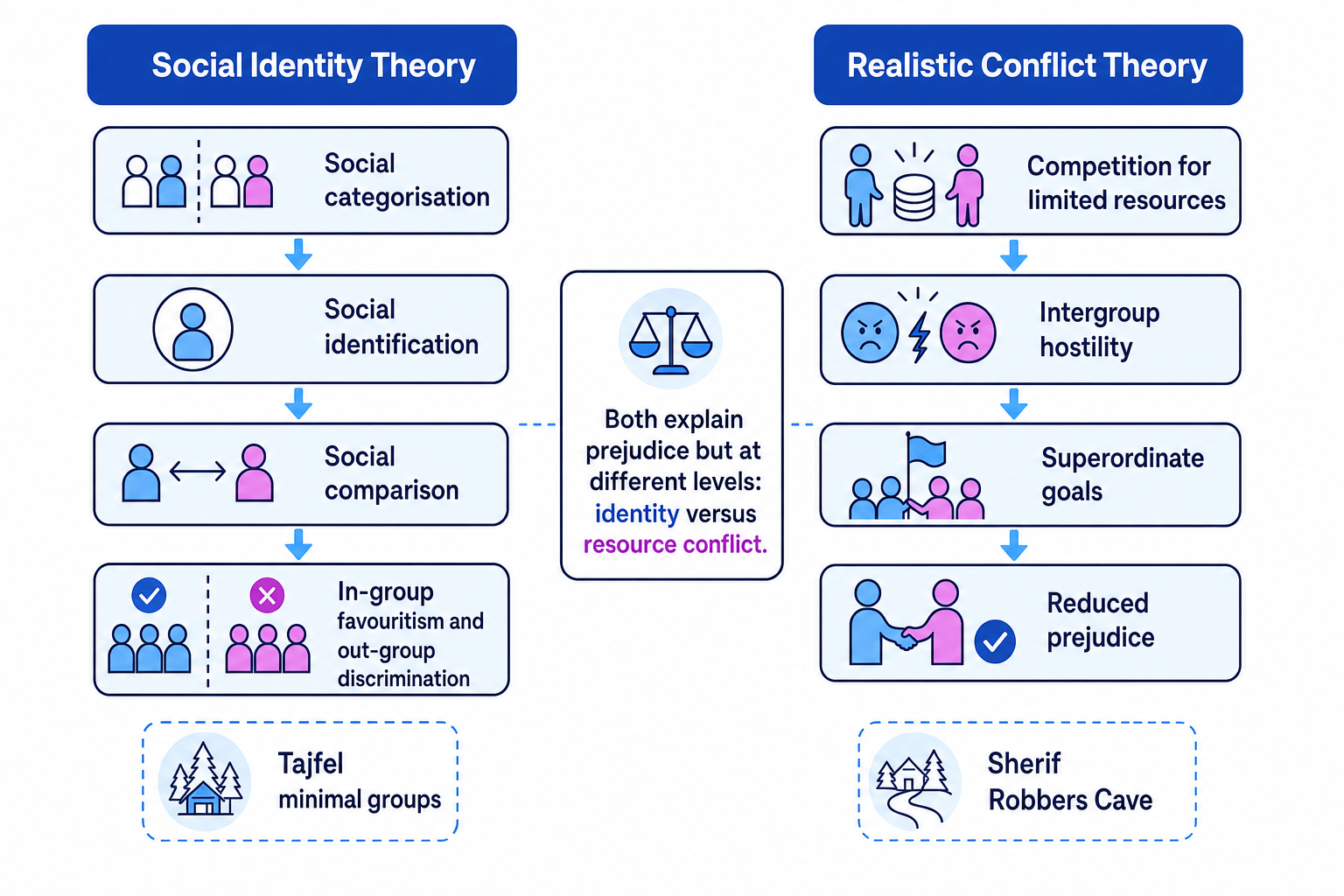
Prejudice can also be explained in different ways. Social identity theory, linked to Tajfel et al. (1970/1971), argues that people categorise themselves into groups, identify with their in-group, compare with out-groups, and seek positive distinctiveness. Realistic conflict theory, supported by Sherif et al. (1954/1961), argues that prejudice arises when groups compete for scarce resources.
The diagram below shows the key contrast: identity-based explanation versus resource-conflict explanation.
Compare, don’t just describe
Social identity theory is strong because it explains prejudice even without real competition. Realistic conflict theory is strong because it explains why hostility increases when groups compete and why superordinate goals can reduce conflict.
Applying two theories of prejudice
- If two school houses become hostile because only one house can win a prize, realistic conflict theory gives the stronger explanation because the hostility follows competition for a scarce reward.
- If pupils show favouritism after being randomly labelled “Group A” and “Group B”, social identity theory gives the stronger explanation because prejudice appears without a real conflict of interest.
- A balanced evaluation would say the theories can interact: competition can make group identities more important, increasing in-group favouritism and out-group discrimination.
Culture, gender and nature-nurture
Culture, gender and nature-nurture
Culture refers to shared norms, values and practices. Gender refers to socially shaped expectations linked to masculinity, femininity and identity. The nature-nurture debate asks whether behaviour is mainly due to inherited/dispositional factors or environmental/social factors.
Many classic social psychology studies used narrow samples. Milgram’s original research was conducted in the USA. Sherif studied boys at an American summer camp. Tajfel’s minimal group studies used schoolboys. This means generalising to all cultures, genders and age groups is risky.
Culture may influence obedience because societies differ in attitudes towards authority, hierarchy and individual responsibility. Prejudice is also culturally shaped: which groups are targeted, and how prejudice is expressed, depends on history and social norms. Researchers must avoid ethnocentrism, where one culture’s behaviour is treated as the normal standard.
Gender findings should be handled carefully. Burger (2009) found no major gender difference in obedience in his sample, which challenges simple claims that men or women are naturally more obedient. However, male-only samples in Sherif and Tajfel limit generalisability.
Nature-nurture appears in obedience when comparing personality and situation. A dispositional explanation might focus on authoritarian personality or individual willingness to conform. A situational explanation focuses on authority, uniform, proximity, legitimacy and group pressure.
Balancing nature and nurture in obedience
- If a participant obeys more when the experimenter wears a uniform, the situational explanation is strong because the authority cue changes behaviour.
- If some participants resist despite the same authority cue, personality or individual moral reasoning may help explain why they behave differently.
- A strong conclusion is interactionist: obedience is shaped by both the situation and individual differences, rather than nature or nurture alone.
Development over time, social control and real-world use
Psychological understanding changes over time. Milgram (1963) showed high obedience in a controlled but ethically controversial setting. Burger (2009) showed that obedience research could be updated with stronger ethical safeguards, while still finding that many participants continued past 150 volts.
Ideas about prejudice also developed. Sherif et al. (1954/1961) focused on competition and superordinate goals. Tajfel et al. (1970/1971) showed that mere group categorisation could produce discrimination. Together, these studies show a shift from explaining prejudice mainly through real conflict to also explaining it through identity and cognition.
Social psychology has clear real-world applications. Research into prejudice can support interventions such as cooperative learning, equal-status contact and superordinate goals. Research into obedience can help people recognise dangerous authority pressure, such as uniforms, status symbols and gradual commitment.
However, this creates a social control issue. The same knowledge that helps people resist harmful obedience could also be used to manipulate compliance. For example, organisations may use authority symbols to increase obedience, while governments may use psychological knowledge to influence attitudes.
Usefulness with caution
Social psychology is useful because it can reduce conflict and harmful obedience, but its findings must be applied ethically, especially when dealing with prejudice, racism and cultural differences.
In the exam
- Start by naming the issue clearly, such as ethics, reductionism, culture, gender, social control, or psychology as a science.
- Anchor the point in a named theory or study, such as Sherif et al. (1954/1961), Milgram (1963), Tajfel et al. (1970/1971), or Burger (2009).
- Explain the consequence: say how the issue affects validity, generalisability, ethics, usefulness, or the strength of the explanation.
Check yourself
- How would you compare social identity theory and realistic conflict theory as explanations of prejudice?
- Why is Burger’s 2009 study useful when discussing ethics and development over time?
- How could social desirability bias affect a questionnaire about prejudice?
