What you'll learn
- How labelling theory explains crime as partly shaped by society’s reaction to behaviour.
- How a self-fulfilling prophecy can make a “criminal” label become part of someone’s identity.
- How to apply these ideas to scenarios and evaluate them for AO1, AO2 and AO3 essays.
Starting point: what makes this a “social” explanation?
A social explanation looks outside the individual and asks how other people, institutions and social expectations influence behaviour. For crime, this means looking at how police, courts, schools, peers, families and the media respond to someone’s actions.
Instead of asking only, “What is wrong with the offender?”, social explanations ask, “How does society define, react to and possibly amplify deviant behaviour?”
Crime, deviance and anti-social behaviour
Crime is behaviour that breaks the law; deviance is behaviour that breaks social norms or expectations; anti-social behaviour is behaviour that may cause distress, alarm or disruption to others, even if it is not always treated as a serious criminal offence.
This matters because not every rule-breaking act is reacted to in the same way. Two people may do similar things, but one may be dismissed as “messing about” while another is treated as a “future criminal”.
Labelling theory
Labelling theory is most associated with Becker (1963), who argued that deviance is not simply a quality of an act. Instead, an act becomes “deviant” when society applies that label to it.
Labelling
Labelling is the process where a person is publicly defined as deviant or criminal, which can change how others treat them and how they see themselves.
A key idea is that powerful groups in society often decide which behaviours count as deviant. These groups are sometimes called moral entrepreneurs, meaning people or institutions with the power to create or enforce social rules, such as politicians, police, courts, schools or the media.
Primary and secondary deviance
Labelling theory separates offending into two stages.
Primary deviance means the first or original rule-breaking behaviour. This might be a minor act such as vandalism, shoplifting or fighting.
Secondary deviance means further deviance that happens after a person has been labelled. The label may affect their opportunities, relationships and self-concept, making further offending more likely.
Two more terms help here:
- Stigma means social disgrace or negative judgement attached to a label.
- Master status means one identity becomes the main way a person is seen, so “criminal” overshadows other identities such as student, friend, sibling or employee.
The core argument
Labelling theory does not mainly explain why someone commits the first offence. It explains how society’s reaction to that offence may push the person towards a criminal identity and further offending.
The process often works like a chain: a person commits a minor act, society reacts strongly, a deviant label is applied, opportunities narrow, the person internalises the label, and further offending becomes more likely.
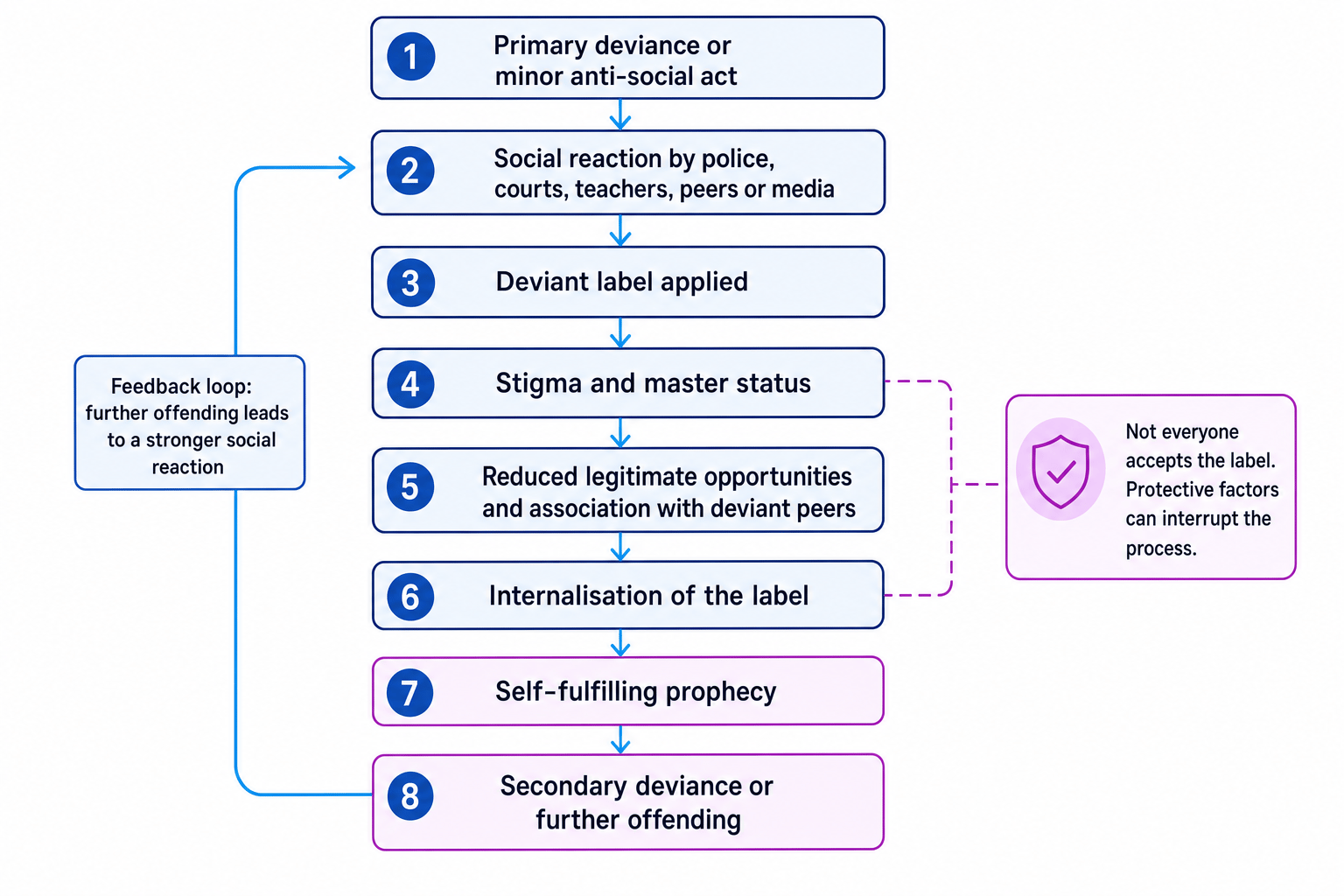
Applying labelling to a youth-offending scenario
A 15-year-old is caught spraying graffiti. Teachers start calling him a “troublemaker”, he is excluded from clubs, and he begins spending more time with older boys who offend.
- The graffiti is primary deviance because it is the initial rule-breaking act before the criminal identity has developed.
- The teachers’ response applies a deviant label, because the student is now being treated as a “troublemaker” rather than as someone who made one poor choice.
- Exclusion from clubs reduces legitimate opportunities and increases contact with deviant peers, making pro-social behaviour harder to maintain.
- If he accepts the label and starts seeing himself as “the kind of person who gets into trouble”, this can lead to secondary deviance, such as repeated offending.
Self-fulfilling prophecy
A self-fulfilling prophecy explains how expectations can shape behaviour. Merton (1948) described this as a false definition of a situation that leads to behaviour making the original belief come true.
Self-fulfilling prophecy
A self-fulfilling prophecy occurs when a person is expected to behave in a certain way, is treated according to that expectation, and then begins to behave in a way that confirms it.
In criminological psychology, the prophecy might begin when a young person is repeatedly told they are “bad”, “dangerous” or “bound to end up in prison”. If teachers, police or family members treat them as if this is true, the person may lose motivation to behave differently.
Rosenthal and Jacobson (1968) showed the broader mechanism in schools: when teachers were led to expect certain pupils to make rapid progress, those pupils tended to improve more. This was not a crime study, but it supports the idea that expectations can influence outcomes.
How self-fulfilling prophecy links to crime
The process usually has four parts:
- Expectation: others expect criminal or anti-social behaviour.
- Differential treatment: the person is treated with suspicion, rejection or lower expectations.
- Internalisation: the person starts to accept the label as part of their identity.
- Confirmation: the person behaves in a way that appears to prove the original expectation correct.
Distinguishing labelling from self-fulfilling prophecy
A police officer repeatedly stops a teenager because he is known locally as a “gang member”, even though he has not been convicted of gang-related crime.
- The phrase “gang member” is the label, because it is the social identity being attached to him.
- Repeated stops and suspicion are differential treatment, because others respond to him as if the label is already true.
- If the teenager feels rejected by mainstream peers and joins a group involved in offending, the expectation has shaped his behaviour.
- The later offending is the self-fulfilling prophecy, because the original assumption helped create the outcome it predicted.
Labelling is not just name-calling
Do not reduce labelling theory to “someone gets called a bad name”. In essays, show the full process: social reaction, stigma, master status, reduced opportunities, internalisation and possible secondary deviance.
Evidence you can use in evaluation
Chambliss (1973) carried out an ethnographic study, meaning he observed groups in their natural social setting. He compared two groups of boys: the “Saints”, who were middle-class, and the “Roughnecks”, who were working-class. Both groups engaged in deviant behaviour, but the Saints were more often excused as harmless, while the Roughnecks were labelled as troublemakers. This supports labelling theory because social class influenced how similar behaviour was interpreted.
Cicourel (1968) argued that juvenile justice decisions were affected by officials’ assumptions about young people and their backgrounds. This suggests that “criminality” in official statistics may partly reflect social reactions and decision-making, not just actual offending.
Bernburg, Krohn and Rivera (2006) provided more contemporary support using a longitudinal design, meaning they followed people over time. They found that official intervention, such as police or court involvement, was linked to later delinquency partly through weakened school bonds and association with deviant peers.
Using evidence well
A strong AO3 point is that labelling theory is supported by research showing that social reactions can affect later offending, but the evidence often shows association rather than definite cause.
Ethics in research on labelling
Research in this area can be ethically sensitive because it may involve young people, criminal records or hidden observation. Under the BPS Code of Ethics and Conduct (2009), researchers must consider consent, deception, right to withdraw, protection from harm, confidentiality and debriefing.
For example, studies involving schools or youth offending must protect participants from being further stigmatised. If pupils are deceived about teacher expectations, as in expectation research, researchers must consider whether this could harm self-esteem or educational opportunities.
Evaluation: strengths of social explanations
They explain why social reactions matter
A major strength is that labelling theory explains why some people become officially defined as criminal while others do not. It draws attention to power, social class, ethnicity, age and institutional decision-making.
This is useful because official crime statistics may reflect policing patterns and social stereotypes, not only actual offending rates.
They have real-world applications
Labelling theory has influenced ideas such as diversion, where young offenders are kept away from formal court processes when possible. The aim is to avoid giving a minor offender a lasting criminal identity.
It also supports approaches such as restorative justice, careful school discipline, and avoiding language that defines a young person as “a criminal” rather than focusing on the behaviour.
They fit youth offending particularly well
The theory is especially useful for explaining youth crime because adolescence is a time when identity is still developing. A strong negative label during this stage may have long-term effects on self-concept and peer group membership.
Evaluation: limitations of social explanations
They do not explain the first offence very well
Labelling theory is weaker at explaining primary deviance. It can explain why offending continues or escalates, but it does not fully explain why the person first broke the rule.
For that, you might need other explanations, such as biological factors, personality, social learning, poverty, peer pressure or family influences.
They can be too deterministic
The theory may sound as if a label automatically causes crime. However, many people reject negative labels, receive support, or change direction. Protective factors such as strong family support, positive teachers or employment opportunities can interrupt the process.
Assuming labels always work
Avoid writing that being labelled “criminal” inevitably causes criminal behaviour. A better answer says labelling can increase the risk of secondary deviance, especially when the person internalises the label and loses legitimate opportunities.
Some evidence has methodological weaknesses
Much evidence for labelling uses observations, case studies or correlational data. Correlational evidence means researchers measure whether two things are linked, but this does not prove that one caused the other.
For example, official intervention may be linked with later offending because the label caused harm, but it may also be because those individuals were already at higher risk of offending.
Bringing AO1, AO2 and AO3 together
For AO1, describe the process clearly: primary deviance, social reaction, label, stigma, master status, self-fulfilling prophecy and secondary deviance.
For AO2, apply each stage to the scenario. If the question describes a young person being repeatedly treated as a criminal, use that detail rather than writing a generic answer.
For AO3, evaluate both sides. Use evidence such as Chambliss (1973), Cicourel (1968) or Bernburg et al. (2006), then balance it with limitations such as determinism, weak explanation of first offending, methodological issues and ethical concerns.
In the exam
- Build a clear chain: primary deviance → social reaction → label → stigma/master status → internalisation → self-fulfilling prophecy → secondary deviance.
- For AO2, attach theory terms directly to the scenario rather than just retelling the story.
- For AO3, avoid one-sided answers: include useful applications and research support, but also explain that labelling does not fully explain the first offence or guarantee later crime.
Check yourself
- What is the difference between primary deviance and secondary deviance?
- How can a self-fulfilling prophecy turn a social label into real offending behaviour?
- Why might official crime statistics partly reflect social reactions rather than only actual crime rates?
