What you'll learn
- How personality can affect whether someone obeys an authority figure.
- How prejudice can be explained as partly linked to personality.
- The key idea of the authoritarian personality, including Adorno et al. (1950).
- How to evaluate personality explanations using AO3 points such as evidence, methodology, ethics and real-world application.
Starting point: why “individual differences” matter
In social psychology, we often explain behaviour using the situation: for example, people may obey because an authority figure is close by, wearing a uniform, or seen as legitimate.
This section adds another layer: people do not all react to the same situation in the same way. Some people may be more likely to obey or to show prejudice because of their personality.
Individual differences
Individual differences are the ways people vary from one another, such as personality traits, attitudes, beliefs, intelligence or emotional tendencies. In this topic, the key individual difference is personality.
Personality
Personality means a person’s relatively stable pattern of thoughts, feelings and behaviours. A personality explanation is often called a dispositional explanation, because it focuses on internal characteristics rather than external pressures.
Obedience and prejudice: the two behaviours
Obedience
Obedience is following a direct order from an authority figure, even if the person may not personally agree with the action.
Prejudice
Prejudice is a negative attitude or judgement about a person based on their membership of a social group, rather than their individual qualities.
A useful distinction for essays is:
- Situational explanations: behaviour is caused mainly by the environment, such as authority, group pressure, social roles or conflict between groups.
- Dispositional explanations: behaviour is caused mainly by the person’s characteristics, such as personality.
Core idea
Individual differences explanations do not say “the situation does not matter”. They say that the same situation may affect different people differently because people bring different personalities, attitudes and histories into it.
Separating dispositional and situational factors
A student obeys a teacher’s unfair instruction to exclude another student from a group activity.
- If you focus on the teacher’s status, classroom rules and fear of punishment, you are using a situational explanation because the cause is outside the student.
- If you focus on the student’s strong respect for authority and discomfort with challenging rules, you are using a dispositional explanation because the cause is linked to the student’s personality.
- A stronger answer can combine both: the teacher’s authority creates pressure, but the student’s personality may make obedience more likely than it would be for a more rebellious student.
The authoritarian personality
The main personality explanation for both obedience and prejudice is the authoritarian personality.
Authoritarian personality
The authoritarian personality is a personality type involving strong respect for authority, commitment to traditional values, and hostility towards people seen as weaker, lower status or different.
This explanation is strongly linked to Adorno et al. (1950). Adorno and colleagues were interested in why some people were more likely to support fascist and anti-democratic ideas after the Second World War. They argued that some people develop a personality structure that makes them more obedient to powerful authorities and more prejudiced towards out-groups.
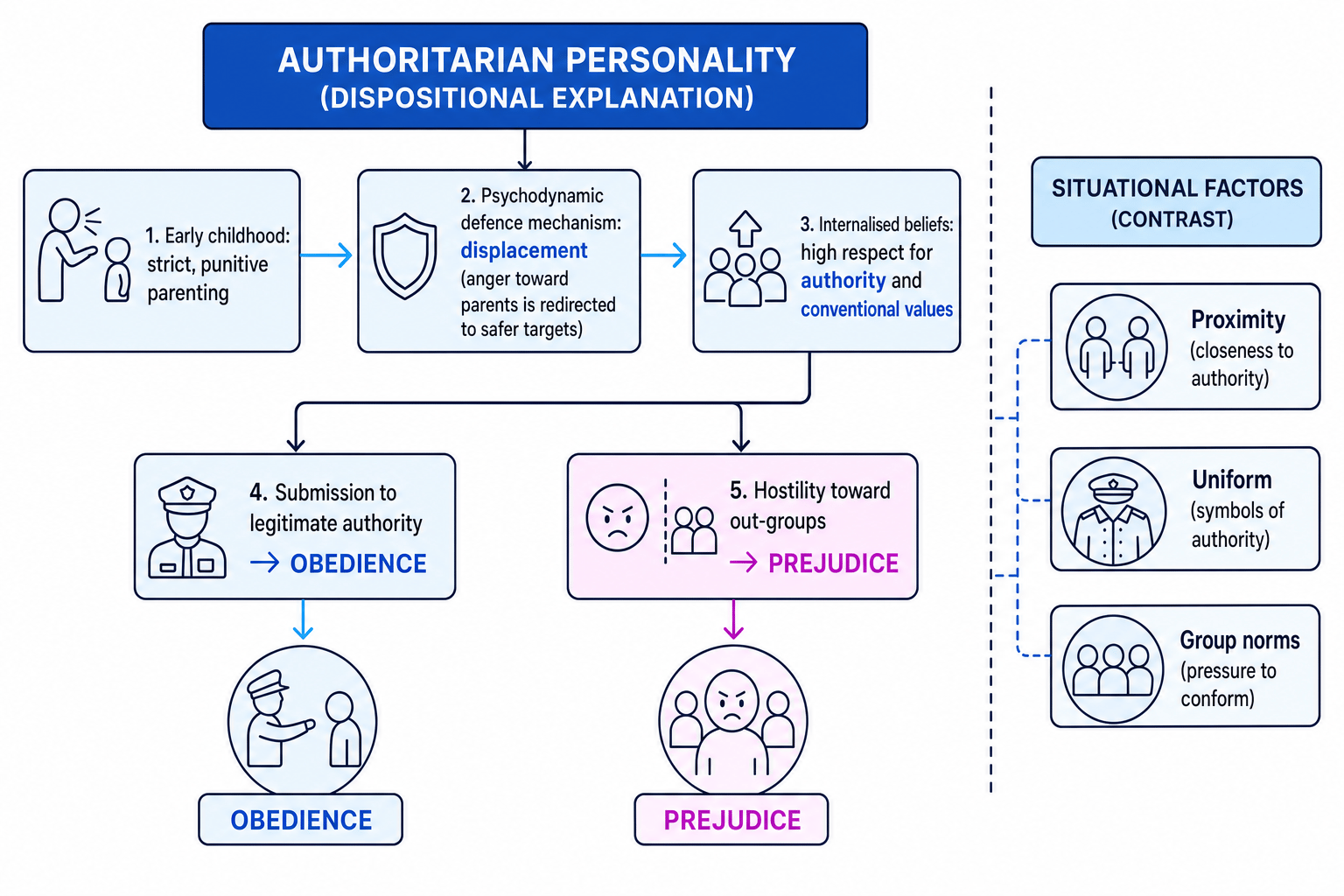
The diagram below shows how the same personality pattern can be linked to both obedience and prejudice.
How authoritarian personality may develop
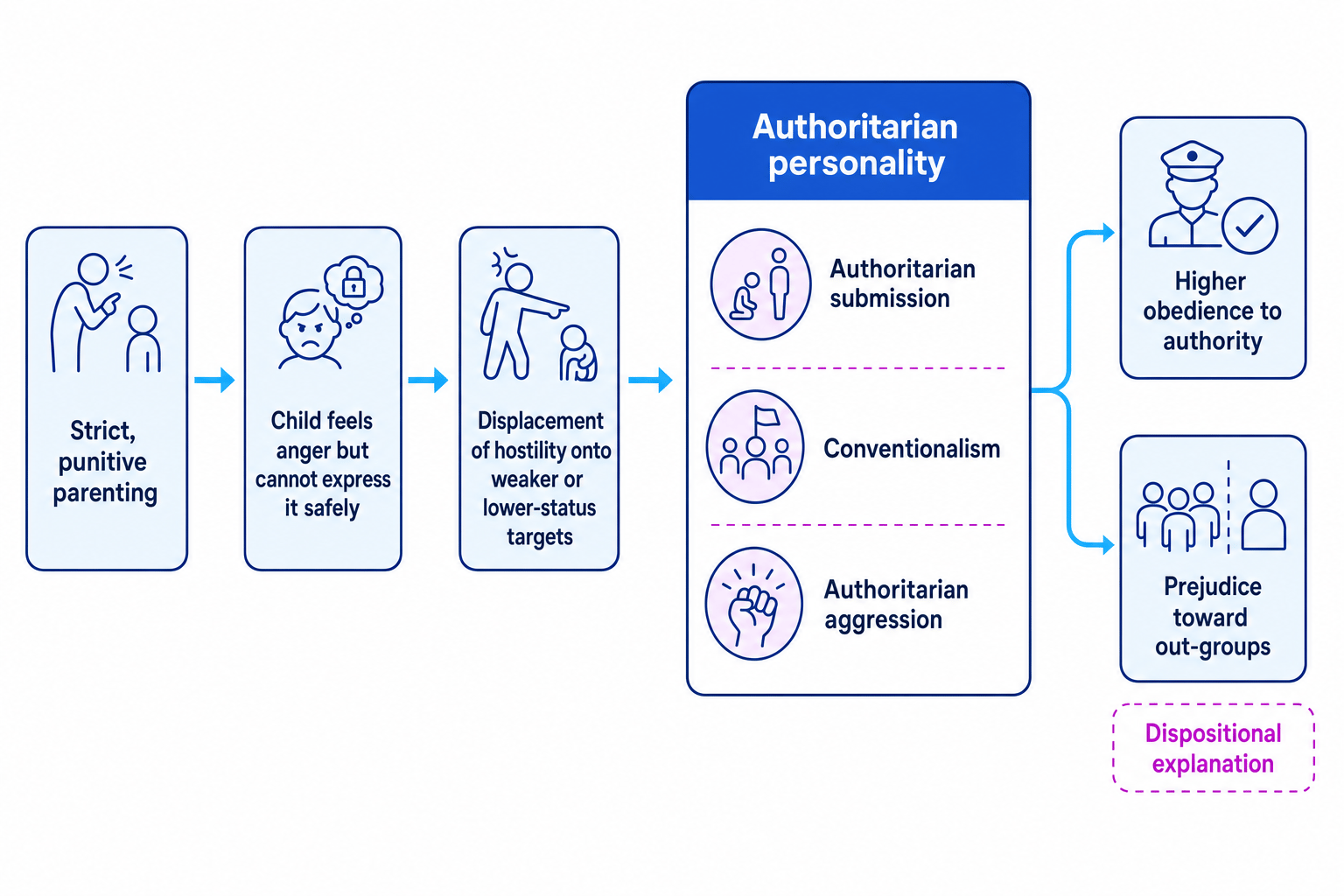
Adorno et al. suggested that authoritarian personality can develop from strict, punitive parenting.
The basic logic is:
- A child is raised by parents who are harsh, demanding and controlling.
- The child cannot safely express anger towards the parents.
- The child may redirect this anger towards safer targets, such as people seen as weaker or lower status.
- The child learns to value authority, discipline and obedience.
- In adulthood, this may appear as high obedience to authority and prejudice against out-groups.
Displacement
Displacement is a defence mechanism where feelings towards one target are redirected onto a safer or more available target. In this explanation, anger towards strict parents may be redirected towards minority or lower-status groups.
Assuming personality is destiny
Do not write as if everyone with authoritarian traits will always obey or always be prejudiced. A dispositional explanation suggests an increased likelihood, not a guaranteed outcome.
Personality and obedience
A person with an authoritarian personality may be especially likely to obey because they see authority as legitimate and important. They may believe that rules should be followed and that challenging authority is wrong.
This links well to obedience research such as Milgram (1963) and Burger (2009). Those studies mainly investigate situational pressures, but individual differences help explain why some participants obeyed more than others.
A key follow-up study is Elms and Milgram (1966), who interviewed some participants from Milgram’s original research. They found that those who had been more obedient tended to score higher on measures linked to authoritarianism than those who had been more defiant.
Obedience link
Authoritarian personality may increase obedience because the person strongly values authority, hierarchy and rule-following.
Applying authoritarian personality to obedience
Imagine two workers are ordered by a manager to treat a new employee unfairly. One worker obeys immediately, while the other challenges the instruction.
- The obedient worker may be showing authoritarian submission, because they accept the manager’s authority and treat the order as legitimate.
- If the worker says, “Rules are rules — the manager knows best,” this supports a personality explanation because it shows strong respect for authority and hierarchy.
- However, you should also consider the situation: the worker may fear losing their job. A balanced explanation would say obedience may result from both personality and external pressure.
Personality and prejudice
The same authoritarian personality can also be used to explain prejudice.
A person high in authoritarian traits may divide the world into clear categories: “us” and “them”, “right” and “wrong”, “respectable” and “deviant”. They may be hostile towards groups that appear to threaten traditional values or social order.
This means prejudice is not only explained by group conflict or social identity. It may also be partly explained by the individual’s personality.
Out-group
An out-group is a group a person does not identify with. Prejudice is often directed towards out-groups.
In Adorno et al.’s view, prejudice comes from a deeper personality structure: hostility is displaced onto minority groups or those seen as socially inferior.
Applying authoritarian personality to prejudice
A person strongly dislikes a minority group and says they are “ruining traditional values”.
- The phrase “traditional values” suggests conventionalism, which is a key feature of authoritarian personality.
- The hostility towards a minority group suggests authoritarian aggression, where anger is directed towards an out-group.
- If the person also admires strict leaders and harsh punishments, the explanation becomes stronger because it links prejudice with wider authoritarian attitudes, not just one isolated opinion.
Adorno et al. (1950) and the F-scale
Adorno et al. developed the F-scale, where “F” stands for fascism. It was a questionnaire designed to measure authoritarian personality traits.
F-scale
The F-scale is a questionnaire created by Adorno et al. (1950) to measure authoritarian tendencies, including obedience to authority, conventional values and hostility towards out-groups.
People who scored highly on the F-scale were thought to be more likely to hold prejudiced attitudes. This gave psychologists a way to investigate the link between personality and prejudice using quantitative data.
AO1 shortcut
For description, remember: strict parenting → authoritarian personality → obedience to authority and prejudice towards out-groups.
AO3 evaluation: strengths
Research support
There is some evidence that authoritarian traits are linked to obedience and prejudice. For example, Elms and Milgram (1966) found that more obedient participants tended to show more authoritarian characteristics than defiant participants.
This supports the idea that personality can help explain why some people obey more readily than others.
Explains individual variation
Situational theories are powerful, but they may not fully explain why people behave differently in the same situation. Personality explanations help fill this gap.
For example, in obedience studies, not everyone obeys to the same level. Individual differences can explain why one person resists while another complies.
Real-world application
Understanding authoritarian attitudes may help in education, prejudice reduction and preventing blind obedience. For example, schools and workplaces can encourage critical thinking, empathy and respectful challenge to authority.
AO3 evaluation: weaknesses
The F-scale has methodological problems
The F-scale has been criticised because many of its items were worded in the same direction. This means someone who tends to agree with statements may score as authoritarian even if they are not genuinely authoritarian.
Acquiescence bias
Acquiescence bias is the tendency for some participants to agree with questionnaire items regardless of their actual beliefs.
This reduces the validity of the F-scale because it may not measure authoritarian personality accurately.
Correlation does not prove causation
A link between authoritarian personality and prejudice does not prove that personality causes prejudice. It could be that social environment, education, culture or family background influences both personality and prejudiced attitudes.
Writing correlation as causation
Avoid saying “the F-scale proves authoritarian personality causes prejudice.” It shows an association, but other variables may explain the relationship.
It may ignore social and cultural factors
Prejudice can also be explained by realistic conflict theory, such as Sherif’s Robbers Cave study (1954/1961), where hostility developed between groups competing for resources. It can also be explained by social identity theory, where people favour their in-group to boost self-esteem.
This means personality is not the only explanation. A full essay should show that prejudice can come from both the individual and the social context.
Risk of blaming the individual
A personality explanation may make prejudice seem like a problem inside certain people, rather than a wider social issue. This can be too reductionist because prejudice is also shaped by media, institutions, family, peers and historical inequality.
Reductionism
Reductionism means explaining a complex behaviour using only one narrow factor, such as personality, while ignoring other important influences.
Ethics angle
When psychologists investigate personality, obedience or prejudice, ethical issues matter.
Questionnaires about prejudice can involve sensitive attitudes, so researchers should protect confidentiality and avoid causing unnecessary distress. Participants should give informed consent, know their right to withdraw, and receive a debrief if the study involves any deception or uncomfortable material.
Milgram-style obedience research raises stronger ethical concerns, especially deception, psychological stress and whether participants felt they could withdraw. Burger (2009) reduced some of these issues by stopping the procedure earlier than Milgram did and using screening procedures to protect participants.
Using ethics in evaluation
Ethics can be an AO3 point, but make it specific. Say exactly which issue applies: consent, deception, withdrawal, protection from harm, confidentiality or debrief.
Building an essay paragraph
A strong essay paragraph on this section might follow this pattern:
- AO1: Define authoritarian personality and describe how it develops.
- AO2: Apply it to obedience or prejudice in a scenario.
- AO3: Evaluate using evidence, methodological problems with the F-scale, or alternative explanations.
Building an evaluation point
Evaluate the claim that authoritarian personality explains prejudice.
- Start with the strength: Adorno et al. (1950) provided a measurable explanation using the F-scale, which allowed researchers to investigate links between personality and prejudice.
- Add the limitation: the F-scale may suffer from acquiescence bias because participants could score highly simply by agreeing with statements.
- Draw the judgement: this weakens the explanation because the evidence may not validly measure authoritarian personality, so prejudice may not be as strongly linked to personality as the theory claims.
In the exam
- For AO1, clearly define authoritarian personality and link it to both obedience and prejudice.
- For AO2, use the scenario details: look for respect for authority, harsh attitudes, traditional values or hostility to out-groups.
- For AO3, balance personality with situational explanations such as Milgram’s authority factors, Sherif’s realistic conflict theory or social identity theory.
Check yourself
- How does authoritarian personality help explain obedience?
- Why might authoritarian personality be linked to prejudice?
- What is one methodological weakness of the F-scale?