What you'll learn
- What a digit span task measures in cognitive psychology.
- How Sebastián and Hernández-Gil (2012) studied digit span in a Spanish sample.
- The key findings: how memory span changes with age.
- How to evaluate the study for AO3, including methodology, ethics and application.
Why this study matters
Sebastián and Hernández-Gil (2012) is the contemporary study for the Cognitive Psychology topic. It links directly to memory, especially short-term memory and the phonological loop in Baddeley and Hitch’s working memory model.
The study is useful because it shows that short-term memory capacity is not fixed in the same way for everyone. It develops with age, especially through childhood and adolescence.
Digit span
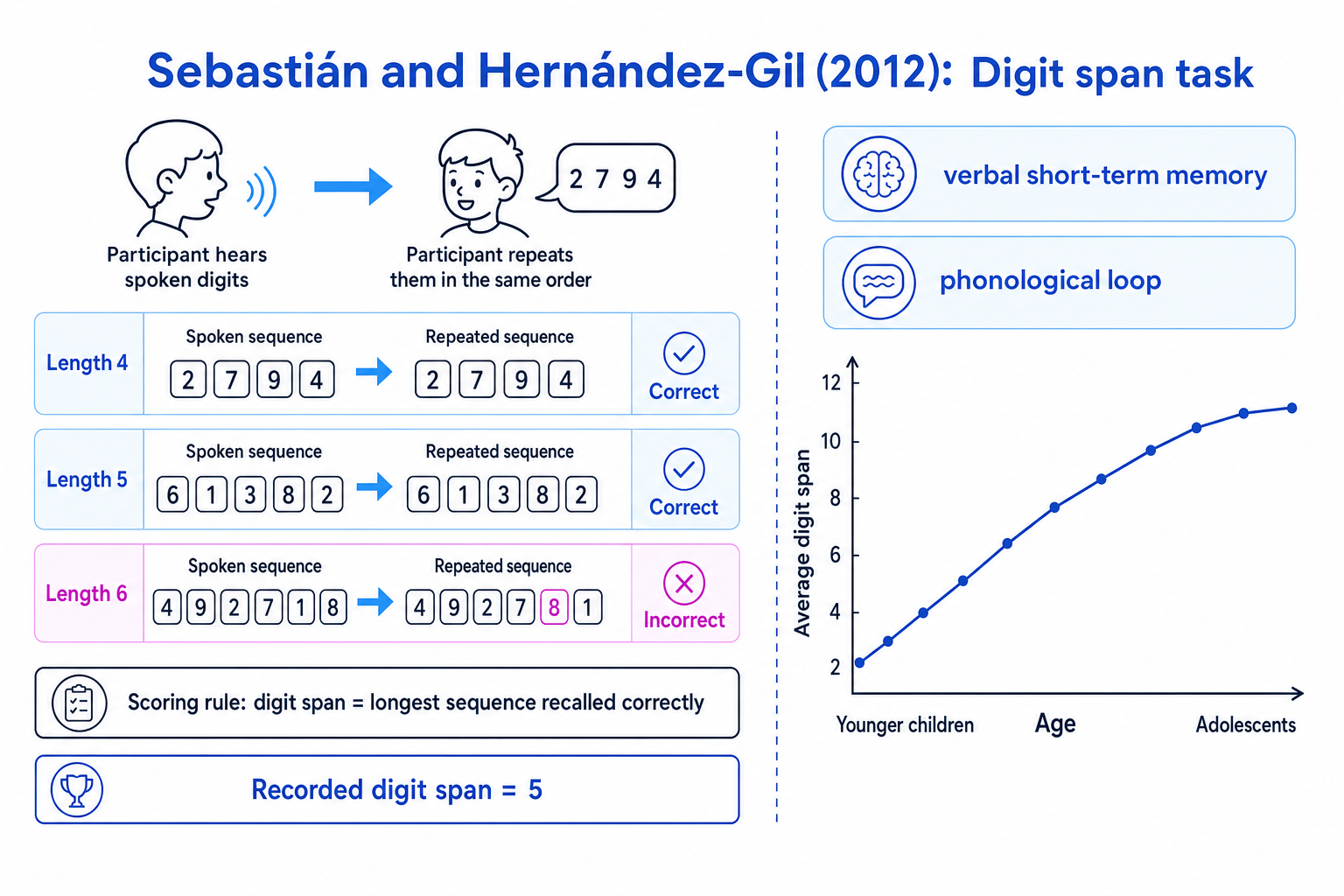
Digit span is the number of digits a person can correctly repeat immediately after hearing them. It is often used as a measure of verbal short-term memory, because the person must briefly store spoken information.
Background: short-term memory and digit span
Short-term memory
Short-term memory, or STM, is the memory store that holds a small amount of information for a brief period of time. In the multi-store model, STM is separate from long-term memory.
In classic memory research, STM is often described as having limited capacity, meaning it can only hold a certain amount of information at one time.
Miller (1956) famously suggested that adult short-term memory capacity is around seven items, plus or minus two. However, later research shows that capacity depends on the task, the material, and the person.
The phonological loop
In Baddeley and Hitch’s working memory model, the phonological loop is the component that deals with speech-based information. It is especially relevant to digit span, because participants hear digits and repeat them verbally.
Phonological loop
The phonological loop is the part of working memory that temporarily stores and rehearses speech-based information, such as words, sounds and spoken digits.
Digit span is therefore not just a “memory test” in general. It is mainly testing a person’s ability to hold and rehearse verbal material for a few seconds.
Core link to the memory topic
Sebastián and Hernández-Gil’s study supports the idea that verbal short-term memory develops with age, rather than being a completely fixed capacity from early childhood.
Aim of the study
Sebastián and Hernández-Gil (2012) aimed to investigate the developmental pattern of digit span in a Spanish population.
In simpler terms, they wanted to see how the ability to repeat sequences of digits changes as children and young people get older.
They were also interested in producing useful data for Spanish-speaking participants, because digit span can be affected by language. For example, digit names differ across languages in length and ease of pronunciation.
Sample
The study used a Spanish sample of children and young people, with participants across a range of ages from childhood into adolescence.
This matters because the researchers were looking for a developmental pattern: whether younger children had lower digit spans than older children and teenagers.
Cross-sectional design
A cross-sectional design compares different groups of people at one point in time. In this study, different age groups were compared to see how digit span varied with age.
A cross-sectional design is quicker than following the same children for many years. However, it also means differences between age groups might be caused by other factors, not only development.
Procedure
Participants completed a digit span task.
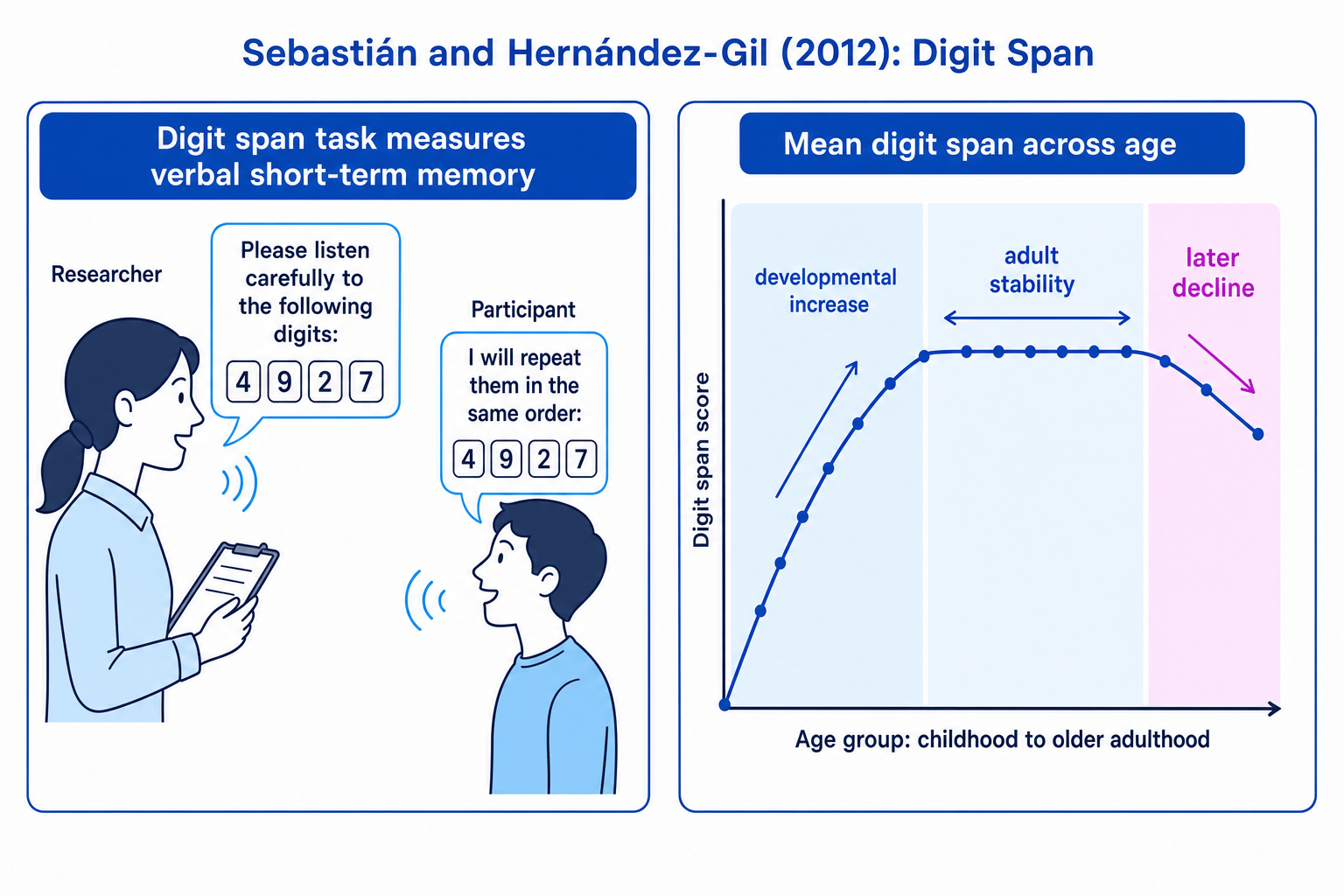
They heard sequences of digits, such as 4, 9, 2, 7, and had to repeat them back in the same order. The sequences became longer as the task progressed.
A participant’s digit span was based on the longest sequence they could correctly recall.
This task is highly controlled because every participant is given the same basic type of task. That makes it easier to compare performance between age groups.
Understanding how digit span is measured
Working out a participant’s digit span
A participant is given digit sequences of increasing length.
- They correctly repeat a 4-digit sequence, so their span is at least 4.
- They correctly repeat a 5-digit sequence, so their span is now at least 5.
- They fail the 6-digit sequences, so the best length they reliably recalled was 5.
- Their digit span would therefore be recorded as 5.
Findings
The main finding was that digit span increased with age.
Younger children had a lower average digit span than older children and adolescents. This suggests that verbal short-term memory improves during development.
The increase was not necessarily equal at every age. Development is often faster in earlier childhood and then begins to level off as young people approach adult-like performance.
The findings support the idea that memory development is linked to changes such as:
- increased rehearsal ability
- faster speech and articulation
- better attention control
- improved use of memory strategies
Main finding
As age increased, average digit span also increased, showing a developmental improvement in verbal short-term memory.
Conclusions
Sebastián and Hernández-Gil concluded that digit span follows a developmental pattern in the Spanish population.
This suggests that short-term memory capacity, especially for verbal information, improves as children grow older.
The study also shows why psychologists should be careful when comparing children’s memory performance with adults’. A lower digit span in a child does not necessarily mean there is a problem; it may reflect normal cognitive development.
AO2: applying the study
You could apply this study to education, assessment and developmental psychology.
For example, if a teacher gives complex spoken instructions to a 6-year-old, the child may struggle to remember all the steps. This could be because their verbal short-term memory is still developing, not because they are being careless.
An educational psychologist might also use digit span data to judge whether a child’s memory is typical for their age group.
Applying digit span to a classroom situation
A teacher says: “Put your book away, collect a worksheet, write your name, answer questions 1 to 5, and hand it in.”
- The instruction contains several separate pieces of verbal information that must be held in short-term memory.
- A younger child with a lower digit span may lose some of the steps before acting on them.
- The teacher could reduce memory load by giving instructions in smaller chunks or writing them on the board.
AO3: strengths of the study
Standardised task
A major strength is that the digit span task is easy to standardise. Participants can be given similar instructions, similar digit sequences and similar scoring rules.
This improves reliability, because the procedure can be repeated in the same way with other participants.
Reliability
Reliability means consistency. A reliable study or test produces similar results when repeated under similar conditions.
Objective measurement
Digit span gives a numerical score. This is useful because it allows clear comparison between age groups.
It is also less subjective than asking a researcher to judge whether someone has “good” or “poor” memory.
Useful real-world application
The findings can help psychologists and educators understand normal memory development. This has practical value in schools and clinical assessment.
For example, if a child’s digit span is much lower than expected for their age, it could indicate a need for further assessment.
AO3: weaknesses of the study
Cross-sectional design cannot prove development directly
Because the study compared different age groups at one point in time, it cannot prove that each individual’s digit span increases in the same way over time.
A stronger test of development would be a longitudinal study, where the same children are tested repeatedly as they grow older.
Longitudinal study
A longitudinal study follows the same participants over a period of time, allowing researchers to observe change within individuals.
Cross-sectional does not mean longitudinal
Do not write that Sebastián and Hernández-Gil “followed the same children as they grew up” unless you are clearly describing a longitudinal design. Their study is best understood as comparing age groups.
Digit span is a narrow measure of memory
Digit span mainly measures immediate verbal memory. It does not measure all types of memory.
For example, it tells us less about:
- visual memory
- long-term memory
- autobiographical memory
- memory for meaningful stories
- everyday memory tasks
So, the study is useful, but it should not be treated as a complete measure of memory ability.
Cultural and language issues
The sample was Spanish-speaking, which is important because digit span can be affected by language. Some languages have shorter number words, which may make rehearsal quicker.
This means the findings may not generalise perfectly to all populations.
Generalisability
Generalisability is the extent to which findings from a study can apply to other people, settings or situations beyond the original sample.
Possible practice and motivation effects
Performance on a digit span task may be affected by concentration, confidence or familiarity with test situations.
A child who is anxious, tired or bored may perform worse even if their underlying memory capacity is typical.
Ethics
This study is low risk compared with many psychological studies, but ethical issues still matter.
Using the BPS Code of Ethics and Conduct (2009), researchers should consider:
- Consent: children should agree to take part, and parental or guardian consent should be gained where appropriate.
- Right to withdraw: participants should know they can stop without penalty.
- Protection from harm: the task should not cause distress or embarrassment.
- Confidentiality: scores should be anonymised.
- Debrief: participants should be told what the study was about afterwards in age-appropriate language.
Ethics evaluation
For this study, ethics are usually a strength because the task is non-invasive and low risk — but you can still mention the need to protect children from embarrassment if they perform poorly.
Writing about the study in essays
For AO1, describe the aim, sample, procedure, findings and conclusion.
For AO2, apply the idea of digit span to real situations, such as classroom instructions, memory assessment or age-related expectations.
For AO3, evaluate the methodology. The strongest points are standardisation, objective scoring and usefulness. The main limitations are cross-sectional design, narrow measurement of memory and possible cultural/language limits.
In the exam
- Link the study clearly to short-term verbal memory and the phonological loop, not memory in general.
- For AO3, use paired evaluation: make a point, then explain why it matters for validity, reliability or generalisability.
- Do not just say “the study was ethical”; refer to specific BPS issues such as consent, right to withdraw, protection from harm, confidentiality and debrief.
Check yourself
- What does a digit span task measure, and why is it linked to the phonological loop?
- Why is a cross-sectional design useful but limited for studying development?
- Give one strength and one weakness of using digit span as a measure of memory.