What you'll learn
- What Reicher and Haslam (2006) investigated in the BBC Prison Study.
- How social identity theory explains resistance, power and tyranny.
- The study’s aim, procedure, findings and conclusions for AO1.
- How to evaluate the study using methods, ethics and real-world application for AO3.
Big picture: why study tyranny?
Reicher and Haslam (2006), in “Rethinking the psychology of tyranny”, wanted to understand why people sometimes accept unequal power systems — and why they sometimes challenge them.
Tyranny
Tyranny means harsh, oppressive or unfair use of power, especially when one group controls another and restricts its freedom.
A simple explanation might be: “people just conform to the role they are given.” Reicher and Haslam questioned this. They argued that people do not automatically become cruel because they are labelled “guards”, and people do not automatically become passive because they are labelled “prisoners”.
Their study is often discussed alongside Zimbardo’s Stanford Prison Experiment (1973), but Reicher and Haslam’s explanation is different: they focused on social identity and group processes.
The headline finding
Reicher and Haslam argued that tyranny is not automatic role conformity. It depends on whether people develop a shared group identity, see authority as legitimate, and believe there are alternatives to the current system.
Prerequisite: the social identity approach
Social identity
A social identity is the part of your self-concept that comes from belonging to a group, such as being a student, a football fan, a guard, or a prisoner.
When a group identity becomes important, people may define themselves less as “I” and more as “we”. This can shape behaviour: people may follow group norms, support group leaders, and act in ways that benefit the group.
An in-group is the group you see yourself as belonging to. An out-group is a group you see as separate from you. In Reicher and Haslam’s study, the main in-groups/out-groups were guards and prisoners.
Three key social identity conditions
Reicher and Haslam built their study around three ideas from social identity theory.
- Permeability means how easy it is to move from one group to another. If prisoners think they can become guards, they may focus on individual escape rather than group resistance.
- Legitimacy means whether the group hierarchy seems fair and justified. If the guards’ higher status seems deserved, prisoners may accept it more.
- Cognitive alternatives are beliefs that the current system could be different. If prisoners can imagine a fairer system, collective resistance becomes more likely.
Linking the manipulations to the prediction
-
If a low-status group believes its members can move into the high-status group, the group boundary is permeable, so members are more likely to pursue individual mobility than unite as a group.
-
If movement becomes impossible and the original hierarchy seems unfair, the boundary is impermeable and illegitimate, so low-status members have a stronger reason to identify with each other.
-
If someone suggests a realistic alternative way to organise the system, this creates cognitive alternatives, making collective action more likely.
-
Therefore, the prediction is that prisoners should become more united and resistant after promotion is stopped and the hierarchy is questioned.
AO1: aim and procedure
For essays, AO1 means accurate description, AO2 means applying material to a scenario or issue, and AO3 means evaluation.
Aim
Reicher and Haslam aimed to investigate how unequal groups develop, how people respond to power, and what conditions lead to resistance or acceptance of tyranny.
They wanted to test whether behaviour in a prison-like setting was best explained by automatic conformity to roles, or by the development of shared social identities.
Participants and setting
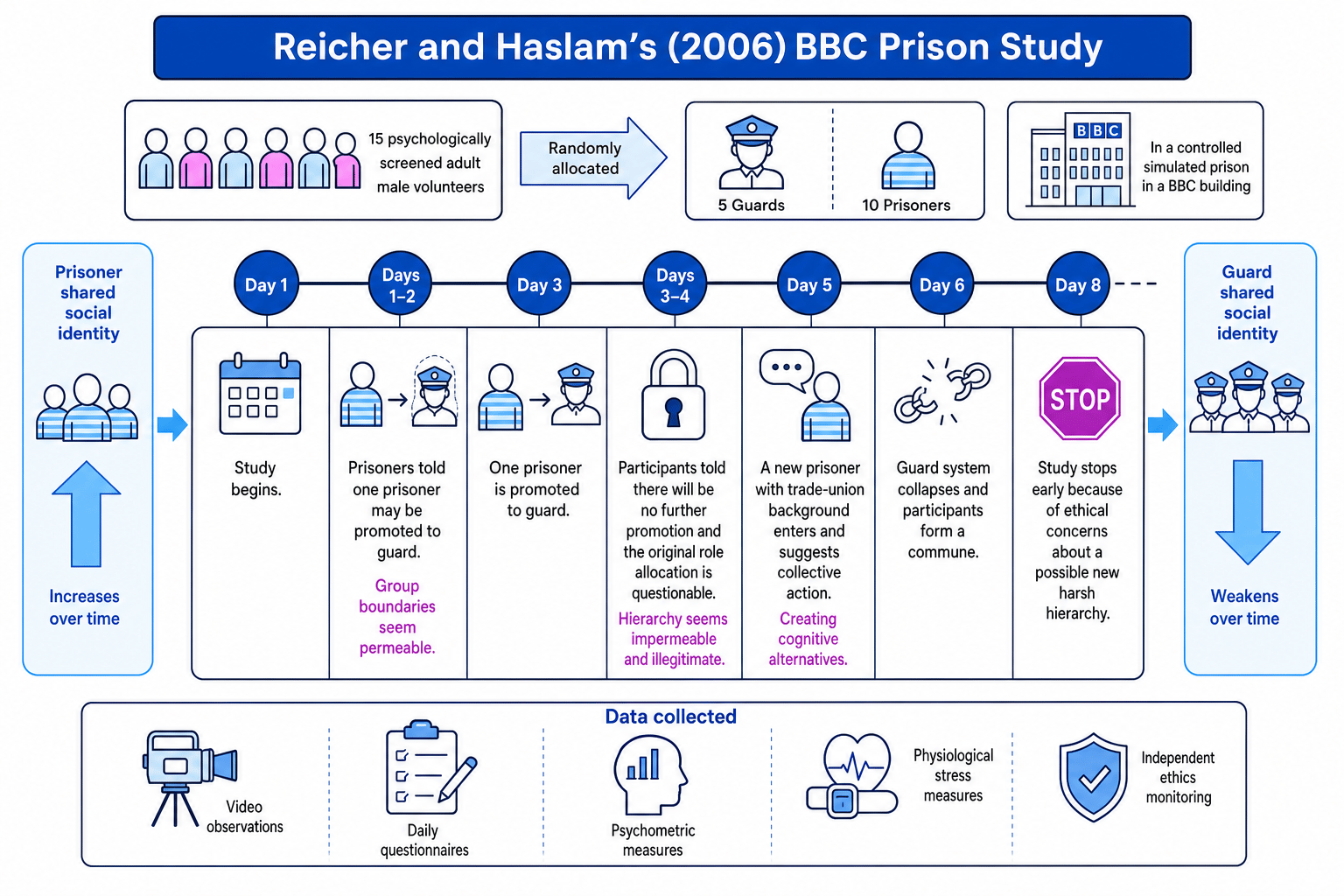
The study used 15 adult male volunteers, selected from a much larger pool after psychometric screening. Psychometric screening means using standardised psychological tests to assess traits, wellbeing and suitability.
Participants were randomly allocated, meaning chance was used to assign them to roles. There were initially 5 guards and 10 prisoners. The study took place in a purpose-built simulated prison in a BBC building and was filmed for the BBC programme The Experiment.
This timeline keeps the study’s changing group conditions clear.
Procedure
Participants were placed into a controlled prison-like environment. Guards had higher status, better resources and authority over prisoners. Prisoners had lower status and fewer privileges.
The study included several planned manipulations:
- At first, prisoners were told that one prisoner might be promoted to guard. This made group boundaries seem permeable.
- On Day 3, one prisoner was promoted.
- After this, participants were told there would be no further promotions and that the original role allocation was questionable. This made the hierarchy seem more impermeable and illegitimate.
- A new prisoner with trade-union experience was introduced. He helped create cognitive alternatives by encouraging collective action.
- The guard system collapsed and participants formed a more equal “commune”.
- The study was stopped early on Day 8 because of ethical concerns about a possible new harsh hierarchy.
Data were collected through video observation, daily questionnaires, psychometric measures and physiological stress measures such as cortisol. The researchers also used independent ethical monitoring.
AO1: findings and conclusions
Main findings
The guards did not develop a strong shared social identity. They disagreed with each other, struggled to impose a consistent regime, and did not become an organised tyrannical group.
The prisoners initially showed limited unity because promotion seemed possible. This encouraged individual mobility: some prisoners focused on trying to become guards rather than challenging the guard system.
After promotion was stopped and the hierarchy seemed unfair, prisoners developed stronger shared identity. They challenged the guards more effectively, and the guard regime collapsed.
The commune that replaced the guard system also struggled. Without clear structure or shared agreement, some participants became attracted to a stricter authoritarian solution. This was one reason the study was stopped early.
Conclusions
Reicher and Haslam concluded that people do not simply conform blindly to social roles. Instead, group behaviour depends on whether people identify with a group and whether leaders can create a convincing shared identity.
The study suggests that tyranny can emerge when people support an authoritarian group and its leadership, especially if democratic alternatives seem to fail. It also suggests that disadvantaged groups can resist power when they develop a shared identity and believe change is possible.
Saying the guards simply became tyrants
Do not write that Reicher and Haslam found automatic guard brutality. The important finding is almost the opposite: the guards failed to unite, while the prisoners became more united and resistant.
AO2: applying the study
If you are given a scenario about unequal groups, use the three social identity conditions.
For example, imagine workers are told that one worker might be promoted into management. At first, they compete with each other. Later, promotions are cancelled and workers are told the selection system was unfair. A respected worker then suggests forming a union.
You could apply Reicher and Haslam like this:
-
The possible promotion makes the boundary between workers and management permeable, so workers may focus on individual success.
-
Cancelling promotions makes the boundary impermeable, reducing hope of moving up alone.
-
Discovering that selection was unfair makes the hierarchy illegitimate, so workers have a reason to challenge it.
-
The union suggestion provides cognitive alternatives, because workers can imagine a different power structure.
-
Social identity theory predicts stronger worker unity and greater collective resistance.
AO3: evaluation
Strengths
One strength is that the study had more ecological validity than a simple laboratory task. Ecological validity means the extent to which a study reflects real-life settings or behaviour. The simulated prison was still artificial, but it created a richer social environment than a short questionnaire study.
Another strength is triangulation, which means using several types of evidence to study the same issue. Reicher and Haslam collected behavioural observations, self-report questionnaires and physiological stress data. If different measures point in a similar direction, the findings are more convincing.
The study also has useful real-world applications. It helps explain why oppressed groups may accept inequality at some times but resist it at others. This can be applied to prisons, workplaces, political movements and leadership.
Weaknesses
A key weakness is the small, all-male volunteer sample. This limits generalisability, meaning the extent to which findings apply beyond the people studied. Volunteers for a televised prison study may differ from the wider population.
There may also have been demand characteristics. These are cues that help participants guess the aim of a study and change their behaviour. Because the study was filmed by the BBC, participants may have acted in ways they thought would be interesting or acceptable on television.
The setting was still artificial. Participants knew it was a study, guards had ethical restrictions, and the situation lasted only days. Real prisons involve longer-term power, legal authority and more serious consequences.
Ethics
Using the British Psychological Society Code of Ethics and Conduct (2009) as a guide, there are several points to discuss.
Participants gave consent to take part and were screened to reduce risk. However, there was some deception about role allocation and promotion. The right to withdraw was important because the study could become stressful. Protection from harm was taken seriously through clinical screening, monitoring, a ban on physical violence, and early termination. Confidentiality was more complicated because the study was televised, so participants needed to understand what would be shown. Debriefing was also essential after such an intense study.
Evaluation shortcut
A strong AO3 paragraph can compare Reicher and Haslam with Zimbardo: Zimbardo appears to show rapid role conformity, whereas Reicher and Haslam suggest behaviour depends on shared identity, legitimacy and leadership.
Research methods links
This study is best seen as a controlled observational study with experimental manipulations. It was not a simple laboratory experiment, because the social situation developed over several days.
The video evidence could be analysed using thematic analysis, which means identifying repeated themes or patterns in qualitative data. Questionnaire scores could be summarised using measures of central tendency, such as the mean or median, and measures of dispersion, such as the range or standard deviation.
If you were analysing similar data in an Edexcel methods question:
- Wilcoxon signed-ranks could compare the same participants’ identification before and after a manipulation.
- Mann-Whitney U could compare guards and prisoners on a score.
- Spearman’s rho could test a correlation between social identification and stress.
- Chi-square could test an association between role and category of behaviour.
These are often used when data are ordinal, categorical, or skewed rather than normally distributed. A normal distribution is a symmetrical bell-shaped pattern; a skewed distribution is bunched more to one side.
For inferential testing, you compare an observed value with a critical value from a table. The usual significance level is p≤.05p \le .05p≤.05, though p≤.10p \le .10p≤.10 is more lenient and p≤.01p \le .01p≤.01 is stricter. A lenient level increases the risk of a Type I error, which means finding a false positive. A strict level increases the risk of a Type II error, which means missing a real effect.
In the exam
-
For AO1, describe the aim, sample, role allocation, key manipulations and findings clearly.
-
For AO2, apply permeability, legitimacy and cognitive alternatives to the scenario you are given.
-
For AO3, balance strengths and weaknesses: mention rich data and ethical safeguards, but also small sample, artificiality and demand characteristics.
Check yourself
- Why did the possibility of promotion initially weaken prisoner unity?
- What changed when the hierarchy became impermeable and illegitimate?
- How does Reicher and Haslam’s explanation of tyranny differ from simple role conformity?
