What you'll learn
- What screening and brief intervention means in health psychology.
- How Pengpid et al. used a randomised controlled trial with South African hospital out-patients.
- The key aim, procedure, findings and conclusions you need for AO1.
- How to evaluate the study for methodology, ethics and real-world application.
Why this study matters
Pengpid et al. (2012) is the contemporary study for the Health Psychology option. It focuses on hazardous and harmful alcohol use, and asks a very applied question: can hospitals identify risky drinkers and help them reduce alcohol use through a short intervention?
This makes it useful for essay answers because it links psychology to public health, addiction, prevention, and behaviour change.
Key background concepts
Alcohol use: hazardous, harmful and dependent
Not all alcohol use is treated the same in health research.
Hazardous alcohol use
Hazardous alcohol use means a pattern of drinking that increases the risk of future physical, psychological or social harm, even if serious damage has not happened yet.
Harmful alcohol use
Harmful alcohol use means alcohol consumption that is already causing damage, such as health problems, relationship difficulties, accidents or reduced functioning.
This study was not mainly about severe alcohol dependence. It targeted people whose drinking was risky enough to need help, but who could realistically be supported through a short hospital-based intervention.
Screening
Screening
Screening is a quick process used to identify people who may have a health or psychological problem and need further support.
Pengpid et al. used an alcohol screening tool called the AUDIT, the Alcohol Use Disorders Identification Test. It is a questionnaire developed by the World Health Organization to assess drinking frequency, alcohol-related problems and signs of dependence.
Brief intervention
Brief intervention
A brief intervention is a short, structured conversation designed to motivate a person to change risky behaviour, such as reducing alcohol consumption.
Brief interventions often include personalised feedback, advice about risks, encouragement to take responsibility, goal-setting and discussion of coping strategies. In this study, the brief intervention was designed to be realistic for busy hospital settings.
The main psychological idea
Pengpid et al. tested whether a short, practical intervention could move people from risky drinking towards safer drinking without needing long-term therapy.
Research design: a randomised controlled trial
Pengpid et al. used a randomised controlled trial, often shortened to RCT.
Randomised controlled trial
A randomised controlled trial is an experiment where participants are randomly allocated to an intervention group or a control group so that outcomes can be compared fairly.
The intervention group received the brief alcohol intervention. The control group did not receive the same intervention, so the researchers could compare whether the intervention made a difference.
The independent variable was the condition participants were allocated to: brief intervention or control. The dependent variables were alcohol-related outcomes, such as AUDIT score and reported drinking behaviour at follow-up.
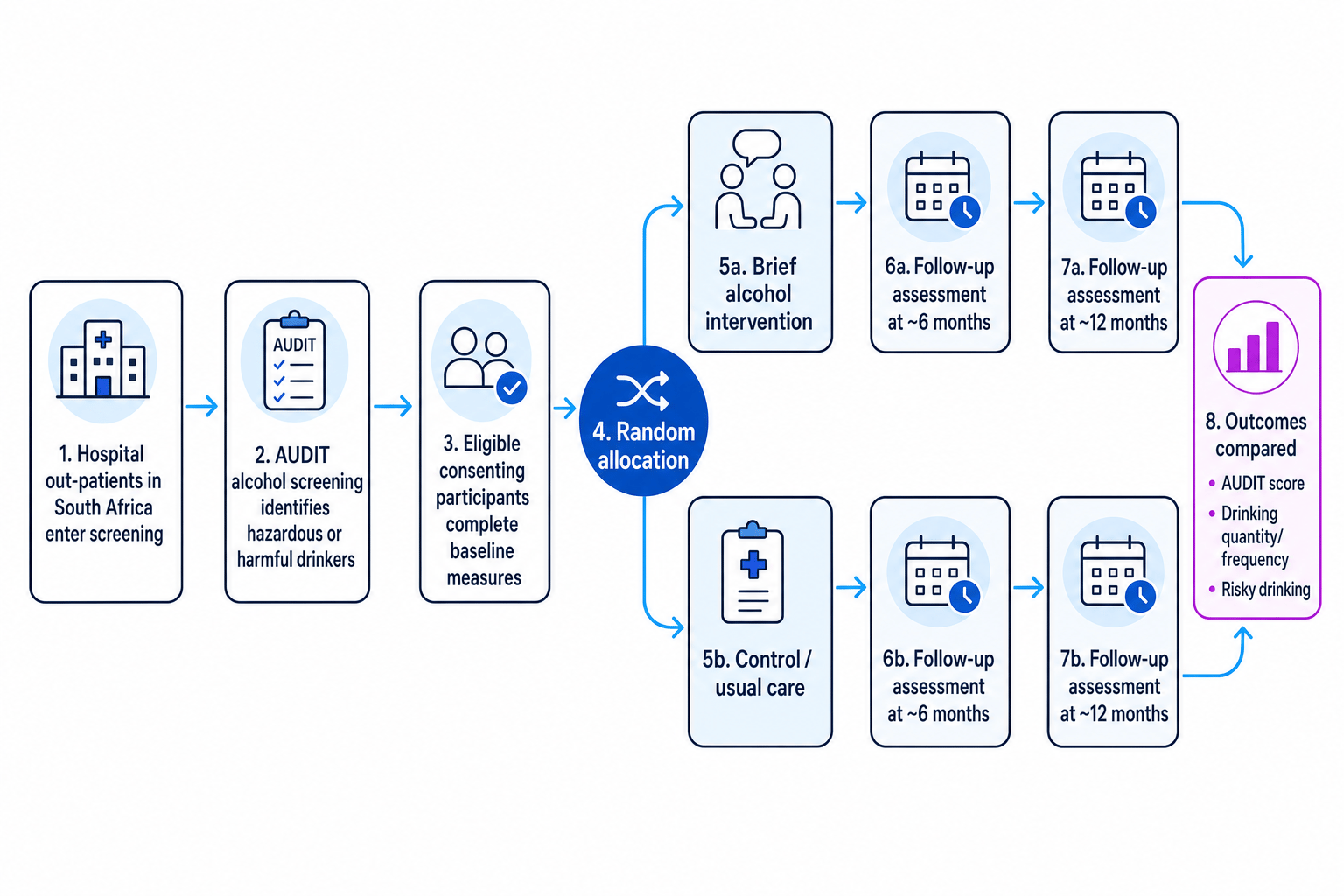
Tracing the logic of the RCT
-
The researchers first screened hospital out-patients to identify people with hazardous or harmful alcohol use, so the sample matched the target behaviour.
-
Eligible participants were randomly allocated to either the brief intervention group or the control group, reducing the chance that one group was already more motivated or healthier than the other.
-
Both groups were followed up later, so any difference in alcohol outcomes could be linked more confidently to the intervention rather than to initial group differences.
Calling it a laboratory experiment
This was an experiment because there was random allocation to conditions, but it was carried out in a real hospital context. It is better described as a field experiment or randomised controlled trial, not a lab experiment.
AO1: Aim of the study
The aim was to investigate whether screening and brief intervention could reduce hazardous and harmful alcohol use among hospital out-patients in South Africa.
The wider context is important: alcohol misuse is a major public health issue in South Africa, linked to accidents, violence, illness and pressure on health services. Hospitals may therefore be a useful place to identify people at risk.
AO1: Sample
Participants were adult hospital out-patients in South Africa.
Out-patient
An out-patient is someone who attends a hospital for assessment or treatment but is not admitted overnight.
Patients were screened using the AUDIT. Those whose scores suggested hazardous or harmful alcohol use were eligible for the trial, assuming they met the study criteria and gave consent.
The sample is a strength because it used real patients in a real healthcare setting. However, it also means the findings may not generalise perfectly to people who do not attend hospitals, or to countries with different healthcare systems and drinking cultures.
AO1: Procedure
The study followed a clear sequence.
- Hospital out-patients were approached and screened for alcohol use.
- Those identified as hazardous or harmful drinkers completed baseline measures.
- Participants were randomly allocated to either:
- a brief intervention condition, or
- a control/usual care condition.
- The intervention involved a short alcohol-focused discussion, including feedback and advice about reducing drinking.
- Participants were followed up later, commonly reported as around 6 and 12 months, to assess whether their drinking had changed.
The researchers compared alcohol outcomes between the groups over time.
AO1 memory shortcut
Remember the study as S-R-I-F-C: Screening, Random allocation, Intervention, Follow-up, Comparison.
AO1: Findings and conclusions
Pengpid et al. found that alcohol use tended to reduce over time, with evidence that brief intervention could help reduce risky drinking among hospital out-patients. However, the effects were not necessarily dramatic across every measure, and reductions can also occur because screening and follow-up themselves make people reflect on their drinking.
The main conclusion is that hospital settings can be used to identify hazardous and harmful drinkers, and that brief interventions may be a useful, low-cost public health tool.
Core conclusion
Screening plus a short alcohol-focused intervention can be a practical way to reduce risky drinking, especially when delivered in everyday healthcare settings.
Research methods link
Because this was a trial comparing groups, the researchers were interested in whether differences between conditions were statistically meaningful.
In A-Level research methods, you should know that a test of difference is used when comparing groups or conditions. For example, Mann-Whitney U is used for a difference between two independent groups, while Wilcoxon signed-ranks is used for related data, such as before-and-after scores from the same participants. Spearman’s rho is used for correlation, and chi-square is used for association between categories.
The usual significance level is p≤.05p \le .05p≤.05, though researchers may use p≤.10p \le .10p≤.10 or p≤.01p \le .01p≤.01 depending on how strict they want to be. With critical-value tables, always check whether the observed value needs to be greater than or less than the critical value, because this differs between tests.
Assuming change proves the intervention worked
If both the intervention and control groups reduce drinking, you need to ask whether the intervention group improved more than the control group. Improvement over time alone is not enough to prove the intervention caused the change.
AO3: Strengths
Strong control through random allocation
Random allocation improves internal validity because participant variables, such as motivation, severity of drinking or general health, should be spread more evenly across groups.
This makes it easier to argue that differences in outcome were caused by the intervention rather than pre-existing differences.
Real-world setting
The study has good ecological validity because it was conducted with real hospital out-patients. The intervention was also short, which makes it realistic for healthcare professionals to deliver.
This supports real-world application: if hospitals can screen patients quickly and provide brief advice, public health services may reduce alcohol-related harm without relying only on specialist addiction clinics.
Use of a standardised measure
AUDIT is a recognised alcohol screening tool. This improves reliability because participants are assessed using the same structured questions rather than informal judgement.
AO3: Weaknesses
Self-report data
Alcohol consumption was measured largely through self-report. Participants may under-report drinking because of embarrassment, memory problems or social desirability bias.
Social desirability bias
Social desirability bias occurs when participants give answers that make them look better rather than answers that are fully accurate.
This is especially relevant when the topic is alcohol misuse, because drinking can be socially sensitive or stigmatised.
Attrition at follow-up
Attrition
Attrition means participants dropping out before the end of a study.
Longitudinal studies often lose participants between baseline and follow-up. If heavier drinkers were more likely to drop out, the final results may make the intervention look more successful than it really was.
Generalisability
The study was carried out in South African hospital out-patients. This is valuable because psychology should not only rely on Western student samples, but the findings may not apply equally to other countries, age groups, rural communities or people with severe alcohol dependence.
Ethics
The study involved a sensitive health behaviour, so ethical safeguards were important.
Under the BPS Code of Ethics and Conduct (2009), researchers should consider consent, deception, right to withdraw, protection from harm, confidentiality and debriefing.
Participants should have been informed about the study, given the right to withdraw, and reassured that their alcohol data would be confidential. Because the study identified risky drinking, researchers also had a duty to protect participants from harm by giving appropriate advice or referral routes where needed.
Ethical tension
A control group in a health intervention study can raise ethical issues if researchers believe the intervention is beneficial. However, control groups are often needed to test whether an intervention genuinely works before it is rolled out widely.
Using this study in essays
For AO1, describe the aim, sample, RCT design, AUDIT screening, brief intervention and follow-up.
For AO2, apply it to a scenario about a hospital, GP clinic, university wellbeing service or public health campaign trying to reduce harmful drinking.
For AO3, evaluate the use of random allocation, real-world setting, self-report measures, attrition, cultural context and ethics.
In the exam
-
Start with the study’s purpose: Pengpid et al. tested whether screening and brief intervention could reduce hazardous and harmful alcohol use among South African hospital out-patients.
-
Use the language of experimental design: random allocation, intervention group, control group, dependent variables and follow-up.
-
For evaluation, balance a strong method point, such as random allocation or ecological validity, with a limitation such as self-report bias, attrition or limited generalisability.
Check yourself
- What is the difference between hazardous and harmful alcohol use?
- Why does random allocation improve the validity of Pengpid et al.’s study?
- Why might self-report alcohol data be less accurate than it first appears?
