When a defendant stands trial, they are supposedly judged by a jury of their peers. But does the demographic makeup of that jury influence the final verdict? In your Criminological Psychology option, Bradbury and Williams (2013) is your key contemporary study investigating how race affects jury decision-making.
What you'll learn
- How researchers use real-world court data (archival research) to study jury decision-making.
- The specific effects of Black, White, and Hispanic juror representation on conviction rates of Black defendants.
- How to critically evaluate the study's high ecological validity against its correlational limitations (AO3).
The Background: Why Study Jury Race?
In many judicial systems, including those of the US and the UK, juries are expected to be impartial. However, social psychological theories of prejudice—such as Social Identity Theory (Tajfel & Turner, 1979)—suggest that we naturally favor our "in-group" (those we share characteristics with) and hold biases against the "out-group."
Historically, most research on jury bias relied on mock trials, where university students read written transcripts of a crime and voted on a hypothetical verdict.
Mock Trial
An experimental simulation of a courtroom trial. While highly controlled, mock trials lack ecological validity because participants do not experience real trial dynamics, and their decisions carry no real-world consequences.
Bradbury and Williams wanted to address this major limitation. They bypassed simulated courtrooms and analyzed real, completed trials to see if racial bias occurs when real lives and freedoms are on the line.
Aim and Methodology
The primary aim of Bradbury and Williams (2013) was to investigate whether the racial composition of a jury influences the likelihood of conviction for Black defendants.
Research Design
The researchers used an archival research design.
Archival Research
A research method that involves analyzing pre-existing data, records, or documents rather than gathering primary data directly from participants.
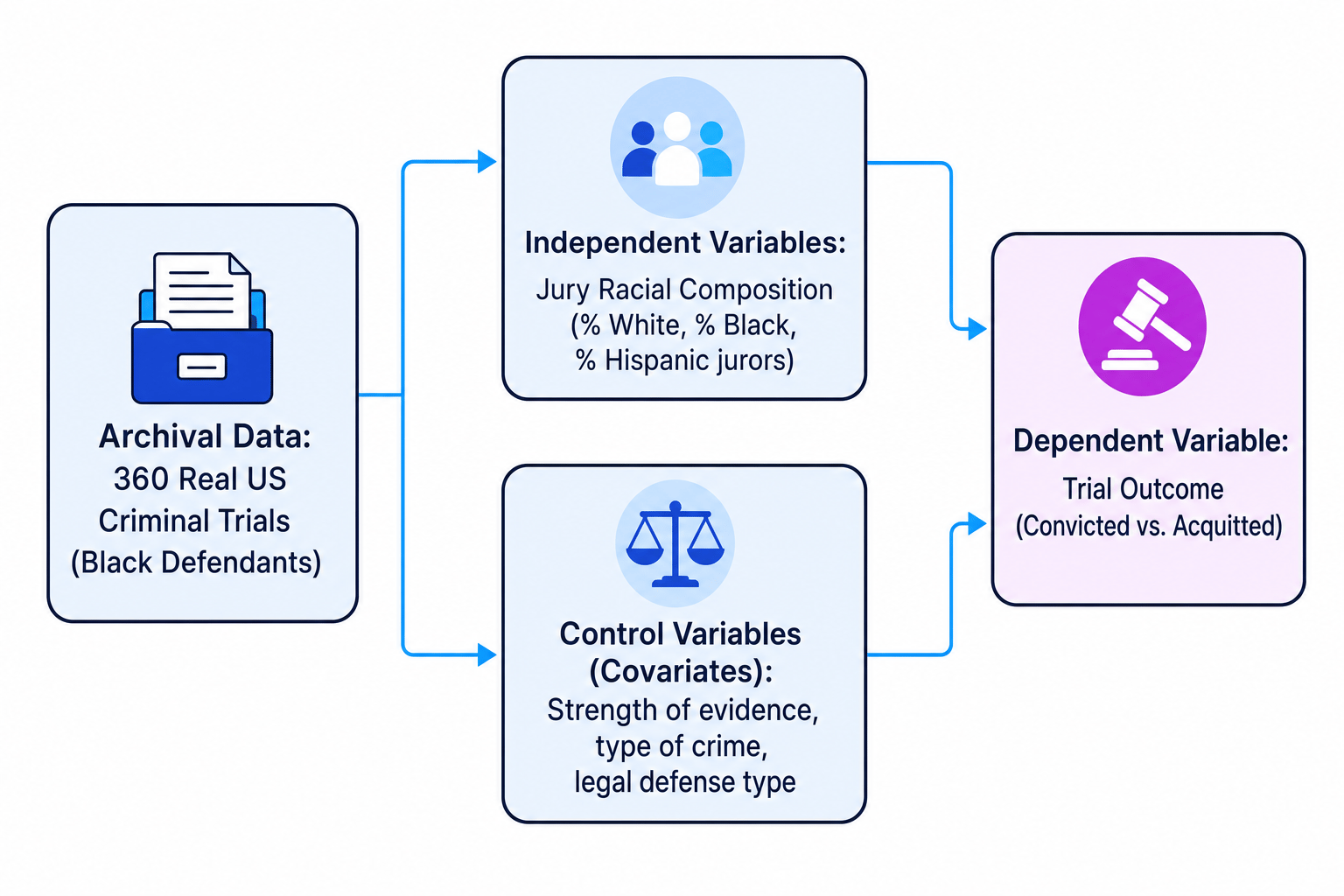
Instead of running an experiment, the researchers analyzed data from 360 real criminal trials involving Black defendants across four US jurisdictions (New York, Arizona, Washington D.C., and California).
The Variables
- Independent Variables (IVs): The racial composition of the juries. This was measured as the percentage of White, Black, and Hispanic jurors on each panel.
- Dependent Variable (DV): The final verdict of the trial (whether the Black defendant was convicted or acquitted).
- Control Variables (Covariates): To ensure that jury race was the actual factor influencing the verdict, the researchers statistically controlled for other key influences, including:
- The strength of the prosecution's evidence (e.g., eyewitnesses, physical evidence).
- The severity/type of the crime.
- The type of legal representation (private attorney vs. public defender).
The relationship between these variables is mapped out below:
Key Findings
The researchers used advanced statistical modeling to isolate the effect of race. Their findings revealed clear, significant patterns of racial bias:
- White Juror Representation: Juries with higher percentages of White jurors were significantly more likely to convict Black defendants.
- Hispanic Juror Representation: Juries with higher percentages of Hispanic jurors were also significantly more likely to convict Black defendants.
- Black Juror Representation: Juries with higher percentages of Black jurors were significantly less likely to convict Black defendants.
The Headline Takeaway
The racial makeup of a jury is a strong predictor of trial outcomes for Black defendants. Juries dominated by out-group members (White and Hispanic jurors) show higher conviction rates, whereas juries with greater in-group representation (Black jurors) are less likely to convict.
Worked Example: Interpreting Statistical Significance
In research methods, we must determine if a pattern in our data is a genuine effect or just down to random chance. Because Bradbury and Williams analysed categorical data (e.g., jury composition category vs. guilty/not guilty verdict), a Chi-Square (χ2\chi^2χ2) test of association is typically used to analyze these relationships.
Interpreting a Chi-Square Test of Association
Suppose a researcher conducts a follow-up study looking at whether jury composition (Majority White vs. Diverse) is associated with the conviction of Black defendants. They calculate an observed Chi-Square value of χ2=5.12\chi^2 = 5.12χ2=5.12.
Follow these steps to determine if this finding is statistically significant.
-
Identify the Degrees of Freedom (dfdfdf): For a 2×22 \times 22×2 contingency table, the formula is:
df=(rows−1)×(columns−1) df = (\text{rows} - 1) \times (\text{columns} - 1) df=(rows−1)×(columns−1)Substituting our values:
df=(2−1)×(2−1)=1 df = (2 - 1) \times (2 - 1) = 1 df=(2−1)×(2−1)=1 -
Locate the Critical Value: Look up the critical value table for df=1df = 1df=1 at the standard significance level of p≤.05p \le .05p≤.05. The critical value in the table is 3.843.843.84.
-
Compare Observed and Critical Values: Compare the calculated (observed) value to the critical table value. Our observed value is 5.125.125.12. Because 5.12≥3.845.12 \ge 3.845.12≥3.84, our observed value is greater than the critical value.
-
Draw a Statistical Conclusion: Since the observed value exceeds the critical value, we reject the null hypothesis and accept the alternative hypothesis. There is a statistically significant association between the racial composition of the jury and the trial outcome (p≤.05p \le .05p≤.05).
Evaluation (AO3)
To score highly on 8- and 12-mark essay questions, you must balanced your AO1 description with rigorous AO3 evaluation. Let's break down the strengths and weaknesses of Bradbury and Williams (2013).
Strengths
- High Ecological Validity: Because the data came from real trials with real defendants, the study avoids the artificiality of mock-trial experiments. The decisions had life-altering consequences, meaning the data reflects genuine human behavior in a high-stakes environment.
- Robust Controls (Internal Validity): By statistically controlling for "covariates" like the strength of the evidence and the type of crime, Bradbury and Williams isolated race as the key variable. This reduces the risk that the results were simply due to Black defendants facing stronger evidence in certain trials.
- Ethical Soundness: The researchers used public archival court records. They did not actively deceive, stress, or manipulate participants, making it highly ethical under the BPS guidelines.
Avoid 'General' Strengths
Do not just write "it is ethical." Be specific! Explain why: "Because they used pre-existing public records, there was no risk of psychological harm to real jurors or defendants, and consent was not required as the data was already in the public domain."
Weaknesses
- Correlational Nature (No Direct Causation): Archival research is fundamentally correlational. Although the researchers controlled for several variables, they could not control for everything (e.g., the charisma of the lawyers, the non-verbal behavior of the defendant, or individual juror prejudices). Therefore, we cannot establish a definitive cause-and-effect relationship.
- Geographical Generalizability: The sample was drawn from only four US jurisdictions. Legal procedures, jury selection rules (such as voir dire), and regional racial dynamics differ widely across the US, and differ even more from the UK legal system. Thus, the findings may not apply globally.
Confusing the US and UK Jury Systems
Do not assume that jury selection processes are identical worldwide. In the US, attorneys can dismiss potential jurors using "peremptory challenges" based on questioning (voir dire). In the UK, jurors are selected purely at random from the electoral register, meaning UK attorneys have very limited powers to influence the racial makeup of a jury.
In the exam
- Focus on the "Why": If asked to evaluate Bradbury and Williams, always compare their archival method to mock trials. Highlighting why archival data is better for ecological validity is a classic way to secure top-band evaluation marks.
- Control Variables are Key: Do not forget to mention that they controlled for the strength of prosecution evidence. If they hadn't, their findings would be easily dismissed by critics arguing that Black defendants were simply more guilty in trials with White-majority juries.
- Link to Social Identity Theory: If a question asks you to "explain" their findings, use AO1 concepts from social psychology. Frame the higher conviction rates of out-group jurors as an example of in-group favoritism and out-group derogation.
Check yourself
- Why did Bradbury and Williams choose to use archival data rather than conducting a mock trial?
- What were the three independent variables examined in this study?
- What did the study conclude about the impact of Black juror representation on the trial outcomes of Black defendants?
