What you'll learn
- What a biological treatment is and why it can be used with offenders.
- How improved diet may reduce aggression, impulsivity and prison rule-breaking.
- Key research evidence, especially Gesch et al. (2002).
- How to build AO1, AO2 and AO3 points for essay-style answers.
The basic idea: treating offending biologically
In Criminological Psychology, a treatment for offenders is an intervention designed to reduce future offending, not just punish the offender. A treatment is judged by whether it reduces behaviours such as aggression, disciplinary incidents in prison, or recidivism, which means reoffending after punishment or rehabilitation.
Biological treatment
A biological treatment is an intervention that aims to reduce offending by changing or supporting the body’s physiological functioning, such as brain chemistry, hormones, diet, or medication.
For this specification point, Edexcel asks for one biological treatment. The examples in the specification include improved diet and hormone treatment. These notes focus on improved diet, because it is a clear, research-supported example.
Remember the e.g. wording
When the specification says “e.g.”, the examples are illustrative. You do not need to write about every possible biological treatment, but you should know one in enough depth for AO1 and AO3.
Why diet might affect offending
To understand improved diet, you need one key assumption: behaviour is partly influenced by how well the brain is functioning. This does not mean food “causes crime” in a simple way. It means poor nutrition may make self-control harder, especially for people already at risk of impulsive or aggressive behaviour.
Neurotransmitter
A neurotransmitter is a chemical messenger that carries signals between neurons in the brain and nervous system.
One neurotransmitter often linked to aggression and impulse control is serotonin. Low serotonin activity has been associated with impulsive aggression, although this relationship is complex and not perfectly causal.
Diet can support brain functioning because the brain needs:
- Vitamins and minerals: micronutrients needed for normal metabolism and neurotransmitter production.
- Essential fatty acids, such as omega-3: fats the body cannot make enough of by itself, used in cell membranes and brain communication.
- Stable energy and general nutritional balance: important for concentration, mood regulation and self-control.
Main mechanism
Improved diet is based on the idea that better nutrition may improve brain functioning and impulse control, which can reduce aggressive or antisocial behaviour.
The flow below shows the logic of improved diet as a biological treatment.
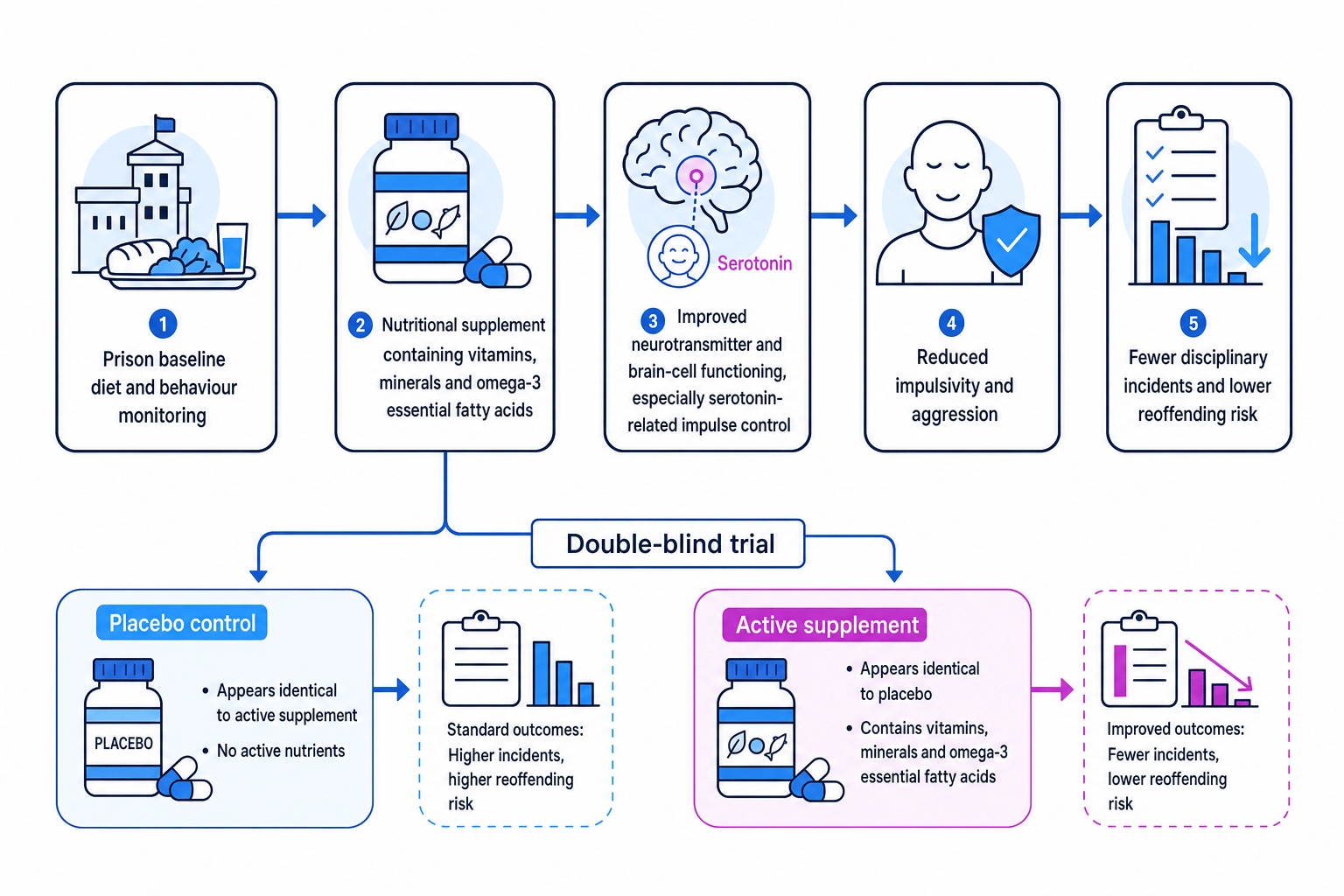
Improved diet as a biological treatment
Improved diet
Improved diet is a biological treatment where offenders are given better-quality food or nutritional supplements, such as vitamins, minerals and essential fatty acids, to support brain functioning and reduce antisocial behaviour.
In practice, improved diet might involve:
- checking the offender’s existing diet;
- providing more balanced prison meals;
- giving daily supplements containing vitamins, minerals and omega-3 fatty acids;
- monitoring outcomes such as aggression, rule-breaking, disciplinary reports or later reoffending.
This treatment is usually used in prisons or young offender institutions, where food can be controlled more easily than in the community.
Applying the treatment
Applying improved diet to a prison scenario
A young offender institution has frequent impulsive fights between prisoners. Staff introduce daily vitamin, mineral and omega-3 supplements for some prisoners and monitor disciplinary incidents.
-
Identify the target behaviour: the treatment is aimed at impulsive aggression, shown by frequent fights and disciplinary incidents.
-
Link the treatment to biology: the supplements may support neurotransmitter functioning and brain-cell communication, which could improve emotional regulation.
-
Connect biology to offending: if prisoners become less impulsive, they may be less likely to react aggressively to provocation.
-
Choose an outcome measure: disciplinary incidents before and after the intervention can be compared to see whether aggressive rule-breaking has reduced.
Research evidence: Gesch et al. (2002)
A key study supporting improved diet is Gesch et al. (2002).
Gesch and colleagues carried out a double-blind placebo-controlled trial with young adult prisoners. A placebo is a fake treatment that looks like the real treatment but does not contain the active ingredient. Double-blind means neither the participants nor the researchers directly working with them know who is receiving the real supplement.
The prisoners were allocated to receive either:
- an active supplement containing vitamins, minerals and essential fatty acids; or
- a placebo capsule.
Their prison disciplinary records were then examined. The active supplement group showed a reduction in offences compared with the placebo group. The study reported about 26% fewer disciplinary offences and about 37% fewer serious offences in the supplement group.
This supports the idea that nutrition can influence antisocial behaviour, at least within a prison environment.
Interpreting a significant finding
Suppose a nutritional trial reports that the supplement group reduced disciplinary offences with p=.03p=.03p=.03.
-
Compare the result with the usual psychology significance level: p=.03p=.03p=.03 is less than p≤.05p \le .05p≤.05, so the finding is statistically significant at the standard level.
-
Consider the stricter level: p=.03p=.03p=.03 is not less than p≤.01p \le .01p≤.01, so it would not meet a very strict significance level.
-
Draw a careful conclusion: the result supports improved diet as a treatment, but it does not prove that diet alone explains all offending behaviour.
AO3: strengths of improved diet
Research support
A major strength is that improved diet has support from controlled research. Gesch et al. (2002) used a placebo group and a double-blind procedure, which helps reduce demand characteristics and researcher bias.
Later research, such as Zaalberg et al. (2010) in Dutch prisons, also found that nutritional supplements were linked with reduced incidents, giving the treatment some wider support.
Practical benefits
Improved diet is relatively cheap, non-invasive and easy to add to existing prison routines. It may also improve general health, not just behaviour. This gives it strong real-world application, because prisons already provide meals and can introduce supplements without needing highly specialised therapy rooms or long individual sessions.
Ethical advantages
Compared with some biological treatments, such as hormone treatment or medication, improved diet is usually less intrusive. If consent is gained and prisoners are properly informed, it is less likely to raise serious concerns about bodily autonomy.
AO3: weaknesses and limitations
It may be reductionist
A reductionist explanation oversimplifies behaviour by reducing it to one level, such as biology. Offending is affected by many factors, including poverty, peer influence, childhood experiences, substance misuse, cognition and opportunity.
Do not overclaim
Do not write that poor diet “causes crime” or that supplements “cure offenders”. A stronger answer says diet may reduce impulsivity or aggression for some offenders, especially when combined with other rehabilitation.
Generalisability issues
Much of the evidence comes from male prisoners or young offenders. This means findings may not generalise to:
- female offenders;
- older offenders;
- offenders living in the community;
- people whose crimes are planned rather than impulsive.
Improved diet may be more useful for impulsive aggression than for carefully planned fraud, burglary or organised crime.
Measuring prison behaviour is not the same as measuring reoffending
A reduction in prison disciplinary incidents is useful, but it is not identical to reduced recidivism after release. Someone may behave better in prison but still reoffend later due to unemployment, addiction or returning to the same peer group.
Ethical issues in research
Research with prisoners needs careful ethical protection because prisoners may feel pressured to take part.
The BPS Code of Ethics and Conduct (2009) is relevant here:
- Consent: prisoners should freely agree to take part.
- Deception: placebo use must be justified and explained during debriefing.
- Right to withdraw: prisoners must be able to leave the study without punishment.
- Protection from harm: supplements should be checked for safety.
- Confidentiality: disciplinary and health data must be protected.
- Debrief: participants should be told the true aim and whether they received placebo or active supplements.
A balanced conclusion
Improved diet is a promising biological treatment because it is practical, ethical compared with more invasive treatments, and supported by controlled research such as Gesch et al. (2002). However, it should not be treated as a complete solution to offending. Its best use is probably as part of a wider rehabilitation programme, alongside psychological treatments, education, social support and relapse prevention.
Best judgement
Improved diet is strongest as an additional support for reducing impulsive and aggressive behaviour, not as a stand-alone explanation or cure for crime.
In the exam
-
Start AO1 by naming the treatment: improved diet, using vitamins, minerals and essential fatty acids to support brain functioning and impulse control.
-
For AO2, apply it to the type of offending in the scenario: it fits best with impulsive aggression, prison rule-breaking or poor emotional regulation.
-
For AO3, use evidence such as Gesch et al. (2002), then balance it with limits: reductionism, generalisability, prison incidents versus reoffending, and ethics.
Check yourself
- How might omega-3, vitamins and minerals affect brain functioning and impulse control?
- Why is a double-blind placebo-controlled trial useful when testing improved diet?
- What is one strength and one limitation of using improved diet with offenders?
