What you'll learn
- What a hypothesis is and why psychologists use one.
- How to write a clear, operationalised hypothesis.
- The difference between directional and non-directional hypotheses.
- How hypotheses link to research design, statistics, ethics, and exam answers.
Why hypotheses matter
Psychology aims to be a science, so researchers do not just “see what happens”. They make a clear prediction before collecting data, then test that prediction using evidence.
A research aim is a broad statement of what the researcher wants to investigate. A hypothesis is more precise: it predicts what the researcher expects to find.
For example:
- Aim: “To investigate whether sleep affects memory.”
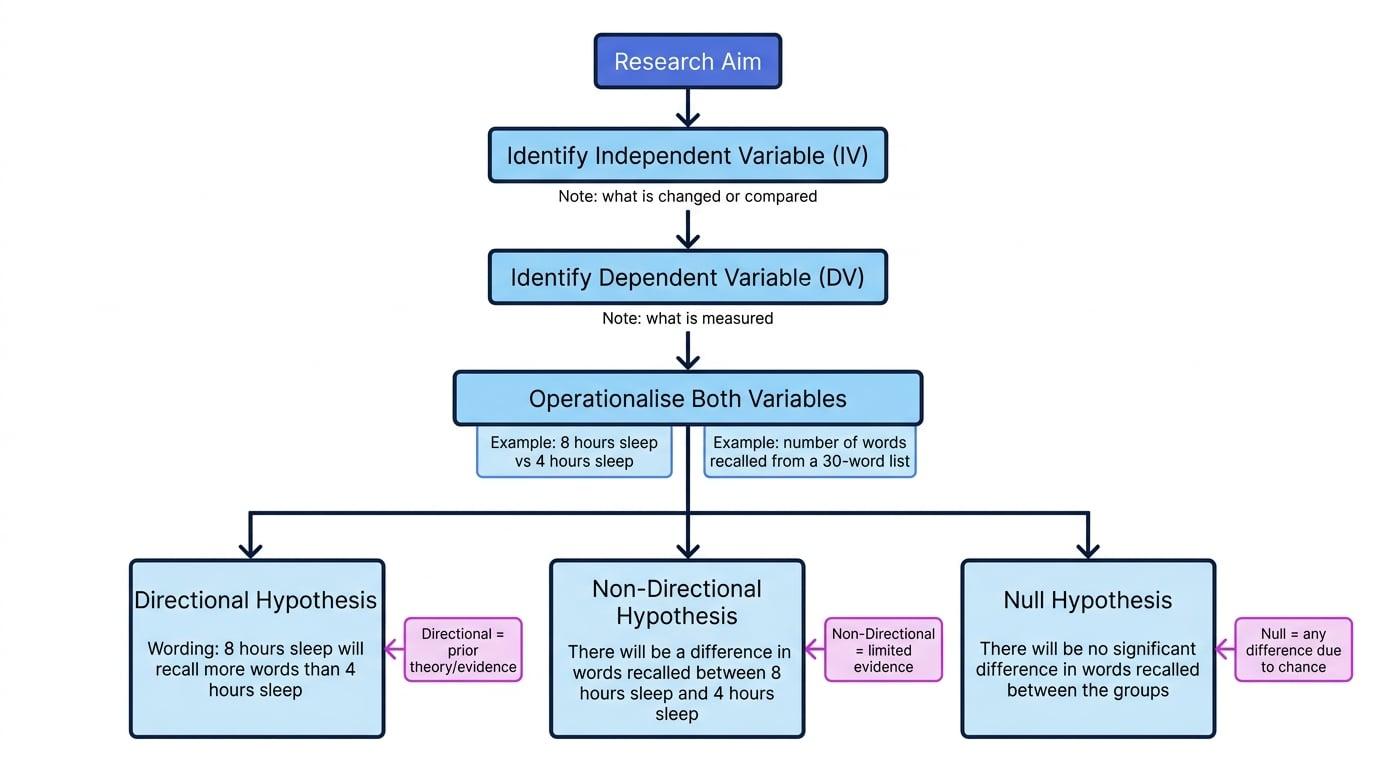
- Hypothesis: “Participants who sleep for 8 hours will recall more words than participants who sleep for 4 hours.”
The second version is better because it says exactly what will be compared and what will be measured.
Hypothesis
A hypothesis is a precise, testable statement predicting an effect, difference, association, or relationship between variables.
The building blocks: variables
A variable is anything that can change or vary in a study, such as anxiety level, reaction time, memory score, or type of question asked.
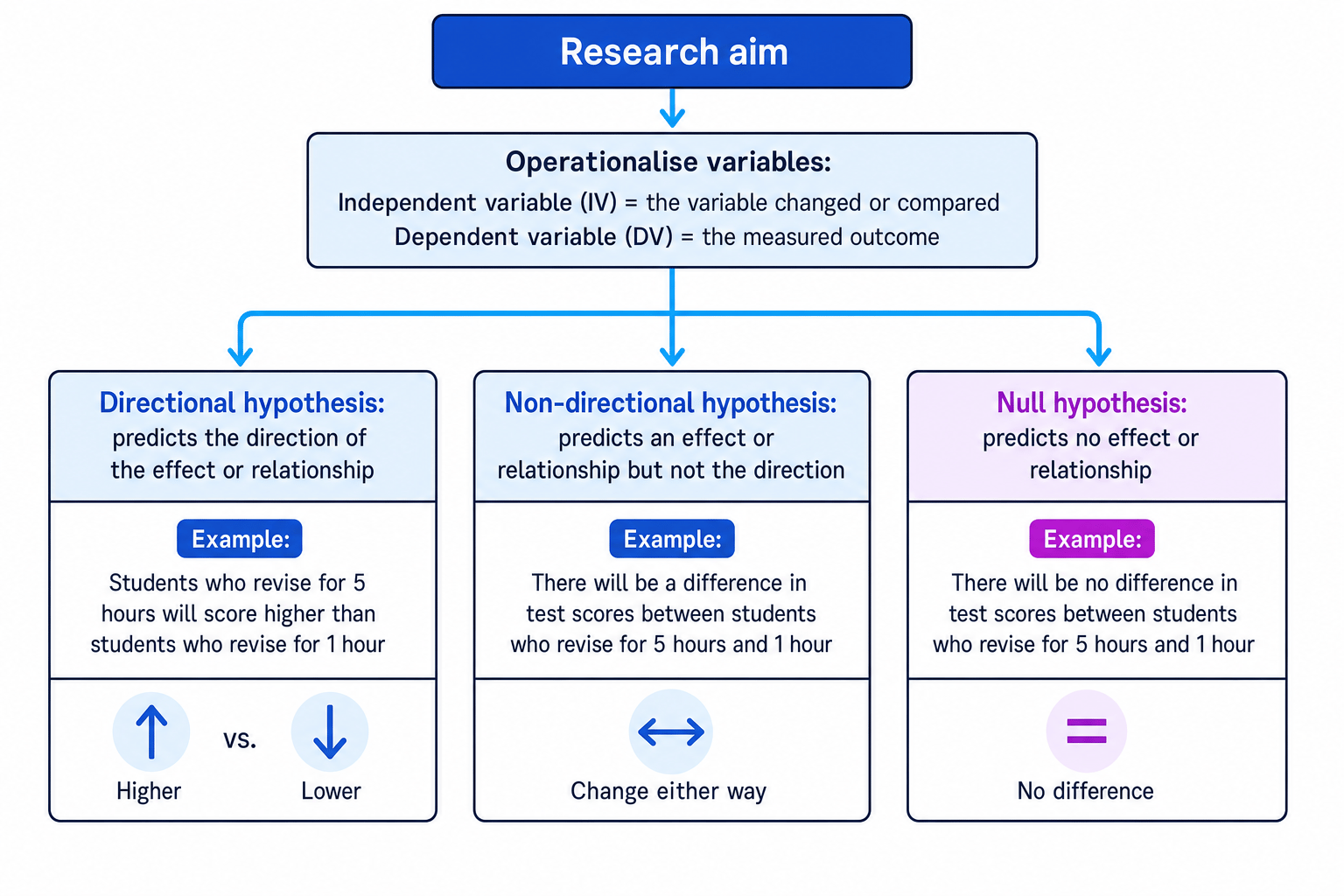
In an experiment, the independent variable, or IV, is the variable the researcher changes or compares. The dependent variable, or DV, is the outcome the researcher measures.
Operationalisation
To operationalise a variable means defining exactly how it will be manipulated or measured in a particular study.
“Memory” is too vague. “Number of words correctly recalled from a 20-word list after two minutes” is operationalised.
Operationalise before you hypothesise
A strong hypothesis names the IV and DV clearly enough that another researcher could repeat the study in the same way.
Operationalising a memory study
A psychologist wants to investigate whether background music affects recall.
-
Identify the IV: The variable being compared is the listening condition. This could be operationalised as “listening to instrumental music” versus “working in silence”.
-
Identify the DV: The measured outcome is recall. This should be operationalised as “the number of words correctly recalled from a 20-word list after one minute”.
-
Turn vague wording into measurable wording: Instead of “music affects memory”, a clearer hypothesis would refer to “instrumental music”, “silence”, and “number of words correctly recalled”.
Alternative and null hypotheses
The alternative hypothesis predicts that there will be an effect, difference, association, or relationship. In an experiment, this is sometimes called the experimental hypothesis.
The null hypothesis predicts that there will be no effect, difference, association, or relationship, and that any pattern in the data is due to chance.
You do not “prove” a hypothesis in psychology. Instead, you collect data and decide whether there is enough evidence to reject the null hypothesis, often using a significance level such as p<0.05p < 0.05p<0.05.
Null hypothesis
A null hypothesis, often written as H0H_0H0, states that there will be no significant effect, difference, association, or relationship between the variables being studied.
Directional hypotheses
A directional hypothesis predicts the specific direction of the effect or relationship.
It tells you which condition will score higher or lower, or whether a correlation will be positive or negative.
Examples:
- “Participants who drink caffeine will have faster reaction times than participants who drink water.”
- “There will be a positive correlation between hours spent revising and test score.”
- “Participants asked a leading question using the verb ‘smashed’ will give higher speed estimates than participants asked using the verb ‘hit’.” This would fit a study like Loftus and Palmer’s work on leading questions and memory.
Directional hypotheses are usually used when previous research or theory gives a strong reason to expect a particular outcome.
Directional hypotheses and one-tailed tests
Later, when you study statistical testing, you may see that directional hypotheses usually link to one-tailed tests. A one-tailed test looks for an effect in one predicted direction only.
For example, if the hypothesis predicts that caffeine will improve reaction time, the test is focused on improvement, not just any change.
Spotting a directional hypothesis
Look for words such as higher, lower, faster, slower, more, less, positive correlation, or negative correlation.
Writing a directional hypothesis
A researcher has evidence from previous studies that sleep improves recall. They compare students who sleep for 8 hours with students who sleep for 4 hours.
-
Use the evidence to choose the hypothesis type: Previous research suggests a clear direction, so a directional hypothesis is justified.
-
State the comparison between conditions: The two conditions are “8 hours of sleep” and “4 hours of sleep”.
-
State the predicted direction for the DV: A suitable hypothesis is: “Students who sleep for 8 hours will recall more words from a 30-word list than students who sleep for 4 hours.”
Non-directional hypotheses
A non-directional hypothesis predicts that there will be an effect, difference, association, or relationship, but it does not say which direction it will go in.
Examples:
- “There will be a difference in reaction times between participants who drink caffeine and participants who drink water.”
- “There will be a relationship between hours spent revising and test score.”
- “There will be a difference in speed estimates between participants asked different leading questions.”
Non-directional hypotheses are useful when the researcher expects something to happen but does not have enough evidence to predict the direction.
Non-directional hypotheses and two-tailed tests
Non-directional hypotheses usually link to two-tailed tests. A two-tailed test checks for an effect in either direction.
For example, a new therapy might reduce anxiety, increase anxiety, or produce an unexpected pattern. If the researcher only predicts “a difference”, the hypothesis is non-directional.
Choosing a non-directional hypothesis
A researcher tests a new revision app. There is very little previous research, so they are unsure whether it will improve scores, reduce scores by distracting students, or make no difference.
-
Judge whether a direction is justified: Because there is little prior evidence, predicting “higher scores” would be too confident.
-
Keep the predicted outcome broad but testable: The researcher can still predict that the app will have some effect on scores.
-
Write the hypothesis without directional language: “There will be a difference in test scores between students who use the revision app for two weeks and students who do not use the app.”
Directional vs non-directional: quick comparison
| Feature | Directional hypothesis | Non-directional hypothesis |
|---|---|---|
| What it predicts | The direction of the effect or relationship | An effect or relationship, but not the direction |
| Typical wording | “Higher than”, “lower than”, “positive correlation”, “negative correlation” | “There will be a difference” or “there will be a relationship” |
| Best used when | Prior research or theory suggests a clear direction | The research is exploratory or evidence is mixed |
| Statistical link | Usually one-tailed | Usually two-tailed |
Writing a vague hypothesis
Avoid statements like “music affects memory” or “stress changes performance”. These do not clearly operationalise the IV or DV, so they are not precise enough for A-Level research methods.
Differences and relationships
Hypotheses can be written for different kinds of research.
In an experiment, researchers manipulate or compare an IV and measure a DV. The hypothesis often predicts a difference between conditions.
Example: “Participants in the noise condition will recall fewer words than participants in the silent condition.”
In a correlation, researchers measure two co-variables and assess whether they are associated. A co-variable is one of the two measured variables in a correlational study. The hypothesis predicts a relationship, not a cause.
Example: “There will be a negative correlation between hours of sleep and self-rated stress.”
Correlation is not causation
A correlational hypothesis should not say that one variable causes the other. “Sleep causes lower stress” is causal language, so it does not fit a correlational design unless the study is actually experimental.
AO2: applying hypotheses to scenarios
In the exam, you may be given a short research scenario and asked to write a hypothesis.
A good answer should:
- include both variables;
- operationalise both variables where possible;
- match the design, such as experiment or correlation;
- be directional or non-directional depending on the question;
- avoid saying “prove” or “show”, because research findings are judged probabilistically.
For example, if the scenario says a psychologist believes anxiety will reduce recall, a directional hypothesis is appropriate:
“Participants with high anxiety scores will recall fewer words from a 20-word list than participants with low anxiety scores.”
If the scenario says the psychologist is simply exploring whether anxiety and recall are linked, a non-directional hypothesis is safer:
“There will be a relationship between anxiety score and the number of words recalled from a 20-word list.”
AO3: evaluating hypotheses
Clear hypotheses improve objectivity, meaning the researcher is less likely to rely on personal opinion when interpreting results. They also improve replicability, meaning another researcher can repeat the study to check whether similar findings occur.
However, a directional hypothesis should only be used when it is justified by theory or previous evidence. If researchers choose a direction after seeing the data, this can increase bias and make the study look more convincing than it really is.
Non-directional hypotheses are more cautious and useful for exploratory research, but they are less precise. In statistical testing, two-tailed tests are often more conservative because they allow for an effect in either direction.
There is also an ethical angle. Sometimes researchers hide the exact hypothesis to reduce demand characteristics, which are cues that might make participants guess the aim and change their behaviour. If deception is used, researchers must still consider informed consent, the right to withdraw, protection from harm, confidentiality, and debriefing.
In the exam
-
Decide whether the question asks for directional or non-directional wording before you start writing.
-
Operationalise the IV and DV so your hypothesis is specific, measurable, and easy to test.
-
Match the research design: write about a “difference” for experiments and a “relationship” or “correlation” for correlational studies.
Check yourself
- What is the difference between a research aim and a hypothesis?
- When would a psychologist choose a directional hypothesis rather than a non-directional one?
- How could you operationalise “memory” in a hypothesis?