What you'll learn
- How learning theory explains attachment using classical and operant conditioning.
- How Bowlby’s monotropic theory explains attachment as innate and evolutionary.
- What the critical period and internal working model mean.
- How to evaluate both explanations using evidence, methodology, ethics, and real-world applications.
The starting point: what is attachment?
Before we compare explanations, make sure the core term is secure.
Attachment
An attachment is a close, two-way emotional bond between two individuals, usually an infant and a caregiver, in which each person sees the other as essential for their emotional security.
In this topic, an explanation means a theory about why attachments form. AQA expects you to know two main explanations:
- Learning theory: attachment is learned through association and reinforcement.
- Bowlby’s monotropic theory: attachment is biologically programmed because it helps infants survive.
Learning theory: attachment is learned
Learning theory is a behaviourist explanation. Behaviourism is an approach that explains behaviour in terms of observable learning from the environment, rather than inner thoughts or emotions.
Learning theory is sometimes called the “cupboard love” explanation because it suggests babies attach to the person who feeds them.
Learning theory in one sentence
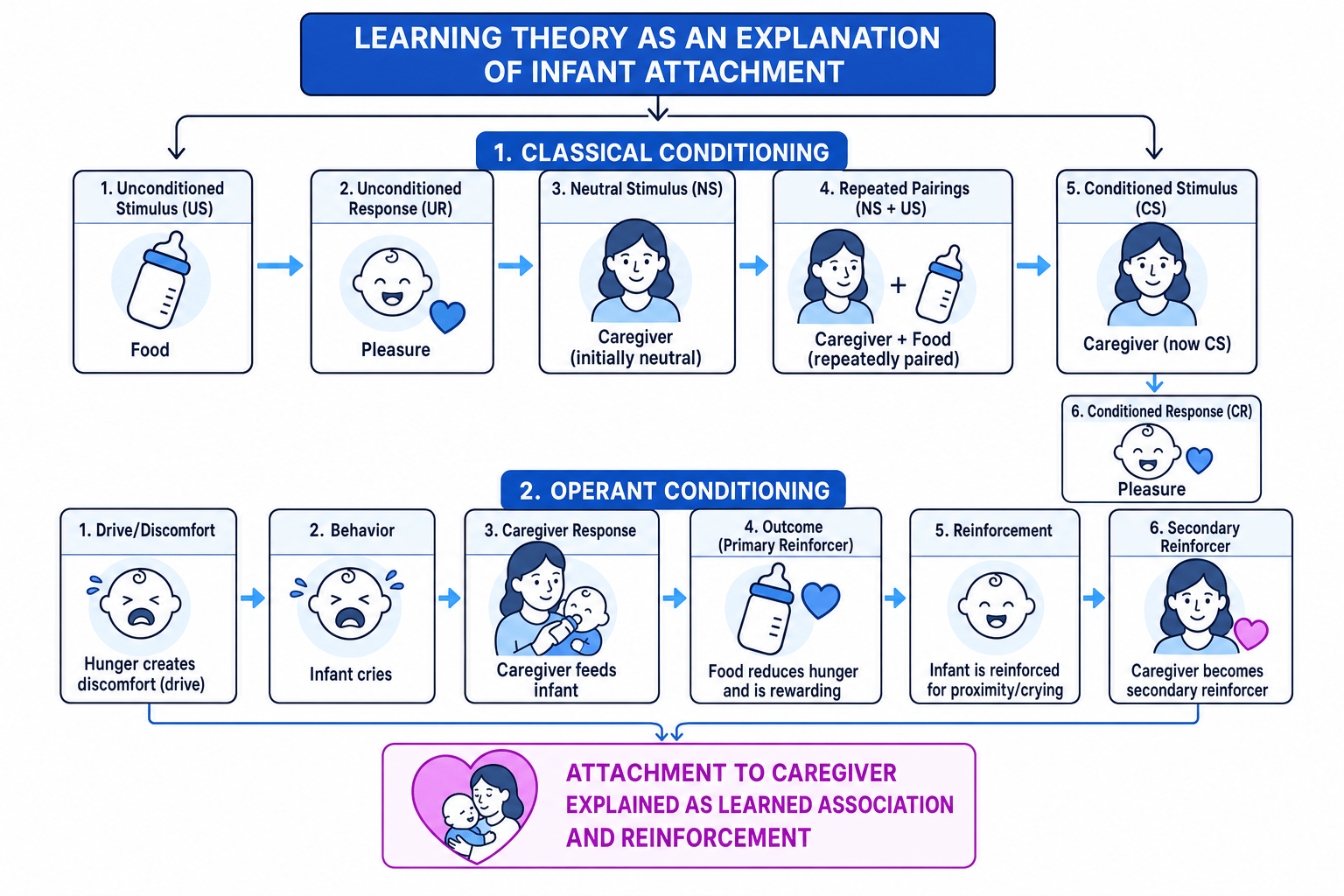
Infants become attached to caregivers because caregivers become associated with food and comfort, and because proximity-seeking behaviours are reinforced.
Classical conditioning
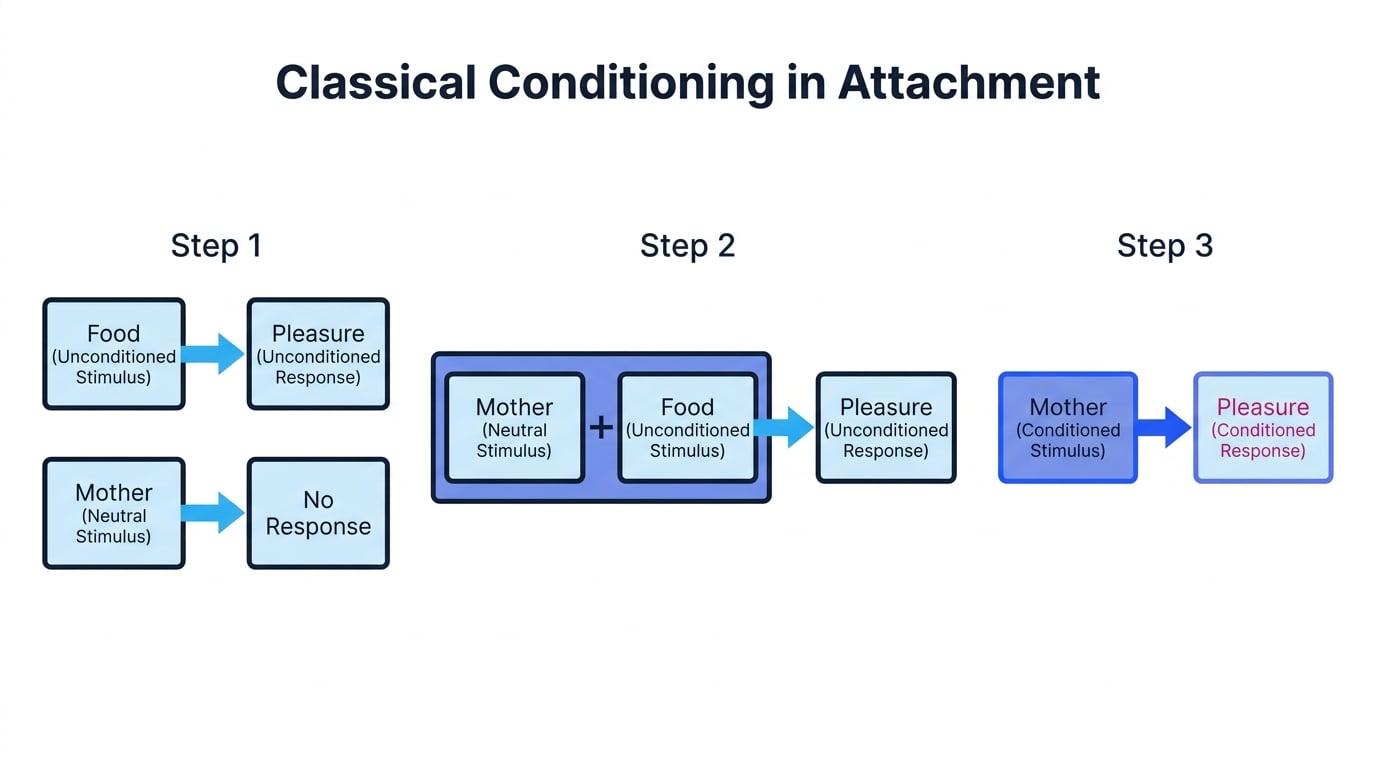
Classical conditioning is learning through association. A stimulus that originally produces no special response becomes associated with another stimulus that naturally produces a response.
In attachment:
- Food naturally produces pleasure.
- The caregiver is repeatedly paired with food.
- Eventually, the caregiver alone produces pleasure.
- The infant then seeks the caregiver because the caregiver has become associated with comfort.
Classical conditioning terms
An unconditioned stimulus is something that naturally produces a response, such as food. An unconditioned response is the natural response, such as pleasure. A neutral stimulus is something that initially produces no special response, such as the caregiver before learning. After association, the neutral stimulus becomes a conditioned stimulus, producing a conditioned response.
Operant conditioning
Operant conditioning is learning through consequences. If a behaviour is followed by a rewarding consequence, that behaviour is more likely to happen again.
In attachment:
- Hunger creates discomfort, which is a drive.
- Crying or seeking the caregiver leads to feeding.
- Feeding reduces hunger, which is rewarding.
- The infant is more likely to cry or stay close to the caregiver in future.
Reinforcement
Reinforcement is a consequence that increases the chance of a behaviour being repeated. Positive reinforcement adds something pleasant, such as food. Negative reinforcement removes something unpleasant, such as hunger or distress.
Food is a primary reinforcer because it satisfies a basic biological need. The caregiver becomes a secondary reinforcer because they are associated with food and comfort.
Applying learning theory to a caregiver scenario
A baby becomes excited when their father enters the room, even before the baby sees the bottle.
- Identify the natural link: milk is the unconditioned stimulus because it naturally produces pleasure, and pleasure is the unconditioned response.
- Identify the learned association: the father begins as a neutral stimulus, but he is repeatedly present when feeding happens.
- Apply classical conditioning: after repeated pairings, the father becomes a conditioned stimulus, so seeing him produces a conditioned response of pleasure.
- Add operant conditioning: crying and proximity-seeking have been reinforced because they led to feeding and hunger reduction, making the infant more likely to seek the father again.
Do not call the caregiver the unconditioned stimulus
In learning theory, the food is the unconditioned stimulus because it naturally produces pleasure. The caregiver starts as a neutral stimulus and becomes a conditioned stimulus after being paired with food.
Evaluating learning theory
Strength: it gives clear mechanisms
Learning theory is precise. It explains attachment using well-known learning processes: association, reinforcement, and drive reduction. This makes it easy to apply to scenarios and to test scientifically.
Weakness: Harlow’s monkeys contradict “cupboard love”
Harlow (1959) studied infant rhesus monkeys raised with two artificial mothers: one made of wire that provided food, and one covered in soft cloth that provided comfort. The monkeys spent far more time with the cloth mother, even when the wire mother provided milk.
This suggests contact comfort was more important than food, challenging the idea that attachment is mainly based on feeding.
Ethically, Harlow’s research is very problematic. The monkeys experienced distress, maternal deprivation, and later social difficulties. This raises issues of protection from harm, even though the study was influential in changing understanding of attachment and childcare.
Weakness: Schaffer and Emerson found feeding was not central
Schaffer and Emerson (1964) carried out a longitudinal study of 60 babies in Glasgow. They found many infants formed their main attachment to the person who was most responsive and interactive, not necessarily the person who fed them. In fact, a sizeable proportion of babies were most attached to someone other than the main feeder.
This challenges learning theory because it suggests sensitive responsiveness matters more than food.
Ethically, this study was much less harmful than Harlow’s. It involved real families being observed and interviewed, so key issues include parental consent, confidentiality, and avoiding distress or intrusion.
Overall judgement on learning theory
Learning theory may explain some behaviours around feeding and comfort, but it is too limited as a complete explanation. Human attachment seems to involve emotional sensitivity, interaction, and biological readiness, not just food.
Bowlby’s monotropic theory: attachment is innate
John Bowlby argued that attachment is an innate system. This means infants are biologically prepared to form attachments because attachment has survival value.
Monotropy
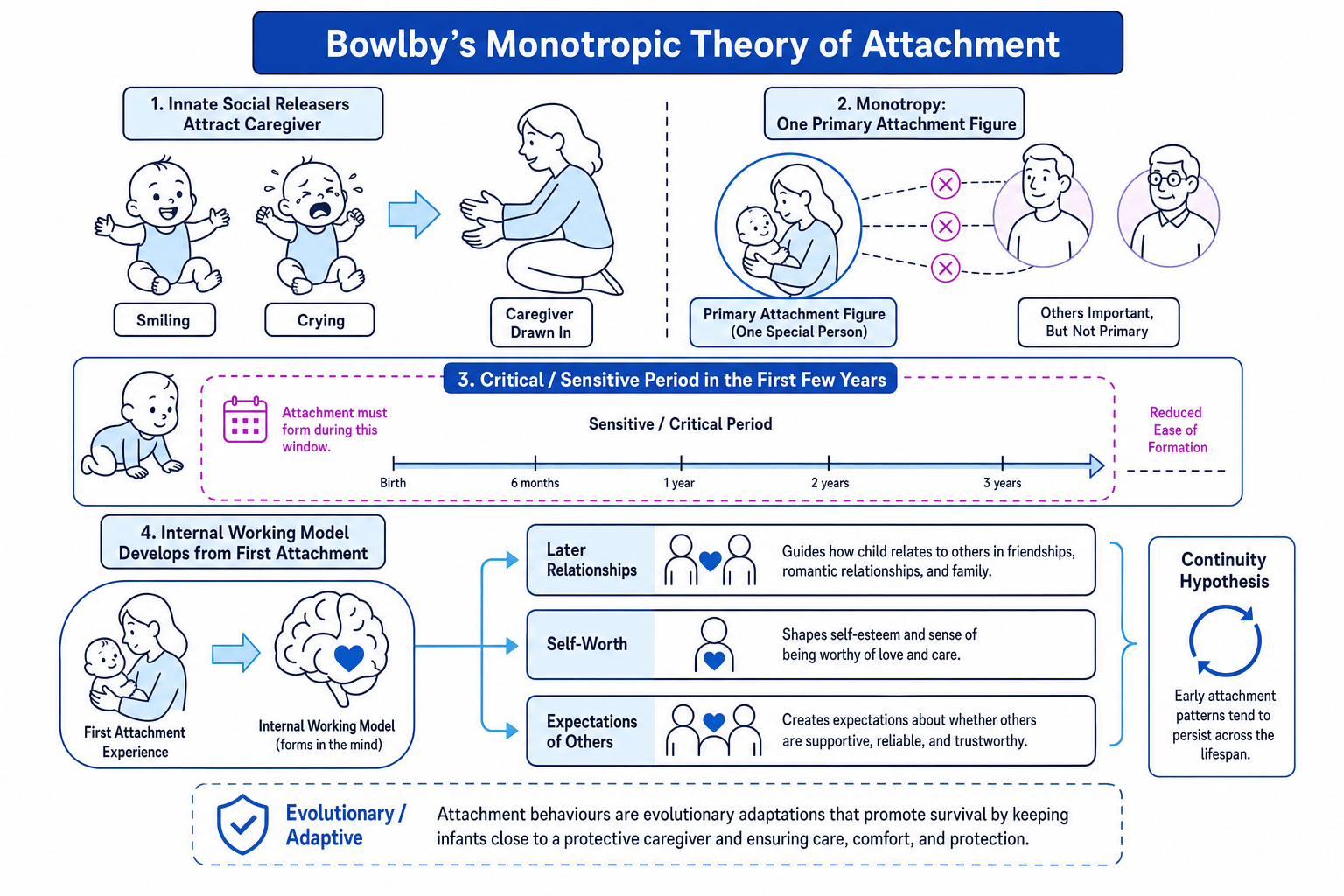
Monotropy is Bowlby’s idea that infants have an innate tendency to form one special attachment, usually with the mother or main caregiver. This person is the primary attachment figure.
Bowlby did not mean babies can only form one attachment. He argued they form a hierarchy, with one attachment being especially important.
Social releasers
Social releasers are innate behaviours that encourage caregiving, such as smiling, crying, gripping, and making eye contact. Bowlby argued these behaviours “unlock” adult caregiving responses.
This makes attachment adaptive: infants who keep caregivers close are more likely to be protected, fed, and kept safe.
The critical period
Critical period
A critical period is a biologically determined time window during which an attachment should form. Bowlby suggested this was roughly the first two to three years of life, often described as around the first 30 months.
Bowlby argued that if an attachment does not form during this period, later emotional and social development may be harmed.
Modern psychologists often prefer the term sensitive period. This means attachment is easiest during the early years, but not impossible later.
The internal working model
Internal working model
The internal working model is a mental template for relationships, formed from the infant’s first attachment. It shapes expectations about the self, other people, and future relationships.
If the first attachment is warm and reliable, the child may develop a model of themselves as lovable and others as trustworthy. If the first attachment is inconsistent or neglectful, the child may expect relationships to be unreliable.
This links to the continuity hypothesis, which is the idea that early attachment patterns tend to continue into later childhood, friendships, romantic relationships, and parenting.
Applying Bowlby’s theory to later relationships
A child has a highly responsive primary caregiver in infancy and later appears confident in friendships.
- Use social releasers: as an infant, behaviours such as smiling and crying would have encouraged caregiver attention and helped maintain closeness.
- Apply monotropy: Bowlby would argue the child formed a special bond with a primary attachment figure, giving them a secure base.
- Apply the internal working model: the child’s early experience of reliable care may have created expectations that others are trustworthy.
- Link to continuity: this internal model could help explain why the child later approaches friendships with confidence.
Monotropy does not mean only one attachment
Bowlby believed one attachment is usually the most important, but he accepted that infants can form multiple attachments to fathers, grandparents, siblings, or other caregivers.
Evaluating Bowlby’s theory
Strength: support from animal research
Lorenz (1935) found that goslings imprinted on the first moving object they saw during a brief early period. This supports the idea that attachment-like bonds can be innate and time-sensitive.
However, imprinting in birds is not the same as human emotional attachment. Generalising from geese to humans is limited. Animal research also raises ethical issues around separation, welfare, and protection from harm, although Lorenz’s work was less deliberately distressing than Harlow’s.
Strength: support for the internal working model
Bailey et al. (2007) studied 99 mothers and their babies. Mothers who reported poor attachment to their own mothers were more likely to have babies who were poorly attached to them. This supports Bowlby’s idea that early attachment experiences may influence later parenting.
However, the study is correlational, so it cannot prove cause and effect. Other factors, such as temperament, social support, or mental health, could influence both early and later relationships. Because the study involved sensitive family experiences, ethical issues include informed consent, confidentiality, and support if participants became distressed.
Hazan and Shaver (1987) also found links between adult romantic attachment styles and reported childhood attachment experiences. This supports continuity, but the method relied on self-report and memory, so responses may be inaccurate or biased.
Weakness: evidence for multiple attachments
Schaffer and Emerson (1964) found that many babies developed multiple attachments soon after their first attachment. Fathers, siblings, and grandparents could all become important attachment figures.
This challenges a very strict version of monotropy. However, Bowlby’s theory can partly cope with this because he argued for a hierarchy, not that all other attachments are irrelevant.
Weakness: temperament may be an alternative explanation
Kagan (1984) argued that a child’s temperament, meaning their innate personality or emotional style, may influence attachment. For example, naturally calm babies may form secure attachments more easily, while more anxious babies may find separation harder.
This challenges Bowlby because later relationship patterns might be caused partly by temperament, not only by the internal working model.
Socially sensitive implications
Bowlby’s theory has had useful real-world applications. It encouraged hospitals, nurseries, adoption agencies, and childcare settings to consider children’s need for stable emotional bonds.
However, it can also be socially sensitive. If presented too simplistically, monotropy may place unfair pressure or guilt on mothers, especially working mothers. A balanced exam answer should say that Bowlby emphasised a primary caregiver, but this does not have to mean the biological mother.
Best comparison point
Learning theory says attachment is mainly learned through food and reinforcement. Bowlby says attachment is mainly innate, adaptive, and based on a special early bond.
Putting it together for essays
For AO1, describe both explanations clearly:
- Learning theory: classical conditioning, operant conditioning, primary and secondary reinforcement.
- Bowlby: innate attachment system, social releasers, monotropy, critical period, internal working model.
For AO3, compare the explanations:
- Learning theory is clear but contradicted by Harlow and Schaffer and Emerson.
- Bowlby is broader and better supported by evidence on continuity, but monotropy and the critical period can be criticised.
- Both theories have ethical issues when supported by animal or family research.
In the exam
- Use the correct technical terms: for learning theory, name the stimulus-response terms; for Bowlby, name monotropy, critical period, and internal working model.
- Make evaluation specific: do not just say “research supports this” — name the study, state the finding, and explain how it supports or challenges the theory.
- Include a balanced judgement: learning theory explains some learned behaviours, but Bowlby gives a fuller explanation of emotional attachment and later relationships.
Check yourself
- How would classical conditioning explain a baby becoming attached to the person who feeds them?
- What is the difference between a critical period and a sensitive period?
- Give one piece of evidence that supports Bowlby and one piece of evidence that challenges him.