What you'll learn
- How the cognitive approach explains depression through patterns of thinking.
- Beck’s explanation: negative schemas, cognitive biases, and the negative triad.
- Ellis’s ABC model, including irrational beliefs such as “musts” and “shoulds”.
- How cognitive behaviour therapy (CBT) treats depression by challenging irrational thoughts.
Starting point: what does “cognitive” mean?
The cognitive approach focuses on mental processes: thoughts, beliefs, interpretations, expectations, memories, and attention. In depression, cognitive psychologists argue that it is not just what happens to a person that matters, but how they interpret what happens.
Depression
Depression is a mood disorder involving persistent low mood and/or loss of pleasure, often alongside symptoms such as low energy, sleep disturbance, changes in appetite, poor concentration, feelings of worthlessness, and suicidal thoughts.
The cognitive approach does not claim that depression is “just thinking negatively” or that the person is to blame. Instead, it suggests that some people become trapped in patterns of thinking that feel automatic and convincing, especially when they are under stress.
Core assumption
Depression can be maintained by distorted, negative interpretations of the self, the world, and the future.
The diagram summarises how Beck’s and Ellis’s explanations link to CBT treatment.
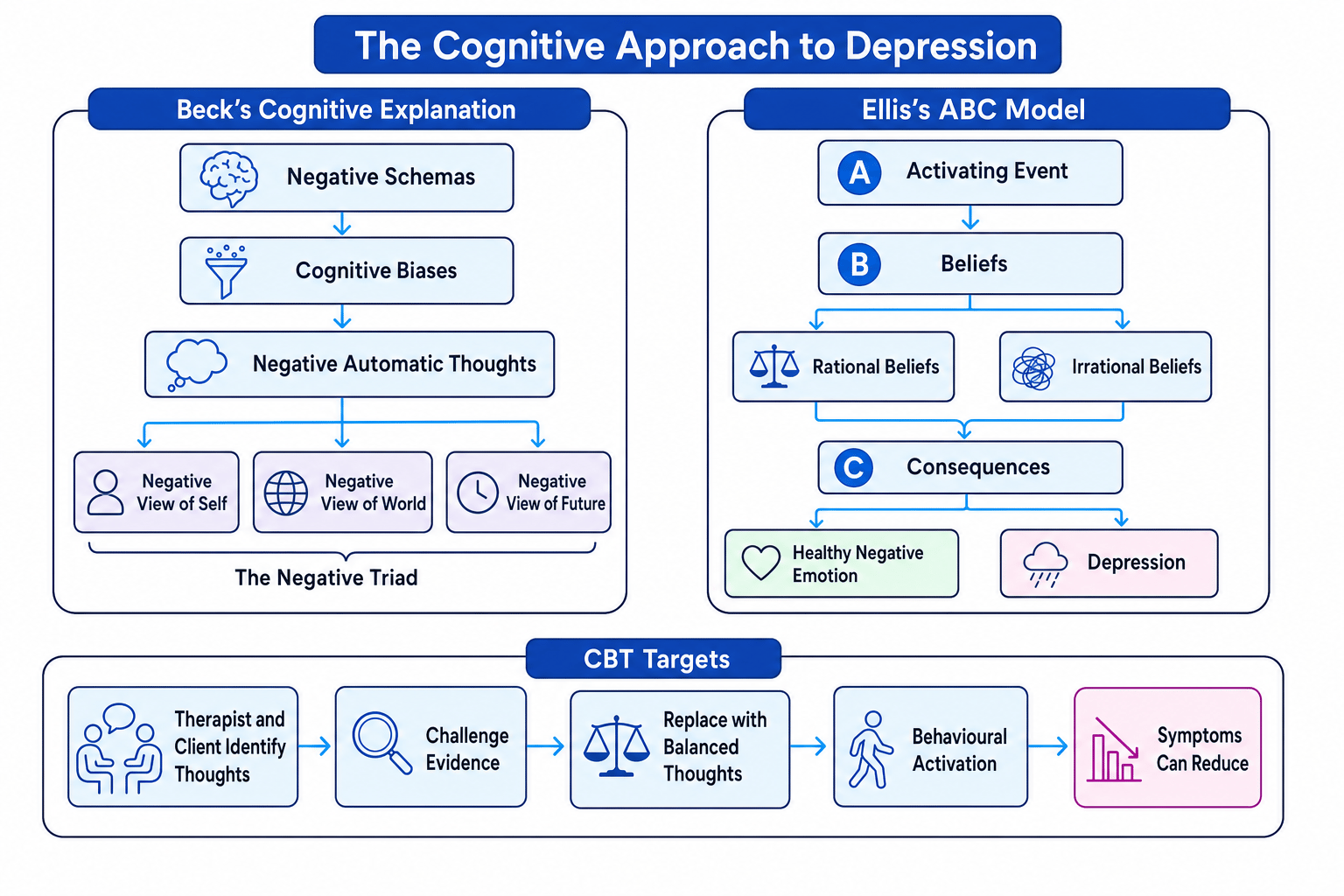
Beck’s cognitive explanation of depression
Aaron Beck (1967) argued that depression is linked to three related cognitive features: negative schemas, cognitive biases, and the negative triad.
Negative schemas
Schema
A schema is a mental framework that helps you organise and interpret information. A negative schema is a deeply held negative belief, often about the self, that influences how events are understood.
Beck suggested that negative schemas may develop from early negative experiences, such as criticism, rejection, bullying, or loss. Once formed, they can lie dormant until triggered by later stressful events.
For example, a person with the schema “I am not good enough” might interpret a low test mark as proof that they are a failure, even if most students found the test difficult.
Cognitive biases
Cognitive bias
A cognitive bias is a systematic error in thinking, where a person processes information in a distorted or one-sided way.
In depression, cognitive biases make the person focus on negative information and discount positive information. Examples include:
- Overgeneralisation: “I failed this test, so I fail at everything.”
- Selective attention: noticing only criticism and ignoring praise.
- Catastrophising: assuming the worst possible outcome will happen.
- Personalisation: blaming yourself for things outside your control.
Negative automatic thoughts
Negative automatic thought
A negative automatic thought is a quick, involuntary negative interpretation that pops into the mind and feels true, even when evidence for it is weak.
These thoughts can be very powerful because the person may not stop to evaluate them. They can become part of a cycle: negative thoughts lower mood, and low mood makes negative thoughts feel even more believable.
The negative triad
Beck’s most famous idea is the negative triad: three linked forms of negative thinking.
Negative triad
The negative triad is Beck’s idea that depressed people tend to hold negative views about the self, the world, and the future.
The triad works like this:
- Negative view of the self: “I am useless.”
- Negative view of the world: “Nobody cares about me.”
- Negative view of the future: “Things will never get better.”
Identifying the negative triad
A student thinks: “I’m stupid. Teachers always pick on me. I’ll never get into university.”
- Classify the first thought: “I’m stupid” is a negative view of the self, because the student is judging their own worth or ability.
- Classify the second thought: “Teachers always pick on me” is a negative view of the world, because the student sees other people and their environment as hostile.
- Classify the third thought: “I’ll never get into university” is a negative view of the future, because the student expects failure to continue.
Mixing up the triad
Do not describe the negative triad as “three symptoms of depression”. It is a set of negative beliefs that Beck argued can help explain depression.
Evaluating Beck’s explanation
Strength: research support
There is evidence that negative thinking is associated with depression. For example, Grazioli and Terry (2000) found that pregnant women with higher cognitive vulnerability were more likely to develop postnatal depression. This supports Beck’s view that negative beliefs can increase risk.
Beck’s theory also has strong practical value because it led directly to CBT, one of the most widely used psychological therapies for depression.
Limitation: cause or effect?
A major issue is that much evidence is correlational.
Correlation
A correlation is a relationship between two variables. It does not prove that one variable caused the other.
Negative thinking and depression often occur together, but this does not prove that negative thinking causes depression. It could be that depression causes more negative thinking, or that a third factor, such as stressful life events or biological vulnerability, causes both.
Limitation: incomplete explanation
Beck’s theory focuses on cognition, but depression can also involve biological factors, such as genes, neurotransmitters, and hormones. This means the cognitive explanation may be better as part of an interactionist account, where biological, psychological, and social factors combine.
AO3 phrase to remember
A strong evaluation point is: Beck’s theory has useful applications in CBT, but much supporting evidence is correlational, so cause and effect are difficult to establish.
Ellis’s ABC model
Albert Ellis (1962) developed a cognitive explanation called the ABC model. It explains emotional consequences by focusing on beliefs.
ABC model
The ABC model suggests that an Activating event does not directly cause an emotional Consequence. Instead, the consequence depends on the person’s Beliefs about the event.
The model has three parts:
- A: Activating event — something happens, such as failing a driving test.
- B: Beliefs — the person interprets the event.
- C: Consequences — emotional and behavioural outcomes follow.
Ellis argued that depression is especially linked to irrational beliefs.
Irrational belief
An irrational belief is an unrealistic, rigid, or self-defeating belief that interferes with healthy emotional responses.
Examples include:
- Musturbation: believing that things “must” or “should” be a certain way, such as “I must be liked by everyone.”
- Utopianism: believing life should always be fair and trouble-free.
- I-can’t-stand-it thinking: believing a difficult situation is unbearable.
- Global negative self-rating: judging the whole self based on one failure, such as “I failed, so I am worthless.”
Applying the ABC model
A student is not invited to a party and feels deeply depressed.
- Identify A, the activating event: the event is not being invited to the party.
- Identify B, the belief: the student may think, “If I am not invited, it means nobody likes me and I am worthless.”
- Identify C, the consequence: the emotional consequence is depressed mood, and the behavioural consequence might be withdrawing from friends.
- Check the model’s logic: Ellis would argue the event alone did not cause the depression; the irrational belief shaped the emotional consequence.
Ellis in one sentence
According to Ellis, depression often follows when a person interprets negative events through rigid, irrational beliefs.
Evaluating Ellis’s ABC model
Strength: useful for treatment
Ellis’s model led to rational emotive behaviour therapy, often considered an early form of CBT. It gives therapists a clear target: identify irrational beliefs and dispute them.
Limitation: not all depression follows an obvious event
The ABC model is easiest to apply when there is a clear activating event, such as a breakup or exam failure. However, some depression appears to develop gradually, without one obvious trigger. This makes the model less complete.
Limitation: may underplay emotion and biology
Ellis focuses heavily on beliefs, but depression can involve powerful emotional, motivational, and biological changes. Some patients may struggle to challenge beliefs because their concentration, energy, and sleep are severely affected.
A does not directly cause C
In Ellis’s model, the activating event does not directly produce the consequence. The belief is the key link.
CBT as a treatment for depression
Cognitive behaviour therapy
Cognitive behaviour therapy (CBT) is a psychological therapy that aims to change unhelpful thoughts and behaviours in order to improve emotional wellbeing.
CBT combines two parts:
- Cognitive work: identifying and challenging negative thoughts.
- Behavioural work: changing actions that maintain depression, such as avoidance and inactivity.
The therapist and client work collaboratively. The client is not simply “told to think positively”; they are helped to test whether their thoughts are realistic and useful.
Challenging irrational thoughts
CBT often involves cognitive restructuring.
Cognitive restructuring
Cognitive restructuring is the process of identifying, questioning, and replacing distorted thoughts with more balanced alternatives.
A therapist might ask questions such as:
- What evidence supports this thought?
- What evidence goes against it?
- Is there another explanation?
- What would you say to a friend in the same situation?
- Is the thought helpful, realistic, or exaggerated?
Behavioural activation
Behavioural activation
Behavioural activation is a CBT technique where the client gradually increases meaningful or enjoyable activities to reduce avoidance and improve mood.
For example, a depressed person may stop seeing friends, which reduces positive experiences and increases isolation. Behavioural activation helps break this cycle by scheduling manageable activities.
Challenging an irrational thought
A client thinks, “I made one mistake at work, so I am completely useless.”
- Identify the distortion: the thought shows overgeneralisation because one mistake is being used to judge the whole person.
- Examine evidence for the thought: the client did make a mistake, so there is some evidence that one task went wrong.
- Examine evidence against the thought: the client has completed many tasks successfully and still has their job, so “completely useless” is not supported.
- Create a balanced thought: “I made a mistake on one task, but that does not define my ability. I can learn from it and improve.”
- Link to behaviour: the client might agree to ask for feedback or try the task again, rather than avoiding work.
CBT is not just positive thinking
CBT aims for balanced, evidence-based thinking, not unrealistic optimism.
Evaluating CBT
Strength: strong evidence base
CBT is supported by many studies. For example, March et al. (2007) found that CBT was effective for adolescents with depression, and outcomes were especially strong when CBT was combined with antidepressant medication. Meta-analyses, such as Cuijpers et al. (2013), also suggest CBT is effective for many people with depression.
Strength: real-world application
CBT is widely used in the NHS and can be delivered face-to-face, in groups, online, or through guided self-help. This makes it practical and adaptable.
Limitation: individual differences
CBT does not work equally well for everyone. Some clients may have depression that is too severe for them to engage fully with homework tasks, thought records, or behavioural activation. Others may prefer medication, counselling, or a more trauma-focused therapy.
Limitation: possible overemphasis on the individual
CBT can sometimes seem to locate the problem inside the person’s thinking. This may underplay social causes of depression, such as poverty, discrimination, loneliness, family conflict, or stressful working conditions.
Ethical considerations in research and therapy
Research into depression involves potentially vulnerable participants. Studies should ensure informed consent, confidentiality, the right to withdraw, and careful protection from harm, especially where participants may experience suicidal thoughts. In therapy, clients should be debriefed about treatment aims, and risk should be monitored throughout.
Risk and responsibility
If a client expresses suicidal intent, confidentiality may need to be broken to protect them from serious harm. This should be handled according to professional ethical guidelines.
Beck vs Ellis: quick comparison
Both Beck and Ellis argue that thinking patterns are central to depression, but they emphasise slightly different processes.
Beck focuses on negative schemas, cognitive biases, and the negative triad. Ellis focuses on how irrational beliefs turn activating events into unhealthy emotional consequences.
For essays, you can treat them as complementary explanations: Beck gives a broad account of negative thinking in depression, while Ellis gives a clear sequence for how beliefs produce emotional outcomes.
In the exam
- For AO1, describe Beck and Ellis separately: Beck = negative schemas, cognitive biases, negative triad; Ellis = activating event, beliefs, consequences.
- For AO2, apply the theory to the person’s actual thoughts in the scenario, not just their behaviour.
- For AO3, balance support with limitations: mention research evidence, real-world CBT applications, correlational evidence, individual differences, and ethical issues with vulnerable participants.
Check yourself
- Can you explain why Beck’s negative triad includes the self, world, and future?
- Can you apply Ellis’s ABC model to a scenario involving exam failure or rejection?
- Can you describe how CBT challenges irrational thoughts without calling it “positive thinking”?
