7.3 The Factor Theorem
What you'll learn
- How substituting a number into a polynomial can test for a factor.
- How the factor theorem links factors, roots, and x-intercepts.
- How to use algebraic division to reduce a cubic to a quadratic.
- How to factorise and solve cubic equations in exam-style problems.
1. Prerequisites: polynomials and substitution
A lot of this topic is about being organised with substitution. You will often be given a polynomial such as
f(x)=2x3−5x2−4x+3f(x)=2x^3-5x^2-4x+3f(x)=2x3−5x2−4x+3and asked to test whether a particular bracket is a factor.
Polynomial
A polynomial is an expression made from powers of a variable with number coefficients, such as x3−4x+7x^3-4x+7x3−4x+7. The highest power tells you its degree. For example, a cubic has degree 3.
When you see f(2)f(2)f(2), it means “put x=2x=2x=2 into the expression for f(x)f(x)f(x)”.
Evaluating a polynomial
For f(x)=3x3−2x2−11x+6f(x)=3x^3-2x^2-11x+6f(x)=3x3−2x2−11x+6, find f(2)f(2)f(2).
-
Substitute x=2x=2x=2 into every place where xxx appears.
f(2)=3(2)3−2(2)2−11(2)+6f(2)=3(2)^3-2(2)^2-11(2)+6f(2)=3(2)3−2(2)2−11(2)+6 -
Work out the powers first.
f(2)=3(8)−2(4)−22+6f(2)=3(8)-2(4)-22+6f(2)=3(8)−2(4)−22+6 -
Simplify carefully.
f(2)=24−8−22+6=0f(2)=24-8-22+6=0f(2)=24−8−22+6=0 -
So f(2)=0f(2)=0f(2)=0.
Substituting negatives
If you substitute a negative number, use brackets. For example, when x=−3x=-3x=−3, write (−3)2=9(-3)^2=9(−3)2=9 and (−3)3=−27(-3)^3=-27(−3)3=−27. Missing brackets is one of the quickest ways to lose accuracy.
2. Factors, roots, and the x-axis
A factor is something that divides exactly into an expression. For example, x−2x-2x−2 is a factor of a polynomial if dividing by x−2x-2x−2 leaves no remainder.
A root or solution of f(x)=0f(x)=0f(x)=0 is a value of xxx that makes the polynomial equal zero.
These two ideas are connected:
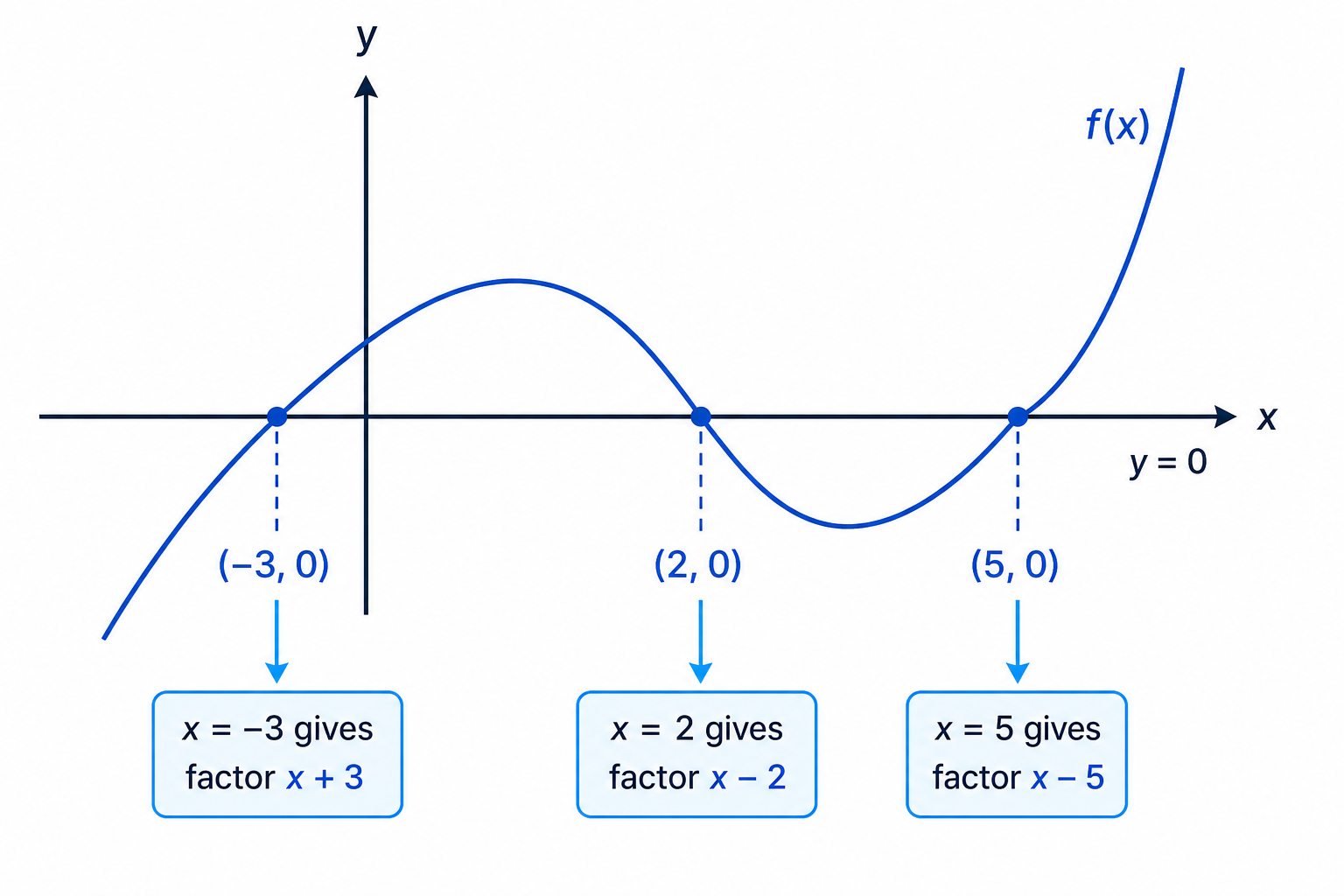
- If x=2x=2x=2 is a root, then x−2x-2x−2 is a factor.
- If x=−3x=-3x=−3 is a root, then x+3x+3x+3 is a factor.
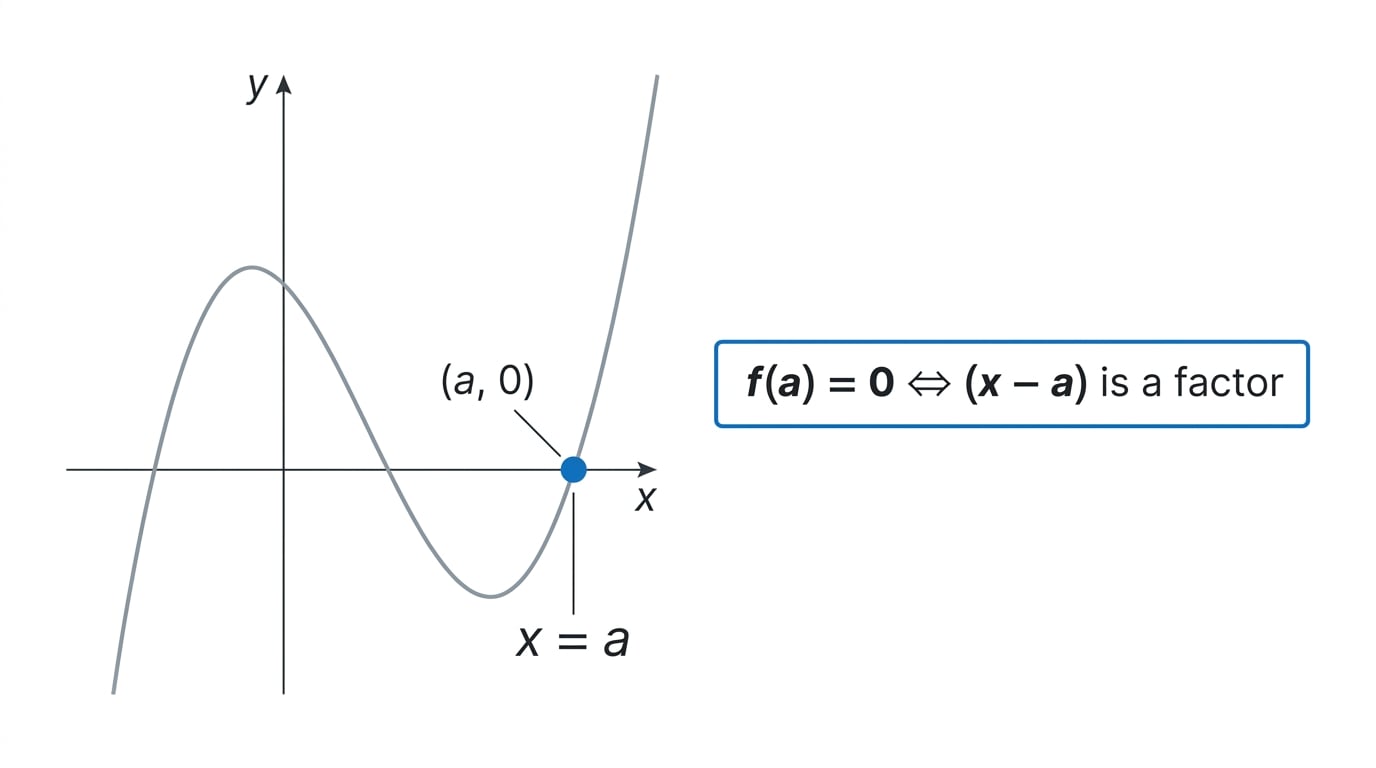
On a graph, roots are the places where the curve crosses or touches the x-axis.
Root to factor
If the root is x=ax=ax=a, the matching factor is x−ax-ax−a. Be especially careful with signs: root x=−3x=-3x=−3 gives factor x+3x+3x+3.
Matching roots and factors
Write down the factor corresponding to each root.
-
If x=5x=5x=5 is a root, then the factor is x−5x-5x−5.
-
If x=−4x=-4x=−4 is a root, then the factor is x+4x+4x+4.
-
If x=12x=\frac{1}{2}x=21 is a root, then the factor is x−12x-\frac{1}{2}x−21. You may also see the equivalent integer-coefficient factor 2x−12x-12x−1.
3. The factor theorem
The factor theorem is the main result for this topic.
The factor theorem
For a polynomial f(x)f(x)f(x), the bracket x−ax-ax−a is a factor of f(x)f(x)f(x) if and only if f(a)=0f(a)=0f(a)=0.
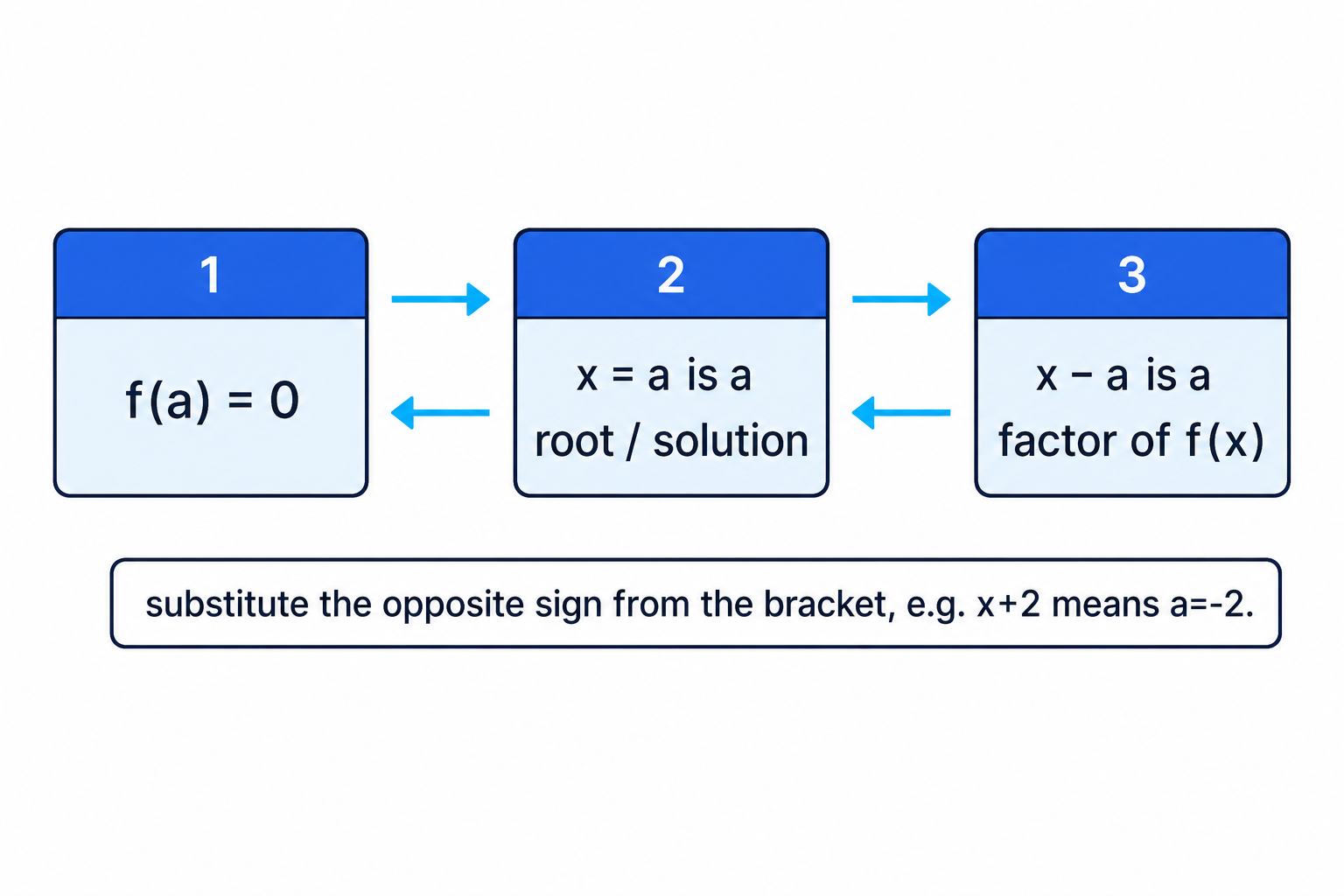
This means you do not need to divide straight away. You can test a possible factor by substitution first.
Showing a bracket is a factor
Show that x+2x+2x+2 is a factor of f(x)=2x3+3x2−8x−12f(x)=2x^3+3x^2-8x-12f(x)=2x3+3x2−8x−12.
-
Rewrite the bracket in the form x−ax-ax−a. Since x+2=x−(−2)x+2=x-(-2)x+2=x−(−2), we need to test x=−2x=-2x=−2.
-
Substitute x=−2x=-2x=−2 into f(x)f(x)f(x).
f(−2)=2(−2)3+3(−2)2−8(−2)−12f(-2)=2(-2)^3+3(-2)^2-8(-2)-12f(−2)=2(−2)3+3(−2)2−8(−2)−12 -
Simplify.
f(−2)=2(−8)+3(4)+16−12f(-2)=2(-8)+3(4)+16-12f(−2)=2(−8)+3(4)+16−12 -
Finish the calculation.
f(−2)=−16+12+16−12=0f(-2)=-16+12+16-12=0f(−2)=−16+12+16−12=0 -
Since f(−2)=0f(-2)=0f(−2)=0, by the factor theorem, x+2x+2x+2 is a factor of f(x)f(x)f(x).
Exam wording
If the question says “use the factor theorem to show”, you must explicitly calculate the relevant value, get zero, and then state the conclusion.
4. Finding a factor by trying possible roots
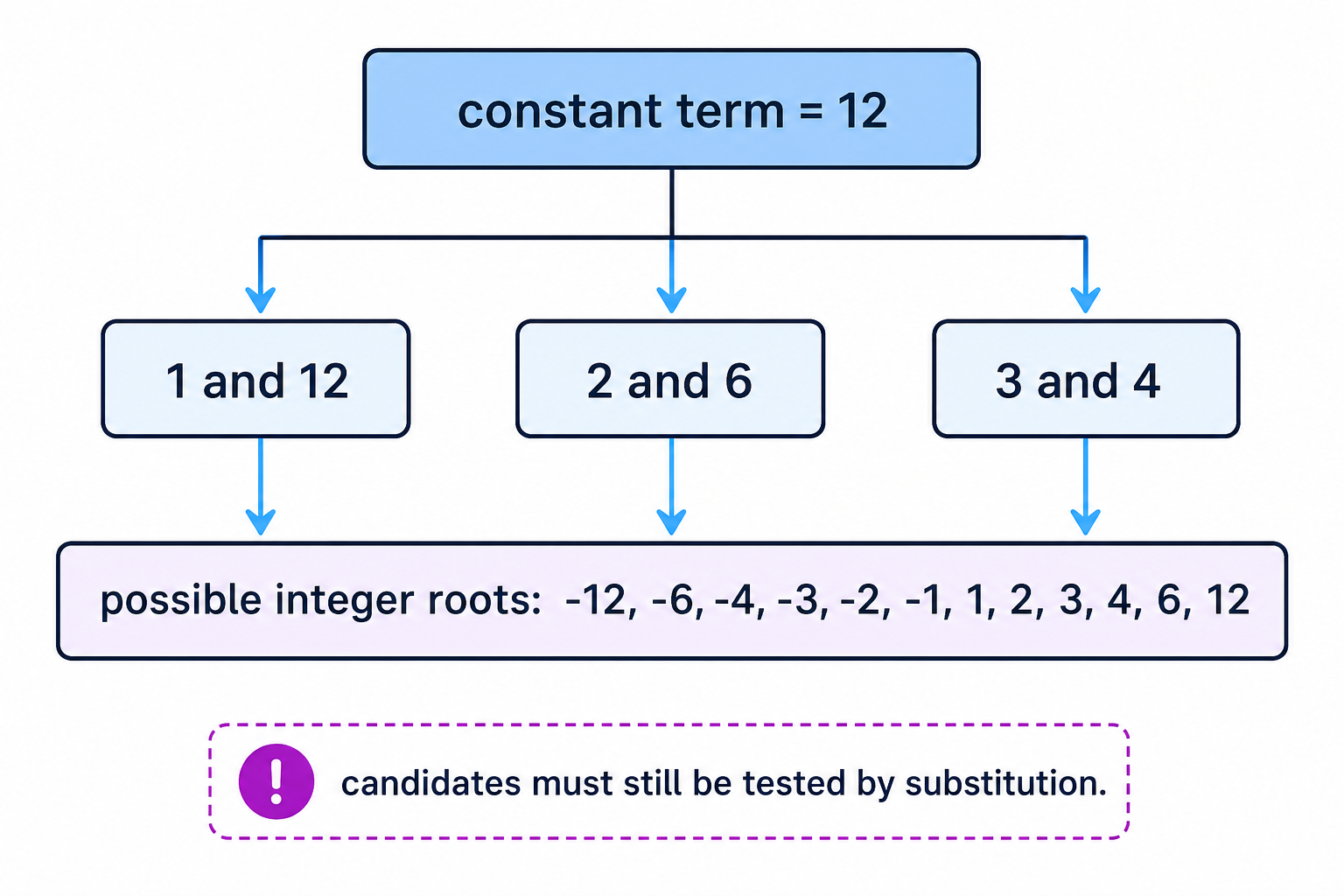
For cubics with integer coefficients, likely integer roots often come from the factors of the constant term.
For example, if the constant term is 12, possible integer roots include plus or minus 1, 2, 3, 4, 6, and 12.
Possible roots are only candidates
Factors of the constant term give values worth trying, but they are not guaranteed roots. You still need to test them by substitution.
Finding a factor of a cubic
Let f(x)=x3−4x2−x+4f(x)=x^3-4x^2-x+4f(x)=x3−4x2−x+4. Find a linear factor.
-
The constant term is 4, so try small factors such as 1, -1, 2, and -2.
-
Test x=1x=1x=1 first.
f(1)=13−4(1)2−1+4f(1)=1^3-4(1)^2-1+4f(1)=13−4(1)2−1+4 -
Simplify.
f(1)=1−4−1+4=0f(1)=1-4-1+4=0f(1)=1−4−1+4=0 -
Since f(1)=0f(1)=0f(1)=0, the factor theorem tells us that x−1x-1x−1 is a factor.
5. Algebraic division after finding a factor
Once you know one linear factor of a cubic, you can divide the cubic by that factor. This leaves a quadratic, which you can usually factorise or solve with the quadratic formula.
Cubic to quadratic
The factor theorem finds a linear factor. Algebraic division then reduces a cubic to a quadratic, which is much easier to finish.
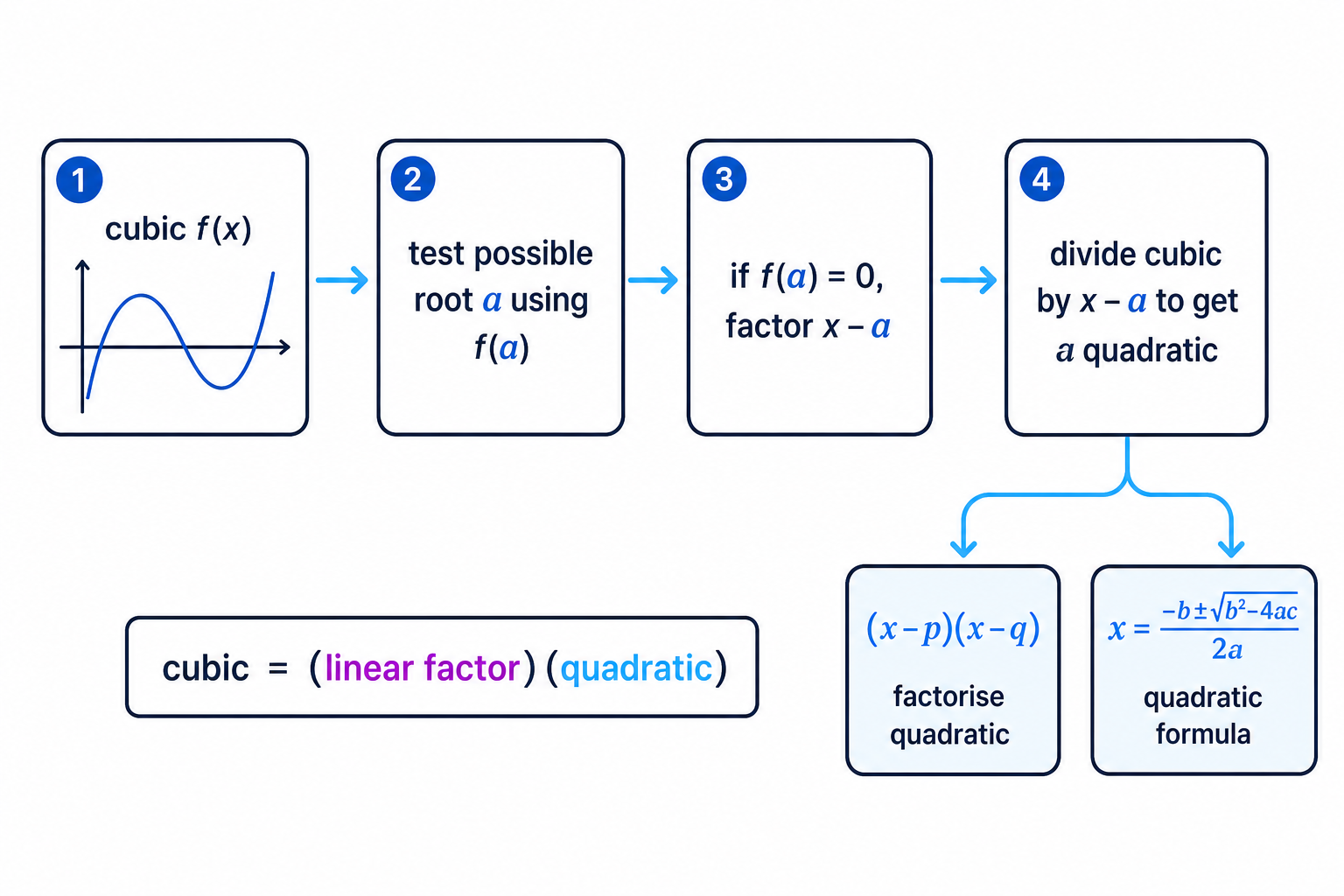
You may use long division or coefficient comparison. Coefficient comparison is often quick once the factor is known.
Factorising a cubic completely
Factorise f(x)=2x3−3x2−11x+6f(x)=2x^3-3x^2-11x+6f(x)=2x3−3x2−11x+6 completely.
-
Try x=2x=2x=2.
f(2)=2(2)3−3(2)2−11(2)+6f(2)=2(2)^3-3(2)^2-11(2)+6f(2)=2(2)3−3(2)2−11(2)+6 -
Simplify.
f(2)=16−12−22+6=−12f(2)=16-12-22+6=-12f(2)=16−12−22+6=−12 -
This is not zero, so x−2x-2x−2 is not a factor. Now try x=3x=3x=3.
f(3)=2(3)3−3(3)2−11(3)+6f(3)=2(3)^3-3(3)^2-11(3)+6f(3)=2(3)3−3(3)2−11(3)+6 -
Simplify.
f(3)=54−27−33+6=0f(3)=54-27-33+6=0f(3)=54−27−33+6=0 -
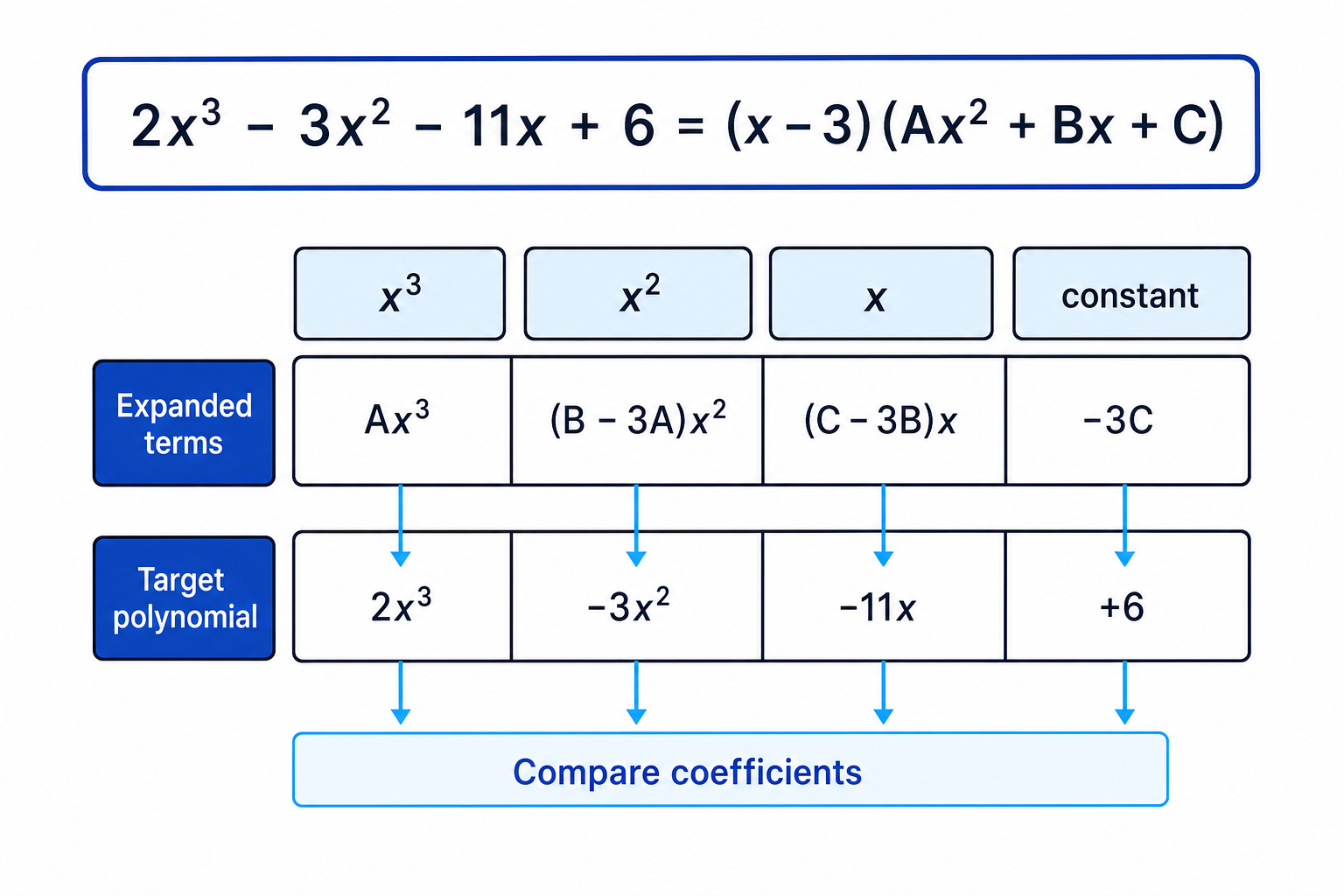
Therefore x−3x-3x−3 is a factor. Write
2x3−3x2−11x+6=(x−3)(Ax2+Bx+C)2x^3-3x^2-11x+6=(x-3)(Ax^2+Bx+C)2x3−3x2−11x+6=(x−3)(Ax2+Bx+C) -
Expand the right-hand side.
(x−3)(Ax2+Bx+C)=Ax3+(B−3A)x2+(C−3B)x−3C(x-3)(Ax^2+Bx+C)=Ax^3+(B-3A)x^2+(C-3B)x-3C(x−3)(Ax2+Bx+C)=Ax3+(B−3A)x2+(C−3B)x−3C -
Compare coefficients with 2x3−3x2−11x+62x^3-3x^2-11x+62x3−3x2−11x+6.
A=2,B−3A=−3,C−3B=−11,−3C=6A=2,\qquad B-3A=-3,\qquad C-3B=-11,\qquad -3C=6A=2,B−3A=−3,C−3B=−11,−3C=6 -
Solve these values. From A=2A=2A=2, then B−6=−3B-6=-3B−6=−3, so B=3B=3B=3. From −3C=6-3C=6−3C=6, C=−2C=-2C=−2. The quadratic factor is 2x2+3x−22x^2+3x-22x2+3x−2.
-
Factorise the quadratic.
2x2+3x−2=(2x−1)(x+2)2x^2+3x-2=(2x-1)(x+2)2x2+3x−2=(2x−1)(x+2) -
So the complete factorisation is
f(x)=(x−3)(2x−1)(x+2)f(x)=(x-3)(2x-1)(x+2)f(x)=(x−3)(2x−1)(x+2)
Stopping too early
If the question says “factorise completely”, do not stop at a linear factor times a quadratic unless the quadratic cannot be factorised further over the required number system.
6. Finding unknown coefficients using given values
Sometimes the polynomial contains unknown constants, such as ppp, qqq, or kkk. Given information like f(4)=0f(4)=0f(4)=0 can be turned into equations.
Finding unknowns, then factorising
Let f(x)=x3+2x2+px+qf(x)=x^3+2x^2+px+qf(x)=x3+2x2+px+q. Given that f(2)=0f(2)=0f(2)=0 and f(−3)=10f(-3)=10f(−3)=10, find ppp and qqq, then factorise f(x)f(x)f(x).
-
Use f(2)=0f(2)=0f(2)=0.
23+2(2)2+2p+q=02^3+2(2)^2+2p+q=023+2(2)2+2p+q=0 -
Simplify to get the first equation.
8+8+2p+q=08+8+2p+q=08+8+2p+q=0 -
So
2p+q=−162p+q=-162p+q=−16 -
Use f(−3)=10f(-3)=10f(−3)=10.
(−3)3+2(−3)2−3p+q=10(-3)^3+2(-3)^2-3p+q=10(−3)3+2(−3)2−3p+q=10 -
Simplify to get the second equation.
−27+18−3p+q=10-27+18-3p+q=10−27+18−3p+q=10 -
So
−3p+q=19-3p+q=19−3p+q=19 -
Solve the simultaneous equations.
2p+q=−16−3p+q=19\begin{aligned} 2p+q&=-16\\ -3p+q&=19 \end{aligned}2p+q−3p+q=−16=19 -
Subtract the second equation from the first.
5p=−355p=-355p=−35 -
Hence p=−7p=-7p=−7. Substitute into 2p+q=−162p+q=-162p+q=−16.
2(−7)+q=−162(-7)+q=-162(−7)+q=−16 -
So q=−2q=-2q=−2, and therefore
f(x)=x3+2x2−7x−2f(x)=x^3+2x^2-7x-2f(x)=x3+2x2−7x−2 -
Since f(2)=0f(2)=0f(2)=0, x−2x-2x−2 is a factor. Divide or compare coefficients:
x3+2x2−7x−2=(x−2)(x2+4x+1)x^3+2x^2-7x-2=(x-2)(x^2+4x+1)x3+2x2−7x−2=(x−2)(x2+4x+1) -
The quadratic does not factorise neatly using integers, so the factorised form is
(x−2)(x2+4x+1)(x-2)(x^2+4x+1)(x−2)(x2+4x+1)
7. Solving cubic equations
To solve a cubic equation:
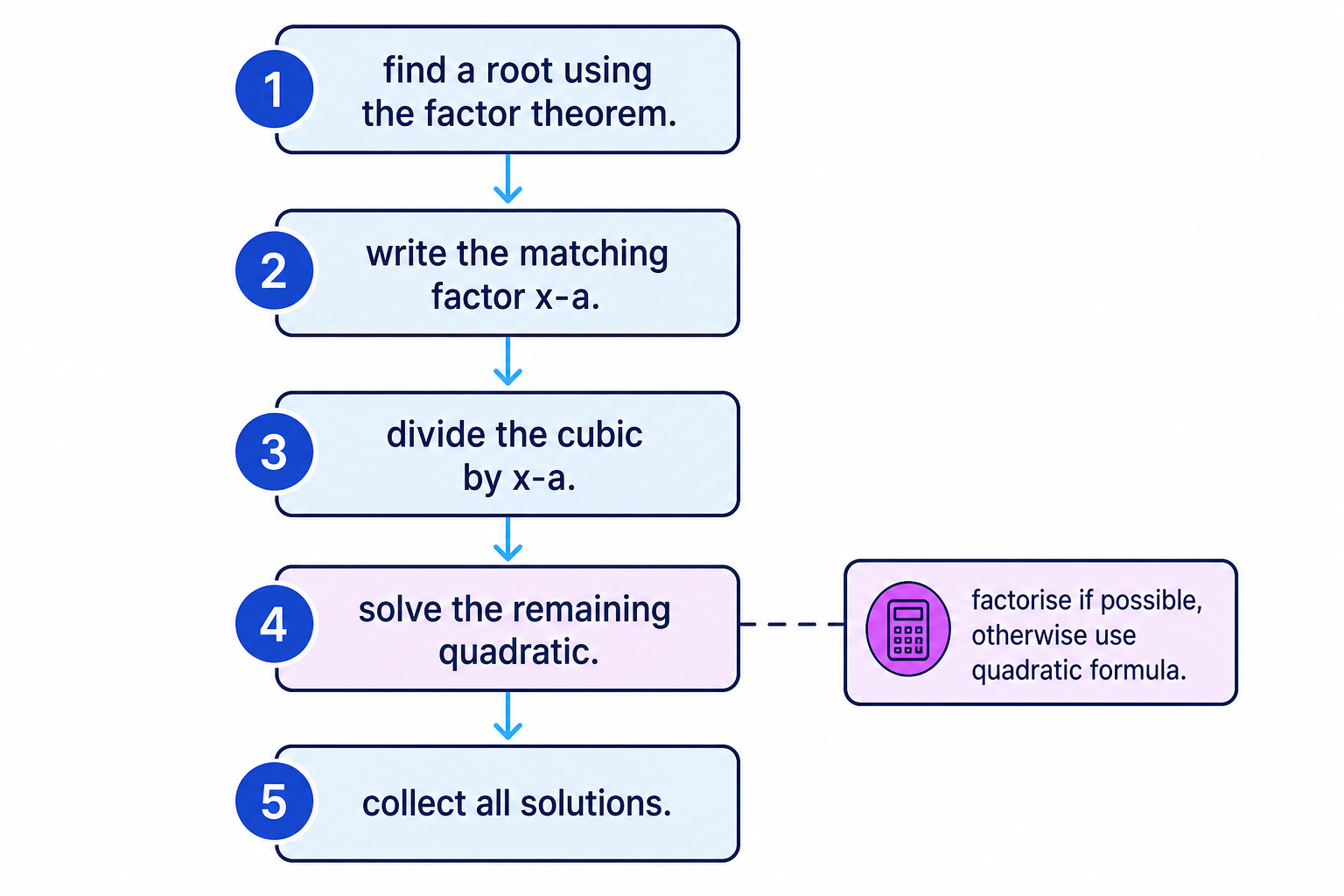
- Find one root using the factor theorem.
- Divide by the matching linear factor.
- Solve the remaining quadratic.
If the quadratic does not factorise, use the quadratic formula:
x=−b±b2−4ac2ax=\frac{-b\pm\sqrt{b^2-4ac}}{2a}x=2a−b±b2−4acSolving a cubic equation
Solve x3+4x2−x−4=0x^3+4x^2-x-4=0x3+4x2−x−4=0.
-
Let f(x)=x3+4x2−x−4f(x)=x^3+4x^2-x-4f(x)=x3+4x2−x−4. Test x=1x=1x=1.
f(1)=1+4−1−4=0f(1)=1+4-1-4=0f(1)=1+4−1−4=0 -
So x=1x=1x=1 is a solution and x−1x-1x−1 is a factor.
-
Divide by x−1x-1x−1 or compare coefficients.
x3+4x2−x−4=(x−1)(x2+5x+4)x^3+4x^2-x-4=(x-1)(x^2+5x+4)x3+4x2−x−4=(x−1)(x2+5x+4) -
Factorise the quadratic.
x2+5x+4=(x+1)(x+4)x^2+5x+4=(x+1)(x+4)x2+5x+4=(x+1)(x+4) -
Therefore
x3+4x2−x−4=(x−1)(x+1)(x+4)x^3+4x^2-x-4=(x-1)(x+1)(x+4)x3+4x2−x−4=(x−1)(x+1)(x+4) -
Set each factor equal to zero.
x−1=0,x+1=0,x+4=0x-1=0,\qquad x+1=0,\qquad x+4=0x−1=0,x+1=0,x+4=0 -
The solutions are
x=1,x=−1,x=−4x=1,\qquad x=-1,\qquad x=-4x=1,x=−1,x=−4
When the quadratic needs decimals
Solve x3+5x2+x−7=0x^3+5x^2+x-7=0x3+5x2+x−7=0, giving non-integer answers to 2 decimal places.
-
Test x=1x=1x=1.
f(1)=1+5+1−7=0f(1)=1+5+1-7=0f(1)=1+5+1−7=0 -
So x−1x-1x−1 is a factor.
-
Divide the cubic by x−1x-1x−1.
x3+5x2+x−7=(x−1)(x2+6x+7)x^3+5x^2+x-7=(x-1)(x^2+6x+7)x3+5x2+x−7=(x−1)(x2+6x+7) -
Solve the quadratic x2+6x+7=0x^2+6x+7=0x2+6x+7=0 using the quadratic formula, where a=1a=1a=1, b=6b=6b=6, and c=7c=7c=7.
x=−6±62−4(1)(7)2(1)x=\frac{-6\pm\sqrt{6^2-4(1)(7)}}{2(1)}x=2(1)−6±62−4(1)(7) -
Simplify.
x=−6±82x=\frac{-6\pm\sqrt{8}}{2}x=2−6±8 -
This gives the two decimal roots.
x≈−1.59,x≈−4.41x\approx -1.59,\qquad x\approx -4.41x≈−1.59,x≈−4.41 -
Include the root from the linear factor as well.
x=1,x≈−1.59,x≈−4.41x=1,\qquad x\approx -1.59,\qquad x\approx -4.41x=1,x≈−1.59,x≈−4.41
In the exam
- If asked to “show” a factor, substitute the correct value and clearly write that the result is zero.
- After finding a factor of a cubic, divide to get a quadratic, then factorise or use the quadratic formula.
- Always check signs: x+3x+3x+3 means test x=−3x=-3x=−3, while x−3x-3x−3 means test x=3x=3x=3.
Check yourself
- If f(−4)=0f(-4)=0f(−4)=0, what linear factor must f(x)f(x)f(x) have?
- How would you show that x−2x-2x−2 is a factor without doing division?
- After dividing a cubic by a known factor, what type of expression should be left?