6.2 Equation of a Circle
What you'll learn
- Write a circle equation in centre-radius form: the version that shows the centre and radius immediately.
- Use completing the square to find the centre and radius from an expanded equation.
- Find a circle equation from a centre and a point, or from a diameter.
- Handle lines that meet or touch a circle, including exact intersections and tangents.
1. The basic geometry of a circle
A circle is all about distance. Every point on the circle is the same distance from one fixed point.
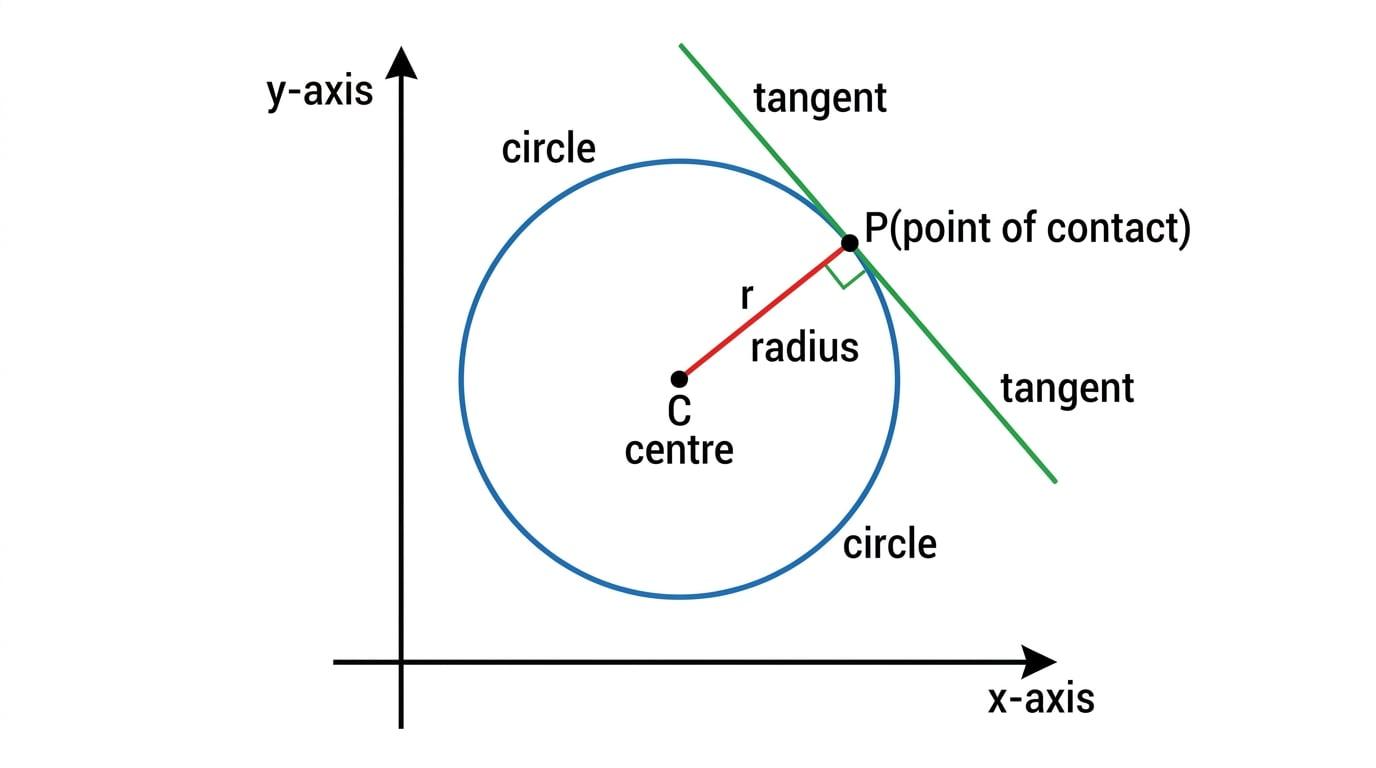
Circle, centre, radius and tangent
-
A circle is the set of all points a fixed distance from a fixed point.
-
The centre is the fixed point in the middle of the circle.
-
The radius is the fixed distance from the centre to any point on the circle.
-
A tangent is a straight line that touches a circle at exactly one point, called the point of contact.
The diagram shows the main geometry: every point on the circle is the same distance from the centre, and a tangent is at right angles to the radius at the point of contact.
Centre-radius form
If a circle has centre (a,b)(a,b)(a,b) and radius rrr, then its equation is
(x−a)2+(y−b)2=r2(x-a)^2+(y-b)^2=r^2(x−a)2+(y−b)2=r2Notice the signs: if the centre is (−2,3)(-2,3)(−2,3), the bracket is (x+2)2(x+2)^2(x+2)2, not (x−2)2(x-2)^2(x−2)2.
Writing an equation from centre and radius
A circle has centre (−2,3)(-2,3)(−2,3) and radius 4. Find its equation.
-
Start with the centre-radius form:
(x−a)2+(y−b)2=r2(x-a)^2+(y-b)^2=r^2(x−a)2+(y−b)2=r2 -
Here a=−2a=-2a=−2, b=3b=3b=3 and r=4r=4r=4, so substitute these values:
(x−(−2))2+(y−3)2=42(x-(-2))^2+(y-3)^2=4^2(x−(−2))2+(y−3)2=42 -
Simplify the brackets and the radius squared:
(x+2)2+(y−3)2=16(x+2)^2+(y-3)^2=16(x+2)2+(y−3)2=16
2. Finding the radius from a point on the circle
The distance formula gives the distance between two points. If the points are (x1,y1)(x_1,y_1)(x1,y1) and (x2,y2)(x_2,y_2)(x2,y2), then
distance=(x2−x1)2+(y2−y1)2\text{distance}=\sqrt{(x_2-x_1)^2+(y_2-y_1)^2}distance=(x2−x1)2+(y2−y1)2For circle equations, it is often quicker to find r2r^2r2 directly, because the equation uses r2r^2r2.
Centre and a point on the circle
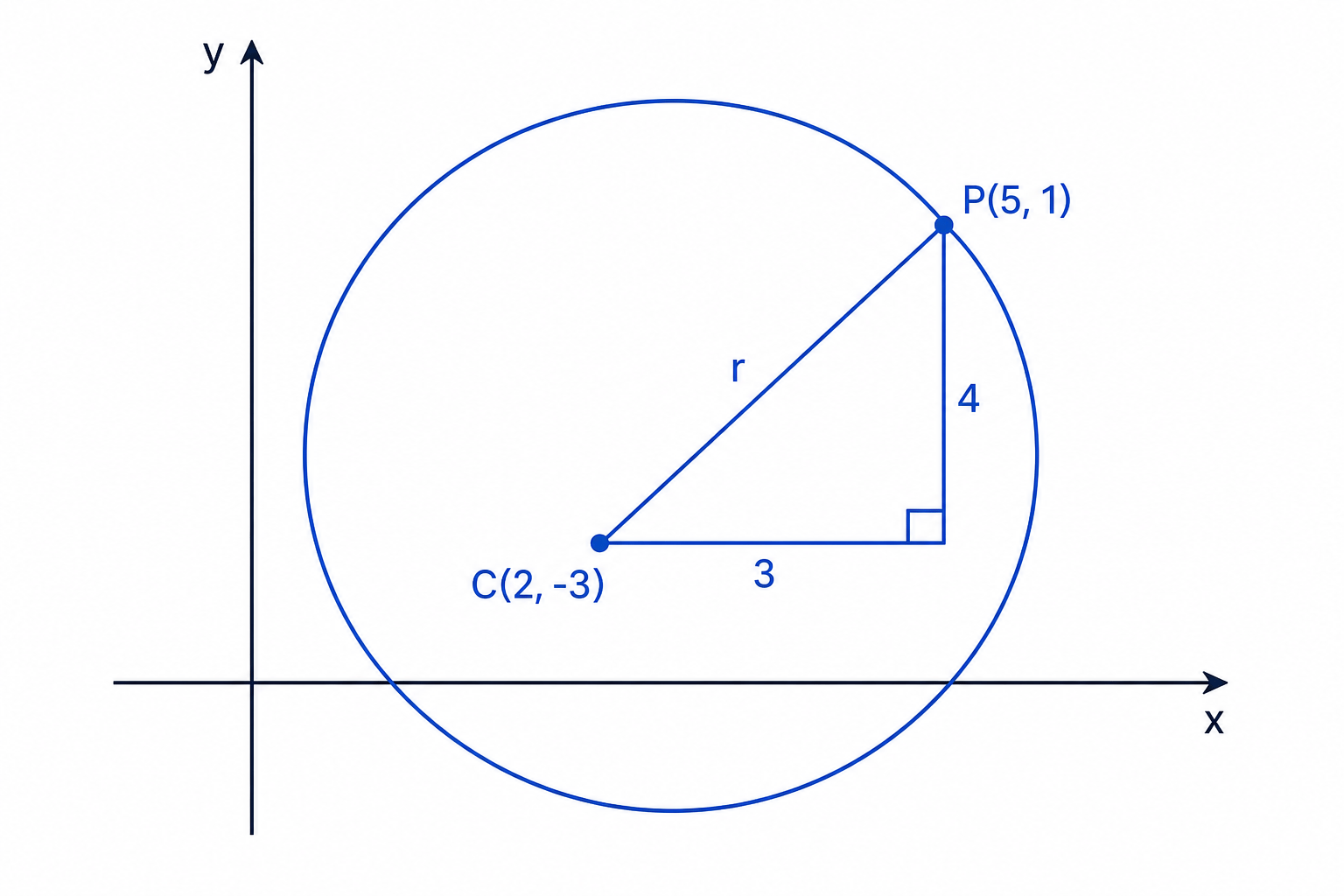
A circle has centre (2,−3)(2,-3)(2,−3) and passes through the point (5,1)(5,1)(5,1). Find its equation.
-
Find r2r^2r2 using the distance from the centre to the point:
r2=(5−2)2+(1−(−3))2=32+42=25\begin{aligned} r^2&=(5-2)^2+(1-(-3))^2\\ &=3^2+4^2\\ &=25 \end{aligned}r2=(5−2)2+(1−(−3))2=32+42=25 -
Substitute the centre and r2=25r^2=25r2=25 into the circle equation:
(x−2)2+(y+3)2=25(x-2)^2+(y+3)^2=25(x−2)2+(y+3)2=25
Use radius squared when possible
If you are writing the equation of a circle, you do not always need to find rrr. Finding r2r^2r2 is enough.
3. Expanded form and completing the square
Circle equations are not always given neatly in centre-radius form. They may be expanded, such as
x2+y2+6x−8y=11x^2+y^2+6x-8y=11x2+y2+6x−8y=11To recover the centre and radius, use completing the square.
Completing the square
Completing the square means rewriting a quadratic expression using a squared bracket, such as changing x2+6xx^2+6xx2+6x into (x+3)2−9(x+3)^2-9(x+3)2−9.
The pattern is: halve the coefficient of xxx, put it inside the bracket, then subtract the square you have added.
x2+6x=(x+3)2−9y2−8y=(y−4)2−16\begin{aligned} x^2+6x&=(x+3)^2-9\\ y^2-8y&=(y-4)^2-16 \end{aligned}x2+6xy2−8y=(x+3)2−9=(y−4)2−16Finding centre and radius from an expanded equation
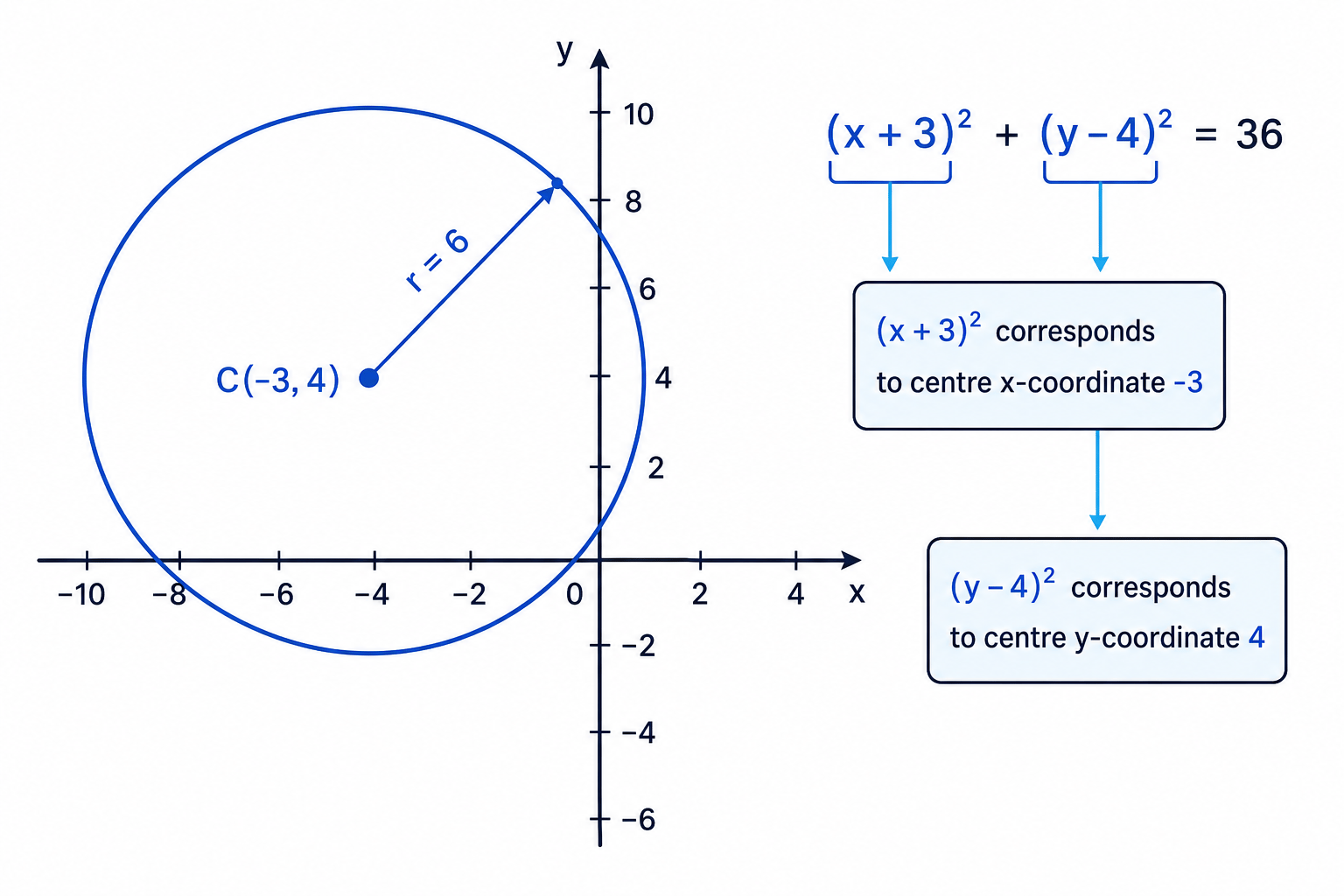
Find the centre and radius of the circle
-
Group the xxx terms and the yyy terms:
(x2+6x)+(y2−8y)=11(x^2+6x)+(y^2-8y)=11(x2+6x)+(y2−8y)=11 -
Complete the square for each pair of terms:
(x+3)2−9+(y−4)2−16=11(x+3)^2-9+(y-4)^2-16=11(x+3)2−9+(y−4)2−16=11 -
Move the constants to the right-hand side:
(x+3)2+(y−4)2=36(x+3)^2+(y-4)^2=36(x+3)2+(y−4)2=36 -
Compare with (x−a)2+(y−b)2=r2(x-a)^2+(y-b)^2=r^2(x−a)2+(y−b)2=r2. The centre is (−3,4)(-3,4)(−3,4) and the radius is 6.
The centre has opposite signs
In (x+3)2+(y−4)2=36(x+3)^2+(y-4)^2=36(x+3)2+(y−4)2=36, the centre is (−3,4)(-3,4)(−3,4), not (3,−4)(3,-4)(3,−4). The signs inside the brackets are opposite to the centre coordinates.
Check it is a real circle
After completing the square, the right-hand side must be non-negative. A negative value for r2r^2r2 means there is no real circle.
4. Using a point to find an unknown constant
Sometimes the equation contains an unknown constant. If a point lies on the circle, its coordinates must satisfy the equation.
Finding an unknown constant
The circle
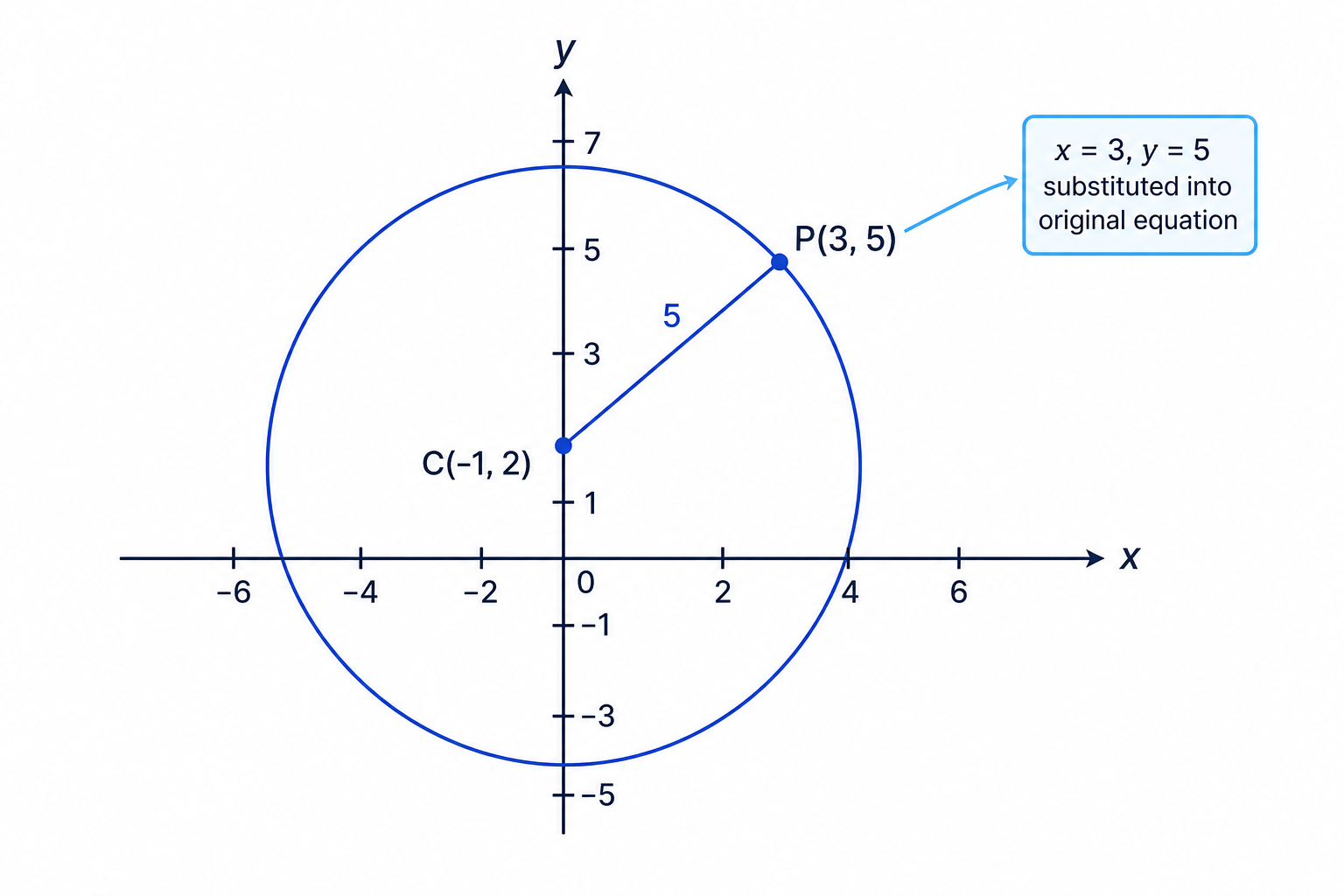
passes through the point (3,5)(3,5)(3,5). Find kkk, then find the centre and radius.
-
Substitute x=3x=3x=3 and y=5y=5y=5 into the equation:
32+52+2(3)−4(5)+k=03^2+5^2+2(3)-4(5)+k=032+52+2(3)−4(5)+k=0 -
Simplify to find kkk:
20+k=0⇒k=−2020+k=0\Rightarrow k=-2020+k=0⇒k=−20 -
Substitute k=−20k=-20k=−20 and complete the square:
x2+y2+2x−4y−20=0(x+1)2−1+(y−2)2−4−20=0(x+1)2+(y−2)2=25\begin{aligned} x^2+y^2+2x-4y-20&=0\\ (x+1)^2-1+(y-2)^2-4-20&=0\\ (x+1)^2+(y-2)^2&=25 \end{aligned}x2+y2+2x−4y−20(x+1)2−1+(y−2)2−4−20(x+1)2+(y−2)2=0=0=25 -
The centre is (−1,2)(-1,2)(−1,2) and the radius is 5.
5. Intersections with a line or an axis
If a line meets a circle, the intersection points satisfy both equations. So you substitute the line equation into the circle equation.
For the coordinate axes:
- On the x-axis, y=0y=0y=0.
- On the y-axis, x=0x=0x=0.
Finding exact intersections with a line
The circle
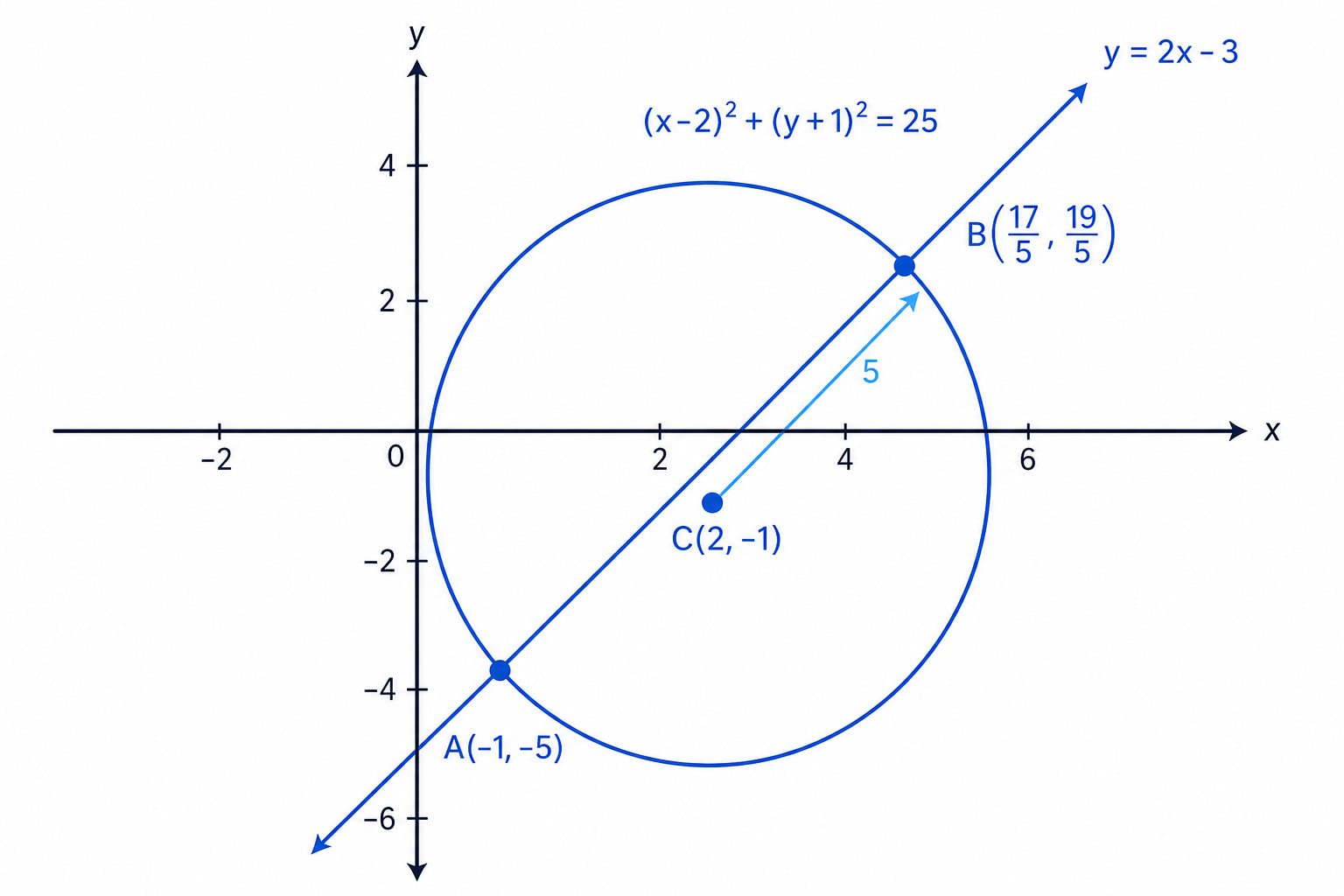
(x−2)2+(y+1)2=25(x-2)^2+(y+1)^2=25(x−2)2+(y+1)2=25meets the line y=2x−3y=2x-3y=2x−3 at two points. Find their exact coordinates.
-
Substitute y=2x−3y=2x-3y=2x−3 into the circle equation. Since y+1=2x−2y+1=2x-2y+1=2x−2:
(x−2)2+(2x−2)2=25(x-2)^2+(2x-2)^2=25(x−2)2+(2x−2)2=25 -
Expand and simplify:
x2−4x+4+4x2−8x+4=255x2−12x−17=0\begin{aligned} x^2-4x+4+4x^2-8x+4&=25\\ 5x^2-12x-17&=0 \end{aligned}x2−4x+4+4x2−8x+45x2−12x−17=25=0 -
Factorise the quadratic:
(5x−17)(x+1)=0(5x-17)(x+1)=0(5x−17)(x+1)=0 -
So the possible xxx-values are x=175x=\frac{17}{5}x=517 and x=−1x=-1x=−1.
-
Use y=2x−3y=2x-3y=2x−3. The intersection points are (175,195)\left(\frac{17}{5},\frac{19}{5}\right)(517,519) and (−1,−5)(-1,-5)(−1,−5).
6. Tangents to a circle
The gradient of a straight line is its slope. For two non-vertical perpendicular lines, their gradients multiply to -1.
Radius meets tangent at 90°
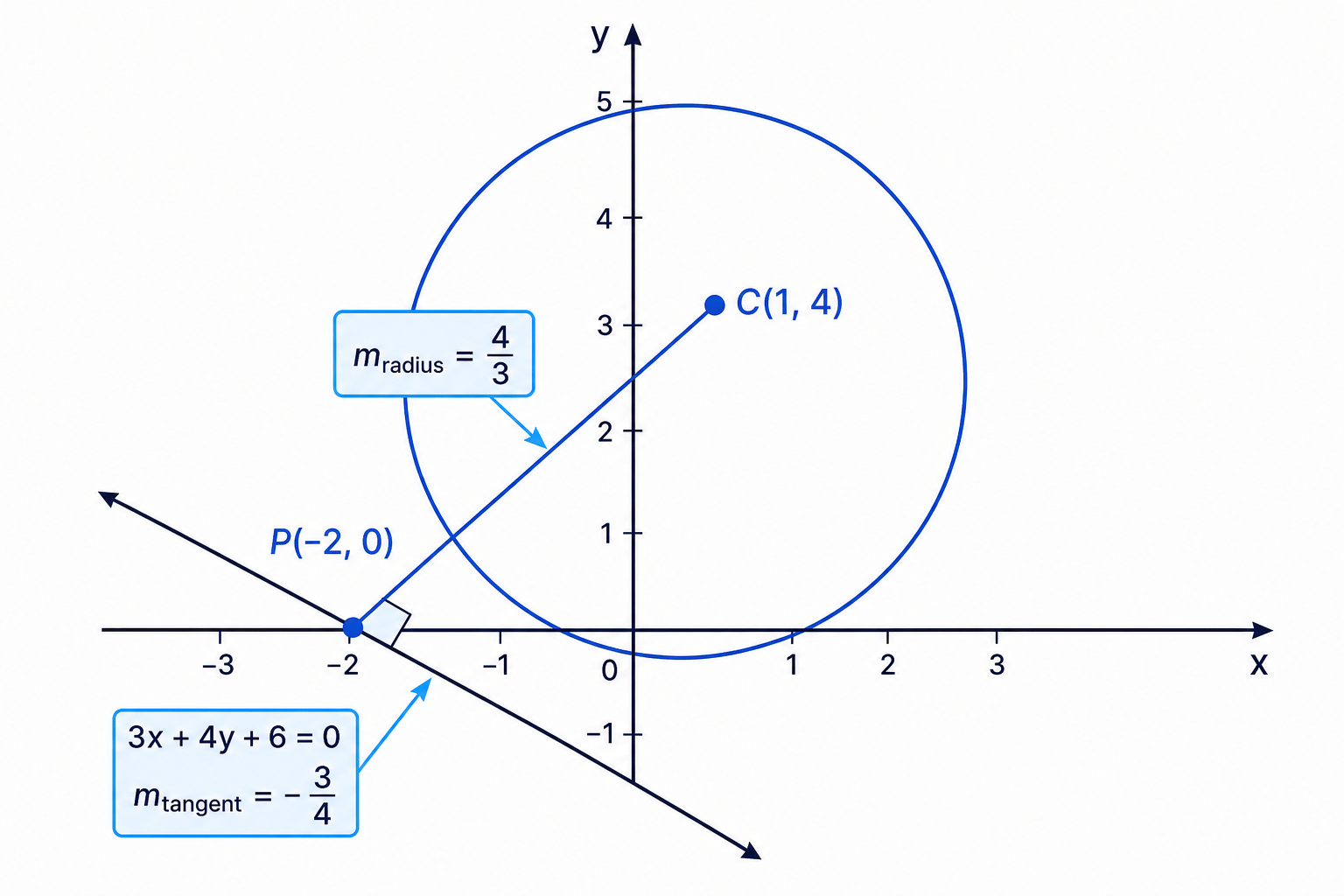
The radius to the point of contact is perpendicular to the tangent. So find the radius gradient first, then use the negative reciprocal for the tangent gradient.
Finding the equation of a tangent
A circle has centre (1,4)(1,4)(1,4). The point P(−2,0)P(-2,0)P(−2,0) lies on the circle. Find the tangent to the circle at PPP, giving your answer in the form ax+by+c=0ax+by+c=0ax+by+c=0.
-
Find the gradient of the radius from the centre to PPP:
m=0−4−2−1=−4−3=43m=\frac{0-4}{-2-1}=\frac{-4}{-3}=\frac{4}{3}m=−2−10−4=−3−4=34 -
The tangent gradient is the negative reciprocal:
−34-\frac{3}{4}−43 -
Use the straight-line equation through P(−2,0)P(-2,0)P(−2,0):
y−0=−34(x+2)y-0=-\frac{3}{4}(x+2)y−0=−43(x+2) -
Rearrange into ax+by+c=0ax+by+c=0ax+by+c=0:
4y=−3x−6⇒3x+4y+6=04y=-3x-6\Rightarrow 3x+4y+6=04y=−3x−6⇒3x+4y+6=0
Horizontal and vertical tangents
If the radius is vertical, the tangent is horizontal. If the radius is horizontal, the tangent is vertical. The negative reciprocal rule only works when both gradients are finite.
Tangent length from an external point
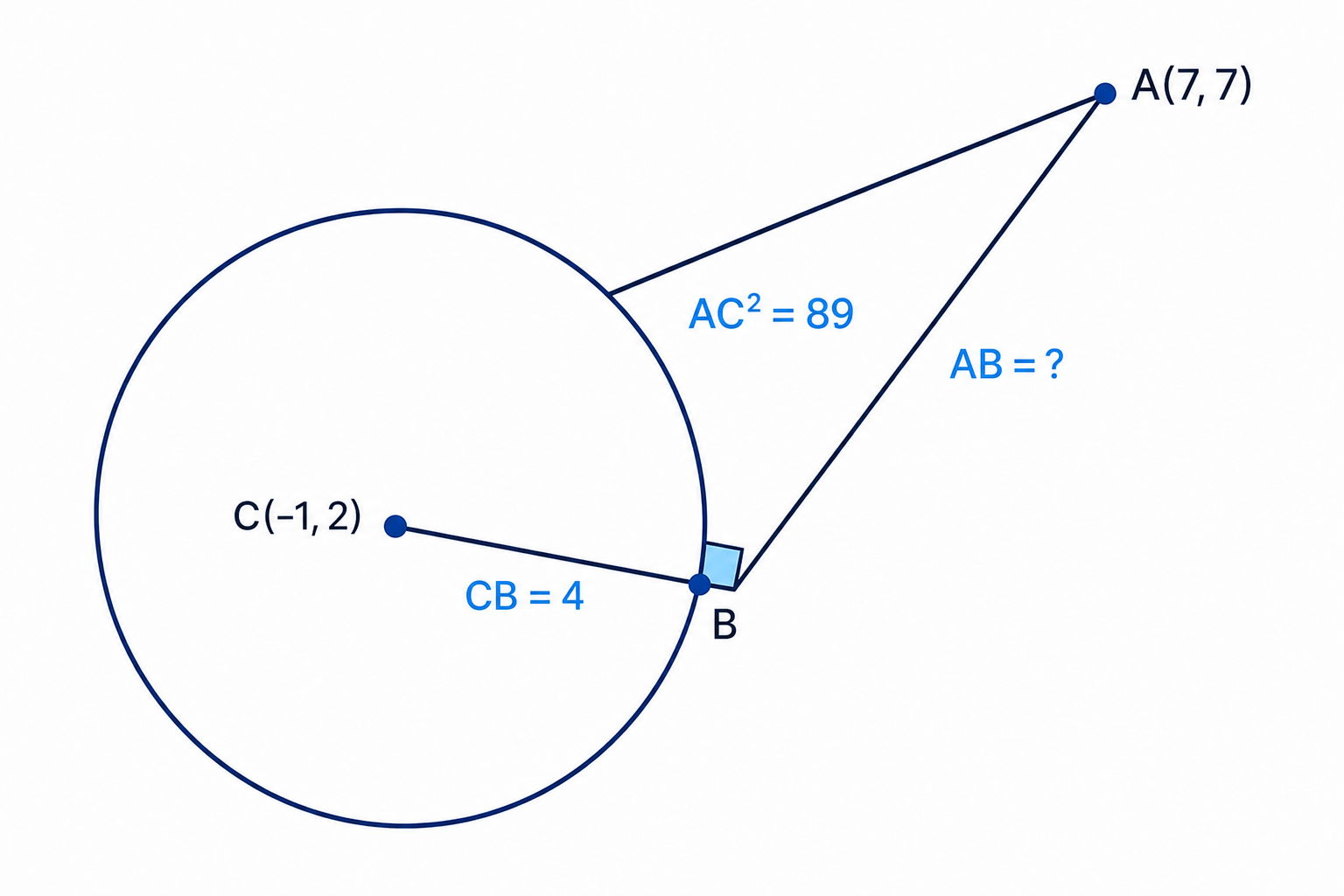
If a point outside a circle has a tangent to the circle, the radius to the point of contact is perpendicular to the tangent. That gives a right-angled triangle, so you can use Pythagoras’ theorem.
Exact length of a tangent segment
A circle has centre C(−1,2)C(-1,2)C(−1,2) and radius 4. A tangent from the point A(7,7)A(7,7)A(7,7) touches the circle at BBB. Find the exact length ABABAB.
-
Find AC2AC^2AC2:
AC2=(7−(−1))2+(7−2)2=82+52=89AC^2=(7-(-1))^2+(7-2)^2=8^2+5^2=89AC2=(7−(−1))2+(7−2)2=82+52=89 -
Since CBCBCB is a radius, CB=4CB=4CB=4, so CB2=16CB^2=16CB2=16.
-
Triangle ACBACBACB is right-angled at BBB, so use Pythagoras:
AB2=AC2−CB2=89−16=73AB^2=AC^2-CB^2=89-16=73AB2=AC2−CB2=89−16=73 -
Therefore the exact length is:
AB=73AB=\sqrt{73}AB=73
7. Diameter questions
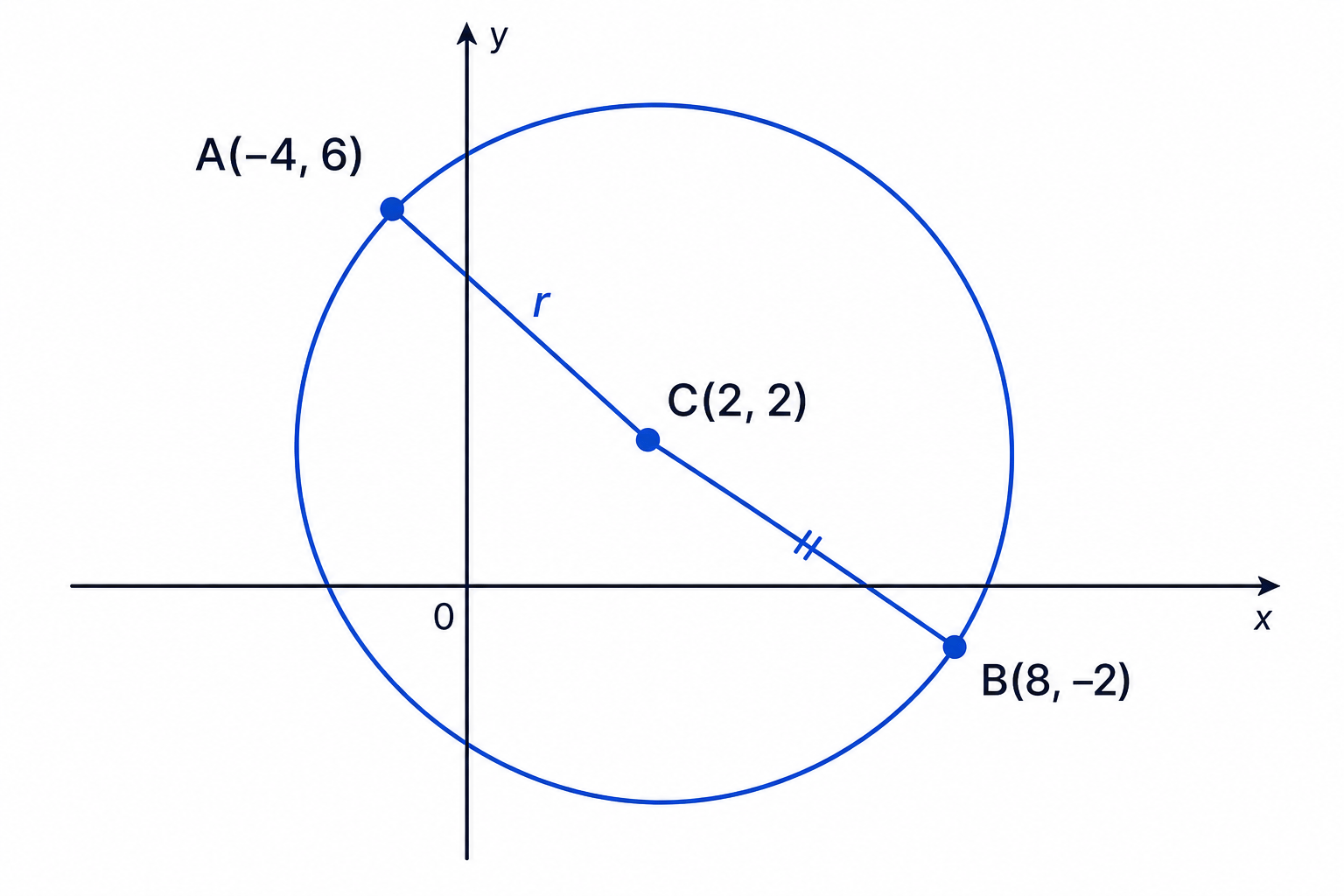
A diameter is a line segment joining two points on the circle and passing through the centre. If you know the endpoints of a diameter, the centre is the midpoint.
Equation from a diameter
The points A(−4,6)A(-4,6)A(−4,6) and B(8,−2)B(8,-2)B(8,−2) are endpoints of a diameter of a circle. Find the equation of the circle.
-
Find the midpoint of AAA and BBB:
(−4+82,6+(−2)2)=(2,2)\left(\frac{-4+8}{2},\frac{6+(-2)}{2}\right)=(2,2)(2−4+8,26+(−2))=(2,2) -
Find r2r^2r2 using the centre (2,2)(2,2)(2,2) and one endpoint:
r2=(−4−2)2+(6−2)2=36+16=52r^2=(-4-2)^2+(6-2)^2=36+16=52r2=(−4−2)2+(6−2)2=36+16=52 -
Write the equation:
(x−2)2+(y−2)2=52(x-2)^2+(y-2)^2=52(x−2)2+(y−2)2=52
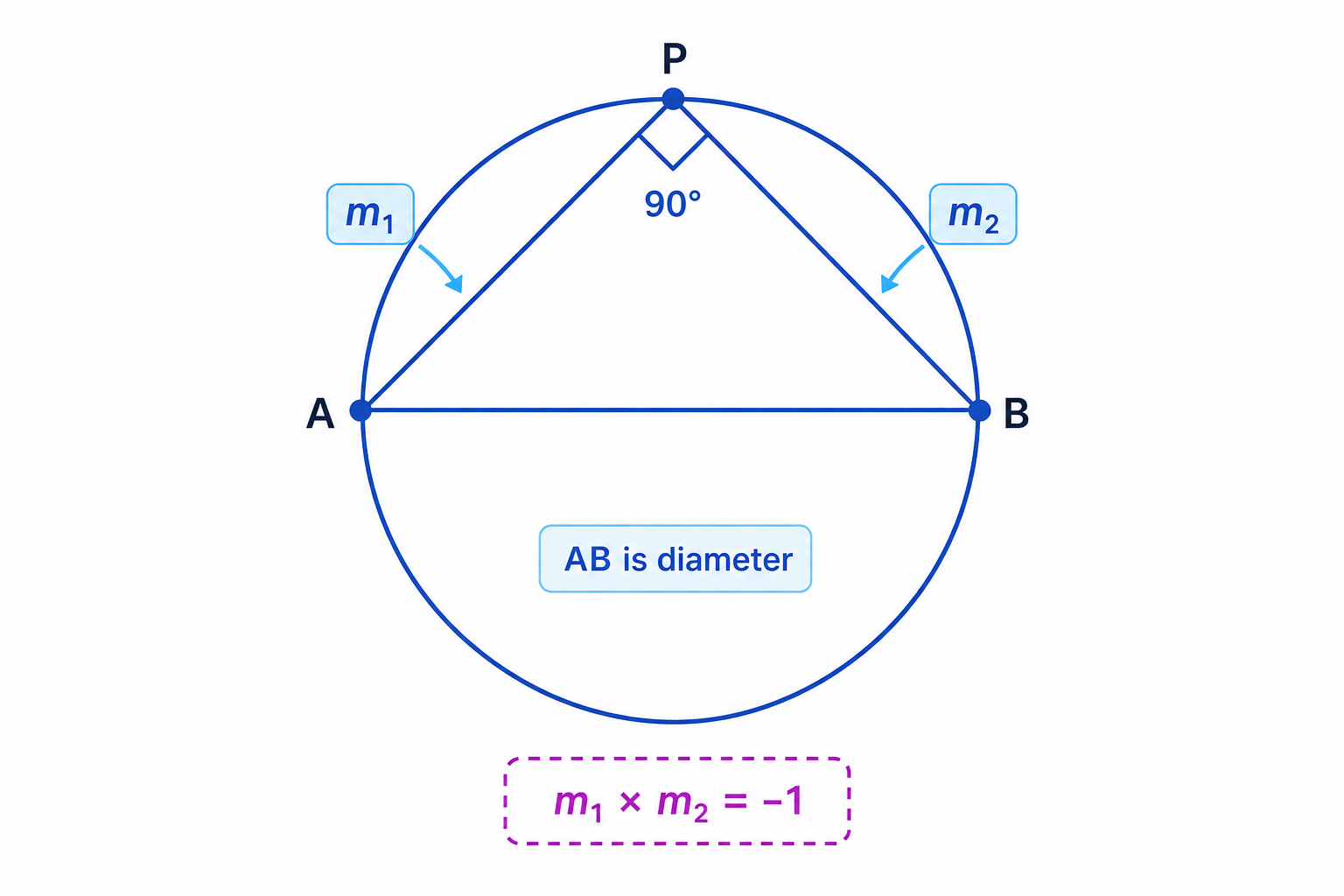
Right angle in a semicircle
If three points lie on a circle and one angle is a right angle, the side opposite the right angle is a diameter. To show a right angle using coordinates, show the two relevant gradients multiply to -1.
In the exam
-
First put the circle into centre-radius form, or identify the centre and r2r^2r2 directly if it is already in that form.
-
For tangents, always draw or imagine the radius to the point of contact: radius and tangent are perpendicular.
-
Keep exact answers where possible, especially fractions and surds, unless the question asks for decimals.
Check yourself
-
Can you complete the square for x2−10xx^2-10xx2−10x and explain why the centre coordinate changes sign?
-
If a circle has centre (4,−1)(4,-1)(4,−1) and passes through (1,3)(1,3)(1,3), can you find r2r^2r2 without first finding rrr?
-
In a tangent question, which gradient do you find first: the tangent’s or the radius’s?