2.4 The Discriminant
What you'll learn
- Decide how many real solutions a quadratic equation has without solving it fully.
- Use the discriminant b2−4acb^2-4acb2−4ac to test for two distinct, equal, or no real roots.
- Find ranges of constants such as kkk, nnn, or ppp.
- Apply the same idea to curve-line intersections and tangents.
Prerequisite: quadratics, coefficients, and roots
Before using the discriminant, you need the quadratic written in standard form.
Quadratic equation
A quadratic equation in xxx is an equation that can be written as ax2+bx+c=0ax^2+bx+c=0ax2+bx+c=0, where a≠0a\neq 0a=0.
- The numbers or algebraic expressions aaa, bbb, and ccc are called coefficients.
- A root is a solution for xxx.
- A real root is a solution that is a real number, so it appears on the number line.
The discriminant only works once you have identified aaa, bbb, and ccc correctly.
Identifying , , and
The equation 5x2+(k−3)x−2=05x^2+(k-3)x-2=05x2+(k−3)x−2=0, where kkk is a constant, is already in standard form.
-
Compare it with the general form:
ax2+bx+c=0ax^2+bx+c=0ax2+bx+c=0 -
Match each part carefully:
a=5,b=k−3,c=−2a=5,\quad b=k-3,\quad c=-2a=5,b=k−3,c=−2 -
Notice that the minus sign belongs to the constant term, so c=−2c=-2c=−2, not 2.
Forgetting the sign
If the equation contains something like −7-7−7 or −(k+1)-(k+1)−(k+1), the minus sign is part of the coefficient. This is one of the most common ways to lose accuracy in discriminant questions.
The discriminant
The quadratic formula is
x=−b±b2−4ac2ax=\frac{-b\pm\sqrt{b^2-4ac}}{2a}x=2a−b±b2−4acThe expression under the square root controls what kind of roots the quadratic has.
The discriminant
For a quadratic equation ax2+bx+c=0ax^2+bx+c=0ax2+bx+c=0, the discriminant is
Δ=b2−4ac\Delta=b^2-4acΔ=b2−4acThe symbol Δ\DeltaΔ is the Greek capital letter “Delta”.
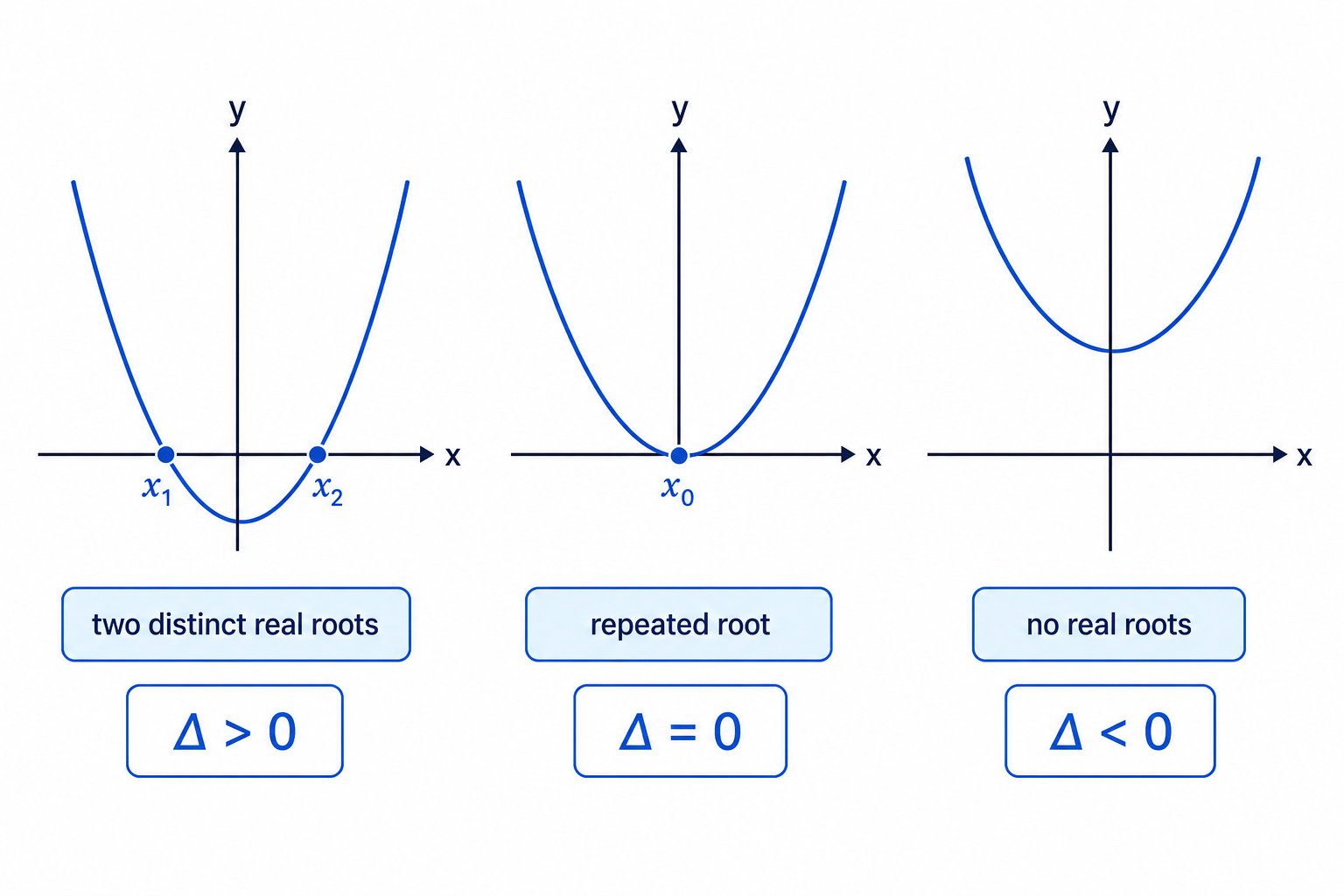
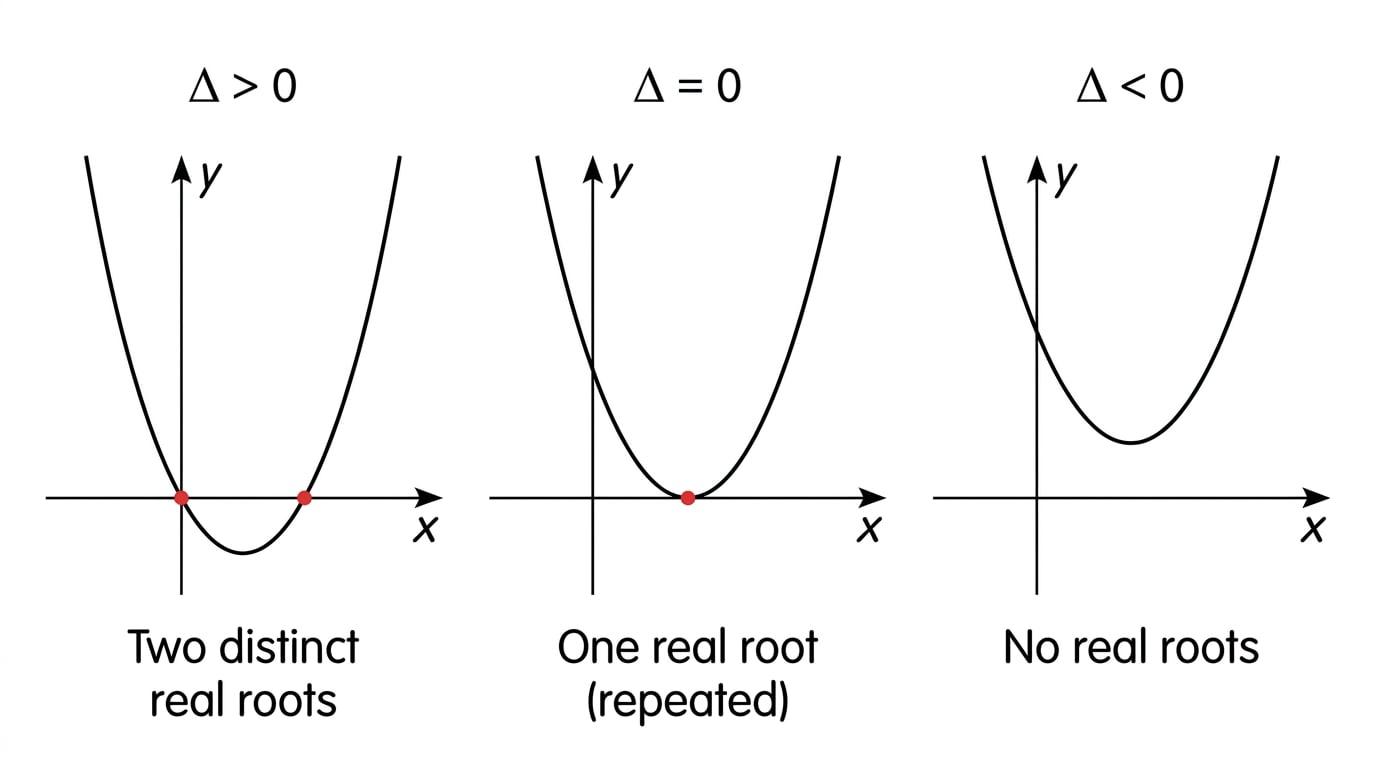
Here is the graph meaning of the three possible discriminant cases.
What the sign of the discriminant tells you
- If Δ>0\Delta>0Δ>0, there are two distinct real roots. Distinct means different.
- If Δ=0\Delta=0Δ=0, there is one repeated root, often called equal roots.
- If Δ<0\Delta<0Δ<0, there are no real roots.
Deciding the number of roots
Decide how many real roots the equation 2x2−5x+7=02x^2-5x+7=02x2−5x+7=0 has.
-
Identify the coefficients:
a=2,b=−5,c=7a=2,\quad b=-5,\quad c=7a=2,b=−5,c=7 -
Substitute into the discriminant:
Δ=b2−4ac=(−5)2−4(2)(7)\Delta=b^2-4ac=(-5)^2-4(2)(7)Δ=b2−4ac=(−5)2−4(2)(7) -
Simplify:
Δ=25−56=−31\Delta=25-56=-31Δ=25−56=−31 -
Since Δ<0\Delta<0Δ<0, the equation has no real roots.
Using the discriminant to find possible values
A parameter is a letter that behaves like a constant in a question. For example, in x2+kx+6=0x^2+kx+6=0x2+kx+6=0, the variable is xxx, but kkk is a parameter.
The usual method is:
- Write down aaa, bbb, and ccc.
- Form Δ=b2−4ac\Delta=b^2-4acΔ=b2−4ac.
- Use the condition from the question: greater than zero, equal to zero, or less than zero.
- Solve the resulting equation or inequality.
No real roots
If a quadratic has no real roots, use Δ<0\Delta<0Δ<0.
Finding a range for a constant
The equation x2+kx+6=0x^2+kx+6=0x2+kx+6=0, where kkk is a constant, has no real roots. Find the possible values of kkk.
-
Identify the coefficients:
a=1,b=k,c=6a=1,\quad b=k,\quad c=6a=1,b=k,c=6 -
Since there are no real roots, use Δ<0\Delta<0Δ<0:
b2−4ac<0b^2-4ac<0b2−4ac<0 -
Substitute the coefficients:
k2−4(1)(6)<0k^2-4(1)(6)<0k2−4(1)(6)<0 -
Simplify:
k2−24<0k^2-24<0k2−24<0 -
Rearrange and square root both sides carefully:
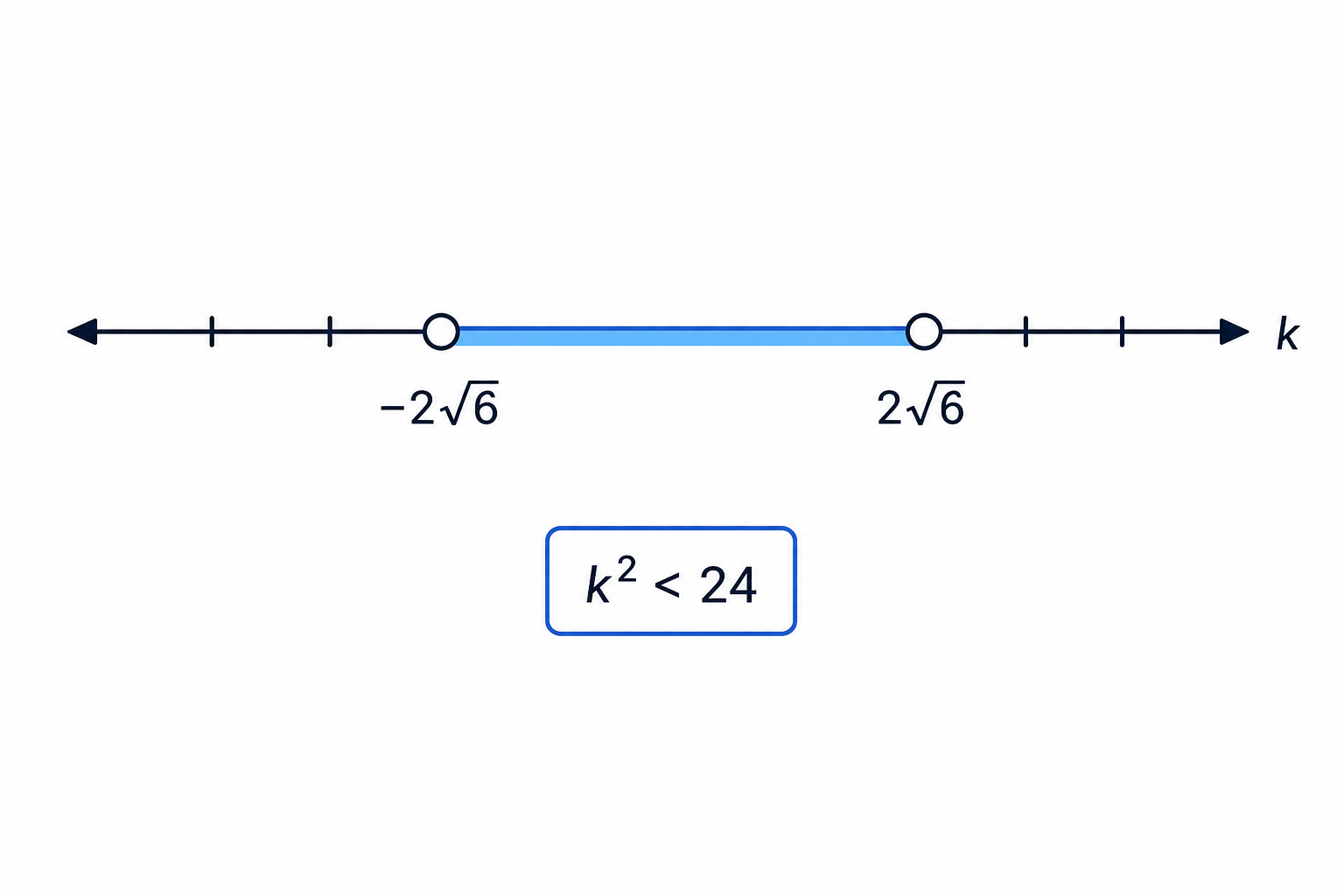
k2<24k^2<24k2<24 -
Therefore the possible values are:
−26<k<26-2\sqrt{6}<k<2\sqrt{6}−26<k<26
Equal roots
If a quadratic has equal roots, use Δ=0\Delta=0Δ=0.
Equal roots with a positive constant
The equation kx2+7x+k=0kx^2+7x+k=0kx2+7x+k=0, where kkk is a positive constant, has equal roots. Find kkk.
-
Identify the coefficients:
a=k,b=7,c=ka=k,\quad b=7,\quad c=ka=k,b=7,c=k -
Equal roots means the discriminant is zero:
b2−4ac=0b^2-4ac=0b2−4ac=0 -
Substitute:
72−4(k)(k)=07^2-4(k)(k)=072−4(k)(k)=0 -
Simplify:
49−4k2=049-4k^2=049−4k2=0 -
Solve for kkk:
4k2=494k^2=494k2=49 -
Take the square root:
k=±72k=\pm\frac{7}{2}k=±27 -
Since kkk is positive, the answer is:
k=72k=\frac{7}{2}k=27
Match the wording to the sign
“Two distinct real roots” means Δ>0\Delta>0Δ>0, “equal roots” means Δ=0\Delta=0Δ=0, and “no real roots” means Δ<0\Delta<0Δ<0.
Solving harder discriminant inequalities
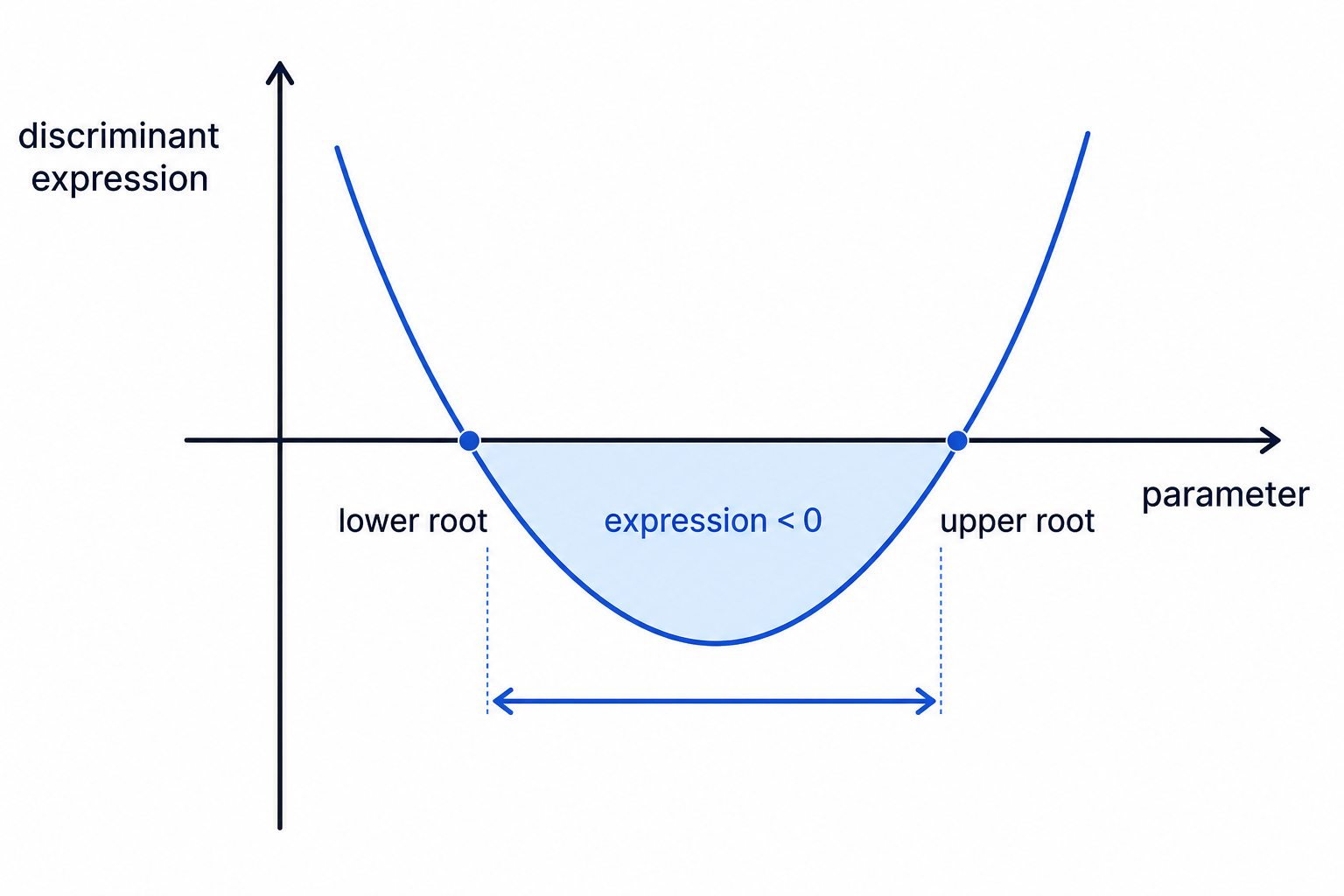
Sometimes the discriminant itself becomes a quadratic expression in the parameter. You then solve a quadratic inequality.
A quadratic inequality in the parameter
The equation x2+(2n−1)x+(n+2)=0x^2+(2n-1)x+(n+2)=0x2+(2n−1)x+(n+2)=0, where nnn is a constant, has no real roots. Find the possible values of nnn.
-
Identify the coefficients:
a=1,b=2n−1,c=n+2a=1,\quad b=2n-1,\quad c=n+2a=1,b=2n−1,c=n+2 -
No real roots means Δ<0\Delta<0Δ<0:
(2n−1)2−4(1)(n+2)<0(2n-1)^2-4(1)(n+2)<0(2n−1)2−4(1)(n+2)<0 -
Expand and simplify:
(2n−1)2−4(n+2)<04n2−4n+1−4n−8<04n2−8n−7<0\begin{aligned} (2n-1)^2-4(n+2)&<0\\ 4n^2-4n+1-4n-8&<0\\ 4n^2-8n-7&<0 \end{aligned}(2n−1)2−4(n+2)4n2−4n+1−4n−84n2−8n−7<0<0<0 -
Solve the boundary equation:
4n2−8n−7=04n^2-8n-7=04n2−8n−7=0 -
Use the quadratic formula:
n=8±64+1128=1±112n=\frac{8\pm\sqrt{64+112}}{8}=1\pm\frac{\sqrt{11}}{2}n=88±64+112=1±211 -
Since 4n2−8n−74n^2-8n-74n2−8n−7 is an upward-opening quadratic, it is negative between its roots:
1−112<n<1+1121-\frac{\sqrt{11}}{2}<n<1+\frac{\sqrt{11}}{2}1−211<n<1+211
When the coefficient of x2x^2x2 depends on the parameter
Be careful if the coefficient of x2x^2x2 contains the parameter. If that coefficient becomes zero, the equation is no longer quadratic.
Check the equation is still quadratic
The discriminant test assumes a≠0a\neq 0a=0. If a=0a=0a=0, the equation becomes linear, so it cannot have two distinct roots.
Excluding a value that makes the equation linear
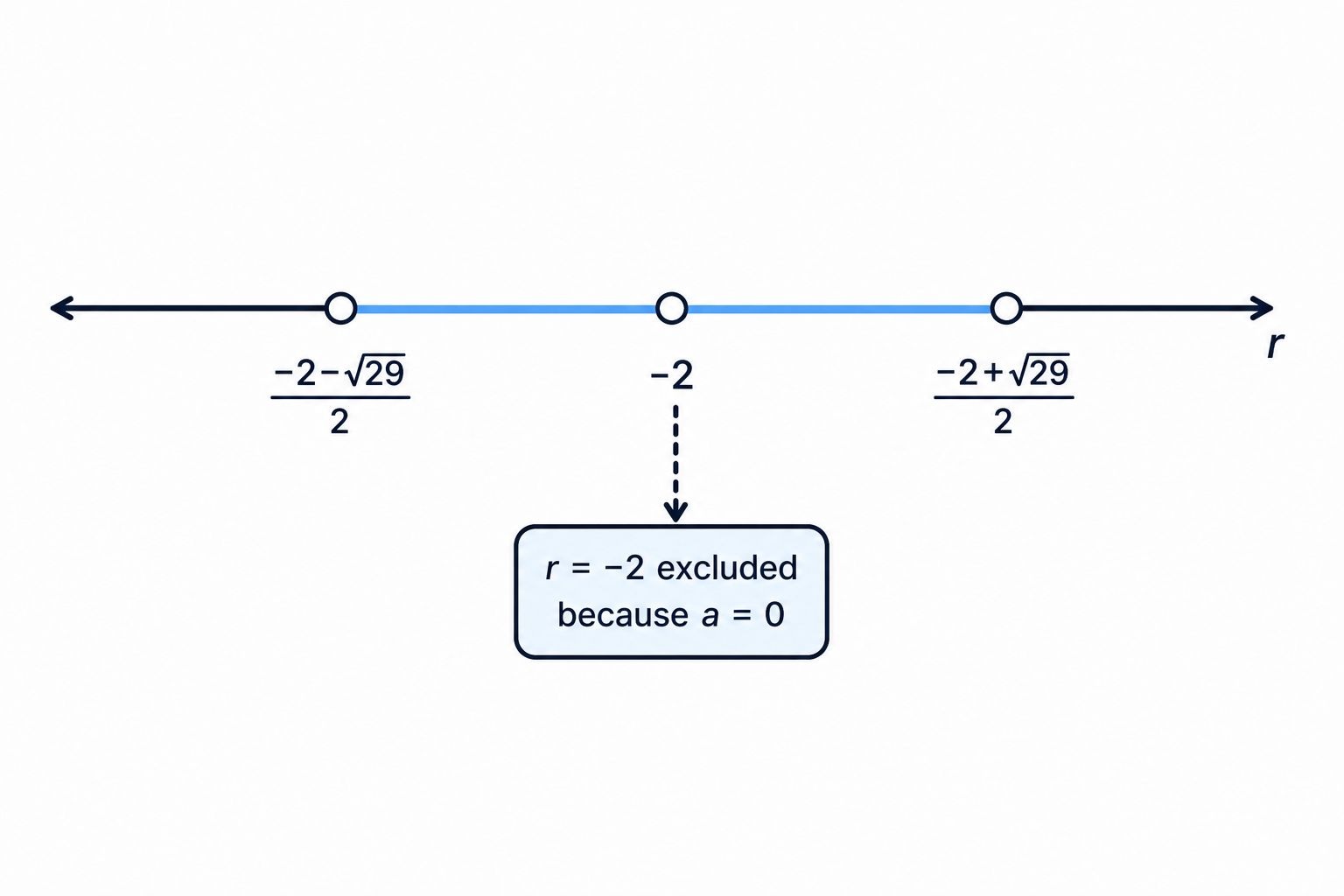
The equation (r+2)x2+5x+r=0(r+2)x^2+5x+r=0(r+2)x2+5x+r=0, where rrr is a constant, has two distinct real roots. Find the possible values of rrr.
-
The coefficient of x2x^2x2 is r+2r+2r+2, so the equation is quadratic only if:
r+2≠0r+2\neq 0r+2=0 -
Therefore:
r≠−2r\neq -2r=−2 -
For two distinct real roots, use Δ>0\Delta>0Δ>0:
52−4(r+2)(r)>05^2-4(r+2)(r)>052−4(r+2)(r)>0 -
Expand and simplify:
25−4r2−8r>025-4r^2-8r>025−4r2−8r>0 -
Rearrange into a more standard inequality:
4r2+8r−25<04r^2+8r-25<04r2+8r−25<0 -
Solve the boundary equation:
4r2+8r−25=04r^2+8r-25=04r2+8r−25=0 -
The boundary values are:
r=−8±64+4008=−2±292r=\frac{-8\pm\sqrt{64+400}}{8}=\frac{-2\pm\sqrt{29}}{2}r=8−8±64+400=2−2±29 -
The expression is negative between the two boundary values, but r=−2r=-2r=−2 must be excluded:
−2−292<r<−2or−2<r<−2+292\frac{-2-\sqrt{29}}{2}<r<-2 \quad\text{or}\quad -2<r<\frac{-2+\sqrt{29}}{2}2−2−29<r<−2or−2<r<2−2+29
Intersections of curves and lines
When a curve and a line intersect, their yyy-values are equal at the points of intersection. So you set the equations equal and form an equation in xxx.
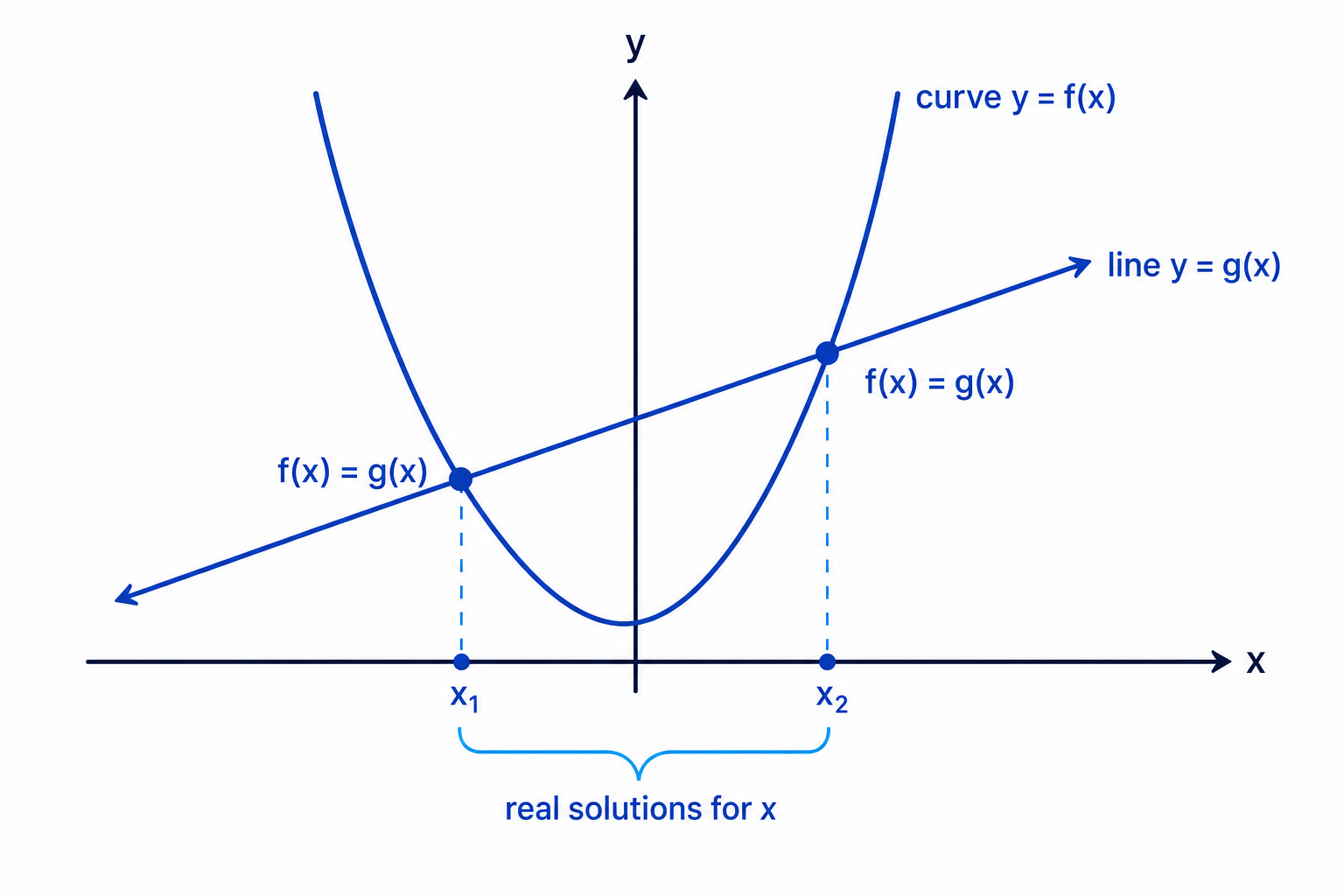
- No intersection means no real solutions, so use Δ<0\Delta<0Δ<0.
- A tangent means one repeated solution, so use Δ=0\Delta=0Δ=0.
- Two intersections means two distinct real solutions, so use Δ>0\Delta>0Δ>0.
A curve and a line that do not meet
The curve y=qx2−2qx−3qy=qx^2-2qx-3qy=qx2−2qx−3q does not intersect the line y=2x−8y=2x-8y=2x−8. Find the possible values of qqq.
-
Set the two expressions for yyy equal:
qx2−2qx−3q=2x−8qx^2-2qx-3q=2x-8qx2−2qx−3q=2x−8 -
Rearrange into a quadratic equation in xxx:
qx2+(−2q−2)x+(8−3q)=0qx^2+(-2q-2)x+(8-3q)=0qx2+(−2q−2)x+(8−3q)=0 -
For no intersection, use Δ<0\Delta<0Δ<0:
(−2q−2)2−4(q)(8−3q)<0(-2q-2)^2-4(q)(8-3q)<0(−2q−2)2−4(q)(8−3q)<0 -
Simplify:
4(q+1)2−4q(8−3q)<04q2+8q+4−32q+12q2<016q2−24q+4<0\begin{aligned} 4(q+1)^2-4q(8-3q)&<0\\ 4q^2+8q+4-32q+12q^2&<0\\ 16q^2-24q+4&<0 \end{aligned}4(q+1)2−4q(8−3q)4q2+8q+4−32q+12q216q2−24q+4<0<0<0 -
Divide by 4:
4q2−6q+1<04q^2-6q+1<04q2−6q+1<0 -
Solve the boundary equation:
q=6±36−168=3±54q=\frac{6\pm\sqrt{36-16}}{8}=\frac{3\pm\sqrt{5}}{4}q=86±36−16=43±5 -
Since the quadratic in qqq opens upwards, the possible values are:
3−54<q<3+54\frac{3-\sqrt{5}}{4}<q<\frac{3+\sqrt{5}}{4}43−5<q<43+5
Tangents to circles
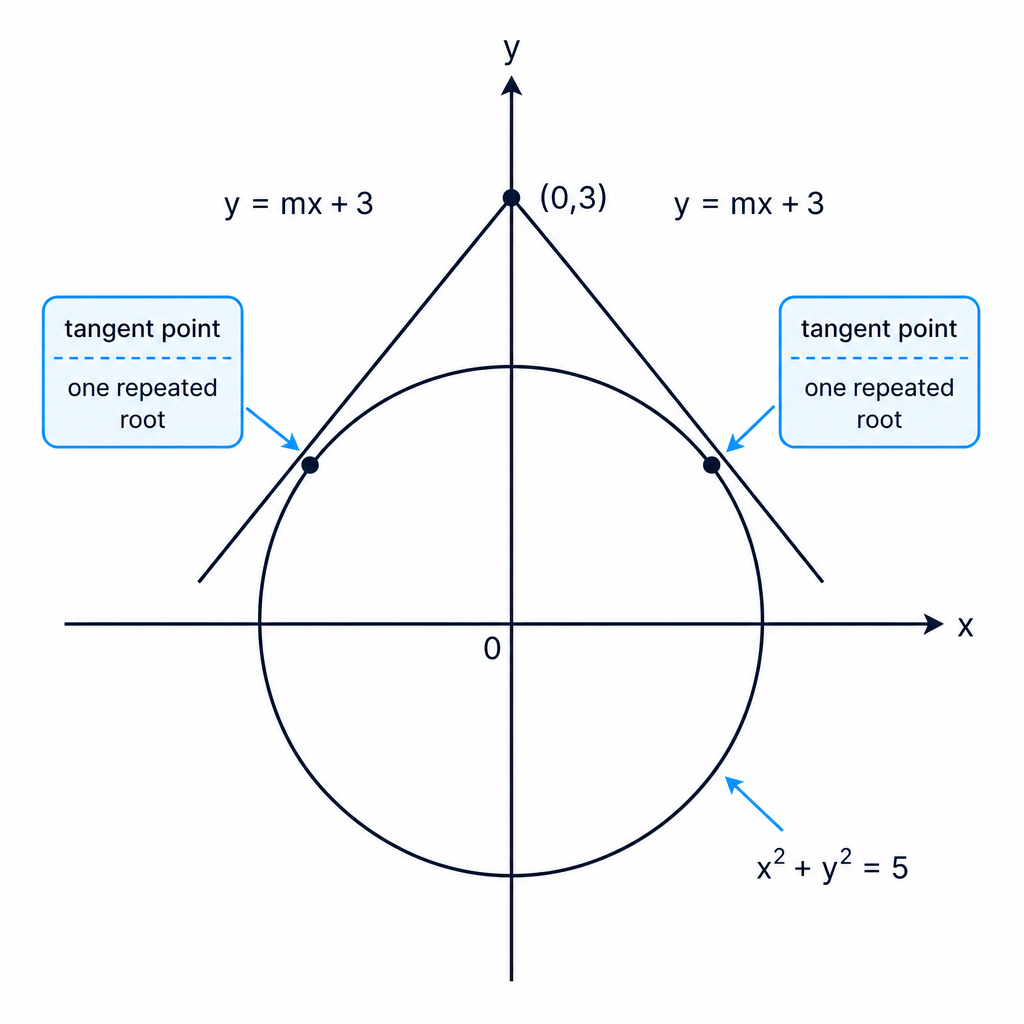
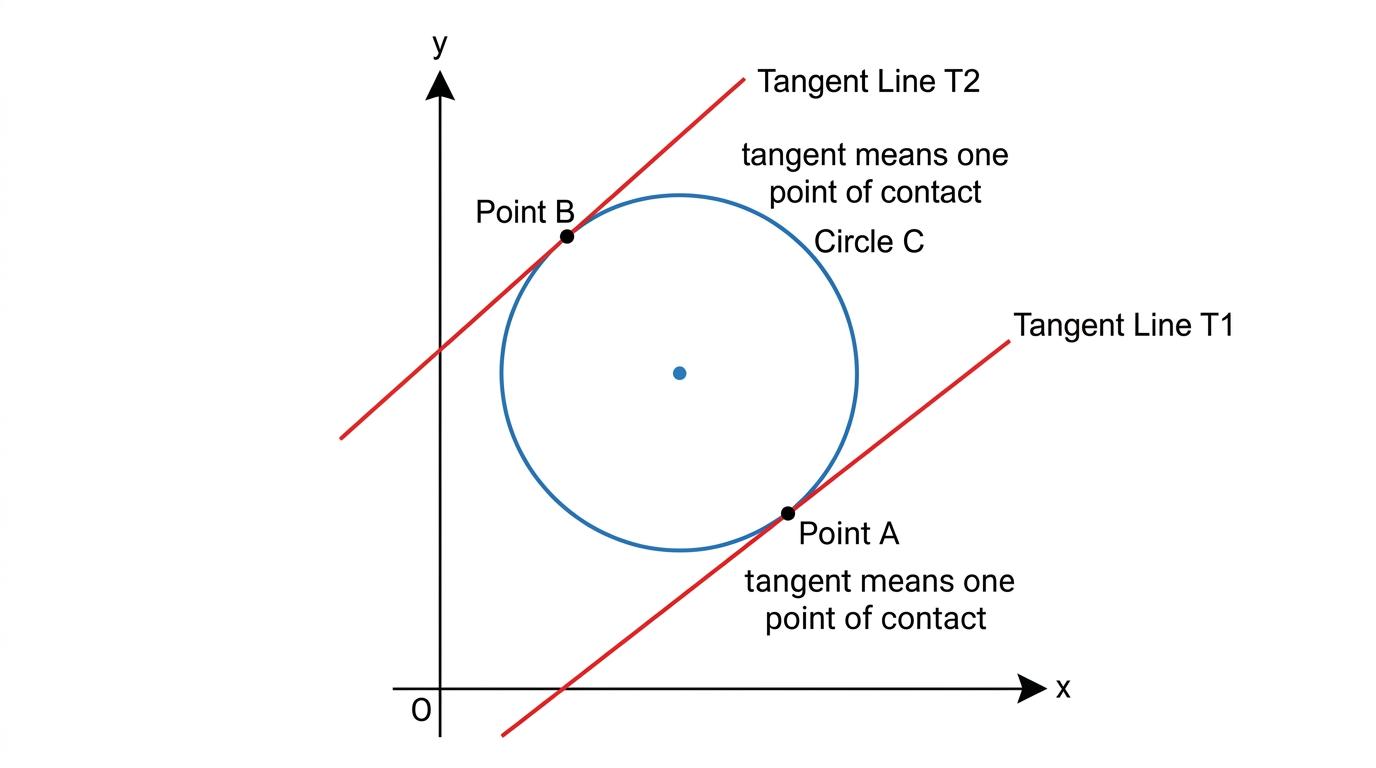
A tangent is a straight line that touches a curve at exactly one point. For a line and circle, substituting the line equation into the circle equation gives a quadratic in xxx. If the line is tangent, that quadratic has equal roots.
Finding tangent gradients exactly
The line y=mx+3y=mx+3y=mx+3 is a tangent to the circle x2+y2=5x^2+y^2=5x2+y2=5. Find the two possible values of mmm.
-
Substitute y=mx+3y=mx+3y=mx+3 into the circle equation:
x2+(mx+3)2=5x^2+(mx+3)^2=5x2+(mx+3)2=5 -
Expand and rearrange:
x2+m2x2+6mx+9=5x^2+m^2x^2+6mx+9=5x2+m2x2+6mx+9=5 -
Write it as a quadratic in xxx:
(1+m2)x2+6mx+4=0(1+m^2)x^2+6mx+4=0(1+m2)x2+6mx+4=0 -
A tangent gives equal roots, so set the discriminant equal to zero:
(6m)2−4(1+m2)(4)=0(6m)^2-4(1+m^2)(4)=0(6m)2−4(1+m2)(4)=0 -
Simplify:
36m2−16−16m2=036m^2-16-16m^2=036m2−16−16m2=0 -
Solve:
20m2=1620m^2=1620m2=16 -
Therefore:
m=±45=±255m=\pm\sqrt{\frac{4}{5}}=\pm\frac{2\sqrt{5}}{5}m=±54=±525
In the exam
-
First decide which discriminant condition the wording needs: greater than zero, equal to zero, or less than zero.
-
Write aaa, bbb, and ccc explicitly before substituting, especially when there are brackets or parameters.
-
If the coefficient of x2x^2x2 contains a parameter, check whether any value makes the equation stop being quadratic.
Check yourself
- What discriminant condition tells you that a quadratic has two distinct real roots?
- If a=k−1a=k-1a=k−1, what value of kkk would make the equation no longer quadratic?
- Why does a tangent line lead to Δ=0\Delta=0Δ=0 after substitution?