Revision notes for Edexcel AS Level Maths Algebraic Methods. Open each subtopic for explanations, worked examples, and summaries of 7.1 Algebraic Fractions, 7.2 Dividing Polynomials, 7.3 The Factor Theorem, 7.4 Mathematical Proof, and 7.5 Methods of Proof. Written against the Edexcel AS Level Maths (8MA0) specification, so the content matches what's examinable rather than general Maths background.
Algebraic Methods
What you'll learn
- Use the factor theorem to spot factors of cubic polynomials.
- Divide a cubic by a known linear factor and factorise completely.
- Solve cubic equations and explain how many real roots they have.
- Write clear algebraic proofs and disproofs using counterexamples.
1. Polynomials, factors and roots
A lot of Algebraic Methods is about recognising structure. Before you start factorising, make sure you are comfortable substituting values into expressions and collecting like terms carefully.
Definition
Polynomial language
- A polynomial in xxx is an expression made from powers of xxx, such as 3x3−2x+53x^3-2x+53x3−2x+5.
- A coefficient is the number multiplying a power of xxx, such as 3 in 3x33x^33x3.
- A root, or zero, of f(x)f(x)f(x) is a value of xxx that makes f(x)=0f(x)=0f(x)=0.
- A factor is an expression that divides exactly into another expression, with no remainder.
Example
Finding unknown coefficients from two values
Suppose f(x)=x3+4x2+px+qf(x)=x^3+4x^2+px+qf(x)=x3+4x2+px+q, with f(2)=0f(2)=0f(2)=0 and f(−3)=10f(-3)=10f(−3)=10. Find ppp and qqq.
-
Substitute x=2x=2x=2 and simplify:
8+16+2p+q=0⇒2p+q=−248+16+2p+q=0 \Rightarrow 2p+q=-248+16+2p+q=0⇒2p+q=−24 -
Substitute x=−3x=-3x=−3 and simplify:
−27+36−3p+q=10⇒−3p+q=1-27+36-3p+q=10 \Rightarrow -3p+q=1−27+36−3p+q=10⇒−3p+q=1 -
Subtract the second equation from the first:
(2p+q)−(−3p+q)=−24−1⇒5p=−25(2p+q)-(-3p+q)=-24-1 \Rightarrow 5p=-25(2p+q)−(−3p+q)=−24−1⇒5p=−25 -
So p=−5p=-5p=−5. Substitute this into 2p+q=−242p+q=-242p+q=−24 to get q=−14q=-14q=−14.
Common Mistake
Substitution signs
A negative input affects every power of xxx: if x=−3x=-3x=−3, then x2=9x^2=9x2=9 but x3=−27x^3=-27x3=−27.
2. The factor theorem
The factor theorem is the main shortcut for cubic factorisation.
Key Idea
The factor theorem
For a polynomial f(x)f(x)f(x), (x−a)(x-a)(x−a) is a factor exactly when f(a)=0f(a)=0f(a)=0. For a factor such as (2x+3)(2x+3)(2x+3), test x=−32x=-\frac{3}{2}x=−23.
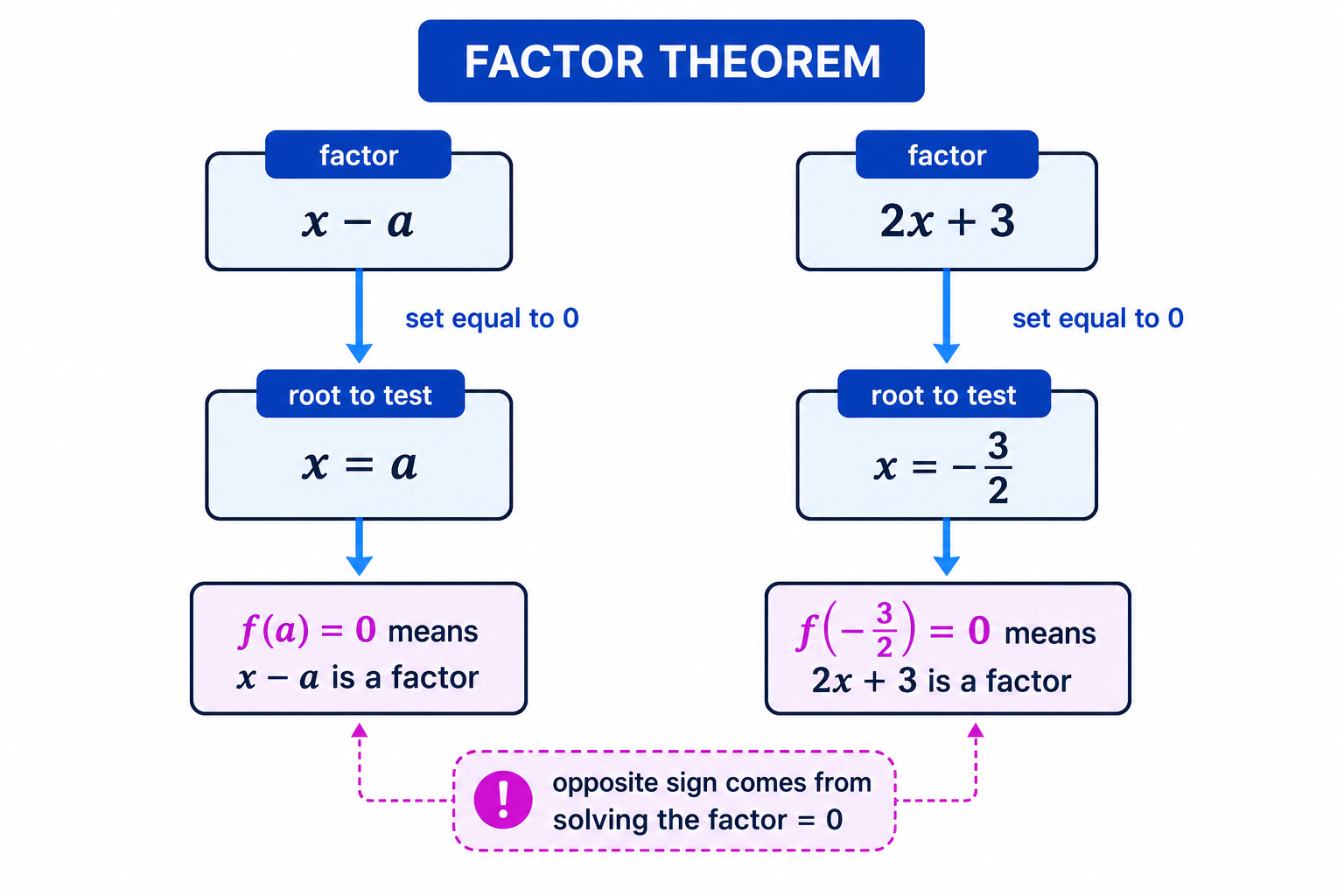
Once you know one linear factor, you can divide the cubic by it. At AS level, comparing coefficients is often cleaner than long division.
Example
Factorising a cubic completely
Let f(x)=2x3−5x2−4x+12f(x)=2x^3-5x^2-4x+12f(x)=2x3−5x2−4x+12. Show that (x−2)(x-2)(x−2) is a factor, then factorise f(x)f(x)f(x) completely.
-
Test x=2x=2x=2:
f(2)=2(2)3−5(2)2−4(2)+12=16−20−8+12=0f(2)=2(2)^3-5(2)^2-4(2)+12=16-20-8+12=0f(2)=2(2)3−5(2)2−4(2)+12=16−20−8+12=0 -
Since f(2)=0f(2)=0f(2)=0, the factor theorem tells us that (x−2)(x-2)(x−2) is a factor.
-
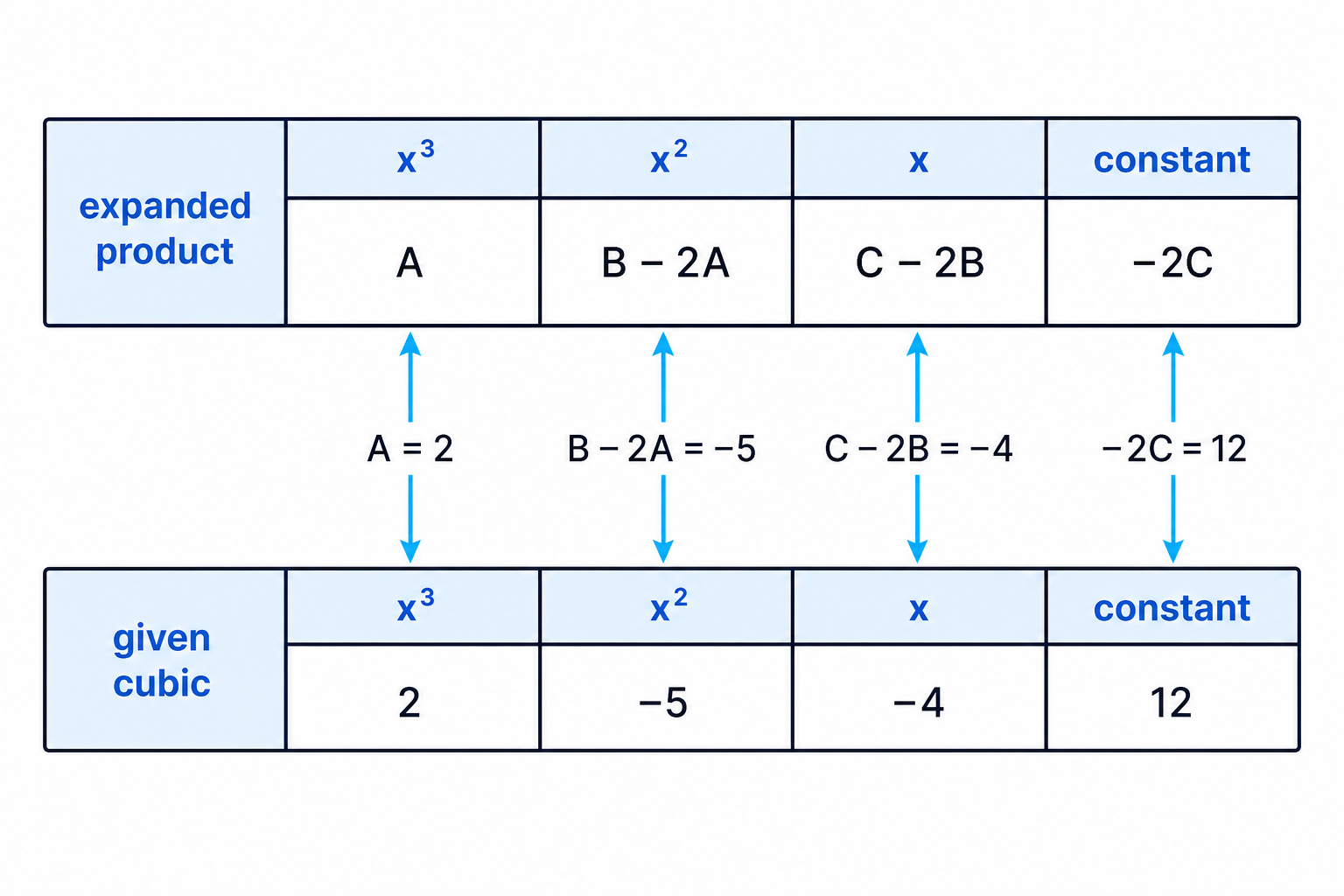
Write the remaining quadratic with unknown coefficients:
$$
f(x)=(x-2)(Ax^2+Bx+C)
$$
4. Expand the right-hand side:
$$
(x-2)(Ax^2+Bx+C)=Ax^3+(B-2A)x^2+(C-2B)x-2C
$$
5. Compare coefficients with 2x3−5x2−4x+122x^3-5x^2-4x+122x3−5x2−4x+12: A=2A=2A=2, B=−1B=-1B=−1 and C=−6C=-6C=−6.
-
Factorise the quadratic factor:
f(x)=(x−2)(2x2−x−6)=(x−2)2(2x+3)f(x)=(x-2)(2x^2-x-6)=(x-2)^2(2x+3)f(x)=(x−2)(2x2−x−6)=(x−2)2(2x+3)
Tip
Testing possible roots
For an integer cubic, try small values first. Possible rational roots often come from factors of the constant term divided by factors of the leading coefficient.
Common Mistake
Opposite sign
If the factor is (x+3)(x+3)(x+3), you test f(−3)f(-3)f(−3), not f(3)f(3)f(3). The sign changes because x+3=0x+3=0x+3=0 gives x=−3x=-3x=−3.
Unknown coefficients from factors
If you are told that expressions are factors, turn each one into a root using the factor theorem. This gives simultaneous equations.
Example
Using two factors to find constants
The polynomial f(x)=px3−5x2−9x+qf(x)=px^3-5x^2-9x+qf(x)=px3−5x2−9x+q has factors (x+2)(x+2)(x+2) and (x−3)(x-3)(x−3). Find ppp and qqq.
-
Since (x+2)(x+2)(x+2) is a factor, f(−2)=0f(-2)=0f(−2)=0:
−8p−20+18+q=0⇒q=8p+2-8p-20+18+q=0 \Rightarrow q=8p+2−8p−20+18+q=0⇒q=8p+2 -
Since (x−3)(x-3)(x−3) is a factor, f(3)=0f(3)=0f(3)=0:
27p−45−27+q=0⇒q=72−27p27p-45-27+q=0 \Rightarrow q=72-27p27p−45−27+q=0⇒q=72−27p -
Equate the two expressions for qqq:
8p+2=72−27p⇒35p=70⇒p=28p+2=72-27p \Rightarrow 35p=70 \Rightarrow p=28p+2=72−27p⇒35p=70⇒p=2 -
Substitute p=2p=2p=2 into q=8p+2q=8p+2q=8p+2, giving q=18q=18q=18.
3. Solving cubics and counting real roots
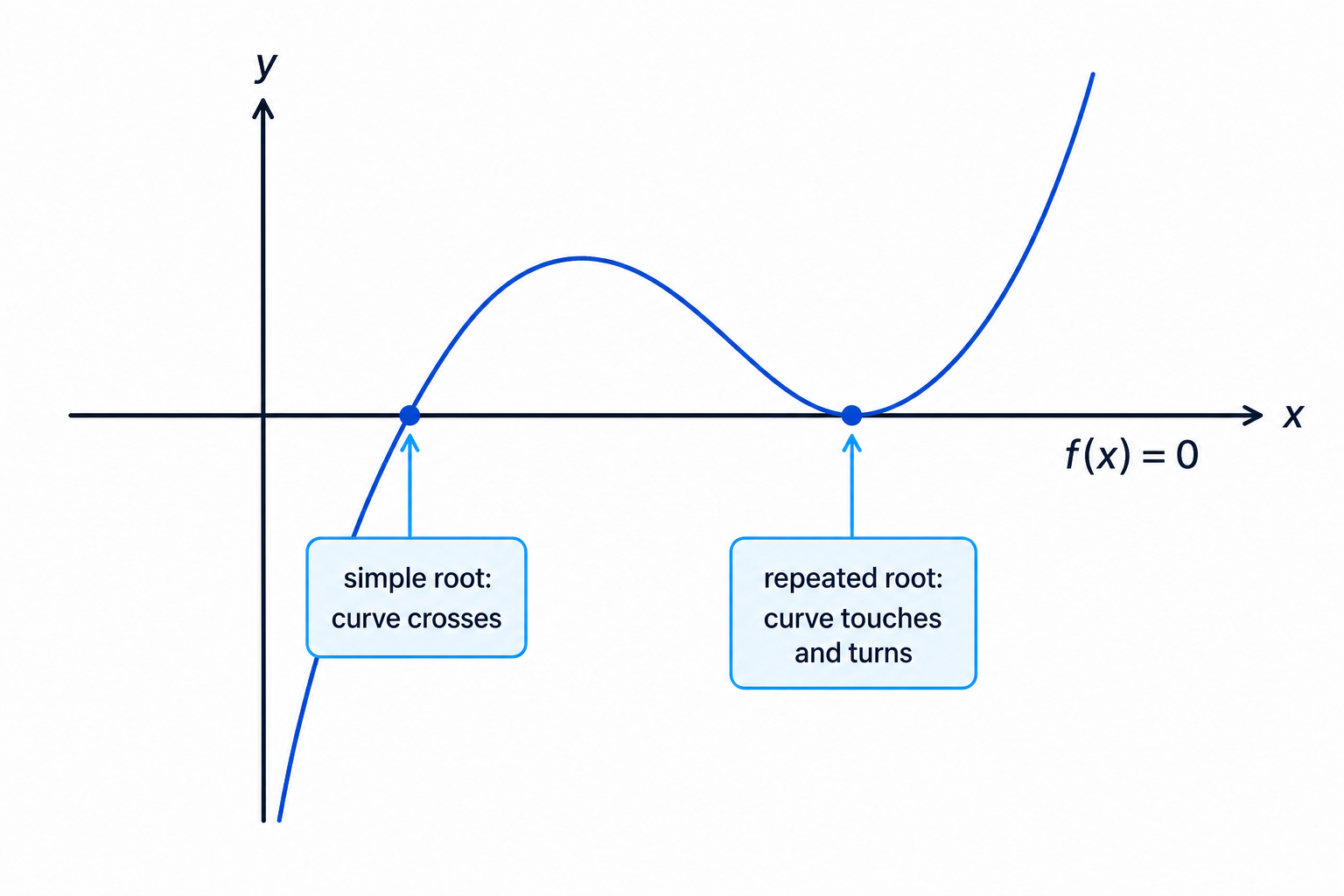
After factorising, solve each factor equal to zero. A distinct real root is a different real solution; a repeated factor counts as the same root repeated.
Definition
Discriminant
For a quadratic ax2+bx+cax^2+bx+cax2+bx+c, the discriminant is b2−4acb^2-4acb2−4ac.
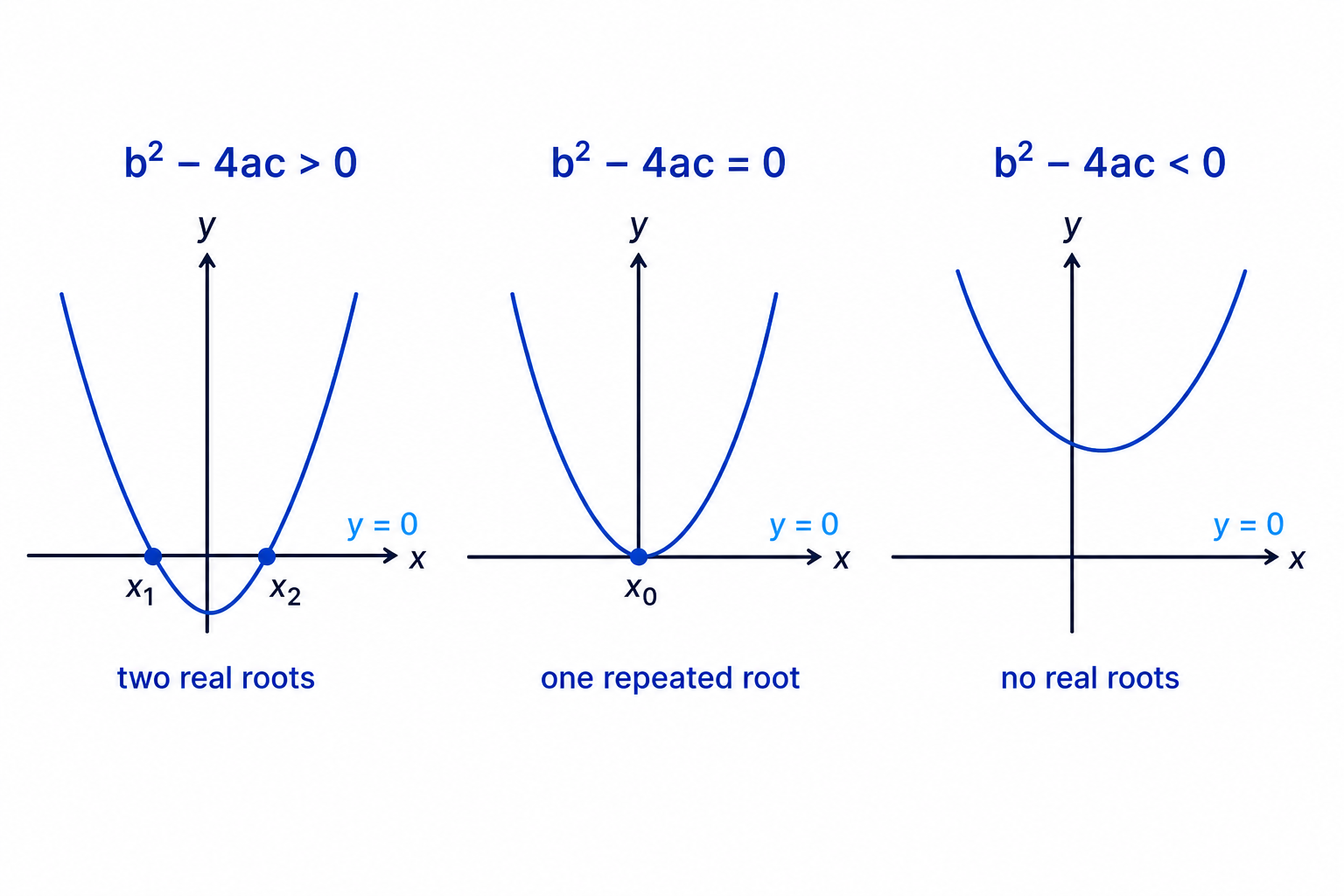
- If b2−4ac>0b^2-4ac>0b2−4ac>0, there are two distinct real roots.
- If b2−4ac=0b^2-4ac=0b2−4ac=0, there is one repeated real root.
- If b2−4ac<0b^2-4ac<0b2−4ac<0, there are no real roots.
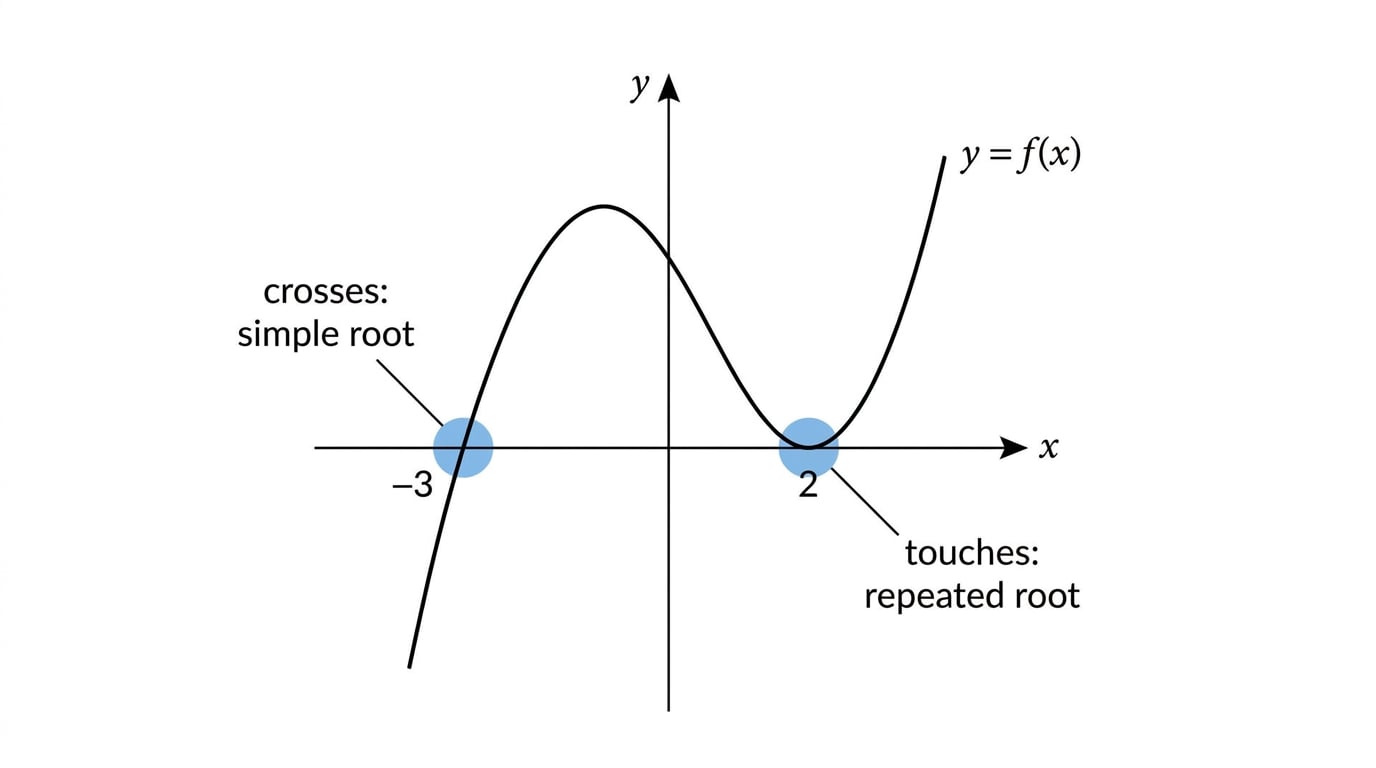
A graph helps you connect algebraic factors with roots: a simple root crosses the x-axis, while a repeated root just touches it and turns around.
Example
Solving a cubic after one root is known
Let r(x)=x3+6x2+4x−15r(x)=x^3+6x^2+4x-15r(x)=x3+6x2+4x−15. Show that x=−3x=-3x=−3 is a solution, then find the other solutions to two decimal places.
-
Substitute x=−3x=-3x=−3:
r(−3)=−27+54−12−15=0r(-3)=-27+54-12-15=0r(−3)=−27+54−12−15=0 -
So (x+3)(x+3)(x+3) is a factor. Dividing gives:
r(x)=(x+3)(x2+3x−5)r(x)=(x+3)(x^2+3x-5)r(x)=(x+3)(x2+3x−5) -
Solve the quadratic factor using the quadratic formula:
x=−3±32−4(1)(−5)2=−3±292x=\frac{-3\pm\sqrt{3^2-4(1)(-5)}}{2}=\frac{-3\pm\sqrt{29}}{2}x=2−3±32−4(1)(−5)=2−3±29 -
The solutions are x=−3x=-3x=−3, x≈−4.19x\approx -4.19x≈−4.19 and x≈1.19x\approx 1.19x≈1.19.
Example
Showing there is only one real root
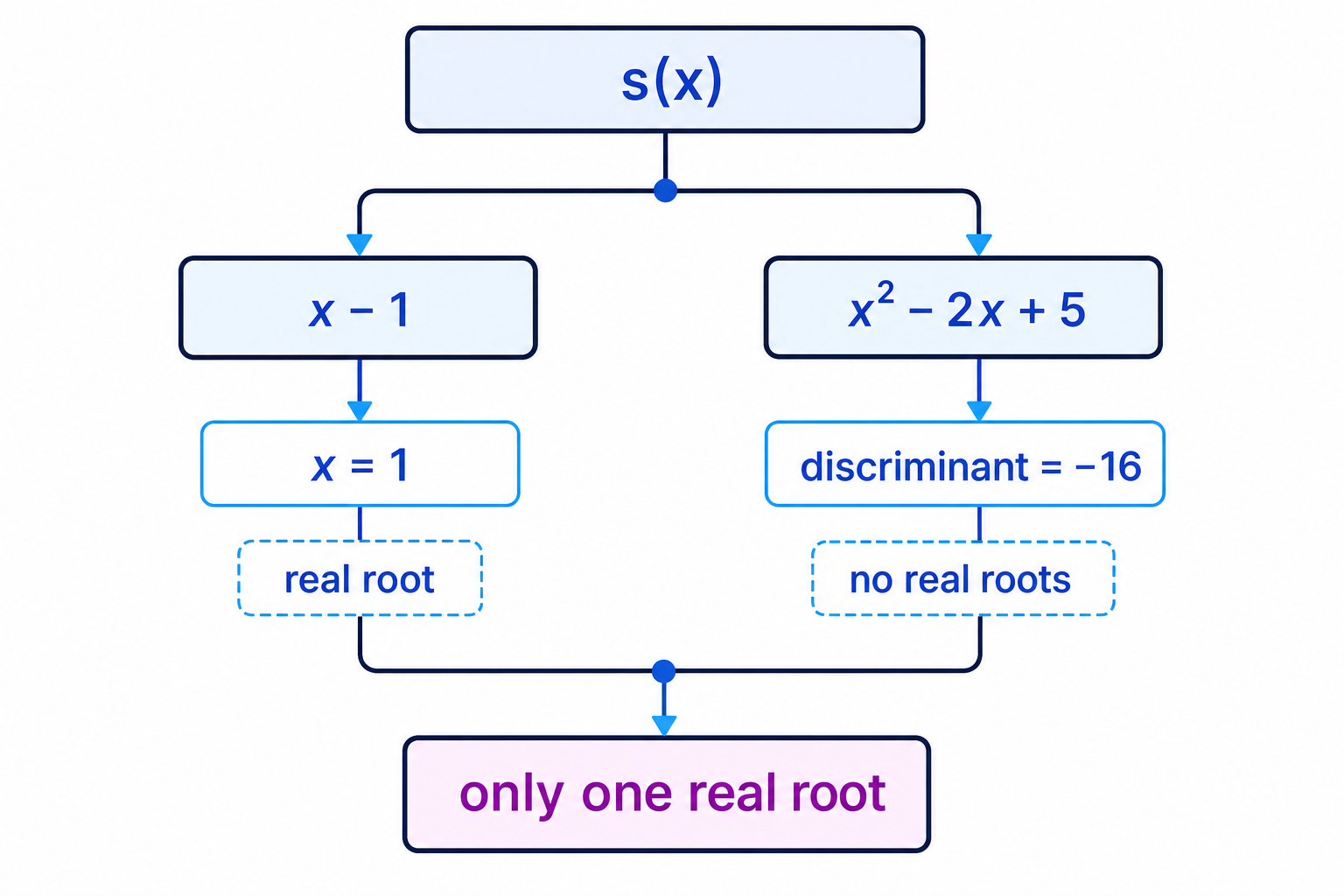
Let s(x)=x3−3x2+7x−5s(x)=x^3-3x^2+7x-5s(x)=x3−3x2+7x−5. Show that s(x)=0s(x)=0s(x)=0 has only one real root.
-
Test x=1x=1x=1:
s(1)=1−3+7−5=0s(1)=1-3+7-5=0s(1)=1−3+7−5=0 -
Therefore (x−1)(x-1)(x−1) is a factor, and division gives:
$$
s(x)=(x-1)(x^2-2x+5)
$$
3. Check the discriminant of the quadratic factor:
$$
(-2)^2-4(1)(5)=4-20=-16
$$
4. Since the discriminant is negative, the quadratic has no real roots. The only real root is x=1x=1x=1.
4. Algebraic proof and counterexamples
A proof is a logical argument showing that a statement is true in every allowed case. A counterexample is one allowed case that makes a statement false.
For parity proofs, use the facts that an even integer can be written as 2n2n2n and an odd integer can be written as 2n+12n+12n+1, where nnn is an integer.
Example
Writing odd numbers algebraically
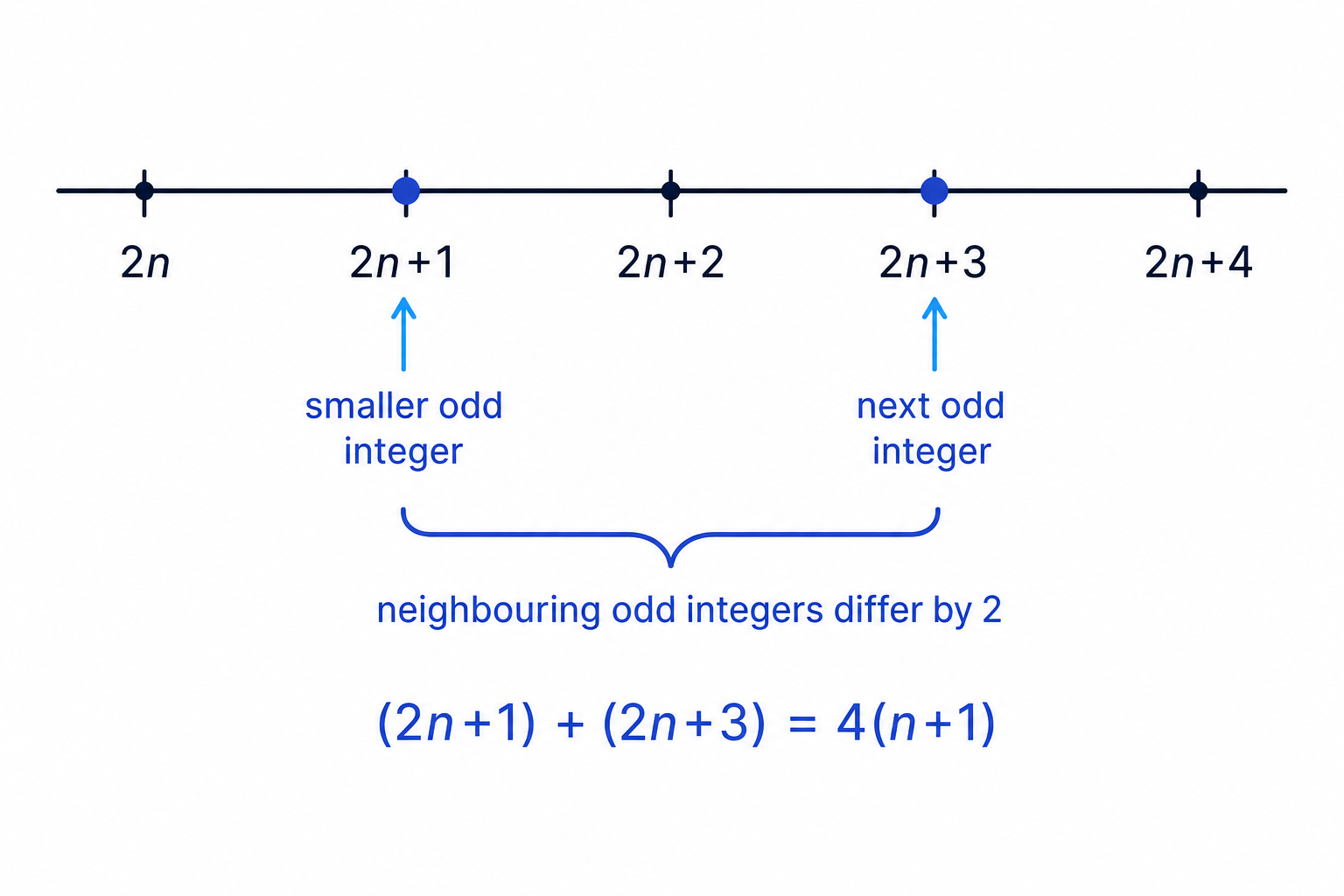
Show that adding two neighbouring odd integers always gives a multiple of 4.
-
Let the smaller odd integer be 2n+12n+12n+1. The next odd integer is 2n+32n+32n+3.
-
Add them:
(2n+1)+(2n+3)=4n+4=4(n+1)(2n+1)+(2n+3)=4n+4=4(n+1)(2n+1)+(2n+3)=4n+4=4(n+1) -
Since n+1n+1n+1 is an integer, 4(n+1)4(n+1)4(n+1) is a multiple of 4.
Example
Disproving an always statement
Disprove the claim: n2−n+3n^2-n+3n2−n+3 is prime for every positive integer nnn.
-
Try a small positive integer, such as n=3n=3n=3.
-
Substitute it into the expression:
32−3+3=93^2-3+3=932−3+3=9 -
Since 9=3⋅39=3\cdot 39=3⋅3, 9 is not prime. So the statement is false.
Example
Proof by odd and even cases
Prove that n2+1n^2+1n2+1 is never a multiple of 4, where nnn is a positive integer.
-
If nnn is even, write n=2kn=2kn=2k:
n2+1=(2k)2+1=4k2+1n^2+1=(2k)^2+1=4k^2+1n2+1=(2k)2+1=4k2+1 -
This is one more than a multiple of 4, so it is not a multiple of 4.
-
If nnn is odd, write n=2k+1n=2k+1n=2k+1:
n2+1=(2k+1)2+1=4k2+4k+2=4(k2+k)+2n^2+1=(2k+1)^2+1=4k^2+4k+2=4(k^2+k)+2n2+1=(2k+1)2+1=4k2+4k+2=4(k2+k)+2 -
This is two more than a multiple of 4, so it is not a multiple of 4. Therefore the statement is true in all cases.
5. Proving inequalities
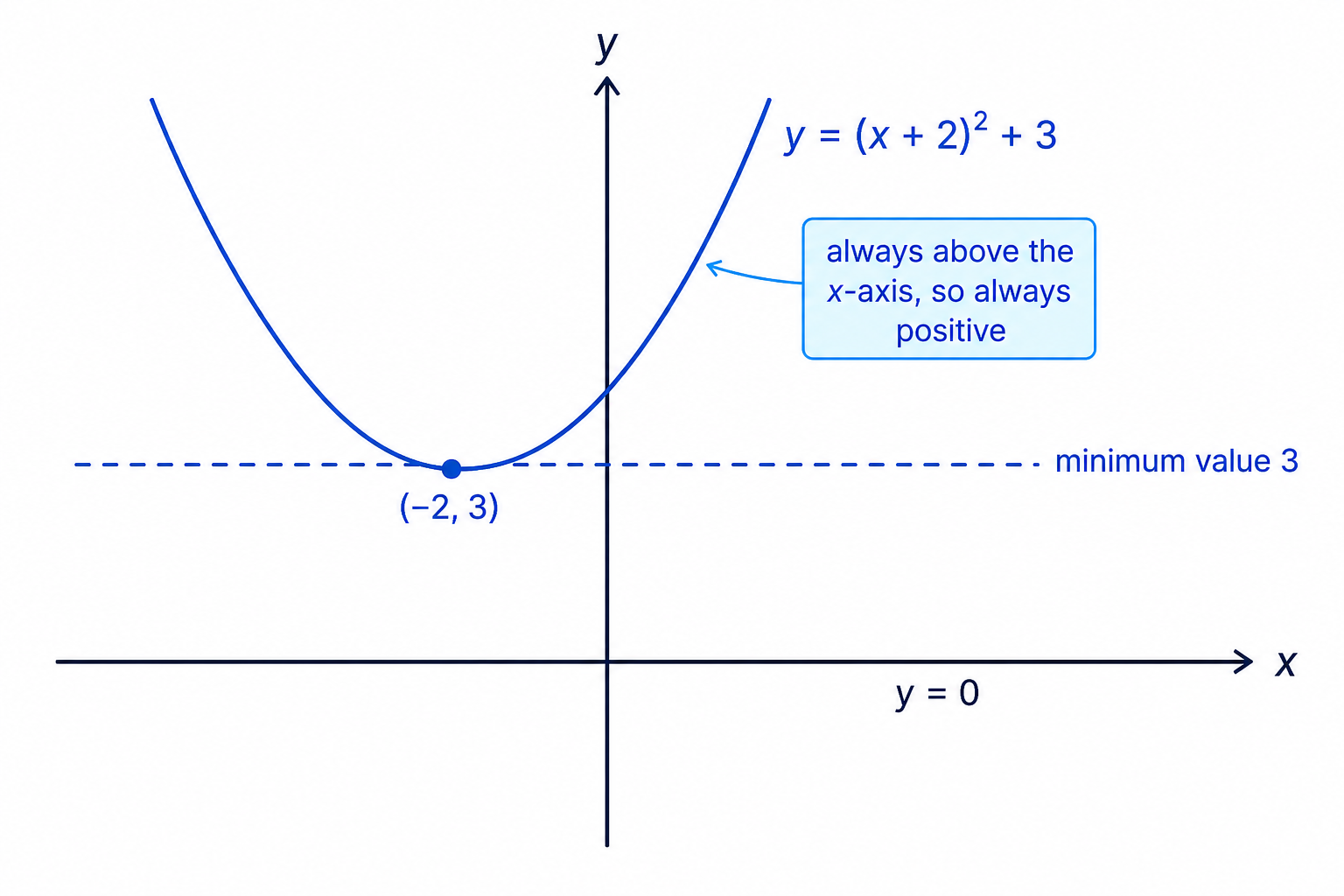
To prove something is positive for all real values, try completing the square. Completing the square means rewriting a quadratic as a squared bracket plus or minus a constant.
Example
Proving a quadratic inequality
Prove that x2+6x>2x−7x^2+6x>2x-7x2+6x>2x−7 for all real values of xxx.
-
Move everything to the left-hand side:
x2+6x−(2x−7)=x2+4x+7x^2+6x-(2x-7)=x^2+4x+7x2+6x−(2x−7)=x2+4x+7 -
Complete the square:
x2+4x+7=(x+2)2+3x^2+4x+7=(x+2)^2+3x2+4x+7=(x+2)2+3 -
Since (x+2)2≥0(x+2)^2\ge 0(x+2)2≥0, we know (x+2)2+3>0(x+2)^2+3>0(x+2)2+3>0 for all real xxx.
-
Therefore x2+6x>2x−7x^2+6x>2x-7x2+6x>2x−7 is always true.
Common Mistake
Dividing by variables
Only divide an inequality by a variable expression when you know its sign. If a>0a>0a>0 and b>0b>0b>0, then ab>0ab>0ab>0, so dividing by ababab does not reverse the inequality sign.
Exam technique
In the exam
-
For cubics, test likely roots with the factor theorem and show the substitution clearly before dividing.
-
After factorising, solve every factor and use the discriminant if you need to justify the number of real roots.
-
For proof, choose the method first: algebraic form for even and odd numbers, a counterexample for false “always” claims, or completing the square for positivity.
Self review
Check yourself
- If (x+4)(x+4)(x+4) is a factor of f(x)f(x)f(x), what value of xxx must you substitute?
- How can a quadratic factor prove that a cubic has no more real roots?
- What single counterexample would disprove “all prime numbers have odd squares”?

Recap questions
Test yourself with 5 quick questions on this guide. Answer them all correctly to complete it.
You've reached the end
Test yourself on this topic, or move on to the next guide.
How was this guide?