Revision notes for Edexcel AS Level Maths Straight Line Graphs. Open each subtopic for explanations, worked examples, and summaries of 5.1 y = mx + c, 5.2 Equations of Straight Lines, 5.3 Parallel and Perpendicular Lines, 5.4 Length and Area, and 5.5 Modelling with Straight Lines. Written against the Edexcel AS Level Maths (8MA0) specification, so the content matches what's examinable rather than general Maths background.
Straight Line Graphs
What you'll learn
- How to find the gradient of a line from two points or from its equation.
- How to write equations of straight lines in forms such as y=mx+cy = mx + cy=mx+c and ax+by+c=0ax + by + c = 0ax+by+c=0.
- How to decide whether lines are parallel or perpendicular.
- How to use midpoints, distances, intercepts and intersections in coordinate geometry problems.
Coordinates and gradient
A point on a graph is written as an ordered pair, such as (3,−2)(3, -2)(3,−2). The first number is the xxx-coordinate, and the second is the yyy-coordinate.
The origin is the point (0,0)(0,0)(0,0), where the axes meet.
Definition
Gradient
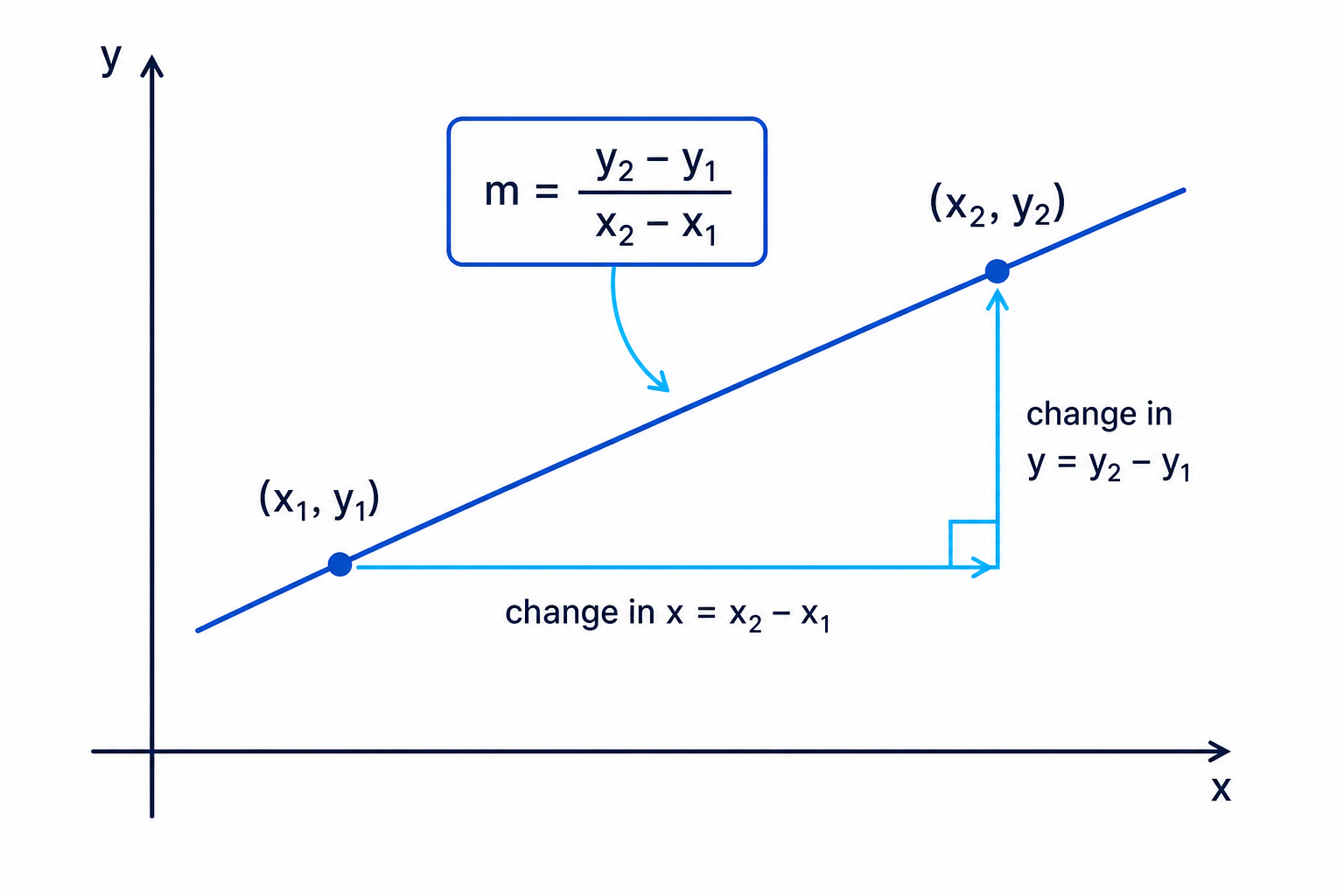
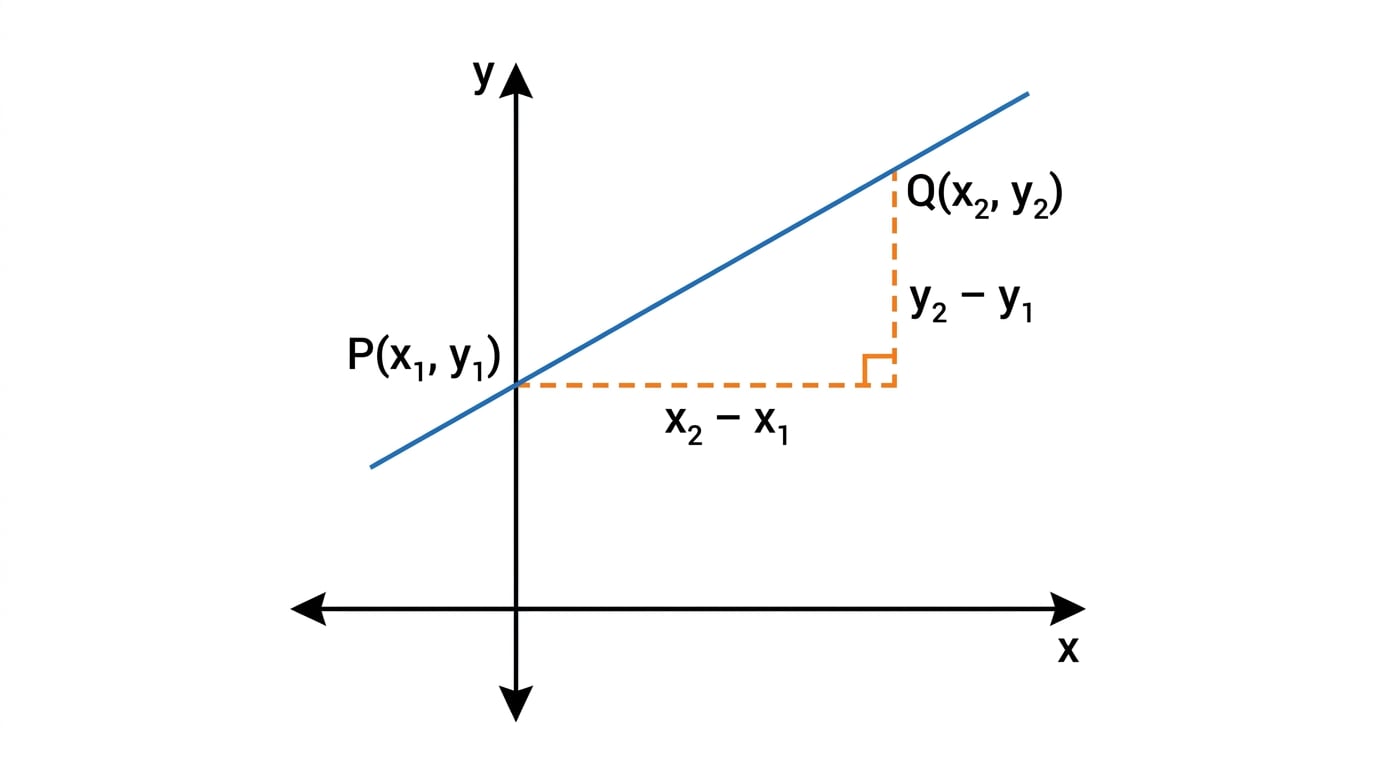
The gradient of a straight line measures its steepness. Between two points (x1,y1)(x_1, y_1)(x1,y1) and (x2,y2)(x_2, y_2)(x2,y2), the gradient is
m=y2−y1x2−x1m = \frac{y_2 - y_1}{x_2 - x_1}m=x2−x1y2−y1Think of gradient as:
Common Mistake
Subtracting in different orders
If you do y2−y1y_2 - y_1y2−y1 on the top, you must do x2−x1x_2 - x_1x2−x1 on the bottom. Do not swap the order halfway through.
Example
Finding the gradient between two points
A line passes through (−1,6)(-1, 6)(−1,6) and (5,−3)(5, -3)(5,−3). Find its gradient.
-
Identify the two points:
(x1,y1)=(−1,6),(x2,y2)=(5,−3)(x_1, y_1) = (-1, 6), \qquad (x_2, y_2) = (5, -3)(x1,y1)=(−1,6),(x2,y2)=(5,−3) -
Substitute into the gradient formula:
m=−3−65−(−1)m = \frac{-3 - 6}{5 - (-1)}m=5−(−1)−3−6 -
Simplify the numerator and denominator:
m=−96=−32m = \frac{-9}{6} = -\frac{3}{2}m=6−9=−23 -
The gradient of the line is −32-\frac{3}{2}−23.
Equations of straight lines
The most common form of a straight-line equation is:
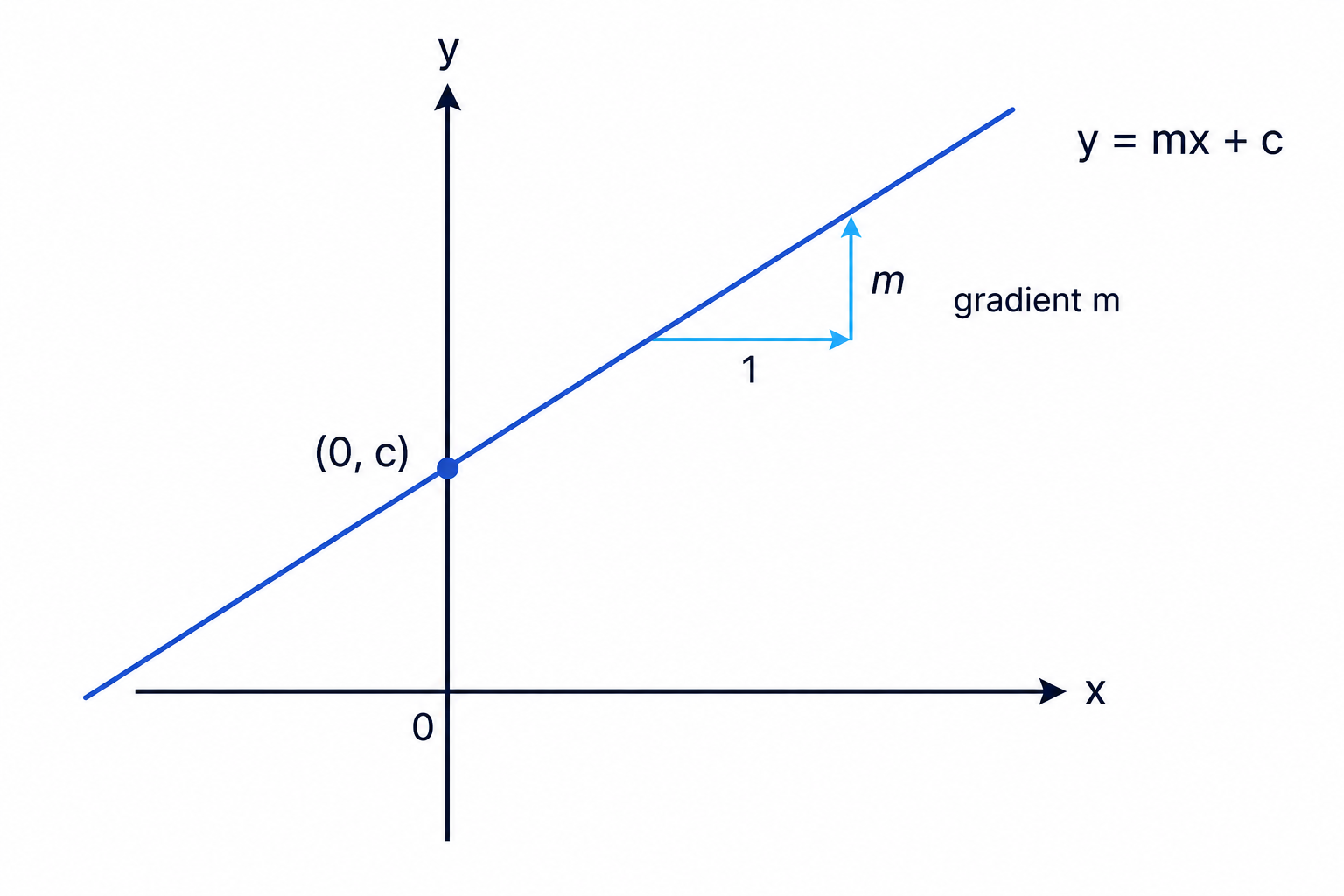
y=mx+cy = mx + cy=mx+cHere, mmm is the gradient and ccc is the yyy-intercept.
Definition
The y-intercept
The yyy-intercept is the point where the line crosses the yyy-axis. In y=mx+cy = mx + cy=mx+c, the line crosses the yyy-axis at (0,c)(0,c)(0,c).
You can find the equation of a line if you know:
- its gradient and one point on it, or
- two points on it.
Key Idea
Equation from gradient and a point
If you know the gradient mmm and a point (x1,y1)(x_1, y_1)(x1,y1), substitute into y=mx+cy = mx + cy=mx+c to find ccc.
Example
Equation of a line through two points
Find an equation of the line through (2,7)(2, 7)(2,7) and (6,−1)(6, -1)(6,−1).
-
First find the gradient:
m=−1−76−2=−84=−2m = \frac{-1 - 7}{6 - 2} = \frac{-8}{4} = -2m=6−2−1−7=4−8=−2 -
Start with y=mx+cy = mx + cy=mx+c. Since the gradient is -2:
y=−2x+cy = -2x + cy=−2x+c -
Substitute one point, for example (2,7)(2, 7)(2,7):
7=−2(2)+c7 = -2(2) + c7=−2(2)+c -
Solve for ccc:
7=−4+c7 = -4 + c7=−4+c -
Therefore c=11c = 11c=11, so the equation is:
y=−2x+11y = -2x + 11y=−2x+11
Rearranging into ax+by+c=0ax + by + c = 0ax+by+c=0
In AS questions, you are often asked to give your answer in the form:
ax+by+c=0ax + by + c = 0ax+by+c=0where aaa, bbb and ccc are integers.
Definition
General form
The form ax+by+c=0ax + by + c = 0ax+by+c=0 is called the general form of a straight-line equation. It collects all terms on one side and leaves zero on the other side.
Example
Writing an equation in general form
A line passes through (−2,4)(-2, 4)(−2,4) and (4,1)(4, 1)(4,1). Find its equation in the form ax+by+c=0ax + by + c = 0ax+by+c=0.
-
Find the gradient:
m=1−44−(−2)=−36=−12m = \frac{1 - 4}{4 - (-2)} = \frac{-3}{6} = -\frac{1}{2}m=4−(−2)1−4=6−3=−21 -
Use y=mx+cy = mx + cy=mx+c:
y=−12x+cy = -\frac{1}{2}x + cy=−21x+c -
Substitute the point (4,1)(4, 1)(4,1):
1=−12(4)+c1 = -\frac{1}{2}(4) + c1=−21(4)+c -
Solve for ccc:
1=−2+c1 = -2 + c1=−2+c -
So c=3c = 3c=3, giving:
y=−12x+3y = -\frac{1}{2}x + 3y=−21x+3 -
Multiply by 2 to remove the fraction:
2y=−x+62y = -x + 62y=−x+6 -
Rearrange into general form:
x+2y−6=0x + 2y - 6 = 0x+2y−6=0
Tip
Removing fractions
If your equation contains fractions, multiply every term by the denominator before rearranging into ax+by+c=0ax + by + c = 0ax+by+c=0.
Intercepts and areas with the axes
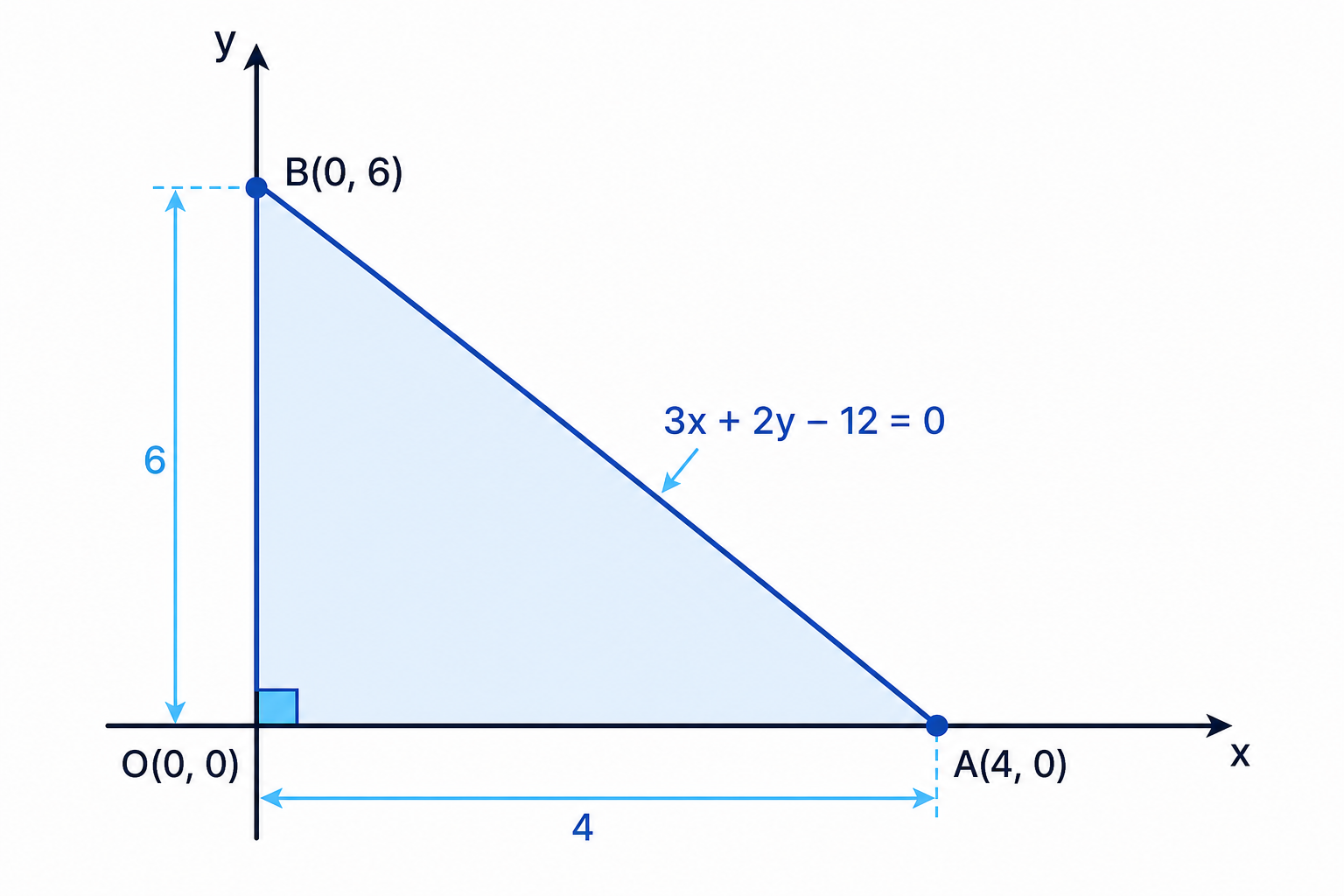
A line may cross the coordinate axes at two useful points:
- The xxx-intercept is where y=0y = 0y=0.
- The yyy-intercept is where x=0x = 0x=0.
These are often used to form a triangle with the origin.
Example
Finding intercepts and an area
The line 3x+2y−12=03x + 2y - 12 = 03x+2y−12=0 meets the axes at points AAA and BBB. Find the area of triangle AOBAOBAOB, where OOO is the origin.
-
To find the xxx-intercept, set y=0y = 0y=0:
3x+2(0)−12=03x + 2(0) - 12 = 03x+2(0)−12=0 -
Solve for xxx:
3x=123x = 123x=12 -
So x=4x = 4x=4, meaning A=(4,0)A = (4,0)A=(4,0).
-
To find the yyy-intercept, set x=0x = 0x=0:
3(0)+2y−12=03(0) + 2y - 12 = 03(0)+2y−12=0 -
Solve for yyy:
2y=122y = 122y=12 -
So y=6y = 6y=6, meaning B=(0,6)B = (0,6)B=(0,6).
-
The triangle has base 4 and height 6, so its area is:
12×4×6=12\frac{1}{2} \times 4 \times 6 = 1221×4×6=12
Parallel and perpendicular lines
Definition
Parallel lines
Two straight lines are parallel if they have the same gradient and never meet.
Definition
Perpendicular lines
Two straight lines are perpendicular if they meet at 90°. Their gradients multiply to give -1.
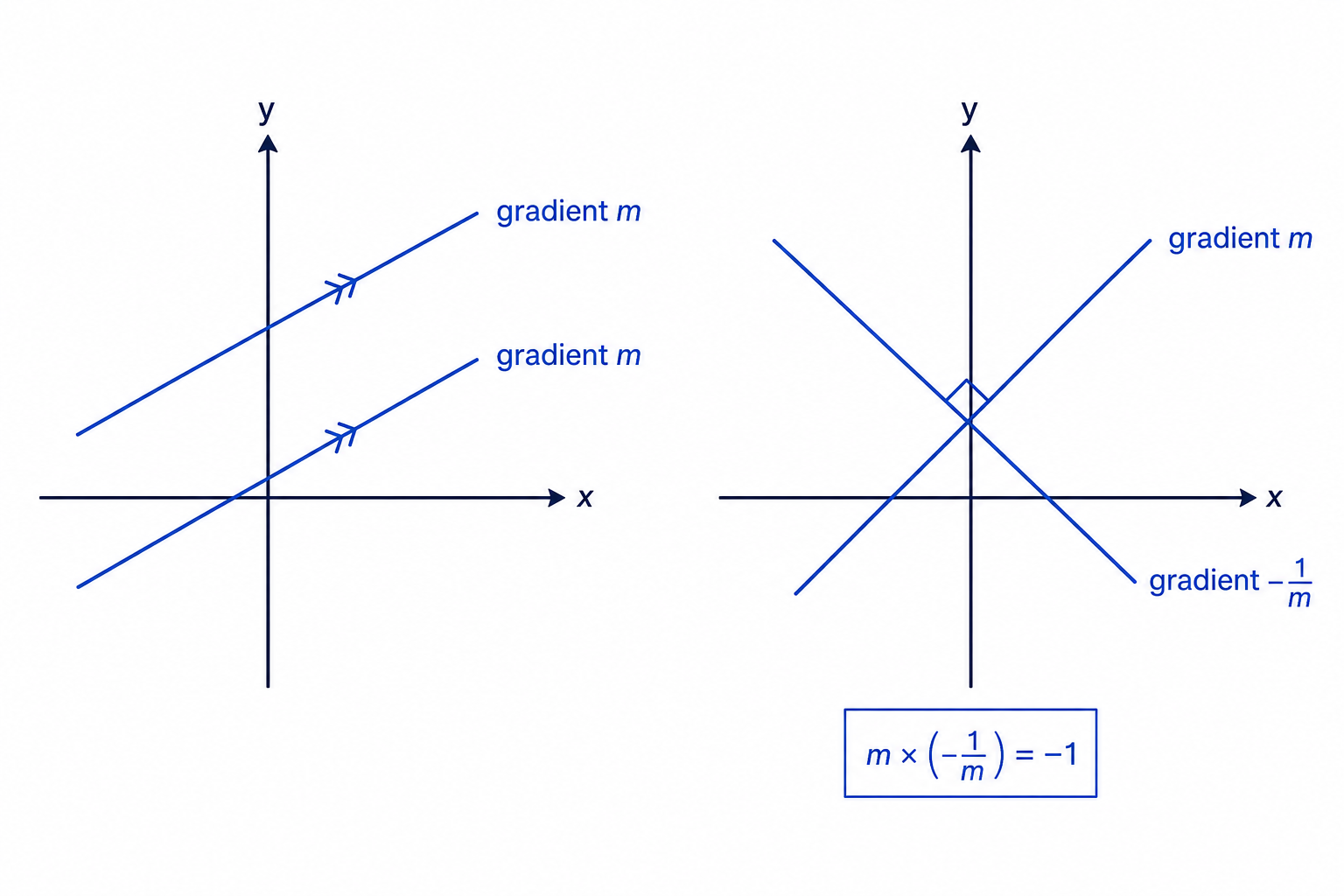
So if one line has gradient 3, a perpendicular line has gradient −13-\frac{1}{3}−31.
If one line has gradient −25-\frac{2}{5}−52, a perpendicular line has gradient 52\frac{5}{2}25.
Example
Deciding whether two lines are parallel or perpendicular
Line l1l_1l1 has equation 4x+2y−10=04x + 2y - 10 = 04x+2y−10=0. Line l2l_2l2 passes through (1,5)(1, 5)(1,5) and (5,−3)(5, -3)(5,−3). Decide whether the lines are parallel, perpendicular or neither.
-
Rearrange l1l_1l1 into y=mx+cy = mx + cy=mx+c form:
4x+2y−10=04x + 2y - 10 = 04x+2y−10=0 -
Make yyy the subject:
2y=−4x+102y = -4x + 102y=−4x+10 -
Divide by 2, so the gradient of l1l_1l1 is -2:
y=−2x+5y = -2x + 5y=−2x+5 -
Find the gradient of l2l_2l2 using its two points:
m=−3−55−1=−84=−2m = \frac{-3 - 5}{5 - 1} = \frac{-8}{4} = -2m=5−1−3−5=4−8=−2 -
Both gradients are the same, so the lines are parallel.
Common Mistake
Perpendicular does not mean opposite signs only
Gradients 2 and -2 are not perpendicular. For perpendicular lines, the gradients must multiply to -1.
Midpoints, distances and perpendicular bisectors
The midpoint of a line segment is the point halfway between its endpoints.
Definition
Midpoint formula
For points (x1,y1)(x_1, y_1)(x1,y1) and (x2,y2)(x_2, y_2)(x2,y2), the midpoint is
(x1+x22,y1+y22)\left(\frac{x_1 + x_2}{2}, \frac{y_1 + y_2}{2}\right)(2x1+x2,2y1+y2)The distance between two points comes from Pythagoras’ theorem.
Definition
Distance formula
For points (x1,y1)(x_1, y_1)(x1,y1) and (x2,y2)(x_2, y_2)(x2,y2), the distance between them is
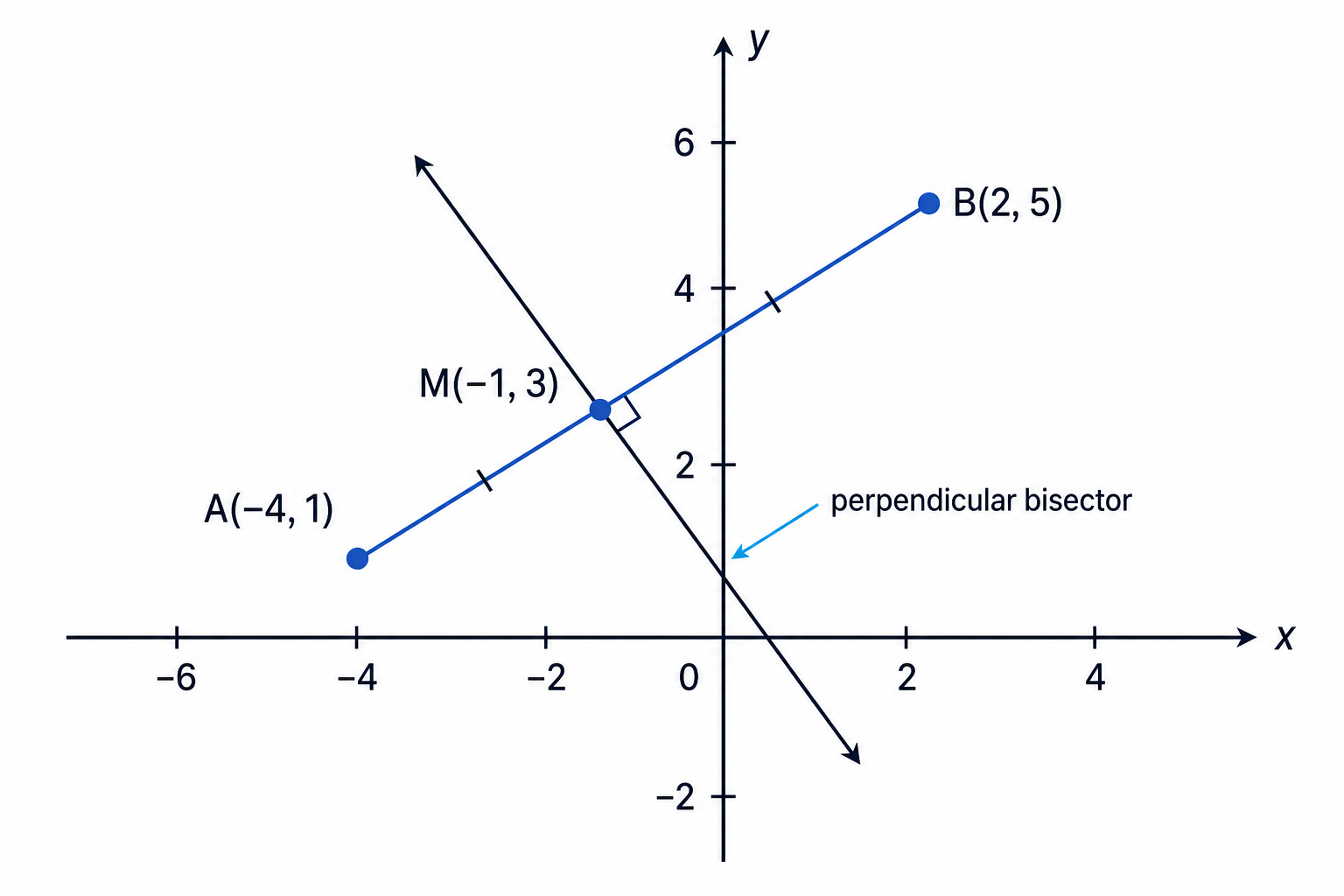
(x2−x1)2+(y2−y1)2\sqrt{(x_2 - x_1)^2 + (y_2 - y_1)^2}(x2−x1)2+(y2−y1)2A perpendicular bisector cuts a line segment exactly in half and meets it at 90°.

Example
Finding a perpendicular bisector
Points A(−4,1)A(-4, 1)A(−4,1) and B(2,5)B(2, 5)B(2,5) are joined by a straight line. Find the equation of the perpendicular bisector of ABABAB in the form ax+by+c=0ax + by + c = 0ax+by+c=0.
-
Find the gradient of ABABAB:
mAB=5−12−(−4)=46=23m_{AB} = \frac{5 - 1}{2 - (-4)} = \frac{4}{6} = \frac{2}{3}mAB=2−(−4)5−1=64=32 -
The perpendicular gradient is the negative reciprocal:
m=−32m = -\frac{3}{2}m=−23 -
Find the midpoint of ABABAB:
(−4+22,1+52)=(−1,3)\left(\frac{-4 + 2}{2}, \frac{1 + 5}{2}\right) = (-1, 3)(2−4+2,21+5)=(−1,3) -
Use y=mx+cy = mx + cy=mx+c with midpoint (−1,3)(-1, 3)(−1,3):
3=−32(−1)+c3 = -\frac{3}{2}(-1) + c3=−23(−1)+c -
Solve for ccc:
3=32+c3 = \frac{3}{2} + c3=23+c -
So c=32c = \frac{3}{2}c=23, giving:
y=−32x+32y = -\frac{3}{2}x + \frac{3}{2}y=−23x+23 -
Multiply by 2 and rearrange:
2y=−3x+32y = -3x + 32y=−3x+3 -
The perpendicular bisector is:
3x+2y−3=03x + 2y - 3 = 03x+2y−3=0
Intersections of straight lines
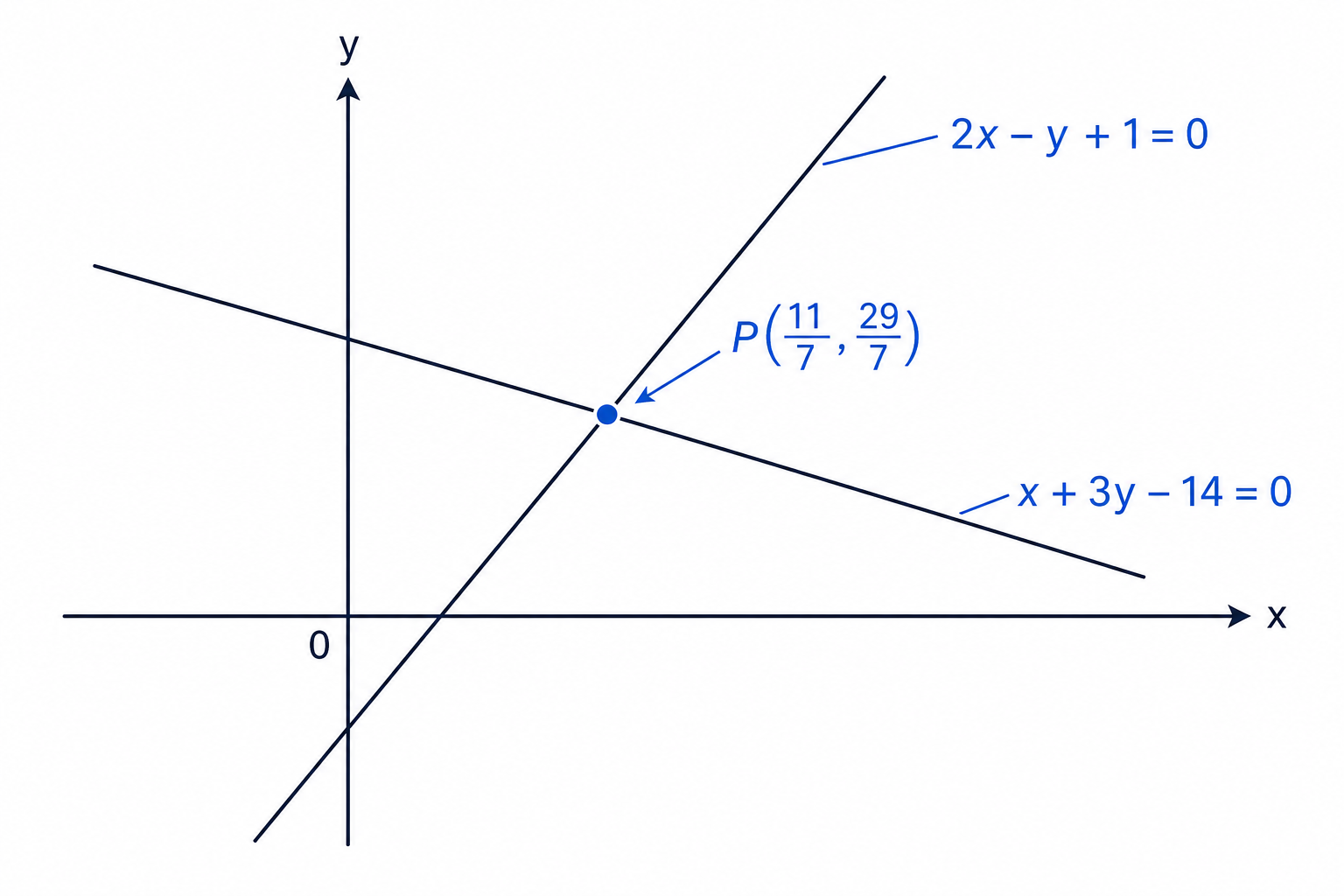
When two lines intersect, their equations are both true at the same point. You find the point of intersection by solving the two equations simultaneously.
Example
Finding the point where two lines meet
Find the coordinates where 2x−y+1=02x - y + 1 = 02x−y+1=0 and x+3y−14=0x + 3y - 14 = 0x+3y−14=0 intersect.
-
Rearrange the first equation to make yyy the subject:
y=2x+1y = 2x + 1y=2x+1 -
Substitute this into the second equation:
x+3(2x+1)−14=0x + 3(2x + 1) - 14 = 0x+3(2x+1)−14=0 -
Expand and simplify:
x+6x+3−14=0x + 6x + 3 - 14 = 0x+6x+3−14=0 -
Solve for xxx:
7x−11=07x - 11 = 07x−11=0 -
So x=117x = \frac{11}{7}x=711.
-
Substitute into y=2x+1y = 2x + 1y=2x+1:
y=2(117)+1y = 2\left(\frac{11}{7}\right) + 1y=2(711)+1 -
Therefore:
y=227+77=297y = \frac{22}{7} + \frac{7}{7} = \frac{29}{7}y=722+77=729 -
The intersection point is (117,297)\left(\frac{11}{7}, \frac{29}{7}\right)(711,729).
Tip
Check your intersection
Substitute your final coordinates into both original equations. If they work in both, your intersection is correct.
Linear models
A linear model assumes that two quantities are linked by a straight-line relationship. At AS Level, this often means using two data points to form an equation.
For example, if AAA is an amount and nnn is the number of years after a starting year, a linear model may look like:
A=mn+cA = mn + cA=mn+cHere, mmm is the rate of change per year, and ccc is the starting value when n=0n = 0n=0.
Example
Forming and commenting on a linear model
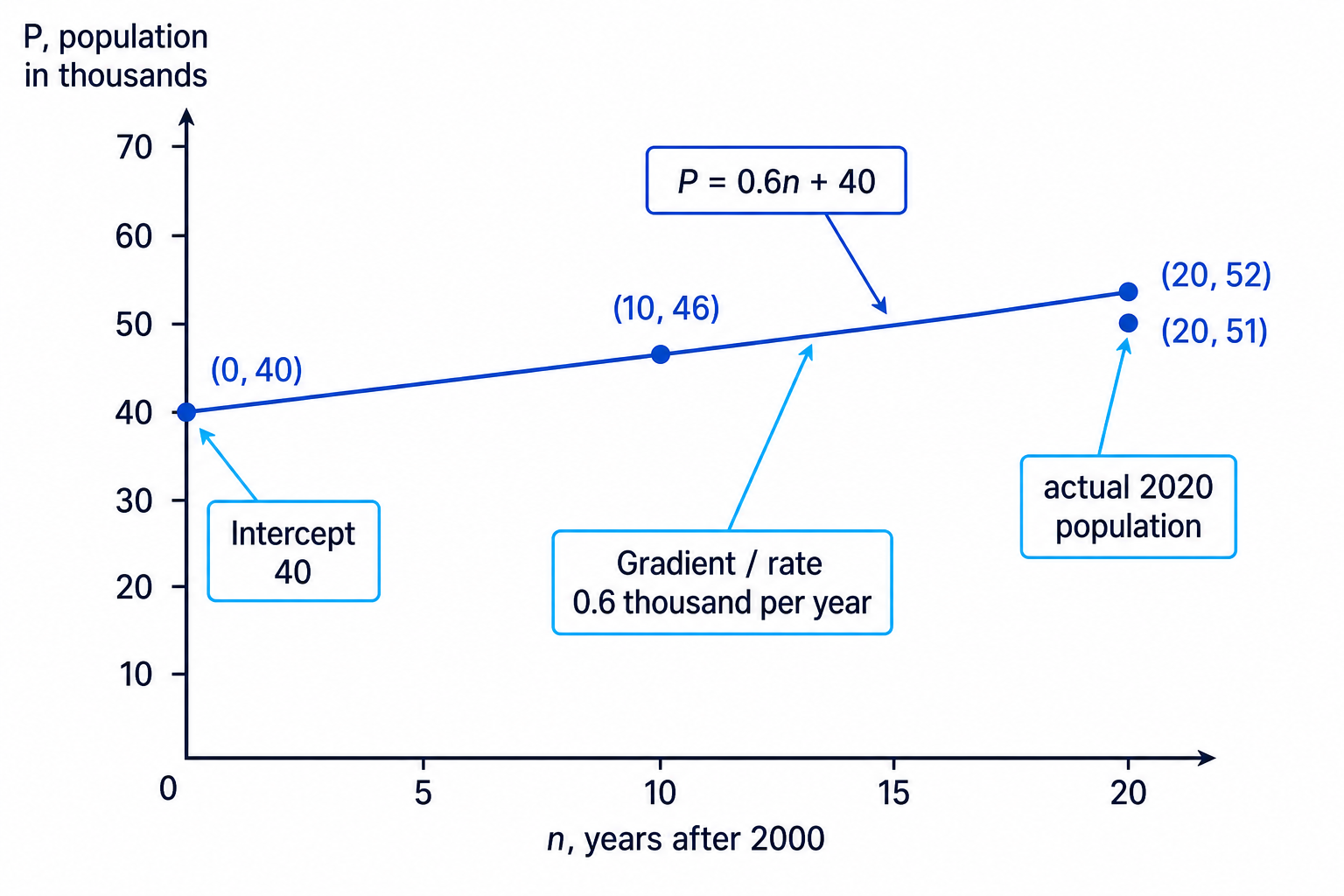
In 2000, a town had population 40 thousand. In 2010, it had population 46 thousand. Let PPP be the population in thousands, nnn years after 2000. Form a linear model, then comment if the actual population in 2020 was 51 thousand.
-
Write the two points using nnn and PPP:
(0,40),(10,46)(0, 40), \qquad (10, 46)(0,40),(10,46) -
Find the gradient:
m=46−4010−0=610=0.6m = \frac{46 - 40}{10 - 0} = \frac{6}{10} = 0.6m=10−046−40=106=0.6 -
Since P=40P = 40P=40 when n=0n = 0n=0, the intercept is 40.
-
The model is:
P=0.6n+40P = 0.6n + 40P=0.6n+40 -
For 2020, n=20n = 20n=20, so the model predicts:
P=0.6(20)+40=52P = 0.6(20) + 40 = 52P=0.6(20)+40=52 -
The model predicts 52 thousand, but the actual value is 51 thousand. It is close, so the model is fairly suitable, although it slightly overestimates.
Common Mistake
Models are not facts
A straight-line model is an assumption. A comment question usually wants you to compare the model’s prediction with the real value and say whether the difference is large or small in context.
Exam technique
In the exam
-
Start by finding the gradient whenever a question involves two points, parallel lines or perpendicular lines.
-
If asked for ax+by+c=0ax + by + c = 0ax+by+c=0, clear fractions and move every term to one side.
-
For a perpendicular bisector, you need both the midpoint and the perpendicular gradient.
-
For axis intercepts, set y=0y = 0y=0 for the xxx-intercept and set x=0x = 0x=0 for the yyy-intercept.
Self review
Check yourself
-
Can you find the equation of a line through two given points?
-
Can you explain how to tell whether two lines are parallel or perpendicular?
-
Can you find the perpendicular bisector of a line segment using its midpoint?

Recap questions
Test yourself with 5 quick questions on this guide. Answer them all correctly to complete it.
You've reached the end
Test yourself on this topic, or move on to the next guide.
How was this guide?