Revision notes for Edexcel AS Level Maths Quadratics. Open each subtopic for explanations, worked examples, and summaries of 2.1 Solving Quadratics, 2.2 Completing the Square, 2.3 Sketching Quadratic Graphs, 2.4 The Discriminant, and 2.5 Modelling with Quadratics. Written against the Edexcel AS Level Maths (8MA0) specification, so the content matches what's examinable rather than general Maths background.
Quadratics
What you'll learn
- How to recognise a quadratic and connect its equation to its graph.
- How the discriminant tells you whether roots are real, repeated, or absent.
- How to complete the square to find turning points and prove inequalities.
- How quadratics appear in tangency, projectile, and profit-style modelling questions.
1. Quadratic basics
Definition
Quadratic expression
A quadratic expression in xxx is an expression of the form ax2+bx+cax^2+bx+cax2+bx+c, where aaa, bbb and ccc are constants and a≠0a\neq0a=0. The number aaa is the coefficient of x2x^2x2, bbb is the coefficient of xxx, and ccc is the constant term.
A quadratic equation is made by setting a quadratic expression equal to zero, for example ax2+bx+c=0ax^2+bx+c=0ax2+bx+c=0.
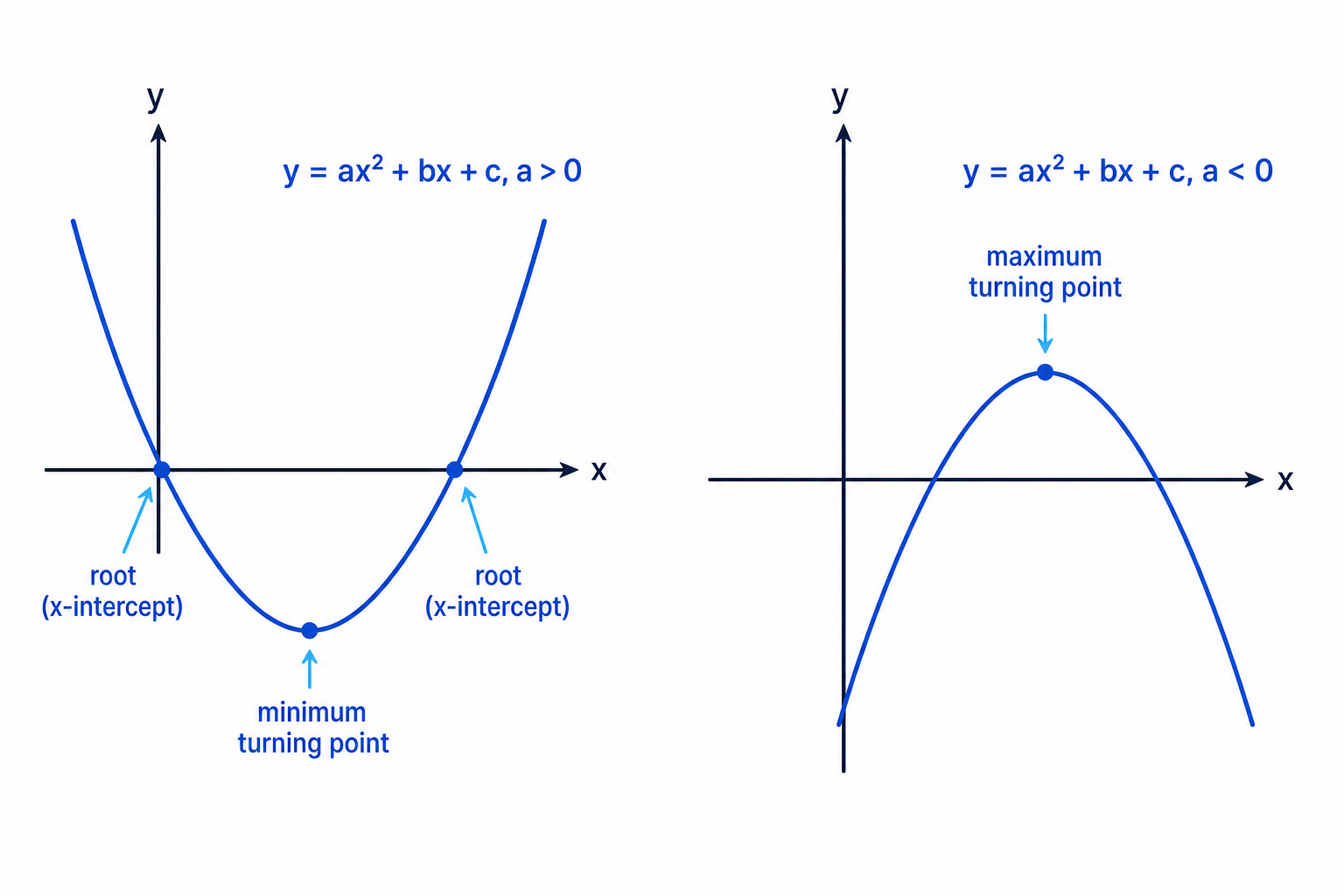
A root or solution is a value of xxx that makes the equation true. On the graph of y=ax2+bx+cy=ax^2+bx+cy=ax2+bx+c, roots are the points where the curve crosses or touches the xxx-axis.
The graph of a quadratic is called a parabola. If a>0a>0a>0, it opens upwards. If a<0a<0a<0, it opens downwards.
Example
Putting a quadratic into standard form
Rewrite 3x2+7=2x3x^2+7=2x3x2+7=2x in the form ax2+bx+c=0ax^2+bx+c=0ax2+bx+c=0 and identify aaa, bbb and ccc.
-
Move every term to the left-hand side:
3x2−2x+7=03x^2-2x+7=03x2−2x+7=0 -
Compare this with ax2+bx+c=0ax^2+bx+c=0ax2+bx+c=0.
-
The values are a=3a=3a=3, b=−2b=-2b=−2 and c=7c=7c=7.
2. The discriminant
Definition
Discriminant
For a quadratic equation ax2+bx+c=0ax^2+bx+c=0ax2+bx+c=0, the discriminant is
Δ=b2−4ac\Delta=b^2-4acΔ=b2−4acIt tells you how many real roots the equation has.
Key Idea
What the discriminant tells you
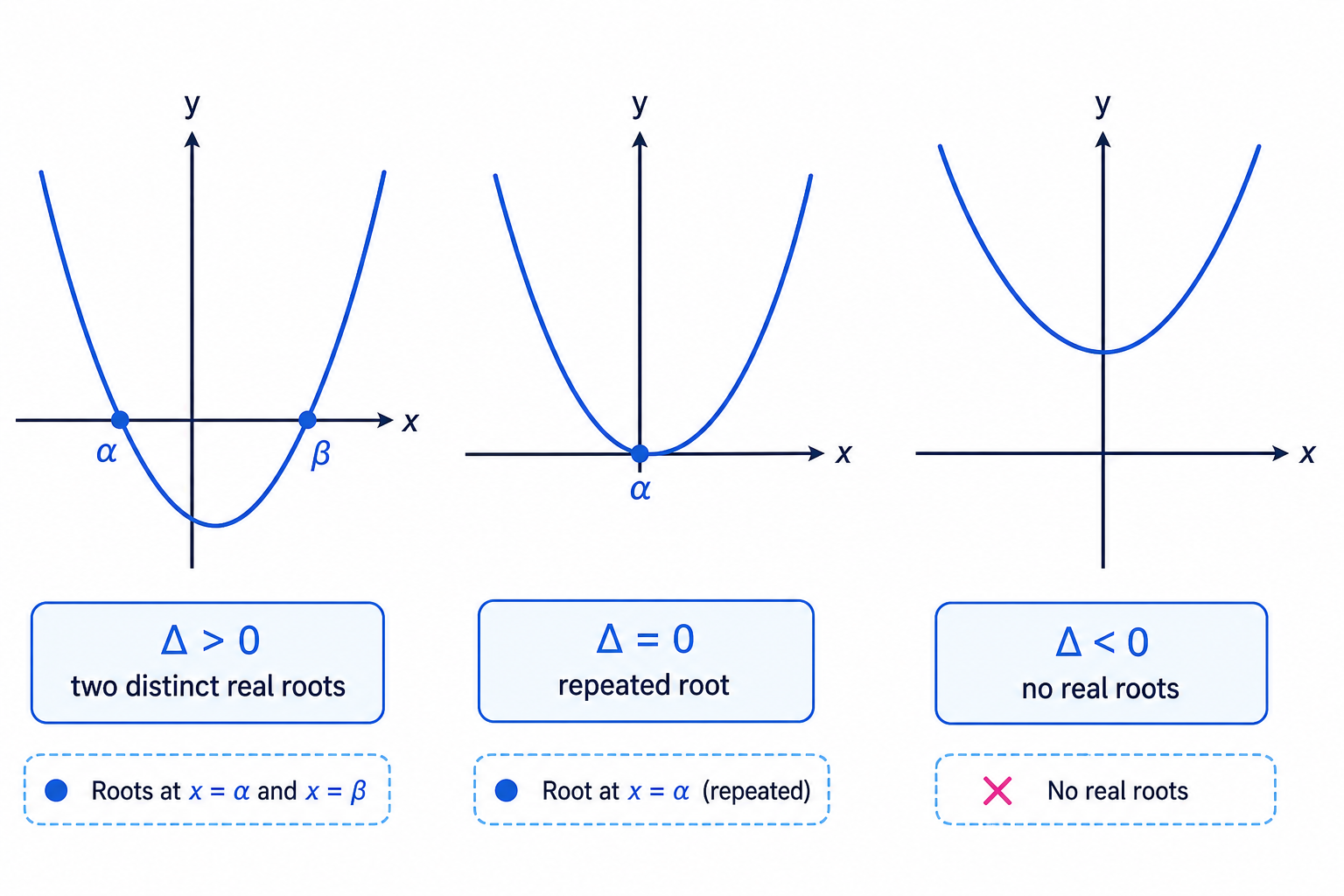
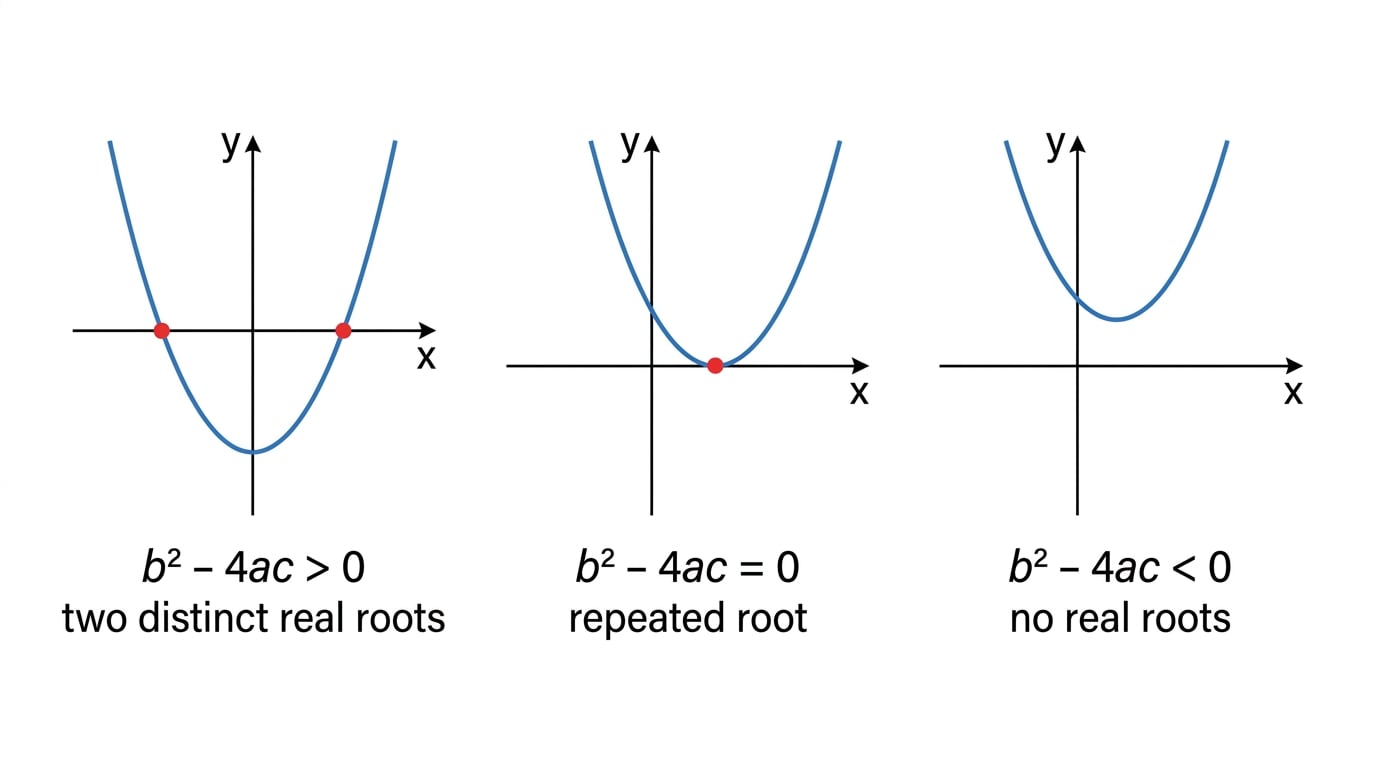
- If Δ>0\Delta>0Δ>0, there are two distinct real roots.
- If Δ=0\Delta=0Δ=0, there is one repeated root, also called equal roots.
- If Δ<0\Delta<0Δ<0, there are no real roots.
The word distinct means “different”. A repeated root means the graph just touches the xxx-axis at its turning point.
Example
Showing there are no real roots
Show that 2x2+5=4x2x^2+5=4x2x2+5=4x has no real roots.
-
Put the equation into standard form:
2x2−4x+5=02x^2-4x+5=02x2−4x+5=0 -
Identify the coefficients: a=2a=2a=2, b=−4b=-4b=−4 and c=5c=5c=5.
-
Calculate the discriminant:
Δ=(−4)2−4(2)(5)=16−40=−24\Delta=(-4)^2-4(2)(5)=16-40=-24Δ=(−4)2−4(2)(5)=16−40=−24 -
Since Δ<0\Delta<0Δ<0, the equation has no real roots.
Example
Equal roots with a positive parameter
The equation kx2+8x+2k=0kx^2+8x+2k=0kx2+8x+2k=0, where kkk is positive, has equal roots. Find kkk.
-
Equal roots means Δ=0\Delta=0Δ=0.
-
Substitute a=ka=ka=k, b=8b=8b=8 and c=2kc=2kc=2k:
82−4(k)(2k)=08^2-4(k)(2k)=082−4(k)(2k)=0 -
Solve for kkk:
64−8k2=0⇒k2=8⇒k=±2264-8k^2=0 \Rightarrow k^2=8 \Rightarrow k=\pm2\sqrt264−8k2=0⇒k2=8⇒k=±22 -
Since kkk is positive, k=22k=2\sqrt2k=22.
3. Parameter ranges and hidden edge cases
Many AS questions ask for a set of values of a constant. That usually means you will form an inequality using the discriminant.
Common Mistake
Check it is still a quadratic
The discriminant rules apply to quadratics, so you need a≠0a\neq0a=0. If the coefficient of x2x^2x2 contains a parameter, check whether it could become zero.
Example
Finding a parameter range
Find the values of kkk for which (k+1)x2+2x+k=0(k+1)x^2+2x+k=0(k+1)x2+2x+k=0 has two distinct real roots.
-
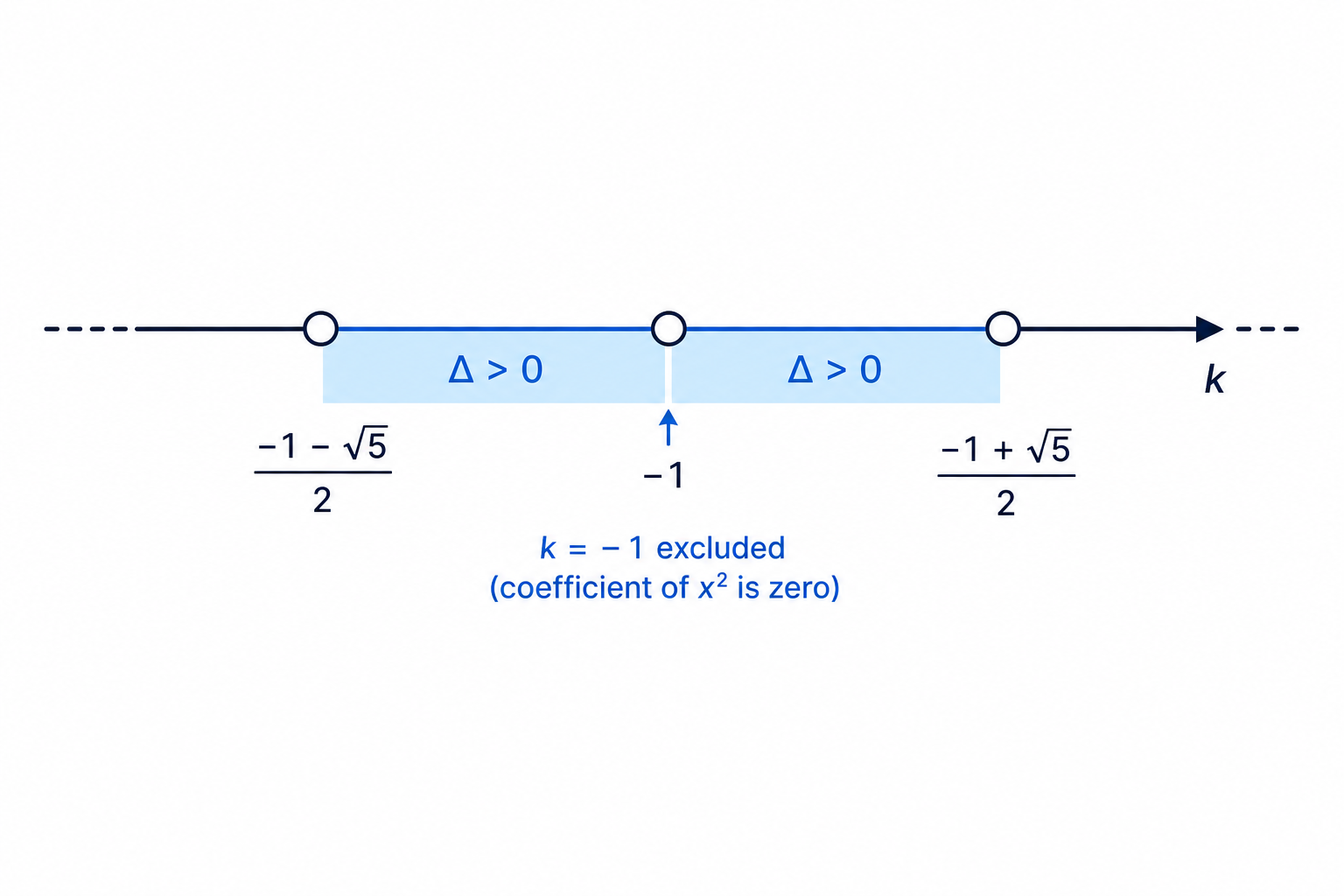
For a genuine quadratic, the coefficient of x2x^2x2 must not be zero, so k≠−1k\neq-1k=−1.
-
Two distinct real roots means Δ>0\Delta>0Δ>0:
22−4(k+1)k>02^2-4(k+1)k>022−4(k+1)k>0 -
Simplify the inequality:
4−4k2−4k>0⇒k2+k−1<04-4k^2-4k>0 \Rightarrow k^2+k-1<04−4k2−4k>0⇒k2+k−1<0 -
Find the critical values by solving k2+k−1=0k^2+k-1=0k2+k−1=0:
k=−1±52k=\frac{-1\pm\sqrt5}{2}k=2−1±5 -
Since k2+k−1k^2+k-1k2+k−1 is negative between its roots, and k=−1k=-1k=−1 must be excluded:
−1−52<k<−1or−1<k<−1+52\frac{-1-\sqrt5}{2}<k<-1 \quad \text{or} \quad -1<k<\frac{-1+\sqrt5}{2}2−1−5<k<−1or−1<k<2−1+5
Common Mistake
Forgetting the excluded value
If aaa contains the parameter, do not just solve Δ>0\Delta>0Δ>0, Δ=0\Delta=0Δ=0 or Δ<0\Delta<0Δ<0. First check whether the equation stops being quadratic for any value of the parameter.
4. Completing the square
Definition
Completed-square form
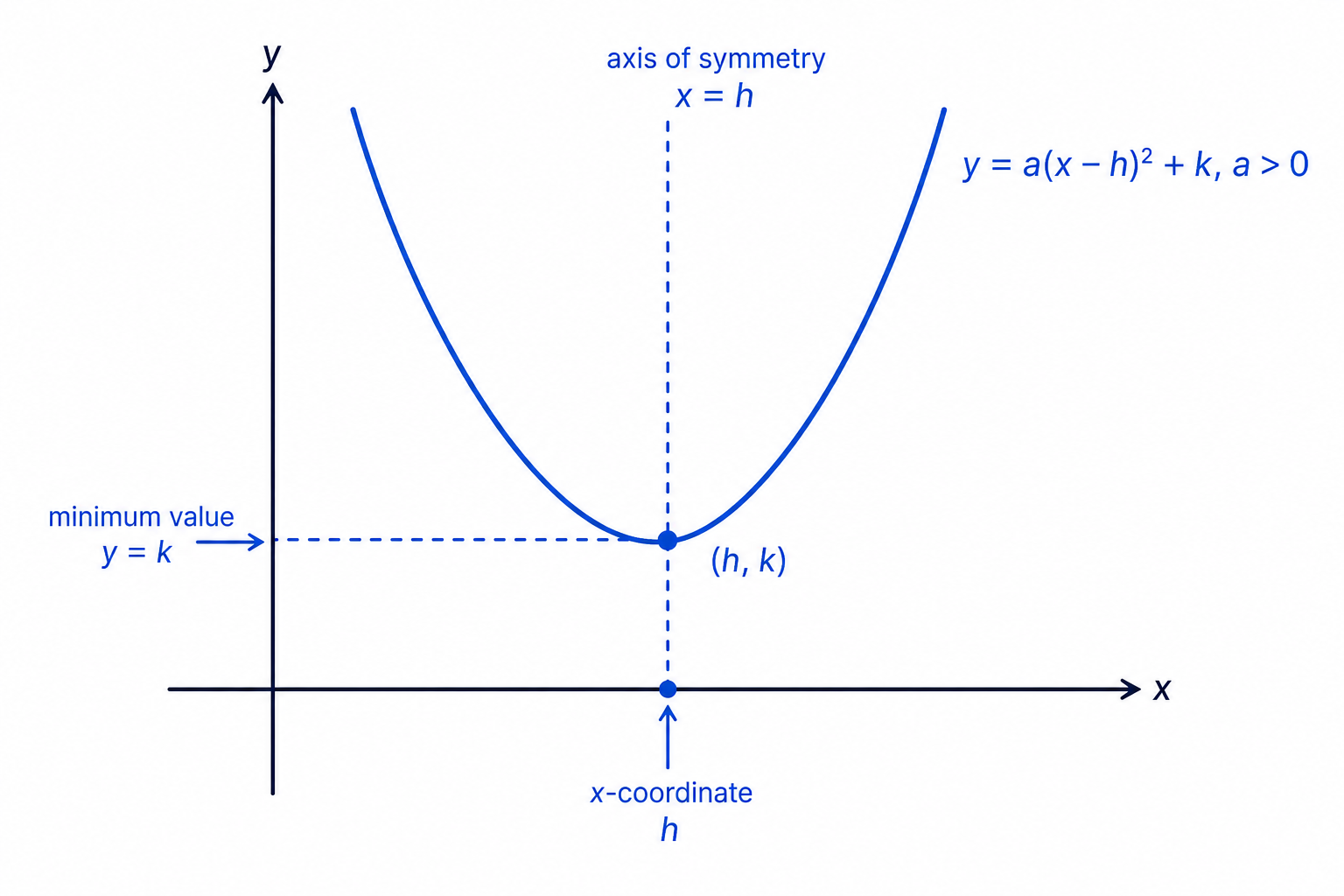
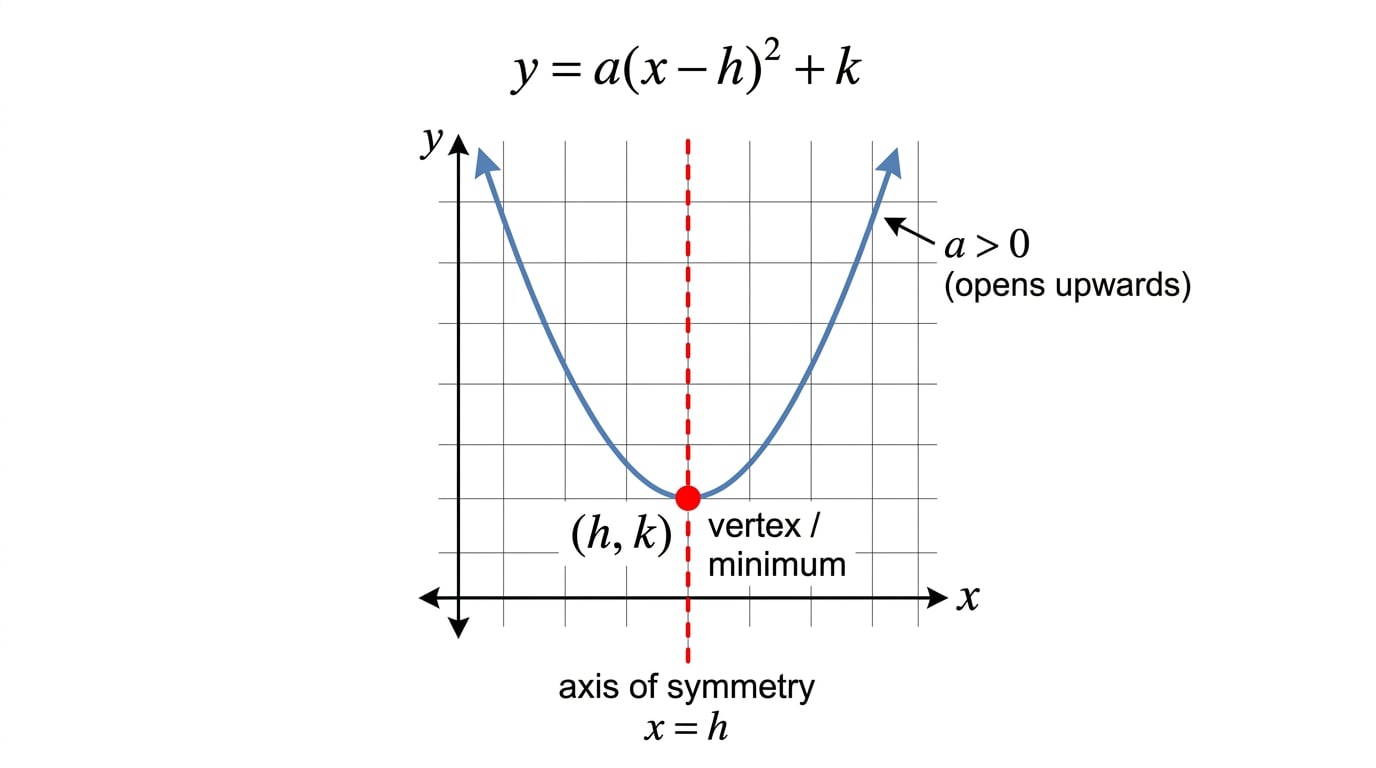
Completing the square means rewriting a quadratic in the form a(x−h)2+ka(x-h)^2+ka(x−h)2+k. This form shows the turning point clearly.
If a quadratic is written as y=a(x−h)2+ky=a(x-h)^2+ky=a(x−h)2+k, its turning point is (h,k)(h,k)(h,k). If it is written as y=a(x+b)2+c‘,itsturningpointisy=a(x+b)^2+c`, its turning point is y=a(x+b)2+c‘,itsturningpointis(-b,c)$.
The turning point is the minimum point if a>0a>0a>0, and the maximum point if a<0a<0a<0. The vertical line through the turning point is called the axis of symmetry.
Tip
Completing the square shortcut
For x2+pxx^2+pxx2+px, halve the coefficient of xxx, put it inside the bracket, then subtract the square you accidentally added.
Example
Finding the turning point
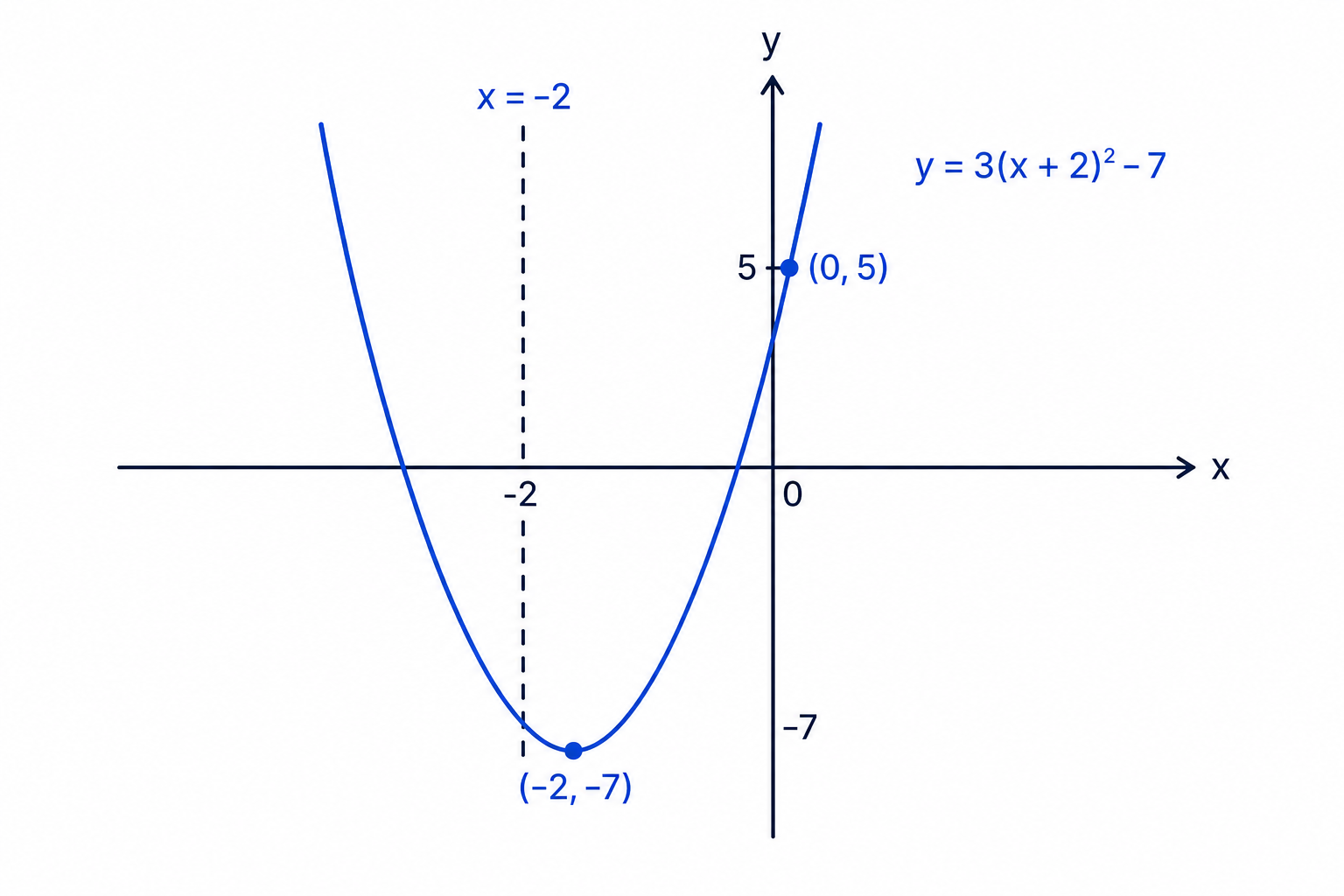
Express 3x2+12x+53x^2+12x+53x2+12x+5 in completed-square form and state the turning point.
-
Factor 3 from the x2x^2x2 and xxx terms:
3x2+12x+5=3(x2+4x)+53x^2+12x+5=3(x^2+4x)+53x2+12x+5=3(x2+4x)+5 -
Complete the square inside the bracket:
x2+4x=(x+2)2−4x^2+4x=(x+2)^2-4x2+4x=(x+2)2−4 -
Substitute this back in:
3((x+2)2−4)+5=3(x+2)2−73\left((x+2)^2-4\right)+5=3(x+2)^2-73((x+2)2−4)+5=3(x+2)2−7 -
The completed-square form is 3(x+2)2−73(x+2)^2-73(x+2)2−7, so the minimum point is (−2,−7)(-2,-7)(−2,−7).
At the minimum or maximum point of a quadratic, the tangent is horizontal. So the normal at that point is vertical, with equation x=turning point x-coordinatex=\text{turning point }x\text{-coordinate}x=turning point x-coordinate.
5. Solving by completing the square
Completing the square can also be used to solve equations exactly, especially when a question asks for roots “in terms of” a parameter.
Example
Roots in terms of a parameter
By completing the square, find the roots of x2+px+7=0x^2+px+7=0x2+px+7=0.
-
Complete the square:
x2+px+7=(x+p2)2+7−p24x^2+px+7=\left(x+\frac{p}{2}\right)^2+7-\frac{p^2}{4}x2+px+7=(x+2p)2+7−4p2 -
Set the expression equal to zero:
(x+p2)2=p24−7\left(x+\frac{p}{2}\right)^2=\frac{p^2}{4}-7(x+2p)2=4p2−7 -
Write the right-hand side as a single fraction:
(x+p2)2=p2−284\left(x+\frac{p}{2}\right)^2=\frac{p^2-28}{4}(x+2p)2=4p2−28 -
Square root both sides:
x+p2=±p2−282x+\frac{p}{2}=\pm\frac{\sqrt{p^2-28}}{2}x+2p=±2p2−28 -
Therefore the roots are:
x=−p±p2−282x=\frac{-p\pm\sqrt{p^2-28}}{2}x=2−p±p2−28
6. Proving quadratic inequalities
A square is always non-negative: (x−h)2≥0(x-h)^2\ge0(x−h)2≥0 for all real xxx. This makes completed-square form very useful for proving that an expression is always positive.
Example
Proving an inequality for all real values
Prove that x2+3x+10>x+1x^2+3x+10>x+1x2+3x+10>x+1 for all real xxx.
-
Move everything to the left-hand side:
x2+3x+10−(x+1)>0⇒x2+2x+9>0x^2+3x+10-(x+1)>0 \Rightarrow x^2+2x+9>0x2+3x+10−(x+1)>0⇒x2+2x+9>0 -
Complete the square:
x2+2x+9=(x+1)2+8x^2+2x+9=(x+1)^2+8x2+2x+9=(x+1)2+8 -
Since (x+1)2≥0(x+1)^2\ge0(x+1)2≥0, the expression (x+1)2+8(x+1)^2+8(x+1)2+8 is always at least 8.
-
Therefore x2+3x+10>x+1x^2+3x+10>x+1x2+3x+10>x+1 for all real xxx.
7. Intersections, tangents and models
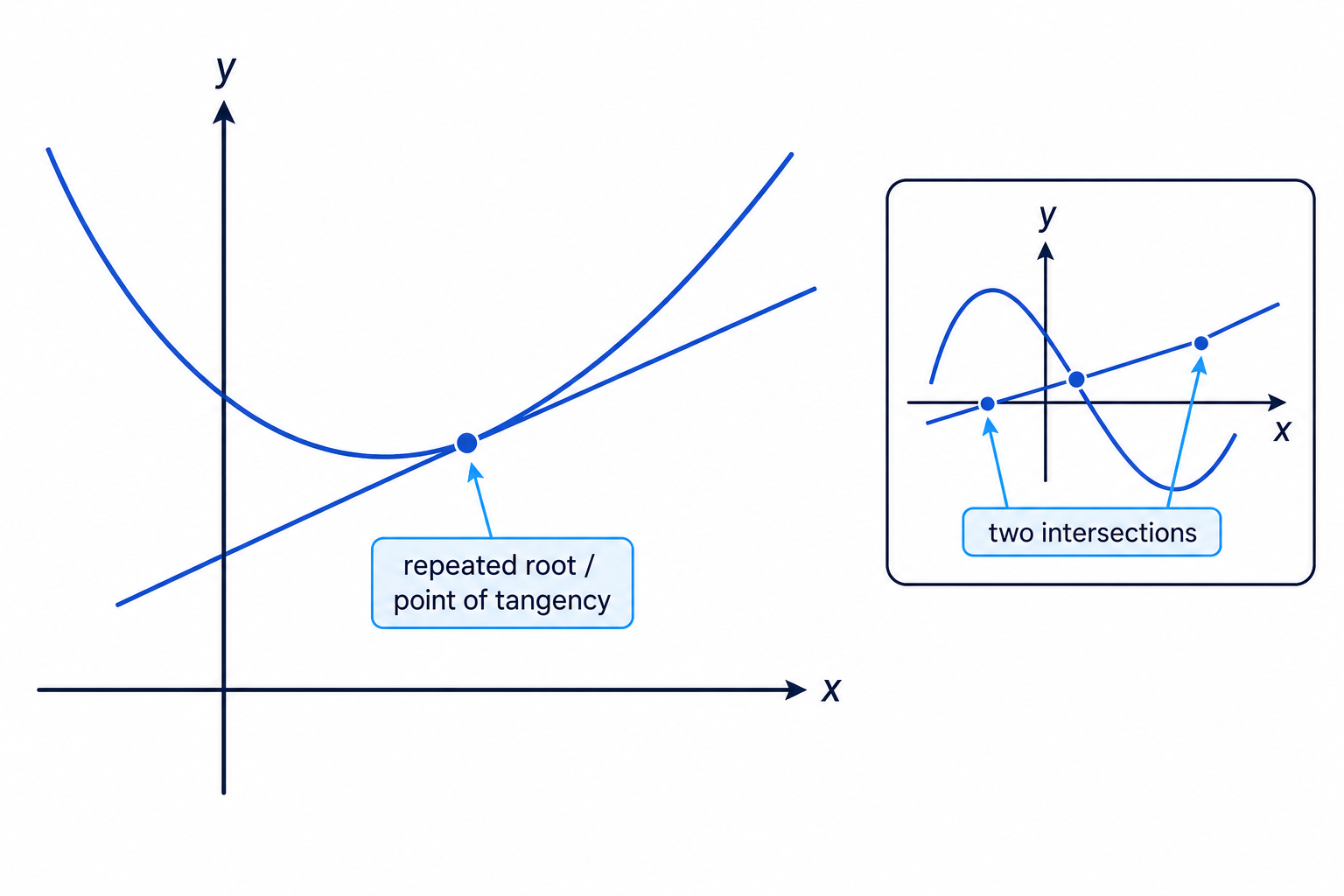
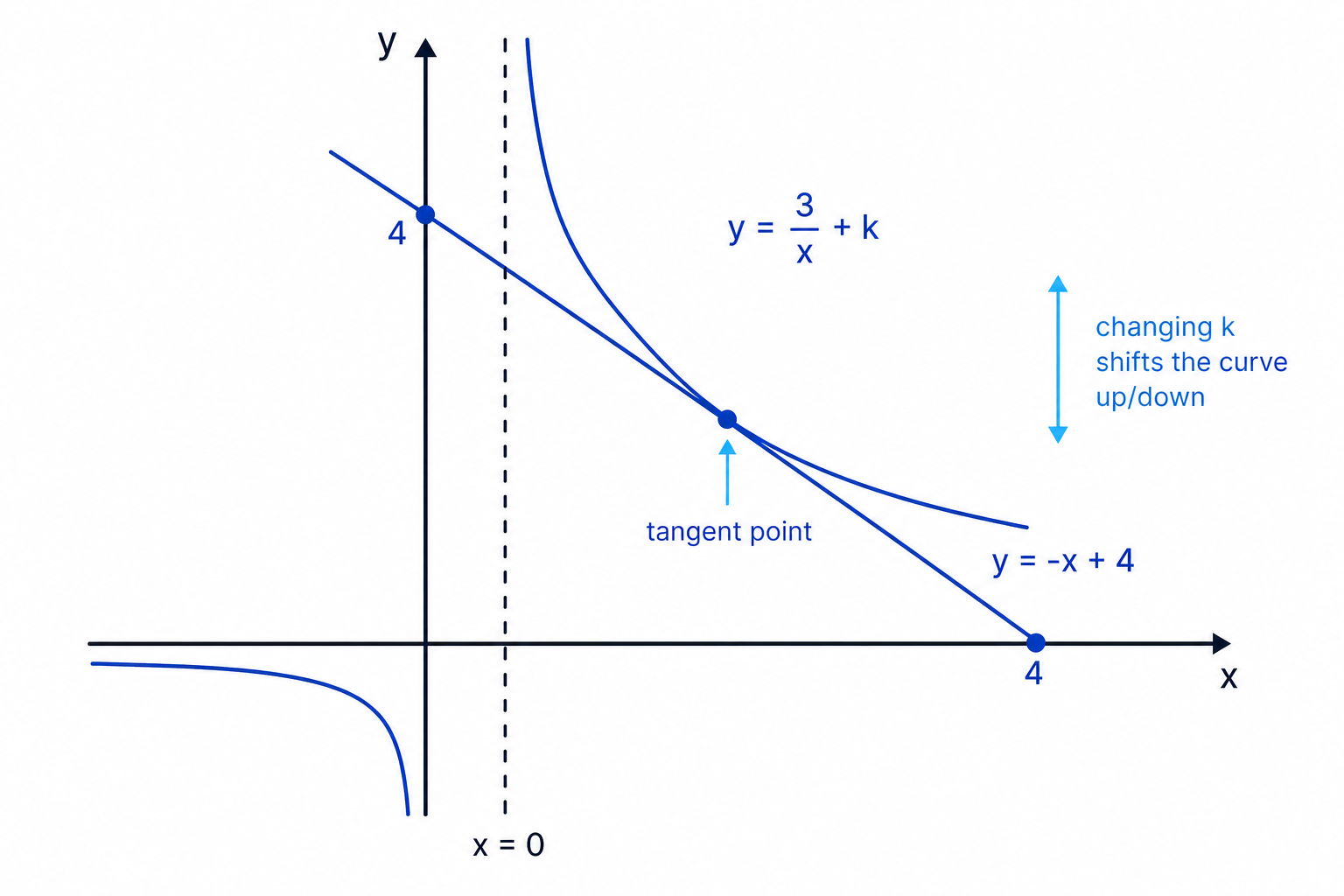
A tangent is a line that touches a curve at exactly one point locally. Algebraically, tangency often means the equation formed by setting the line and curve equal has a repeated root.
Example
Finding tangency values
The curve y=3x+ky=\frac{3}{x}+ky=x3+k, where x≠0x\neq0x=0, meets the line y=−x+4y=-x+4y=−x+4. Find the values of kkk for which the line is a tangent to the curve.
-
Set the two expressions for yyy equal:
3x+k=−x+4\frac{3}{x}+k=-x+4x3+k=−x+4 -
Multiply by xxx:
3+kx=−x2+4x3+kx=-x^2+4x3+kx=−x2+4x -
Rearrange into quadratic form:
x2+(k−4)x+3=0x^2+(k-4)x+3=0x2+(k−4)x+3=0 -
For tangency, this quadratic has a repeated root, so Δ=0\Delta=0Δ=0:
(k−4)2−4(1)(3)=0(k-4)^2-4(1)(3)=0(k−4)2−4(1)(3)=0 -
Solve for kkk:
(k−4)2=12⇒k=4±23(k-4)^2=12 \Rightarrow k=4\pm2\sqrt3(k−4)2=12⇒k=4±23
Quadratic models often use completed-square form directly. The domain is the set of input values where the model makes sense.
Example
Using a profit model
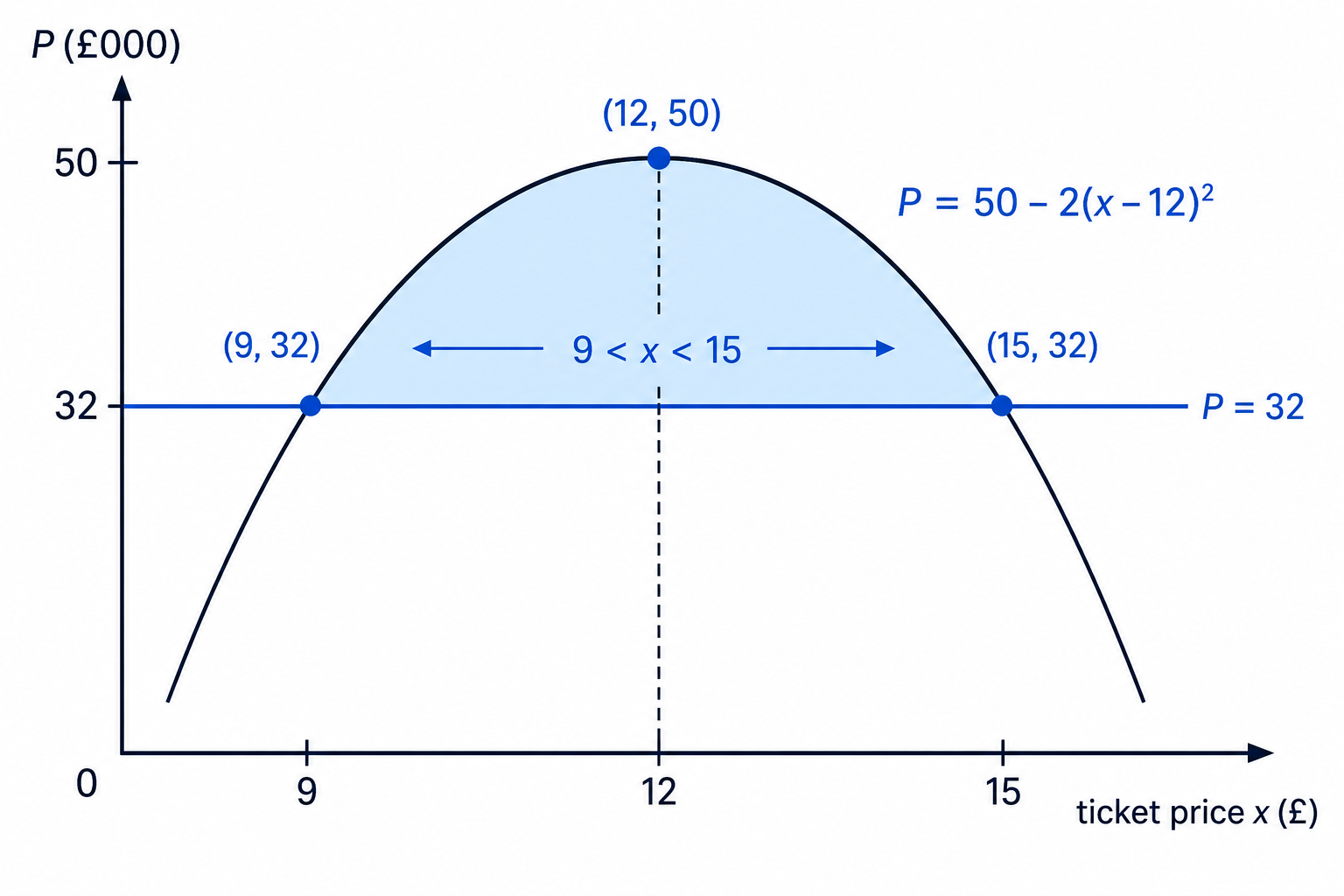
A club models profit using P=50−2(x−12)2P=50-2(x-12)^2P=50−2(x−12)2, where PPP is profit in thousands of pounds and xxx is the ticket price in pounds. Find the maximum profit and the prices giving profit more than £32,000.
-
Since 2(x−12)2≥02(x-12)^2\ge02(x−12)2≥0 and is subtracted from 50, the maximum value is P=50P=50P=50 when x=12x=12x=12.
-
So the maximum profit is £50,000, at a ticket price of £12.
-
Profit more than £32,000 means P>32P>32P>32:
50−2(x−12)2>3250-2(x-12)^2>3250−2(x−12)2>32 -
Solve the inequality:
(x−12)2<9(x-12)^2<9(x−12)2<9 -
Convert this to a range:
−3<x−12<3⇒9<x<15-3<x-12<3 \Rightarrow 9<x<15−3<x−12<3⇒9<x<15 -
The model predicts profit above £32,000 for ticket prices between £9 and £15, not including the endpoints.
Exam technique
In the exam
-
Put the equation into ax2+bx+c=0ax^2+bx+c=0ax2+bx+c=0 before using the discriminant.
-
Translate the wording carefully: two distinct roots means Δ>0\Delta>0Δ>0, repeated roots or tangent means Δ=0\Delta=0Δ=0, and no real roots means $\Delta<0`.
-
If a coefficient contains a parameter, check whether the equation can stop being quadratic.
-
For completed-square form, read the turning point directly and use the sign of aaa to decide minimum or maximum.
-
In modelling questions, mention sensible restrictions such as positive speeds, positive prices, or values within the context.
Self review
Check yourself
-
Can you explain why (x−3)2+5=0(x-3)^2+5=0(x−3)2+5=0 has no real roots?
-
If (k−2)x2+4x+1=0(k-2)x^2+4x+1=0(k−2)x2+4x+1=0 has two distinct real roots, what extra value of kkk must you remember to check?
-
In 4(x+1)2−74(x+1)^2-74(x+1)2−7, where is the turning point, and is it a minimum or maximum?

Recap questions
Test yourself with 5 quick questions on this guide. Answer them all correctly to complete it.
You've reached the end
Test yourself on this topic, or move on to the next guide.
How was this guide?