2.2 Completing the Square
x

Revision notes for Edexcel AS Level Maths 2.2 Completing the Square. Open the guide for explanations and worked examples. Written against the Edexcel AS Level Maths (8MA0) specification, so the content matches what's examinable rather than general Maths background.

2.2 Completing the Square

What you'll learn

  • How to rewrite a quadratic in completed-square form.
  • How completed square form shows the minimum point of a parabola.
  • How to prove a quadratic is always positive.
  • How to solve quadratic equations, including ones with constants such as ppp or kkk.

1. The key prerequisite: expanding a square

Before you can complete the square, you need to be comfortable expanding brackets such as (x+3)2(x+3)^2(x+3)2.

Definition

Perfect square

A perfect square is an expression made by squaring a bracket, such as (x+4)2(x+4)^2(x+4)2 or (x−7)2(x-7)^2(x−7)2.

The important pattern is:
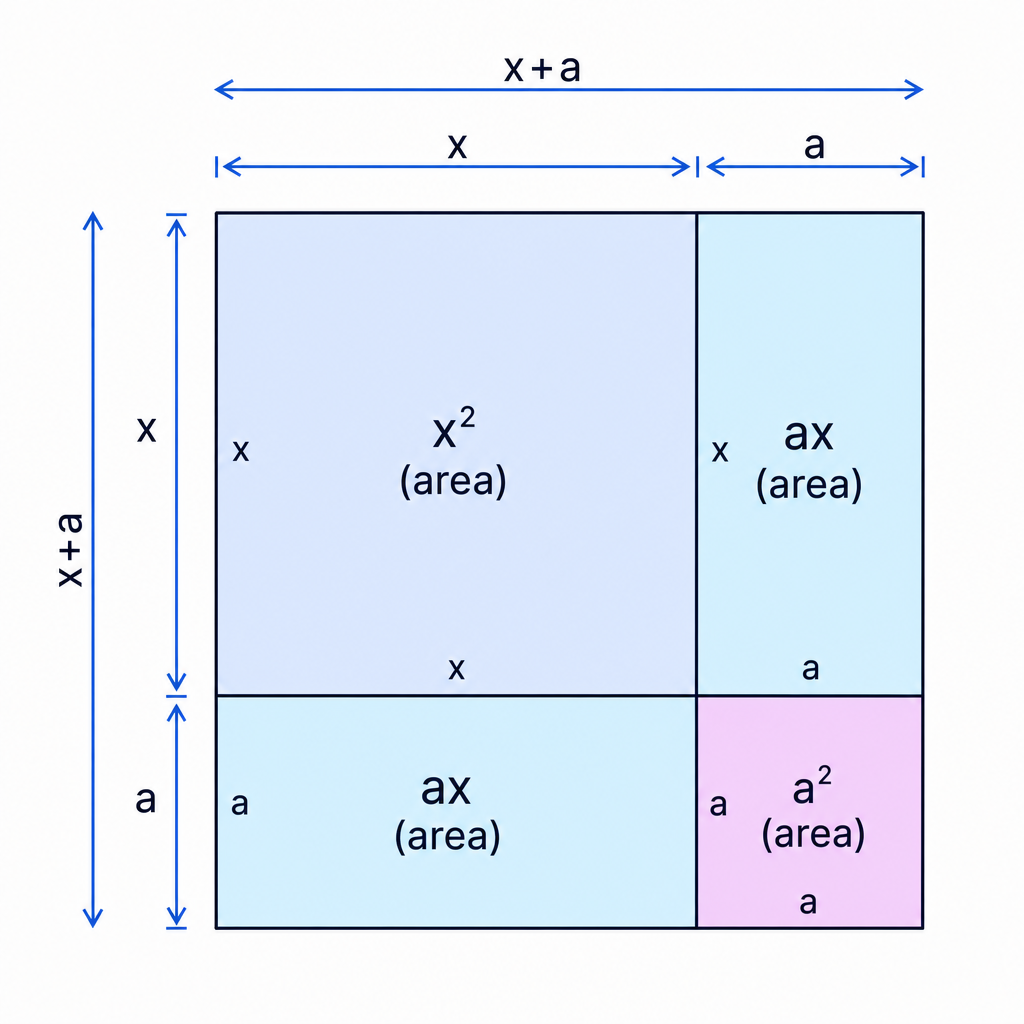
An area model showing why <span class="katex"><span class="katex-mathml"><math xmlns="http://www.w3.org/1998/Math/MathML"><semantics><mrow><mo stretchy="false">(</mo><mi>x</mi><mo>+</mo><mi>a</mi><msup><mo stretchy="false">)</mo><mn>2</mn></msup><mo>=</mo><msup><mi>x</mi><mn>2</mn></msup><mo>+</mo><mn>2</mn><mi>a</mi><mi>x</mi><mo>+</mo><msup><mi>a</mi><mn>2</mn></msup></mrow><annotation encoding="application/x-tex">(x+a)^2=x^2+2ax+a^2</annotation></semantics></math></span><span class="katex-html" aria-hidden="true"><span class="base"><span class="strut" style="height:1em;vertical-align:-0.25em;"></span><span class="mopen">(</span><span class="mord mathnormal">x</span><span class="mspace" style="margin-right:0.2222em;"></span><span class="mbin">+</span><span class="mspace" style="margin-right:0.2222em;"></span></span><span class="base"><span class="strut" style="height:1.0641em;vertical-align:-0.25em;"></span><span class="mord mathnormal">a</span><span class="mclose"><span class="mclose">)</span><span class="msupsub"><span class="vlist-t"><span class="vlist-r"><span class="vlist" style="height:0.8141em;"><span style="top:-3.063em;margin-right:0.05em;"><span class="pstrut" style="height:2.7em;"></span><span class="sizing reset-size6 size3 mtight"><span class="mord mtight">2</span></span></span></span></span></span></span></span><span class="mspace" style="margin-right:0.2778em;"></span><span class="mrel">=</span><span class="mspace" style="margin-right:0.2778em;"></span></span><span class="base"><span class="strut" style="height:0.8974em;vertical-align:-0.0833em;"></span><span class="mord"><span class="mord mathnormal">x</span><span class="msupsub"><span class="vlist-t"><span class="vlist-r"><span class="vlist" style="height:0.8141em;"><span style="top:-3.063em;margin-right:0.05em;"><span class="pstrut" style="height:2.7em;"></span><span class="sizing reset-size6 size3 mtight"><span class="mord mtight">2</span></span></span></span></span></span></span></span><span class="mspace" style="margin-right:0.2222em;"></span><span class="mbin">+</span><span class="mspace" style="margin-right:0.2222em;"></span></span><span class="base"><span class="strut" style="height:0.7278em;vertical-align:-0.0833em;"></span><span class="mord">2</span><span class="mord mathnormal">a</span><span class="mord mathnormal">x</span><span class="mspace" style="margin-right:0.2222em;"></span><span class="mbin">+</span><span class="mspace" style="margin-right:0.2222em;"></span></span><span class="base"><span class="strut" style="height:0.8141em;"></span><span class="mord"><span class="mord mathnormal">a</span><span class="msupsub"><span class="vlist-t"><span class="vlist-r"><span class="vlist" style="height:0.8141em;"><span style="top:-3.063em;margin-right:0.05em;"><span class="pstrut" style="height:2.7em;"></span><span class="sizing reset-size6 size3 mtight"><span class="mord mtight">2</span></span></span></span></span></span></span></span></span></span></span>.

(x+a)2=x2+2ax+a2(x+a)^2 = x^2 + 2ax + a^2(x+a)2=x2+2ax+a2

So the middle coefficient is always twice the number inside the bracket.

Example

Expanding a squared bracket

Expand (x−5)2(x-5)^2(x−5)2.

  1. Write the square as two identical brackets:

    (x−5)2=(x−5)(x−5)(x-5)^2=(x-5)(x-5)(x−5)2=(x−5)(x−5)

  2. Multiply out carefully:

    x2−5x−5x+25x^2-5x-5x+25x2−5x−5x+25

  3. Collect like terms:

    (x−5)2=x2−10x+25(x-5)^2=x^2-10x+25(x−5)2=x2−10x+25

Key Idea

The halfway idea

To complete the square for x2+bx+cx^2+bx+cx2+bx+c, halve the coefficient of xxx first. That number goes inside the bracket.

2. Completing the square when the coefficient of x2x^2x2 is 1

A quadratic like x2+10x+7x^2+10x+7x2+10x+7 is close to a perfect square. The square with the same x2x^2x2 and xxx terms is (x+5)2(x+5)^2(x+5)2, because 5 is half of 10.
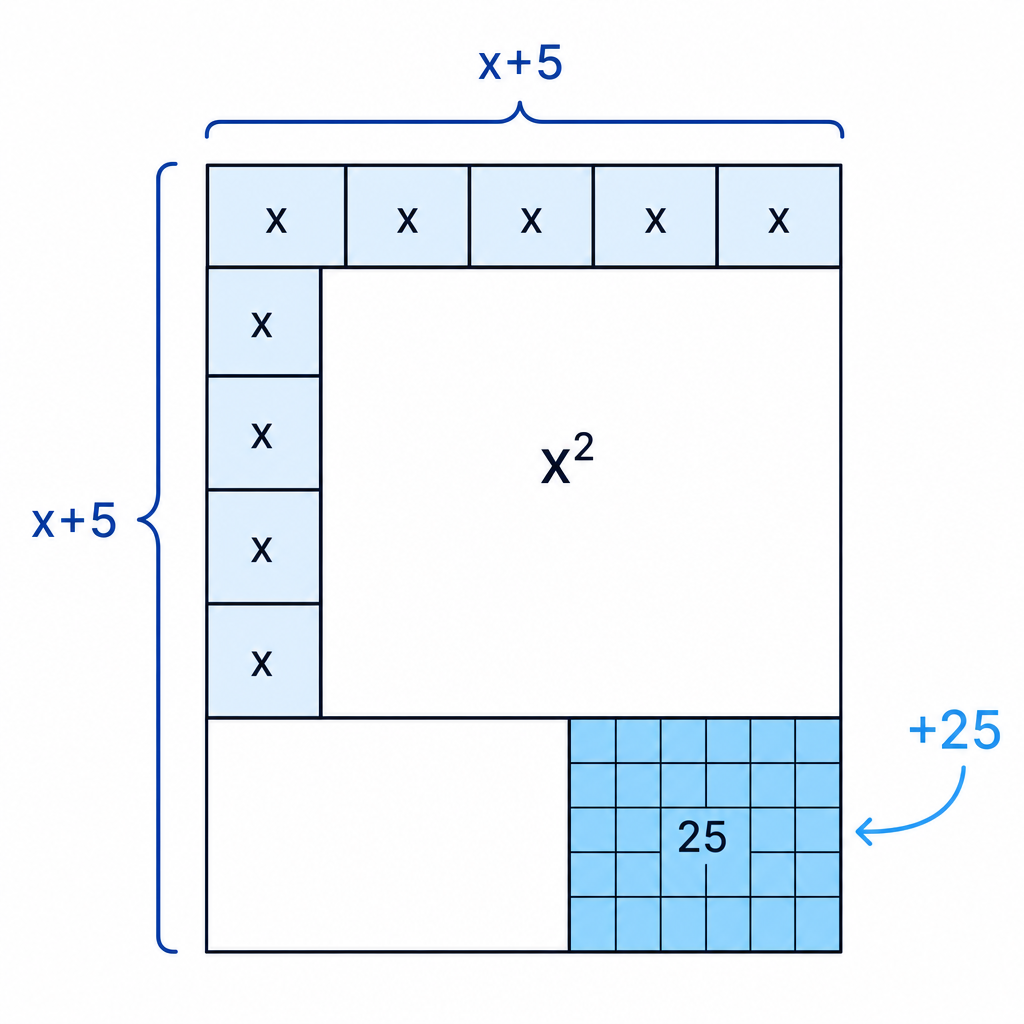
An algebra-tile style diagram showing that <span class="katex"><span class="katex-mathml"><math xmlns="http://www.w3.org/1998/Math/MathML"><semantics><mrow><msup><mi>x</mi><mn>2</mn></msup><mo>+</mo><mn>10</mn><mi>x</mi></mrow><annotation encoding="application/x-tex">x^2+10x</annotation></semantics></math></span><span class="katex-html" aria-hidden="true"><span class="base"><span class="strut" style="height:0.8974em;vertical-align:-0.0833em;"></span><span class="mord"><span class="mord mathnormal">x</span><span class="msupsub"><span class="vlist-t"><span class="vlist-r"><span class="vlist" style="height:0.8141em;"><span style="top:-3.063em;margin-right:0.05em;"><span class="pstrut" style="height:2.7em;"></span><span class="sizing reset-size6 size3 mtight"><span class="mord mtight">2</span></span></span></span></span></span></span></span><span class="mspace" style="margin-right:0.2222em;"></span><span class="mbin">+</span><span class="mspace" style="margin-right:0.2222em;"></span></span><span class="base"><span class="strut" style="height:0.6444em;"></span><span class="mord">10</span><span class="mord mathnormal">x</span></span></span></span> needs <span class="katex"><span class="katex-mathml"><math xmlns="http://www.w3.org/1998/Math/MathML"><semantics><mrow><mn>25</mn></mrow><annotation encoding="application/x-tex">25</annotation></semantics></math></span><span class="katex-html" aria-hidden="true"><span class="base"><span class="strut" style="height:0.6444em;"></span><span class="mord">25</span></span></span></span> added to make <span class="katex"><span class="katex-mathml"><math xmlns="http://www.w3.org/1998/Math/MathML"><semantics><mrow><mo stretchy="false">(</mo><mi>x</mi><mo>+</mo><mn>5</mn><msup><mo stretchy="false">)</mo><mn>2</mn></msup></mrow><annotation encoding="application/x-tex">(x+5)^2</annotation></semantics></math></span><span class="katex-html" aria-hidden="true"><span class="base"><span class="strut" style="height:1em;vertical-align:-0.25em;"></span><span class="mopen">(</span><span class="mord mathnormal">x</span><span class="mspace" style="margin-right:0.2222em;"></span><span class="mbin">+</span><span class="mspace" style="margin-right:0.2222em;"></span></span><span class="base"><span class="strut" style="height:1.0641em;vertical-align:-0.25em;"></span><span class="mord">5</span><span class="mclose"><span class="mclose">)</span><span class="msupsub"><span class="vlist-t"><span class="vlist-r"><span class="vlist" style="height:0.8141em;"><span style="top:-3.063em;margin-right:0.05em;"><span class="pstrut" style="height:2.7em;"></span><span class="sizing reset-size6 size3 mtight"><span class="mord mtight">2</span></span></span></span></span></span></span></span></span></span></span>.

Definition

Completed-square form

For a quadratic with coefficient 1 on x2x^2x2, completed-square form means writing it as

(x+a)2+b(x+a)^2+b(x+a)2+b

where aaa and bbb are constants.

Example

Writing a quadratic in completed-square form

Express x2+10x+7x^2+10x+7x2+10x+7 in the form (x+a)2+b(x+a)^2+b(x+a)2+b.

  1. Halve the coefficient of xxx:

    102=5\frac{10}{2}=5210​=5

  2. Start with the matching square:

    (x+5)2=x2+10x+25(x+5)^2=x^2+10x+25(x+5)2=x2+10x+25

  3. Compare this with the original expression. The square has 25, but the original has 7, so subtract 18:

    x2+10x+7=(x+5)2−18x^2+10x+7=(x+5)^2-18x2+10x+7=(x+5)2−18

Common Mistake

Forgetting to correct the constant

If you write x2+10x+7=(x+5)2+7x^2+10x+7=(x+5)^2+7x2+10x+7=(x+5)2+7, you have added an extra 25 by accident. Always expand your answer mentally to check it returns to the original quadratic.

When the coefficient of xxx is odd

If the coefficient of xxx is odd, you will usually get fractions. That is completely normal at AS level.

Example

Completing the square with fractions

Express x2−7x+4x^2-7x+4x2−7x+4 in completed-square form.

  1. Halve the coefficient of xxx:

    −72=−72\frac{-7}{2}=-\frac{7}{2}2−7​=−27​

  2. Use this inside the bracket:

    (x−72)2\left(x-\frac{7}{2}\right)^2(x−27​)2

  3. Expand the square so you can see the extra constant:

    (x−72)2=x2−7x+494\left(x-\frac{7}{2}\right)^2=x^2-7x+\frac{49}{4}(x−27​)2=x2−7x+449​

  4. Adjust the constant from 494\frac{49}{4}449​ down to 4:

    x2−7x+4=(x−72)2−334x^2-7x+4=\left(x-\frac{7}{2}\right)^2-\frac{33}{4}x2−7x+4=(x−27​)2−433​

Tip

Quick check

In (x+a)2+b(x+a)^2+b(x+a)2+b, the coefficient of xxx will be 2a2a2a. So if your original quadratic has −7x-7x−7x, the bracket must contain −72-\frac{7}{2}−27​.

3. When the coefficient of x2x^2x2 is not 1

A non-monic quadratic is a quadratic where the coefficient of x2x^2x2 is not 1, such as 2x2+8x+12x^2+8x+12x2+8x+1.

Definition

Monic and non-monic

A quadratic is monic if the coefficient of x2x^2x2 is 1. It is non-monic if the coefficient of x2x^2x2 is any other non-zero number.

For non-monic quadratics, first factor out the coefficient of x2x^2x2 from the x2x^2x2 and xxx terms.
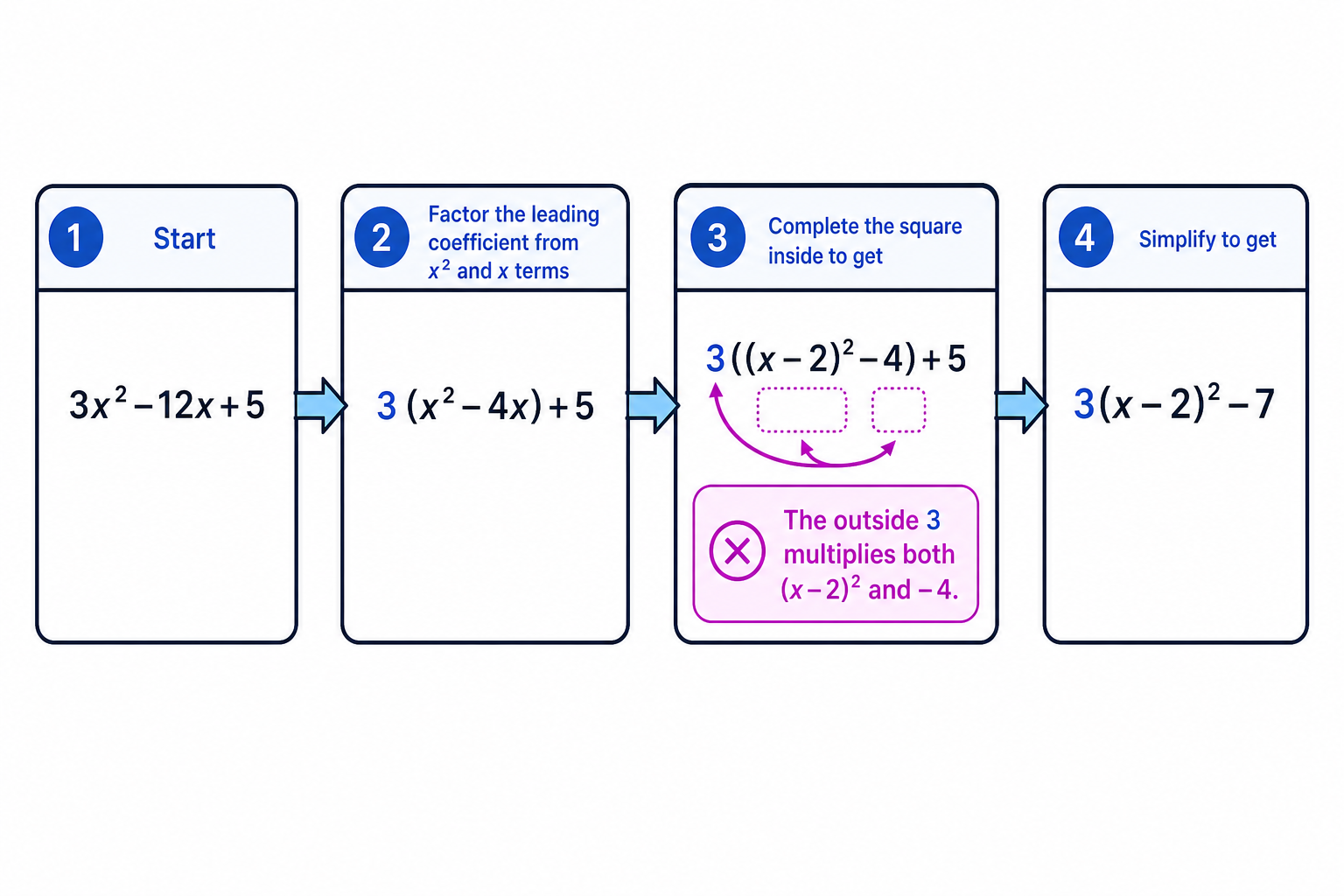
A step diagram showing the structure of completing the square for a non-monic quadratic.

Example

Completing the square when the leading coefficient is not 1

Write 3x2−12x+53x^2-12x+53x2−12x+5 in the form A(x+B)2+CA(x+B)^2+CA(x+B)2+C.

  1. Factor 3 out of the x2x^2x2 and xxx terms:

    3x2−12x+5=3(x2−4x)+53x^2-12x+5=3(x^2-4x)+53x2−12x+5=3(x2−4x)+5

  2. Complete the square inside the bracket:

    x2−4x=(x−2)2−4x^2-4x=(x-2)^2-4x2−4x=(x−2)2−4

  3. Substitute this back in:

    3(x2−4x)+5=3((x−2)2−4)+53(x^2-4x)+5=3\left((x-2)^2-4\right)+53(x2−4x)+5=3((x−2)2−4)+5

  4. Expand the outside 3 through the constant part and simplify:

    3(x−2)2−12+5=3(x−2)2−73(x-2)^2-12+5=3(x-2)^2-73(x−2)2−12+5=3(x−2)2−7

  5. Read off the constants:

    A=3,B=−2,C=−7A=3,\quad B=-2,\quad C=-7A=3,B=−2,C=−7

4. Using completed-square form to find a minimum point

The expression (x+2)2(x+2)^2(x+2)2 can never be negative, because squaring any real number gives a value greater than or equal to zero.

So for a curve like y=(x+2)2−3y=(x+2)^2-3y=(x+2)2−3, the smallest possible value of the square is zero. That makes the minimum point (−2,−3)(-2,-3)(−2,−3).
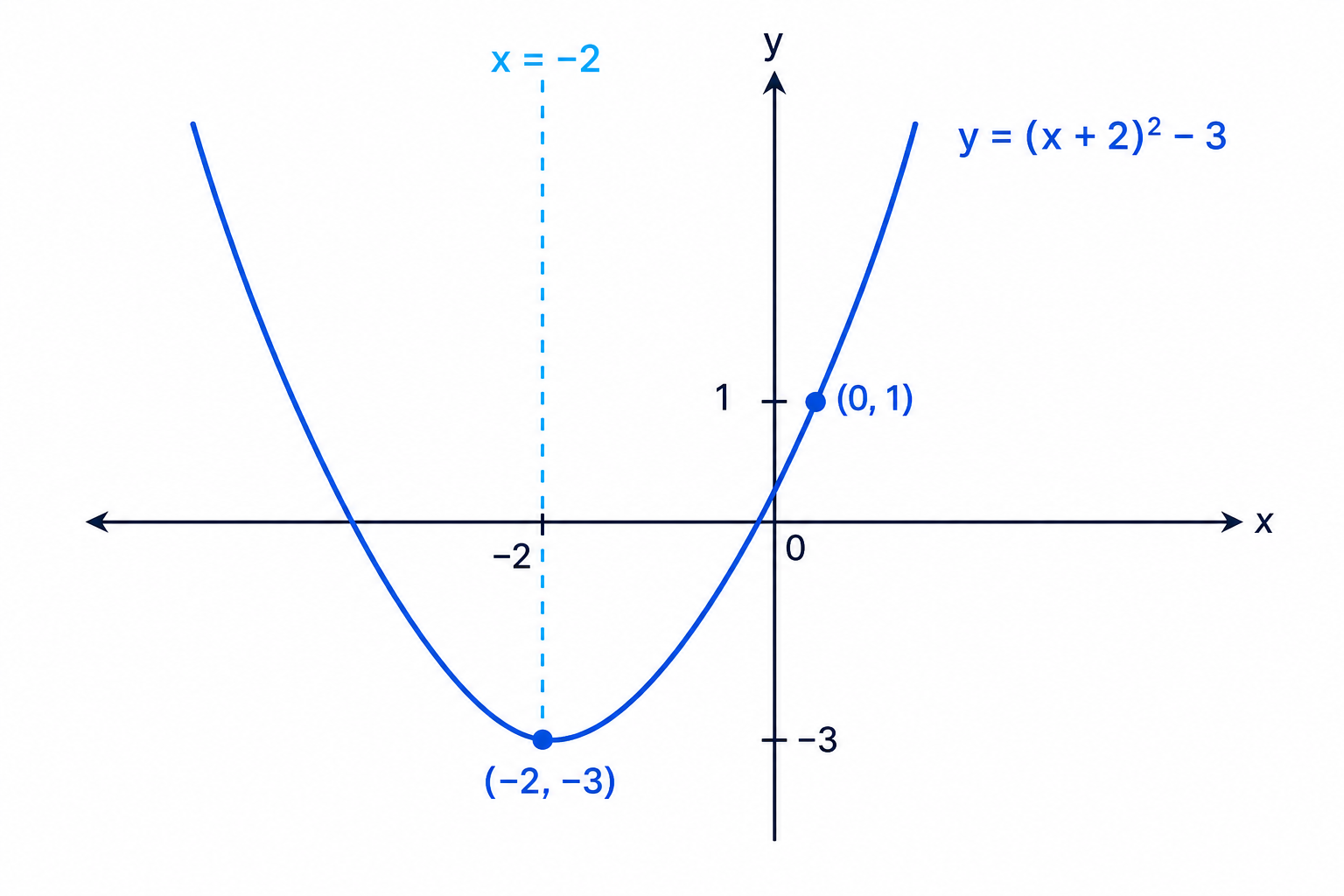
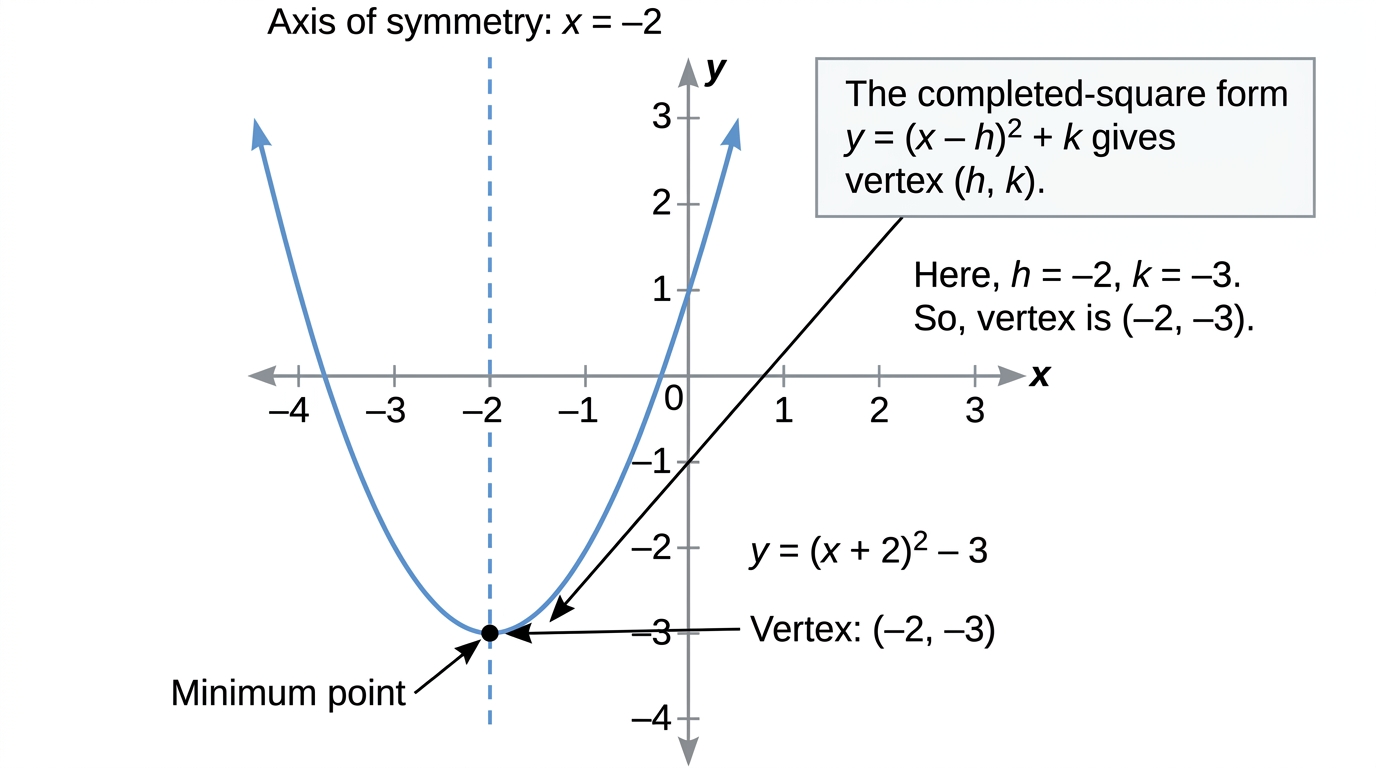
The graph of <span class="katex"><span class="katex-mathml"><math xmlns="http://www.w3.org/1998/Math/MathML"><semantics><mrow><mi>y</mi><mo>=</mo><mo stretchy="false">(</mo><mi>x</mi><mo>+</mo><mn>2</mn><msup><mo stretchy="false">)</mo><mn>2</mn></msup><mo>−</mo><mn>3</mn></mrow><annotation encoding="application/x-tex">y=(x+2)^2-3</annotation></semantics></math></span><span class="katex-html" aria-hidden="true"><span class="base"><span class="strut" style="height:0.625em;vertical-align:-0.1944em;"></span><span class="mord mathnormal" style="margin-right:0.0359em;">y</span><span class="mspace" style="margin-right:0.2778em;"></span><span class="mrel">=</span><span class="mspace" style="margin-right:0.2778em;"></span></span><span class="base"><span class="strut" style="height:1em;vertical-align:-0.25em;"></span><span class="mopen">(</span><span class="mord mathnormal">x</span><span class="mspace" style="margin-right:0.2222em;"></span><span class="mbin">+</span><span class="mspace" style="margin-right:0.2222em;"></span></span><span class="base"><span class="strut" style="height:1.0641em;vertical-align:-0.25em;"></span><span class="mord">2</span><span class="mclose"><span class="mclose">)</span><span class="msupsub"><span class="vlist-t"><span class="vlist-r"><span class="vlist" style="height:0.8141em;"><span style="top:-3.063em;margin-right:0.05em;"><span class="pstrut" style="height:2.7em;"></span><span class="sizing reset-size6 size3 mtight"><span class="mord mtight">2</span></span></span></span></span></span></span></span><span class="mspace" style="margin-right:0.2222em;"></span><span class="mbin">−</span><span class="mspace" style="margin-right:0.2222em;"></span></span><span class="base"><span class="strut" style="height:0.6444em;"></span><span class="mord">3</span></span></span></span> showing how completed-square form gives the vertex.

Graph of the parabola y = (x + 2)^2 - 3, labelled with vertex (-2, -3) and axis of symmetry x = -2

Definition

Minimum point

The minimum point of a parabola is its lowest point. For y=(x−a)2+by=(x-a)^2+by=(x−a)2+b, the minimum point is (a,b)(a,b)(a,b).

Example

Finding the minimum point

Find the minimum point of the curve y=x2−8x+11y=x^2-8x+11y=x2−8x+11.
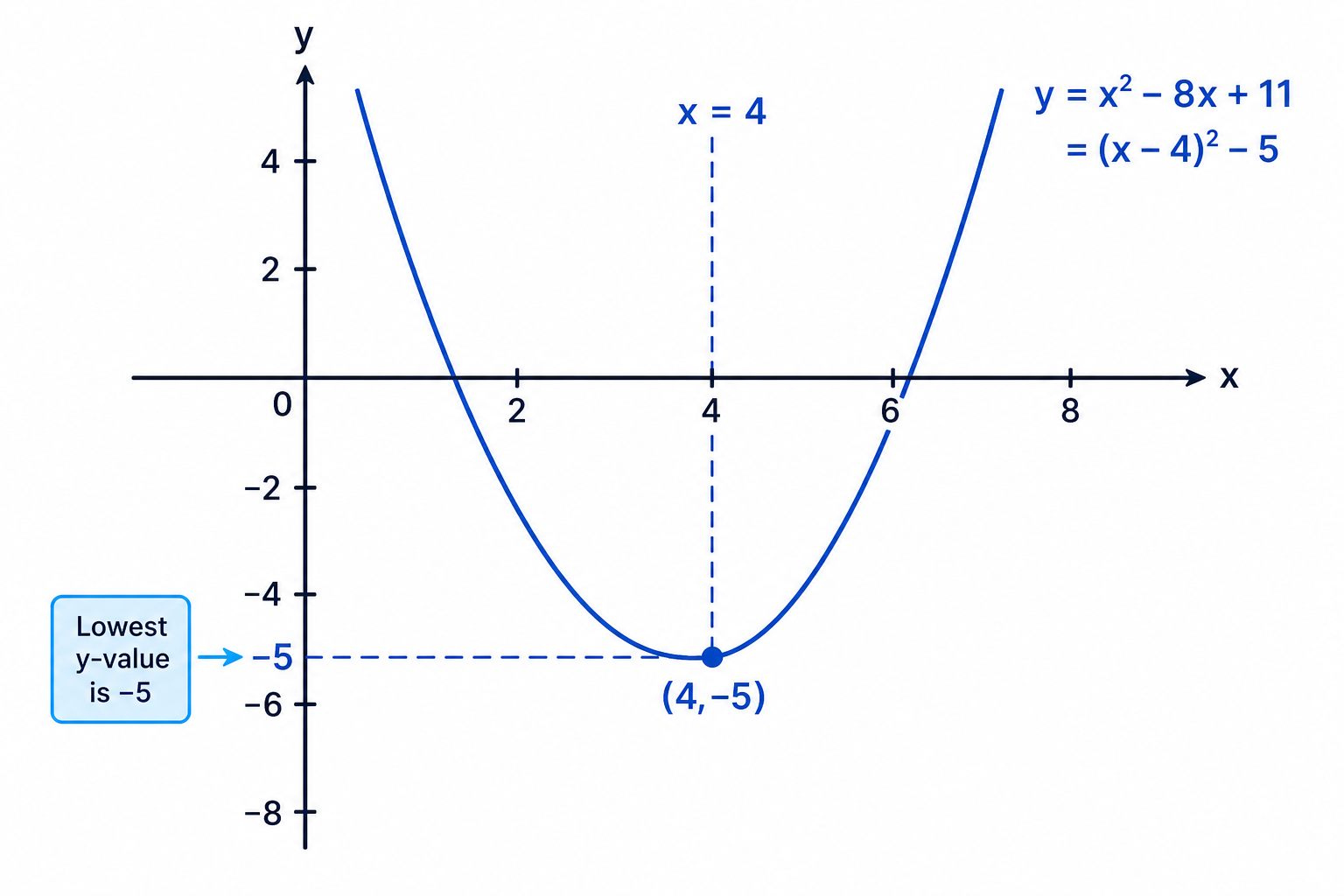
The completed-square form <span class="katex"><span class="katex-mathml"><math xmlns="http://www.w3.org/1998/Math/MathML"><semantics><mrow><mo stretchy="false">(</mo><mi>x</mi><mo>−</mo><mn>4</mn><msup><mo stretchy="false">)</mo><mn>2</mn></msup><mo>−</mo><mn>5</mn></mrow><annotation encoding="application/x-tex">(x-4)^2-5</annotation></semantics></math></span><span class="katex-html" aria-hidden="true"><span class="base"><span class="strut" style="height:1em;vertical-align:-0.25em;"></span><span class="mopen">(</span><span class="mord mathnormal">x</span><span class="mspace" style="margin-right:0.2222em;"></span><span class="mbin">−</span><span class="mspace" style="margin-right:0.2222em;"></span></span><span class="base"><span class="strut" style="height:1.0641em;vertical-align:-0.25em;"></span><span class="mord">4</span><span class="mclose"><span class="mclose">)</span><span class="msupsub"><span class="vlist-t"><span class="vlist-r"><span class="vlist" style="height:0.8141em;"><span style="top:-3.063em;margin-right:0.05em;"><span class="pstrut" style="height:2.7em;"></span><span class="sizing reset-size6 size3 mtight"><span class="mord mtight">2</span></span></span></span></span></span></span></span><span class="mspace" style="margin-right:0.2222em;"></span><span class="mbin">−</span><span class="mspace" style="margin-right:0.2222em;"></span></span><span class="base"><span class="strut" style="height:0.6444em;"></span><span class="mord">5</span></span></span></span> places the minimum at <span class="katex"><span class="katex-mathml"><math xmlns="http://www.w3.org/1998/Math/MathML"><semantics><mrow><mo stretchy="false">(</mo><mn>4</mn><mo separator="true">,</mo><mo>−</mo><mn>5</mn><mo stretchy="false">)</mo></mrow><annotation encoding="application/x-tex">(4,-5)</annotation></semantics></math></span><span class="katex-html" aria-hidden="true"><span class="base"><span class="strut" style="height:1em;vertical-align:-0.25em;"></span><span class="mopen">(</span><span class="mord">4</span><span class="mpunct">,</span><span class="mspace" style="margin-right:0.1667em;"></span><span class="mord">−</span><span class="mord">5</span><span class="mclose">)</span></span></span></span>.

  1. Complete the square:

    x2−8x+11=(x−4)2−5x^2-8x+11=(x-4)^2-5x2−8x+11=(x−4)2−5

  2. Use the fact that (x−4)2≥0(x-4)^2 \ge 0(x−4)2≥0 for all real xxx.

  3. The smallest value occurs when the square equals zero:

    x−4=0x-4=0x−4=0

  4. Therefore x=4x=4x=4, and the minimum value of yyy is -5.

  5. The minimum point is:

    (4,−5)(4,-5)(4,−5)

Example

Finding constants from a given minimum point

The curve y=x2+ax+by=x^2+ax+by=x2+ax+b has minimum point (3,−4)(3,-4)(3,−4). Find aaa and bbb.

  1. Use the vertex form directly. Since the minimum point is (3,−4)(3,-4)(3,−4), the curve can be written as:

    y=(x−3)2−4y=(x-3)^2-4y=(x−3)2−4

  2. Expand the bracket:

    (x−3)2−4=x2−6x+9−4(x-3)^2-4=x^2-6x+9-4(x−3)2−4=x2−6x+9−4

  3. Simplify:

    y=x2−6x+5y=x^2-6x+5y=x2−6x+5

  4. Compare with y=x2+ax+by=x^2+ax+by=x2+ax+b:

    a=−6,b=5a=-6,\quad b=5a=−6,b=5

5. Proving a quadratic is always positive

Completed-square form is very powerful for inequalities because a square is always at least zero.

Key Idea

Positive for all real values

If you can write a quadratic as (x+a)2+c(x+a)^2+c(x+a)2+c where c>0c>0c>0, then the whole expression is always positive.

Example

Showing a quadratic is always positive

Show that x2−10x+28>0x^2-10x+28>0x2−10x+28>0 for all real values of xxx.
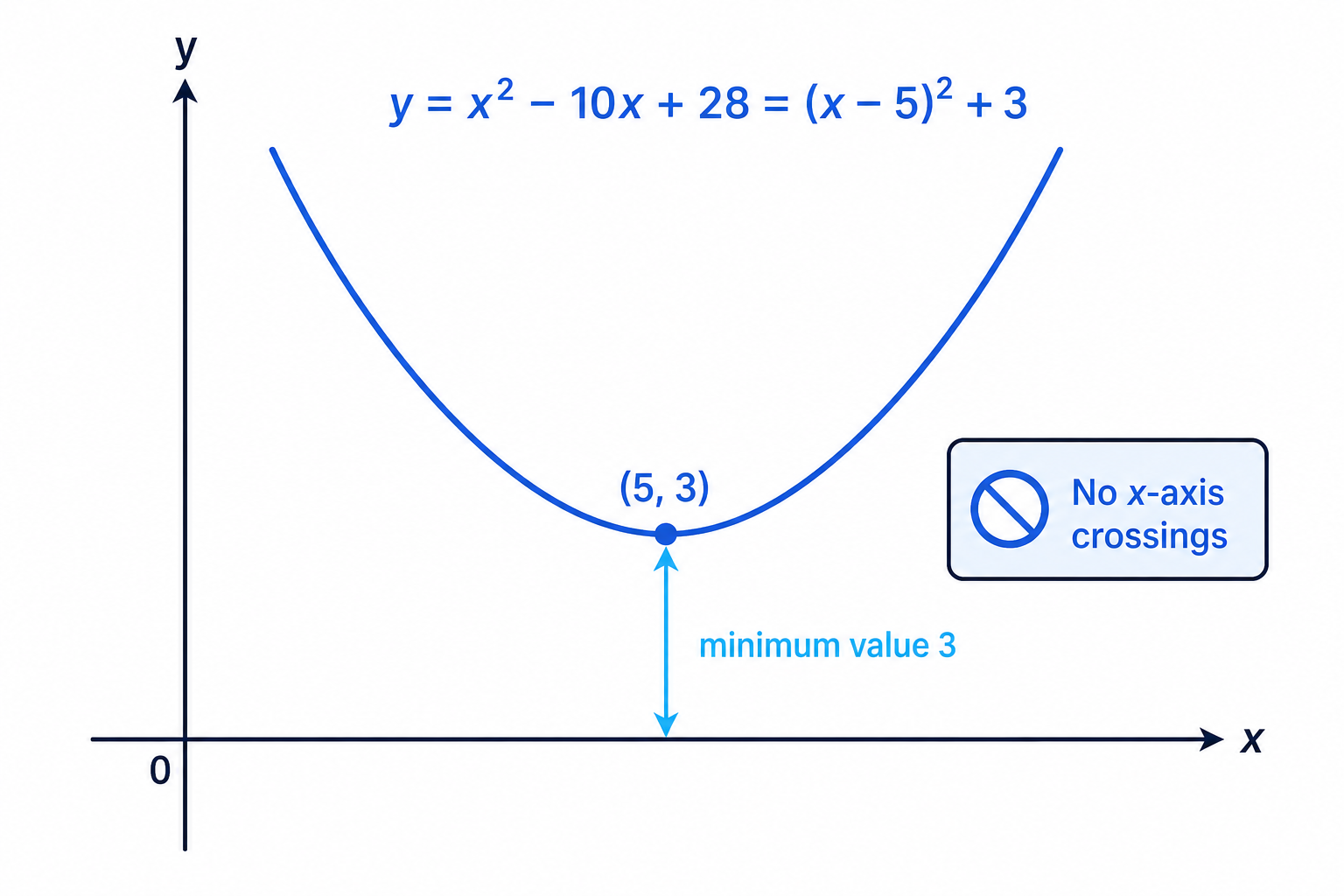
The graph of <span class="katex"><span class="katex-mathml"><math xmlns="http://www.w3.org/1998/Math/MathML"><semantics><mrow><mi>y</mi><mo>=</mo><mo stretchy="false">(</mo><mi>x</mi><mo>−</mo><mn>5</mn><msup><mo stretchy="false">)</mo><mn>2</mn></msup><mo>+</mo><mn>3</mn></mrow><annotation encoding="application/x-tex">y=(x-5)^2+3</annotation></semantics></math></span><span class="katex-html" aria-hidden="true"><span class="base"><span class="strut" style="height:0.625em;vertical-align:-0.1944em;"></span><span class="mord mathnormal" style="margin-right:0.0359em;">y</span><span class="mspace" style="margin-right:0.2778em;"></span><span class="mrel">=</span><span class="mspace" style="margin-right:0.2778em;"></span></span><span class="base"><span class="strut" style="height:1em;vertical-align:-0.25em;"></span><span class="mopen">(</span><span class="mord mathnormal">x</span><span class="mspace" style="margin-right:0.2222em;"></span><span class="mbin">−</span><span class="mspace" style="margin-right:0.2222em;"></span></span><span class="base"><span class="strut" style="height:1.0641em;vertical-align:-0.25em;"></span><span class="mord">5</span><span class="mclose"><span class="mclose">)</span><span class="msupsub"><span class="vlist-t"><span class="vlist-r"><span class="vlist" style="height:0.8141em;"><span style="top:-3.063em;margin-right:0.05em;"><span class="pstrut" style="height:2.7em;"></span><span class="sizing reset-size6 size3 mtight"><span class="mord mtight">2</span></span></span></span></span></span></span></span><span class="mspace" style="margin-right:0.2222em;"></span><span class="mbin">+</span><span class="mspace" style="margin-right:0.2222em;"></span></span><span class="base"><span class="strut" style="height:0.6444em;"></span><span class="mord">3</span></span></span></span> stays above the <span class="katex"><span class="katex-mathml"><math xmlns="http://www.w3.org/1998/Math/MathML"><semantics><mrow><mi>x</mi></mrow><annotation encoding="application/x-tex">x</annotation></semantics></math></span><span class="katex-html" aria-hidden="true"><span class="base"><span class="strut" style="height:0.4306em;"></span><span class="mord mathnormal">x</span></span></span></span>-axis, so the quadratic is always positive.

  1. Complete the square:

    x2−10x+28=(x−5)2+3x^2-10x+28=(x-5)^2+3x2−10x+28=(x−5)2+3

  2. Use the square fact:

    (x−5)2≥0(x-5)^2 \ge 0(x−5)2≥0

  3. Add 3 to both sides mentally, so the smallest possible value is 3.

  4. Therefore:

    x2−10x+28>0x^2-10x+28>0x2−10x+28>0

Example

Proving one expression is bigger than another

Prove that x2+3x+9>x+1x^2+3x+9>x+1x2+3x+9>x+1 for all real xxx.

  1. Move everything to the left-hand side:

    x2+3x+9−(x+1)>0x^2+3x+9-(x+1)>0x2+3x+9−(x+1)>0

  2. Simplify:

    x2+2x+8>0x^2+2x+8>0x2+2x+8>0

  3. Complete the square:

    x2+2x+8=(x+1)2+7x^2+2x+8=(x+1)^2+7x2+2x+8=(x+1)2+7

  4. Since (x+1)2≥0(x+1)^2 \ge 0(x+1)2≥0, the smallest possible value of (x+1)2+7(x+1)^2+7(x+1)2+7 is 7.

  5. Therefore x2+3x+9>x+1x^2+3x+9>x+1x2+3x+9>x+1 for all real xxx.

6. Solving equations by completing the square

A root of an equation is a value of xxx that makes the equation true. For a quadratic equation, the roots are where the graph crosses the xxx-axis.
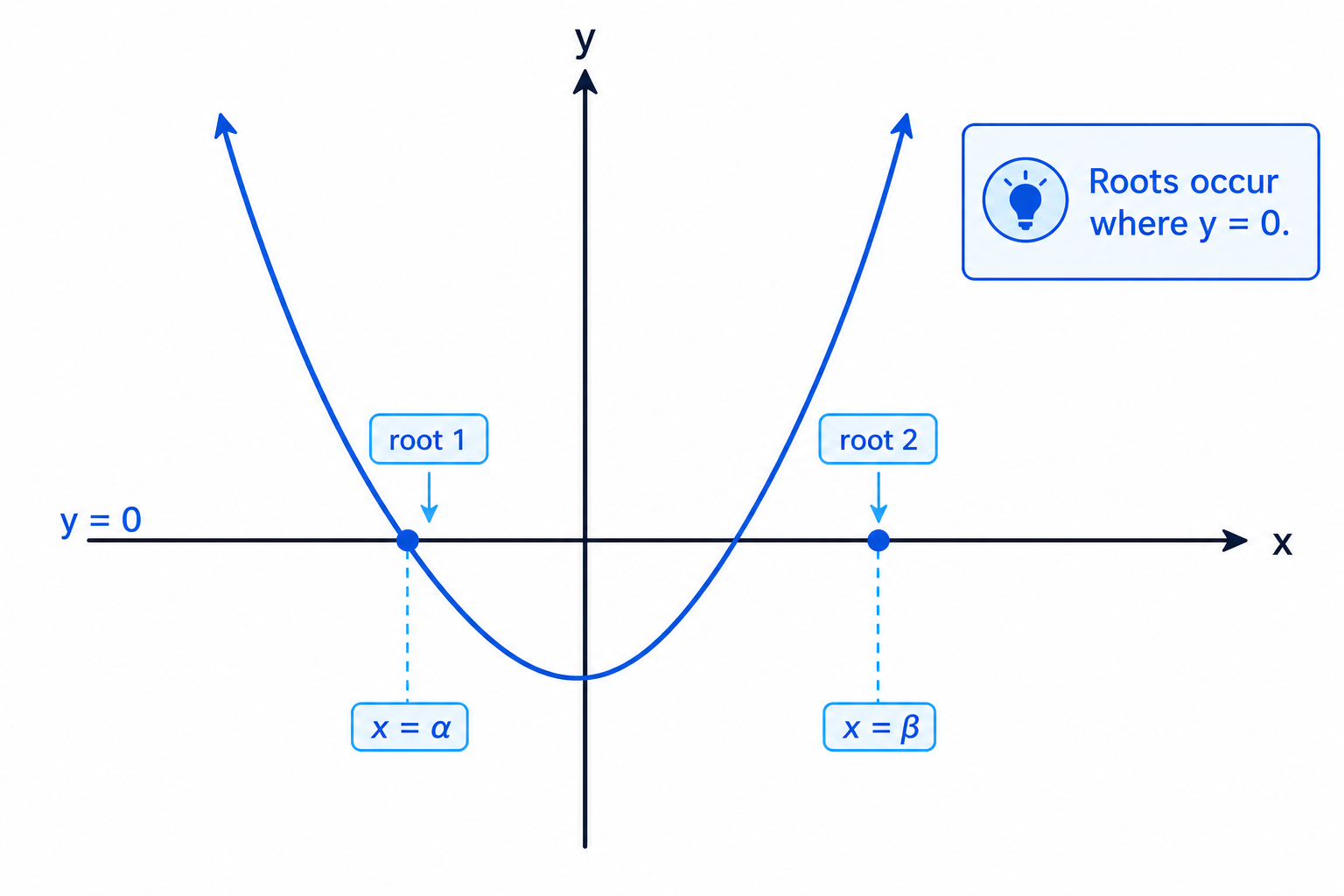
Quadratic roots are the <span class="katex"><span class="katex-mathml"><math xmlns="http://www.w3.org/1998/Math/MathML"><semantics><mrow><mi>x</mi></mrow><annotation encoding="application/x-tex">x</annotation></semantics></math></span><span class="katex-html" aria-hidden="true"><span class="base"><span class="strut" style="height:0.4306em;"></span><span class="mord mathnormal">x</span></span></span></span>-coordinates where the parabola crosses the <span class="katex"><span class="katex-mathml"><math xmlns="http://www.w3.org/1998/Math/MathML"><semantics><mrow><mi>x</mi></mrow><annotation encoding="application/x-tex">x</annotation></semantics></math></span><span class="katex-html" aria-hidden="true"><span class="base"><span class="strut" style="height:0.4306em;"></span><span class="mord mathnormal">x</span></span></span></span>-axis.

Example

Solving a quadratic with a constant parameter

By completing the square, find the roots of x2+px+5=0x^2+px+5=0x2+px+5=0 in terms of ppp.

  1. Complete the square:

    x2+px+5=(x+p2)2−p24+5x^2+px+5=\left(x+\frac{p}{2}\right)^2-\frac{p^2}{4}+5x2+px+5=(x+2p​)2−4p2​+5

  2. Set the completed-square form equal to zero:

    (x+p2)2−p24+5=0\left(x+\frac{p}{2}\right)^2-\frac{p^2}{4}+5=0(x+2p​)2−4p2​+5=0

  3. Rearrange to isolate the square:

    (x+p2)2=p24−5\left(x+\frac{p}{2}\right)^2=\frac{p^2}{4}-5(x+2p​)2=4p2​−5

  4. Take square roots of both sides:

    x+p2=±p24−5x+\frac{p}{2}=\pm \sqrt{\frac{p^2}{4}-5}x+2p​=±4p2​−5​

  5. Write the roots neatly:

    x=−p2±12p2−20x=-\frac{p}{2}\pm \frac{1}{2}\sqrt{p^2-20}x=−2p​±21​p2−20​

Common Mistake

No real roots

When solving by square rooting, the expression under the square root must be non-negative if you want real roots. If it is negative, the quadratic has no real roots.

Example

Finding when there are no real roots

Find the values of ppp for which x2+px+5=0x^2+px+5=0x2+px+5=0 has no real roots.
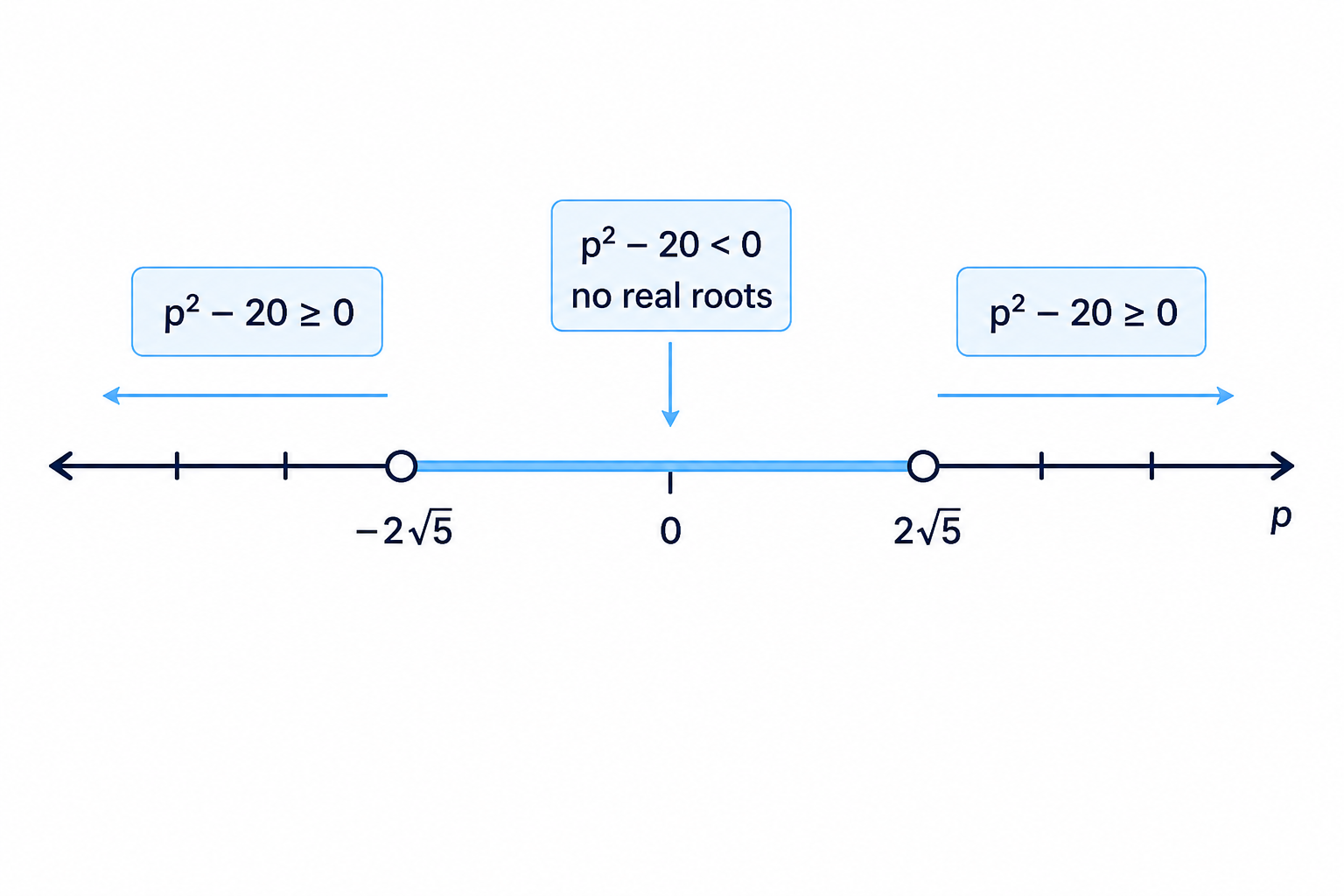
The parameter number line shows the interval <span class="katex"><span class="katex-mathml"><math xmlns="http://www.w3.org/1998/Math/MathML"><semantics><mrow><mo>−</mo><mn>2</mn><msqrt><mn>5</mn></msqrt><mo><</mo><mi>p</mi><mo><</mo><mn>2</mn><msqrt><mn>5</mn></msqrt></mrow><annotation encoding="application/x-tex">-2\sqrt5<p<2\sqrt5</annotation></semantics></math></span><span class="katex-html" aria-hidden="true"><span class="base"><span class="strut" style="height:1.04em;vertical-align:-0.1328em;"></span><span class="mord">−</span><span class="mord">2</span><span class="mord sqrt"><span class="vlist-t vlist-t2"><span class="vlist-r"><span class="vlist" style="height:0.9072em;"><span class="svg-align" style="top:-3em;"><span class="pstrut" style="height:3em;"></span><span class="mord" style="padding-left:0.833em;">5</span></span><span style="top:-2.8672em;"><span class="pstrut" style="height:3em;"></span><span class="hide-tail" style="min-width:0.853em;height:1.08em;"><svg xmlns="http://www.w3.org/2000/svg" width="400em" height="1.08em" viewBox="0 0 400000 1080" preserveAspectRatio="xMinYMin slice"><path d="M95,702
c-2.7,0,-7.17,-2.7,-13.5,-8c-5.8,-5.3,-9.5,-10,-9.5,-14
c0,-2,0.3,-3.3,1,-4c1.3,-2.7,23.83,-20.7,67.5,-54
c44.2,-33.3,65.8,-50.3,66.5,-51c1.3,-1.3,3,-2,5,-2c4.7,0,8.7,3.3,12,10
s173,378,173,378c0.7,0,35.3,-71,104,-213c68.7,-142,137.5,-285,206.5,-429
c69,-144,104.5,-217.7,106.5,-221
l0 -0
c5.3,-9.3,12,-14,20,-14
H400000v40H845.2724
s-225.272,467,-225.272,467s-235,486,-235,486c-2.7,4.7,-9,7,-19,7
c-6,0,-10,-1,-12,-3s-194,-422,-194,-422s-65,47,-65,47z
M834 80h400000v40h-400000z"/></svg></span></span></span><span class="vlist-s">​</span></span><span class="vlist-r"><span class="vlist" style="height:0.1328em;"><span></span></span></span></span></span><span class="mspace" style="margin-right:0.2778em;"></span><span class="mrel"><</span><span class="mspace" style="margin-right:0.2778em;"></span></span><span class="base"><span class="strut" style="height:0.7335em;vertical-align:-0.1944em;"></span><span class="mord mathnormal">p</span><span class="mspace" style="margin-right:0.2778em;"></span><span class="mrel"><</span><span class="mspace" style="margin-right:0.2778em;"></span></span><span class="base"><span class="strut" style="height:1.04em;vertical-align:-0.1328em;"></span><span class="mord">2</span><span class="mord sqrt"><span class="vlist-t vlist-t2"><span class="vlist-r"><span class="vlist" style="height:0.9072em;"><span class="svg-align" style="top:-3em;"><span class="pstrut" style="height:3em;"></span><span class="mord" style="padding-left:0.833em;">5</span></span><span style="top:-2.8672em;"><span class="pstrut" style="height:3em;"></span><span class="hide-tail" style="min-width:0.853em;height:1.08em;"><svg xmlns="http://www.w3.org/2000/svg" width="400em" height="1.08em" viewBox="0 0 400000 1080" preserveAspectRatio="xMinYMin slice"><path d="M95,702
c-2.7,0,-7.17,-2.7,-13.5,-8c-5.8,-5.3,-9.5,-10,-9.5,-14
c0,-2,0.3,-3.3,1,-4c1.3,-2.7,23.83,-20.7,67.5,-54
c44.2,-33.3,65.8,-50.3,66.5,-51c1.3,-1.3,3,-2,5,-2c4.7,0,8.7,3.3,12,10
s173,378,173,378c0.7,0,35.3,-71,104,-213c68.7,-142,137.5,-285,206.5,-429
c69,-144,104.5,-217.7,106.5,-221
l0 -0
c5.3,-9.3,12,-14,20,-14
H400000v40H845.2724
s-225.272,467,-225.272,467s-235,486,-235,486c-2.7,4.7,-9,7,-19,7
c-6,0,-10,-1,-12,-3s-194,-422,-194,-422s-65,47,-65,47z
M834 80h400000v40h-400000z"/></svg></span></span></span><span class="vlist-s">​</span></span><span class="vlist-r"><span class="vlist" style="height:0.1328em;"><span></span></span></span></span></span></span></span></span> where the quadratic has no real roots.

  1. From the completed-square solution, the roots involve:

    p2−20\sqrt{p^2-20}p2−20​

  2. For no real roots, the expression under the square root must be negative:

    p2−20<0p^2-20<0p2−20<0

  3. Rearrange:

    p2<20p^2<20p2<20

  4. Take square roots carefully:

    −25<p<25-2\sqrt{5}<p<2\sqrt{5}−25​<p<25​

Exam technique

In the exam

  1. Always show the completed-square line clearly; it often earns method marks even if the final answer goes wrong.

  2. For minimum points, remember that (x−a)2+b(x-a)^2+b(x−a)2+b has minimum point (a,b)(a,b)(a,b), not (−a,b)(-a,b)(−a,b).

  3. For “no real roots” questions, focus on the expression under the square root and set it less than zero.

Self review

Check yourself

  • Can you complete the square for x2+12x−7x^2+12x-7x2+12x−7 without expanding fully?

  • What is the minimum point of y=(x+6)2−11y=(x+6)^2-11y=(x+6)2−11?

  • For x2+kx+10=0x^2+kx+10=0x2+kx+10=0, what expression would appear under the square root when solving by completing the square?

Recap questions

Test yourself with 5 quick questions on this guide. Answer them all correctly to complete it.

You've reached the end

Test yourself on this topic, or move on to the next guide.

FlashcardsSelf-test with active recall
2.4 The DiscriminantUp next

How was this guide?

2.2 Completing the Square Revision Guide

  1. AS Level
  2. /Maths
  3. /2.2 Completing the Square