Revision notes for Edexcel AS Level Maths Trigonometric Identities and Equations. Open each subtopic for explanations, worked examples, and summaries of 10.1 Angles in all four Quadrants, 10.2 Exact Values of Trigonometric Ratios, 10.3 Trigonometric Identities, 10.4 Solving Trigonometric Equations, 10.5 Harder Trigonometric Equations, and 10.6 Equations and Identities. Written against the Edexcel AS Level Maths (8MA0) specification, so the content matches what's examinable rather than general Maths background.
Trigonometric Identities and Equations
What you'll learn
- How to find all angles that satisfy a trigonometric equation in a given interval.
- How to use the key identities sin2x+cos2x≡1\sin^2 x+\cos^2 x\equiv 1sin2x+cos2x≡1 and tanx≡sinxcosx\tan x\equiv \frac{\sin x}{\cos x}tanx≡cosxsinx.
- How to turn trig equations into quadratics in sinx\sin xsinx or cosx\cos xcosx.
- How to avoid losing solutions when rearranging equations involving tanx\tan xtanx.
1. The basics: angles, periods and quadrants
In AS Maths, trigonometric equations are usually in degrees. Before doing anything else, make sure your calculator is in degree mode.
Definition
Period and reference angle
- The period of a trig function is the angle after which its values repeat. Sine and cosine have period 360°, while tangent has period 180°.
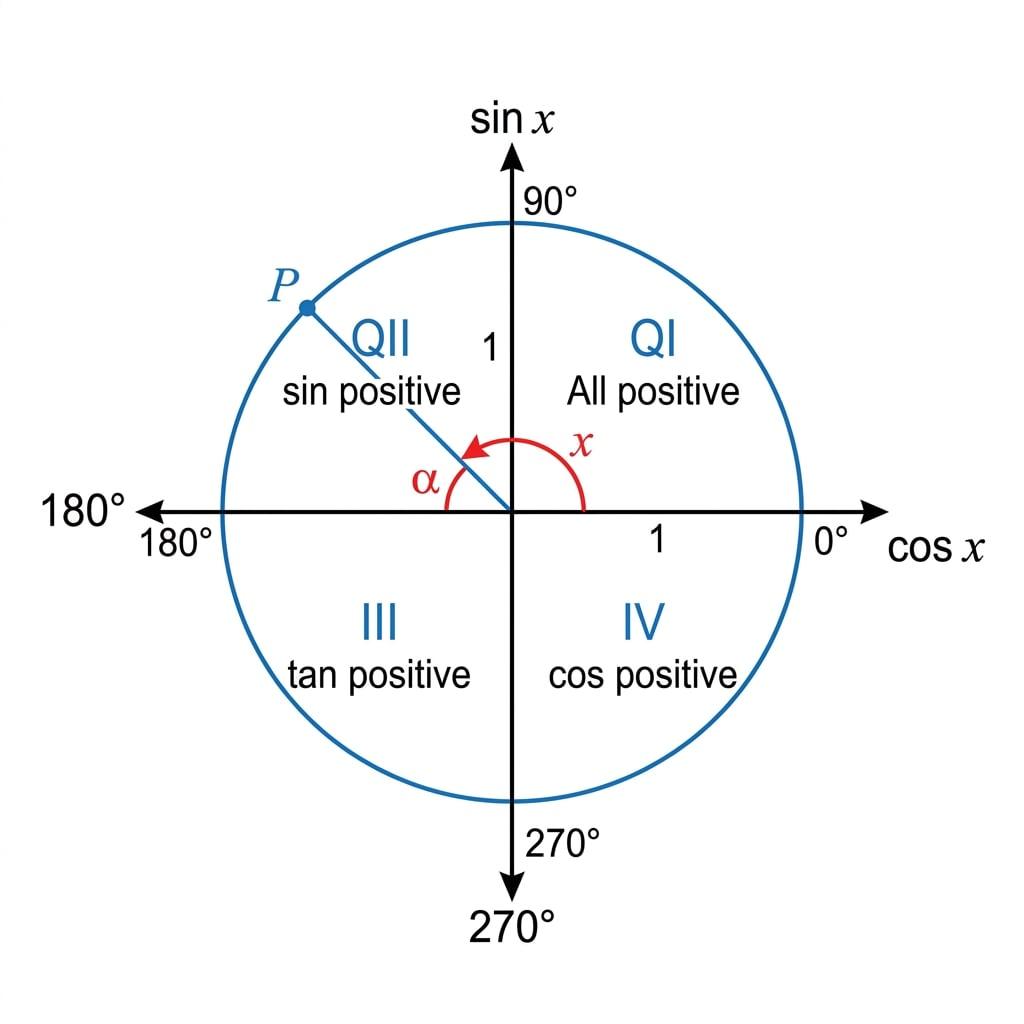
- A reference angle is the acute angle made with the x-axis. It helps you find the matching angle in another quadrant.
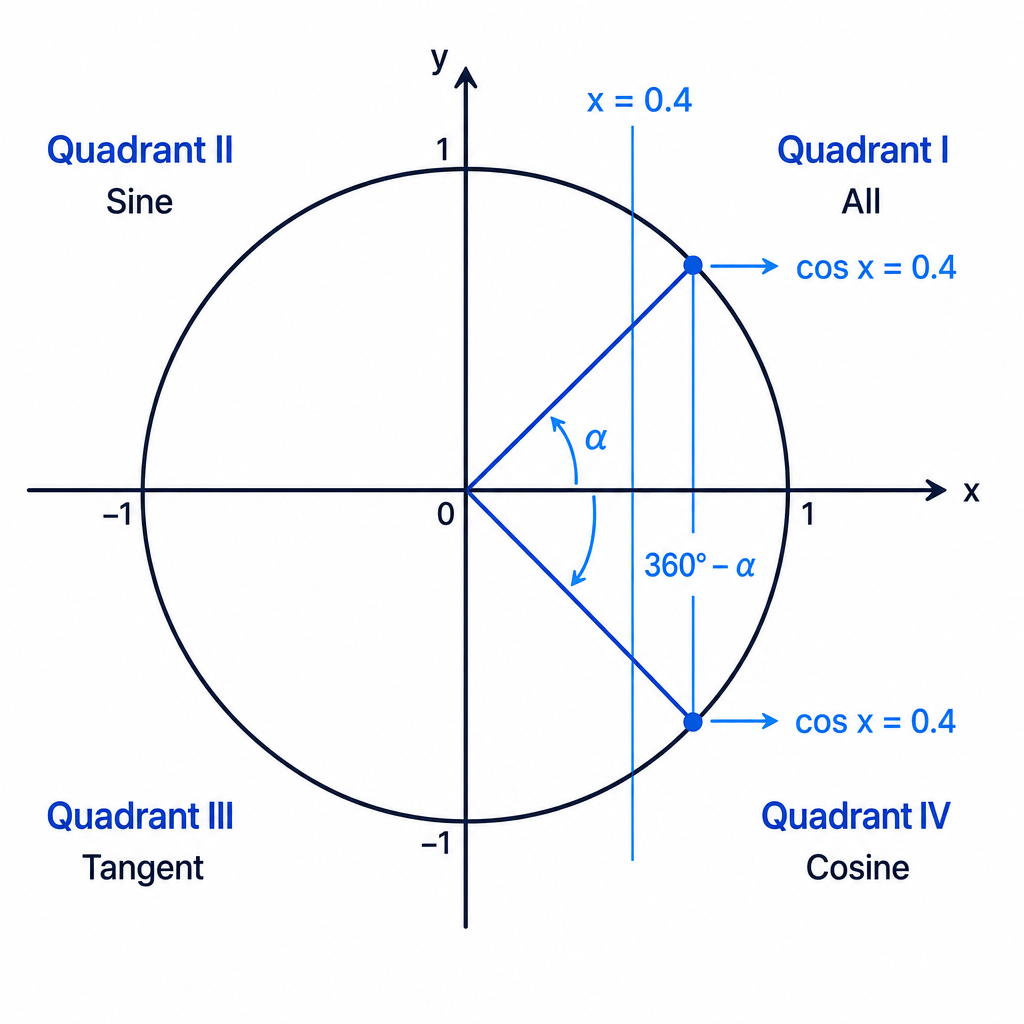
The unit circle explains why one trig value often gives more than one answer. For example, cosx=0.4\cos x=0.4cosx=0.4 has two solutions between 0° and 360° because cosine is positive in Quadrants I and IV.
Key Idea
CAST rule
Use CAST to remember signs: All positive in Quadrant I, Sine positive in Quadrant II, Tangent positive in Quadrant III, Cosine positive in Quadrant IV.
Example
Solving a shifted cosine equation
Solve 5cos(x−35)=25\cos(x-35)=25cos(x−35)=2 for 0∘≤x<360∘0^\circ \leq x < 360^\circ0∘≤x<360∘, giving your answers to two decimal places.
-
Divide both sides by 5:
cos(x−35)=0.4\cos(x-35)=0.4cos(x−35)=0.4 -
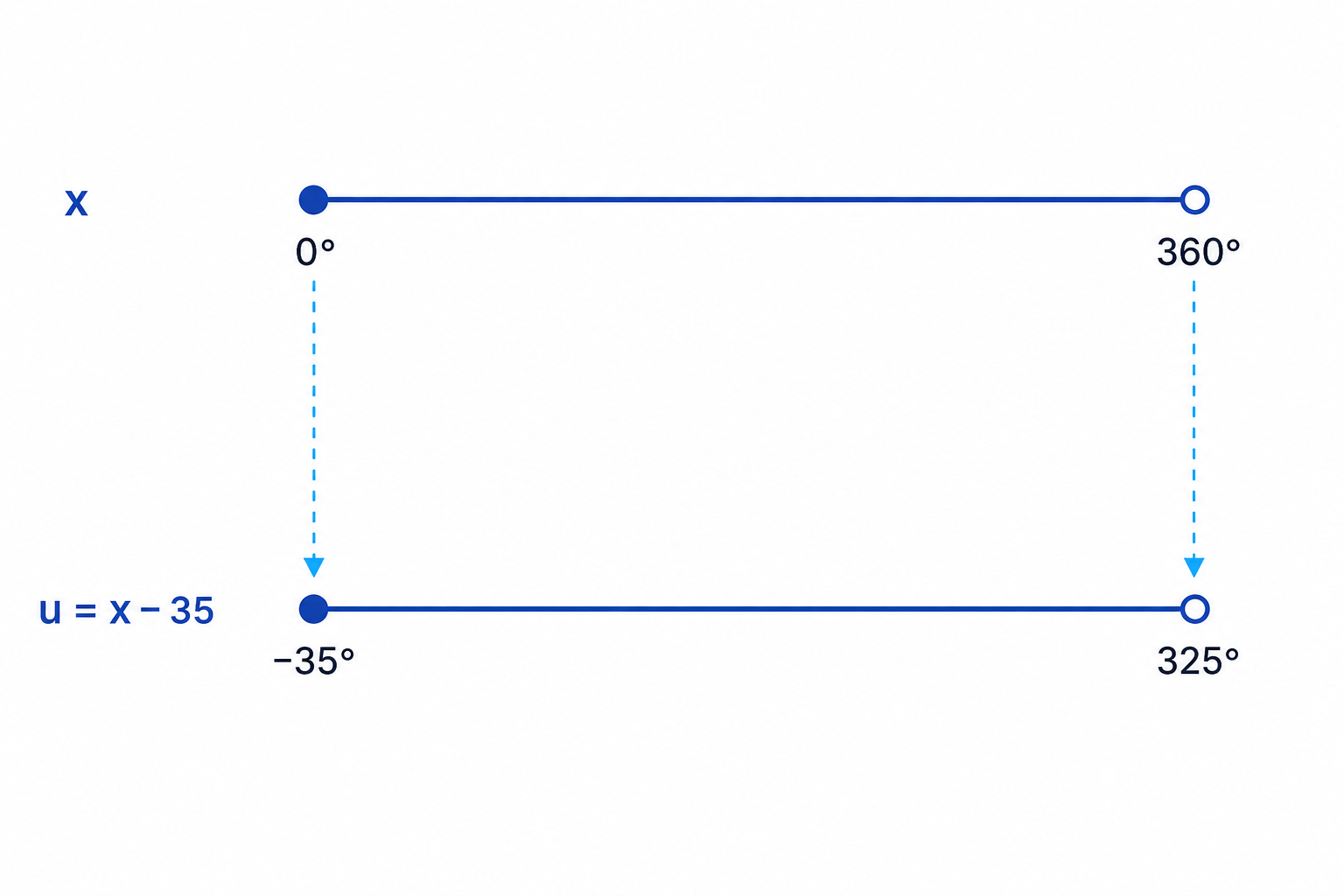
Let u=x−35u=x-35u=x−35. Since 0∘≤x<360∘0^\circ \leq x < 360^\circ0∘≤x<360∘, the new interval is:
$$
-35^\circ \leq u < 325^\circ
$$
3. Find the reference angle using inverse cosine:
$$
\alpha=\cos^{-1}(0.4)=66.4218\ldots^\circ
$$
4. Cosine is positive in Quadrants I and IV, so within the interval for uuu:
$$
u=66.4218\ldots^\circ,\quad u=360^\circ-66.4218\ldots^\circ=293.5781\ldots^\circ
$$
5. Add 35° to return to xxx:
$$
x=101.42^\circ,\quad x=328.58^\circ
$$
Tip
Calculator warning
If you use sin−1\sin^{-1}sin−1, cos−1\cos^{-1}cos−1 or tan−1\tan^{-1}tan−1, your calculator gives only one angle. Your job is to use quadrants and the interval to find the rest.
2. Composite angles: change the interval carefully
The argument of a trig function is the expression inside it. In sin(3θ−20)\sin(3\theta-20)sin(3θ−20), the argument is 3θ−203\theta-203θ−20.
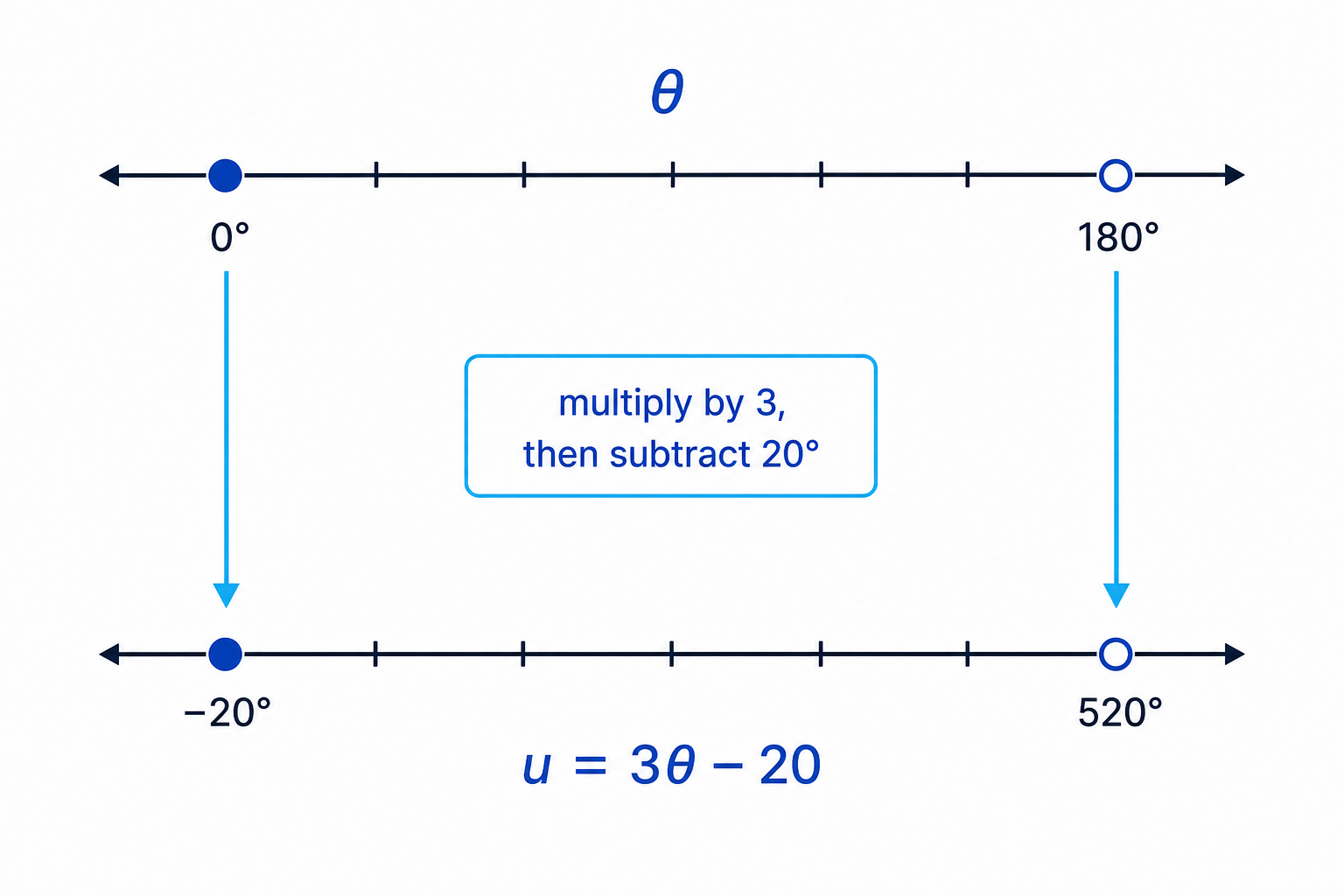
When the argument is not just the variable, solve using a substitution such as u=3θ−20u=3\theta-20u=3θ−20. The most important step is to transform the interval.
Example
Solving a sine equation with a composite angle
Solve sin(3θ−20)=0.7\sin(3\theta-20)=0.7sin(3θ−20)=0.7 for 0∘≤θ<180∘0^\circ \leq \theta < 180^\circ0∘≤θ<180∘, giving your answers to two decimal places.
-
Let u=3θ−20u=3\theta-20u=3θ−20.
-
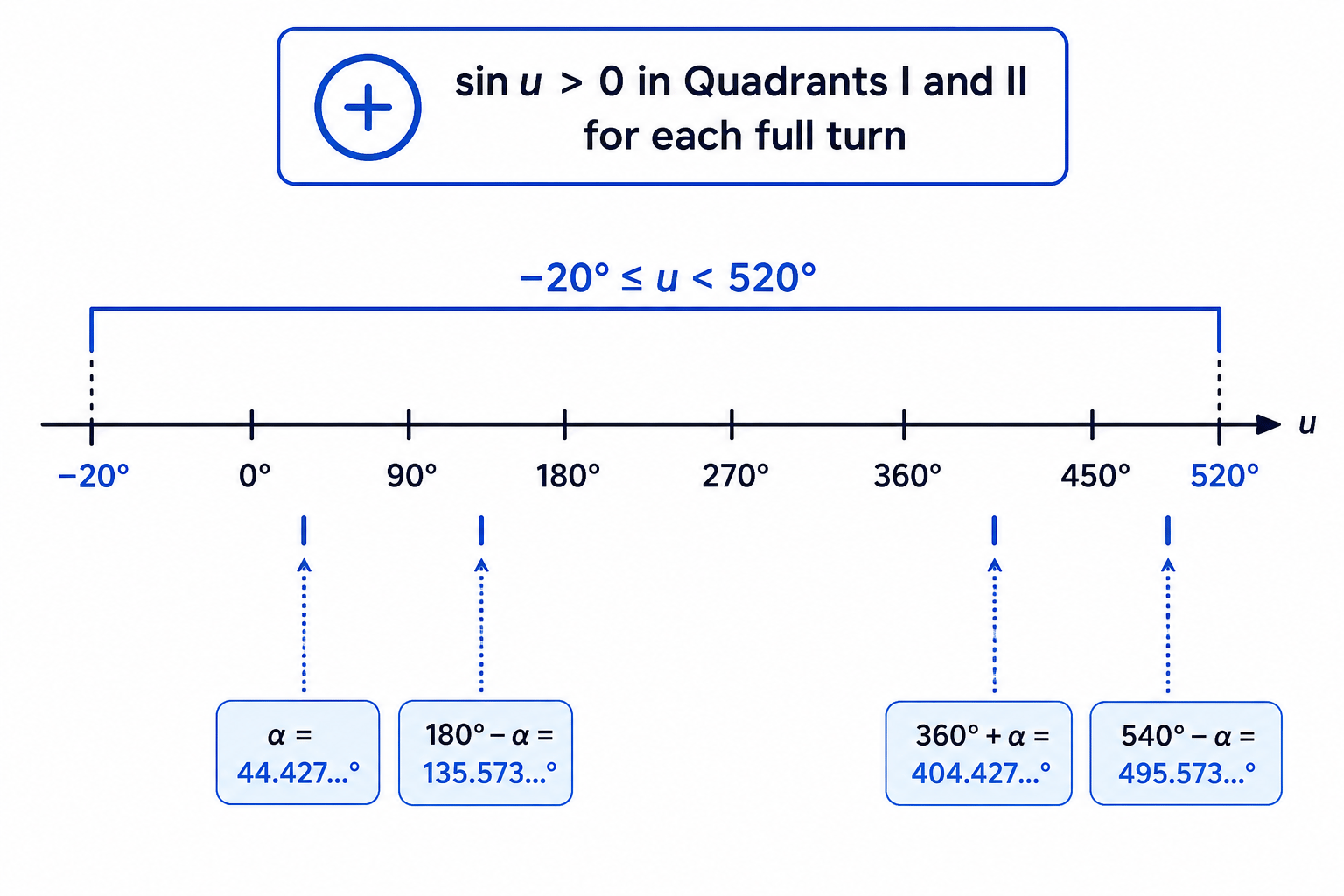
Convert the interval. When θ=0∘\theta=0^\circθ=0∘, u=−20∘u=-20^\circu=−20∘. When θ\thetaθ approaches 180°, uuu approaches 520°:
$$
-20^\circ \leq u < 520^\circ
$$
3. Find the reference angle:
$$
\alpha=\sin^{-1}(0.7)=44.4270\ldots^\circ
$$
4. Sine is positive in Quadrants I and II, so the possible values of uuu are:
$$
u=44.4270\ldots^\circ,\quad 135.5729\ldots^\circ,\quad 404.4270\ldots^\circ,\quad 495.5729\ldots^\circ
$$
5. Use u=3θ−20u=3\theta-20u=3θ−20, so θ=u+203\theta=\frac{u+20}{3}θ=3u+20:
$$
\theta=21.48^\circ,\quad 51.86^\circ,\quad 141.48^\circ,\quad 171.86^\circ
$$
3. Core identities
Definition
Trigonometric identity
A trigonometric identity is an equation that is true for all allowed values of the variable. The symbol ≡\equiv≡ means “identically equal to”.
The two identities you use most in this topic are:
sin2x+cos2x≡1\sin^2 x+\cos^2 x\equiv 1sin2x+cos2x≡1and
tanx≡sinxcosx,cosx≠0\tan x\equiv \frac{\sin x}{\cos x},\quad \cos x\neq 0tanx≡cosxsinx,cosx=0You can rearrange the first one as:
sin2x≡1−cos2x\sin^2 x\equiv 1-\cos^2 xsin2x≡1−cos2xor
cos2x≡1−sin2x\cos^2 x\equiv 1-\sin^2 xcos2x≡1−sin2xThese are especially useful when an equation contains both sin2x\sin^2 xsin2x and cosx\cos xcosx, or both cos2x\cos^2 xcos2x and sinx\sin xsinx.
Example
Turning a trig equation into a quadratic
Show that 3sin2x=4cosx+23\sin^2 x=4\cos x+23sin2x=4cosx+2 can be written as 3cos2x+4cosx−1=03\cos^2 x+4\cos x-1=03cos2x+4cosx−1=0, then solve it for 0∘≤x<360∘0^\circ \leq x < 360^\circ0∘≤x<360∘.
-
Replace sin2x\sin^2 xsin2x with 1−cos2x1-\cos^2 x1−cos2x:
3(1−cos2x)=4cosx+23(1-\cos^2 x)=4\cos x+23(1−cos2x)=4cosx+2 -
Expand and rearrange into a quadratic:
3−3cos2x=4cosx+23cos2x+4cosx−1=0\begin{aligned} 3-3\cos^2 x&=4\cos x+2\\ 3\cos^2 x+4\cos x-1&=0 \end{aligned}3−3cos2x3cos2x+4cosx−1=4cosx+2=0 -
Factorise:
(3cosx−1)(cosx+1)=0(3\cos x-1)(\cos x+1)=0(3cosx−1)(cosx+1)=0 -
Solve each part:
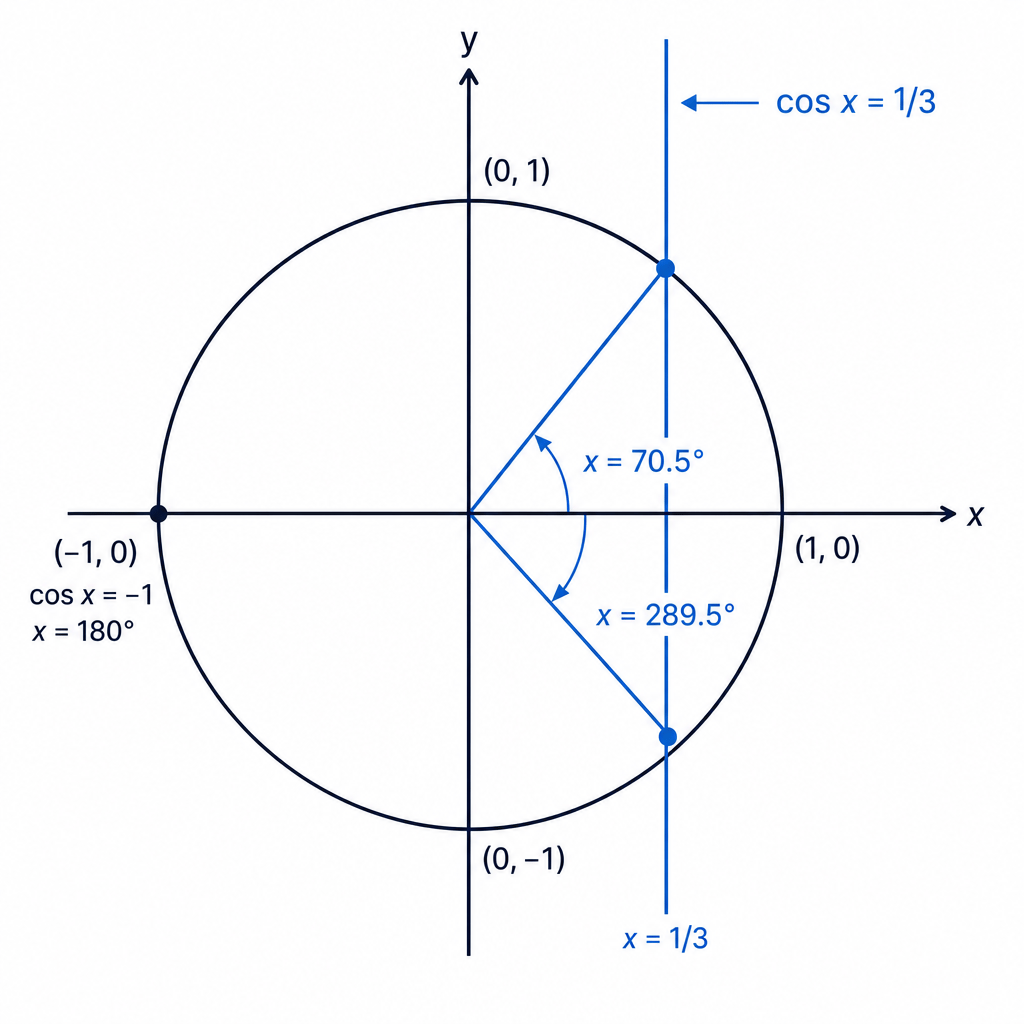
cosx=13orcosx=−1\cos x=\frac{1}{3}\quad \text{or}\quad \cos x=-1cosx=31orcosx=−1 -
For cosx=13\cos x=\frac{1}{3}cosx=31, cosine is positive in Quadrants I and IV. Also, cosx=−1\cos x=-1cosx=−1 gives x=180∘x=180^\circx=180∘:
$$
x=70.5^\circ,\quad 180^\circ,\quad 289.5^\circ
$$
Common Mistake
Accepting impossible trig values
If a quadratic gives sinx=1.4\sin x=1.4sinx=1.4 or cosx=−2\cos x=-2cosx=−2, reject it immediately. Sine and cosine values must lie between -1 and 1.
4. Equations involving tangent
Tangent often appears with sine and cosine because:
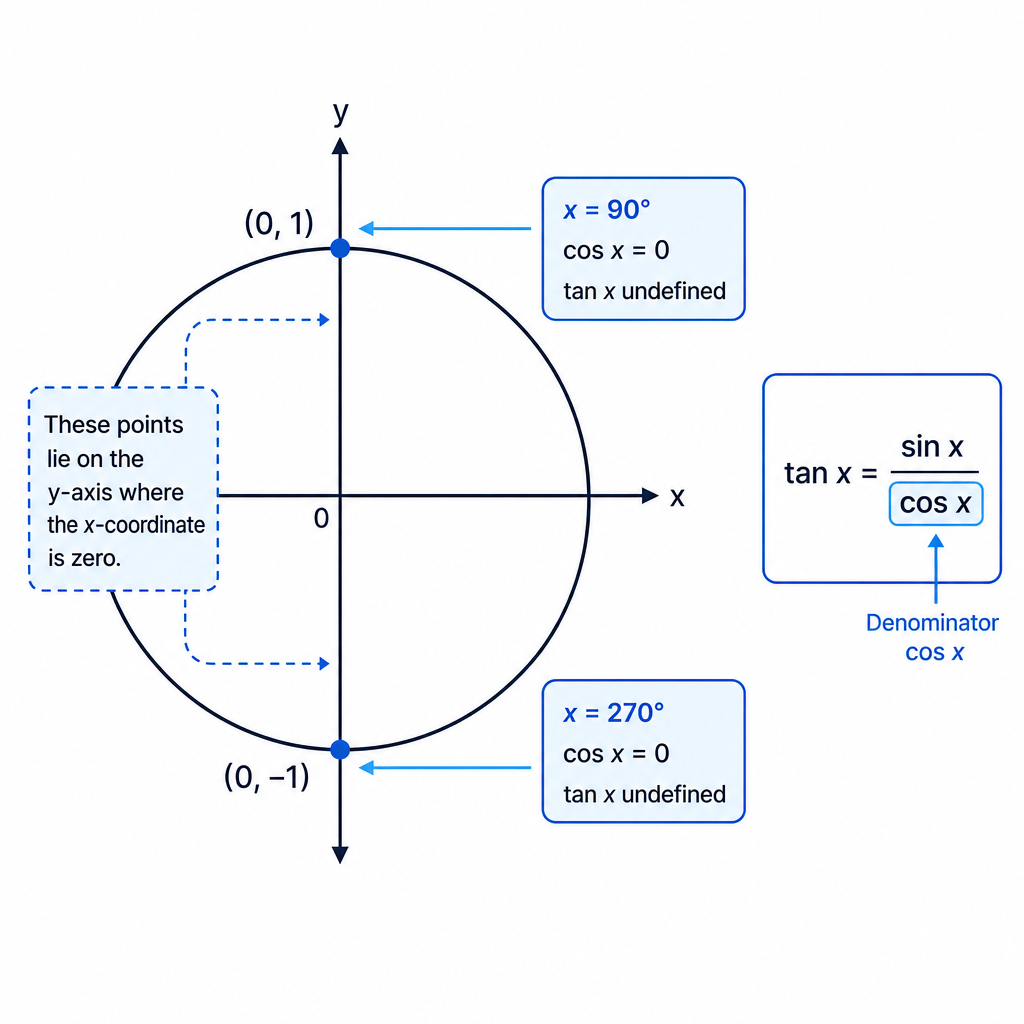
tanx=sinxcosx\tan x=\frac{\sin x}{\cos x}tanx=cosxsinxBut be careful: tanx\tan xtanx is undefined when cosx=0\cos x=0cosx=0.
Example
Do not divide by a possible zero factor
Solve 3tanx=5sinx3\tan x=5\sin x3tanx=5sinx for 0∘≤x<360∘0^\circ \leq x < 360^\circ0∘≤x<360∘, giving answers to one decimal place where appropriate.
-
Replace tanx\tan xtanx with sinxcosx\frac{\sin x}{\cos x}cosxsinx:
3⋅sinxcosx=5sinx3\cdot \frac{\sin x}{\cos x}=5\sin x3⋅cosxsinx=5sinx -
Multiply by cosx\cos xcosx. Values with cosx=0\cos x=0cosx=0 are not valid anyway because tanx\tan xtanx would be undefined:
3sinx=5sinxcosx3\sin x=5\sin x\cos x3sinx=5sinxcosx -
Bring everything to one side and factorise:
$$
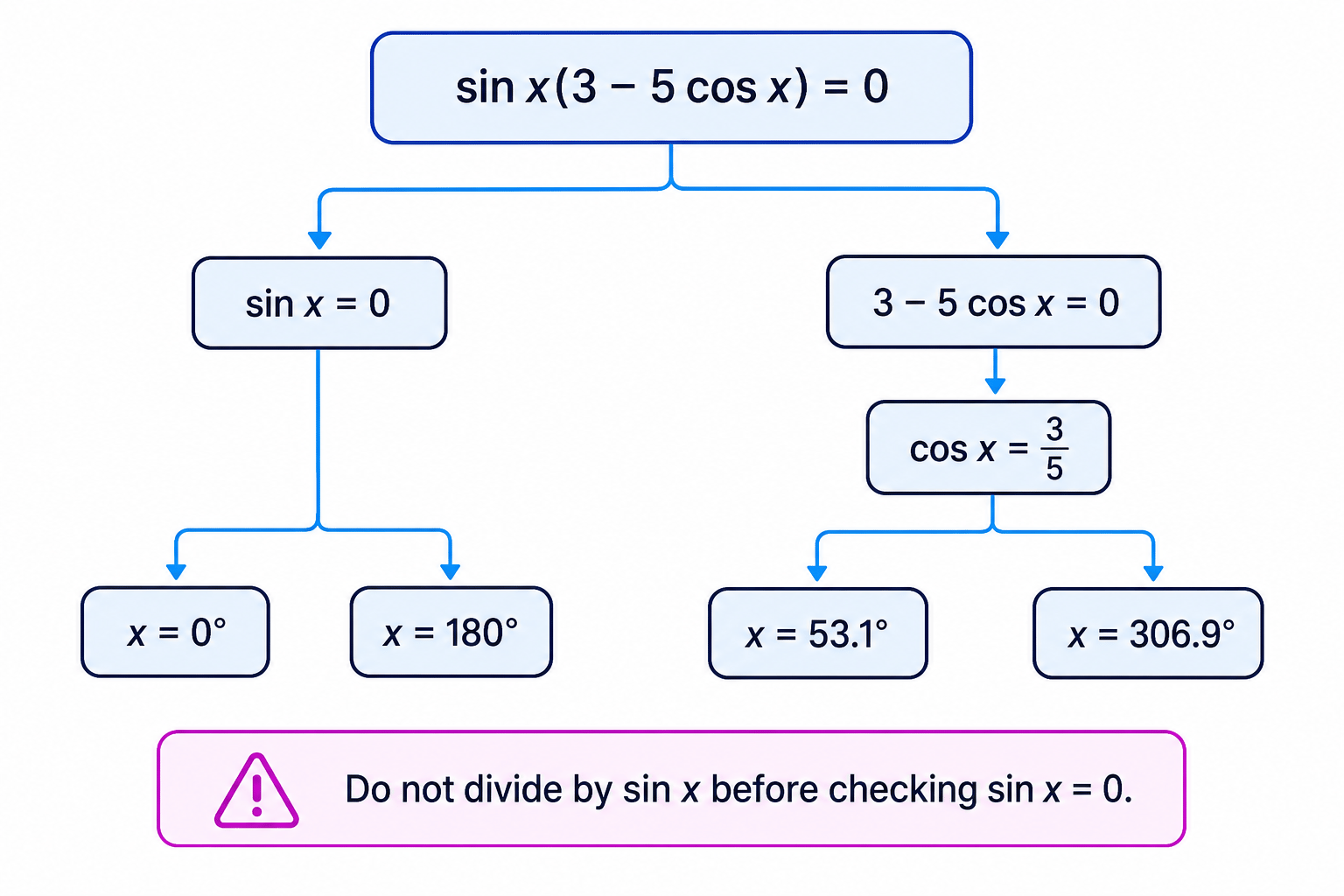
\sin x(3-5\cos x)=0
$$
4. Solve each factor:
$$
\sin x=0\quad \text{or}\quad \cos x=\frac{3}{5}
$$
5. Find all values in the interval:
$$
x=0^\circ,\quad 53.1^\circ,\quad 180^\circ,\quad 306.9^\circ
$$
Common Mistake
Cancelling away solutions
Do not divide both sides by sinx\sin xsinx unless you have separately checked sinx=0\sin x=0sinx=0. In this example, dividing by sinx\sin xsinx would lose x=0∘x=0^\circx=0∘ and x=180∘x=180^\circx=180∘.
5. Squared trig equations
If you see something like tan2x=3\tan^2 x=3tan2x=3, remember that this means:
tanx=3ortanx=−3\tan x=\sqrt{3}\quad \text{or}\quad \tan x=-\sqrt{3}tanx=3ortanx=−3So squared equations often produce more solutions than expected.
Example
Solving a squared tangent equation
Solve tan2(2x)=3\tan^2(2x)=3tan2(2x)=3 for 0∘≤x<180∘0^\circ \leq x < 180^\circ0∘≤x<180∘.
-
Take the square root carefully:
tan(2x)=±3\tan(2x)=\pm\sqrt{3}tan(2x)=±3 -
Let u=2xu=2xu=2x. The interval becomes:
0∘≤u<360∘0^\circ \leq u < 360^\circ0∘≤u<360∘ -
Since tanu=3\tan u=\sqrt{3}tanu=3 or tanu=−3\tan u=-\sqrt{3}tanu=−3, the solutions for uuu are:
u=60∘,120∘,240∘,300∘u=60^\circ,\quad 120^\circ,\quad 240^\circ,\quad 300^\circu=60∘,120∘,240∘,300∘ -
Divide by 2:
x=30∘,60∘,120∘,150∘x=30^\circ,\quad 60^\circ,\quad 120^\circ,\quad 150^\circx=30∘,60∘,120∘,150∘
6. Graphs and transformations
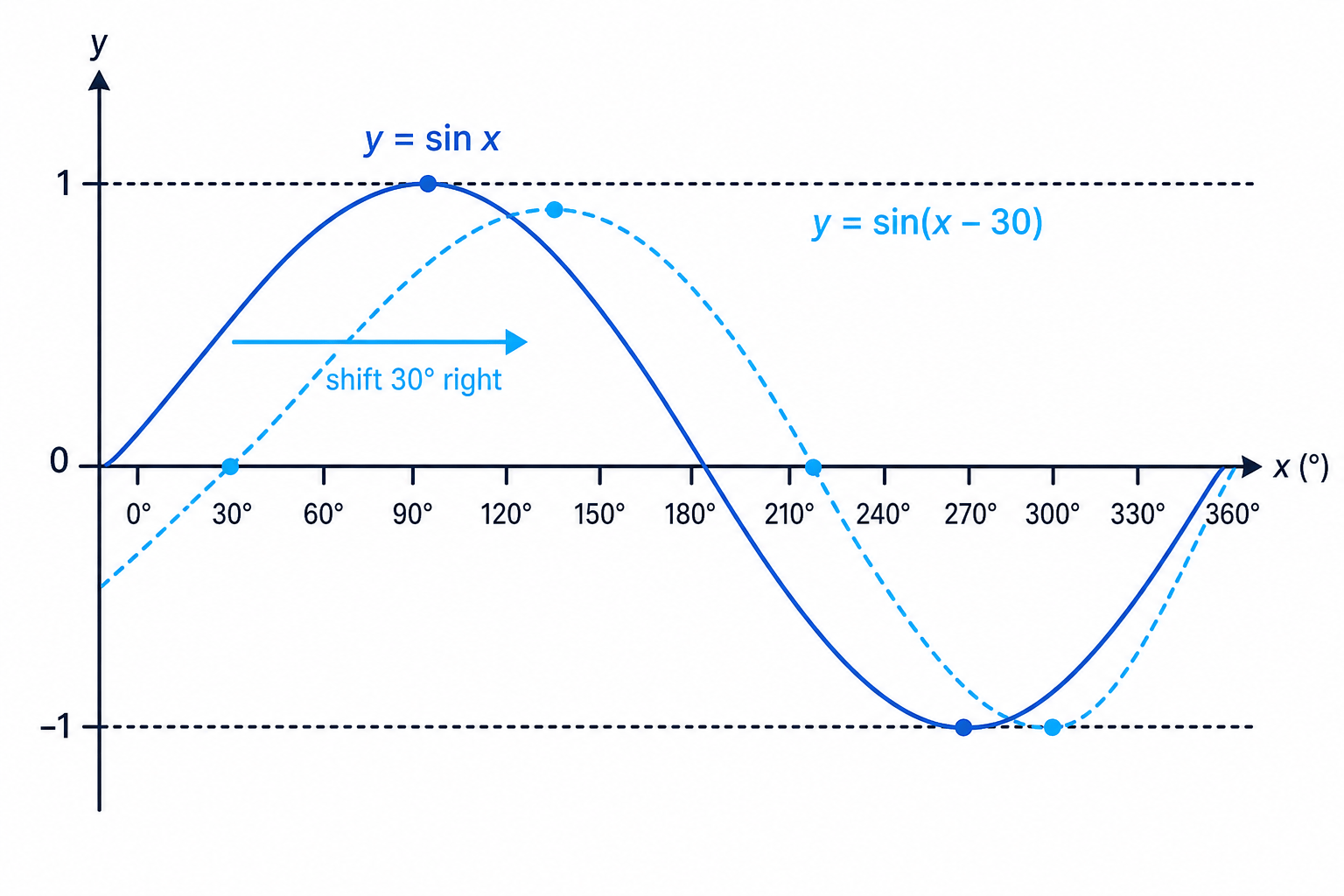
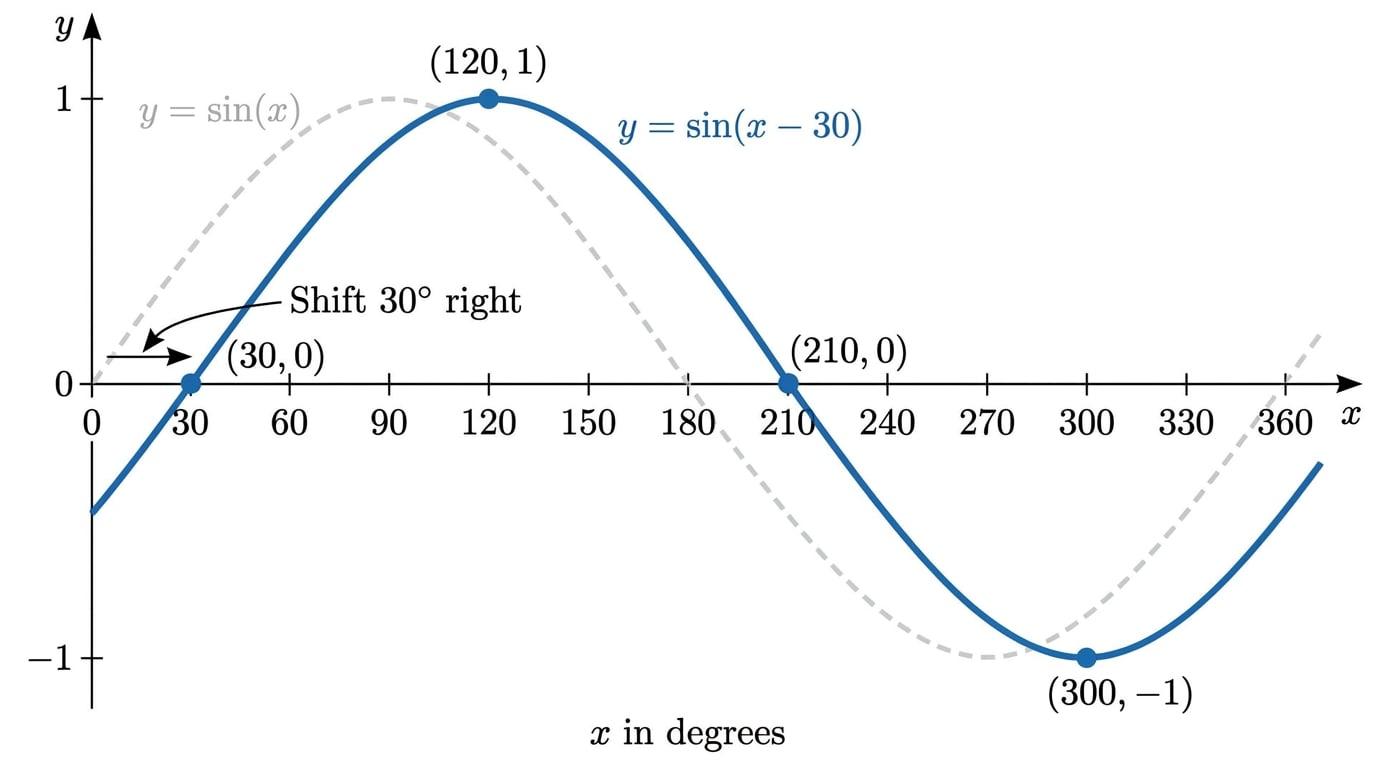
The graph of y=sin(x−30)y=\sin(x-30)y=sin(x−30) is the graph of y=sinxy=\sin xy=sinx shifted 30° to the right. This helps you check whether your number of solutions is sensible.
Example
Using a transformed sine graph idea
Find all solutions of sin(x−30)=0.4\sin(x-30)=0.4sin(x−30)=0.4 for 0∘≤x<360∘0^\circ \leq x < 360^\circ0∘≤x<360∘.
-
Let u=x−30u=x-30u=x−30, so:
−30∘≤u<330∘-30^\circ \leq u < 330^\circ−30∘≤u<330∘ -
Find the reference angle:
α=sin−1(0.4)=23.5781…∘\alpha=\sin^{-1}(0.4)=23.5781\ldots^\circα=sin−1(0.4)=23.5781…∘ -
Sine is positive in Quadrants I and II, so:
u=23.5781…∘,156.4218…∘u=23.5781\ldots^\circ,\quad 156.4218\ldots^\circu=23.5781…∘,156.4218…∘ -
Add 30° to return to xxx:
x=53.6∘,186.4∘x=53.6^\circ,\quad 186.4^\circx=53.6∘,186.4∘
7. Proving identities by simplifying one side
To prove an identity, usually start with the more complicated side and use known identities until it becomes the simpler side.
Example
Proving a fractional identity
Prove that 3sinx−cos2x+13+sinx≡sinx\frac{3\sin x-\cos^2 x+1}{3+\sin x}\equiv \sin x3+sinx3sinx−cos2x+1≡sinx.
-
Start with the left-hand side:
3sinx−cos2x+13+sinx\frac{3\sin x-\cos^2 x+1}{3+\sin x}3+sinx3sinx−cos2x+1 -
Replace cos2x\cos^2 xcos2x with 1−sin2x1-\sin^2 x1−sin2x:
3sinx−(1−sin2x)+13+sinx\frac{3\sin x-(1-\sin^2 x)+1}{3+\sin x}3+sinx3sinx−(1−sin2x)+1 -
Simplify the numerator:
3sinx+sin2x3+sinx\frac{3\sin x+\sin^2 x}{3+\sin x}3+sinx3sinx+sin2x -
Factorise the numerator:
sinx(3+sinx)3+sinx\frac{\sin x(3+\sin x)}{3+\sin x}3+sinxsinx(3+sinx) -
Cancel the common factor:
sinx\sin xsinx
Exam technique
In the exam
- Write the transformed interval when you use a substitution like u=2x+15u=2x+15u=2x+15.
- Use CAST or a sketch to find every solution, not just the calculator’s first answer.
- Avoid dividing by sinx\sin xsinx or cosx\cos xcosx unless you have checked the zero case and any undefined tangent values.
Self review
Check yourself
- Can you explain why cosx=0.4\cos x=0.4cosx=0.4 has two solutions between 0° and 360°?
- When solving sin(3x−10)=0.5\sin(3x-10)=0.5sin(3x−10)=0.5, what interval should you use for the argument?
- Why might dividing an equation by sinx\sin xsinx cause you to lose a solution?

Recap questions
Test yourself with 5 quick questions on this guide. Answer them all correctly to complete it.
You've reached the end
Test yourself on this topic, or move on to the next guide.
How was this guide?