Revision notes for Edexcel AS Level Maths Constant Acceleration. Open each subtopic for explanations, worked examples, and summaries of Modelling Assumptions, Quantities and Units, Working with Vectors, Displacement-Time Graphs, Velocity-Time Graphs, Constant Acceleration Formulae 1, Constant Acceleration Formulae 2, and Vertical Motion Under Gravity. Written against the Edexcel AS Level Maths (8MA0) specification, so the content matches what's examinable rather than general Maths background.
Constant Acceleration
What you'll learn
- How to use the SUVAT equations for motion in a straight line.
- How to choose a positive direction and handle signs correctly.
- How to solve vertical motion questions using gravity.
- How velocity-time graphs give acceleration and distance.
1. The basic motion quantities
In constant acceleration questions, the object is usually moving along a straight line. We often model it as a particle, meaning we ignore its size and shape.
Definition
Core motion terms
- Displacement is distance in a chosen direction. It can be positive or negative.
- Velocity is speed in a chosen direction. Speed is the magnitude, meaning the size without the sign.
- Acceleration is the rate of change of velocity.
- Constant acceleration means the velocity changes by the same amount in each equal time interval.
The five main symbols are remembered by SUVAT:
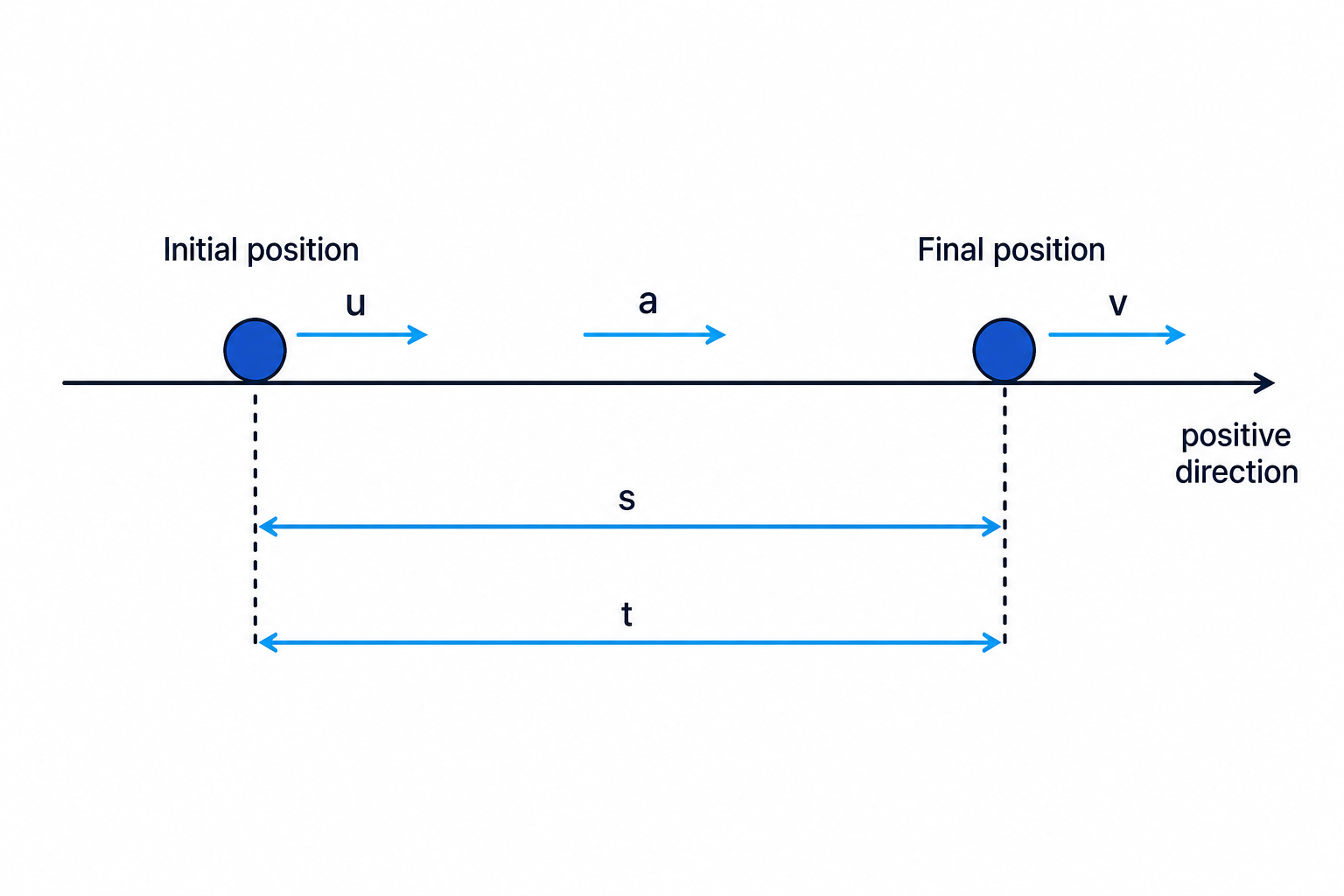
- sss: displacement
- uuu: initial velocity
- vvv: final velocity
- aaa: acceleration
- ttt: time
Before using any formula, check that all speeds are in m s⁻¹ and all distances are in metres.
Example
Converting speeds before using acceleration
A car increases its speed from 18 km h⁻¹ to 54 km h⁻¹ in 10 seconds. Find its acceleration and the distance travelled.
-
Convert both speeds to m s⁻¹ by dividing by 3.6.
u=18÷3.6=5v=54÷3.6=15\begin{aligned} u &= 18 \div 3.6 = 5\\ v &= 54 \div 3.6 = 15 \end{aligned}uv=18÷3.6=5=54÷3.6=15 -
Use acceleration as change in velocity divided by time.
a=v−ut=15−510=1a=\frac{v-u}{t}=\frac{15-5}{10}=1a=tv−u=1015−5=1 -
For constant acceleration, the distance is average velocity multiplied by time.
s=u+v2t=5+152×10=100s=\frac{u+v}{2}t=\frac{5+15}{2}\times 10=100s=2u+vt=25+15×10=100
Common Mistake
Forgetting unit conversion
If a speed is given in km h⁻¹, convert it before using SUVAT. Divide by 3.6 to get m s⁻¹.
2. The SUVAT equations
The SUVAT equations work only when acceleration is constant.
v=u+ats=ut+12at2s=vt−12at2s=u+v2tv2=u2+2as\begin{aligned} v &= u+at\\ s &= ut+\frac{1}{2}at^2\\ s &= vt-\frac{1}{2}at^2\\ s &= \frac{u+v}{2}t\\ v^2 &= u^2+2as \end{aligned}vsssv2=u+at=ut+21at2=vt−21at2=2u+vt=u2+2asKey Idea
Choosing the right equation
List the quantities you know, then choose an equation containing only one unknown. Avoid using an equation with two unknowns unless you have another equation to pair with it.
Example
Finding acceleration and time
A particle starts from rest, moves 75 m with constant acceleration, and reaches a speed of 30 m s⁻¹. Find the acceleration and the time taken.
-
Write down the known quantities.
u=0,v=30,s=75u=0,\quad v=30,\quad s=75u=0,v=30,s=75 -
Choose an equation without ttt, because time is not known yet.
v2=u2+2as302=02+2a(75)900=150aa=6\begin{aligned} v^2 &= u^2+2as\\ 30^2 &= 0^2+2a(75)\\ 900 &= 150a\\ a &= 6 \end{aligned}v2302900a=u2+2as=02+2a(75)=150a=6 -
Now use v=u+atv=u+atv=u+at to find the time.
30=0+6tt=5\begin{aligned} 30 &= 0+6t\\ t &= 5 \end{aligned}30t=0+6t=5
3. Choosing equations efficiently
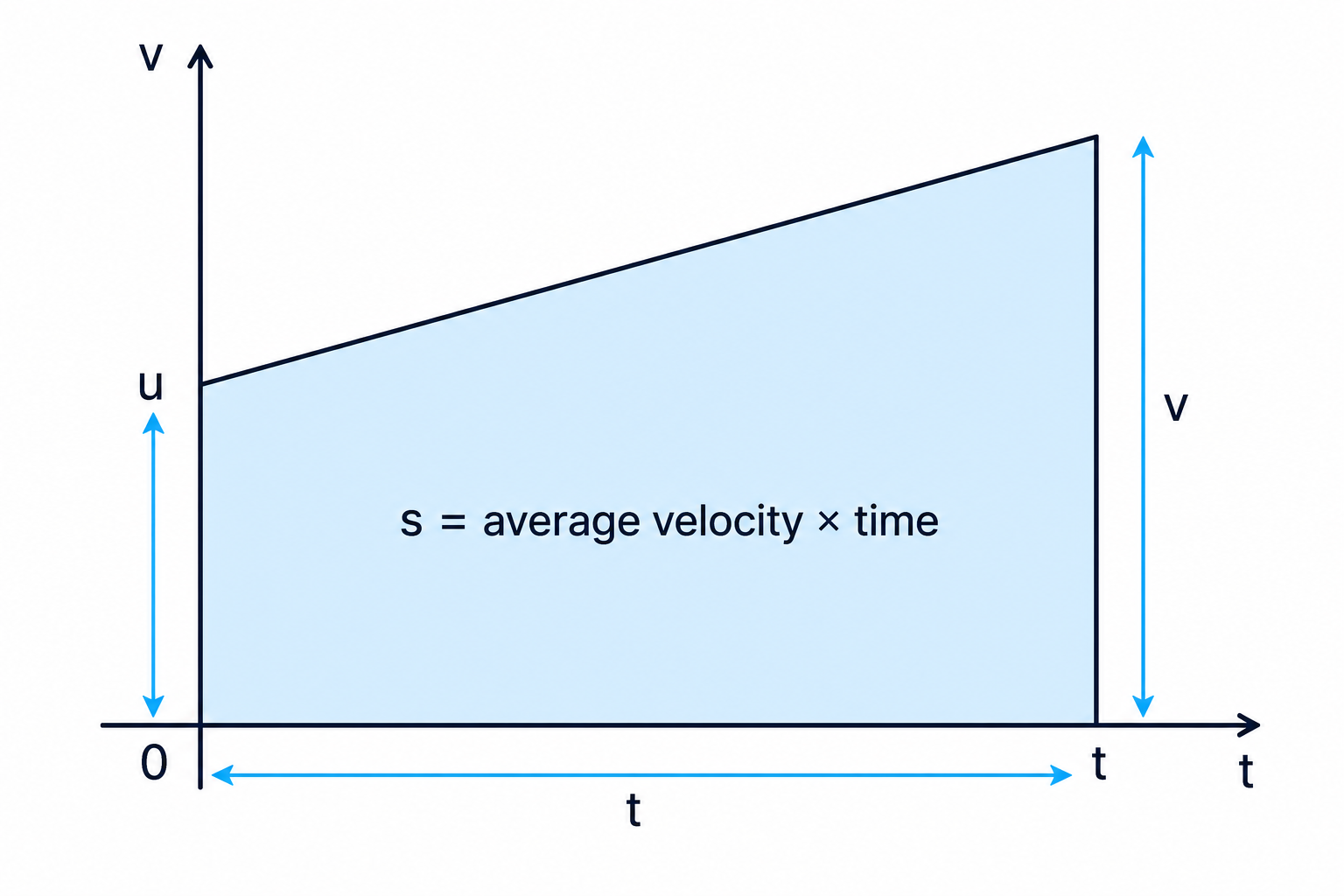
Some questions give distance, time and one speed. In that case, the average velocity formula is often quickest:
s=u+v2ts=\frac{u+v}{2}ts=2u+vtThis formula is valid because the velocity changes evenly when acceleration is constant.
Example
Using distance, time and final speed
A particle moves 96 m in 6 seconds. Its final velocity is 20 m s⁻¹. Find its initial velocity and acceleration.
-
Use s=u+v2ts=\frac{u+v}{2}ts=2u+vt because sss, vvv and ttt are known.
96=u+202×696=3(u+20)32=u+20u=12\begin{aligned} 96 &= \frac{u+20}{2}\times 6\\ 96 &= 3(u+20)\\ 32 &= u+20\\ u &= 12 \end{aligned}969632u=2u+20×6=3(u+20)=u+20=12 -
Use v=u+atv=u+atv=u+at to find aaa.
20=12+6a8=6aa=43\begin{aligned} 20 &= 12+6a\\ 8 &= 6a\\ a &= \frac{4}{3} \end{aligned}208a=12+6a=6a=34
Common Mistake
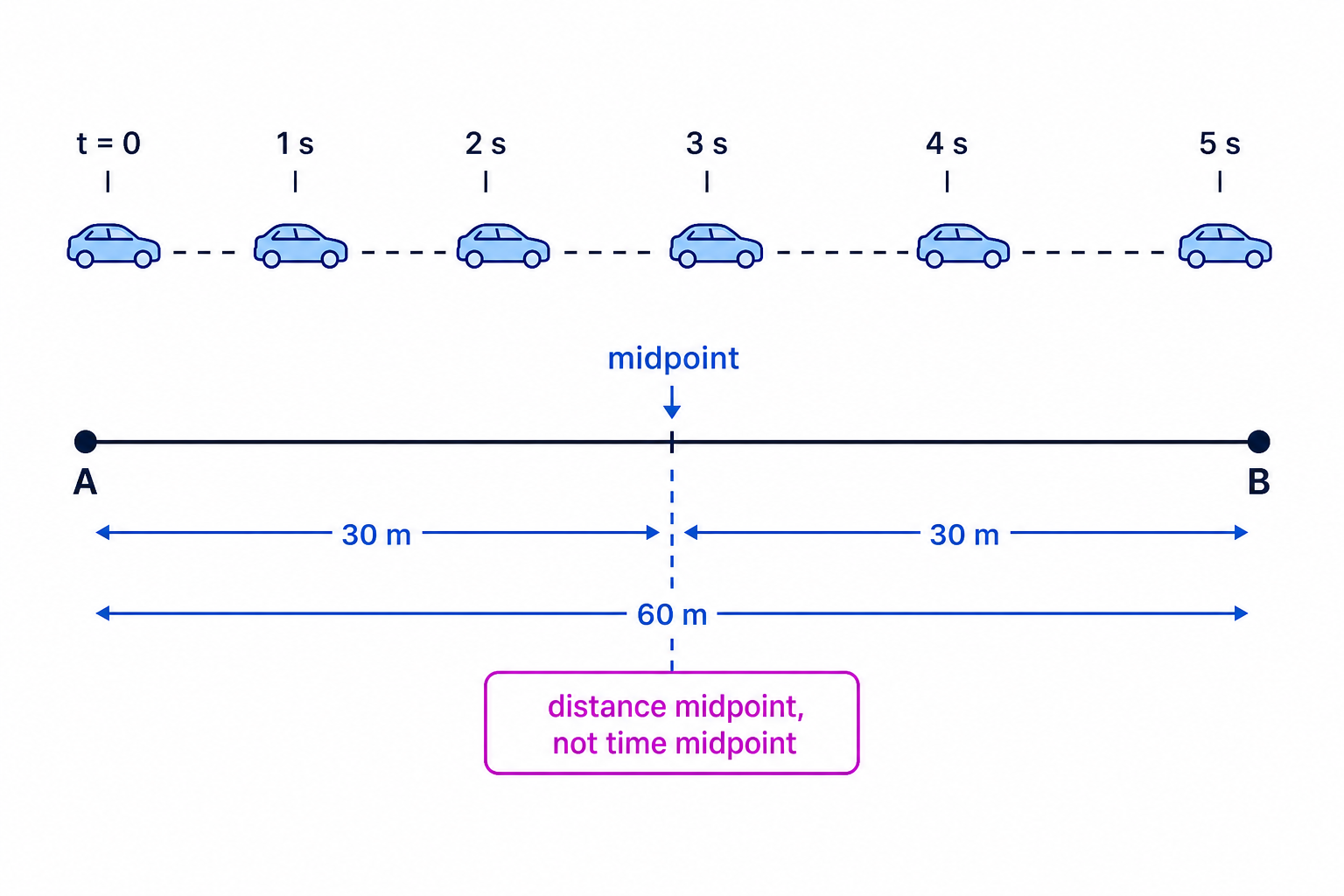
Midpoint does not mean half the time
With acceleration, the object covers unequal distances in equal time intervals. To find the time to a midpoint, first find the midpoint distance, then solve a SUVAT equation.
Example
Time to reach the midpoint
A car passes A at 4 m s⁻¹ and reaches B 6 seconds later at 16 m s⁻¹. The acceleration is constant. Find the time taken to reach the midpoint of AB.
-
Find the acceleration and total distance AB.
a=16−46=2AB=4+162×6=60\begin{aligned} a&=\frac{16-4}{6}=2\\ AB&=\frac{4+16}{2}\times 6=60 \end{aligned}aAB=616−4=2=24+16×6=60 -
The midpoint is 30 m from A.
s=30s=30s=30 -
Use s=ut+12at2s=ut+\frac{1}{2}at^2s=ut+21at2 and take the positive root.
30=4t+12(2)t230=4t+t20=t2+4t−30t=−2+34t≈3.83\begin{aligned} 30 &= 4t+\frac{1}{2}(2)t^2\\ 30 &= 4t+t^2\\ 0 &= t^2+4t-30\\ t &= -2+\sqrt{34}\\ t &\approx 3.83 \end{aligned}30300tt=4t+21(2)t2=4t+t2=t2+4t−30=−2+34≈3.83
4. Vertical motion under gravity
For vertical motion, choose a positive direction first. A common choice is upwards positive. Then gravity acts downwards, so the acceleration is negative.
The diagram shows a ball thrown upwards from above the ground, with upwards chosen as positive and gravity acting downwards.
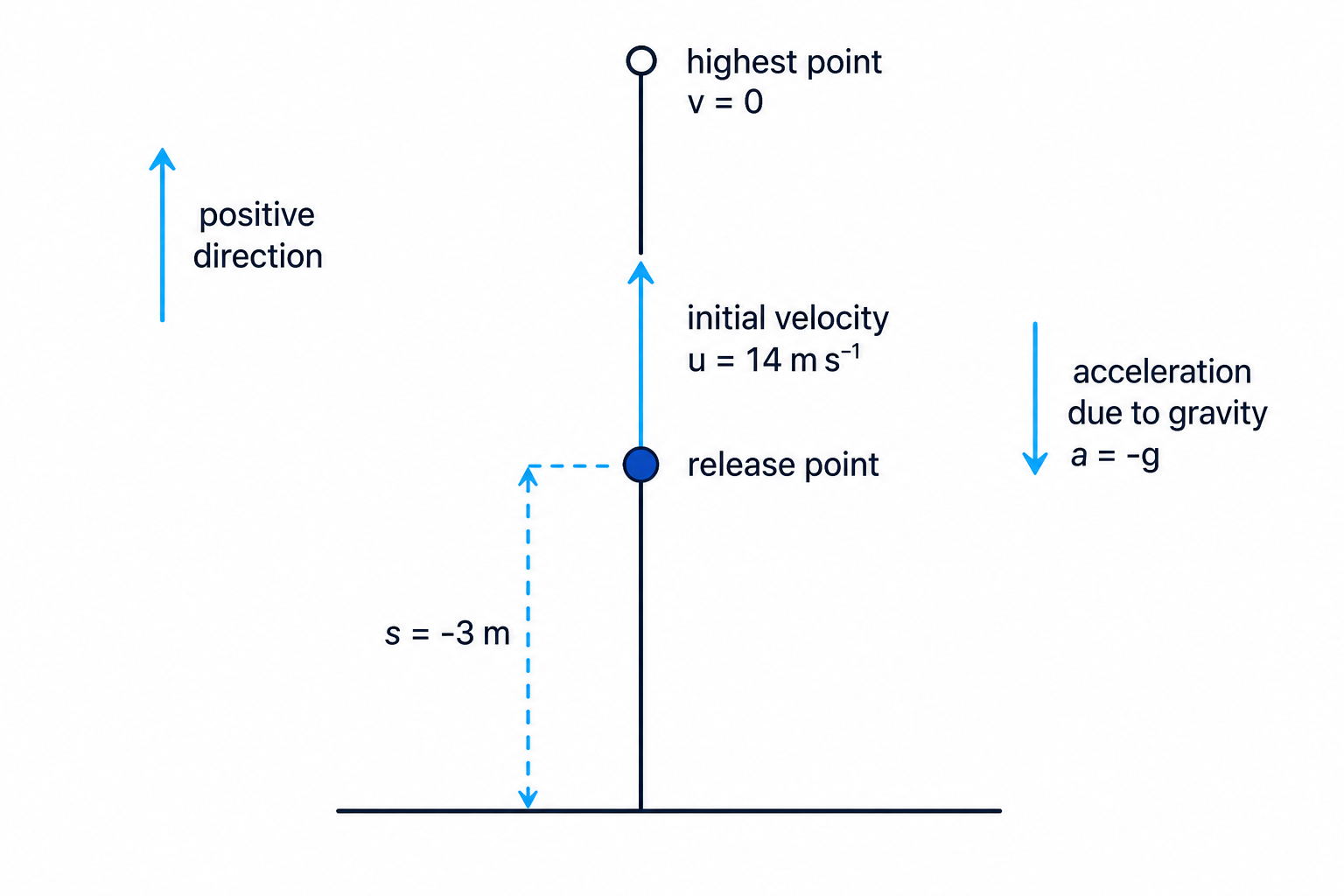
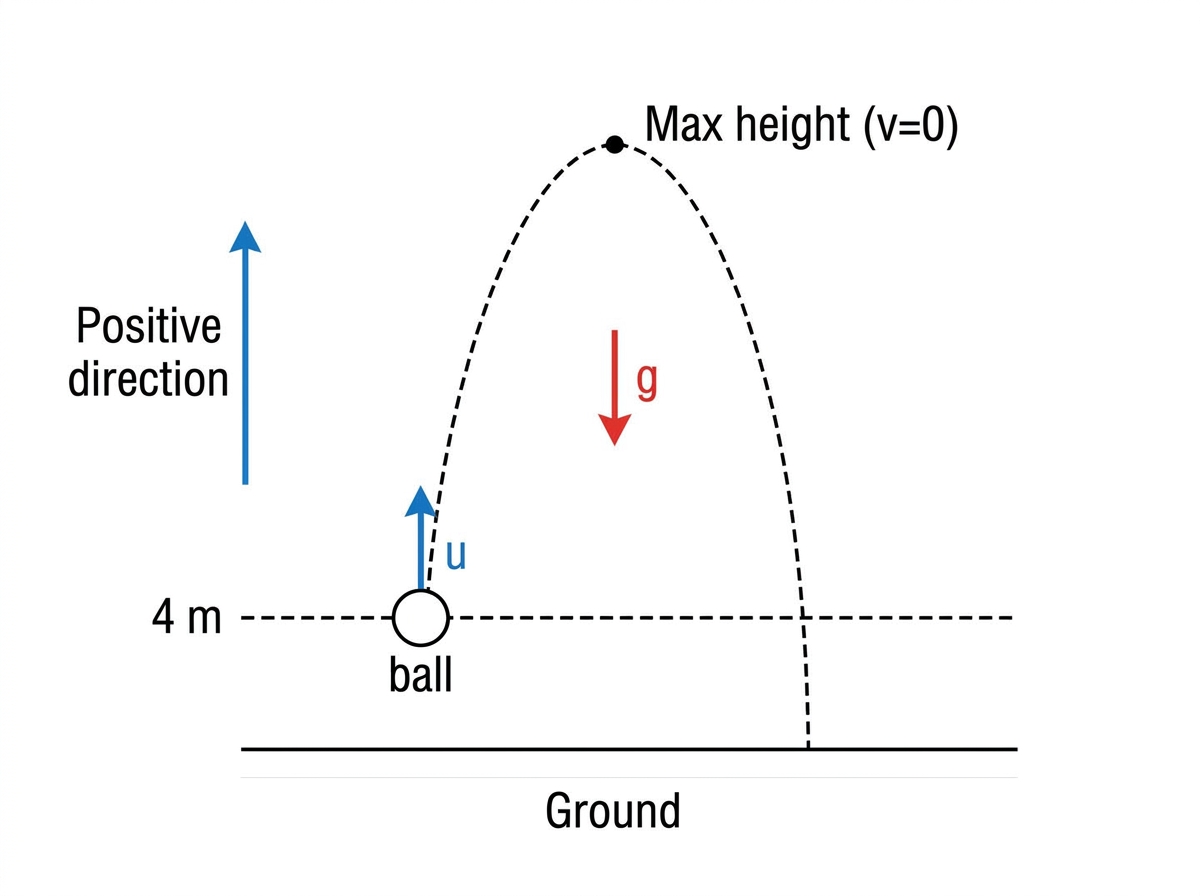
If a question says an object is moving freely under gravity, it means air resistance is ignored and the acceleration is constant. Use 9.8 m s⁻² unless the question states a different value, such as 10 m s⁻².
Common Mistake
Gravity signs
If upwards is positive, use a=−ga=-ga=−g. If downwards is positive, use a=ga=ga=g. Both choices work, but you must stay consistent.
Example
A ball thrown upwards from above the ground
A ball is thrown vertically upwards at 14 m s⁻¹ from a point 3 m above the ground. Take g=10g=10g=10. Find the greatest height above the ground, the time to hit the ground, and the impact speed.
-
Choose upwards as positive.
u=14,a=−10u=14,\quad a=-10u=14,a=−10 -
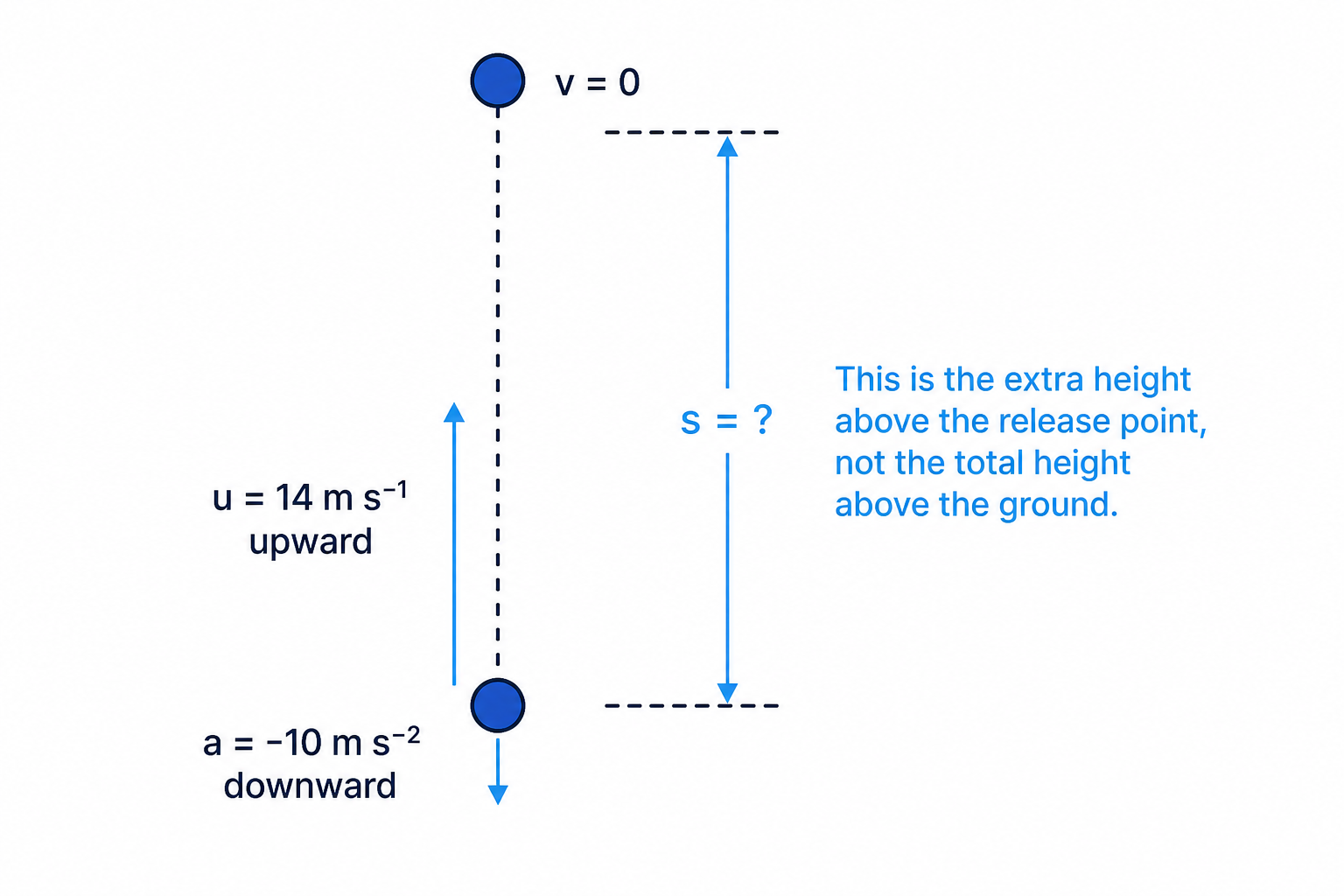
At the greatest height, the velocity is zero. Find the extra height above the release point.
$$
\begin{aligned}
v^2 &= u^2+2as\\
0^2 &= 14^2+2(-10)s\\
0 &= 196-20s\\
s &= 9.8
\end{aligned}
$$
3. Add the starting height of 3 m.
$$
H=3+9.8=12.8
$$
4. At the ground, the displacement from the release point is s=−3s=-3s=−3. Solve for TTT.
$$
\begin{aligned}
s &= ut+\frac{1}{2}at^2\\
-3 &= 14T-5T^2\\
5T^2-14T-3 &= 0\\
T &= 3
\end{aligned}
$$
5. Find the velocity at impact.
$$
v=u+at=14-10(3)=-16
$$
6. The negative sign means the ball is moving downwards, so the impact speed is 16 m s⁻¹.
5. Velocity-time graphs
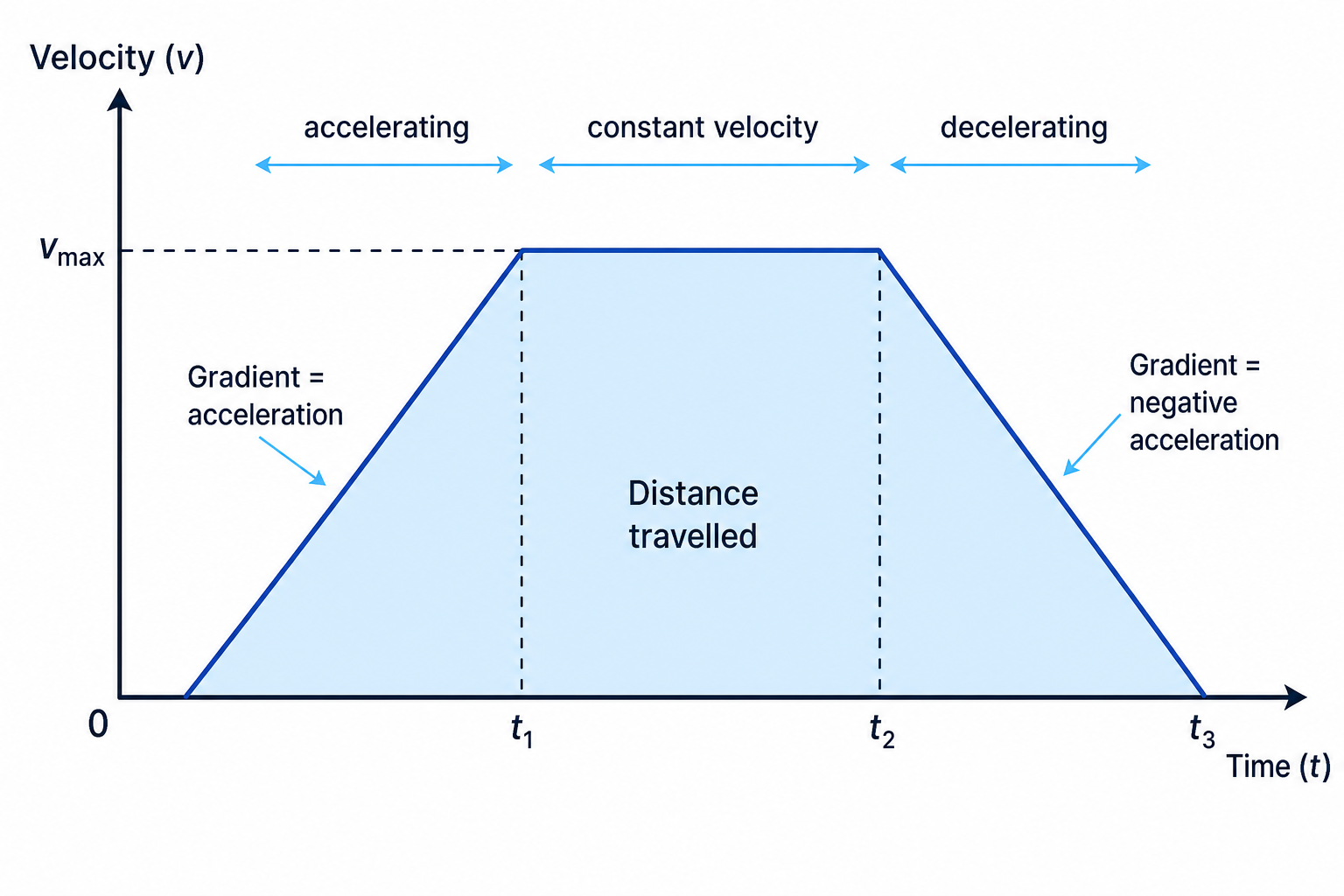
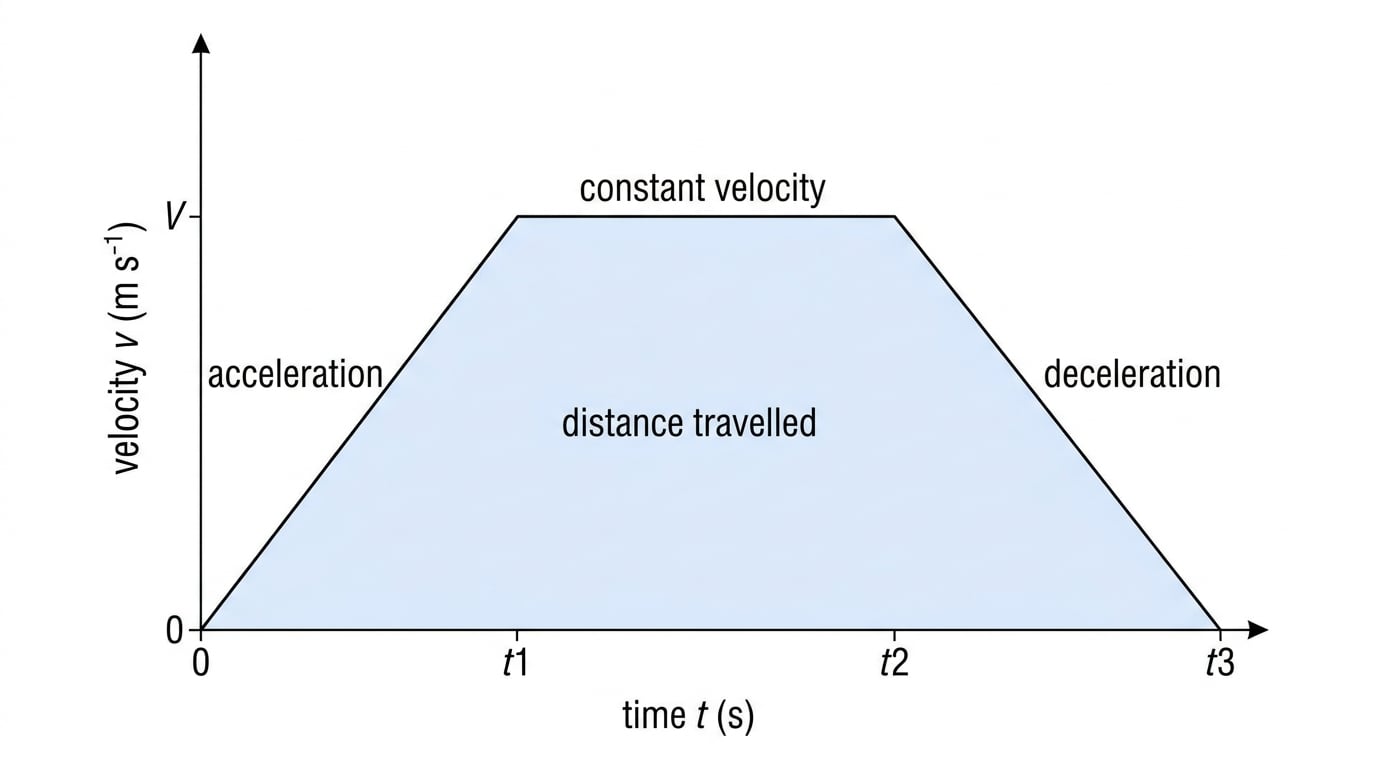
A velocity-time graph shows velocity on the vertical axis and time on the horizontal axis.
- The gradient is the acceleration.
- The area under the graph is the displacement.
- If the velocity is always positive, the area is also the distance travelled.
The graph below shows a typical train journey: accelerate, travel at constant velocity, then decelerate to rest. The shaded area represents the distance travelled.
Tip
Area units check
On a velocity-time graph, m s⁻¹ multiplied by seconds gives metres, so the area should have distance units.
Example
Train journey using a velocity-time graph
A train starts from rest and accelerates at 0.6 m s⁻² for 40 seconds. It then travels at constant velocity before decelerating at 0.4 m s⁻² to rest. The total distance is 3 km. Find the total time.
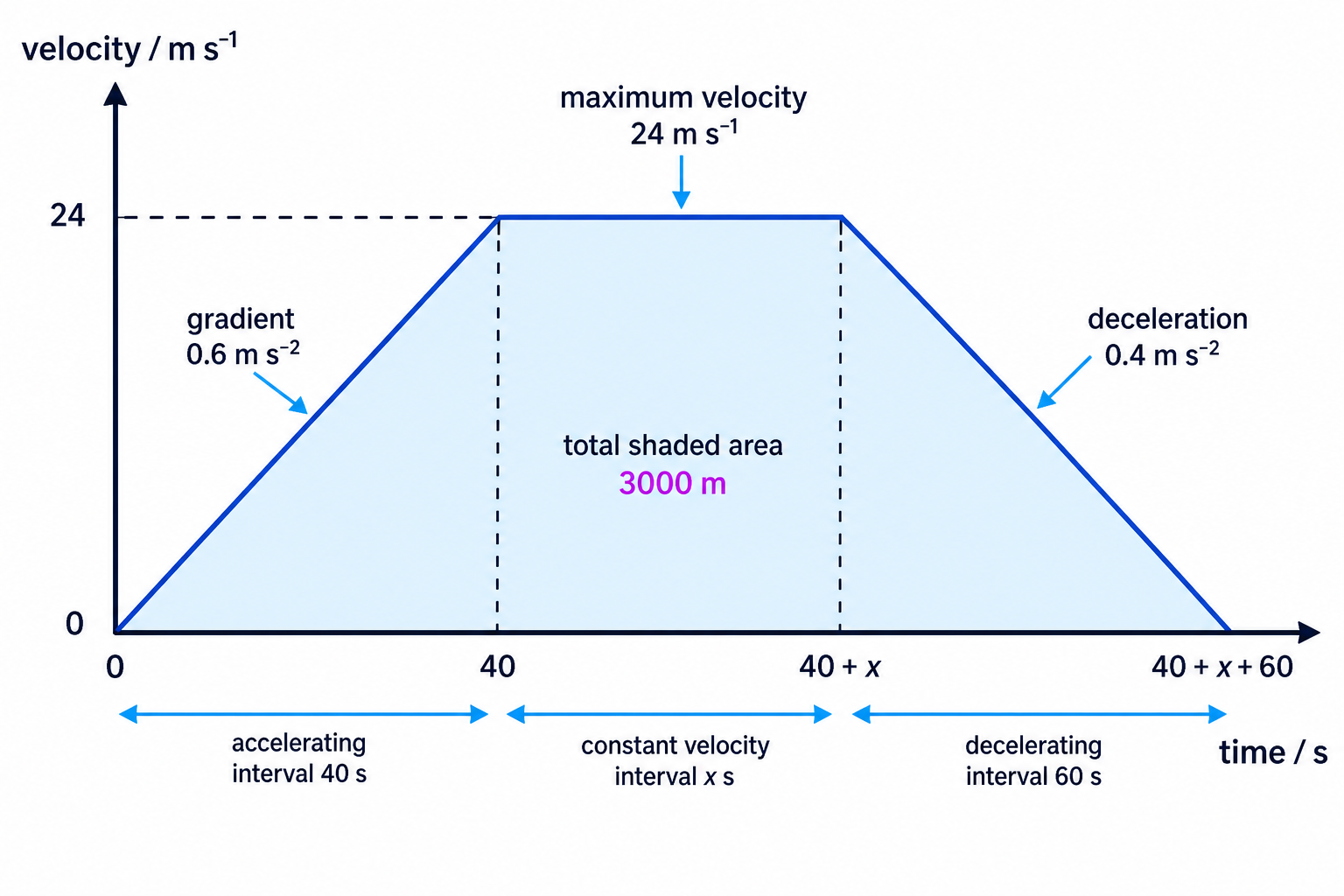
-
Find the maximum velocity.
v=u+at=0+0.6(40)=24v=u+at=0+0.6(40)=24v=u+at=0+0.6(40)=24 -
Find the time spent decelerating.
t=240.4=60t=\frac{24}{0.4}=60t=0.424=60 -
Convert 3 km to 3000 m, then find the two triangular areas.
accelerating area=12×40×24=480decelerating area=12×60×24=720\begin{aligned} \text{accelerating area} &= \frac{1}{2}\times 40\times 24=480\\ \text{decelerating area} &= \frac{1}{2}\times 60\times 24=720 \end{aligned}accelerating areadecelerating area=21×40×24=480=21×60×24=720 -
The remaining distance is covered at 24 m s⁻¹.
remaining distance=3000−480−720=1800constant speed time=180024=75\begin{aligned} \text{remaining distance} &= 3000-480-720=1800\\ \text{constant speed time} &= \frac{1800}{24}=75 \end{aligned}remaining distanceconstant speed time=3000−480−720=1800=241800=75 -
Add the three time intervals.
total time=40+75+60=175\text{total time}=40+75+60=175total time=40+75+60=175
Exam technique
In the exam
-
Write a SUVAT list before choosing a formula: sss, uuu, vvv, aaa, ttt.
-
Choose and state a positive direction for vertical motion; most sign errors come from mixing directions.
-
For velocity-time graphs, remember: gradient gives acceleration, area gives displacement.
Self review
Check yourself
- If an object is thrown upwards and upwards is positive, what sign should its acceleration have?
- Which SUVAT equation would you use if time is not involved?
- Why is the time to reach the midpoint of a journey not usually half the total time?

Recap questions
Test yourself with 5 quick questions on this guide. Answer them all correctly to complete it.
You've reached the end
Test yourself on this topic, or move on to the next guide.
How was this guide?