Revision notes for OCR AS Level Law Law reform. Open the guide for explanations and worked examples. Written against the OCR AS Level Law specification, so the content matches what's examinable rather than general Law background.
Law reform
What you'll learn
- How Parliament is influenced by politics, public opinion, media, pressure groups, lobbyists and the Law Commission.
- How the Law Commission researches and recommends changes to the law.
- Examples of Acts influenced by different reform pressures.
- How to evaluate the advantages and disadvantages of these influences in AO3 answers.
Starting point: what is law reform?
Definition
Law reform
Law reform means changing the law to improve it. This could involve creating a new Act of Parliament, amending an existing Act, simplifying old rules, or removing law that no longer works well.
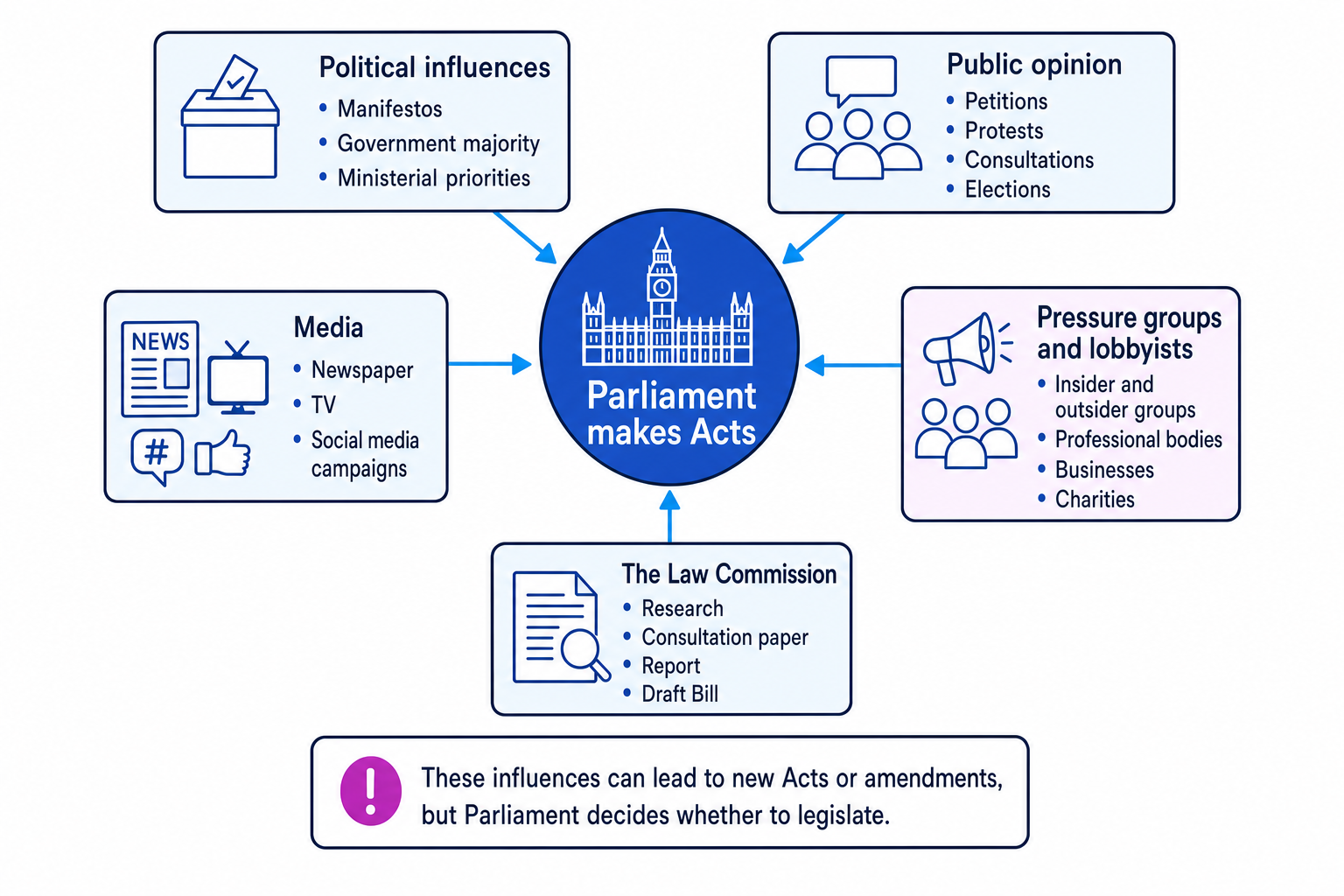
Parliament is the main body that makes primary legislation, meaning Acts of Parliament. But Parliament does not think of every reform idea by itself. Many outside influences push, persuade or inform Parliament.
Definition
Parliamentary sovereignty
Parliamentary sovereignty means Parliament has the legal power to make or unmake any law. Influences may be powerful, but they cannot themselves pass Acts of Parliament.
The key point is this: law reform is often a conversation between society, experts, pressure groups, the media and politicians — but Parliament makes the final legal decision.
Political influences
Definition
Political influence
Political influence means the effect of political parties, government priorities, election promises and ministers on the creation or amendment of laws.
Most successful Bills are introduced by the government because the government usually controls parliamentary time and, if it has a majority, can often get its proposals through the House of Commons.
Political influence often works through:
- Manifesto promises: policies promised before an election.
- Ministerial priorities: areas a government department wants to reform.
- Party ideology: political beliefs about issues such as crime, welfare, taxation or individual freedom.
- Major events: governments may legislate quickly after crises or public concern.
Examples include:
| Political influence | Act example | What changed |
|---|---|---|
| Labour government policy on rights protection | Human Rights Act 1998 | Incorporated many European Convention on Human Rights rights into UK law. |
| Conservative government policy after the Brexit referendum | European Union (Withdrawal) Act 2018 | Repealed the European Communities Act 1972 and retained much EU-derived law domestically. |
| Government focus on sentencing and criminal justice | Criminal Justice Act 2003 | Reformed sentencing, including the statutory purposes of sentencing in s142 Criminal Justice Act 2003. |
Key Idea
Politics matters because government controls the agenda
A reform idea is far more likely to become law if the government supports it, because government Bills usually receive priority in Parliament.
Public opinion
Definition
Public opinion
Public opinion means the views and attitudes of the general public on an issue, shown through elections, petitions, protests, consultations, polling or campaigning.
Public opinion can pressure MPs because MPs want to represent constituents and may want to be re-elected. If many people are concerned about a social issue, Parliament may respond by changing the law.
Examples include:
- Hunting Act 2004: strong public debate and campaigning contributed to Parliament banning hunting wild mammals with dogs, subject to exceptions.
- Marriage (Same Sex Couples) Act 2013: reflected changing public attitudes towards equality and legal recognition of same-sex relationships.
- Dangerous Dogs Act 1991: introduced after serious dog attacks and public concern, though it is often criticised as rushed law-making.
Common Mistake
Do not treat popularity as automatic proof of good law
A law may be popular but still be poorly drafted, unfair to minorities, or difficult to enforce. Public opinion is relevant, but it is not the same as legal expertise.
The media
Definition
Media influence
Media influence means the effect of newspapers, television, online news and social media on public debate and political pressure for legal change.
The media can shape which issues Parliament notices. A sustained campaign can make an issue politically difficult to ignore. Media influence often works by highlighting individual stories, exposing injustice, or framing an issue as urgent.
Examples include:
- Firearms (Amendment) Acts 1997: after the Dunblane school shooting, media coverage and the Snowdrop Campaign contributed to tighter handgun controls.
- Dangerous Dogs Act 1991: tabloid coverage of dog attacks helped create pressure for quick legislation.
- s33 Criminal Justice and Courts Act 2015: created the offence of disclosing private sexual photographs or films without consent, often called “revenge porn”, following public and media concern.
Media pressure can be useful because it brings hidden problems into the open. However, it can also lead to emotional or rushed law-making.
Pressure groups and lobbyists
Definition
Pressure group
A pressure group is an organised group that tries to influence law or government policy without seeking to become the government.
Definition
Lobbyist
A lobbyist is a person or organisation paid or organised to persuade politicians or officials to support a particular policy or legal change.
Pressure groups may be:
- Insider groups: regularly consulted by government because they have expertise, such as professional bodies.
- Outsider groups: groups that rely more on public campaigns, protests or media attention because they have less direct access.
Examples include:
| Group or campaign | Act example | Influence |
|---|---|---|
| Snowdrop Campaign | Firearms (Amendment) Acts 1997 | Campaigned for tighter handgun laws after Dunblane. |
| Stonewall and equality campaigners | Equality Act 2010 and Marriage (Same Sex Couples) Act 2013 | Campaigned for legal equality and anti-discrimination protections. |
| Business and consumer organisations | Consumer Rights Act 2015 | Contributed to debate on clearer consumer protection. |
Pressure groups can improve law-making because they provide specialist knowledge and represent people affected by the law. But they can also create unequal influence if wealthy organisations have more access than ordinary citizens.
Example
Identifying the strongest influence behind reform
A government introduces a Bill to regulate online scams after a charity gathers victim stories, newspapers run a major campaign, and a minister says the reform is now a government priority.
- Separate the influences. The charity is a pressure group, the newspapers are media influence, and the minister shows political influence.
- Assess which influence can actually move the Bill forward. The charity and newspapers create pressure, but the government controls most parliamentary time.
- Link the influences together. The pressure group and media may have persuaded the government, but political influence is likely the strongest immediate reason the Bill is introduced.
- Reach a balanced conclusion. The best answer would say the reform is politically driven, but triggered or strengthened by pressure group and media campaigning.
The Law Commission
Definition
Law Commission
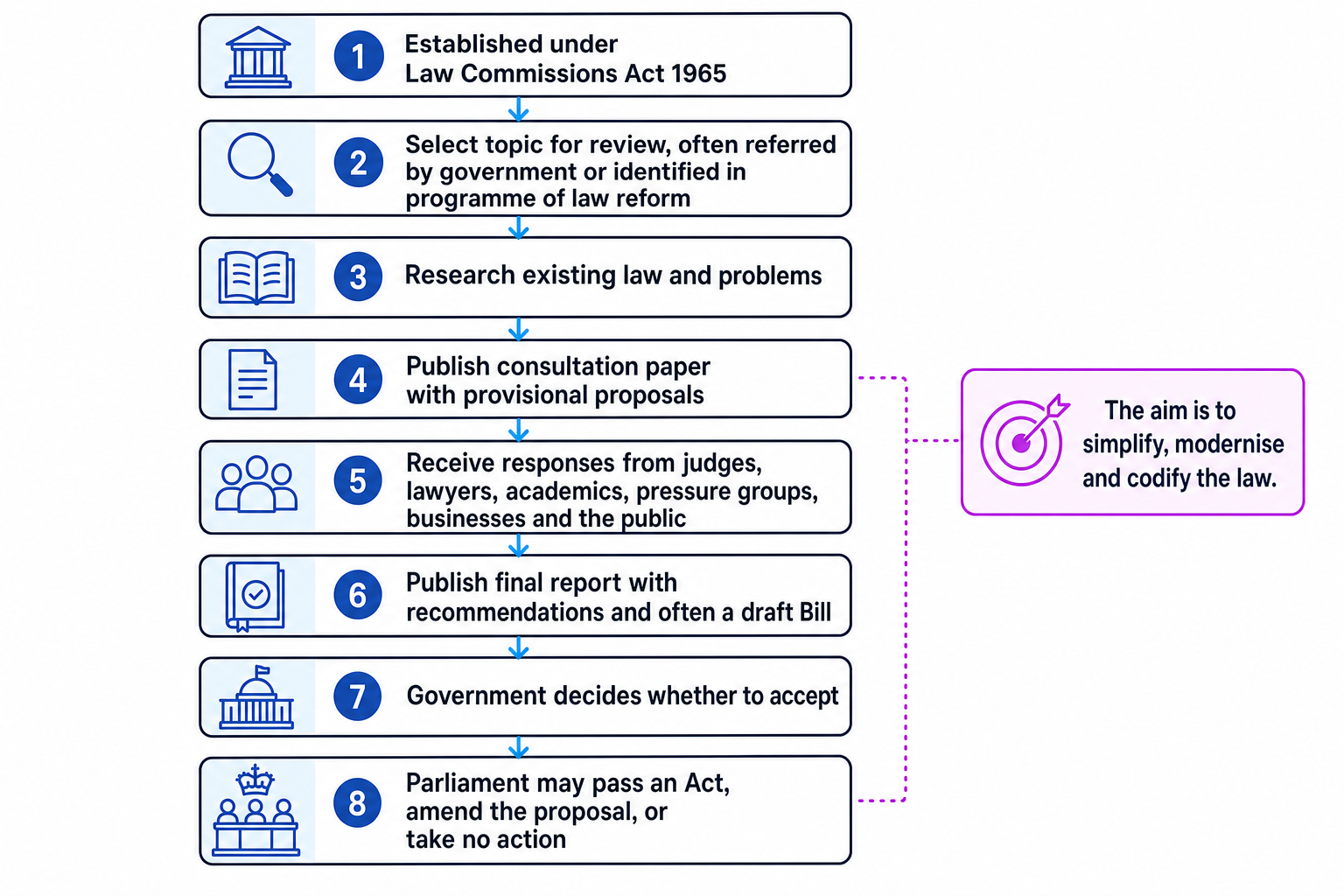
The Law Commission is an independent statutory body created by the Law Commissions Act 1965 to keep the law of England and Wales under review and recommend reform.
The Law Commission is made up of legally qualified Commissioners and specialist teams. Its role is not to campaign emotionally or politically, but to improve the law through research and consultation.
Its aims include making the law:
- Simpler: easier to understand.
- More modern: updated for current society.
- Fairer and more practical: removing problems in existing law.
- Codified where appropriate: bringing scattered rules into a clearer statutory form.
Definition
Codification
Codification means collecting legal rules from different sources and putting them into one organised statute or code.
The Law Commission’s power is influential rather than binding. It recommends reform, but the government and Parliament decide whether to act.
How the Law Commission reforms law
The usual process is:
- A topic is selected, often because the law is outdated, complex or unfair.
- The Commission researches the current law and identifies problems.
- It publishes a consultation paper, meaning a document setting out provisional ideas and inviting responses.
- It receives evidence from judges, lawyers, academics, businesses, pressure groups and the public.
- It publishes a final report with recommendations and often a draft Bill.
- The government decides whether to introduce legislation.
- Parliament may pass an Act, change the proposal, or do nothing.
Examples of Law Commission influence include:
| Law Commission reform area | Act example | Result |
|---|---|---|
| Fraud law was complex and outdated | Fraud Act 2006 | Created clearer fraud offences, including fraud by false representation. |
| Bribery law was fragmented | Bribery Act 2010 | Modernised bribery offences and created a corporate offence of failing to prevent bribery. |
| Liability to trespassers needed clarification | Occupiers’ Liability Act 1984 | Created a statutory duty owed by occupiers to some trespassers. |
| Consumer law needed clearer rights and remedies | Consumer Rights Act 2015 | Consolidated and updated consumer protection rules. |
Tip
Use Law Commission examples precisely
In essays, do not just say “the Law Commission changes the law”. Say it recommended reform, and Parliament later enacted legislation such as the Fraud Act 2006 or Bribery Act 2010.
Advantages of influences on law-making
Different influences can improve law reform in different ways.
Political influence: advantages
Political influence gives reform democratic legitimacy because governments are elected. Manifesto promises also let voters know what a party intends to do.
It can also make reform efficient. If a government strongly supports a Bill, it has a realistic chance of becoming law.
Public opinion: advantages
Public opinion helps law reflect current social values. For example, changing attitudes towards equality supported reforms such as the Marriage (Same Sex Couples) Act 2013.
It can also highlight real-world problems that legal professionals may overlook.
Media: advantages
The media can expose injustice quickly and make Parliament confront urgent issues. It can give a voice to victims and generate public awareness.
Pressure groups and lobbyists: advantages
Pressure groups may have specialist knowledge. For example, charities working with victims of domestic abuse can explain practical weaknesses in the law.
They can also represent groups who might otherwise be ignored.
Law Commission: advantages
The Law Commission is expert, independent and evidence-based. Its consultation process means reform is usually more careful than reform caused by panic or headlines.
It is especially useful for technical areas of law where public opinion alone may not identify the best solution.
Disadvantages of influences on law-making
Political influence: disadvantages
Political reform may be shaped by party advantage rather than legal principle. Governments may prioritise vote-winning issues over less popular but important reforms.
Public opinion: disadvantages
Public opinion can be emotional, temporary or based on incomplete information. If Parliament responds too quickly, the result may be flawed law, as critics argue happened with the Dangerous Dogs Act 1991.
Media: disadvantages
The media may sensationalise cases. This can encourage “knee-jerk” legislation: law made quickly in response to public pressure rather than careful evidence.
Pressure groups and lobbyists: disadvantages
Some groups have more money, access and professional lobbying power than others. This can make influence unequal.
There is also a risk that a pressure group represents a narrow interest rather than the wider public interest.
Law Commission: disadvantages
The Law Commission cannot force Parliament to act. Strong recommendations may be ignored if the government lacks time or political interest.
Its process can also be slow, especially where consultation and research take years.
Example
Evaluating a Law Commission proposal
Suppose the Law Commission recommends replacing several confusing old theft-related offences with one modern statute, but the government delays acting for years.
- Identify the advantage. The proposal is likely to be expert and evidence-based because the Law Commission researches the problem and consults affected groups.
- Apply the advantage to the facts. Replacing scattered offences with one statute could simplify the law and make it easier for courts, lawyers and the public to understand.
- Identify the disadvantage. The Law Commission only recommends reform; it cannot make Parliament pass the statute.
- Balance the evaluation. The Law Commission may produce high-quality reform, but its practical impact depends on political will and parliamentary time.
Key Idea
Best evaluation point
No influence is automatically good or bad. Strong AO3 answers compare expertise, democracy, speed, fairness and risk of bias, then decide which influence is most suitable for the type of reform.
Bringing it together
For OCR, you should be able to explain not just the names of the influences, but how they work.
A strong paragraph might look like this:
- Identify the influence.
- Explain the mechanism: election promise, consultation, campaign, lobbying, media pressure or expert report.
- Support it with a named Act.
- Evaluate one advantage or disadvantage.
For example, you could say that media influence can be powerful because sustained reporting can increase public pressure on MPs. The Firearms (Amendment) Acts 1997 followed major concern after Dunblane, supported by campaigning and media attention. This shows the media can help expose urgent problems, but it may also encourage emotional law-making if reform is rushed.
Exam technique
In the exam
- Use named Acts as evidence. For example, link the Law Commission to the Fraud Act 2006 or political influence to the Human Rights Act 1998.
- Explain the route of influence. Do not just name “media” or “pressure groups”; show how the influence reaches Parliament.
- Evaluate in pairs. For each advantage, add a matching disadvantage, such as expertise versus delay or democracy versus short-term popularity.
- Remember the final decision-maker. Influences can propose, pressure and persuade, but Parliament must pass the Act.
Self review
Check yourself
- Why can the Law Commission be described as expert but limited?
- Give one Act linked to media or public pressure and explain how that influence worked.
- What is one advantage and one disadvantage of pressure groups influencing law reform?

Keep learning
Make a free account to read the full revision notes and worked examples.