What you'll learn
- How sociologists define youth, youth culture, subculture and counterculture.
- Why youth cultures form, using functionalist, Marxist, interactionist, feminist and postmodern explanations.
- How to apply the topic to UK examples such as drill, grime, climate activism, online fandoms and moral panics.
- How to evaluate evidence and methods used to research young people.
Youth: more than an age category
In everyday life, “youth” often means people in their teens and early twenties. In sociology, we treat youth as a socially constructed stage of life. A social construction is an idea or category that is created and given meaning by society, rather than being fixed by biology alone.
For example, UK law gives different rights at different ages: you can consent to sex at 16, drive at 17, and vote in UK general elections at 18. This shows that “becoming adult” is not one simple biological moment.
Youth culture
Youth culture means the shared norms, values, styles, leisure activities and meanings associated with young people. Sociologists link it closely to socialisation, the process through which people learn the norms and values of their society, and identity, the way people understand who they are and how others recognise them.
Youth culture is also shaped by power and stratification. Stratification means structured inequality between social groups, such as class, gender, ethnicity and locality. Young people do not all experience youth in the same way.
Showing youth is socially constructed
- Compare age-related rules: a 16-year-old may legally work and consent to sex, but cannot vote in a UK general election.
- Identify the sociological point: society gives different meanings to “young person”, “child” and “adult” depending on the institution involved.
- Apply this to youth culture: because youth is socially defined, youth styles and expectations also vary across time, place, class, gender and ethnicity.
Treating young people as one group
Do not write as if all young people share one culture. Strong answers split youth by class, gender, ethnicity, locality, sexuality, disability and online access.
Culture, subculture and counterculture
Culture means a group’s shared way of life, including norms, values, language, symbols, beliefs and everyday practices. A norm is an expected pattern of behaviour; a value is a general belief about what is important or desirable.
A subculture is a smaller group within wider society with distinctive norms, values or styles. Examples might include goths, skaters, gamers, football ultras, K-pop fans, ravers, or climate activists.
A counterculture is a subculture that actively rejects or opposes dominant social values. Some political protest groups, punk movements or radical environmental groups may be understood this way.
The key distinction
A subculture is different from the mainstream; a counterculture is actively against the mainstream.
Sociologists often study youth style because clothes, music, slang, hairstyles and online content can act as symbols. A symbol is something that carries social meaning. For example, a hoodie might be seen by one young person as comfort or fashion, but by some media outlets as threatening.
Classifying a youth group
- Imagine a group of students who share music tastes, fashion, slang and TikTok trends.
- If they mainly use these to create belonging and identity, they are best described as a youth subculture.
- If they use these styles to reject dominant values, such as consumerism, capitalism or traditional authority, the label counterculture may fit better.
- If membership is loose, changing and based on lifestyle choices, a postmodern sociologist might call them a neo-tribe.
Why do youth cultures form?
Functionalist explanations
Functionalism is a consensus perspective which argues that society’s institutions generally work together to create order and stability. Functionalists see youth culture as a useful bridge between childhood and adulthood.
Parsons (1942) argued that youth culture can help young people move away from emotional dependence on the family and towards adult roles in work, relationships and citizenship. Eisenstadt (1956) similarly saw age groups as helping young people manage the transition into adult society.
Albert Cohen (1955) developed a related idea of status frustration, where working-class boys who cannot gain status through school may form alternative subcultures where different behaviours bring respect.
AO3 evaluation: functionalism is useful because it explains why youth culture may provide belonging. However, it can be too positive and may underplay conflict, inequality and the power of adults, schools, police and media to define young people as “problems”.
Marxist and neo-Marxist explanations
Marxism is a conflict perspective which argues that capitalist society is shaped by class inequality. Capitalism is an economic system based on private ownership, profit and wage labour.
Neo-Marxists at the Centre for Contemporary Cultural Studies, often called the CCCS, argued that many youth subcultures express resistance to class inequality. Hall and Jefferson (1976) described youth subcultures as forms of “resistance through rituals”. Hebdige (1979) argued that punk style used bricolage, meaning the reworking of ordinary objects into new meanings, such as safety pins becoming fashion statements.
Phil Cohen (1972) studied East London and argued that skinhead style was partly a response to working-class community change. The subculture symbolically recovered a lost sense of toughness, masculinity and local identity.
AO2 application: grime and drill can be analysed as forms of working-class and Black British cultural expression, reflecting experiences of policing, poverty, racism, exclusion and urban life. However, they can also become commercial products sold by the music industry.
AO3 evaluation: Marxist approaches are strong on class, capitalism and power. But they can romanticise resistance, as if every style choice is political. They were also often based on male street cultures, neglecting girls and private spaces.
Interactionism, labelling and moral panic
Interactionism is a micro-level approach that focuses on meanings created through social interaction. Interactionists ask how young people are labelled and how those labels affect identity.
Becker (1963) argued that deviance is not simply an act itself, but the result of social reactions. A label is a name or category attached to someone, such as “troublemaker”, “chav”, “gang member” or “snowflake”. If a label affects how someone sees themselves, it may become a self-fulfilling prophecy, where the prediction helps produce the behaviour it describes.
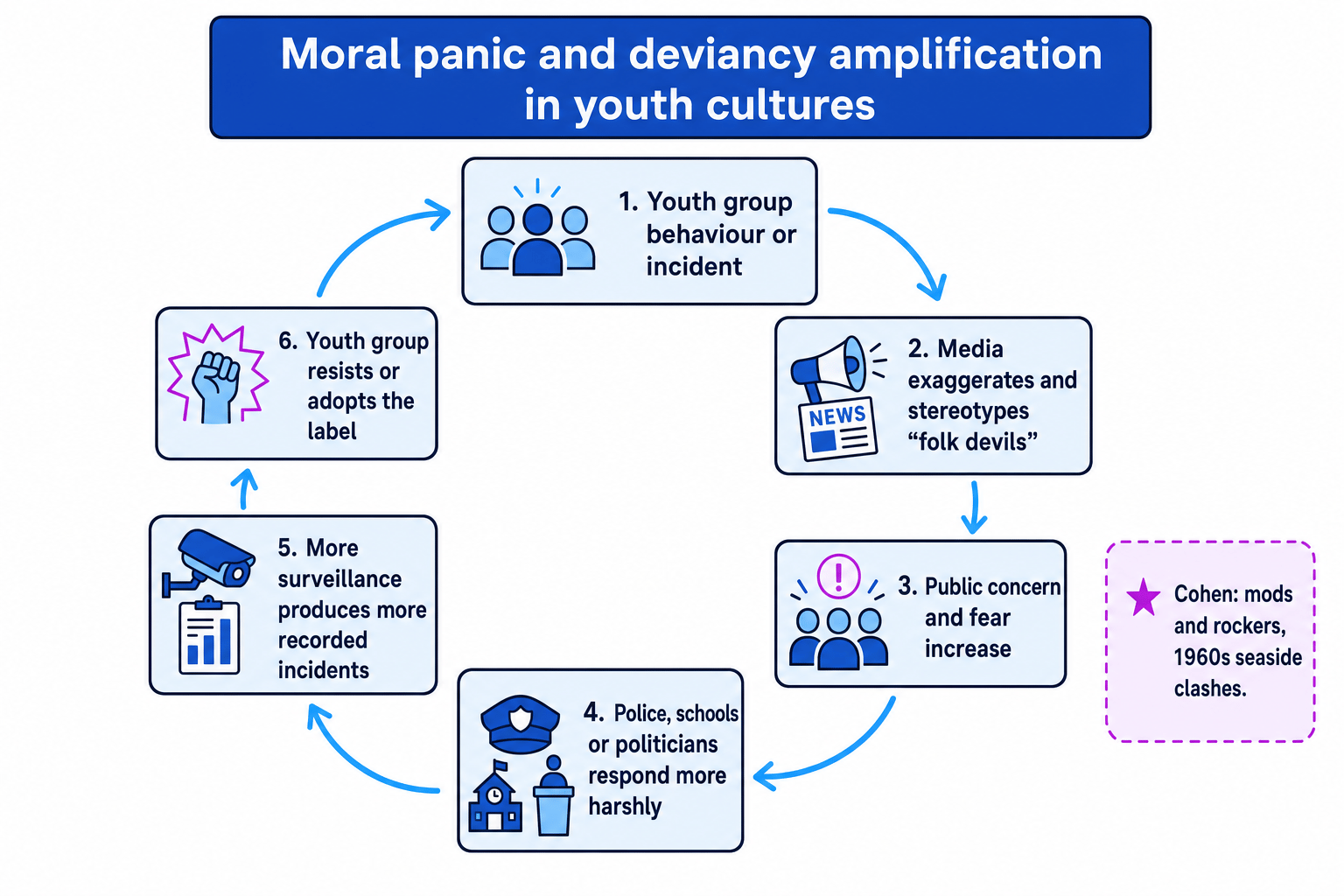
Stan Cohen (1972) studied the media reaction to mods and rockers in the 1960s. He developed the idea of a moral panic, a wave of exaggerated public concern about a group seen as a threat to social order. The targeted group becomes a folk devil, meaning a symbol of social danger.
The flow below shows how media attention can amplify, rather than simply report, youth deviance.
Analysing drill music and moral panic
- Identify the social reaction: some UK newspapers, politicians and police have linked drill music to knife crime and gang violence.
- Apply Cohen: drill artists may be constructed as folk devils if complex social problems are reduced to a threatening youth image.
- Add power: police requests to remove music videos from platforms show that adults and institutions have power to control young people’s cultural expression.
- Evaluate: interactionism explains labelling well, but it may underplay real harms or the material causes of violence, such as poverty, exclusion and local deprivation.
Feminist explanations
Feminism examines gender inequality and patriarchy, a social system in which men hold more power than women. Feminist sociologists criticised early youth studies for focusing too much on boys in public spaces.
McRobbie and Garber (1976) argued that girls were often absent from classic subcultural studies because researchers looked for spectacular street styles. Girls’ youth cultures were more likely to be based around bedrooms, magazines, friendship, romance, fashion and music. This does not mean they were unimportant; it means researchers were looking in the wrong places.
Today, feminist analysis can be applied to online beauty cultures, TikTok trends, gaming, lad culture, misogynistic influencers, and the policing of girls’ sexuality and appearance. Connell’s idea of hegemonic masculinity also helps explain why some male youth cultures reward toughness, heterosexual dominance or risk-taking.
AO3 evaluation: feminism improves the topic by showing that youth culture is gendered. However, the best feminist answers are also intersectional. Intersectionality, associated with Crenshaw (1989), means inequalities overlap, so a young Black working-class woman may experience youth differently from a middle-class white girl.
Postmodern explanations
Postmodernism argues that identities are more fluid, fragmented and chosen than in the past. Postmodernists are less likely to see youth subcultures as fixed class-based groups.
Maffesoli (1996) used the term neo-tribes for loose, temporary lifestyle groupings. Bennett (1999) applied this to youth culture, arguing that young people may move between scenes rather than belong permanently to one subculture. Thornton (1995) developed subcultural capital, meaning status gained through knowing the “right” music, brands, events or styles.
AO2 application: a young person might be into anime, gym culture, Afrobeats, vintage fashion, gaming and climate activism at the same time. Their identity may be built through Spotify, TikTok, Discord, Instagram and local friendship groups.
AO3 evaluation: postmodernism is very useful for online and consumer cultures. However, it can exaggerate choice. Not everyone has equal money, safety, mobility or digital access. Class, gender, ethnicity and locality still shape what identities are available and how they are judged.
A simple evaluation move
When evaluating postmodernism, write: “This captures fluid online identity, but it may understate continuing structural inequalities such as class, gender and racism.”
Researching youth cultures
Sociologists often use qualitative methods, which collect detailed data about meanings and experiences. Common methods include ethnography, where the researcher studies a group in its real social setting, and participant observation, where the researcher joins in with group life to observe behaviour.
Willis (1977) used ethnographic methods in Learning to Labour, studying working-class “lads” and their anti-school culture. He found that their resistance to school helped reproduce class inequality because it pushed them towards working-class jobs. Hodkinson (2002), studying goths, showed that some subcultures could be more stable and committed than postmodern theories suggest.
Researching young people raises practical, ethical and theoretical issues. Practical issues include access to schools, clubs, online spaces or friendship networks. Ethical issues include informed consent, confidentiality and avoiding harm, especially with under-18s. Theoretical issues include the trade-off between validity, meaning truthful depth, and reliability, meaning consistency and repeatability.
Choosing a method for studying online youth identity
- If your aim is to understand meanings, choose semi-structured interviews or digital ethnography rather than only a questionnaire.
- If the group is hard to access, snowball sampling may help because one participant can introduce others.
- Consider ethics: young people may need parental consent, usernames should be anonymised, and private online spaces should not be treated as automatically public.
- Evaluate the evidence: the data may be valid and detailed, but the sample may not be representative of all young people.
Pulling the topic together
Youth cultures are about much more than music or clothes. They show how young people create identity, how peer groups socialise members, and how wider inequalities shape cultural choices. They also reveal adult power: schools, police, parents, politicians and media organisations often define which youth styles are acceptable and which are threatening.
For Eduqas, strong answers usually combine AO1, AO2 and AO3: define the concept, apply it to a real or source-based example, then evaluate by comparing perspectives or questioning the evidence.
In the exam
- Start with a clear concept: youth culture, subculture, counterculture, moral panic, labelling, neo-tribe or patriarchy.
- Apply it to a specific example, such as mods and rockers, punk, goths, grime, drill, climate strikes, gaming communities or online fandoms.
- Evaluate by asking who has power, which inequalities matter, and whether the theory still fits contemporary UK youth cultures.
Check yourself
- Why do sociologists say youth is socially constructed rather than purely biological?
- How would a Marxist and a postmodernist explain the same youth style differently?
- What ethical issues might arise when researching young people’s online subcultures?
