What you'll learn
- How sociologists study globalisation, development and global inequality.
- The main theories: modernisation theory, dependency theory, world-systems theory, neoliberalism and feminist approaches.
- How to apply global ideas to UK examples, such as migration, supply chains, aid, climate change and media culture.
- How to evaluate evidence about the world using research-methods ideas like validity, reliability and representativeness.
What is world sociology?
World sociology is the study of social life beyond the level of one country. Instead of treating Britain, India, Nigeria or Brazil as separate “containers”, it asks how societies are linked through trade, migration, media, colonial history, debt, war, aid, climate change and global capitalism.
In Eduqas Component 3, this topic links especially strongly to power and stratification: who has wealth, status and decision-making power globally, and why?
Global inequality
Global inequality means unequal access to resources, life chances and power between people and countries across the world. It includes differences in income, health, education, security, political influence and environmental risk.
A useful phrase is Global North and Global South. This is a broad shorthand for richer, more powerful countries and poorer, less powerful countries. It is not purely geographical: Australia is in the southern hemisphere but usually counted as part of the Global North.
Avoid outdated labels
Be careful with terms like “Third World”. They can sound dated and imply that poorer countries are simply “behind”. More precise terms include high-income, middle-income and low-income countries, or Global North and Global South.
Globalisation: the starting point
Globalisation
Globalisation is the increasing interconnectedness of societies across the world, so that events, decisions and cultures in one place can quickly affect people elsewhere.
Globalisation has several dimensions:
- Economic globalisation: production, trade and finance operate across national borders. For example, a UK consumer may buy a phone designed in California, assembled in China, using minerals mined in the Democratic Republic of Congo.
- Cultural globalisation: music, fashion, food, religion, language and media circulate globally.
- Political globalisation: states are influenced by organisations such as the United Nations, World Bank, International Monetary Fund and World Trade Organization.
- Technological globalisation: digital platforms allow instant communication, but access is unequal.
Sociologists such as Giddens argue that globalisation stretches social relations across time and space. Beck links globalisation to a “risk society”, where problems such as climate change, pandemics and nuclear threats cross borders.
The big link
World sociology is not just about “other countries”. It is about how your everyday life in the UK is connected to global systems of production, culture, migration and inequality.
Applying globalisation to a fast-fashion purchase
-
A cheap item of clothing bought in the UK is not just a local consumer choice. Its production may involve cotton growers, textile workers, shipping companies, online platforms and UK-based retailers.
-
Economic globalisation helps explain how the retailer can separate design, manufacturing, transport and marketing across several countries to reduce costs and increase profit.
-
Cultural globalisation helps explain why fashion trends spread quickly through Instagram, TikTok, celebrities and global advertising.
-
Power and stratification matter because the greatest profits often go to brand owners and shareholders, while low-paid workers may face insecure conditions in the supply chain.
Development: more than money
Development
Development means improvement in people’s quality of life. It may include higher incomes, better health, education, gender equality, political freedom, environmental sustainability and security.
A simple economic measure is GDP per capita, the average economic output per person. However, this can hide inequality within a country. A country can become richer while many people remain poor.
A broader measure is the Human Development Index, often shortened to HDI. It combines income, education and life expectancy. It is useful because it shows development as more than money, but it still cannot capture everything, such as freedom from violence, discrimination or environmental harm.
Amartya Sen argues that development should be understood as expanding people’s capabilities: their real freedoms to live the kind of life they value.
AO2 application
When applying development, try to name the dimension you mean: income, health, education, gender equality, political freedom or environmental security. “Development” is too broad on its own.
Modernisation theory
Modernisation theory argues that poorer countries are less developed because they have not yet adopted the values, institutions and technologies associated with richer industrial societies.
Rostow described development as a series of stages, including “traditional society”, “take-off” and “high mass consumption”. In this view, poorer countries can develop through industrialisation, investment, education, aid, science, democracy and capitalist markets.
This theory often links development to cultural change. For example, it may argue that achievement, individualism, entrepreneurship and rational planning help economies grow.
Evaluation of modernisation theory
Modernisation theory is clear and optimistic: it suggests development is possible. It also helps explain why infrastructure, education and health systems can support economic growth.
However, dependency theorists criticise it as ethnocentric, meaning it treats Western capitalist societies as the model everyone else should copy. It can blame poorer countries for their own poverty while ignoring colonialism, slavery, unequal trade and exploitation.
Ethnocentrism
Ethnocentrism means judging other cultures by the standards of your own culture, often assuming your own way of life is superior or normal.
Dependency theory
Dependency theory argues that poorer countries are poor largely because richer countries have exploited them and continue to benefit from unequal global relationships.
Frank argued that underdevelopment is not a natural starting point. Instead, it is actively produced by colonialism, slavery, unequal trade and the extraction of resources. In simple terms, rich countries became rich partly because poor countries were made poor.
Dependency theory often uses the idea of neo-colonialism.
Neo-colonialism
Neo-colonialism means indirect control over poorer countries after formal colonial rule has ended, through debt, trade rules, military pressure, aid conditions, transnational corporations or international institutions.
Evaluation of dependency theory
Dependency theory is strong for highlighting power, history and exploitation. It is useful for analysing colonial legacies and the way global capitalism can transfer wealth from poorer regions to richer ones.
But critics say it can be too deterministic. Some countries, such as South Korea or Singapore, have industrialised rapidly, which suggests that poorer countries are not always permanently trapped. Dependency theory may also underplay internal factors such as corruption, civil conflict, gender inequality or state policy.
Evaluating a claim about aid and development
-
If someone claims “aid causes development”, first specify the type of development. Aid might improve vaccination rates or girls’ education without immediately increasing national income.
-
Modernisation theory would see aid as useful if it provides capital, technology, expertise and infrastructure for “take-off”.
-
Dependency theory would ask whether the aid creates dependency, benefits donor countries, opens markets for foreign companies, or comes with political conditions.
-
A balanced judgement is that aid can support development when it is locally controlled and long-term, but it is unlikely to solve global inequality if trade, debt and corporate power remain unequal.
Wallerstein’s world-systems theory
Wallerstein developed world-systems theory, which sees the world as one capitalist system divided into three broad zones:
- Core countries: wealthy, powerful countries with advanced industries, finance, technology and political influence.
- Periphery countries: poorer countries often supplying cheap labour, raw materials and primary commodities.
- Semi-periphery countries: countries with mixed features, which may be exploited by the core but also exploit the periphery.
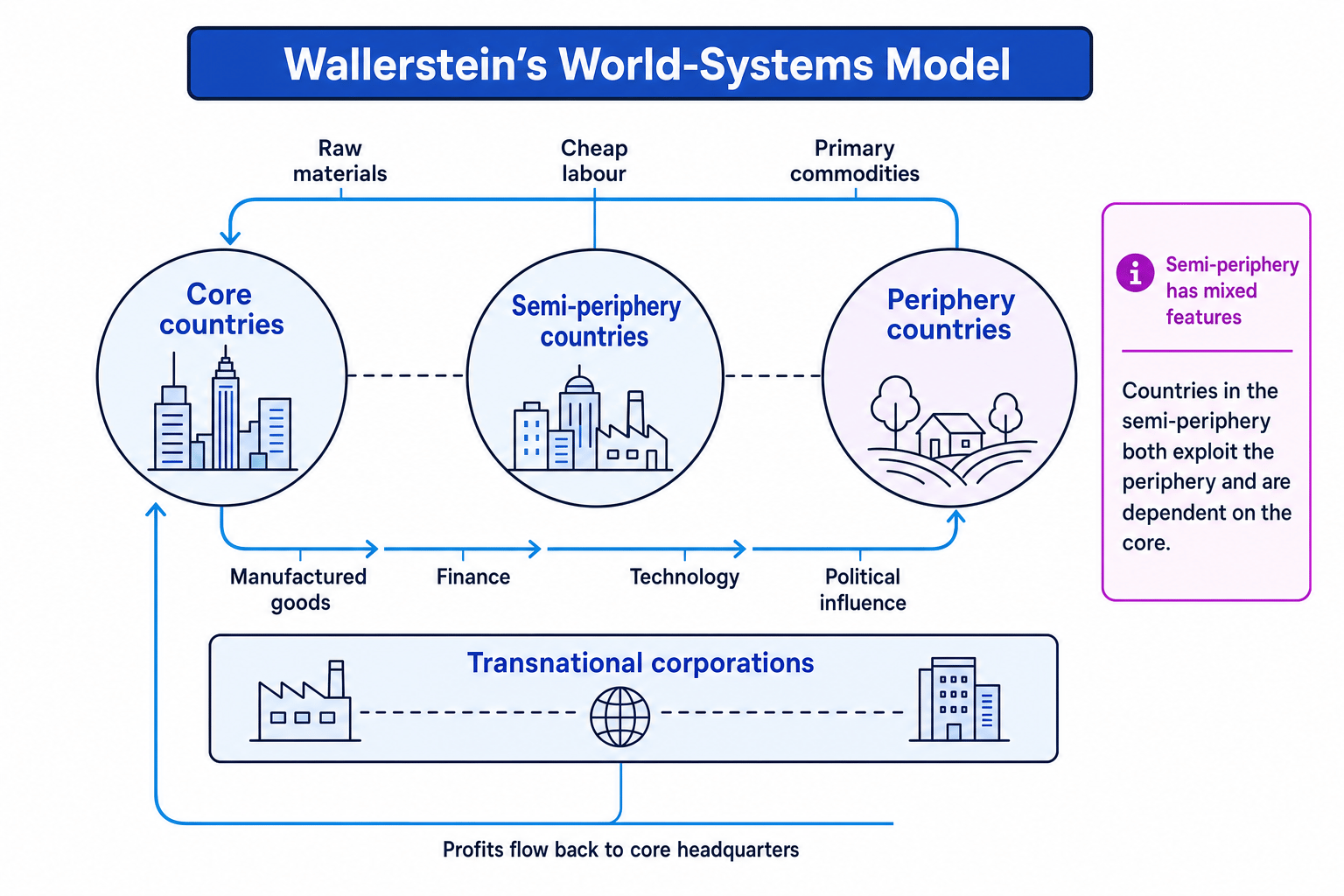
The UK is usually analysed as part of the core because of its financial sector, global political influence, universities, military alliances and high-value service industries.
Core-periphery power
World-systems theory is useful because it shows that global inequality is relational: some places are powerful partly because other places are kept in lower-value roles.
Applying world-systems theory to a smartphone supply chain
-
Identify where value is created and captured. Minerals may be mined in poorer regions, components manufactured in industrialising economies, and branding, finance and design controlled by firms in richer countries.
-
Classify the roles. The country hosting the headquarters and patents fits the core role; large manufacturing economies may fit the semi-periphery; raw-material suppliers may fit the periphery.
-
Analyse power. The core often captures more profit through intellectual property, finance, marketing and ownership, even if physical production happens elsewhere.
-
Evaluate the model. It may oversimplify, because some semi-periphery countries gain jobs, skills and infrastructure, and may move into higher-value industries over time.
Neoliberalism and global capitalism
Neoliberalism
Neoliberalism is an economic and political approach that favours free markets, privatisation, reduced state intervention, deregulation and global free trade.
Neoliberal policies are often linked to international institutions such as the IMF and World Bank. In the 1980s and 1990s, some poorer countries received loans with structural adjustment programmes, which required cuts to public spending, privatisation and opening markets to foreign competition.
Supporters argue that free trade attracts investment, creates jobs and increases efficiency. Critics argue that it can reduce welfare, weaken workers’ rights and make poorer countries vulnerable to powerful transnational corporations.
Transnational corporation
A transnational corporation, or TNC, is a company that operates in more than one country. Examples include Apple, Shell, Nike, Amazon and Nestlé.
Feminist approaches to world sociology
Feminist sociologists argue that global inequality is gendered. Women and girls are often more affected by poverty because of unpaid care work, unequal access to education, gender-based violence, early marriage and lower-paid work.
This links world sociology to patriarchy, a system of male dominance in social institutions and everyday life. Global capitalism may rely on women’s low-paid labour in garment factories, domestic work, agriculture and care work.
However, feminist analysis also highlights women’s agency. Campaigns for girls’ education, reproductive rights, land ownership and political representation can transform development outcomes.
Gender and development
Development is not only about national wealth. A country can grow economically while women remain excluded from education, safety, property rights and political power.
Culture, identity and globalisation
World sociology also connects to socialisation, culture and identity. Global media can spread similar brands, celebrities and lifestyles across the world. This is sometimes called cultural homogenisation, where cultures become more alike.
However, cultures do not simply become identical. Hybridisation means global and local cultures mix to create new forms. For example, British Asian music, Afrobeat’s global popularity, K-pop fandoms in the UK, and local versions of global food chains show that people adapt global culture rather than passively absorbing it.
Glocalisation means global products are adapted to local cultures. A fast-food chain may sell different menus in India, Japan, the UK and Saudi Arabia.
Do not treat culture as one-way Americanisation
American media and corporations are powerful, but global culture also flows from South Korea, Nigeria, India, Brazil, Japan and many other places. Evaluation improves when you show two-way or multi-directional cultural flows.
Researching world sociology
World sociology often uses secondary data, which means data already collected by others. Examples include United Nations reports, World Bank data, census data, NGO reports, government statistics and academic comparative studies.
This raises research-methods issues:
- Practical issues: global data is often easy to access online, but countries may collect data in different ways, making comparison difficult.
- Ethical issues: researching poverty, migration, war or exploitation can involve vulnerable groups, so confidentiality, informed consent and avoiding harm matter.
- Theoretical issues: positivists may value large-scale statistics for reliability and comparison, while interpretivists may prefer qualitative research for validity and lived experience.
Validity and reliability
Validity means whether research measures what it claims to measure. Reliability means whether research could be repeated and produce consistent results.
Official statistics may appear objective, but they can reflect political choices. For example, how a state defines unemployment, poverty or migration affects what the numbers show. Some countries also have weaker administrative systems, so data may be incomplete.
Methods link
In essays, you can evaluate global data by asking: Who collected it? For what purpose? How was the sample defined? Are countries being compared fairly? What voices are missing?
Pulling the topic together
World sociology is strongest when you connect three threads:
- AO1 knowledge: theories, concepts and named sociologists such as Rostow, Frank, Wallerstein, Giddens, Beck and Sen.
- AO2 application: real examples, such as UK consumption, migration, supply chains, foreign aid, climate change, pandemics, global media or TNCs.
- AO3 evaluation: compare perspectives, weigh evidence, challenge assumptions and consider contemporary relevance.
In the exam
-
Define key terms early, especially globalisation, development, global inequality, dependency and world-systems theory.
-
Apply theories to concrete examples: UK fast fashion, smartphones, NHS migrant labour, climate change, aid, debt, global media or TNC supply chains.
-
Evaluate by comparing perspectives: modernisation focuses on internal change, dependency focuses on exploitation, world-systems theory focuses on global structure, and feminist approaches highlight gendered power.
Check yourself
- How would a modernisation theorist and a dependency theorist explain poverty in a low-income country differently?
- Why might GDP per capita be a limited measure of development?
- How could a UK consumer be connected to global inequality through everyday purchases?
