What you'll learn
- How sociologists define religion and why definitions matter.
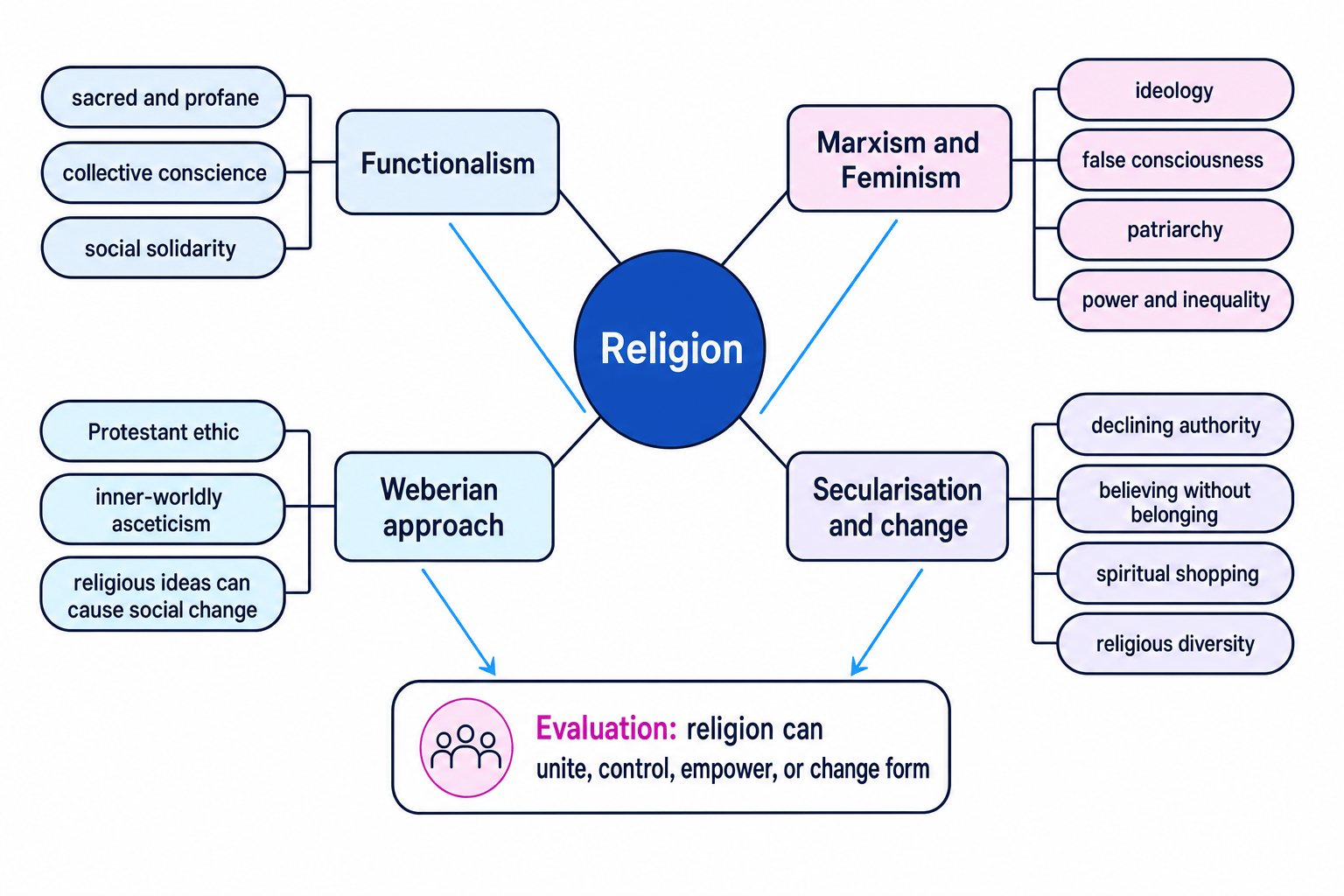
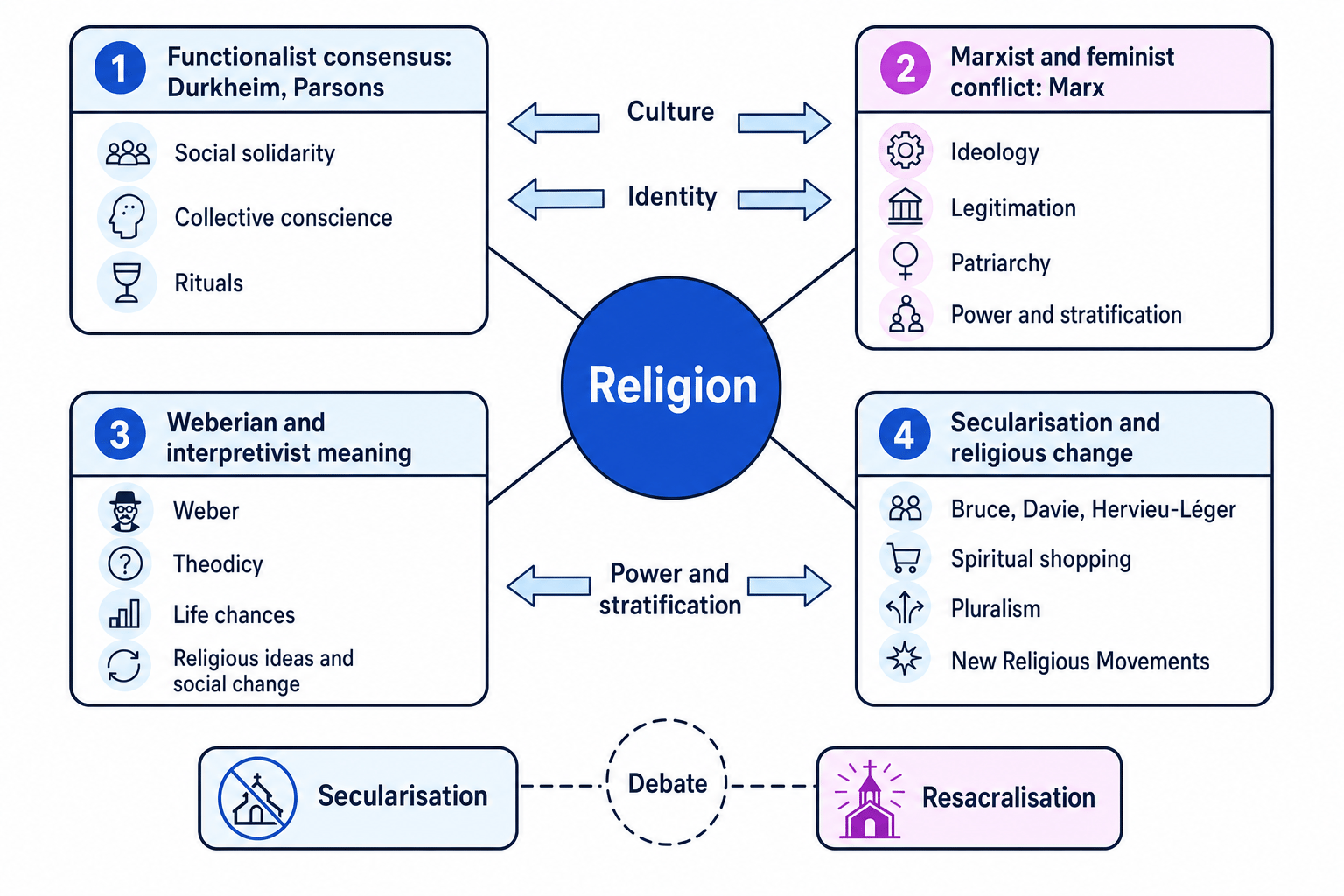
- How functionalists, Marxists, feminists, Weberians and postmodernists explain religion.
- Whether religion is declining in social importance — secularisation — or simply changing form.
- How to apply religion to socialisation (learning norms and values), culture and identity, and power and stratification.
Why sociologists study religion
In this Section C option, you study religion as a social institution: an organised part of society that shapes people’s beliefs, practices, identities and relationships. Sociologists are not trying to prove whether religious beliefs are “true”. They ask what religion does socially: how it creates belonging, justifies power, supports identity, challenges inequality, or changes over time.
Religion
Religion is usually understood as a system of beliefs, practices, symbols and organisations concerned with the sacred, the supernatural, ultimate meaning, or moral order.
The big debate is not simply “religion matters” versus “religion does not matter”. A stronger answer asks: for whom, in what setting, and in what way does religion matter?
Defining religion
Substantive definitions
A substantive definition defines religion by what it contains, such as belief in God, gods, spirits, or the supernatural. This is clear and easy to measure, but it can exclude non-theistic traditions such as some forms of Buddhism.
Functional definitions
A functional definition defines religion by what it does for people or society. Durkheim saw religion as creating social solidarity, meaning a sense of unity and shared belonging. This is useful because it includes rituals and meaning-making, but it can become too broad: football, nationalism or celebrity culture might start to look “religious”.
Social constructionist definitions
A social constructionist definition asks how people themselves define something as religious. This is useful in a diverse society because it takes meanings seriously, but it can make comparison harder.
Classifying a borderline case
A mindfulness group meets weekly, uses candles and chanting, and talks about “inner energy”, but members say it is not religious.
- A substantive approach asks whether the group involves supernatural beliefs or sacred beings. If not, it may not count as religion.
- A functional approach asks whether the group provides ritual, meaning and community. It may count as religion-like because it performs some religious functions.
- A social constructionist approach asks how members label it. If they call it wellbeing rather than religion, the sociologist studies that boundary-making instead of imposing one fixed answer.
Reducing religion to church attendance
Church attendance is only one measure of religion. Sociologists also examine belief, identity, private prayer, festivals, online religion, faith schools, charities, political influence and family socialisation.
Functionalism: religion as social glue
Functionalists see society as a system whose parts work together. Durkheim (1912) argued that religion divides the world into the sacred — things treated as special and set apart — and the profane — ordinary everyday life. Through rituals, people worship society itself, strengthening the collective conscience, the shared norms and values that bind a community.
Parsons (1951) argued that religion gives meaning at moments of uncertainty, suffering and death. Malinowski also saw religion as helping people cope with life crises.
In the UK, functionalist ideas can be applied to royal funerals, Remembrance Sunday, Christmas services, local mosque communities, Sikh gurdwaras offering langar, and faith-based charities. These can create belonging and moral guidance.
Applying Durkheim to Remembrance Sunday
- Identify the sacred symbols: poppies, the Cenotaph, silence and ceremonial rituals are treated as special rather than ordinary objects or actions.
- Link the ritual to social solidarity: people gather physically or through media coverage, producing shared emotion and a sense of national memory.
- Add evaluation: a conflict theorist would ask whose version of the nation is being remembered, and whether all groups feel equally included.
Functionalist takeaway
For functionalists, religion helps society cohere by creating shared meanings, rituals and moral boundaries — but this can underplay conflict, exclusion and inequality.
Conflict approaches: religion and power
Conflict theories focus on inequality. Marx (1844) famously described religion as the “opium of the people”. He meant that religion can comfort the oppressed while also discouraging them from challenging capitalism. In Marxism, ideology means ideas that support the interests of the powerful, while false consciousness means misunderstanding the real causes of inequality.
Religion may legitimate power by teaching that social order is natural, deserved, or God-given. For example, if poverty is framed as part of a divine plan, people may be less likely to demand structural change.
Feminists focus on patriarchy, a system of male power. Many religions have historically restricted women’s authority, controlled sexuality, and represented God or religious leadership in male terms. However, evaluation matters: religion can also give women community, leadership and resistance. The Church of England approved women bishops in 2014, and many women are active organisers in churches, mosques, temples and gurdwaras.
Analysing religion as power
A faith organisation runs food banks and teaches obedience to traditional authority.
- A Marxist analysis notes that charity may reduce suffering while leaving wider class inequality untouched.
- A feminist analysis asks whether leadership, teaching and expectations are gendered, for example whether women do caring work while men hold formal authority.
- A balanced evaluation recognises agency: believers may use religion to challenge injustice, not just accept it.
Weber: religion can create social change
Weber (1905) disagreed with simple versions of Marxism because he argued that religious ideas can help produce economic and social change. In The Protestant Ethic and the Spirit of Capitalism, Weber linked Calvinist Protestantism to early capitalism. Ideas such as a “calling”, discipline and inner-worldly asceticism — self-control while living in the world — encouraged hard work and reinvestment.
Weber also used theodicy to mean religious explanations for suffering and inequality. These explanations can shape people’s identity and life chances.
AO3 evaluation: Weber shows religion is not always conservative, but capitalism also developed in places with different religious traditions, so religion is only one factor among many.
Secularisation and religious change
Secularisation
Secularisation means the declining social significance of religion, especially in public institutions, personal belief, religious practice and moral authority.
Wilson and Bruce argue that Britain has become more secular. They point to falling church attendance, fewer religious weddings, declining clerical authority, and the growth of scientific and rational explanations. Social differentiation also matters: institutions such as education, law, welfare and medicine increasingly operate separately from religious control.
AO2 evidence must be used carefully. In the England and Wales Census 2021, “Christian” fell to 46.2%, while “no religion” rose to 37.2%. This supports secularisation, but it measures self-identity, not how often people pray, attend worship, or believe in God.
Census evidence has limits
Census categories are useful official statistics, but they are broad self-identification measures. They do not fully capture private belief, mixed identity, spirituality, or intensity of practice.
Davie (1994) challenged simple decline with the phrase believing without belonging: people may believe but not attend organised religion. Hervieu-Léger argued that modern people engage in spiritual shopping, choosing beliefs and practices rather than inheriting one tradition. Postmodernists such as Lyon link this to consumer culture, media and identity choice.
Religious diversity also matters. Migration has increased the visibility of Islam, Hinduism, Sikhism, Buddhism and other traditions in the UK. Religion may become especially important for ethnic identity, family socialisation and community support.
You should also know religious organisation types. A church is large, established and often linked to the state; a denomination is accepted but not usually state-linked; a sect is smaller and more demanding, often in tension with wider society; a New Religious Movement is a newer or alternative movement. Wallis (1984) classified NRMs as world-rejecting, world-accommodating or world-affirming.
Weighing evidence for secularisation
- Separate the dimension being measured: Census data mainly shows belonging, while attendance figures show practice, and surveys may show belief.
- Use evidence for decline: fewer people identifying as Christian and weaker church authority support Bruce’s secularisation argument.
- Use evidence for change: minority faith growth, private spirituality and “believing without belonging” suggest religion may be transforming rather than disappearing.
Researching religion sociologically
Sociologists use official statistics such as the Census, surveys such as British Social Attitudes, interviews, ethnography and content analysis of sermons, websites or media debates.
There are practical issues: some religious groups may be hard to access, and researchers may need trust from gatekeepers. There are ethical issues: confidentiality, informed consent, and avoiding harm are important when studying belief, sexuality, conversion or minority communities. There are theoretical issues too: positivists prefer reliable large-scale data, while interpretivists prefer valid, in-depth understanding of meaning.
Build evaluation into methods
When using statistics on religion, ask: what exactly is being measured — belief, belonging, practice, identity, or institutional power?
In the exam
- For AO1, use named theorists accurately: Durkheim for solidarity, Marx for ideology, Weber for social change, Bruce for secularisation, Davie for believing without belonging.
- For AO2, apply ideas to contemporary UK examples such as Census 2021, faith schools, food banks, women bishops, religious diversity and public rituals.
- For AO3, compare perspectives directly: does the evidence show decline, continuing power, or changing forms of religion?
Check yourself
- Why might a functional definition of religion be criticised for being too broad?
- How would a Marxist and a feminist interpret the same religious organisation differently?
- Does Census evidence prove secularisation, or does it only support part of the argument?