What you'll learn
- How sociologists define power, authority, the state, government and civil society.
- How people take part in politics through voting, pressure groups, protest and digital activism.
- How class, age, gender, ethnicity and region shape political participation and voting behaviour.
- How pluralist, Marxist, feminist, elite and postmodern perspectives explain political power.
Starting point: what is politics?
In sociology, politics is not just about MPs, elections or parties. It is about how societies make collective decisions, who gets influence over those decisions, and how power is distributed between groups.
Politics links directly to the Component 3 themes of power and stratification. Some groups have more resources, status and access to decision-makers than others. It also links to socialisation, culture and identity, because your political beliefs are shaped by family, education, media, community, religion, class background and life experiences.
Political power
Political power is the ability to influence decisions, control resources, shape laws or affect how people think and behave in society.
The state, government and civil society
A key first step is separating three terms that students often mix up.
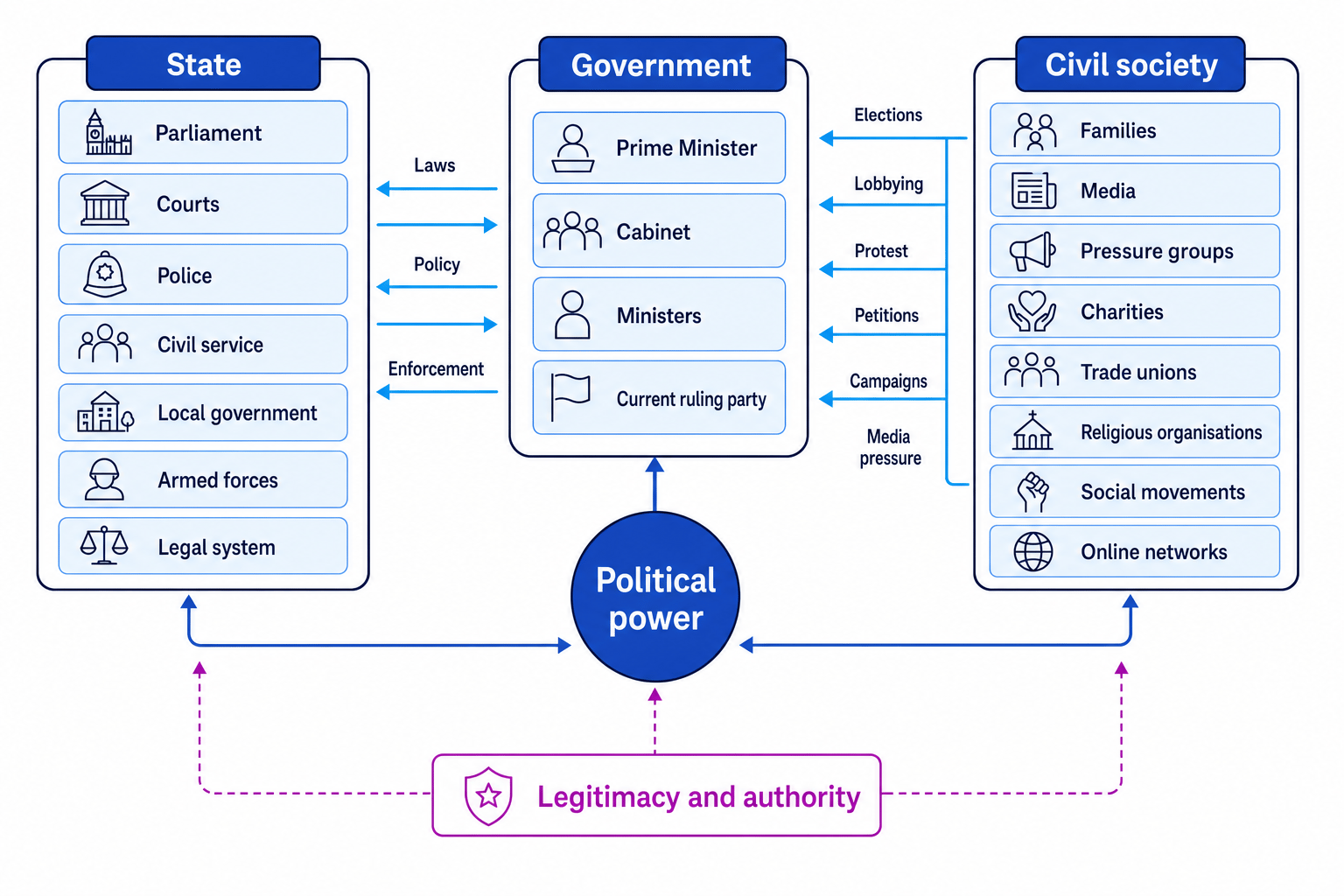
The state means the long-term institutions that organise and enforce political power: Parliament, the courts, the police, the civil service, local government, the armed forces and the legal system.
Government means the temporary group of people who currently run the country, such as the Prime Minister, Cabinet and ministers. Governments change after elections; the state continues.
Civil society means the space between the individual and the state: families, media, pressure groups, charities, trade unions, religious organisations, social movements and online networks.
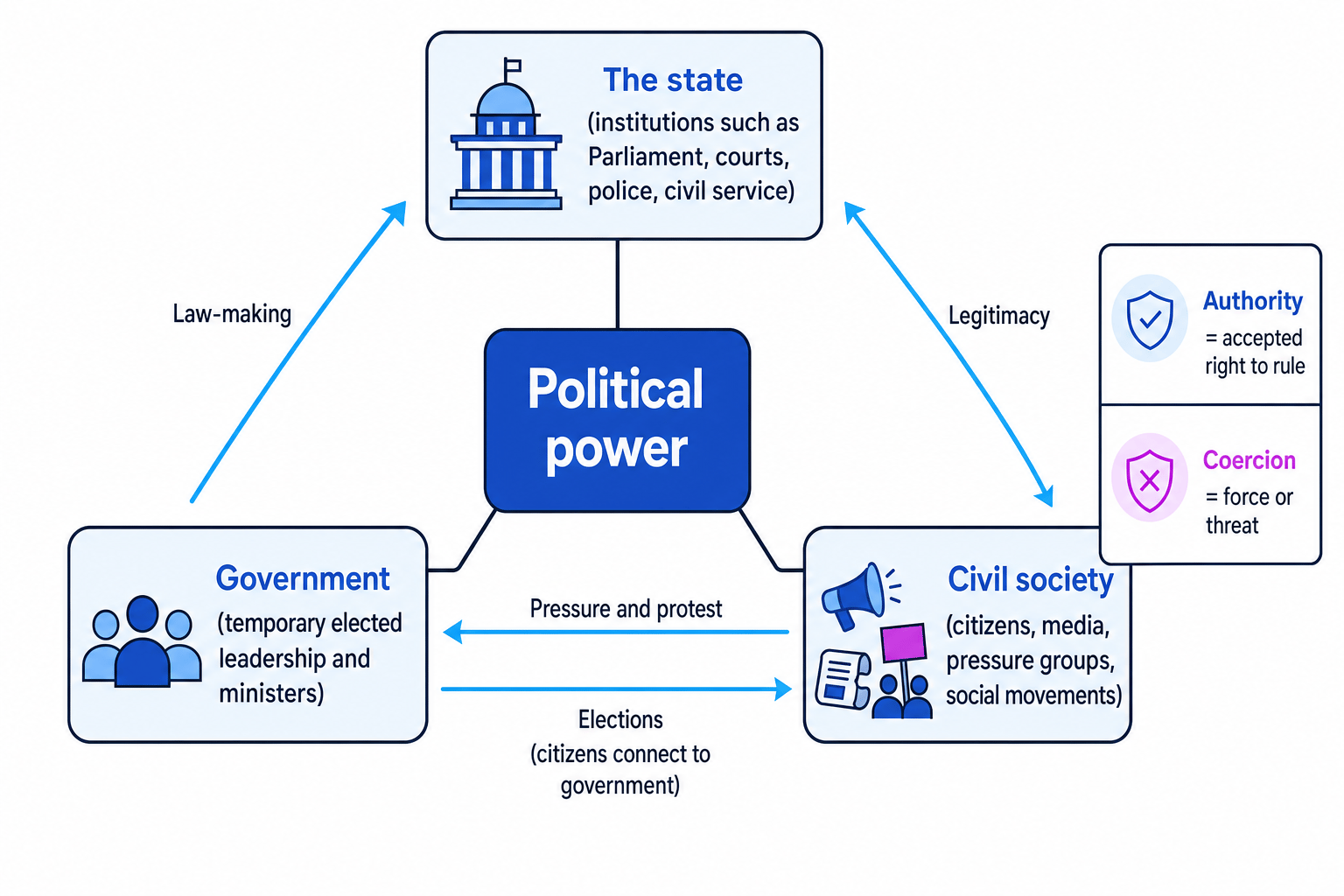
This diagram shows how the core terms fit together: political power flows through elections, law-making, protest, pressure and legitimacy.
Authority and legitimacy
Authority is power seen as rightful or acceptable. Legitimacy is the belief that a political system, leader or institution has the right to rule.
Weber argued that authority can be traditional: based on custom, charismatic: based on personal appeal, or legal-rational: based on rules, laws and offices. Modern UK politics mainly claims legal-rational authority: governments are legitimate because they win elections and operate through law.
State and government are not the same
Do not write “the state won the election”. A government wins an election; the state is the wider set of institutions that remains whichever party is in power.
Democracy and political participation
A democracy is a political system where citizens have some role in choosing leaders and influencing decisions. The UK is usually described as a representative democracy because voters elect representatives to make decisions on their behalf.
A direct democracy is where citizens vote directly on an issue, as in a referendum. The 2016 Brexit referendum is a major UK example.
Political participation includes more than voting. People may join parties, sign petitions, contact MPs, campaign online, donate money, attend protests, join trade unions or take part in pressure groups.
Pressure group
A pressure group is an organisation that tries to influence government policy without seeking to become the government itself.
Examples include trade unions campaigning on workers’ rights, environmental groups such as Greenpeace or Extinction Rebellion, and professional groups such as the British Medical Association.
A social movement is usually broader and looser than a pressure group. It aims for social or cultural change, not just one policy change. Examples include Black Lives Matter, climate justice movements and feminist campaigns against gender-based violence.
Participation is unequal
Democracy gives people formal political rights, but sociologists ask whether all groups have equal capacity to use those rights. Income, education, age, ethnicity, disability, gender, region and digital access can all affect participation.
Worked application: analysing low youth turnout
Explaining unequal political participation
-
Identify the pattern: if young adults vote less often than older adults, participation is unequal by age.
-
Link the pattern to socialisation: older voters may have stronger habits of voting, while younger people may feel parties do not represent their identities, work insecurity, housing problems or climate concerns.
-
Add a stratification point: young people with less money, insecure work or frequent address changes may find participation practically harder, so age intersects with class.
-
Evaluate the claim: low turnout does not mean young people are “apathetic”. They may participate through protests, online campaigning, boycotts or social movements instead of party politics.
Voting behaviour: why do people vote as they do?
Voting behaviour means patterns in how people vote and the reasons behind those choices. Sociologists look for links between voting and social characteristics such as class, age, gender, ethnicity, education, religion and region.
Historically, UK voting was strongly linked to social class. Many working-class voters supported Labour, while many middle-class voters supported the Conservatives. This reflected different class interests around wages, taxation, welfare, trade unions and ownership.
However, sociologists now often discuss class dealignment, meaning social class has become a weaker predictor of voting than it once was. This may be linked to changes in work, home ownership, education, individualism, media influence and weaker trade union membership.
Partisan dealignment
Partisan dealignment is the weakening of long-term loyalty to a political party. Voters become more willing to switch parties between elections.
Other important influences include:
- Age: younger voters may be more likely to prioritise climate change, equality and housing; older voters may prioritise pensions, tax and public order.
- Ethnicity: voting patterns can reflect experiences of racism, migration, religion, class position and party policies on equality.
- Gender: feminist sociologists examine whether parties represent women’s interests, childcare, equal pay, reproductive rights and violence against women.
- Region and nation: Scotland, Wales, Northern Ireland and English regions have different political cultures, partly because of devolution, industry, identity and history.
- Media: newspapers, TV, online platforms and algorithms can frame leaders, scandals and policy debates.
Explaining voting behaviour in a UK election
-
Start with a structural factor: class may influence voting if a party is seen as better representing workers, business owners, homeowners or welfare recipients.
-
Add an identity factor: age, region, ethnicity, gender or national identity may pull voters towards different parties or issues.
-
Include agency: voters are not robots controlled by class. They may make rational choices based on policies, leadership, economic conditions or tactical voting.
-
Evaluate with change over time: if voters switch parties or vote differently from their parents, this supports the idea of dealignment and weaker political socialisation.
Theories of political power
Different sociological perspectives disagree about who really holds power. This is a classic AO3 area because you can compare how far power is shared, concentrated, visible or hidden.
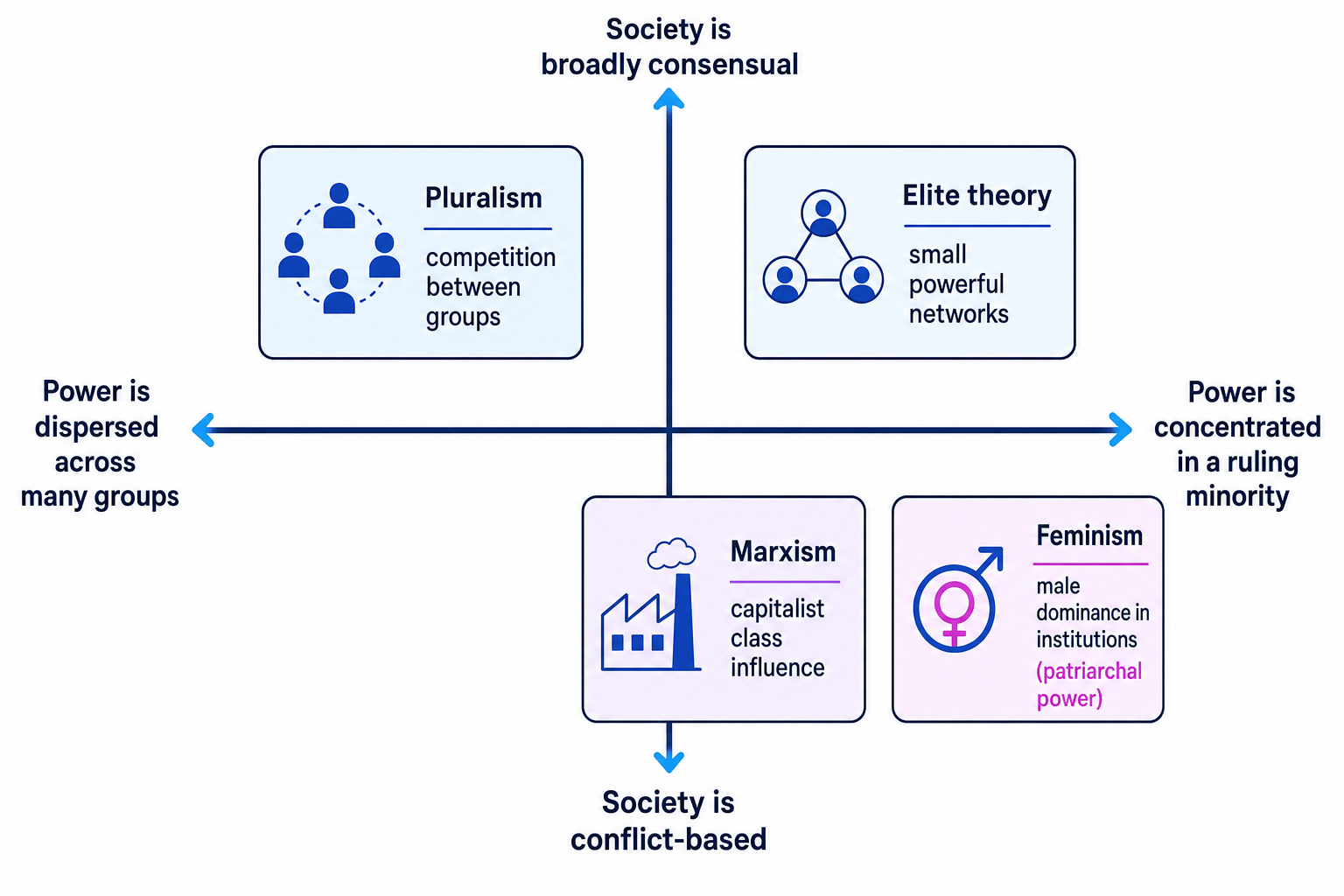
Theories of political power are easiest to understand if you map them by whether they see society as broadly consensual or conflict-based, and whether they see power as dispersed or concentrated.
Pluralism
Pluralism argues that power is spread across many competing groups. No single group always gets its way. Citizens, parties, pressure groups, businesses, trade unions, charities and media organisations all compete to influence policy.
Dahl’s study of New Haven politics is often linked to pluralism because he argued different groups had influence in different decision areas. Applied to the UK, pluralists would point to elections, petitions, judicial review, pressure groups, devolved institutions and protest rights as evidence that power is open to competition.
AO3 evaluation: pluralism may underestimate inequalities in money, media access, lobbying power and political contacts. A billionaire donor and a small local campaign group do not enter politics with equal resources.
Elite theory
Elite theory argues that a small, powerful minority makes the key decisions. Mills described a power elite in the USA made up of overlapping political, military and corporate leaders. In the UK, elite theorists might examine private schools, Oxbridge, think tanks, lobbying firms, senior civil servants, media owners and business networks.
This links to stratification because political influence may be reproduced through wealth, education, cultural capital and social connections.
Marxism
Marxism sees the state as shaped by capitalism. Marxists argue that political power tends to protect the interests of the bourgeoisie, meaning the capitalist class who own major economic resources.
Some Marxists see the state as directly influenced by capitalist elites. Others, such as Gramsci, stress hegemony: the ruling class maintains power partly by shaping common sense, values and consent through culture, education and media.
AO2 UK application might include debates about corporate lobbying, tax policy, privatisation, trade union laws or austerity. Marxists ask whether governments prioritise profitability and business confidence over working-class needs.
Feminism
Feminism argues that political institutions have historically been shaped by patriarchy, meaning male dominance in society. Feminists examine under-representation of women in Parliament, sexism in political media coverage, gendered online abuse, and whether policy addresses unpaid care, childcare, domestic abuse and reproductive rights.
Walby’s work on patriarchy is useful here because she sees gender inequality operating across institutions, including paid work, the state, violence, sexuality, culture and the household.
Postmodern and Foucauldian views
Postmodern approaches are suspicious of the idea that power sits only in Parliament or the economy. Foucault argued that power is dispersed through knowledge, surveillance, expert language and everyday institutions. For example, politics can operate through schools, prisons, hospitals, welfare assessments, policing data and media categories.
This is useful for analysing contemporary politics because power is increasingly exercised through data, algorithms, risk assessments and public narratives about “deserving” and “undeserving” groups.
A quick way to compare perspectives
Ask: Who has power? How do they keep it? Can ordinary people challenge it? Those three questions help you turn AO1 description into AO3 comparison.
Political socialisation and political culture
Political socialisation is the process through which people learn political values, identities and behaviours. It happens through family conversations, school citizenship education, peer groups, religion, workplaces, unions, media, social media and major events.
A political culture is the set of shared beliefs and expectations about politics in a society. For example, people may believe voting is a civic duty, distrust politicians, value free speech, support protest, or see politics as distant and elitist.
This matters because participation is not only about legal rights. People need a sense that they belong, that their voice matters, and that political institutions are responsive.
Researching politics sociologically
Political sociology uses several research methods:
- Official statistics: turnout, election results, demographic voting data and parliamentary representation. These are often reliable and allow comparison over time, but they may not explain motives.
- Surveys and opinion polls: useful for measuring attitudes before elections, but affected by sampling, question wording, response rates and social desirability bias.
- Interviews and focus groups: strong for validity because they explore meanings, distrust, identity and political emotions, but samples are smaller and less representative.
- Content analysis: used to study manifestos, speeches, newspapers, social media posts or campaign adverts.
Methodological evaluation matters. A positivist researcher may favour large-scale surveys for reliability and patterns. An interpretivist may prefer interviews to understand how people make sense of politics in everyday life.
Do not treat statistics as self-explanatory
If turnout is low in one group, the statistic shows a pattern, not the reason. You still need sociological explanation: access, trust, socialisation, identity, inequality or political opportunity.
Contemporary UK issues to apply
Good answers feel current. You could apply politics to:
- Brexit and debates over national identity, sovereignty and class.
- Devolution in Wales, Scotland and Northern Ireland.
- Protest movements around climate change, racism, policing, gender violence and public-sector pay.
- Online campaigning, misinformation and algorithmic influence.
- Trust in politicians after scandals, economic crises or policy failures.
- Representation of women, ethnic minorities, disabled people and working-class people in Parliament.
In the exam
-
Define the key concept first, then apply it to a specific political example such as voting, protest, lobbying, devolution or media campaigning.
-
Build paragraphs using AO1, AO2 and AO3: explain the theory, apply it to the UK, then evaluate it against another perspective or evidence.
-
Avoid one-factor answers. Politics is shaped by class, age, gender, ethnicity, region, media, institutions and socialisation working together.
Check yourself
- What is the difference between the state, government and civil society?
- How would a pluralist and a Marxist explain pressure-group influence differently?
- Why might low voter turnout not automatically mean political apathy?